Monday Was Wash Day
How did people wash their clothes in the 1800s? By hand, in a day-long sequence that began with the linen worn next to the skin, and usually on a Monday.
In nineteenth-century Britain and the United States, clothes were washed by hand in a long chain of jobs: soak, soap, rub, boil, rinse, blue, starch, wring, dry, iron. Women did the work, at home or for pay, and Monday was the day the household turned to it, though the tubs themselves did not always go on that day. The whole effort centered on the linen worn next to the skin.
This piece covers Britain and the United States, mainly in the 1800s. Practice varied by place, income and household, and a few points come from earlier or from a single local study. Each is labeled as such.
Why did a shirt do the washing for the whole outfit?
Because linen worn next to the skin took the sweat and body oils so that the clothes over it did not have to. The V&A puts it plainly in the record for an 1851 British chemise: women wore chemises next to the skin to protect the outer layers, and made them of cotton or linen so they could be easily washed. This one is marked in ink with the wearer's name and a number, to help identify it during the laundry process.
The same logic reaches back much further. A Cadw guide to medieval clothing, written about replicas, notes that it was far easier to wash a linen shift than a heavy woolen or elaborately embroidered outer garment. By Mrs. Beeton's day the habit was built into the system. Her laundry-maid sorts the week's wash into heaps, and the first is "white linen and collars, sheets and body-linen," with fine muslins in a separate heap. Over the chemise went the petticoat and gown, part of what the V&A calls the many other layers of underwear and dress.
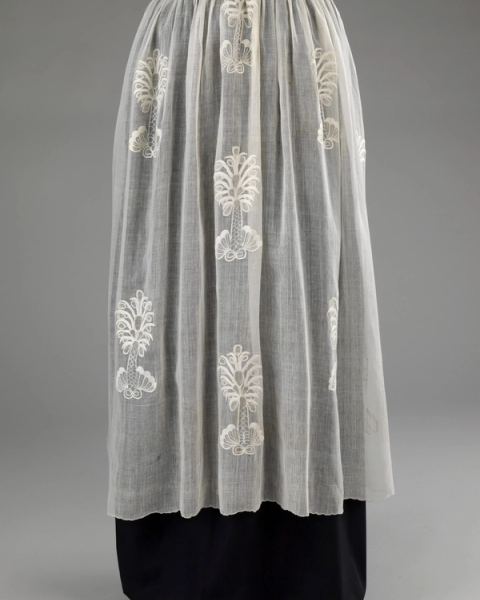
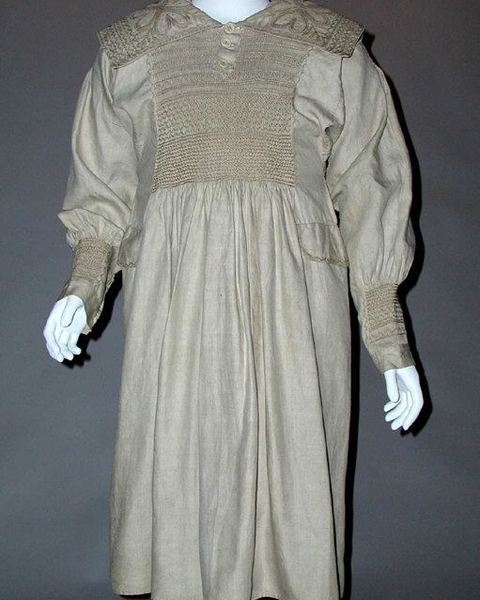
Clean linen also carried meaning. According to its abstract, a 2021 University of Alberta thesis on eighteenth-century England argues that white linen was a symbol of cleanliness, respectability and status, and that the gendering of laundry work reflected and reinforced the low standing of the work and the women who did it. The plain linen or cotton apron of a maid, described in A Lady's Apron Was Not for Work, belonged to the same washable layer of working life, and the smock-frock of English farm workers, covered in Smocking: Gathering Cloth into Structure, was also linen.
What happened on a wash day?
Water was hauled and heated, soap or lye loosened the dirt, and heat and muscle did the rest. The V&A's gallery label for that chemise gives the short version: soaked, pounded and scrubbed in soap and hot water, then boiled, rinsed, sometimes starched, wrung out, hung to dry and finally ironed.
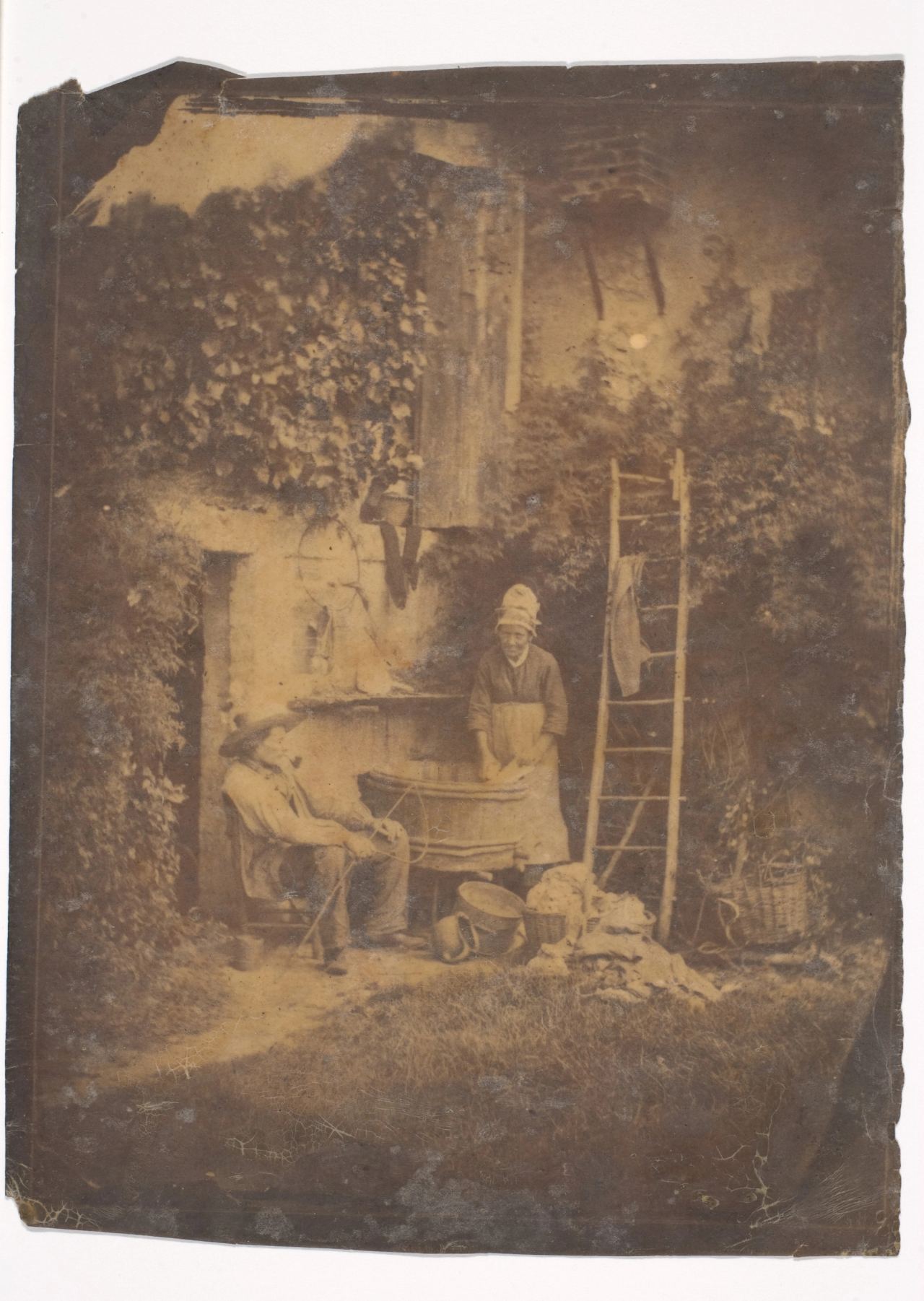
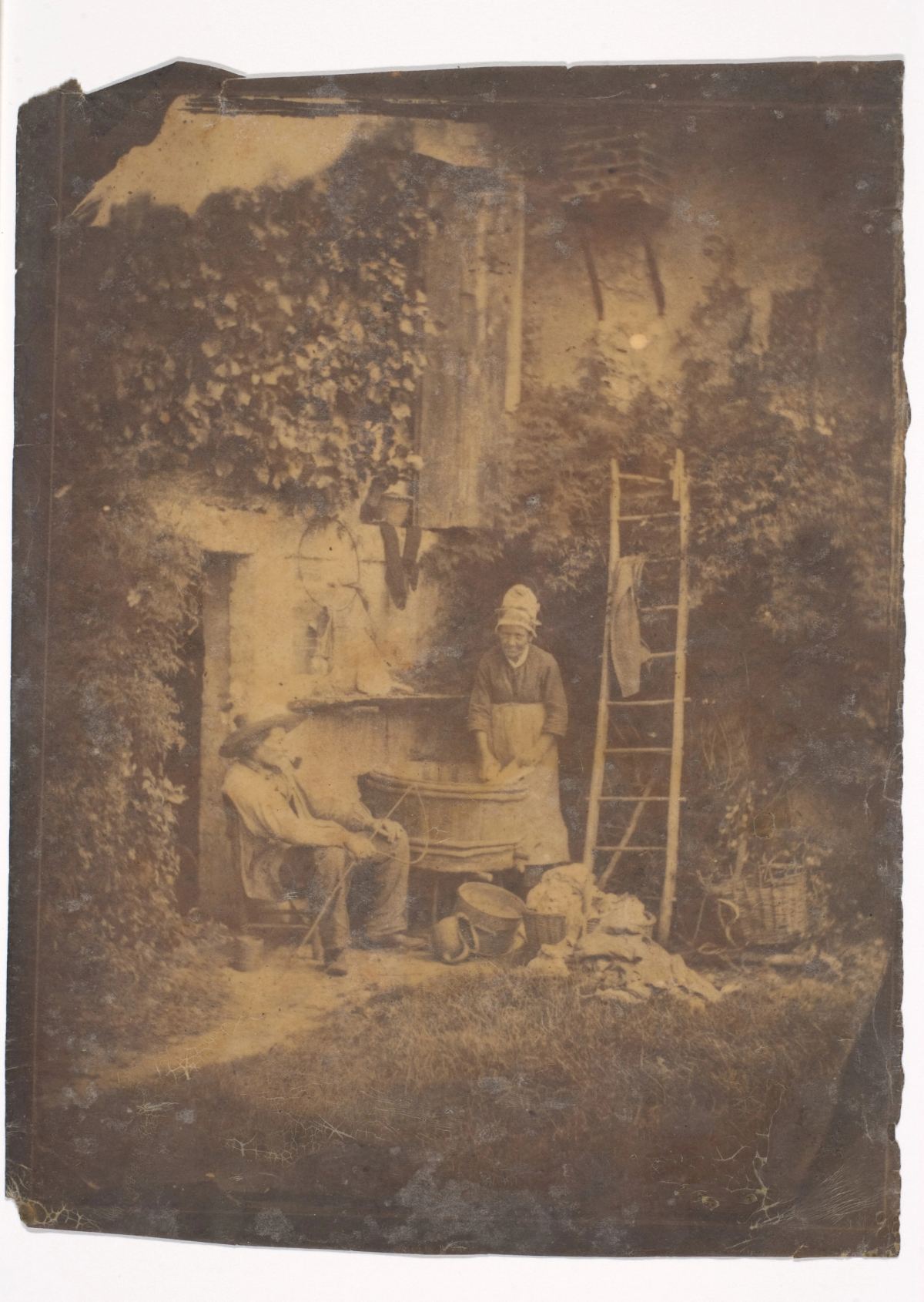
The Met's 1840s photograph by Louis-Adolphe Humbert de Molard, above, shows a woman at a large tub, laundry piled on the grass and a ladder against the wall. A learning resource built around a nineteenth-century weaver's cottage at Golcar, West Yorkshire, supplies the labor behind a scene like it. With no running water, the water came from a well and was heated in a set pot. Soap was grated into a barrel-shaped tub, a posser pushed the suds through the cloth, and each piece was rubbed on a washboard. Coal was costly, so one tub of hot water served two loads: whites first, dirtier work clothes second.
| Stage | What it involved | Source |
|---|---|---|
| Sort and soak | White linen and collars, fine muslins, colored cottons, woolens and greasy cloths in separate heaps; sheets and fine linen soaked overnight in lukewarm water with soda | Beeton, 1861 |
| Wash | Body linen first, soaped and rubbed, then a second, hotter water | Beeton, 1861 |
| Boil | About an hour and a half in the copper, with soda | Beeton, 1861 |
| Rinse and blue | Hot water, then cold water "slightly tinged with fig-blue" | Beeton, 1861 |
| Wring and dry | Rollers squeezed out the water; most washing was hung outside | MyLearning |
| Starch, mangle, iron | Starch for shirt fronts and collars; mangle for sheets and table linen; irons for body linen and anything gathered | Beeton, 1861 |
American advice runs the same way: in 1842 Catharine Beecher told servants to sort the clothes, soak the whites overnight, wash the fine things first the next day, boil them in a bag for half an hour, rinse them, put them through bluing water and starch what needed stiffening.
Why Monday?
Because it was the day the household turned to the wash, in sayings and in many homes. A folk rhyme, printed in Charles Welsh's A Book of Nursery Rhymes (1901) and recorded in a school folklore collection from County Cavan, Ireland, begins "They that wash on Monday / Have all the week to dry," and goes on to rate each later day worse, ending with Saturday. The Golcar resource states that for nearly everyone Monday was the day the women and girls of the house did the washing. It adds a household detail: the range was needed all day to heat water, so Monday's meals were cold leftovers from Sunday, and Tuesday was ironing day.
The manuals complicate the picture. Beeton's laundry-maid starts on Monday morning, but only by sorting and soaking. The washing begins "early on the following morning," and in a laundry in full employment Thursday and Friday go to mangling, starching and ironing. Catharine Beecher and Harriet Beecher Stowe's The American Woman's Home (1869) describes a weekly routine used by some of the best housekeepers, in which Monday is for assorting the clothes for the wash, and "Tuesday is devoted to washing, and Wednesday to ironing." None of these sources explains why Monday came first. The rhyme's own logic is drying time.
The nickname "Blue Monday" is often tied to the bluing rinse. Word Histories records the phrase as a calque of German blauer Montag, first printed in English in 1790, for a Monday workers took off after weekend indulgence. Wikipedia says the laundry link is contested.
Who did the washing, and what changed?
Women did it, as housewives and daughters at home and as paid laundresses and washerwomen. A local study of Whitby, Yorkshire, finds only ten laundresses in the 1841 census, nine of them aged 45 to 60, and argues that many more worked unrecorded. The census instructions agree: the work of wives and unpaid children living at home "need not be inserted."
Pay is thinly documented. In London Labour and the London Poor (1861–62 edition), Henry Mayhew counted 21,000 laundresses in London and assumed, for his own estimate, an average wage of 10 shillings a week. A bachelor greengrocer told him that many men of his class paid a washerwoman 3 pence or less a shirt, and poorer people washed their own. Brighton's women's history adds that children carried water and turned the mangle, that mangles had no safety guards, and that the Factory Act of 1891 did not cover women laundering at home. The 1895 Act brought laundries in.
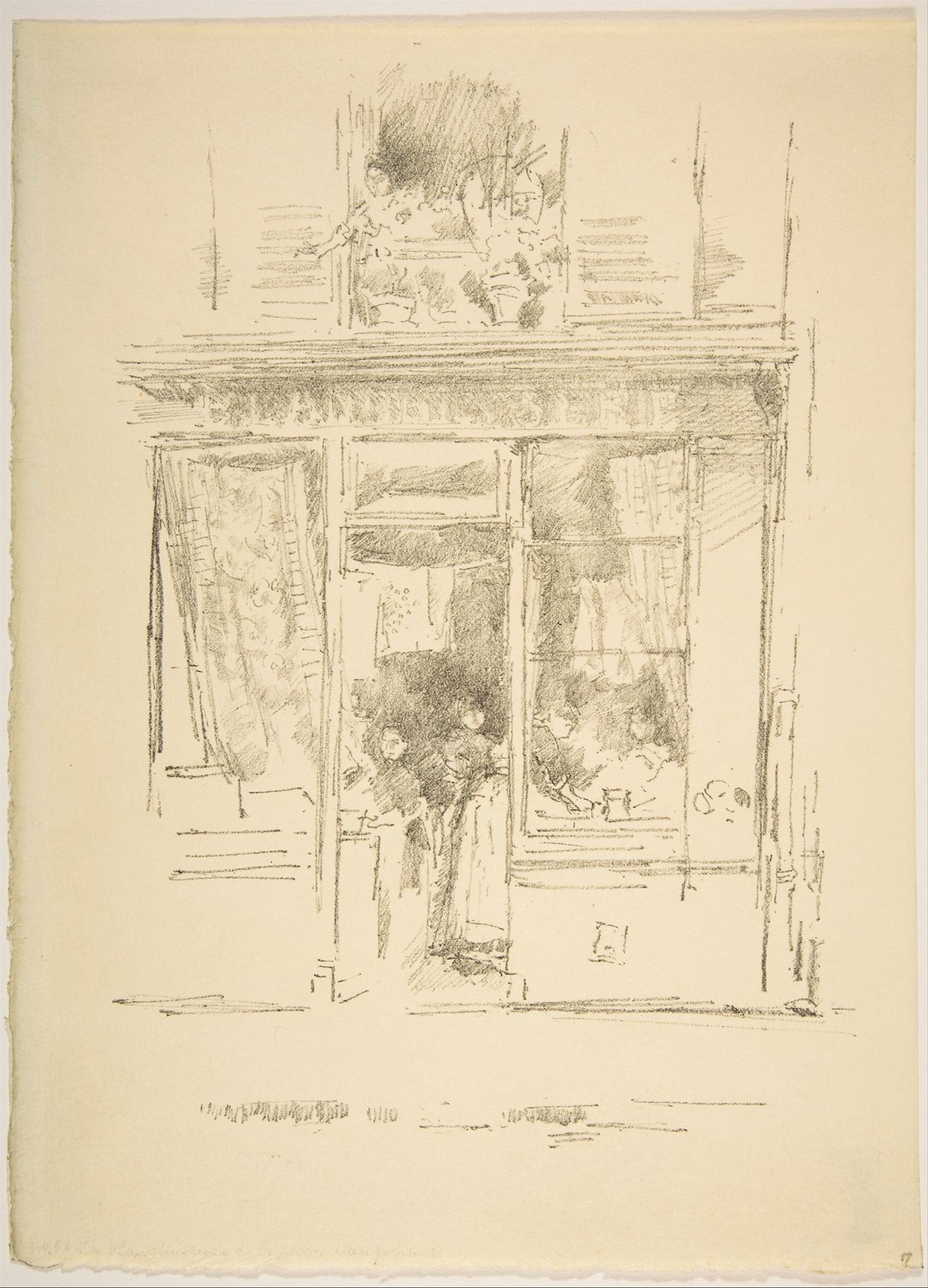
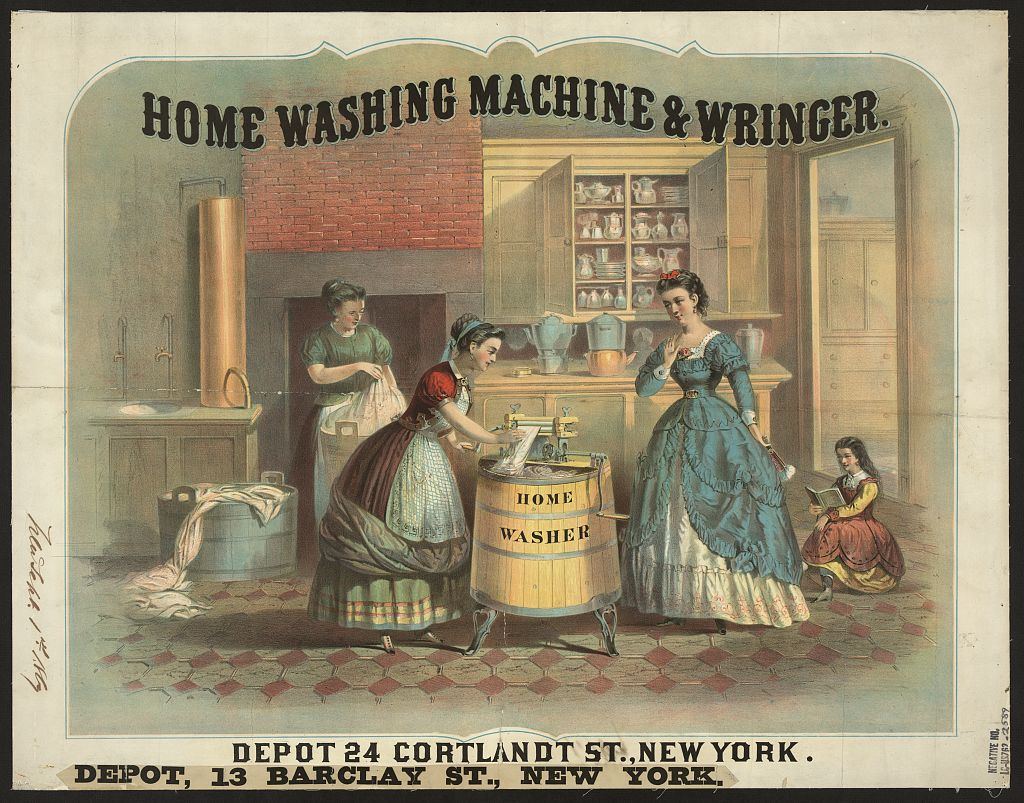
Tools changed in steps. Stephen Rust of Manlius, New York, received the first U.S. patent for a metal washboard on February 9, 1833, according to a label at the Iowa State University museum and an Ohio newspaper column. A wringer in a Massachusetts museum carries a brass plate dated October 28, 1862. A color print cataloged by the Library of Congress as "c. 1869?" shows a barrel-shaped "Home Washer" with a wringer on top, worked by a servant while her employer looks on. Encyclopedia.com adds the commercial turn: public laundries arrived in Britain in the mid-nineteenth century, power laundries multiplied in the 1890s, and by the late 1800s a laboring family's washing costs could equal half its rent. Whistler's 1894 lithograph, above, sketches a Paris laundress's shopfront, with a woman in the doorway.
Where can you see it?
Besides the three images here, the Met's open-access collection holds The Washerwoman, an engraving after Charles Nicolas Cochin I dated 1739, The Young Laundresses by Joseph Vernet, 1768, and Honoré Daumier's 1857 lithograph Le nouvel étendard des blanchisseuses. The V&A's 1851 chemise still carries its owner's laundry mark.
Sources
- Chemise, 1851 (T.148-1961). Victoria and Albert Museum. Read in full: worn next to the skin to protect outer layers; linen or cotton so it could be easily washed; marked with the wearer's name and a number for the laundry; gallery label gives the wash sequence. Accessed October 16, 2026.
- The Book of Household Management (Mrs. Beeton), Duties of the laundry-maid, paras 2372-2396. Project Gutenberg #10136 (title page: first published in a bound edition 1861, originally in monthly parts 1859-61). Read in full: sorting heaps, Monday-morning sort and soak, washing the next morning, copper boil, fig-blue rinse, mangling, starching and ironing on Thursday and Friday. Accessed October 16, 2026.
- Letters to Persons Who Are Engaged in Domestic Service (Catharine E. Beecher, 1842), On Washing and Ironing. Project Gutenberg #57985 (copyright line: 1842). Read in full: assort, soak whites overnight, wash fine things first next day, boil in a bag half an hour, rinse, bluing water, starch. Accessed October 16, 2026.
- The American Woman's Home (Catharine E. Beecher and Harriet Beecher Stowe, 1869). Project Gutenberg #6598. Read: weekly routine with Monday for assorting clothes, Tuesday washing, Wednesday ironing. Date 1869 from Wikipedia (used to locate references) and the book's own citations. Accessed October 16, 2026.
- Domestic life in a 19th-century weaver's cottage: Washday Monday (and story page). MyLearning. Read in full: weaver's cottage at Golcar, West Yorkshire; Monday wash day, well water, set pot, posser, washboard, two loads, mangle, hanging out, cold Sunday leftovers, Tuesday ironing. Century stated, no single year. Accessed October 16, 2026.
- Victorian clothes mangle. MyLearning (image credit: Colne Valley Museum). Read in full: mangle description. Accessed October 16, 2026.
- Clothes (guide to medieval replica clothing). Cadw. Read in full: about 13th-century replica shifts, not 19th-century practice; cited only for the long-standing logic of washing the linen layer. Accessed October 16, 2026.
- Women and the Labour of Laundry in the English Eighteenth Century (MA thesis, 2021). Terri L. Rolfson, University of Alberta. Abstract read in full and the only part used: gendered, low-status, low-paying, physically demanding work; white linen as a symbol of cleanliness, respectability, status. The 146-page PDF is an image-only scan with no text layer, so the thesis body was not read. Accessed October 16, 2026.
- Laundry occupations: a case study via censuses in Whitby 1841 to 1911. Viveka Hansen, iTextilis (Ikfoundation). Read: 1841 census lists ten laundresses, nine aged 45-60; many unrecorded. A local case study. Accessed October 16, 2026.
- Women Workers in the British Industrial Revolution. Joyce Burnette, EH.net. Read: quotes the 1841 enumerator direction that wives' and unpaid children's work "need not be inserted". Accessed October 16, 2026.
- Brighton women's history: laundresses. Brighton Women's History. Read: children carried water and turned the mangle; mangles without guards; Factory Act 1891 excluded home laundering, 1895 Act included laundries. Local-history site. Accessed October 16, 2026.
- London Labour and the London Poor, vol. 2 (Henry Mayhew; four-volume edition 1861-62). Project Gutenberg #60440. Read the washing passages: 21,000 London laundresses and an assumed 10s a week (Mayhew's own calculation); a bachelor greengrocer's report of 3d or less a shirt; poor people wash their own. Accessed October 16, 2026.
- Laundry. Encyclopedia.com. Read in full: lye and soap, soap tax 1712-1853, public laundries mid-19th century, 1890s power laundries, washing costs up to half of rent for laboring families late in the century. Accessed October 16, 2026.
- A Book of Nursery Rhymes, Part IV (Charles Welsh, D. C. Heath, 1901). Wikisource. Wash-day rhyme ("They that wash on Monday / Have all the week to dry"); 1901 from the book's title page and copyright line. Accessed October 16, 2026.
- Schools' Collection: Carrigans (C.), Co. Cavan. Dúchas.ie, National Folklore Collection. Irish variant of the wash-day rhyme; collection compiled by schoolchildren in the 1930s (no exact year on the page). Accessed October 16, 2026.
- Blue Monday history. Word Histories. Read: calque of German blauer Montag, first recorded in English in 1790 (Dornford translation). Accessed October 16, 2026.
- Blue Monday (term). Wikipedia. Read: says the wash-day/bluing link is contested. Used only for that statement. Accessed October 16, 2026.
- Washboard (object label). Iowa State University museums. Read: Stephen Rust of Manlius, NY, received the first U.S. patent for a metal washboard on February 9, 1833. Accessed October 16, 2026.
- How the 1833 washboard patent changed early American laundry. Farm and Dairy (newspaper column). Read: Rust patented a fluted-metal washboard on Feb. 9, 1833. A folklife column, not scholarship. Accessed October 16, 2026.
- Amidon's First Wash Wringer. Old Tool Heaven. Wringer in the Museum of Our Industrial Heritage, Greenfield, Massachusetts, with a brass plate dated Oct. 28, 1862. Read through a page-summary tool. Accessed October 16, 2026.
- Home washing machine & wringer (LC-DIG-pga-03845). Library of Congress, Prints and Photographs Division. Record read: [New York : c1869?], color lithograph; rights statement "No known restrictions on publication."; summary of the scene. Accessed October 16, 2026.
- The Laundry, Louis-Adolphe Humbert de Molard (2005.100.1241). The Metropolitan Museum of Art. Met Collection API record: title, date (1840s), medium, credit line, public domain. Accessed October 16, 2026.
- La Blanchisseuse de la Place Dauphine, James McNeill Whistler (1984.1119.12). The Metropolitan Museum of Art. Met Collection API record: title, date (1894), medium, credit line, public domain. Accessed October 16, 2026.
Glossary
Last updated · Markdown · Report an error