Tied On, Not Sewn In: The Lost Pocket
For two centuries a woman's pocket was a separate pouch tied under her skirt and reached through a slit in the seam. Museums still hold hundreds, and they answer the question of where women kept things.
For roughly two hundred years a woman's pocket was not part of her dress at all. It was a separate pouch on a tape, tied round the waist under the skirt and reached through a slit in the seam. The nursery-rhyme pocket of Lucy Locket was this object.
Did women's clothes really have no pockets?
They did have them, just not where we look today. The Victoria and Albert Museum states the arrangement plainly: in the 18th century women's pockets were not sewn into gowns but attached to a tape and tied around the waist as separate garments, worn under the hoops and petticoats. The wearer reached them through openings in the seams of the gown and petticoat.
The popular version of the story, that women had nowhere to put anything, collapses on contact with the objects. What women lacked was a pocket that was part of the outer garment. The pocket existed; it simply lived underneath.
What did a tie-on pocket look like?
Pockets were usually pear-shaped, narrow at the waist and wider at the bottom, and came as a single pouch or a pair. In their study of the form, Barbara Burman and Seth Denbo describe a front and back piece sewn together round the edge, often with a folded-back or French seam for strength, and a vertical slit for the hand that began near the top of the front piece and ended partway down. The edge of the opening was normally reinforced with extra stitching or binding.
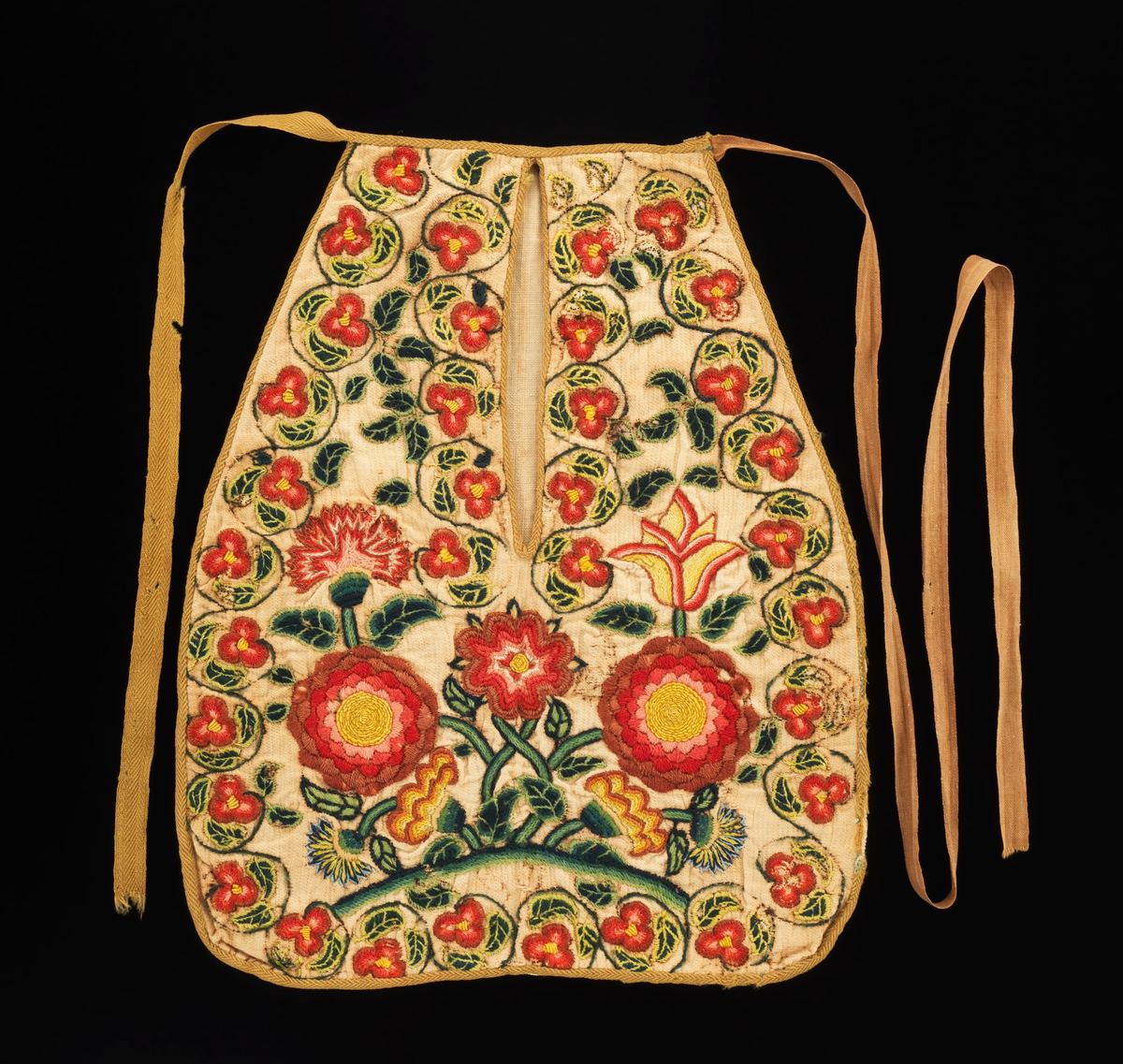
The pocket at the top of this page, catalogued by the Metropolitan Museum of Art as American, about 1784, and made of cotton and wool, shows the form at its most decorative. The slit sits at the top centre, and the whole front is covered in flowers worked in coloured yarn inside a border of linked scrolls. Burman and Denbo note that embroidered pockets are in the minority among survivors, and that embroiderers often placed a curving basket or urn of flowers below the opening and outlined the edges.
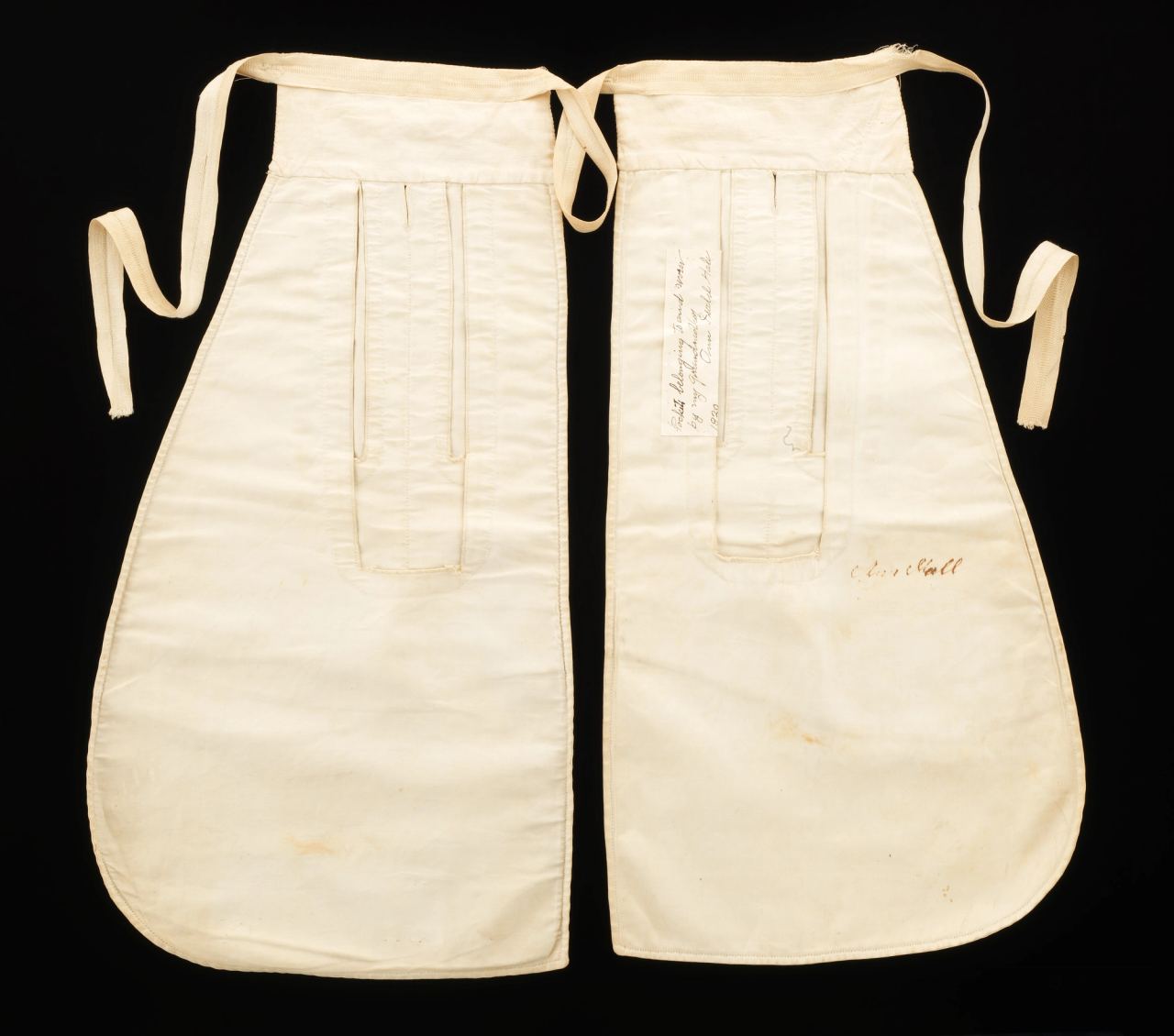
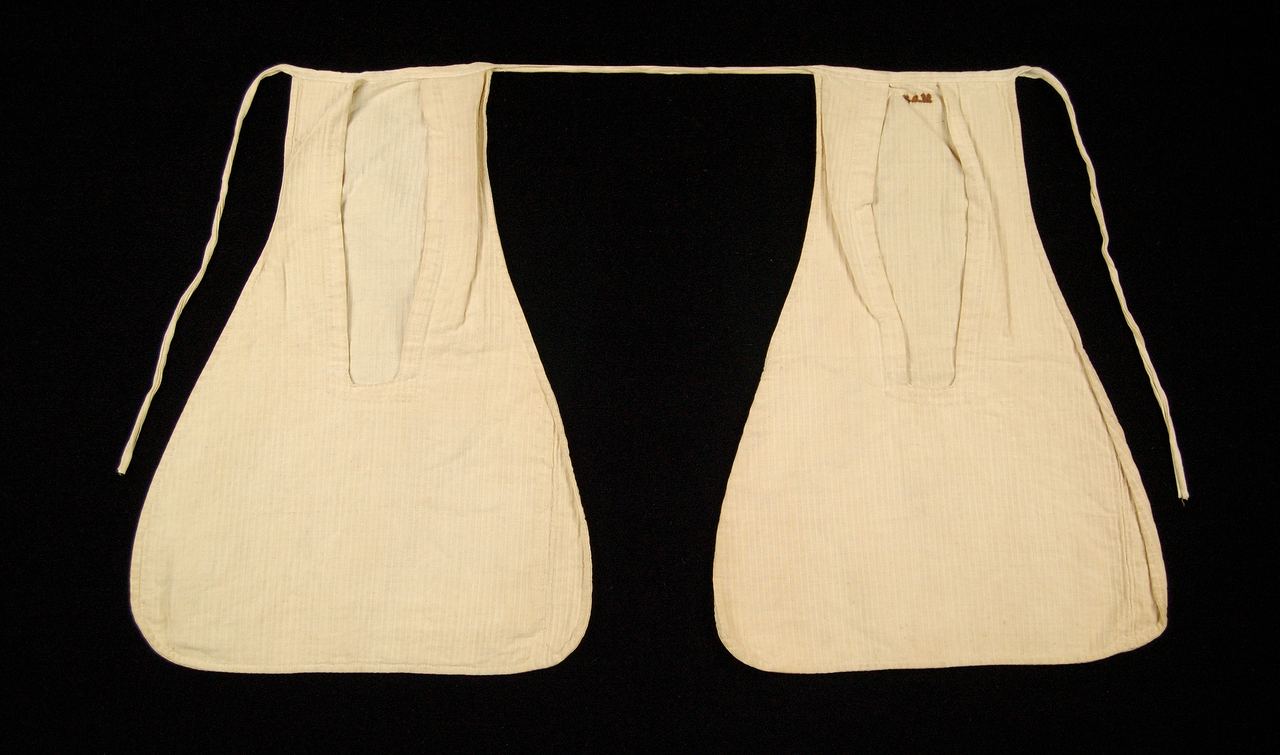
Plainer pockets were far more common. The Met also holds a pair of 1820 British cotton pockets and a pair of American linen ones from 1800 to 1810, with no ornament beyond the stitching around the opening.
What did women carry in them?
The V&A's gallery label for a pair of quilted yellow silk pockets made in Britain in the 1740s lists money, jewellery, mirrors and combs, and calls pockets of this kind one of the precursors of today's handbags. The same label says they were worn beneath the gown, petticoat and hoops but above the shift. Hidden from view, they allowed small belongings to be carried discreetly on the body.
Burman and Denbo add that this privacy had a practical edge. Women of all social classes had little private space and few rights to own property, and many worked in family businesses or as servants, so a pocket was an efficient way to keep things both accessible and secure. Court cases of the period record thefts from pockets, and women often put the pocket they were using under the pillow at night.
Why tie it on rather than sew it in?
A separate pocket could be moved between outfits. The V&A notes that pockets were sometimes made to match other garments, such as a bodice or petticoat, and its pair is part of an ensemble with a matching waistcoat; even so, the pocket stayed a separate object on its own tape. Burman and Denbo say part of the form's popularity was its efficiency and its simple, economical construction, and that it was worn in different places: usually under the petticoat, but sometimes just under the dress or apron.
It also fitted the fashion for wide skirts. Burman and Denbo observe that the tie-on pocket could still be accommodated when hoops of various shapes came into fashion in the 18th century, since an opening for the hand was easy to provide in any under or outer garment. (For the skirt shape that made this necessary, see the glossary entry for the pannier.)
When did tie-on pockets start, and when did they stop?
Burman and Denbo write that the tie-on pocket "seems likely" to have emerged sometime in the 17th century, to replace girdles worn outside the skirt and hung with small tools and accessories. They stress that it is impossible to know exactly when it began to fall from use, but suggest it was probably around the middle of the 19th century, with generational and regional differences.
| Period | What the sources say |
|---|---|
| 17th century | Tie-on pocket probably emerges, replacing girdles hung with tools (Burman and Denbo) |
| 1690s–1850s | Fashion dolls survive with miniature tie-on pockets (Burman and Denbo) |
| 1740s | V&A pair of quilted yellow silk pockets, British, T.87A&B-1978 |
| Early 19th century | Tie-on pockets lampooned as old-fashioned, yet many dated pockets survive (Burman and Denbo) |
| Mid to late 19th century | More associated with country women and older or less fashionable women (Burman and Denbo) |
| 20th century | Survives among some working women, notably in the fish trade in Wales and North Shields (Burman and Denbo) |
Did the reticule replace the pocket?
Not outright. The skimpy neo-classical dresses that arrived from the 1790s are the usual suspects for the pocket's disappearance, and the small handbag called a reticule did become fashionable in the neo-classical period. But Burman and Denbo say there is plenty of evidence, including many dated pockets from this period, that women went on valuing them, and that the tie-on pocket was never the only way to carry things: baskets, looped-up aprons, cloth bundles and the front of the stays were all used too.
The 1820 pair above carries handwriting in ink, on a paper label and on the cotton itself, a reminder that pockets were personal property. Burman and Denbo note that marking pockets with names and initials was the simplest way of personalizing them.
Where can you see one?
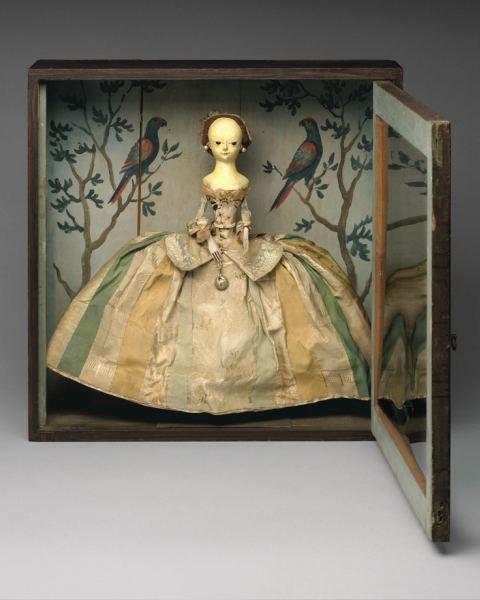
The V&A's pair of quilted yellow silk pockets was shown in its Bags: Inside Out display. The Met has put its Costume Institute pockets online with open-access images, including the three shown here. Dolls are another way in: Burman and Denbo point to fashion dolls dating from the 1690s to the 1850s that still wear miniature tie-on pockets, which show how the pocket was fitted into each period's fashionable style. See also Fashion Dolls Before Fashion Magazines.
Further reading: Burman and Denbo's essay, listed below, ends with a bibliography that points to the research on tie-on pockets, including the work of Barbara Burman and Linda Baumgarten.
The lesson of the pocket is that "no pockets" is a story about the outer dress, not about women. Underneath the petticoat, women were carrying money, tools and keepsakes all along.
Sources
- Pair of pockets, British, 1740s (T.87A&B-1978). Victoria and Albert Museum. Construction, how worn and reached, matching garments, gallery label (contents carried, precursor of handbags) Accessed October 15, 2026.
- The history of pockets (Pockets of History project). Barbara Burman and Seth Denbo (copy hosted by Enfilade). Origins in the 17th century, construction, use, reticule and decline, dolls, 20th-century survival Accessed October 15, 2026.
- Pocket, American, ca. 1784 (2009.300.2241). The Metropolitan Museum of Art. Date, materials, credit line Accessed October 15, 2026.
- Pocket, British, 1820 (2009.300.3472). The Metropolitan Museum of Art. Date, materials, credit line Accessed October 15, 2026.
- Pocket, American, 1800–1810 (2009.300.4327). The Metropolitan Museum of Art. Date, materials, credit line Accessed October 15, 2026.
Glossary
Last updated · Markdown · Report an error