Dolls
A Doll Is a Dress Rehearsal
Long before fashion magazines, dressed dolls carried new styles between courts and workshops. Here is what they did, and where to see one.
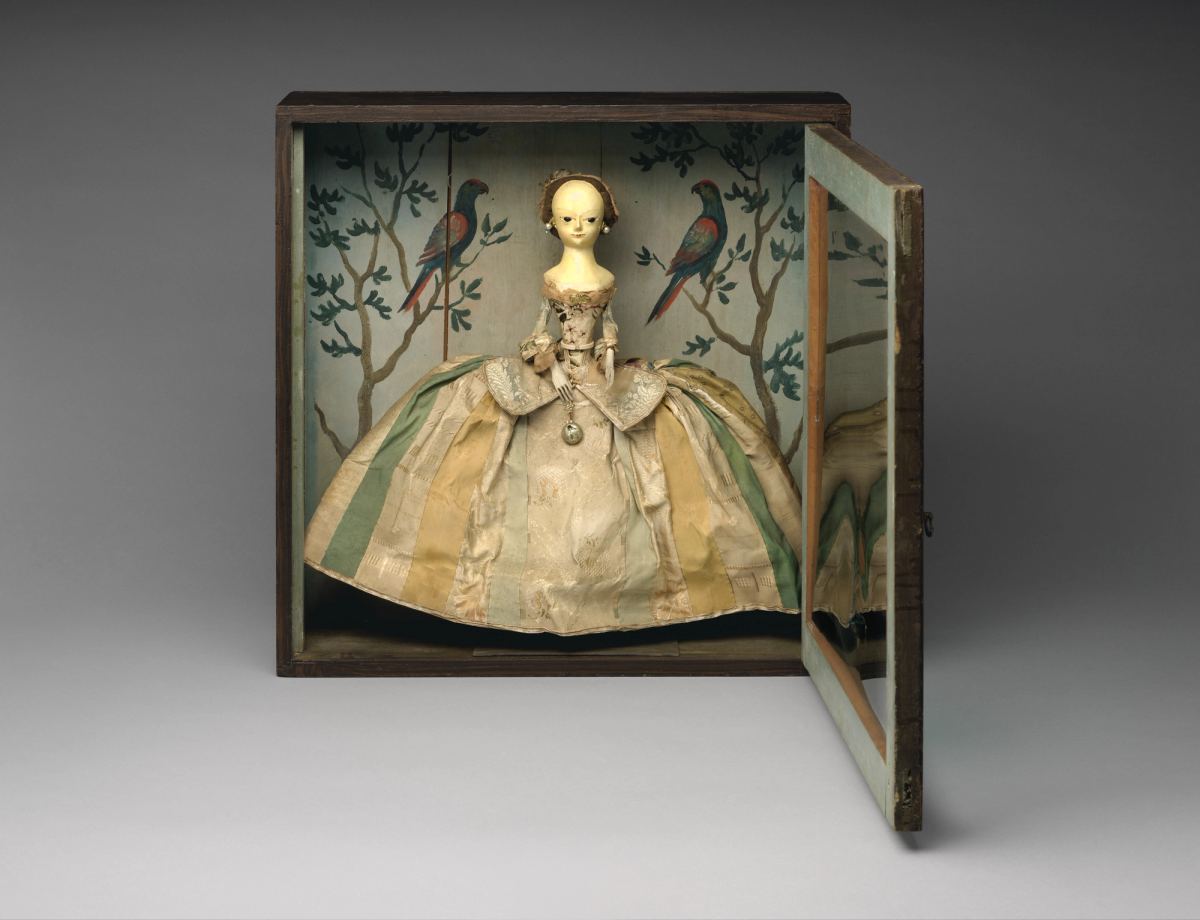
Before fashion magazines, a dressed doll was a sample you could post: a small figure wearing a new gown, sent by a maker or a relative to someone who wanted to copy it. The documented practice goes back at least to 1515, and it faded in the late eighteenth century, once illustrated fashion periodicals appeared.
What was a fashion doll used for?
A fashion doll was a miniature dressed figure that showed how a new style looked: its cut, trimmings and accessories. Dressmakers used dolls to show clients what they could make, and courts and families sent them from city to city so that someone far away could see a fashion and copy it.
The evidence for the trade side is scattered but consistent. Georgian mantua-makers used dolls to show clients new styles, according to Paxton House, which describes surviving examples as usually wooden and jointed. The Metropolitan Museum says dolls of this kind worked as both toys and advertisements of the latest fashion. The Victoria and Albert Museum adds a useful caution about one surviving example: dolls this large and elaborate were made for older girls and women, not for small children, in the eighteenth century (V&A).
When did dolls first carry fashion between courts?
The earliest well-documented case is from 1515. On 19 November, Federico Gonzaga wrote on behalf of King Francis I of France to his mother, Isabella d'Este, asking for a doll dressed in her own clothes and hairstyles, so that the women of the French court could have similar pieces made.
That letter is the centerpiece of Yassana Croizat's article "Living Dolls": François Ier Dresses His Women, published in Renaissance Quarterly in 2007. Croizat argues that Renaissance courts used fashion dolls, alongside portraits and diplomatic reports, to learn about foreign dress; the Project MUSE record of the same article gives the same summary.
A second, later example comes with a letter. In April 1604 Helena Snakenborg, Marchioness of Northampton, a Swedish-born noblewoman who had served Elizabeth I, had a doll dressed in London to send to her sister Karin Bonde in Sweden. The episode is recorded in Wikipedia's article on fashion dolls and in its article on Snakenborg; we have not seen the letter itself, so treat the details as secondhand.
Accounts of the trade's origin vary. Coverage of the current FIT exhibition by Hyperallergic, a piece sponsored by the museum, says dolls circulated across Europe as miniature fashion models as early as the fourteenth century. The exhibition-related book description cited by Smithsonian Magazine puts the royal exchange in the sixteenth century. The 1515 letter is the earliest case we could source to a scholarly article.
What does an eighteenth-century fashion doll look like?
The Met's "Doll in a box" is an English fashion doll of about 1748, made of wood, paint, glass, silk and human hair. She wears two petticoats and shoes made of metallic ribbon, and she still has her pearl earrings and a watch. She probably reached the American colonies as a girl's plaything, where someone built her a glazed pine box.
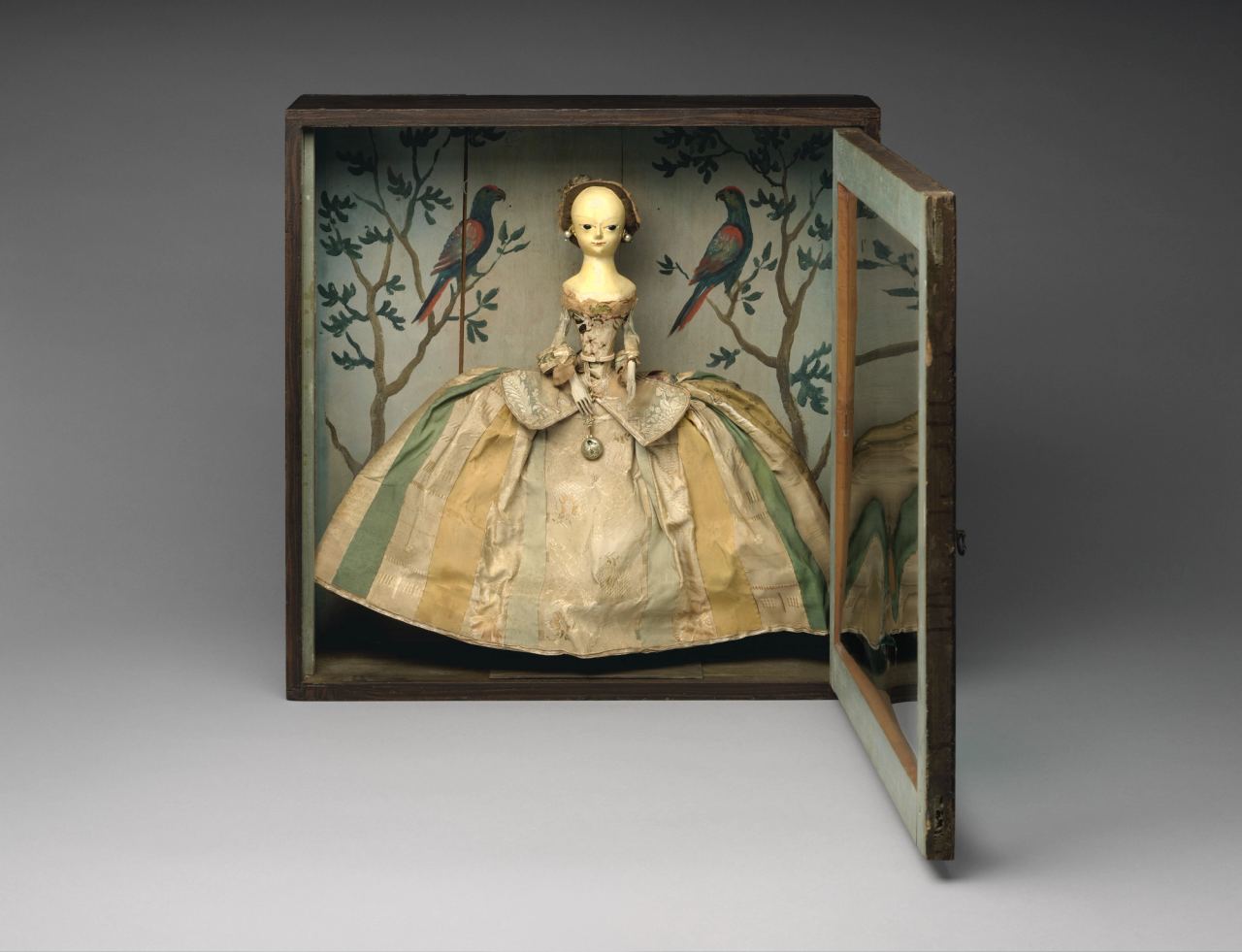
The box, painted inside with trees and parrots, is American; the doll is British. In the open view her skirt spreads sideways at the hips, the wide silhouette of the mid-century gown (compare the pannier, the frame that produced it). Her tiny watch and earrings are a reminder that these dolls were dressed in whole outfits, not just a gown.
The V&A's wooden doll of 1755 to 1760 is similarly complete. It wears a silk sack gown with matching petticoat and stomacher, and its record lists 23 parts, including stays, shoes, a fob watch and an etui, all in a wooden box. Fully dressed it is about 60 centimeters (roughly 24 inches) tall. The London Museum lists a similar doll of the same years.
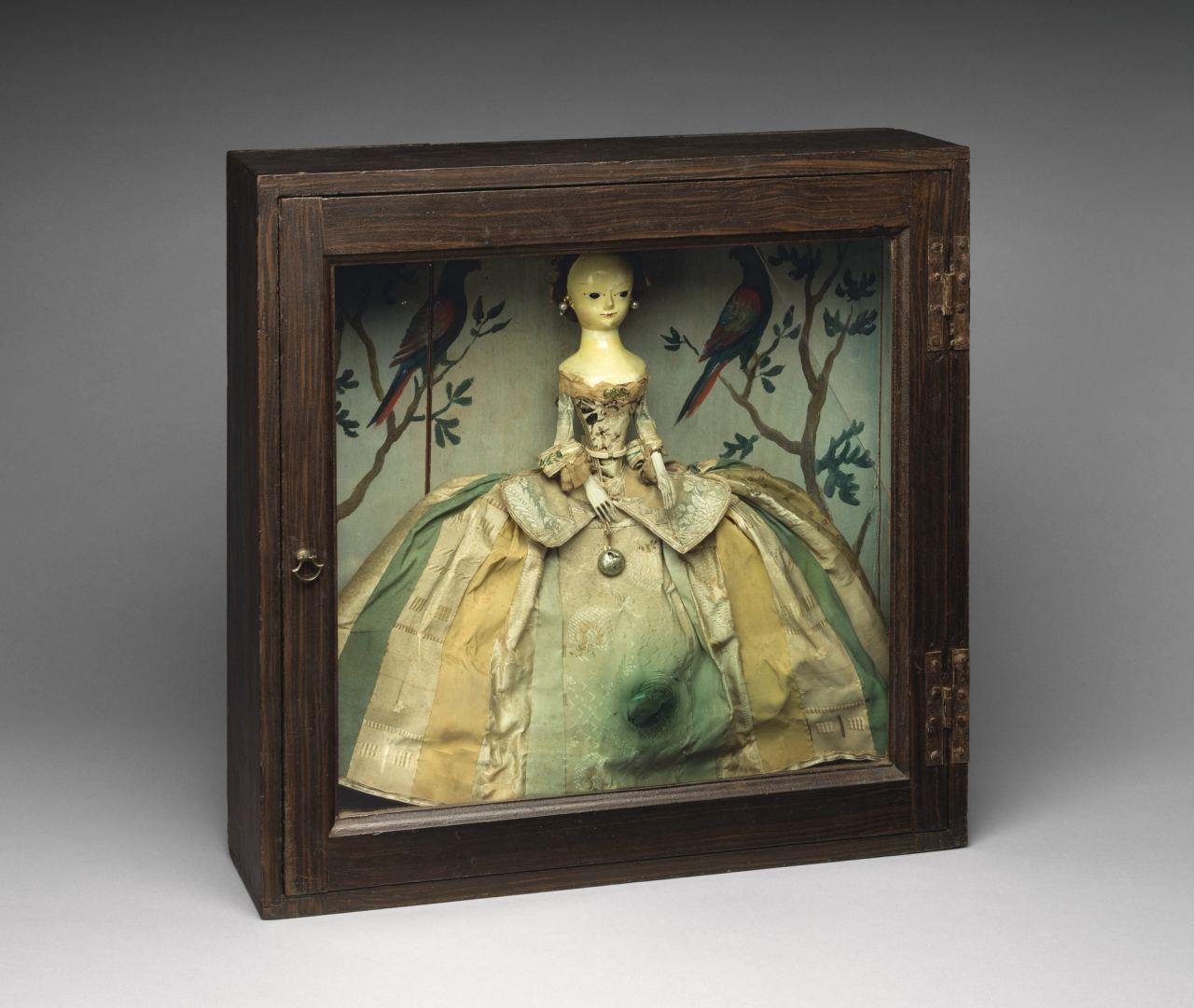
Modern writers often call such dolls "Pandoras." We found the name in several secondary sources but could not trace it to a period document, and the dates given for its origin conflict, so we use "fashion doll" here.
Why did fashion dolls give way to fashion magazines?
A printed plate could be copied, posted flat and sold to many people at once, which a hand-dressed doll could not. The Cabinet des Modes, generally called the first French fashion magazine, began in Paris on 15 November 1785 and was sold by subscription in France and abroad. Accounts say dolls faded as illustrated periodicals spread.
The Rijksmuseum holds prints from the magazine under the title "The First Fashion Magazine", and the magazine's publication history is summarized in Wikipedia, which we used to locate sources. By 1794 London had its own example. Our find A Fashion Magazine by Subscription, 1794 describes Nicolaus Heideloff's monthly hand-coloured fashion plates, which did for a London subscriber what a Pandora had done for a distant court.
| Date | What happened | Source |
|---|---|---|
| 1515 | Federico Gonzaga, for Francis I, asks Isabella d'Este for a dressed doll | Croizat, Renaissance Quarterly, 2007 |
| 1604 | Helena Snakenborg has a doll dressed in London for her sister in Sweden | Wikipedia (letter not seen) |
| ca. 1748 | English doll later boxed in the American colonies | The Met, 53.179.12a, b |
| 1755-60 | Large English doll with 23 parts | V&A, O100708 |
| 1785 | Cabinet des Modes begins in Paris | Rijksmuseum; Wikipedia |
A plate shows a garment from one angle; a doll can be turned and viewed in the round. That difference is our reading rather than a sourced finding, but it may explain why the idea never quite went away.
Where can you see one?
The Museum at FIT in New York is showing Doll Dressing from 16 September 2026 to 3 January 2027 (one listing gives 4 January, so check before you go). Curated by Colleen Hill, it has more than 170 objects, and its first section is a brief history of fashion dolls from the eighteenth century to the present. FashionUnited reports that it includes an eighteenth-century doll on loan from Colonial Williamsburg.
The Met's Doll in a box is in The American Wing, but its record says it is not currently on view. The V&A's doll and the London Museum's similar doll can be studied in their online records. You can also read our guide to the wide skirts such dolls wore, The Width of a Room.
Sources
- Doll in a box, ca. 1748, 53.179.12a, b. The Metropolitan Museum of Art. Primary record: date, materials, accession, provenance narrative Accessed October 14, 2026.
- Doll (wooden fashion doll, England, 1755-1760). Victoria and Albert Museum. 23 parts, ~60 cm, not for young children Accessed October 14, 2026.
- Doll. London Museum. Similar 1755-1760 doll Accessed October 14, 2026.
- "Living Dolls": François Ier Dresses His Women (Yassana C. Croizat, Renaissance Quarterly 60/1, 2007). Cambridge University Press. Federico Gonzaga's letter of 19 Nov 1515 Accessed October 14, 2026.
- "Living Dolls": François Ier Dresses His Women. Project MUSE. Second record of the same article Accessed October 14, 2026.
- Fashion doll. Wikipedia. Used to locate references; 1604 Snakenborg doll Accessed October 14, 2026.
- Helena Snakenborg, Marchioness of Northampton. Wikipedia. Used to locate references Accessed October 14, 2026.
- Doll Dressing. The Museum at FIT. Exhibition dates, curator, scope Accessed October 14, 2026.
- The Museum at FIT to explore how dolls shaped fashion in new exhibition. FashionUnited. Opening section; Colonial Williamsburg loan Accessed October 14, 2026.
- FIT Exhibition Explores the Cultural Dialogue Between Dolls and Fashion. Hyperallergic. Sponsored by the museum; 14th-century claim attributed Accessed October 14, 2026.
- Centuries ago, royals dressed up their dolls to share latest fashions. Smithsonian Magazine. Exhibition coverage Accessed October 14, 2026.
- Pandora: Rebirth of a Georgian Fashion Doll. Paxton House. Mantua-makers used dolls; wooden, jointed Accessed October 14, 2026.
- The First Fashion Magazine (Cabinet des Modes), RP-P-2009-2176. Rijksmuseum. Prints from the 1785 magazine Accessed October 14, 2026.
- Cabinet des Modes. Wikipedia. Used to locate references; first issue 15 Nov 1785 Accessed October 14, 2026.
Glossary
Last updated · Markdown · Report an error