Pattern books
This Lion Is 59 Meshes Tall
A page from a lace pattern book printed in Paris in 1588 does what every filet crochet chart still does: it draws a picture in squares and tells you how many to count.
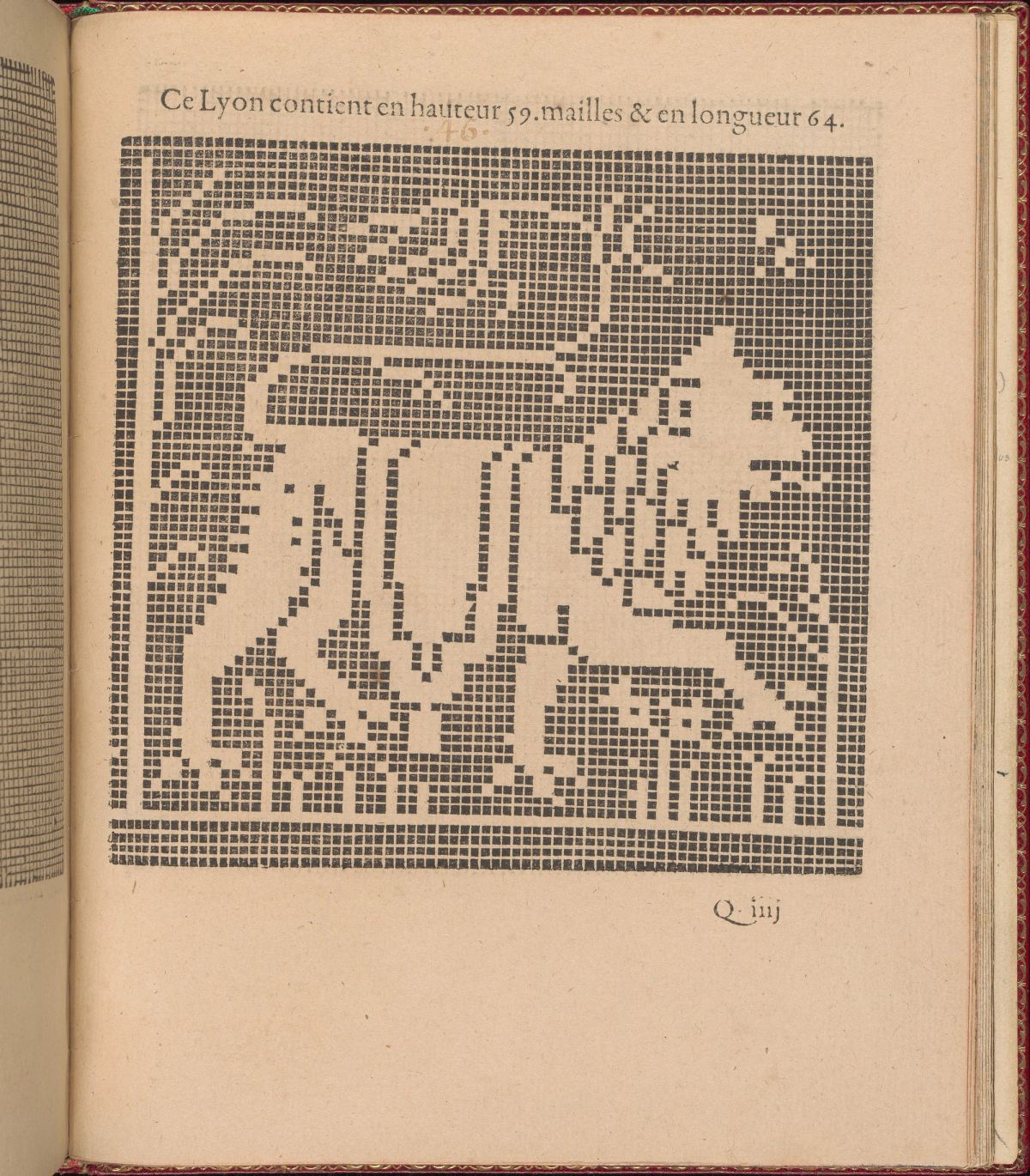
The line of French above this lion reads “Ce Lyon contient en hauteur 59. mailles & en longueur 64”: this lion is 59 meshes high and 64 long. It is a counting chart, printed in Paris in 1588 for needleworkers to copy square by square.
What is this page?
It is page 64 of Les Singuliers et Nouveaux Portraicts, a pattern book by Federico de Vinciolo, an Italian designer active in Paris from about 1587. The first surviving edition was published in Paris in 1587, the copy at The Metropolitan Museum of Art is dated 1588, and the book went on being reprinted for decades. Its publisher, Jean Le Clerc, was a Paris printmaker, and the Met’s copy includes portraits of Henri III and of his queen, Louise of Lorraine.
What was the grid for?
The book has two parts. The first gives designs for cutwork, in which lace is cut and stitched out of linen. The second, where the lion appears, gives designs for lacis: a net of small knotted squares on which a pattern is darned in with thread. Each square of the printed grid stands for one mesh of the net, so the caption tells the worker exactly how large a piece of net the design needs.
The grid itself was hard to print. Cutting a woodblock that leaves thousands of tiny squares standing is slow work, so the lines were cut away instead and the page prints as fine white lines on black, with the lion picked out in white squares.
How does it connect to filet crochet?
Lacis is also known as filet lace, from the French filet, a net. Filet crochet imitates the same look with a hook: open squares of chain stand in for the empty meshes, and squares of solid stitches for the darned ones. A filet crochet chart works on Vinciolo’s principle, one square of the chart for one square of the work. Modern charts add row numbers, and odd rows are usually read from right to left and even rows from left to right, following the turn of the work.
The Teazle filet chart generator does the counting for you: it turns text or a picture into a numbered grid and gives its size in squares, as the line above this lion does.
Sources
- Les Singuliers et Nouveaux Portraicts… page 64 (recto), 1588, 18.68(83). The Metropolitan Museum of Art. Caption text, date, publisher Jean Le Clerc, dimensions Accessed October 12, 2026.
- Les Singuliers et Nouveaux Portraicts…, 1588, 18.68(1-93). The Metropolitan Museum of Art. Designer active in Paris ca. 1587–99; portraits of Henri III and Louise de Lorraine-Vaudemont Accessed October 12, 2026.
- Lacemaking pattern book. Folger Shakespeare Library, The Collation. First surviving edition Paris 1587; two sections, cutwork and lacis; how the grid was cut Accessed October 12, 2026.
- Federico de Vinciolo. Wikipedia. Editions from 1587; used to locate the sources above Accessed October 12, 2026.
- Cloth with Winged and Two-Tailed Animals, 1933.303. The Cleveland Museum of Art. Technique record: filet/lacis, knotted ground darned with thread Accessed October 12, 2026.
- Filet crochet pamphlet by Hugo Kirchmaier and Anna Wijerfel Brown (1912), scan. Antique Pattern Library. Darned netting (lacis) and filet share the square-mesh ground Accessed October 12, 2026.
- Les singvliers et novveavx povrtraicts (digitised copy). Internet Archive Accessed October 12, 2026.
Last updated · Markdown · Report an error