Dress
Golden Threads: Reading the Dress of Saudi Arabia
Cotton, wool, silk and metal-wrapped thread, cut wide and decorated by region. What to understand about traditional Saudi Arabian dress before you see the V&A's free Golden Threads display.
Traditional Saudi Arabian dress is made of cotton, wool and silk, cut from straight lengths of cloth into wide, loose garments and, for celebrations, decorated with metal-wrapped thread, silk gussets and dense embroidery. Some of the most elaborate pieces were made in India. Cut, color and stitch tell you which region a garment belongs to, if you know where to look.
On 26 October 2026 the V&A opens Golden Threads: Dress from Saudi Arabia, a free display in Gallery 42 at South Kensington that runs until 30 May 2027. It shows colorful, voluminous thobes from the Najd region that King Abdulaziz gave to a British ambassador's daughter in 1942 and 1952, all embellished with metal-wrapped thread that adds, in the museum's words, "a golden shimmer". This is not a review. It is what to understand before you go: what the clothes are made of, how they are cut, how regions differ, who made them, and how to look at a garment under glass.
What is traditional Saudi Arabian dress made of?
Cotton, wool and silk, with metal-wrapped thread for decoration and, from the twentieth century, synthetics. Which cloth a woman or man wore depended on region, income, season and occasion, so the records give a range rather than one answer.
Cotton was the everyday cloth. H. R. P. Dickson, whom AramcoWorld calls a leading Western authority on Bedouin life, published The Arab of the Desert in 1949 as a glimpse of Badawin life in Kuwait and Saudi Arabia. He describes a Bedouin woman's overgarment, the thobe (he spells it thaub), as black cotton, worn over a dress of colored cotton, flannelette or silk. AramcoWorld's survey of the women's thobe lists the same spread by season, status and era: sturdy cotton, lightweight wool, satin, polyester or silk.
Wool went into cloaks. Dickson's men's cloak was made of finely woven sheep's or camel's wool, in two pieces; his Bedouin women's cloak was black wool bound at the edge with black silk. Wool also went into household weaving. UNESCO inscribed Al Sadu in 2025 for Saudi Arabia, Kuwait and Qatar, describing a tightly woven textile made by Bedouin women on a ground loom from natural fibers found in their environment. Its text does not say whether the cloth is for tents, furnishings or clothes, so we treat it as context, not as evidence about dress.
Silk carried the luxury. The V&A's pink silk robe from the same family gift is recorded as having "heavy gold and some silver embroidery". AramcoWorld says the finer thobes of Najdi towns, and of eastern Kuwait and southern Iraq, used black or red silk, tulle or lace, with gold and silver embroidery and sequins at neckline, sleeves and hem. In the south-west, Saudipedia describes the Asiri festive dress as black velvet with geometric embroidery, and the V&A holds an Asiri dress of about 1970 in synthetic velvet, lined with colored textiles and embroidered in several colors.
How is a thobe cut?
A woman's thobe is cut wide and from near-rectangles, so the shape comes largely from the cloth and not from fitting to the body. AramcoWorld describes large, square or nearly square cuts whose side panels open into billowing sleeves, some with decorative gussets, and many long enough at the back to trail on the floor. A man's thobe, by contrast, is usually a plain white shirt-robe.
The V&A's catalog entry for a Najdi bridal thobe of about 1940 (ME.9-2025) gives the details to look for. It is silk, metal-wrapped thread and cotton, made from "generous lengths of fabric" and finished with a sweeping train. Its signature feature is the tikhrasa, the gusset under the sleeve, often of contrasting silk, revealed when the wide sleeves are lifted over the head. At the neckline, bands of metal-wrapped thread form what the museum calls a dense, glittering embellishment.
The thobe is the top layer of a stack. Dickson's list of a Bedouin woman's clothes runs from the thaub to a dishdasha, a long-sleeved dress worn under it, and sirwal, long trousers tied at the waist. The V&A's gift from one family is a stack in itself:
| Garment (V&A's term) | Count | Described as |
|---|---|---|
| Dorra'a | 8 | under dresses |
| Thobe | 5 | outer dresses |
| Sirwal | 3 | pairs of trousers |
| Abaya | 2 | black wool robes |
| Aba | 1 | silk robe |
| Waistcoat | 1 | a single waistcoat |
| Shoes | 1 | one pair |
The V&A's object history explains the group. King Abdulaziz gave one set of traditional garments to Norah, the daughter of the British diplomat Sir Hugh Stonehewer-Bird, in 1942, and a further set when she married in London in 1952. Her family donated them in 2025.
How does Najd differ from the Hejaz and Asir?
Saudi Arabia has no single costume. The V&A's catalog says traditional dress "varies enormously across the country", and AramcoWorld says the women's thobe was once made in nearly as many styles as there were regions of the Peninsula. Three regions come up most in the sources: Najd in the center, the Hejaz along the west coast and Asir in the south-west. The evidence is uneven, so here is what it supports, and where it thins out.
| Region | Cloth and color | Where the decoration sits | Source |
|---|---|---|---|
| Najd (center) | Bedouin: dark cotton, sometimes inset strips of silk in cerise, turquoise and gold. Towns: black or red silk, tulle, lace. Mid-20th-century festive thobes in bright silk | Neckline, sleeves and hem; metal-wrapped thread bands at the neck; contrasting gusset | AramcoWorld; V&A ME.9-2025 |
| Hejaz (west) | Sapphire blue, fuchsia, dark red, green and purple in a 2001 reconstruction; straight cut | Embroidery described as more varied; lead beads at neck and wrists on one gown | Arab News, 2001 |
| Asir (south-west) | Black velvet; vivid purples in the 2001 reconstruction | Geometric embroidery on bodice and sleeves | Saudipedia; Arab News, 2001; V&A ME.17-2023 |
Najd is the best documented. Women there wore dark cotton in the desert, and in the towns finer silk with gold and silver. AramcoWorld names Najdi styles by their construction: mukhattam, with vertical embroidered bands, a wider cut and longer sleeves, and mutaffat, "taffeta'd", striped with colorful remnants. Lailah Al-Bassam, a Saudi scholar of traditional costume, told Arab News about the names of Najdi stitches: jehhah, from the Arabic word for watermelon because the stitch resembles its seeds, and sleslah, the chain stitch. A cloth dotted with gold circles is called daq al-lairah, after an old Arabic term for gold coins. A 2001 article adds that older Najdi gowns used an earth-toned palette of green and burgundy, and that Najdi gowns are cut in a triangle.
The nineteenth-century traveler Charles Doughty, who crossed Arabia in the late 1870s, left a precise note on Hayil, a town of north-central Arabia. There was, he wrote, "a petty industry among women of sewing and embroidering, with silk and metal thread, the mantles which are brought down (in the piece) from Jauf and Bagdad". He added, "none are made here". The cloth came from elsewhere; the embroidery was done in the town.
The Hejaz and Asir are harder. A 2001 Arab News report described a gown show at a charitable society in Riyadh, in which the designer Samia Jafferi made reproductions of older styles. It found the Hejazi gowns straight cut and colored in sapphire blues, fuchsias, dark reds, greens and purples, with outside influences visible. The director of the society's heritage center, Somaya Badr Mohamed, said: "You can tell by the cut of the gown." A 2017 study of Hijazi bridal costumes by Tawfiq and Marcketti, in the Clothing and Textiles Research Journal, says little is known about them because they are handmade by a few families. We could read its abstract only. For Asir, Saudipedia describes a dress called al-mujannab or al-mutawwar, worn at weddings and Eids, embroidered by hand or machine in threads that tend toward golden tones; the 2001 show added vivid purples.
Note the limits. The 2001 gowns were reproductions, and the Saudipedia page names no author, so neither is a museum record. The V&A's Asiri dress of about 1970 is the firmest object evidence we found for the south-west.
Where does the gold thread come from?
Often from India, where some of the finest embroidery was done. The V&A records the place of origin of its 1940 thobe as India, noting that "the dress was probably made in India" and that the gold embroidery in metal-wrapped thread is known as zari and linked to Indian textile traditions. Some dresses of this style, the record adds, were known in Saudi Arabia as the thobe hind, the Indian thobe. AramcoWorld agrees on the trade: local tailors and women at home sewed and embroidered most thobes, but the more elaborate ones came from tailors in India.
Zari is the general Indian term for goldwork, from the Persian word for gold, according to the Textile Research Centre in Leiden. The V&A's Rosemary Crill describes one form of the thread as a silk core wrapped in spiral layers of very thin metal, with red or yellow silk giving a gold effect and white giving silver. That construction is what lets it be woven or embroidered while staying thin and flexible.
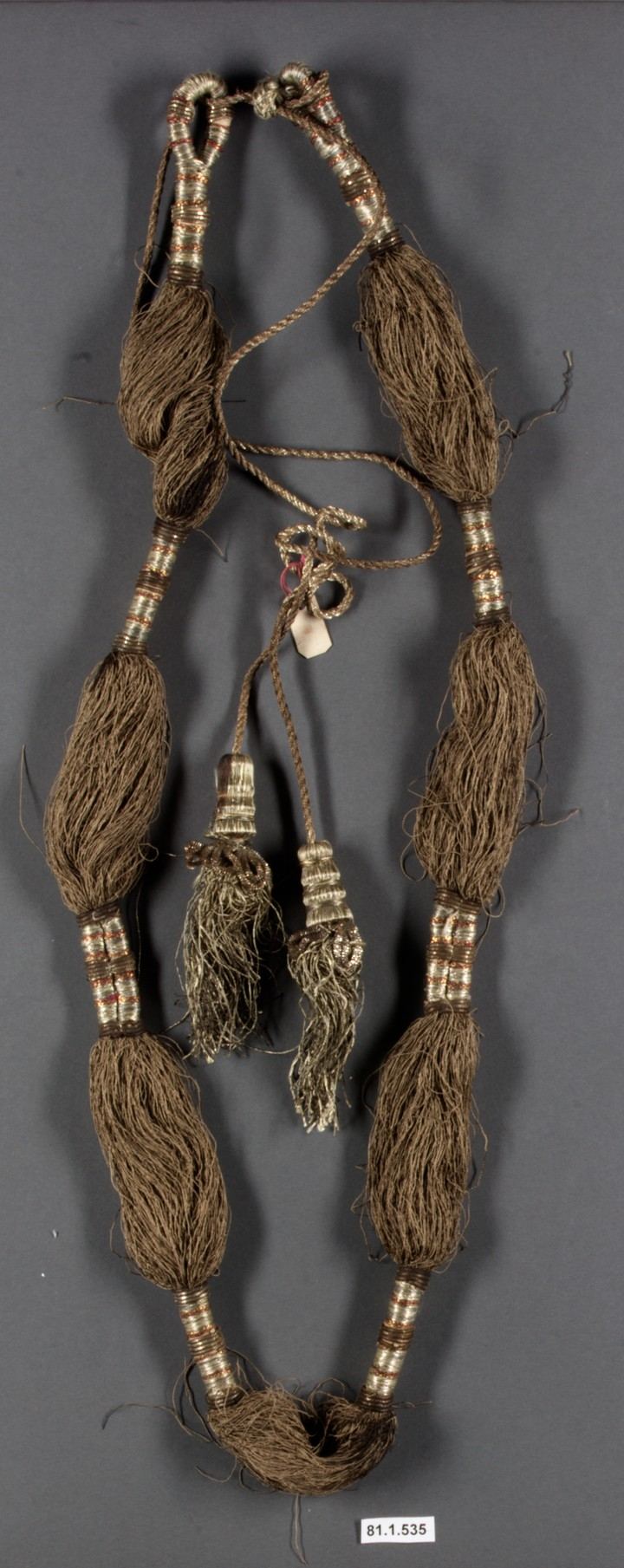
The link to India is old. In the market at Hayil in the late 1870s, Doughty writes, shopkeepers often put fine skeins of silk, folded in printed papers, into his hands to read for them. The language was English, and his index identifies the paper as the Bombay Gazette. The Met holds a Saudi Arabian headband of the nineteenth century, silk and metal thread, wrapped and braided, shown here, which uses the thread for something other than a dress. And sequins entered the same wardrobe: two Saudi robes of 1962 at the Met are recorded as silk with metal-wrapped thread and sequins, a story we tell in The Coin on the Sleeve.
Gold also traveled as a gift. The V&A explains that King Abdulaziz followed the long-standing Islamic tradition of rulers presenting fine garments, including to foreign visitors. That is how a Najdi festive thobe, probably made in India, came to a London museum.
What is the abaya, and is it always black?
The abaya is a loose cloak worn over other clothes, and it has not always been black or a woman's garment. Merriam-Webster dates the English word to 1810, from the Arabic 'abāya. In Saudi Arabia today it usually means a woman's outdoor cloak, traditionally black. Historically the word covers more.
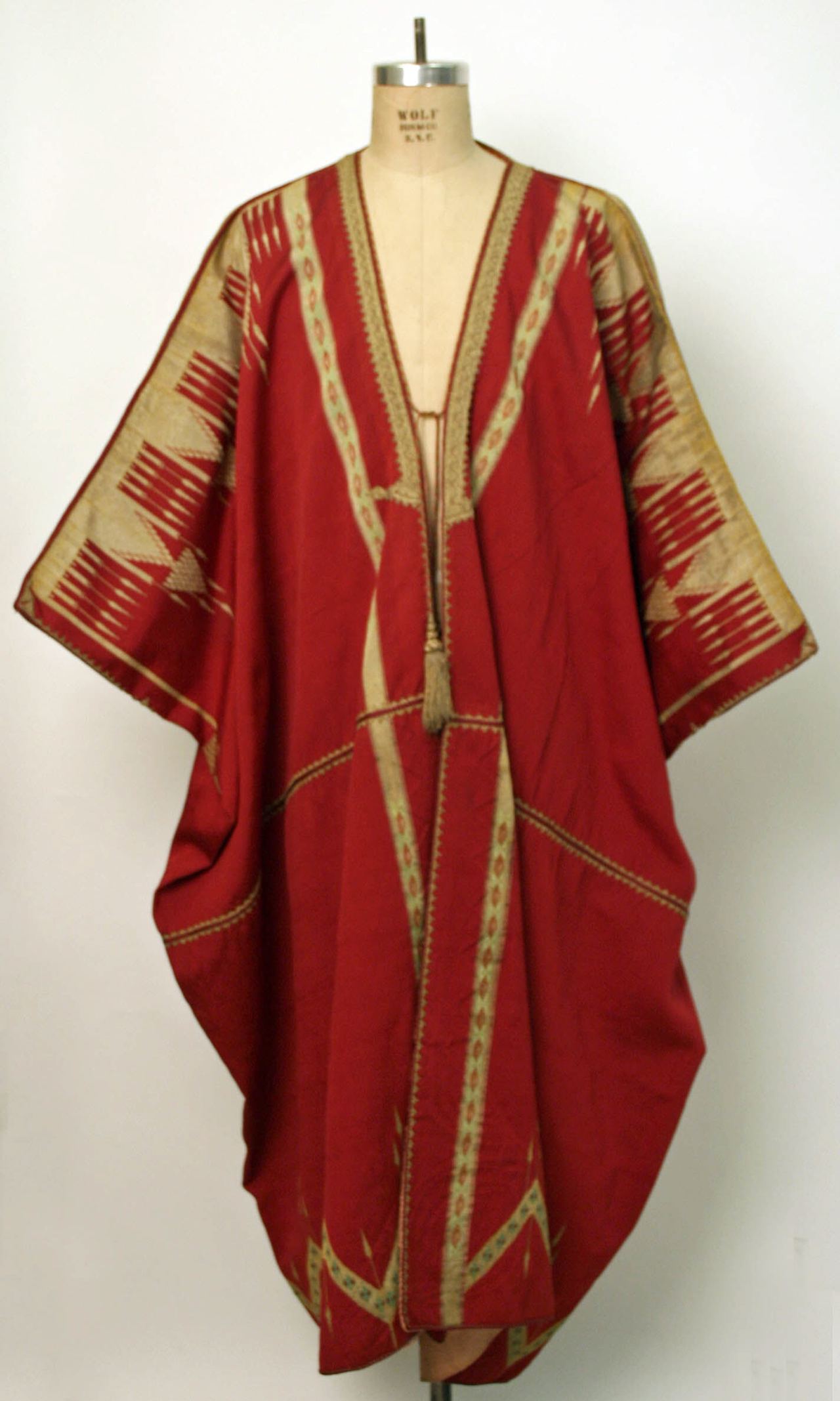
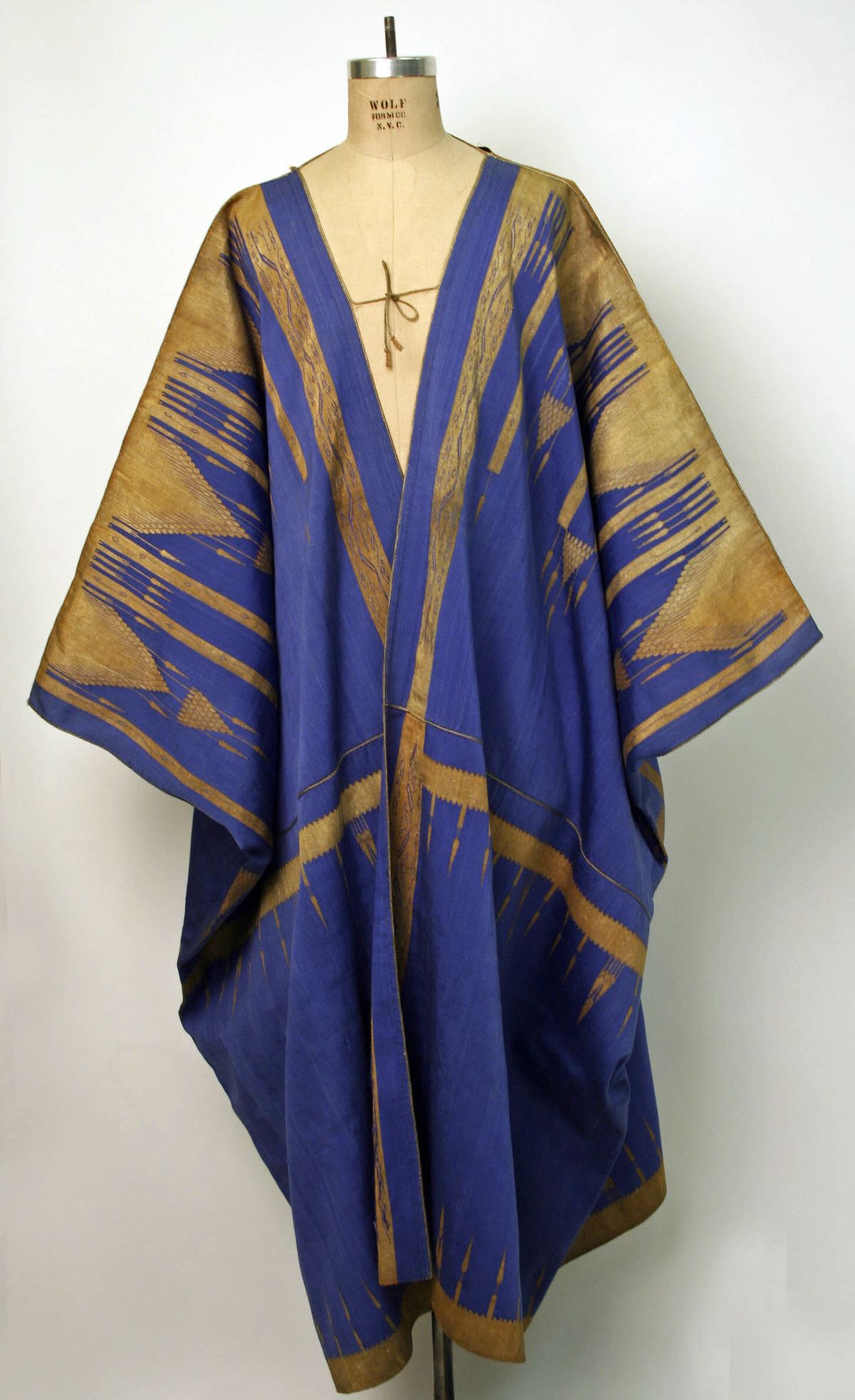
In Dickson's account, a Bedouin woman wore a black woolen 'abba outside the tent when men were near, and one sewn with gold thread only on holidays or when calling on important women. Men's 'abbas, also called bisht, were fine wool with gold embroidery round the neck and down both fronts. The Met's cloaks of this kind, most of them recorded as made in Syria in the late nineteenth or early twentieth century, are in silk and cotton with metal-wrapped thread, some in slit-tapestry weave, in which each color is woven back and forth only where the pattern needs it. They show how far the word travels: the garment belongs to a region, not a state.
The sources disagree on dates. One Arab News account, quoting historians, places the abaya's introduction about 80 years ago and says it was at first worn rarely, mainly for market trips. It adds that the cloak was originally black only, that Jeddah designers introduced muted colors, and that embroidery on sleeves and hem appeared in the early 2000s. Dickson's 1949 list of Bedouin women's clothes already includes a woolen 'abba. The two are probably describing different groups and kinds of wear, urban and Bedouin, so we do not give a start date.
Who made these clothes, and who wore them?
Makers were a mix. Women sewed at home: Arab News reports that Saudi women cut and sewed their own clothes, often following magazines such as Egypt's Hawwa'a. Tailors made finer pieces, and some, as above, were in India. Doughty's Hayil embroiderers were women.
Wearers dressed for occasions. The V&A says women of Najd wore elaborate thobes of this kind for weddings and other celebrations in the mid-twentieth century. AramcoWorld adds Ramadan evening visits and henna nights across the Gulf. Garments also sent messages. Dickson and AramcoWorld both describe a woman hanging her best thobe on a pole like a banner to welcome a traveler or an honored guest, which Dickson calls hoisting the raiyat. AramcoWorld quotes the curator Aisa Martinez calling such garments "a language of personal adornment".
The language changed. According to Al-Bassam, once oil wealth arrived women quickly set aside heritage dress as "a symbol of poverty". The National Guard first organized the Al-Janadriyah festival, which celebrated Saudi traditions including dress, in 1985, and later government bodies, including the heritage commission, encouraged a revival. The V&A holds a 2012–13 outfit by the Jeddah designer Yahya Al Bishri, who launched his label in 1990: a white thobe of vertical panels edged in red piping, with red-and-white keffiyeh fabric at the sleeve and neck. It cites tradition and is, the museum says, "utterly distinct".
How do you read a garment in a museum?
Start with the cut, then follow the glitter, then ask who is speaking. Here is a method you can use in front of any case in the V&A display:
- Find the seams. Where do the panels join? Look for rectangles, triangles and gussets. A 2001 account called Najdi cut triangular and Hejazi straight. On the red Syrian cloak above, gold-edged lines run diagonally across the chest where panels appear to be joined.
- Check the neckline, sleeve and hem. The sources put the gold, silk and sequins of a Najdi festive thobe there.
- Look at the thread. Metal-wrapped thread has a core wrapped in a thin metal skin; sequins are discs. Ask which you are looking at.
- Look for the lining and the gusset. The Asiri dress is lined in colored textiles, and the V&A's waistcoat is lined with printed cotton, the kind of fact that never shows in a photograph.
- Read the label for two places. The V&A gives Najd as where its thobe was worn and India as where it was probably made. A museum's "made in" line may differ from the dress's home.
- Read the date as a range. The V&A dates the same thobe to 1940 because it was given in 1942 and so must be earlier.
- Ask who gave it. A gift from a king and a gift from a family tell different stories.
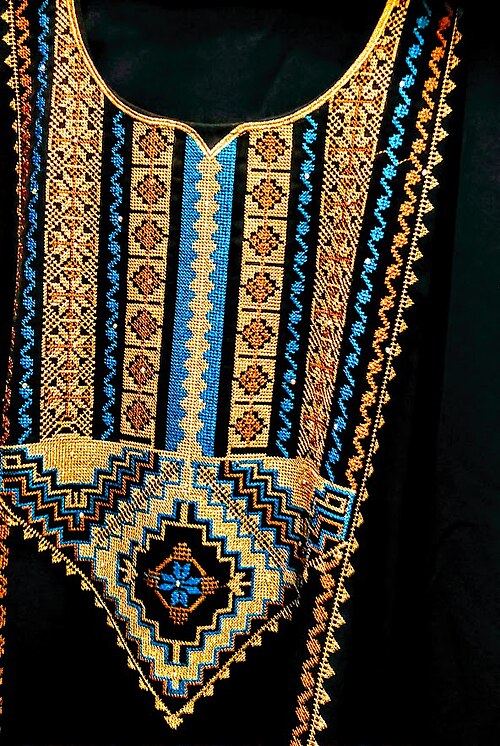
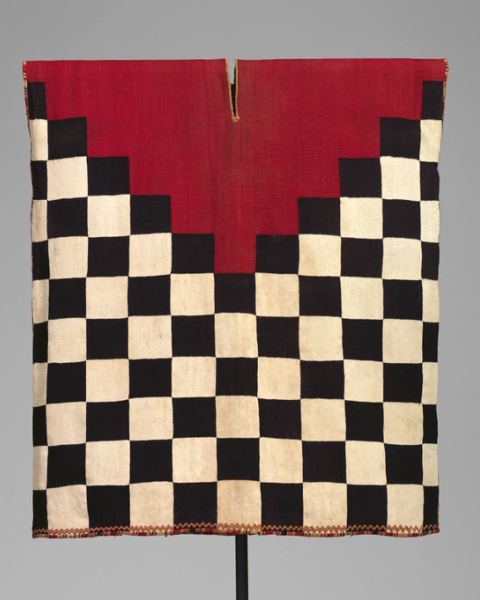
The photograph above shows a chest panel of dense embroidery on a black dress, photographed in 2019 and described on Wikimedia Commons as traditional female attire in Saudi Arabia. Its region, maker and date are not recorded, which makes it a fair test. The cut is out of frame, so you can read only the neckline, the stitch and the palette, and the caption cannot tell you more than its source does. For method beyond this subject, see How to Date a Garment from Its Construction, and for another garment read as a text of cloth and status, the Inka tunic.
Where can you see it?
The V&A display is free, in Gallery 42 at South Kensington, from 26 October 2026 to 30 May 2027, with a short film, Traditional Saudi Arabian Dress Explained | 1940s Bridal Thobes. The museum's online record for the Najdi bridal thobe (ME.9-2025) is worth reading first. Most of the Met's Saudi dress is not in the public domain and is not reproduced here, but its records for the 1962 robes and a twentieth-century men's ensemble can be read online. AramcoWorld's 2016 article "The Gown That Steals Your Heart" is a good introduction to the women's thobe across the Gulf.
What we could not settle: when the abaya became general among Saudi women, which of the V&A's own dresses are Najdi town and which Bedouin, and how the Hejazi and Asiri traditions changed over the twentieth century.
Sources
- Golden Threads: Dress from Saudi Arabia (exhibition page). Victoria and Albert Museum. Primary. Opened: display text, dates (until 30 May 2027), free, V&A South Kensington. Accessed October 26, 2026.
- Golden Threads: Dress from Saudi Arabia, 2026–2027 (event page). Victoria and Albert Museum. Primary. Opened: 26 Oct 2026 – 30 May 2027, Gallery 42, free, accompanying film title. Accessed October 26, 2026.
- Thobe, Najd, about 1940, ME.9-2025. Victoria and Albert Museum. Primary. Read through the V&A API record O1778195: summary, object history (21 objects, 1942/1952 gifts, Stonehewer-Bird), place and date notes (probably made in India, zari, thobe hind), materials, credit line. Accessed October 26, 2026.
- Thawb, 'Asir province, about 1970, ME.17-2023. Victoria and Albert Museum. Primary. Read through the V&A API: synthetic black velvet, lined with colored textiles, polychrome embroidery, 1970s. Accessed October 26, 2026.
- Waistcoat, ME.29-2025; Robe, ME.8-2025; Abayah, ME.13-2025; Aba, ME.15-2025. Victoria and Albert Museum. Primary. Read through the V&A API: brief descriptions (pink silk robe with heavy gold and some silver embroidery; black wool abayah with gold tassels; waistcoat lined with printed cotton). Accessed October 26, 2026.
- Outfit by Yahya Al Bishri, 2012–13, ME.7:1 to 3-2013. Victoria and Albert Museum. Primary. Read through the V&A API: designer, Yahya Couture launched in Jeddah in 1990, description of the outfit. Accessed October 26, 2026.
- Abaya Cloak, late 19th–early 20th century, C.I.41.86.10. The Metropolitan Museum of Art. Primary. Met Collection API record: made in Syria, medium, Open Access (public domain). Web page returns 429 to bots; the API was read. Image inspected. Accessed October 26, 2026.
- Abaya Cloak, C.I.56.6.8. The Metropolitan Museum of Art. Primary. Met Collection API record: made in Syria, medium incl. slit-tapestry weave, public domain. Image inspected. Accessed October 26, 2026.
- Headband, Saudi Arabia, 19th century, 81.1.535. The Metropolitan Museum of Art. Primary. Met Collection API record: silk, metal thread; wrapped and braided; L. 81.3 cm; public domain. Image inspected. Accessed October 26, 2026.
- Robe, 1962, Saudi Arabia, 1980.253.1 and 1980.253.2. The Metropolitan Museum of Art. Primary. Met API record: silk, metal-wrapped thread, sequins; embroidered. Not public domain; no image used. Accessed October 26, 2026.
- The Arab of the Desert: a glimpse into Badawin life in Kuwait and Sau'di Arabia (H. R. P. Dickson), first published 1949. George Allen & Unwin. Primary. Full text read on archive.org: men's clothing ('Abbah or Bisht), the Badawin women's clothes, raiyat custom, glossary. Paraphrased; no long quotation. Accessed October 26, 2026.
- Travels in Arabia Deserta (Charles M. Doughty), first published 1888; 1921 edition, vol. 2. Cambridge University Press. Primary. Full text read: the Hayil passage on women's embroidery of mantles; skein silks from Bombay; first-publication year and 1876–78 dates from the book's own pages and index. Accessed October 26, 2026.
- The Gown That Steals Your Heart (Kay Hardy Campbell, March–April 2016). AramcoWorld. Scholarly/editorial. Full text read: cut, fabrics, regional styles, tailors in India, occasions, raayah custom, Aisa Martinez quote. Accessed October 26, 2026.
- Charting the revival of Najdi fashion and a return to Saudi Arabia's roots (Nada Alturki, 3 October 2023). Arab News. Full text read: Lailah Al-Bassam; stitch names; abaya history; home sewing; Al-Janadriyah 1985. Accessed October 26, 2026.
- Reviving the art of traditional gowns (Sarah Kwiatkowski, 22 November 2001). Arab News. Full text read. Describes a gown show of reproductions by designer Samia Jafferi; regional colors and cut; lead beads. Treated as a modern reconstruction, not a museum record. Accessed October 26, 2026.
- Handicrafts in Aseer Region. Saudipedia. Full text read: Asiri dress (al-mujannab / al-mutawwar), black velvet, geometric embroidery on bodice and sleeves. No author shown. Accessed October 26, 2026.
- Traditional weaving of Al Sadu (Representative List, 2025). UNESCO. Primary. Full text read: inscribed 2025 (20.COM), Saudi Arabia, Kuwait, Qatar; Bedouin women, ground loom. Does not say what the cloth is used for. Accessed October 26, 2026.
- Indian Zari Embroidery (TRC Needles). Textile Research Centre, Leiden. Scholarly. Full page read: zari definition and Persian zar; techniques; production centers. No mention of Arabia. Accessed October 26, 2026.
- All that glitters (Rosemary Crill, 23 April 2015). Victoria and Albert Museum. Full page read: construction of metal-wrapped thread (silk core, spiral metal wrap). Accessed October 26, 2026.
- abaya. Merriam-Webster. Read: etymology from Arabic 'abaya; first known use 1810. Accessed October 26, 2026.
- Meaning and Symbolism in Bridal Costumes in Western Saudi Arabia, 2017. Clothing and Textiles Research Journal (Tawfiq and Marcketti). Scholarly. ABSTRACT ONLY (via Crossref and OpenAlex; publisher page blocks bots; the 2016 ITAA proceedings version was also blocked). Used only for: little known; handmade by a few families. Accessed October 26, 2026.
- File:Female_traditional_attire_in_Saudi_Arabia.jpg (Cloud Consciousness, CC0). Wikimedia Commons. Opened the file page: own work, 9 December 2019, CC0 1.0. Uploaded the 500 px thumbnail (original blocked by rate limit). Accessed October 26, 2026.
- Saudi national dress. Wikipedia. Used to locate references only; no claim rests on it. Accessed October 26, 2026.
Glossary
Last updated · Markdown · Report an error