Ornament
The Coin on the Sleeve: A History of Sequins
The word sequin began as a Venetian gold coin. How a coin became a disc sewn to cloth, why the dictionaries disagree on when, and what museum records can and cannot show.
A sequin is a small shiny disc, pierced so it can be sewn to cloth, and its name is a coin's. The word reached English through French from zecchino, the Venetian gold coin, which was named for the Venetian mint, the zecca, which in turn goes back to the Arabic sikka, a minting die. The discs took the coin's name only in the nineteenth century, after women had spent centuries sewing both coins and metal discs to their clothes.
Where does the word sequin come from?
Sequin comes from the Venetian gold coin called the zecchino, borrowed into English by way of French. The coin was named for the Venetian mint, the zecca, a word that traces back to the Arabic sikka, a minting die. The word meant a coin first. Only later, by the mid-nineteenth century, did it describe the shiny disc sewn to cloth.
The chain is short but the dates are not firm. Etymonline dates the English coin sense to the 1610s, while Dictionary.com gives 1575 to 1585. For the decorative sense, Etymonline finds fashion articles using it by 1852, and the examples it describes are Venetian coins worn as earrings and necklaces, so the jewelry meaning comes before the clothing one. One fashion-history blogger, citing the Oxford English Dictionary, gives 1882 for the first use of sequin for the discs. The two are thirty years apart. "Nineteenth century" is the safe answer.
Several accounts add that the name moved to the discs after Napoleon ended the Venetian Republic, and its coinage, in 1797. We could not reach a source that documents that handoff directly, so treat it as a tidy story rather than an established step.
What was a zecchino?
A zecchino was a Venetian gold coin, first struck in 1284 as the ducat, in nearly pure gold at about 3.5 grams. It kept almost the same design for roughly five centuries, and took the name zecchino, from the mint, around the middle of the sixteenth century. Britannica gives 1284 for the first ducat; Laura Morelli says only the thirteenth century.
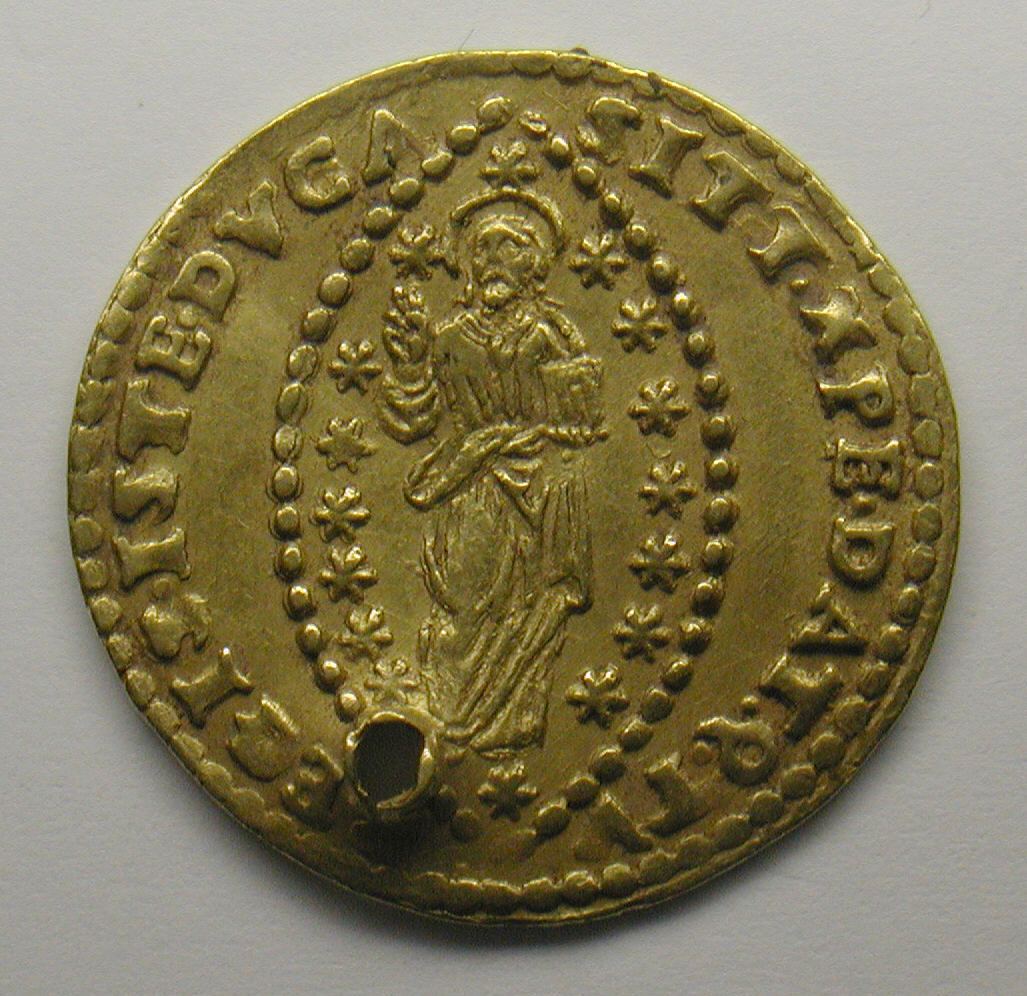
The weight is just as consistent: Britannica gives 3.56 grams and Numista about 3.545, with the purity above 99 percent. The name is dated to 1543 in one account and to the mid-sixteenth century in another, and the sources give 1796 or 1797 for the last issues. Numismatic descriptions put a kneeling doge receiving a banner from Saint Mark on one face and Christ in an almond-shaped frame on the other.
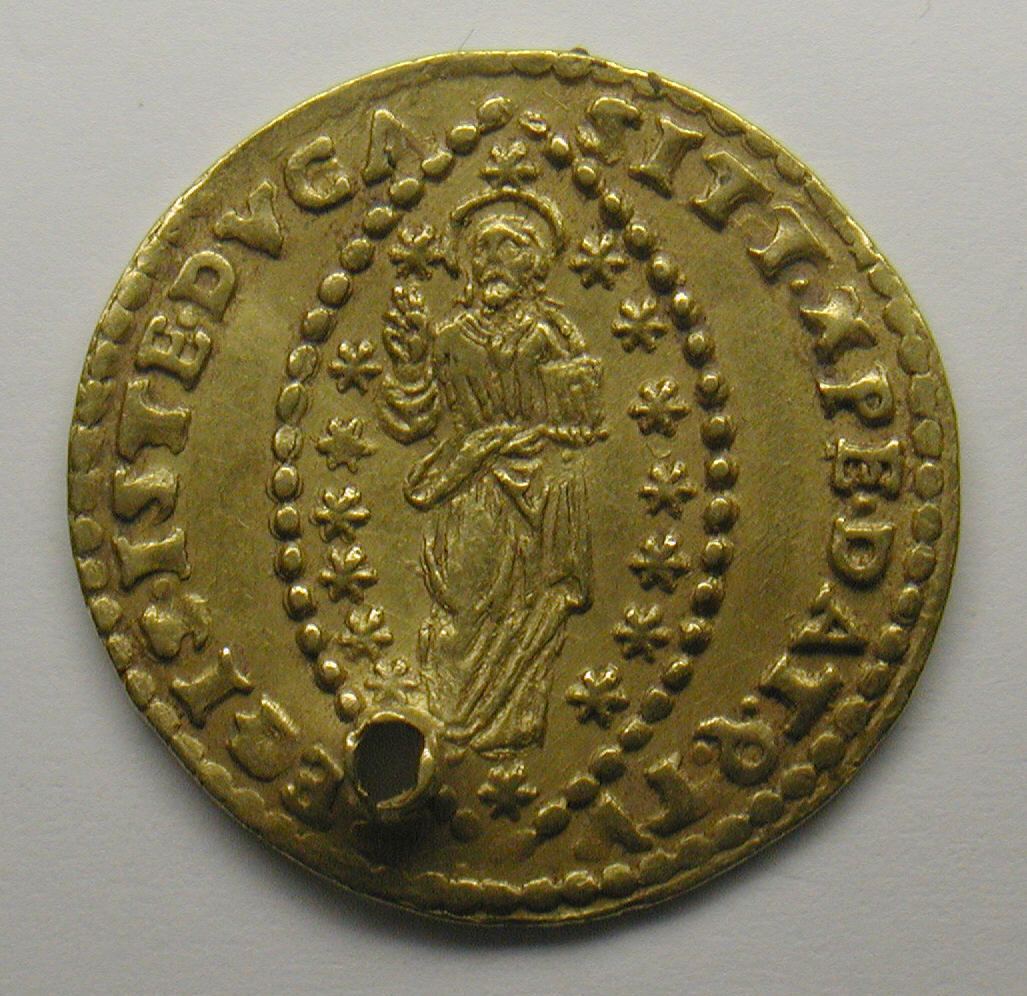
The Met owns a zecchino struck for Doge Domenico Contarini, who ruled from 1659 to 1675: gold, 22 millimeters across, accession 99.35.7225. The side photographed is the Christ face, with the figure inside an oval of beads and stars. Look at the lower edge. A round hole has been pierced through the rim. The record does not say why, and a hole proves nothing by itself. But a gold coin with a hole in it is exactly the kind of coin that can be sewn down.
Did people really sew coins onto their clothes?
Accounts of Venetian and wider Mediterranean dress say yes: women attached zecchini and other gold coins to their clothing and headdresses, carrying wealth where it could be seen and could not be left behind. We found no object record that pins this to a particular garment, so the claim rests on secondary sources, and the pierced Met coin is suggestive, not conclusive.
Morelli's account describes the fashion across the Mediterranean, and The Dreamstress says the coins were punched and sewn to women's vests and headdresses. The Cleveland Museum of Art holds the same logic in cloth rather than coin: an Algerian beniqa of the 1800s, a linen headdress worn for the ritual bath before a Jewish woman's wedding, worked with gold and silver metal thread and "shimmering spangles" and made part of her dowry. Shine that travels with the bride is not a new idea.
Did Tutankhamun wear sequins?
Not sequins by name, but small gold pieces sewn to cloth. The Nelson-Atkins Museum in Kansas City holds a small gold piece, about 1.6 centimeters across, that its record places in Tutankhamun's tomb and links to Howard Carter, around 1922. A second museum page says the sequins were attached to the king's linen clothing, and that there were a great many.
Why sew gold to a burial garment? Smithsonian Magazine offers a list: provision for the afterlife, a status symbol, a deterrent to thieves, a guide for the spirit. It is a list of possibilities, not a finding. The sequins in this story are, before anything else, gold sewn where it would show.
Did the tomb then start the sequin craze of the 1920s? The Dreamstress says that after the 1922 discovery spangles became fashionable, and that many 1920s evening gowns were heavily embellished. We found no primary evidence linking the two. Take it as a plausible influence, not a proven one.
What is the difference between a spangle and a sequin?
A spangle is the older English word for a small metal disc sewn to cloth, in use from the sixteenth century to the early nineteenth. Sequin gradually replaced it. Some writers reserve spangle for discs coiled from wire and sequin for solid punched ones, but museums and dictionaries do not apply that rule consistently, and neither do the museums here.
Two American museums show it. The Met catalogs a coif of 1600 to 1630 as linen worked with silk and metal thread and spangles, with couching among its stitches. The Cleveland Museum of Art lists the materials of an Elizabethan coif of the late 1500s as silk, gold and silver thread and sequins. Different words, the same small bright things.
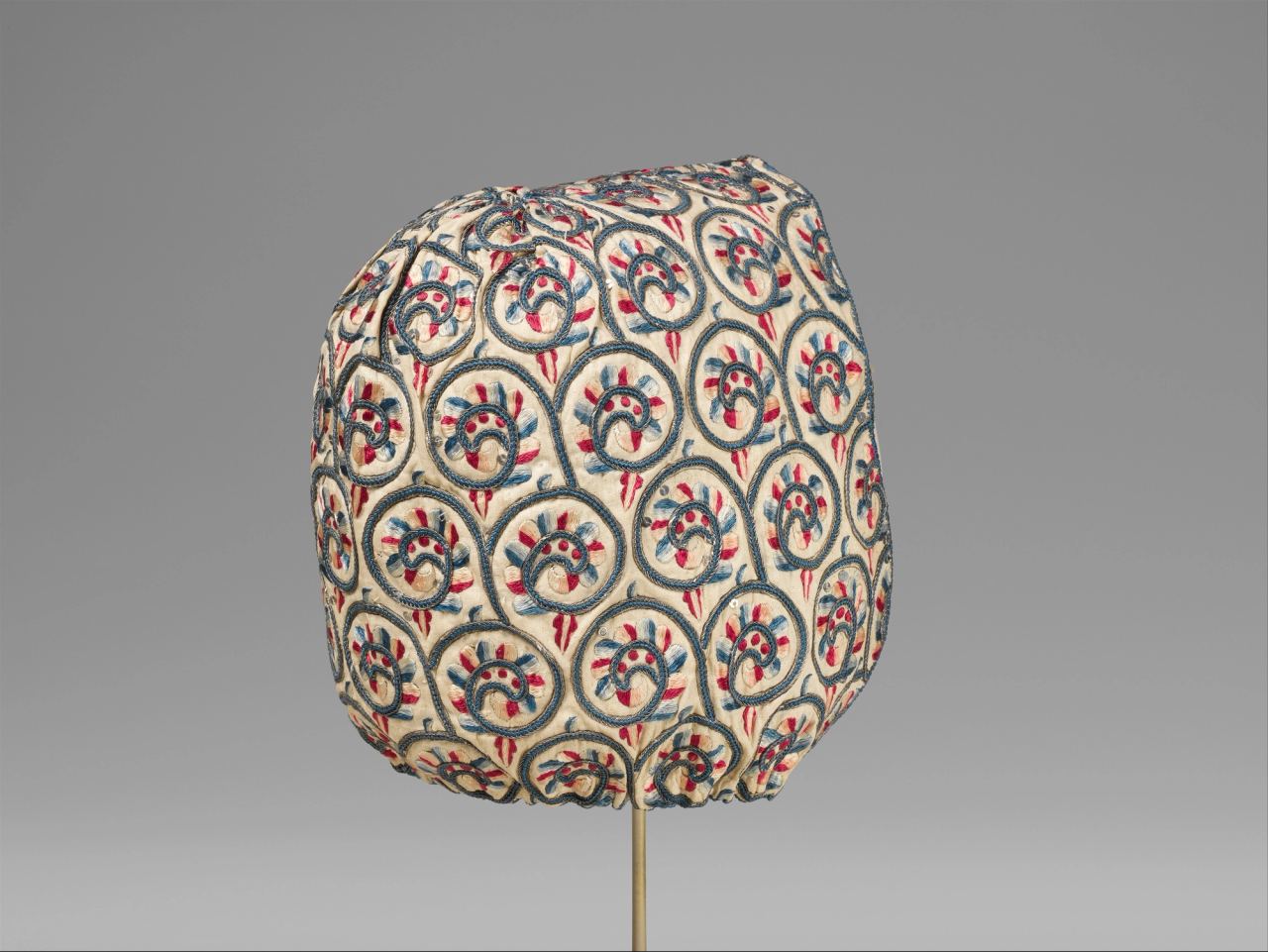
In the sixteenth and seventeenth centuries spangles were also called oes. Historic Jamestowne describes spangles of silver, gold and copper alloy among the finds from the Virginia settlement, including round copper-alloy ones with a thin silver layer, sewn into cloth as part of a pattern. How they were made is reported two ways: The Dreamstress describes wire coiled around a rod, cut into rings and hammered flat, while the Jamestowne page says they were cut from thin sheet metal. Both methods may have existed, and one account says punched discs overtook coiled ones in the first half of the nineteenth century.
| Term | What it names | Where it shows up |
|---|---|---|
| Zecchino | Venetian gold coin, 1284 onward | [Britannica](https://www.britannica.com/topic/ducat); Met, 99.35.7225 |
| Spangle or oe | Metal disc sewn to cloth, 16th to early 19th century | [Historic Jamestowne](https://historicjamestowne.org/collections/artifacts/spangles/); Met, 64.101.1242 |
| Sequin | Coin first, then a pierced disc of any material | [Etymonline](https://www.etymonline.com/word/sequin); Cleveland, 1934.206 |
| Paillette | Usually a larger, flatter disc | Met, [court robe, ca. 1900](https://www.metmuseum.org/art/collection/search/85436), 1977.398a–c |
When did sequins move from court to department store?
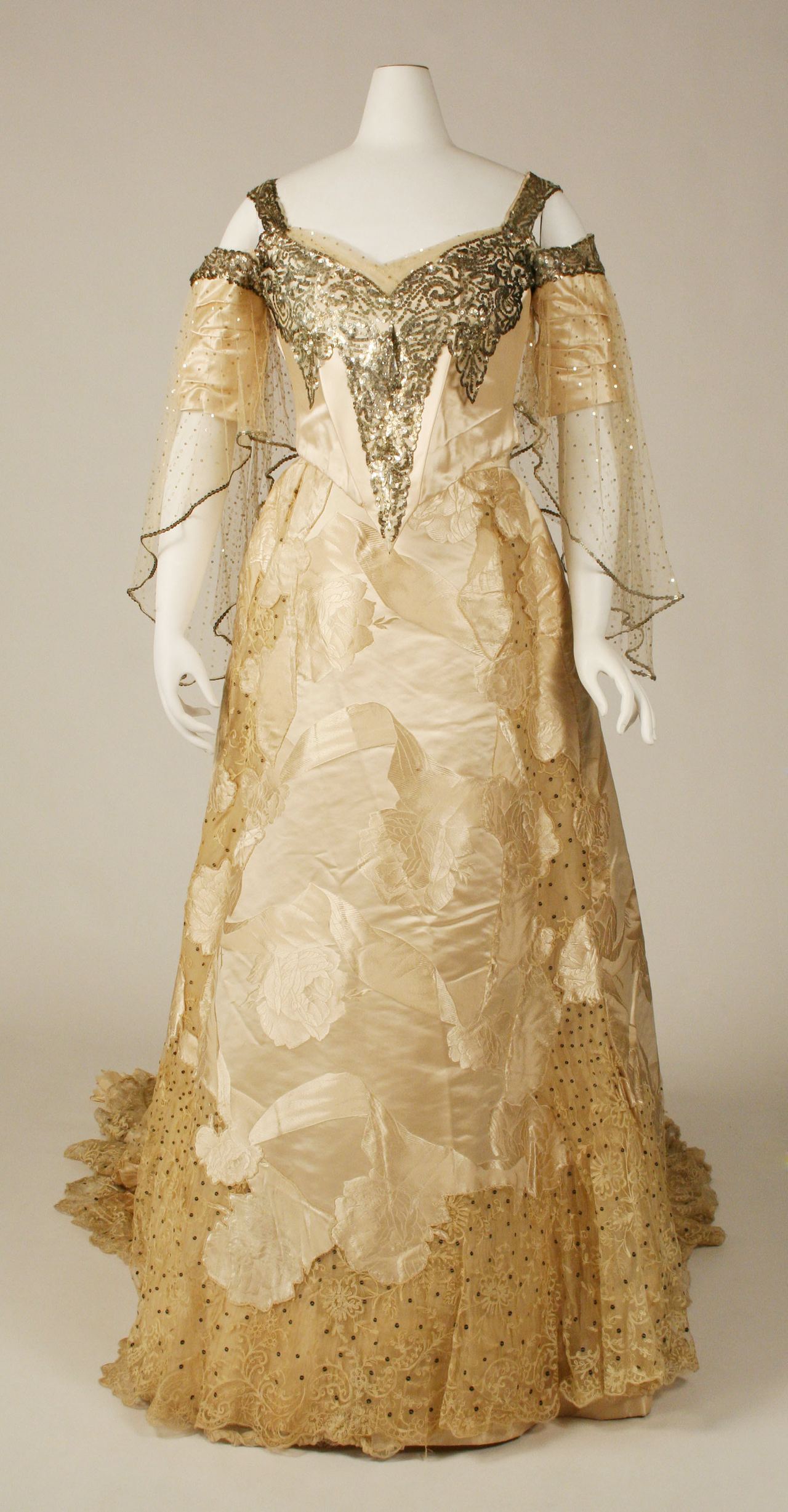
By the 1890s at the latest, sequined clothing could come from a Paris department store as well as from a couturier. Museum records show gold sequins on velvet in the early nineteenth century, a sequined cape credited to Au Bon Marché around 1895, and a sequined ball gown credited to the House of Worth around 1900.
The early piece is a dress border, accession 40.63.1, recorded as gold sequins on velvet. The Met credits an evening cape of about 1895 in silk and sequins to Au Bon Marché, the Paris department store (Maison A. Boucicaut), and a ball gown of about 1900 to the House of Worth.
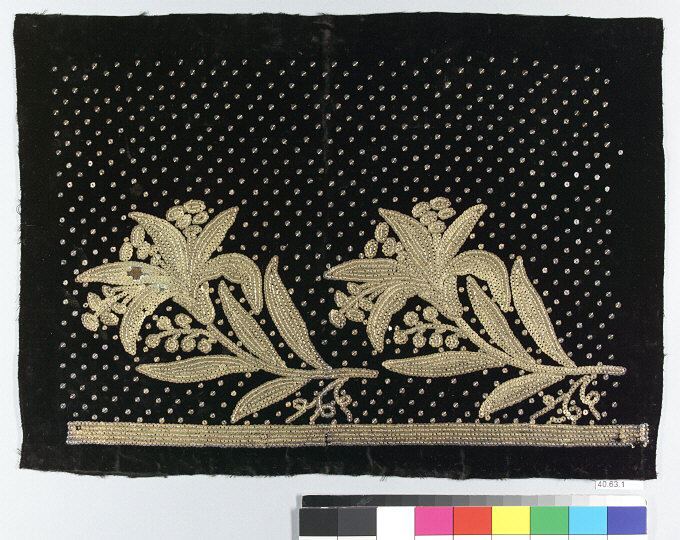
The border is a small panel of dark velvet seeded with gold sequins in a regular grid, with two sprays of flowers in denser gold. It is not much bigger than a book page, 24.1 by 34.3 centimeters. That is the whole technique in miniature: a field of tiny reflections, with the pattern made of where they are packed close.
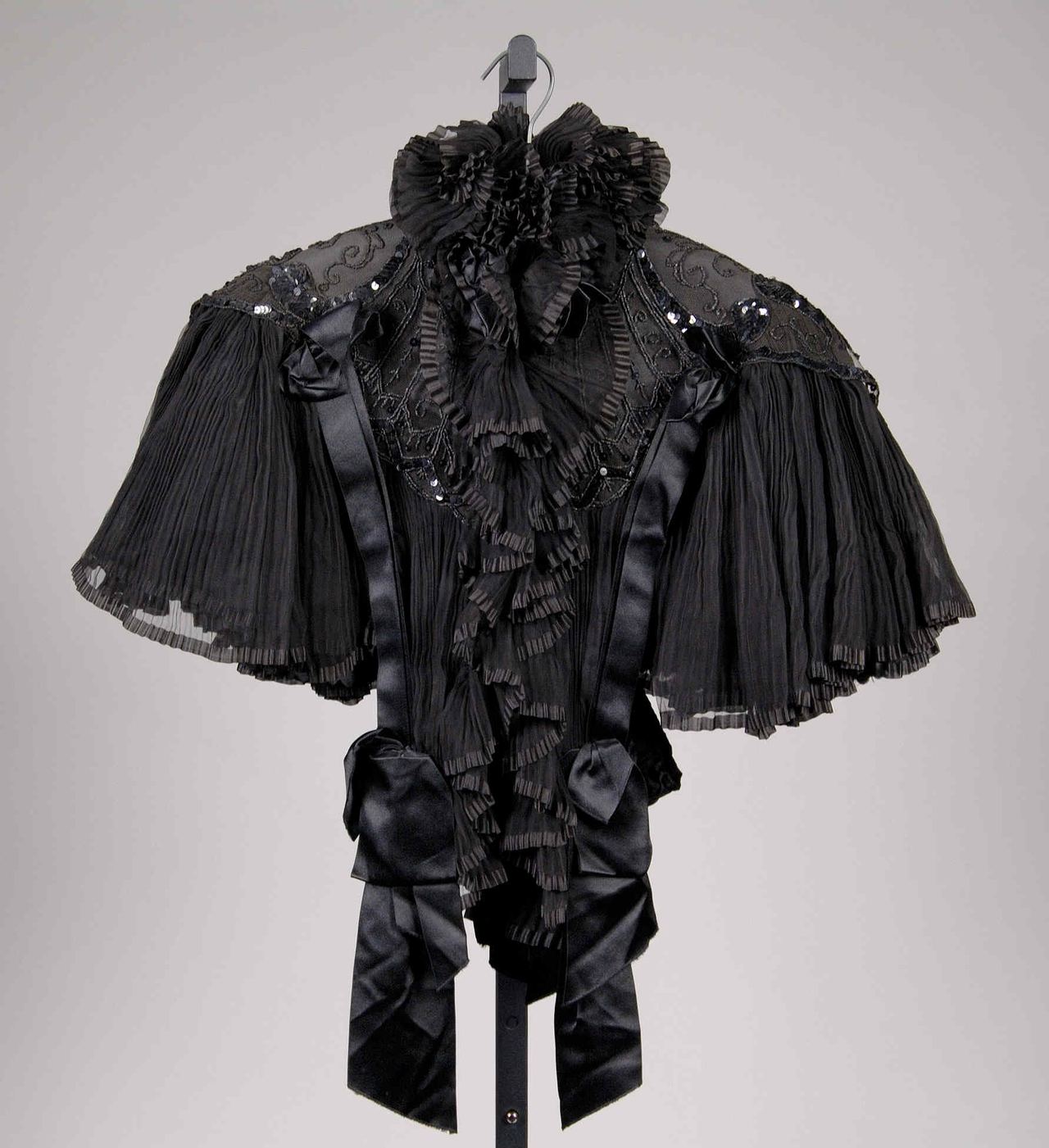
Two objects are not a market, but they show the range. The cape is black sequins and ribbon from a department store; the Worth gown is cream satin with a pointed sequined bodice, net sleeves dotted with sequins, and a train. Worth's house is the subject of our own account of the man who signed the dress, and a court dress of 1885 from the same house is in Dressed by Worth to Meet the Queen.
| Date | Event | Source |
|---|---|---|
| 1284 | First Venetian gold ducat (13th century in one account) | [Britannica](https://www.britannica.com/topic/ducat) |
| 1543 or mid-1500s | Coin renamed zecchino | [Wikipedia](https://en.wikipedia.org/wiki/Zecchino); [Aste Bolaffi](https://astebolaffi.it/en/articles/dal-ducato-allo-zecchino-d-oro-di-venezia-cinque-secoli-di-storia-scolpiti-nell-oro) |
| 1575–85 or 1610s | English *sequin*, coin sense | [Dictionary.com](https://www.dictionary.com/browse/Sequin); [Etymonline](https://www.etymonline.com/word/sequin) |
| 1600–30 | Met coif with spangles | Met, 64.101.1242 |
| Early 19th century | Gold sequins on velvet | Met, 40.63.1 |
| 1852 or 1882 | *Sequin* for the discs, first recorded | [Etymonline](https://www.etymonline.com/word/sequin); [Fashion Historian](http://www.thefashionhistorian.com/2014/01/spangles-sequins-and-spangs-oe-my.html) |
| 1893 | Early newspaper mentions of gelatin ornaments | [Koek](https://costume.mini.icom.museum/wp-content/uploads/sites/10/2020/08/Marjolein-Koek-%E2%80%98Fantaisies-en-g%C3%A9latine%E2%80%99.pdf) |
| ca. 1895 and ca. 1900 | Met cape (Au Bon Marché) and Worth gown | Met, 2009.300.6596; 49.3.6a, b |
What were sequins made of before plastic?
Metal came first: gold, silver, steel and brass. By the late nineteenth and early twentieth centuries, analyses of surviving costumes also find gelatin, varnishes, cellulose nitrate and various plastics. Heat, water and dry-cleaning solvents can severely damage several of these materials, which makes old sequined garments a conservation problem as well as a fashion one.
That finding comes from a survey by the conservators Chris Paulocik and R. Scott Williams, who analyzed sequins from a selection of costumes with infrared spectroscopy and published in the Journal of the Canadian Association for Conservation in 2010. They report that gelatin was common because it was inexpensive and was often laminated with cellulose nitrate. Marjolein Koek, a textile conservator at the Rijksmuseum, makes the history of gelatin the subject of her 2018 paper "Fantaisies en gélatine", drawing on newspaper mentions from 1893 and archival records of a French gelatin trade in the early twentieth century. A disc that heat and water can ruin is a strange thing to sew to an evening dress, but gelatin was cheap, and the trade was thriving enough to leave an archive.
The step after gelatin is thinly sourced. Popular accounts, such as Mental Floss, credit an acetate sequin developed with Eastman Kodak, later replaced by vinyl, and they name the Lieberman family and the firm Algy Trimmings differently. We could not trace the step to a primary source, so it has no date here.
For the same reason this story stops where the verified record stops. The twentieth-century sequin, from the dresses of the 1920s to the stage costumes of the 1970s, belongs to museum collections that do not publish open images, and we will not describe what we cannot show or source.
Where can you see one?
The Met's zecchino, spangled coif, gold sequin border, Worth gown and evening cape are all in its online collection under Open Access. The Cleveland Museum of Art's coif, forehead cloth and beniqa are likewise searchable online.
In person, the Fashion and Textile Museum in London is showing Sequinology from 2 October 2026 to 11 April 2027, a small display on sequins in fashion, fine art and costume from the sixteenth century to today, guest-curated by Amy de la Haye, with research and works by the designer Richard Sorger (Art Fund listing; one other listing gives 10 April as the closing date). The Met also catalogs a 2021 "Algae Sequin" dress, a gift of 3.1 Phillip Lim in 2024; its record names Phillip Lim and Charlotte McCurdy as designers and lists algae, bamboo, abalone shell and glass among its materials. It is not in the public domain, so there is no picture here. Look it up and notice that the word sequin is still in the title.
Further reading: our The Width of a Room, on how courts kept clothes fixed long after fashion moved on, and A Sleeve Worth a Portrait, on dress and ornament as a statement of family wealth. On terms: zecchino, spangle, sequin and paillette.
Sources
- Zecchino, Domenico Contarini (1659–75), 99.35.7225. The Metropolitan Museum of Art. Primary. Object record via Met API: gold, 22 mm, CC0. Pierced hole seen in the image. Accessed October 14, 2026.
- Coif, 1600–30, 64.101.1242. The Metropolitan Museum of Art. Primary. "spangles"; couching among stitches. Accessed October 14, 2026.
- Dress border, early 19th century, 40.63.1. The Metropolitan Museum of Art. Primary. Gold sequins on velvet, 24.1 x 34.3 cm. Accessed October 14, 2026.
- Ball gown, House of Worth, ca. 1900, 49.3.6a, b. The Metropolitan Museum of Art. Primary. Silk, sequins. Accessed October 14, 2026.
- Evening cape, Au Bon Marché/Maison A. Boucicaut, ca. 1895, 2009.300.6596. The Metropolitan Museum of Art. Primary. Silk, sequins. Accessed October 14, 2026.
- Court robe, Russian, ca. 1900, 1977.398a–c. The Metropolitan Museum of Art. Primary. "paillettes" in the materials line. Accessed October 14, 2026.
- "Algae Sequin" dress, 2021, 2024.58. The Metropolitan Museum of Art. Primary. Not public domain; no image used. Accessed October 14, 2026.
- Coif, late 1500s, 1934.206. Cleveland Museum of Art. Primary. Materials list "sequins"; cites Jacqui Carey and Underhill (1934). Accessed October 14, 2026.
- Beniqa (headdress), 1800s, 1916.1221. Cleveland Museum of Art. Primary. Gold and silver metal thread, "shimmering spangles"; dowry. Accessed October 14, 2026.
- The Chemical Composition and Conservation of Late 19th and Early 20th Century Sequins. Journal of the Canadian Association for Conservation, vol. 35 (2010), Paulocik and Williams. Scholarly. Infrared analysis of costume sequins; gelatin, cellulose nitrate, metals. Accessed October 14, 2026.
- Fantaisies en gélatine: Gelatin and the production of sequins and other decorative elements on costumes. ICOM Costume Committee, Utrecht 2018 (Marjolein Koek, Rijksmuseum). Scholarly. 1893 newspaper mentions; French gelatin trade. Accessed October 14, 2026.
- Sequin (object 67-21/5). Nelson-Atkins Museum of Art. Primary. Gold, 5/8 x 5/8 in.; Tutankhamun tomb, Howard Carter, ca. 1922. Accessed October 14, 2026.
- Funerary jewelry. Nelson-Atkins Museum of Art. Primary. Sequins attached to linen clothing. Accessed October 14, 2026.
- Spangles. Historic Jamestowne. Archaeological collection page; "oes"; silver, gold, copper alloy. Accessed October 14, 2026.
- Ducat. Encyclopaedia Britannica. 1284; 3.56 g. Accessed October 14, 2026.
- Venitian Sequin (series). Numista. About 3.545 g. Accessed October 14, 2026.
- From the ducat to the gold zecchino of Venice: five centuries of history sculpted in gold. Aste Bolaffi. Name change mid-16th century. Accessed October 14, 2026.
- Sequin (etymology). Etymonline. Coin sense 1610s; decorative sense by 1852. Accessed October 14, 2026.
- Sequin. Dictionary.com. Coin sense 1575–85. Accessed October 14, 2026.
- The Venetian Origins of Sequins. Laura Morelli. Coins sewn to clothing and headdresses; thirteenth century. Accessed October 14, 2026.
- Terminology: Sequins vs. Spangles (& their history in fashion). The Dreamstress. Terminology; coiled vs punched; Tut claim. Accessed October 14, 2026.
- Spangles, Sequins, and Spangs, Oe My!. The Fashion Historian. Cites OED for 1882. Accessed October 14, 2026.
- A History of Sequins from King Tut to the King of Pop. Smithsonian Magazine (Emily Spivack). Afterlife / status / theft deterrent. Accessed October 14, 2026.
- 5 Sparkling Facts About Sequins. Mental Floss. Acetate/Kodak, vinyl; popular account, not primary. Accessed October 14, 2026.
- Sequinology. Art Fund. Fashion and Textile Museum, 2 Oct 2026 – 11 Apr 2027. Accessed October 14, 2026.
- Zecchino. Wikipedia. Used to locate references; 1543 name date. Accessed October 14, 2026.
Glossary
Last updated · Markdown · Report an error