Printed Cloth, Block to Screen
Block, copper plate, roller and screen each leave a signature in printed cloth. What each method can repeat, how many colours it can carry, and how to read the difference.
Printed cloth is made in one of four ways, and each leaves its own signature. A carved block is pressed by hand, an engraved copper plate is pressed on a press, an engraved copper roller prints continuously, and a screen forces colour through a stencil. Learn the four and you can read a printed fabric the way a dealer does.
What are the main ways to print a pattern on cloth?
Four methods carry the history of European printed textiles: block, copper plate, roller and screen. They differ in what they can repeat, how many colours they can handle at once and how fast they work. A fifth, stencilling, runs alongside them. The 1911 Encyclopædia Britannica entry on textile-printing, written when hand block, perrotine (a mechanised block process), roller and stencil printing were all in use and copper plate was nearly gone, treats each as a separate craft, and the Victoria and Albert Museum's catalogue records add the arrival of screen printing in the 20th century.
| Method | How the pattern is applied | Typical strengths | Typical limits |
|---|---|---|---|
| Block | A carved block is inked on a colour sieve and struck onto the cloth by hand | Large repeats, up to about a dozen colours | Slow; one colour at a time unless the printer uses special equipment |
| Copper plate | An engraved plate is inked and pressed onto the cloth | Very fine detail, large repeats | Hard to join impressions invisibly; often a single colour |
| Roller | An engraved copper cylinder prints cloth continuously as it turns | Speed, exact joins, repeats from 1 to 80 inches, several colours at once | Needs a separate engraved roller for each part of the pattern |
| Screen | Colour is forced through the open parts of a stencil held on a mesh | Flexible, good for short runs; one screen per colour | One colour per screen |
How does block printing work?
A block is carved or built up so the pattern stands in relief, and the printer presses it onto the cloth. The Britannica describes the workshop: a table topped with a slab of stone and a stretched woollen blanket, which gives the block an elastic surface to print against; a "colour sieve" floating in a tub of starch paste, over which the colour is spread; and a printer who dips the block, sets it on the cloth and strikes it on the back with a wooden mallet.
Joining the impressions is the skill. The Britannica explains that the blocks carry pins at their corners, so that when the pins on one side of a new impression drop onto the pin marks of the last, the pattern continues without a break. Multicolour work was usually done one colour at a time over the whole length, which was then dried and rewound for the next. The Britannica also describes "tobying", a sieve with separate colour compartments that printed from two to six colours in one stroke, though only for patterns whose coloured parts were spaced apart. Hand block printing, it says, is slow, but can give "highly artistic results, some of which are unobtainable by any other means."
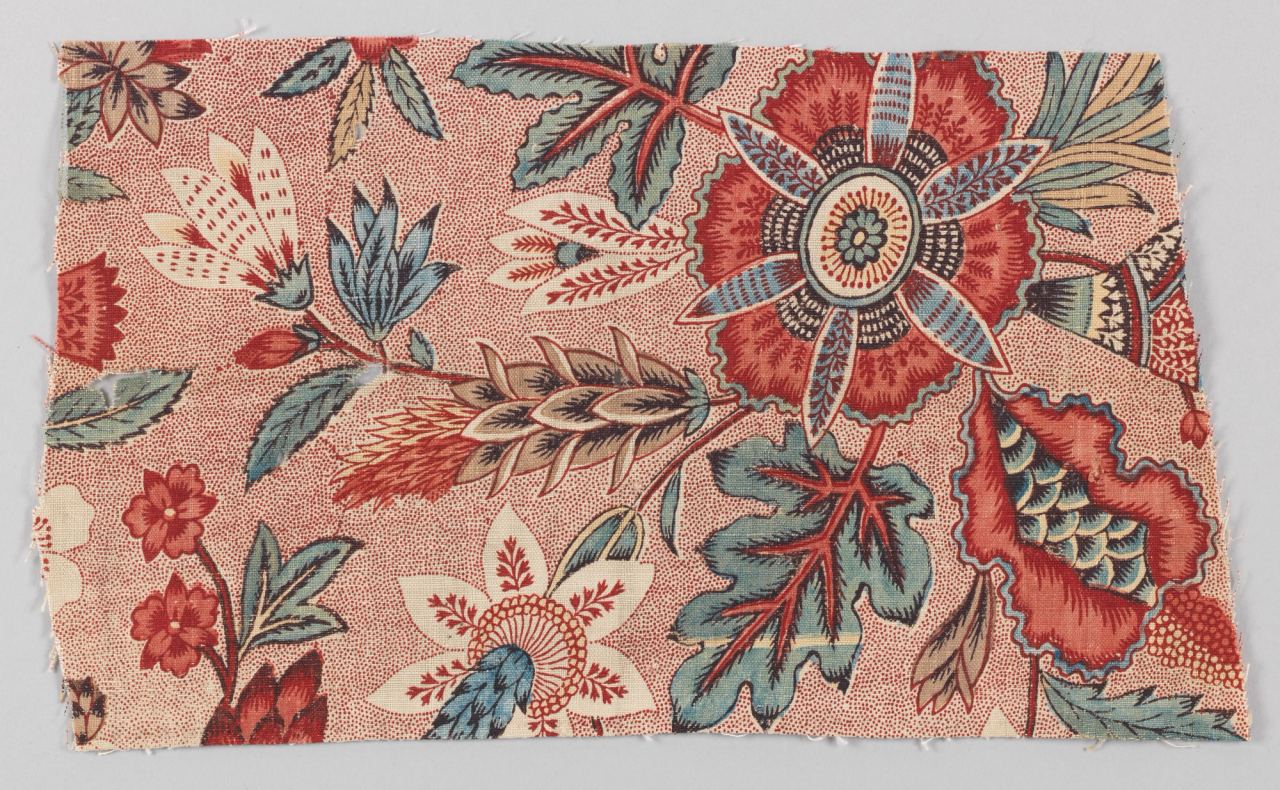
The cotton fragment above, in the Metropolitan Museum of Art, is catalogued as block printed, late 18th century, and measures 27.9 by 16.5 centimetres. Its large flowers and feathery sprays sit on a ground of fine dots. The Britannica notes that hand block printing could cope with repeats of almost any scale, and for decorative work it gives a typical repeat of 15 to 20 inches and anywhere from one to a dozen colours.
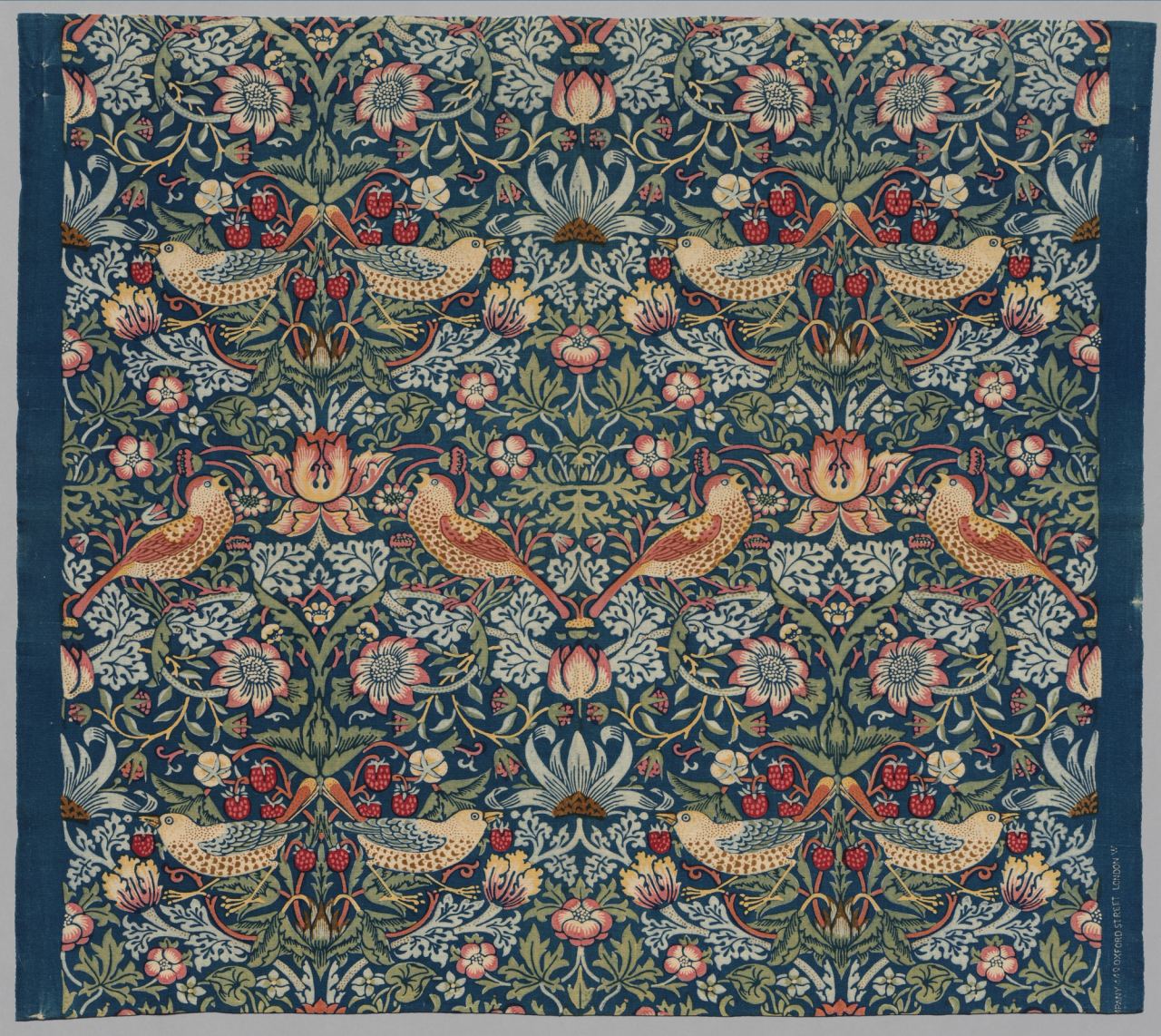
Block printing is the oldest of the four: the Britannica traces European practice to India, from where it reached Europe in the later 17th century, and Wikipedia notes that William Morris revived it for textiles in the mid-19th. The Cleveland Museum of Art, describing the Morris Strawberry Thief shown below, says Morris perfected the indigo-discharge process, in which the whole cloth was dyed blue before being bleached and block printed, here with more colours than any of his other textiles.
How did copper plates change printing?
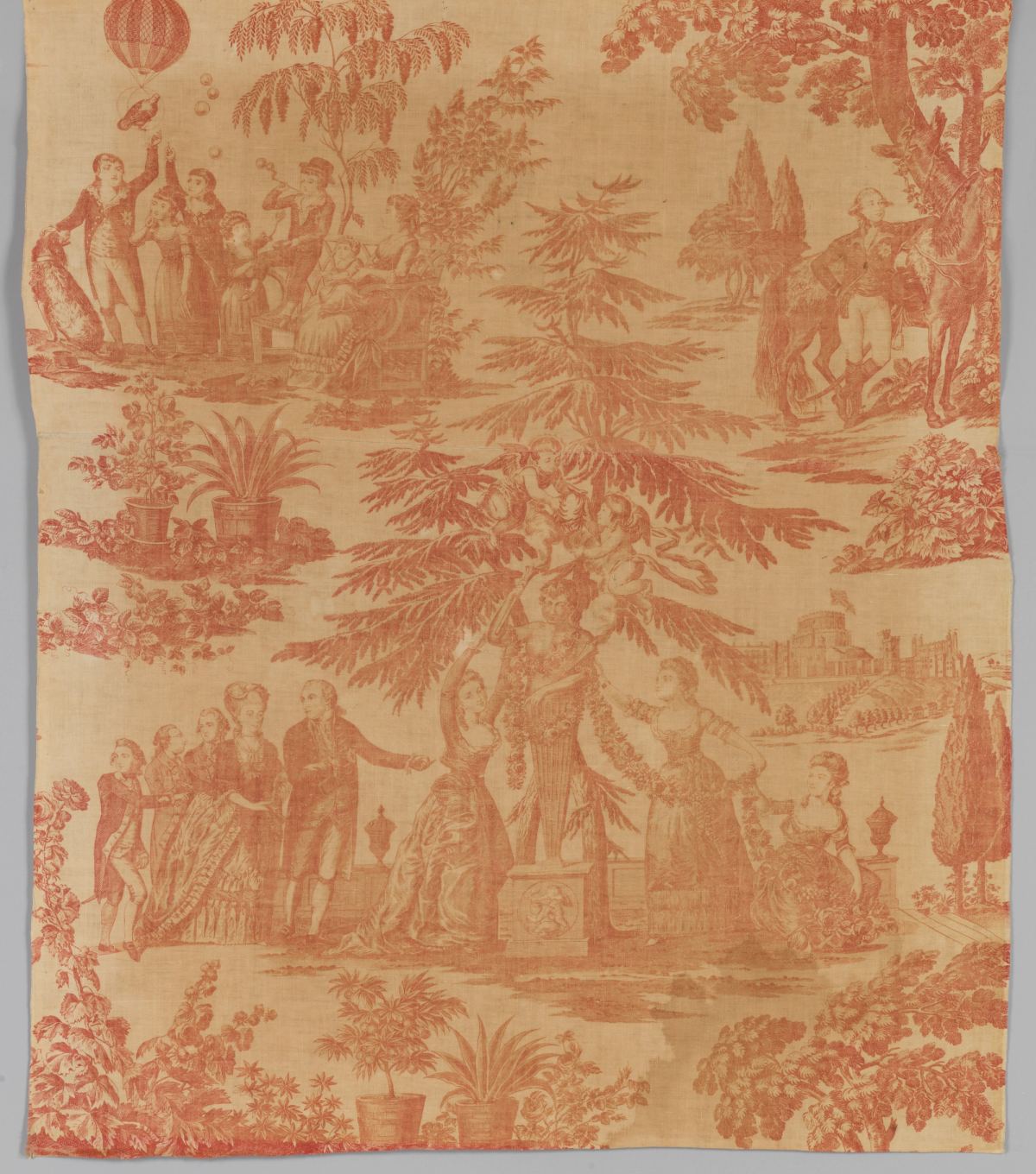
Engraved plates allowed finer drawing than a carved block could. The V&A's catalogue note for a plate-printed furnishing fabric made by Ollive and Talwin at Bromley Hall in East London, about 1780, states that the introduction of copper-plate printing in the 1750s allowed a fineness of detail and delicacy of drawing not achieved in earlier woodblock textiles, and much larger pattern repeats, which made it particularly suitable for bed hangings. The same record describes how a blue called china blue was made: the indigo was printed onto the cloth as a finely ground paste by plate or block, and the cloth was then dipped alternately in baths of lime and iron sulphate until the blue had developed. Because the process could not be combined with others, the V&A adds, china blue prints were always single-coloured, and polychrome designs needed hand-painting, or "pencilling", of indigo.
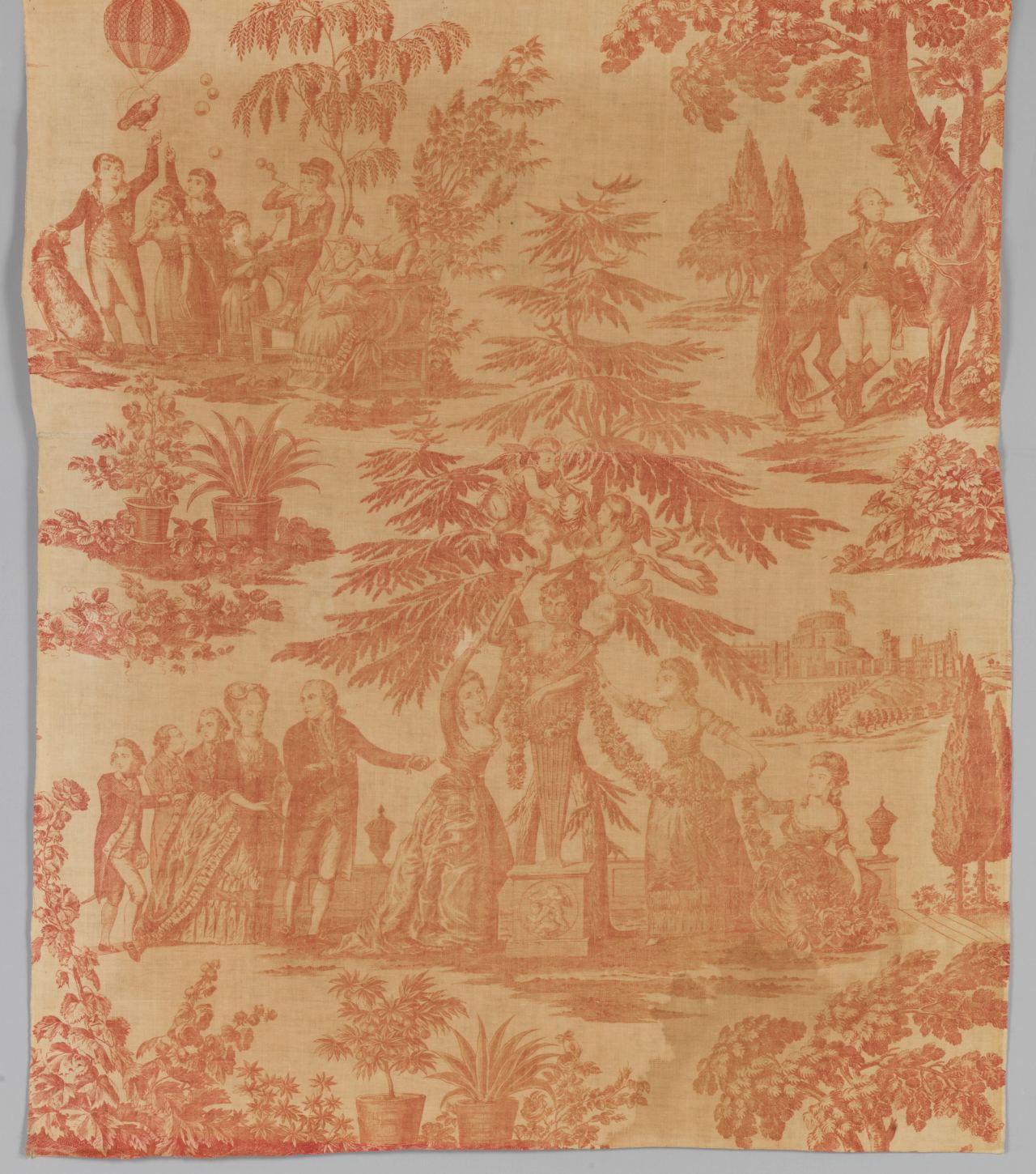
The Met's panel above, attributed in its record to J. Seymour and dated about 1785, is printed in a single red-brown colour and shows a family group by a statue, a balloon in the sky and a castle on the horizon.
The sources disagree on dates here. The V&A puts the introduction of copper-plate printing in the 1750s; the Britannica credits Bell with first practising it in 1770. Both agree on the limit: the Britannica says the great difficulty in plate printing was making impressions join exactly, which was never certain, so plate printing was eventually confined to patterns complete in one repeat or to widely spaced sprays and spots.
How does roller printing work?
A roller is an engraved copper cylinder that prints cloth as it turns. The Britannica's account describes the machine in some detail: an engraved copper roller rests against a heavy iron pressure cylinder wrapped in a special wool-and-cotton lapping; a smaller roller carries colour to the copper from a trough; and a thin steel blade, the "doctor", scrapes every trace of surplus colour from the roller's surface, leaving only the colour in the engraving. A second brass blade, the "lint doctor", cleans loose fibres off the roller. The cloth passes between roller and cylinder with an endless woollen blanket and is carried over steam-heated drying cylinders as it leaves.
Joining is no longer a problem, because the pattern is one continuous turn of the roller. The Britannica gives repeats of 1 to 80 inches and praises the "wonderful exactitude" with which each part of a multicolour pattern can be fitted into place. Its history is shorter: Bell's first patent was for a machine to print six colours at once, but keeping the rollers in register was hard, and Adam Parkinson of Manchester helped solve it. In 1785, the Britannica says, Bell's machine with Parkinson's improvement was used by Messrs Livesey, Hargreaves, Hall & Co. of Bamber Bridge, near Preston, to print calico in from two to six colours at one operation.
Wikipedia gives 1783 for Bell's patent, so the safe form is "Bell, in the 1780s."
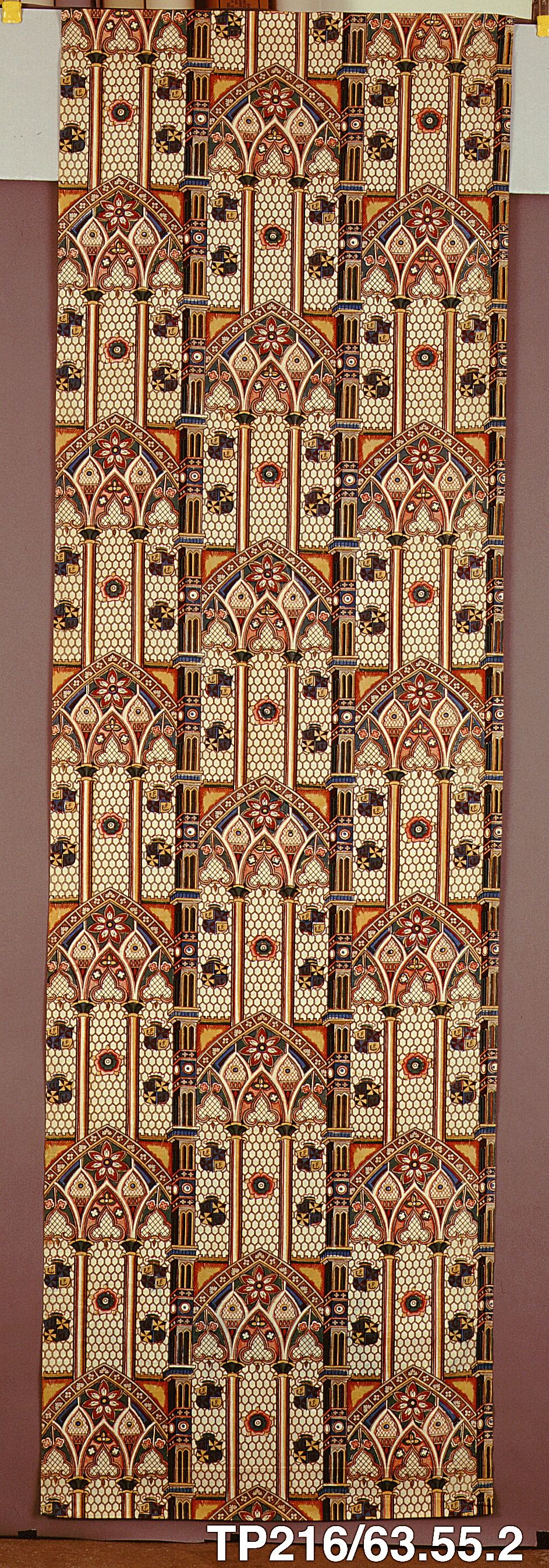
By the 1830s the process had become, in the V&A's words, highly mechanised and had largely replaced block printing in the production of fashionable furnishings. The V&A's record for a floral panel printed at Bannister Hall in Lancashire in 1830–36 says the pattern was made with an engraved metal roller, with extra colours added by wooden rollers or a woodblock, and that Joseph Lockett, one of the finest engravers in the English industry, drove the fashion for "fancy machine-grounds," in which the whole background was covered in minute engraved patterns. The Met's length of roller-printed glazed cotton, 1830–35, is 213 centimetres long and prints Gothic arches in brown, orange, cream and black.
What is stencilling, and why did it need "ties"?
Stencilling is very old. In the Britannica's description, the pattern is cut out of a sheet of paper or thin metal with a knife, laid on the cloth, and colour is brushed through the openings. Its peculiarity is that the design has to be held together by "ties": a circle cannot be cut without its centre dropping out, so its outline has to be interrupted at points. The Britannica says the need for ties shapes the design and, in a skilled hand, becomes part of the drawing.
That limit is the one the screen later removes. A screen holds the stencil on a mesh, so a printed circle can keep its centre, which is our reading of the process rather than a point the sources make.
How does screen printing work, and when did it reach textiles?
In screen printing, a mesh is used to transfer ink or dye onto cloth except in the areas blocked by a stencil. Wikipedia's summary, used here only to locate the standard description, says a blade, or squeegee, moves across the screen to fill the open mesh and then pulls the ink through as the screen springs back; one colour is printed at a time, so several screens produce a multicoloured design. A supplier's guide describes the stencil as made by exposing a coated mesh to UV light so the coating hardens, and says a new screen is used for each colour of a multicolour design.
The V&A's catalogue shows when it spread. Its note on the 'Daphne and Apollo' furnishing fabric by Duncan Grant, made by Allan Walton Textiles in 1932–33, says that screen printing let the company increase the variety of pattern sizes and colour palettes. On a 1947 rayon crêpe dress fabric designed by Graham Sutherland for Cresta Silks, it notes that the firm had used block printing but that after the Second World War screen printing was introduced, which allowed more flexibility in design. And in the 1970s, according to the record for Jane Wentworth's 'Raspberry Lips' print, designers from the Royal College of Art were producing furnishing and dress fabrics in small runs for OK Textiles.
None of those records says anything about how the Ossie Clark and Celia Birtwell fabrics were printed, so this piece does not either.
How can you tell which method printed a fabric?
Treat these as starting points drawn from the descriptions above. A repeat of 15 to 20 inches with between one and a dozen colours is typical of hand-blocked decorative work (Britannica). Very fine drawing in one colour, in a large repeat or a scene complete in itself, suggests a copper plate (V&A, Britannica). A tight, exact multicolour repeat, perhaps over a minutely engraved background of the 'machine ground' kind, suggests a roller (Britannica, V&A). Flat colours that are each printed separately, in a design made for a short run, suggest screens (V&A, Wikipedia). They are not proof: the Britannica itself notes that combinations of methods are common.
Where can you see them?
The Fashion and Textile Museum in London presents Ossie Clark / Celia Birtwell; the Art Fund listing gives the run as 2 October 2026 to 11 April 2027, so check dates with the museum before you go. For printed cloth before the 20th century, the Met, the Cleveland Museum of Art and the V&A all have printed cottons in their online collections; the Met and Cleveland publish their images as open access. For a related textile story, see Why Is It Called Paisley?, and for indigo and chintz, the glossary.
Sources
- Textile-printing, Encyclopædia Britannica (11th ed., 1911). Encyclopædia Britannica via Wikisource. Block, perrotine, copper plate, roller and stencil processes; Bell; register; repeat sizes Accessed October 15, 2026.
- Furnishing fabric of plate-printed cotton, Ollive and Talwin, Bromley Hall, ca. 1780 (T.380-1960). Victoria and Albert Museum. Copper-plate printing from the 1750s; china blue process; pencilling Accessed October 15, 2026.
- Panel of floral furnishing fabric, 1830-1836, Bannister Hall (T.52-1911). Victoria and Albert Museum. Roller printing; mechanisation by the 1830s; Joseph Lockett; machine grounds Accessed October 15, 2026.
- 'Daphne and Apollo' furnishing fabric, Allan Walton Textiles, 1932-33 (T.340:1-1998). Victoria and Albert Museum. Screen printing increased pattern sizes and colour palettes Accessed October 15, 2026.
- 'Web' dress fabrics, Cresta Silks, 1947 (CIRC.105 to E-1947). Victoria and Albert Museum. Screen printing introduced after WWII, more design flexibility than block Accessed October 15, 2026.
- Dress with 'Raspberry Lips' print by Jane Wentworth, 1970s (T.39-2022). Victoria and Albert Museum. OK Textiles; small runs of screen-printed furnishing and dress fabrics Accessed October 15, 2026.
- Strawberry Thief, c. 1936 printing (1937.696). The Cleveland Museum of Art. Morris and the indigo-discharge process; block printed Accessed October 15, 2026.
- Screen printing; Roller printing on textiles. Wikipedia (used to locate the standard description; 1783 Bell patent date from the roller printing article). Squeegee, one colour per screen; 1783 patent date Accessed October 15, 2026.
- How Does Screen Printing Work?. ScreenPrinting.com (supplier's guide). Emulsion-coated mesh stencil, one screen per colour Accessed October 15, 2026.
- Ossie Clark / Celia Birtwell (exhibition listing). Art Fund, Fashion and Textile Museum, London. Dates and subject; no information on printing method Accessed October 15, 2026.
- Fragment of printed cotton (2010.500.3); Copper plate printed cotton (62.43.1); Length of roller printed cotton (63.55.2). The Metropolitan Museum of Art. Dates, media, dimensions (Collection API) Accessed October 15, 2026.
Glossary
Last updated · Markdown · Report an error