Pattern
From Kashmir to Paisley: The Journey of a Pattern
The teardrop motif began on shawls woven by hand in Kashmir. Weavers in Edinburgh, Norwich and Paisley copied them for British buyers, and the Scottish town's name is the one that stuck.
Paisley is named for Paisley, a town in southwest Scotland whose weavers made so many imitations of Kashmir shawls in the nineteenth century that the shawls, and later the pattern on them, took the town's name. The teardrop itself is far older. In India and Persia it is called buta or *boteh*.
Why is it called paisley?
Because the Scottish town of Paisley became one of the most important centers for weaving imitations of Kashmir shawls. Gradually, all shawls of that type, wherever they were made, came to be called paisley shawls, and by the early twentieth century the motif itself had taken the name, according to the RISD Museum.
The Cleveland Museum of Art's catalogue says the same thing from the other side. Its curators write that Kashmir shawls were status symbols that European imitations could not equal, and that those woven in Paisley "gave rise to the popular term paisley". So the word is a trade label, not a clue to where the pattern began.
The label outlived the product. Shawls fell out of fashion from the 1870s, and the Norwich-based Costume & Textile Association links that to new bustle skirts, over which a shawl did not drape well. For a court dress from the decade that followed, see Dressed by Worth to Meet the Queen.
Where does the teardrop come from, and how was a Kashmir shawl woven?
Called buta or boteh in India and Persia, the teardrop has no agreed origin. One theory traces it to a wing or leaf form in ancient Near Eastern art, another to a single flower flanked by leaves in seventeenth-century Persian art. On Kashmir shawls it was woven by hand, and one complicated shawl could take three years.
Cleveland's curators offer a third reading in a shawl of about 1850 to 1870: the slender cypress trees around its center "became the inspiration for paisley." They describe the cone itself as the end point of a gradual change. Early shawls had plain fields with isolated plants in the end panels. Side borders and vases of flowering stems followed, and finally dense blossoms packed into cone-shaped botehs.
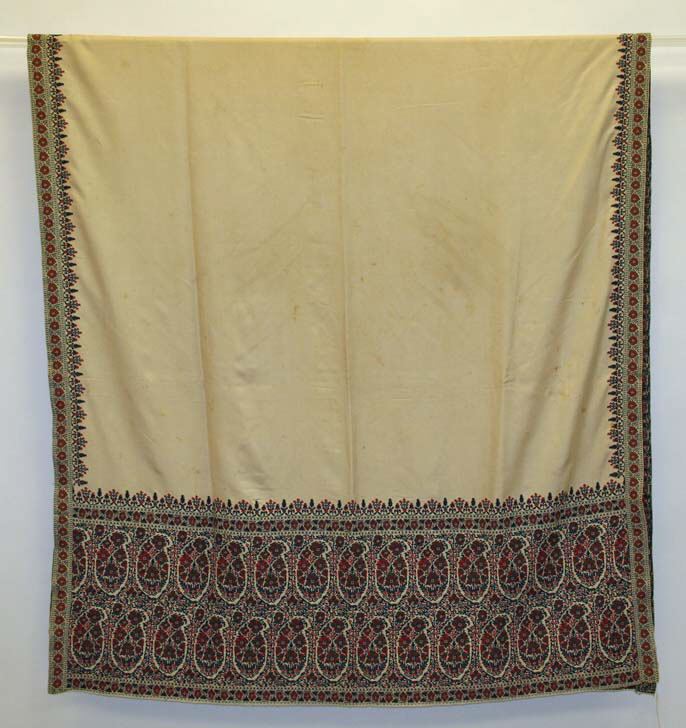
The cloth was fine goat-hair wool woven in a 2/2 twill tapestry weave, which the same entry calls "the equivalent of painting with colored weft threads." The Met's shawl of 1800 to 1810, catalogued as Indian and made of silk and wool, shows the early arrangement: a plain field with a deep end border of small cones.
How did the shawls reach Britain, and who copied them?
Men serving the East India Company brought shawls home from the subcontinent, V&A Dundee says. Because hand-weaving was slow, European weavers began imitating the cloth: in Edinburgh from 1767 by one count, in Norwich in the 1790s, and in Paisley from about 1808.
A paper on the Company civil servant Charles Trevelyan notes that shawls circulated as gifts among Company families from the later eighteenth century into the early Victorian era. Heriot-Watt University, which holds over 100 Paisley shawls and fragments, says Edinburgh weavers began copying Kashmir shawls in 1767, and that by 1810 more than 100 of them were at it. Norwich's industry is dated to the 1790s. Those are the same years in which London subscribers began receiving a monthly set of hand-colored plates of the newest dress; see A Fashion Magazine by Subscription, 1794.
The Jacquard loom changed the economics of copying. The Met's catalogue text says it was invented in 1801 and first used in Paisley in the 1820s. Heriot-Watt dates its arrival earlier, and a Rijksmuseum record gives a different start for Edinburgh. The sources do not agree.
| Question | One account | Another account |
|---|---|---|
| First Edinburgh copies of Kashmir shawls | 1767 (Heriot-Watt University) | 1790, by two weavers (Rijksmuseum record, via Europeana) |
| Jacquard looms in Paisley | 1808 (Heriot-Watt University) | 1820s (The Met) |
What does a design drawing from 1823 show?
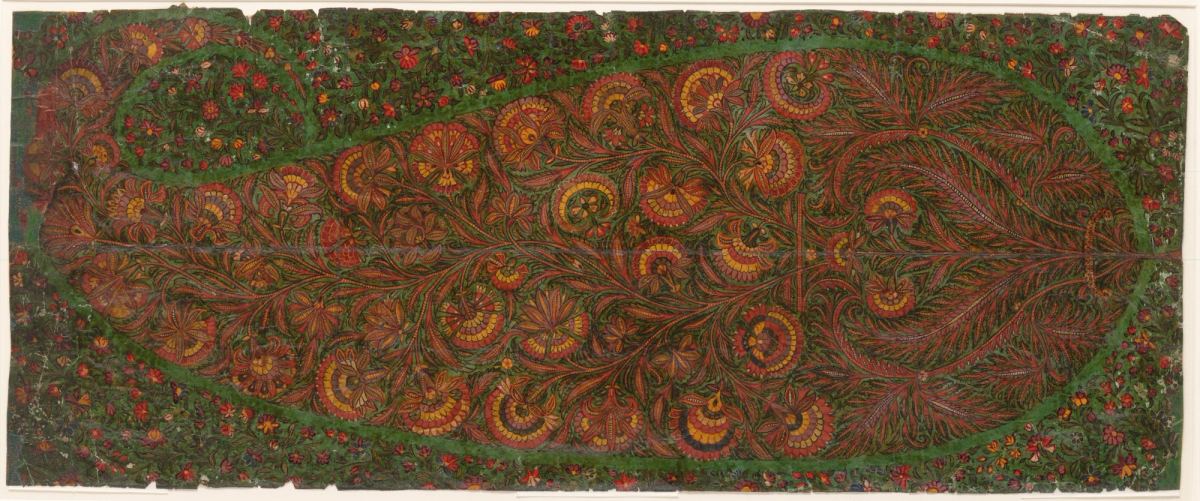
It shows the motif in transit. The Met's drawing, ca. 1822-23, is one of eight surviving designs made in Kashmir and sent to England in 1823 by William Moorcroft for the shawl industry. They are all that remains of 34 drawings. Each centers on one large cone, here outlined in green and packed with small flowers.
The drawing is the lead image above. Its title, "Motif from Kashmir Shawl: Pheerozee (Turquoise Color), No. 23, By Order of Mahummud Azeem Khan," names a color and a person for whom a shawl was made. In England, the Met's catalogue entry says, a drawing like this would have been translated onto graph paper to make a mise-en-carte, the squared guide a weaver followed.
Moorcroft, an Englishman who lived from 1767 to 1825, was in Srinagar in the winter of 1822 to 1823 on behalf of the East India Company, Kashmir Life reports, and copied shawl designs to send to contacts in England. So the pattern traveled two ways: as finished shawls for sale, and as drawings made to be copied.
Where can you see it?
Several museums put their shawl records online, and the Met and Cleveland records below are open access. The Met holds the 1823 drawing and an Indian shawl of 1800 to 1810. Cleveland catalogues Kashmir shawls from about 1785 to 1870. Heriot-Watt University holds more than 100 Paisley shawls and fragments. Check display status before you travel.
- The Met: Motif from Kashmir Shawl, ca. 1822-23 (62.600.235(8); the Met lists it as not on view) and Shawl, 1800-1810 (1975.348.3).
- Cleveland Museum of Art: Apricot Long Shawl, 1785-1800, Shawl with boteh, 1820-1830 and Square Shawl, c. 1850-70.
- Heriot-Watt University textile collection: Paisley shawls.
Sources
- Motif from Kashmir Shawl: Pheerozee (Turquoise Color), No. 23, By Order of Mahummud Azeem Khan, ca. 1822–23, 62.600.235(8). The Metropolitan Museum of Art. Object data (API); Moorcroft 1823 designs, 8 of 34; mise-en-carte Accessed October 14, 2026.
- Shawl, 1800–1810, 1975.348.3. The Metropolitan Museum of Art. Object data (API): Indian, silk and wool, public domain Accessed October 14, 2026.
- Shawl with boteh, 1820–1830 (1952.190). Cleveland Museum of Art. Open Access record: Paisley term; twill tapestry; status symbols Accessed October 14, 2026.
- Apricot Long Shawl, 1785–1800 (2008.215). Cleveland Museum of Art. Open Access record: evolution of the boteh; 2/2 twill tapestry Accessed October 14, 2026.
- Square Shawl, c. 1850–70 (1940.600). Cleveland Museum of Art. Open Access record: cypress-tree reading of the motif Accessed October 14, 2026.
- What's in a Name? The Paisley Pattern in Kashmir Shawls. RISD Museum. Origin theories; three years per shawl; how the name spread; 1870s decline Accessed October 14, 2026.
- Edinburgh was weaving Paisley shawls 40 years before Paisley. Heriot-Watt University. Edinburgh copies from 1767; Paisley from 1808; over 100 weavers by 1810 Accessed October 14, 2026.
- Paisley shawls (textile collection). Heriot-Watt University. Collection of Paisley shawls; Jacquard looms in Paisley in 1808 Accessed October 14, 2026.
- Norwich shawls. Costume & Textile Association (Norfolk Museums Service). Norwich shawls from the 1790s; decline in the 1870s and bustle skirts Accessed October 14, 2026.
- A long way from home: the Paisley pattern and India. V&A Dundee. East India Company men bringing shawls home Accessed October 14, 2026.
- Finn, M., Corruption and the East India Company (TRHS 2019). UCL Discovery. Shawls as gifts in Company families, later 18th to early Victorian era Accessed October 14, 2026.
- Shawl, 1830–50 (Costume Institute catalogue text). The Metropolitan Museum of Art. Jacquard loom invented 1801; first used in Paisley in the 1820s Accessed October 14, 2026.
- Moorcroft's Kashmir days. Kashmir Life. Moorcroft in Srinagar winter 1822–23 for the East India Company, copying shawl designs Accessed October 14, 2026.
- Rijksmuseum record BK-1963-52 (via Europeana). Rijksmuseum / Europeana. Gives 1790 for the first convincing Edinburgh copy Accessed October 14, 2026.
Glossary
Last updated · Markdown · Report an error