Dress
Black, and Not Just Black: Victorian Mourning Dress
Crape, a dull, crinkled silk gauze, was only the first word in a grammar of fabric, trim and time that told strangers who you had lost and how long ago. How the system worked, what it cost, and why it faded.
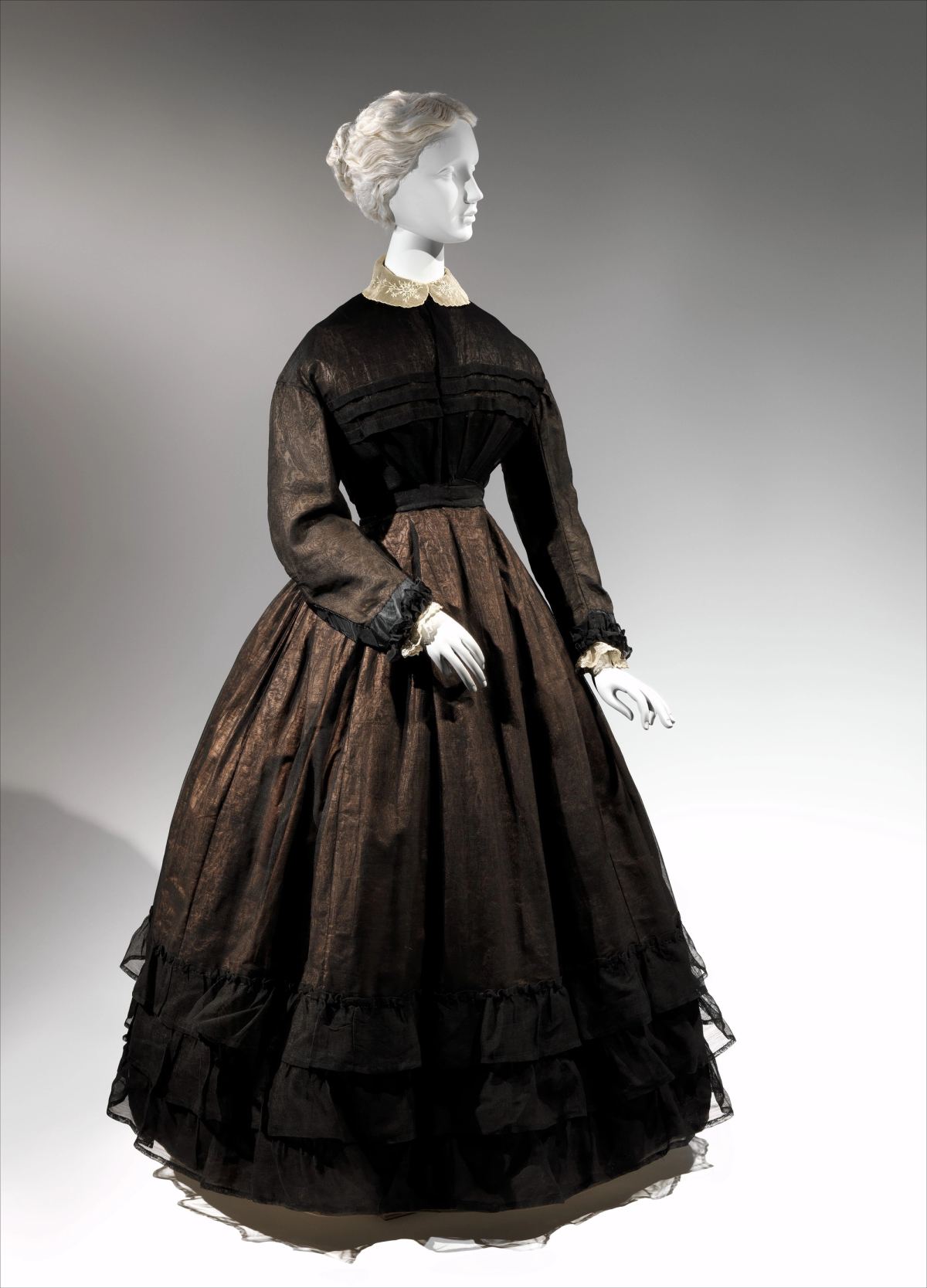
Victorians wore black crape because mourning was a visible code, and crape, a dull, crinkled silk gauze, was the cloth of its first and deepest stage. Over the following months the wearer moved through plainer silks, white collars and finally gray and violet, so a stranger's veil told you how recent the loss was and how close.
What is crape, and how was it made?
Crape is a light, transparent gauze of raw silk that was gummed and twisted before weaving, with a crisped, crinkled surface. An American encyclopedia printed in 1858 calls it “much used in mourning.” The crinkle came from how hard the threads were twisted.
The same entry gives the recipe in outline. The silk was twisted on the mill, and the degree of twist, especially in the warp, the lengthwise threads, produced the crisping. Taken from the loom, the cloth was steeped in clear water and rubbed with a piece of wax. Smooth crape simply took less twist. It came originally from Bologna, had been made chiefly at Lyons, and was now made in various parts of Great Britain (Encyclopædia Americana, vol. 4, Boston, 1858).
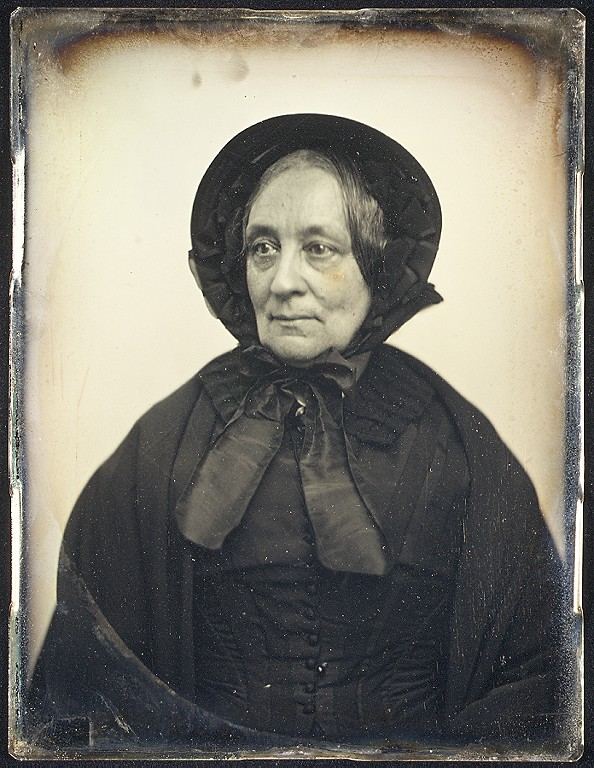
A daguerreotype cannot show texture. The Met's catalog title for this one, made by the American studio Southworth & Hawes around 1850, names “mourning crape” on the woman's black cape and bonnet. What the plate does show is the silhouette: a plain bonnet tied under the chin, a cape, no ornament but a bow (The Met, 37.14.17).
Why was crape expensive, and why did people complain about it?
Crape was all silk, and silk got dearer. A report on the 1867 Paris Exposition quotes an estimate that silkworm disease pushed the price of Chinese and Indian raw silk up by 80 to 100 percent. Advice writers warned against saving money, and critics called mourning a burden on the bereaved and a hazard to health.
The report, by Paran Stevens and published by the U.S. Government Printing Office in 1870, quotes Professor Leone Levi: the disease set buyers competing for Chinese and Indian raw silk, “causing a rise of from eighty to one hundred per cent” (Report on Clothing and Woven Fabrics). The same year, S. Annie Frost's etiquette manual told readers to buy only the best mourning goods, because “poor crapes or woolens in black, wear miserably” (The Art of Dressing Well). For the poor the bill was harder to meet. Helen Gilbert Ecob, a writer on dress and health, wrote in 1892: “The poor widow often takes her last dollar for mourning garments even when her children are crying for bread and shoes” (The Well-Dressed Woman).
The health complaints were specific. Ecob claimed that crape's “poisonous dyes” injured the wearer. A compilation of 1878 called the thick crape veil “prejudicial to health” (Sensible Etiquette of the Best Society). An 1895 manual reported that oculists were beginning to forbid the black veil as an injury to the eye, and that it rubbed the forehead and nose into sores (Our Social Customs).
There was a social complaint too. The 1895 manual quotes a writer who mocks the widow who wears “the badge of widowhood for exactly two years to a day” while already engaged to someone else. An anonymous London manual of 1859 has the older, crueler version: a widow receiving a condolence visit “in her best crape” weeps into her handkerchief, then says, “I am sure you will be glad to hear that Mr. B has left me most comfortably provided for” (The Habits of Good Society). It is an anecdote, not evidence.
How did the stages of mourning work?
Mourning ran in stages, each lighter than the last. Deep mourning meant dull black wool, crape collar and cuffs, and a long crape veil. Second mourning moved to black silk trimmed with crape. Later stages, ending in half-mourning, admitted white, gray, violet and lace, and crape was dropped. A widow was expected to pass through all of them over about two years.
Frost's 1870 manual, which also reprints rules from a Paris etiquette book, is the clearest single account, and the table follows it.
| Stage | Fabric | Trim and accessories | Widow's timing |
|---|---|---|---|
| Deep mourning | Black only: imperial serge, bombazine, delaine, barège, merino; no lustrous alpaca | Plain crape collar and cuffs; folds of crape the only trim; crape bonnet; long, thick crape veil; white tarlatan widow's cap; jet the only ornament | First year |
| Second mourning | Black silk trimmed with crape; lustrous alpaca now allowed | White linen collar and cuffs (black lace for a widow); net or tulle veil, or a shorter crape veil; jewelry of jet alone | Second year |
| Lighter mourning | Black and white, solid purple or gray; foulards | Black silk or straw bonnet with crape and ribbon; a few crape flowers | Not given separately |
| Half-mourning | Light grays, white with black trimming, lilac | Crape dropped; black lace bonnet with white or violet flowers; lace collars; jet set in gold | Last six months |
Outer layers mattered as much as the dress. Frost recommends a long black cashmere shawl or a square barège one with a broad crape border, and a bonnet of plain black crape. John H. Young's Our Deportment (1879), which repeats much of Frost's wording, adds that a hat is “inadmissible” (Our Deportment).
How long did you mourn, and for whom?
It depended on the relationship, and on whom you asked. Rules from Paris, quoted in an 1870 American manual, give a widow two years and a parent one. An 1878 compilation gives French widows a year and six weeks, and Americans two years. The pattern held everywhere: the closer the relative, the longer and deeper the black.
| Mourned | Paris rules quoted by Frost, 1870 | France, per Bloomfield-Moore, 1878 | United States, per Bloomfield-Moore, 1878 |
|---|---|---|---|
| Husband | 2 years, sometimes longer | 1 year 6 weeks: 6 months deep, 6 ordinary, 6 weeks half | 2 years: 1 deep, 1 light |
| Wife | Not given | 6 months: 3 deep, 3 half | 2 years: 1 deep, 1 light |
| Father or mother | 1 year | 6 months: 3 deep, 3 half | 1 to 2 years |
| Grandparent | 6 months | 2½ months, slight mourning | Not given |
| Brother or sister | 6 months | 2 months, 1 of them deep | 1 year (adult siblings) |
| Uncle or aunt | 3 months | 3 weeks, ordinary mourning | Not given |
The sources do not agree, and they say so themselves. Frost admits that “there is really no rule, either for the closeness of the dress or for the length of time it may be worn.” The 1878 compilation claims Americans are the only people with no prescribed periods at all. Its French figures are echoed by the 1895 manual, which gives a French widow 58 weeks, the same year and six weeks, while Frost's Paris source gives two years.
Seclusion came with the clothes. According to the 1895 manual, someone in deep mourning neither went into society nor paid and received visits; concerts were allowed after three months, the theater after six. Even the paper was graded: a manual of 1913 prescribes a black border three-eighths of an inch wide on stationery for a close relative, and half that for a more distant one (The Etiquette of To-day).
What changed after Queen Victoria's widowhood?
Prince Albert died on December 14, 1861. According to Sarah Tooley's 1897 biography, Victoria had worn nothing but mourning colors in all the years of her widowhood, and her servants wore crape armbands for at least eight years. Whether she set the national fashion is harder to show: etiquette books of the 1870s describe English mourning as shorter and plainer.
Tooley dates the death to “the fatal 14th of December,” a 1901 life of the Queen by Thomas Handford gives “the evening of the 14th of December, 1861,” and the Wikidata record for Prince Albert agrees. Tooley says the Queen “has never, throughout the succeeding years of her widowhood, worn any but mourning colours,” and that she was “a little behind the spirit of the times” in her views on mourning, favoring absolute retirement for the bereaved and the heaviest outward signs (The Personal Life of Queen Victoria). Handford and Wikidata both give Queen Victoria's death as January 22, 1901. Handford adds a telling detail from the Diamond Jubilee procession of 1897: the postilions of her carriage rode “for the first time since the Prince Consort's death” without “bands of mourning on their arms” (Queen Victoria, Her Glorious Life and Illustrious Reign).
The manuals tell a different story about ordinary people. In 1878 Clara Bloomfield-Moore wrote that “formerly, mourning was worn in England both for a longer period and of a much deeper character than is usual at the present time,” and that two years for a parent had become one. She reports an English fashion for plain black “without using the materials which are confined to mourning dress,” and says the stages were “less observed everywhere, outside of courts, than formerly.” Courts, where dress was already codified, as in the British court train of 1850, were the exception.
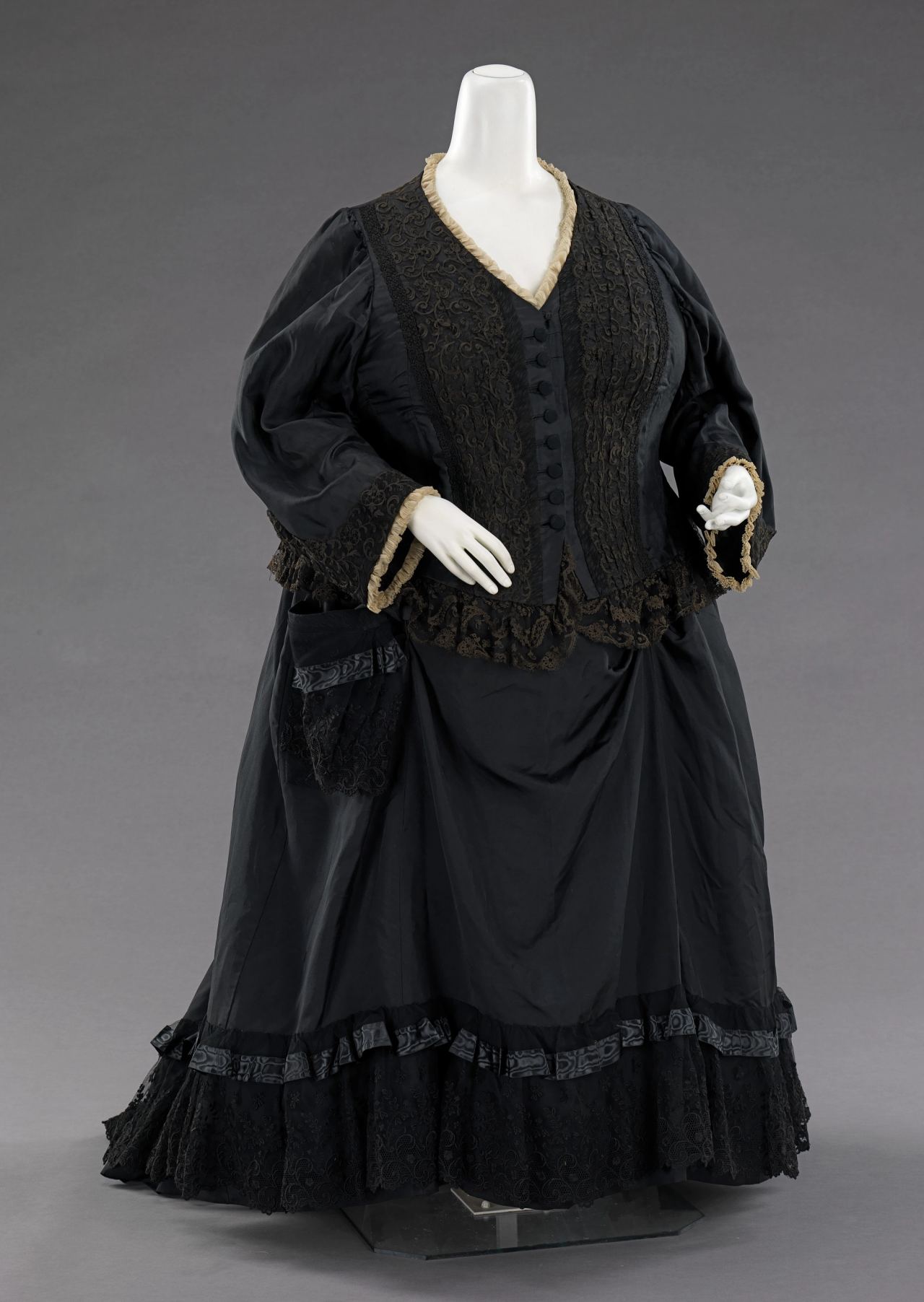
The Met's British mourning dress of 1894, from the decade before the Queen's death, is black silk with black lace and ribbon bands and a narrow cream ruche at the neck and cuffs (The Met, 2009.300.1157a, b).
Did men, children and servants wear mourning too?
Men wore the least: a band of crape on the hat, deeper for a closer loss, and a widower's as wide as the hat itself. Women carried the full wardrobe. Children were increasingly kept out of black, servants were no longer expected to wear it by 1895, and the burden fell hardest on widows with little money.
Frost's rule is that a widower wears a band “the width of his hat,” and she complains that wearing only the hatband is “making a farce of mourning.” By 1913 the band sewn onto the coat sleeve was “a discredited form of mourning” whose only virtue was cheapness; by 1924 another manual says it was worn by “many men who are supposed to know what is correct” (Standard Book of Etiquette).
Children's black was already contested. Frost prescribes white in summer and gray in winter, with black trimmings, for those under twelve. The 1895 manual calls it neither good taste nor good sense to “trick children out in the habiliments of grief,” and says it is equally bad taste to put servants into mourning, a custom that “might once have been honored.” The royal household, by Tooley's and Handford's accounts, had not got the message. The house itself was marked too: Young's 1879 manual has the bell knob draped with crape, tied with a black ribbon if the dead were married or old and a white one if young or unmarried. By 1913 Edith Ordway preferred palm leaves or white flowers “to crape upon the door.”
Why was jet the jewelry of mourning?
Jet is a deep black material that can be turned on a lathe and polished to a high shine, found in England near Whitby. Etiquette let it in where other ornaments were barred: an 1870 manual allows jewelry of jet alone in the first stages of mourning, and jet set in gold as the black lightened.
The 1858 encyclopedia describes jet as a “pure and deep black,” hard enough to be “turned on a lathe and highly polished,” cut for ornaments, buttons and bracelets, and considered by some mineralogists intermediate between coal and bituminous wood (Encyclopædia Americana, vol. 7, Boston, 1858). In the deepest mourning, Frost allows no ornaments “excepting those worn to fasten the collar, cuffs, or belt,” and these “must be of jet.” But the Paris rules she reprints forbid jet trimmings in deep mourning, and any jewelry in the first month. The manuals disagreed about where the line was.
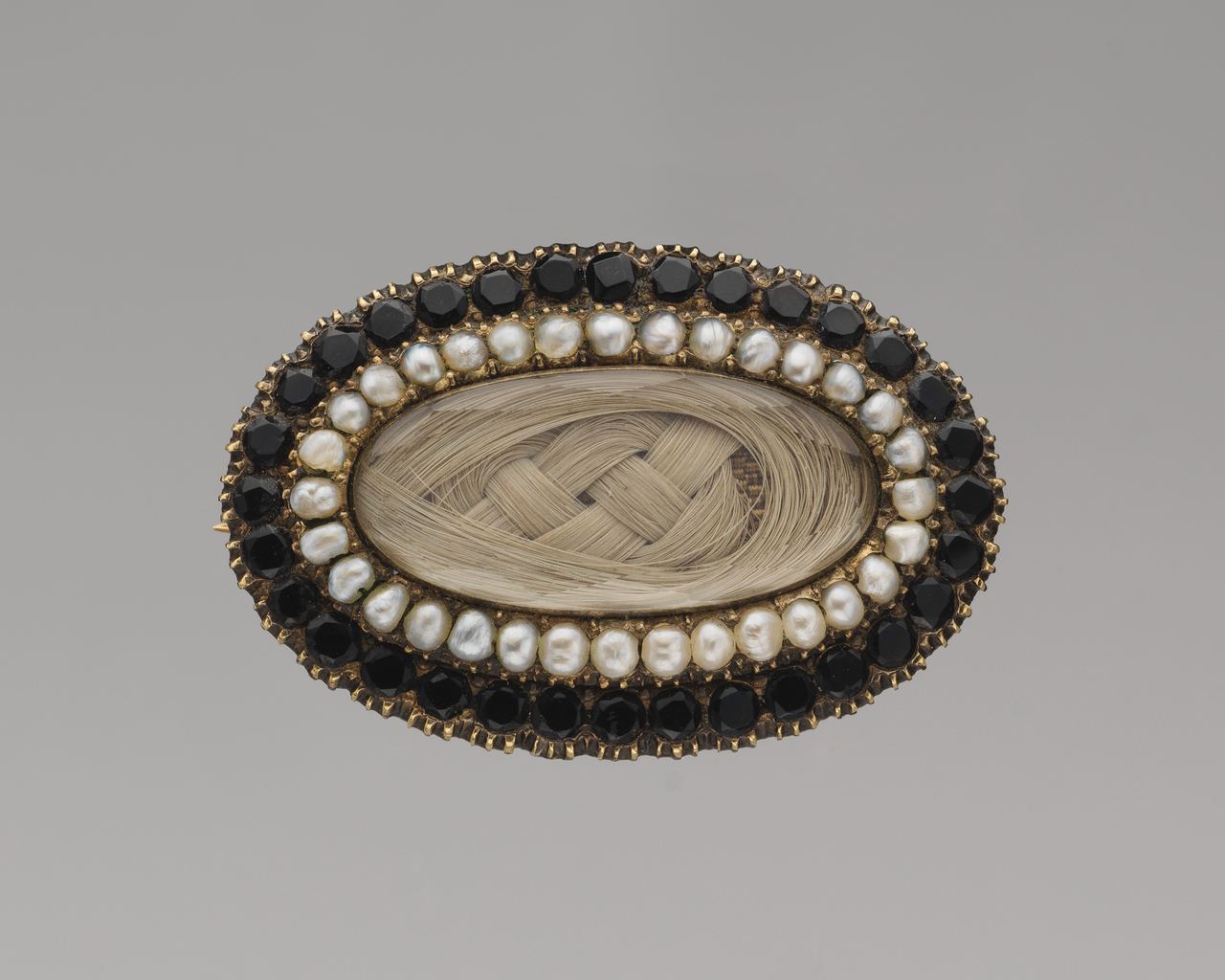
Hair was the other mourning material. Frank Alvah Parsons, writing in 1920, notes that mourning jewelry showing a design made from the hair of the deceased, often with black enamel, was fashionable in eighteenth-century colonial America (The Psychology of Dress). The Met's American brooch of about 1850 belongs to that family. Its record lists gold, jet, pearls, crystal and hair: a braid under glass, framed by pearls and black stones (The Met, 2000.557).
Why did mourning dress fade?
By the 1910s American manuals described shorter, lighter mourning. In 1913 the widow's veil was “of moderate length” and not very thick; in 1924 one manual notes “less deep mourning worn than formerly” and some families asking for no outward signs at all. The sources describe a loosening of custom, and do not give a single cause.
Ordway's 1913 manual says black dresses trimmed with crape were still worn for the first months, but that mourning had been “much modified by the good sense of the people,” especially in England. Renée Stern's Standard Book of Etiquette (1924) says that “customs vary,” that some of the dead asked that no outward signs be shown for them, and that the family then wore dull black or dark colors and, in summer, white. The word crape appears in her book once, for the door.
The First World War falls between these two books. Stern's mourning section does not mention it, and no source consulted for this piece ties the change to it. What the sources do show is an argument that began much earlier: Frost on stained skin in 1870, Ecob on cost and health in 1892, the 1895 manual on oculists. The crape veil had lost that argument long before the code that required it was gone.
Where can you see Victorian mourning dress, and what should you read?
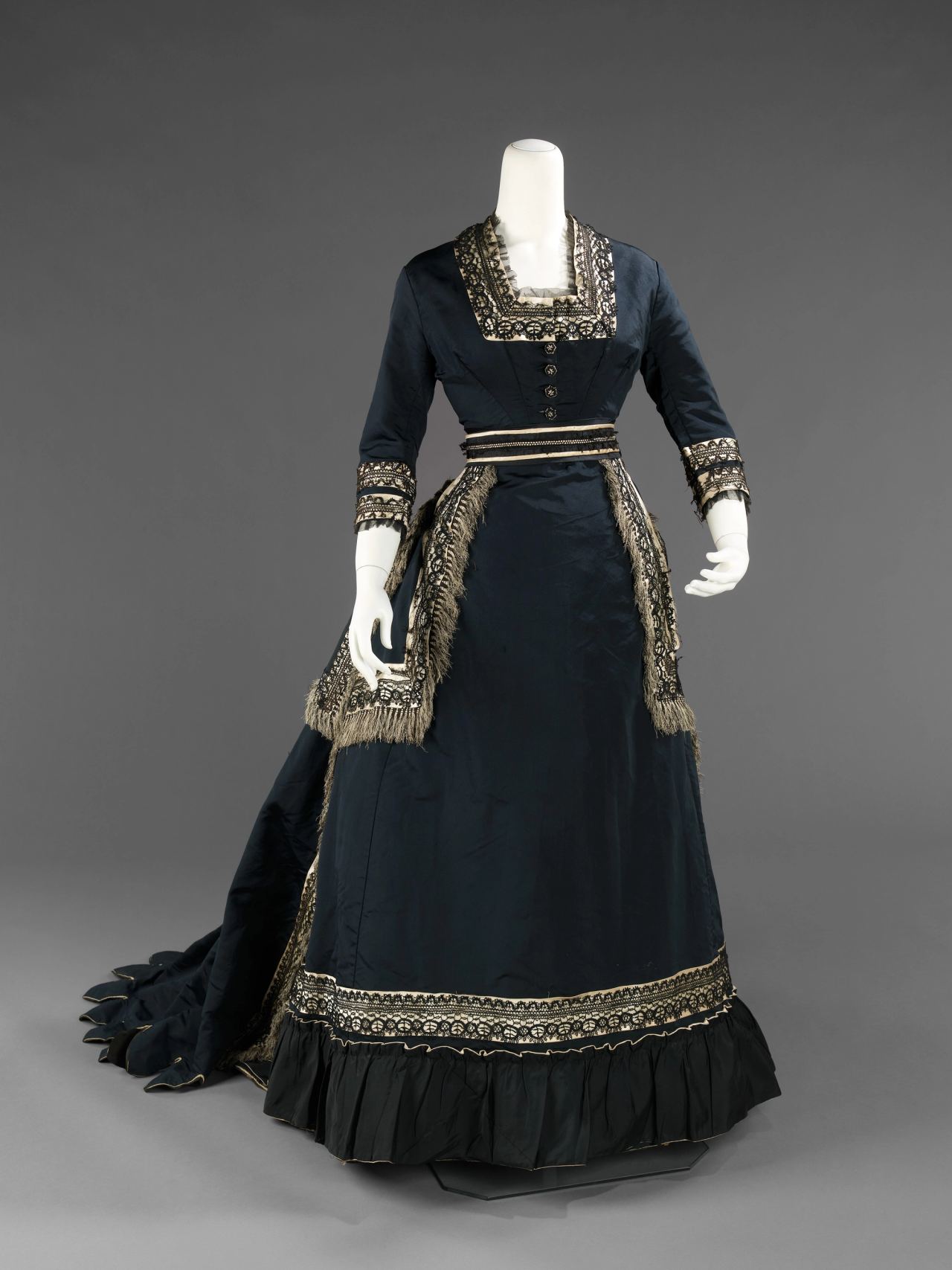
The Metropolitan Museum of Art has well over a hundred open-access mourning garments and accessories in its Costume Institute collection, including the three dresses pictured here. The period books quoted here are free to read in full at the Library of Congress.
- The Met: mourning dress, American, ca. 1867; mourning dress, American, 1872–74; mourning dress, British, 1894; mourning dress, American, ca. 1883 (silk and jet); mourning poke bonnet, American, ca. 1840.
- S. Annie Frost, *The Art of Dressing Well* (1870), for the stages fabric by fabric.
- Clara Bloomfield-Moore, *Sensible Etiquette of the Best Society* (1878), for French, English and American practice compared.
- Charles F. Beezley, *Our Social Customs* (1895), for periods, seclusion and the case against the veil.
- Sarah A. Tooley, *The Personal Life of Queen Victoria* (1897).
- The standard scholarly history is Lou Taylor, Mourning Dress: A Costume and Social History (George Allen and Unwin, 1983).
Sources
- The Art of Dressing Well (1870), S. Annie Frost. Library of Congress (digitized book). Mourning chapter: stages, fabrics, crape, jet, durations (Paris rules), men, children; stain remedy; buy-the-best advice Accessed October 14, 2026.
- Sensible Etiquette of the Best Society (1878), Clara Sophia Bloomfield-Moore. Library of Congress (digitized book). French vs US periods; deep/second/half/complimentary mourning; English change; crape veil and health Accessed October 14, 2026.
- Our Social Customs (1895), Charles F. Beezley. Library of Congress (digitized book). Periods; 58 weeks (France); seclusion; men, children, servants; veil and oculists; 'two years to a day' Accessed October 14, 2026.
- Our Deportment (1879), John H. Young. Library of Congress (digitized book). Repeats Frost's stages (not independent); jet pins and buckles; crape on door; 'a hat is inadmissible' Accessed October 14, 2026.
- The Etiquette of To-day (1913), Edith B. Ordway. Library of Congress (digitized book). Shortened mourning; sleeve band; stationery borders; crape on door; children 15 and under Accessed October 14, 2026.
- Standard Book of Etiquette (1924), Renee B. Stern. Library of Congress (digitized book). Less deep mourning than formerly; no-outward-signs wishes; mourning band Accessed October 14, 2026.
- The Well-Dressed Woman (1892), Helen Gilbert Ecob. Library of Congress (digitized book). Critique of mourning: cost for poor widows, 'poisonous dyes' Accessed October 14, 2026.
- The Personal Life of Queen Victoria (1897), Sarah A. Tooley. Library of Congress (digitized book). Albert's death 14 Dec 1861; Queen in mourning colors through widowhood; crape armbands on servants at least eight years Accessed October 14, 2026.
- Queen Victoria, Her Glorious Life and Illustrious Reign (1901), Thomas W. Handford. Library of Congress (digitized book). Albert's death 14 Dec 1861; Victoria's death 22 Jan 1901; Diamond Jubilee postilions' mourning bands Accessed October 14, 2026.
- Encyclopaedia Americana, vol. 4 (CRA-EVE), Boston, 1858. Library of Congress (digitized book). 'Crape' entry: silk gauze, gummed and twisted, crisping by twist, water and wax; Bologna, Lyons, Britain Accessed October 14, 2026.
- Encyclopaedia Americana, vol. 7, Boston, 1858. Library of Congress (digitized book). 'Jet' entry: properties, Whitby, uses Accessed October 14, 2026.
- Report on Clothing and Woven Fabrics (1870), Paran Stevens. Library of Congress (digitized book). Quotes Leone Levi: raw silk price rise of 80 to 100 percent after silkworm disease Accessed October 14, 2026.
- The Habits of Good Society (1859), anonymous, London: J. Hogg and Sons. Library of Congress (digitized book). Anecdote of the widow 'in her best crape' (illustrative, not evidence) Accessed October 14, 2026.
- The Psychology of Dress (1920), Frank Alvah Parsons. Library of Congress (digitized book). Hair and black-enamel mourning jewelry in 18th-century colonial America Accessed October 14, 2026.
- Mourning dress, American, ca. 1867 (1982.256); 1872-74 (2009.300.673a, b); British, 1894 (2009.300.1157a, b); brooch ca. 1850 (2000.557); daguerreotype ca. 1850 (37.14.17). The Metropolitan Museum of Art (Open Access, CC0). Object data via Met Collection API v1 (dates, media, credit lines, isPublicDomain true) Accessed October 14, 2026.
- Wikidata: Prince Albert of Saxe-Coburg and Gotha (Q152245); Victoria (Q9439). Wikidata (CC0). Dates of death (second source with Tooley/Handford) Accessed October 14, 2026.
Glossary
Last updated · Markdown · Report an error