Technique
Cartridge Pleating: Yards of Cloth in a Waistband
What are cartridge pleats and how do you sew them? The rolled folds that set whole widths of silk into an 1840s waist, how the old manuals made them, and how to spot them in a museum.
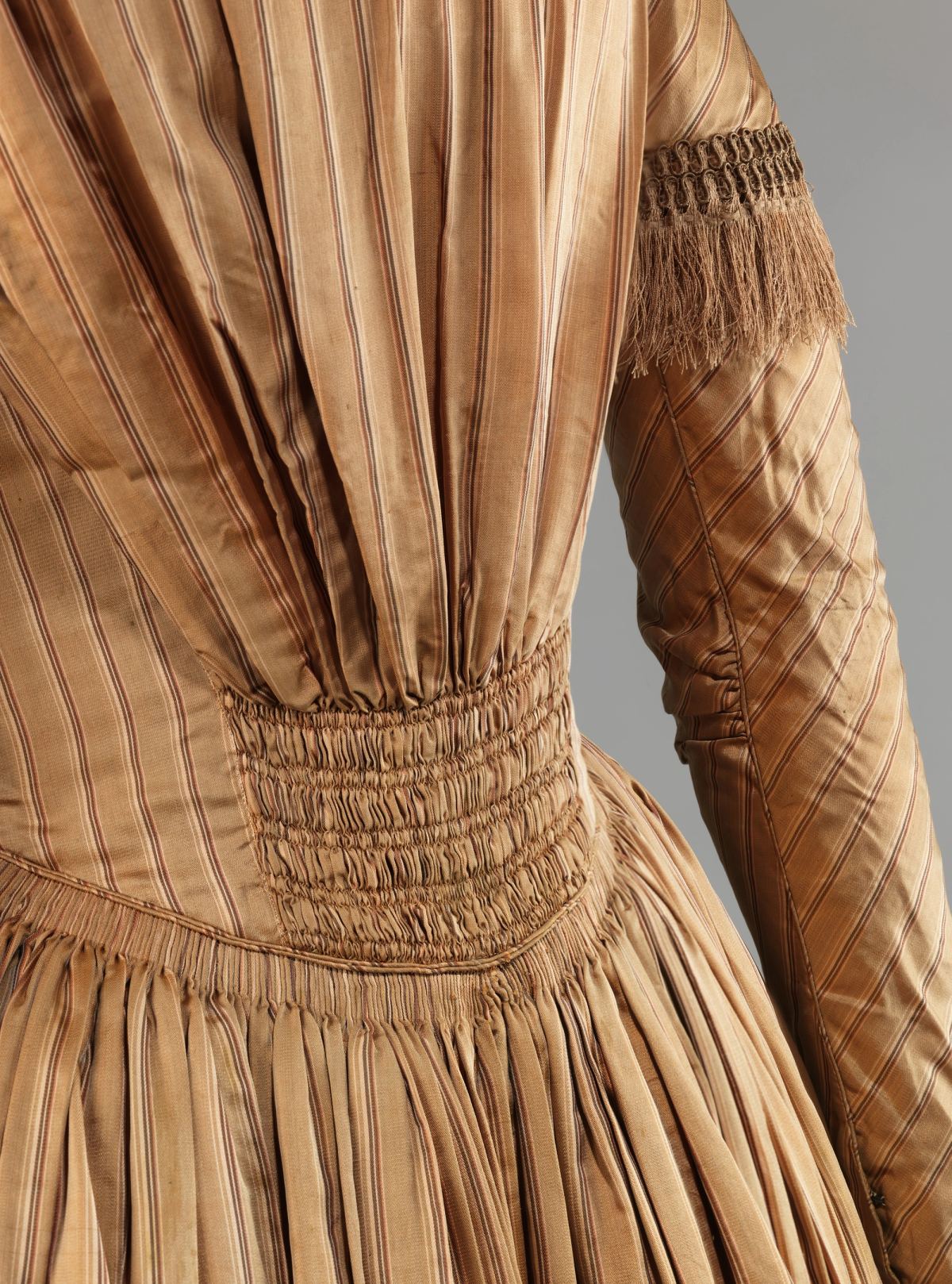
Cartridge pleats are small rounded folds of cloth sewn to a waistband or bodice only at the top of each fold, so several yards of fabric fit into a short seam and the skirt springs out from the body. To make them, finish the top edge, run two or more matching rows of gathering stitches, draw them up into even tubes and stitch each tube to the band.
What are cartridge pleats?
Cartridge pleats are narrow, rounded folds packed side by side along an edge and attached by their tops instead of being flattened into a seam. They let a long piece of cloth meet a short band without bulk. The Getty Art & Architecture Thesaurus describes them as small cylindrical pleats in a row, resembling a military cartridge belt, a likeness that explains the name.
Compare an ordinary pleat. A knife pleat or a box pleat is a fold laid flat, pressed and sewn through the seam with every layer it contains. A cartridge pleat is never pressed. It stays round, like a short tube standing on end, and the band is sewn only to the top edge of each tube. The cloth below is free to stand away from the body.
The Getty definition is written for the decorative use of the term, on costume and hangings. Dress curators use the same words for a structural join. The Victoria and Albert Museum's catalogue, for example, describes the skirt of an 1846 dress as "cartridge pleated into the waist" and 17th-century sleeves as cartridge-pleated at the top. That structural sense is the one this guide follows.
Why did dressmakers use cartridge pleats?
They solved a problem of straight cloth. A skirt cut without gores, the tapered panels that narrow it toward the top, is a tube of whole loom widths, or breadths, and all of that width has to meet the waist. Cartridge pleating set it into a narrow band neatly and let the folds stand away from the body.
Jeanette E. Davis, writing in The Elements of Modern Dressmaking (New York, 1894), looked back on the problem: when "straight (ungored) skirts were in vogue," six or seven breadths of material had to be "stocked" into the waist-belt. Museum records show what that meant in cloth. A printed wool dress of 1836–37 at the V&A has a skirt of four widths of 69.5 cm plus one of 38 cm, about 3.2 meters of cloth in all, with deep cartridge pleating on either side of the center back. A dress dated 1846, also at the V&A, has five widths of about 31 inches each, cartridge pleated into the waist. The museum records the same finish on a French moiré dress of 1844–46 and a black satin mourning dress of 1845–50.
The technique is older than the 1840s. The V&A catalogues a linen sleeve of 1650–75 whose top edge is cartridge-pleated and held with two lines of stitching and a narrow bias-cut strip, and an English bodice of the 1660s with short, full, cartridge-pleated sleeves. Makers who reconstruct 16th- and 17th-century dress use the method for skirts, breeches, petticoats and ruffs. Earlier dates are often given in costume histories, but the earliest examples we could check in a museum record ourselves are those 17th-century sleeves.
From the 1850s, the sources we read place it more and more at the back of the dress. The V&A describes a dress of about 1855 whose skirt is set on in unpressed box pleats everywhere except the back waist, where it is cartridge pleated. J. Henry Symonds's Guide to Dressmaking (Boston, 1876) says that formerly all dresses were gathered, "before the great plaits came in," and that many dresses were now "gauged at the back plait." Davis, in 1894, describes the same thing for the waists of skirts: "often the back-breadths only." Under those skirts, as Under the Dress shows, layered petticoats and the cage crinoline did the work of holding the shape out.
Cartridge pleats or gauging: what did makers call it?
In the 19th-century manuals we read, the word "cartridge" is never used for pleating. Makers called the work gathering or gauging (also spelled "gaging"). "Cartridge pleat" is the name curators and makers use now for the finished folds, while gauging names the rows of drawn-up stitches that make them.
The terms overlapped from the start. The Workwoman's Guide (London, 1838) treats "gaging" as an ornament for the fronts of children's dresses and the tops of cuffs: rows taken up at half-inch intervals, each row picking up the spaces the last one skipped. Its instructions for plain gathering already contain the method for setting fullness into a band: divide the cloth and the band into quarters with pins, draw up the thread, "stroke the gathers nicely down" with a large needle, and sew them on "one at a time."
The Dictionary of Needlework by Sophia Caulfeild and Blanche Saward (London; preface dated June 1882) defines gauging as a series of close parallel runnings drawn up so that the cloth between them sets full, and calls the American word "shirring" an "objectionable Americanism" for the same thing. It also describes the Heberling gauging machine, an American invention whose speed it puts at 2,500 stitches a minute. Today's Getty vocabulary keeps the distinction: gauging is gathering with duplicated rows of alternating short and long stitches to make even parallel folds. Davis, for her part, called smocking "really an ornamental outside strengthening of the smooth gathers"; our smocking guide shows how embroidery turns such rows into a stretchy panel, and shirring is the modern machine cousin.
How do you sew cartridge pleats, step by step?
Finish the top edge, mark evenly spaced stitch points in at least two parallel rows, run strong thread through them, draw the cloth up into tubes, match it to the band by quarters, and sew the top of every tube to the band's lower edge with two firm stitches. The table combines period manuals with two modern makers' guides.
| Step | What to do | Source |
|---|---|---|
| 1. Finish the edge | Hem, fold down or line the top edge. Pleating through a hem or lining makes the tubes stand out farther. | Reconstructing History |
| 2. Divide | Mark halves and quarters on the cloth and on the band with pins, so the fullness is shared evenly. | Workwoman's Guide (1838); Reconstructing History |
| 3. Mark the stitches | Mark dots at even spacing on the wrong side; a second row about 1/4 inch below, exactly matching. A paper strip held under the thumb keeps rows parallel. | Reconstructing History; Dictionary of Needlework |
| 4. Run the threads | Work two or more rows of running stitch, longer on the face than behind, each row taking up the same threads as the row above. Use strong, waxed thread. | Davis (1894); Symonds (1876) |
| 5. Draw up | Pull the rows up together, wind the ends round a pin, and stroke each fold into place with a large needle. Adjust each quarter to its quarter of the band. | Workwoman's Guide (1838) |
| 6. Attach | Place the right sides of band and skirt together and sew the top edge of each fold to the bottom edge of the band, at least two firm stitches per fold. | Davis (1894) |
| 7. Secure | On a heavy skirt, add one or two rows of slip-stitches about an inch below the gauging. The gathering threads can stay in. | Symonds (1876); Reconstructing History |
Davis ties the size of the stitch to the amount of cloth being set into the space. She gives "take two, miss four" threads as the rule for gathering, and for large gathers at the back of a skirt a stitch "the length of the needle on the face and a quarter of an inch behind." The Reconstructing History guide puts the same idea in modern terms: space the marks as far apart as the pleats are to be deep. Symonds adds that skirt gauging is sewn in "fold by fold," and that silk is better than cotton for the sewing.
Modern makers vary the details rather than the principle. The Reconstructing History guide stitches each pleat twice by working from both ends of the band toward the middle; Tammie Dupuis of Renaissance Tailor runs two needles side by side in thick fabric and tacks each pleat with two small stitches.
How much fabric do cartridge pleats take?
As much as you choose to fold. Each pleat swallows twice its depth in cloth, so the amount depends on how deep the tubes are and how many fit in an inch. Makers work it out from a test strip; the numbers below are starting points, not rules.
The Reconstructing History guide asks you to pleat a 6- to 12-inch sample in your fabric, count the pleats per inch, and then calculate: pleat depth × 2 × pleats per inch × finished measurement = inches of fabric. Its worked example is a ruff with 2-inch pleats, five to the inch, on a 13-inch neck: 260 inches, or about 7 1/4 yards.
For skirts, Renaissance Tailor puts period skirts at about 75 to 120 inches of fabric and spaces the stitches from the arithmetic: subtract the waist from the skirt width, divide by the waist, and, since that is a lot, halve the result. A 120-inch skirt on a 28-inch waist gives stitches about 1 1/2 inches apart. Surviving dresses can be fuller still: the V&A's 1846 dress has about 155 inches of fabric in its skirt. Whatever the cloth, sample before cutting.
How is it different from gathers, knife pleats and box pleats?
Gathers are drawn up on a thread and sewn through; knife and box pleats are folded flat and sewn through. Cartridge pleats are drawn up like gathers but kept round and sewn only at their tops. Gauging is the multi-row stitching itself, used either as ornament or to prepare cartridge pleats.
| Method | How the folds are made | How they meet the seam | What you see | Where our sources place it |
|---|---|---|---|---|
| Cartridge pleats | Two or more matching rows of running stitch, drawn up into round tubes | Top of each fold sewn to the band's edge | Even tubes standing out from the seam | Skirt waists of the 1830s–50s; sleeve heads of the 1650s–60s |
| Gathers | One running thread drawn up | Sewn through in the seam, or each gather stitched on in turn | Soft, uneven fullness | Frills, flounces, bodice fronts, sleeves |
| Knife pleats | Narrow folds pressed flat, all turned one way | Stitched flat through the seam | Sharp, flat folds in one direction | Getty definition only; none of the garments here |
| Box pleats | Double folds turned under at each side | Stitched flat through the seam | Flat panels separated by folds | Skirt fronts of about 1855, with cartridge pleats at the back |
| Gauging | Several parallel rows of running stitch drawn up together | Often left as a panel; may also set fullness into a band | Rows of tiny parallel folds | Bodice fronts, cuffs, sleeve heads, children's dresses, bonnets |
You may also meet "organ pleats," used for large rounded folds that look like organ pipes. We found no museum or period definition we could open and check, so the term is not in the table.
How can you recognize cartridge pleats on a museum garment?
Look at the seam where a full skirt or sleeve meets the band. If the cloth stands out in round, evenly sized tubes and the band is caught only to their tops, with no flat stack of folds inside the seam, you are looking at cartridge pleating or something very close to it.
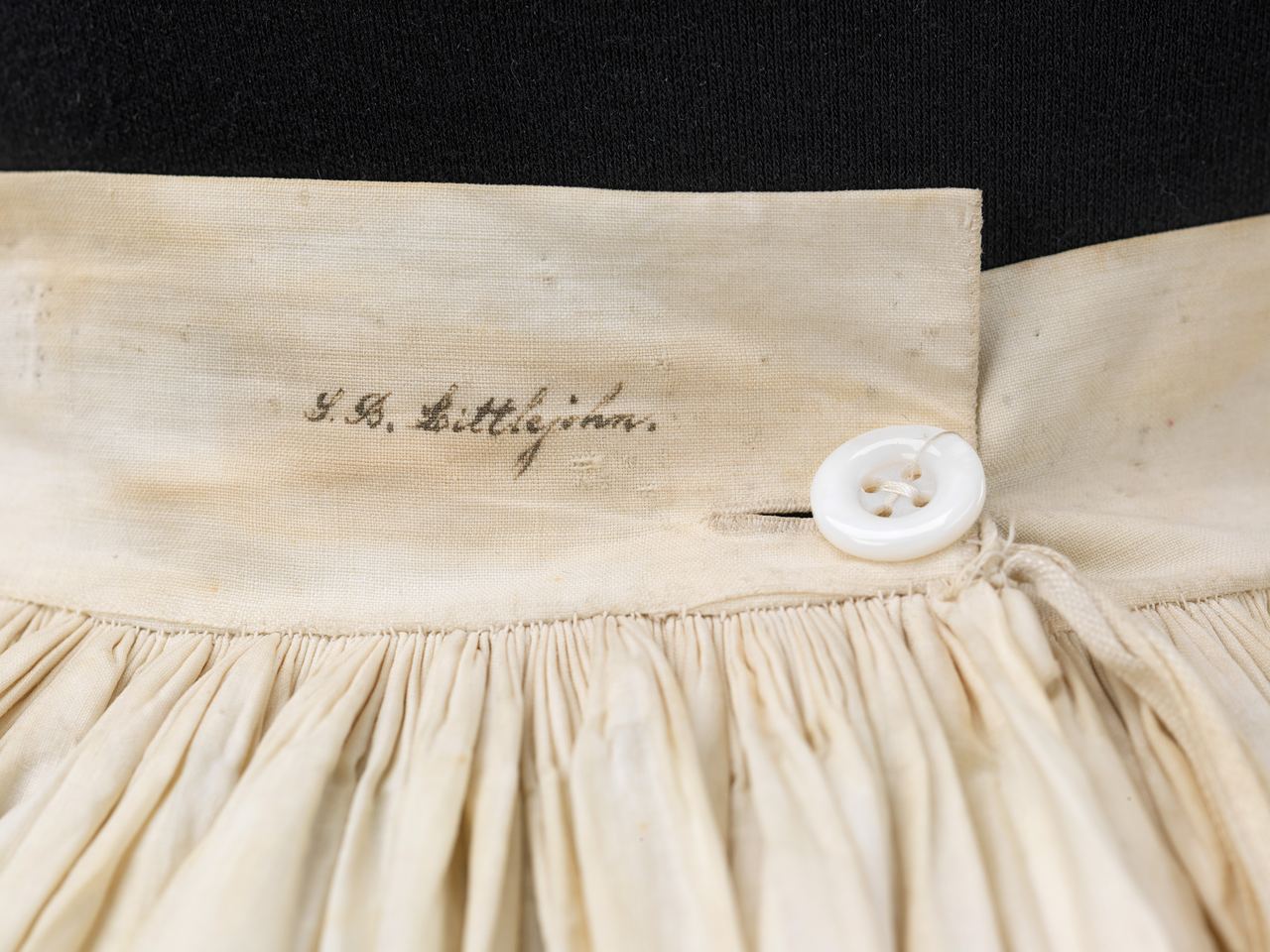
Four clues help. First, shape: the folds are rounded and regular, not pressed flat. Second, stitching: look for one small stitch, or two, at the top of each fold, as on the petticoat waistband below. Third, position: it often appears only across the back, especially from the 1850s, with flat pleats in front. Fourth, the catalogue: the V&A writes both "cartridge pleated" and "gathered at the waist with cartridge pleats," and older manuals say "gauged," so search all three words. For how a construction detail like this fits with zippers, seams and labels when you date a garment, see How to Date a Garment from Its Construction.
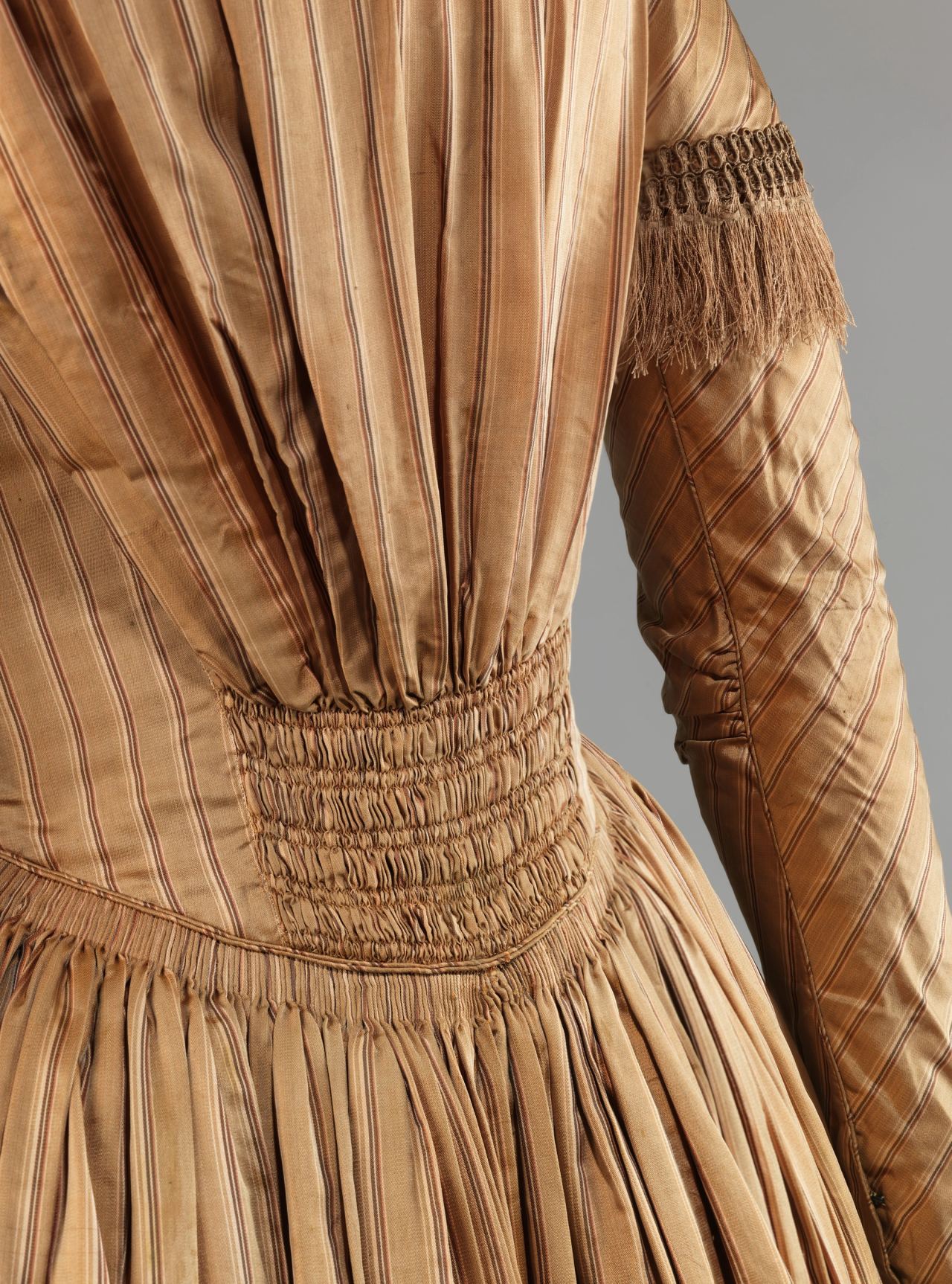
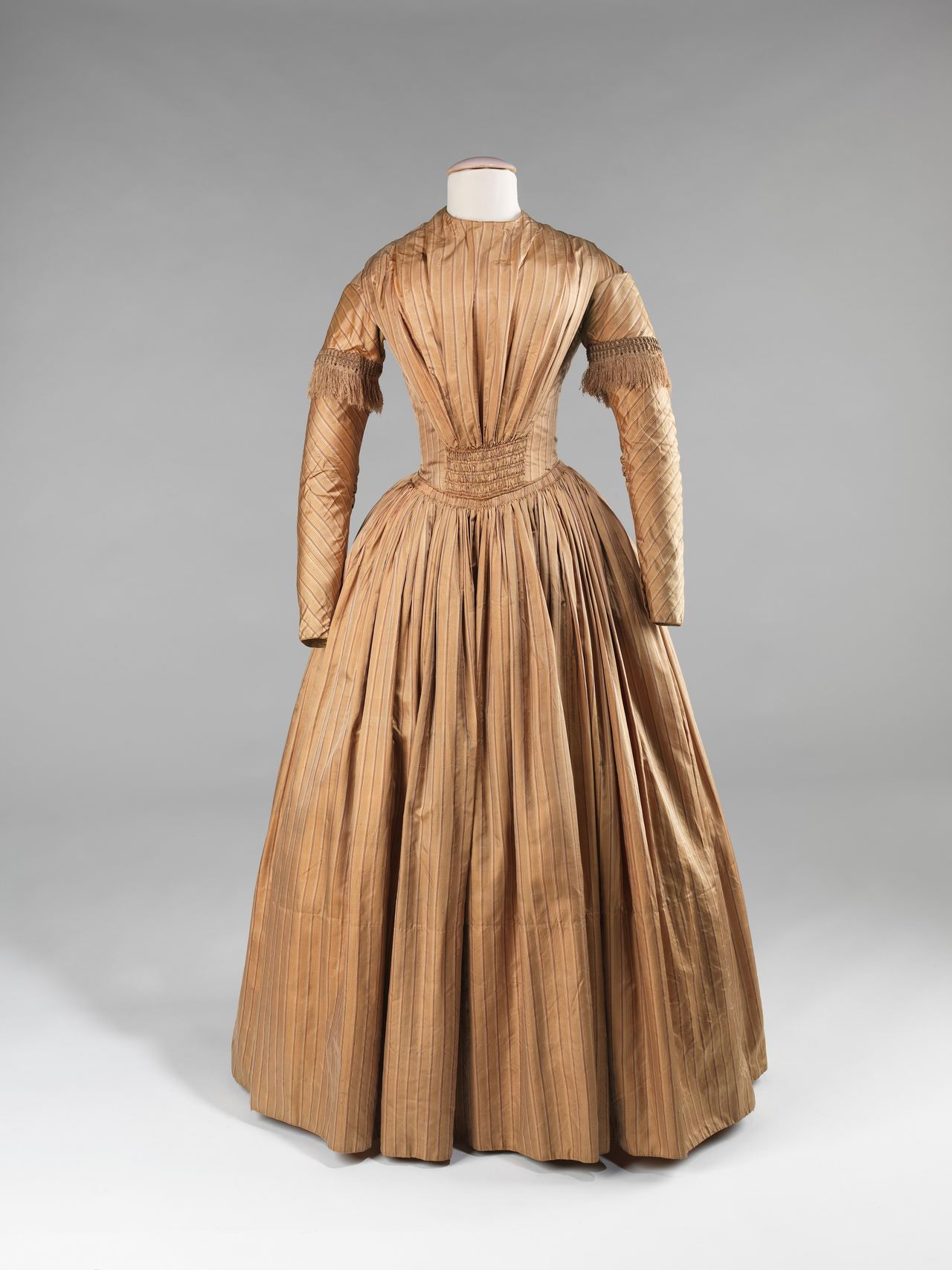
The Met's afternoon dress of about 1845, shown at the top, has the whole vocabulary in a few inches: a bodice front drawn into what look like horizontal rows of gauging, a piped waist seam, and below it a skirt set in tight rounded folds that open into deep ones toward the hem. In the photograph, the narrow upright folds just under the piping are what a cartridge-pleated waist looks like from outside.
Where can you see cartridge pleats?
Online, the Metropolitan Museum's afternoon dress of about 1845 and its petticoat of 1855–65 are open-access and photographed in detail. The V&A's online records of 1830s–1850s dresses and 17th-century sleeves describe the finish precisely.
In Paris, the Palais Galliera's exhibition "En volume ! Donner corps à la mode" runs from 12 December 2026 to 17 October 2027. The museum describes more than 300 works on how cutting and shaping build a silhouette, from the 17th century to now, including a Second Empire crinoline dress. It has not said whether cartridge-pleated skirts are among them, but any full skirt of the 1840s or 1850s in the show deserves a close look at the waist.
For the old instructions in full, the 1838 Workwoman's Guide, Symonds's 1876 Guide to Dressmaking, Caulfeild and Saward's Dictionary of Needlework and Davis's 1894 Elements of Modern Dressmaking are all free to read on the Internet Archive.
Sources
- Afternoon dress, American, ca. 1845 (2009.300.928). The Metropolitan Museum of Art. Record read via the Met Collection API (date ca. 1845, 1843-47; silk, cotton; isPublicDomain true). Full and detail images downloaded and inspected at full size. Web page returned 429 to the session. Accessed November 11, 2026.
- Petticoat, American, 1855-65 (2009.300.768). The Metropolitan Museum of Art. Record read via the Met Collection API (cotton; isPublicDomain true). Waistband detail image inspected at full size. Accessed November 11, 2026.
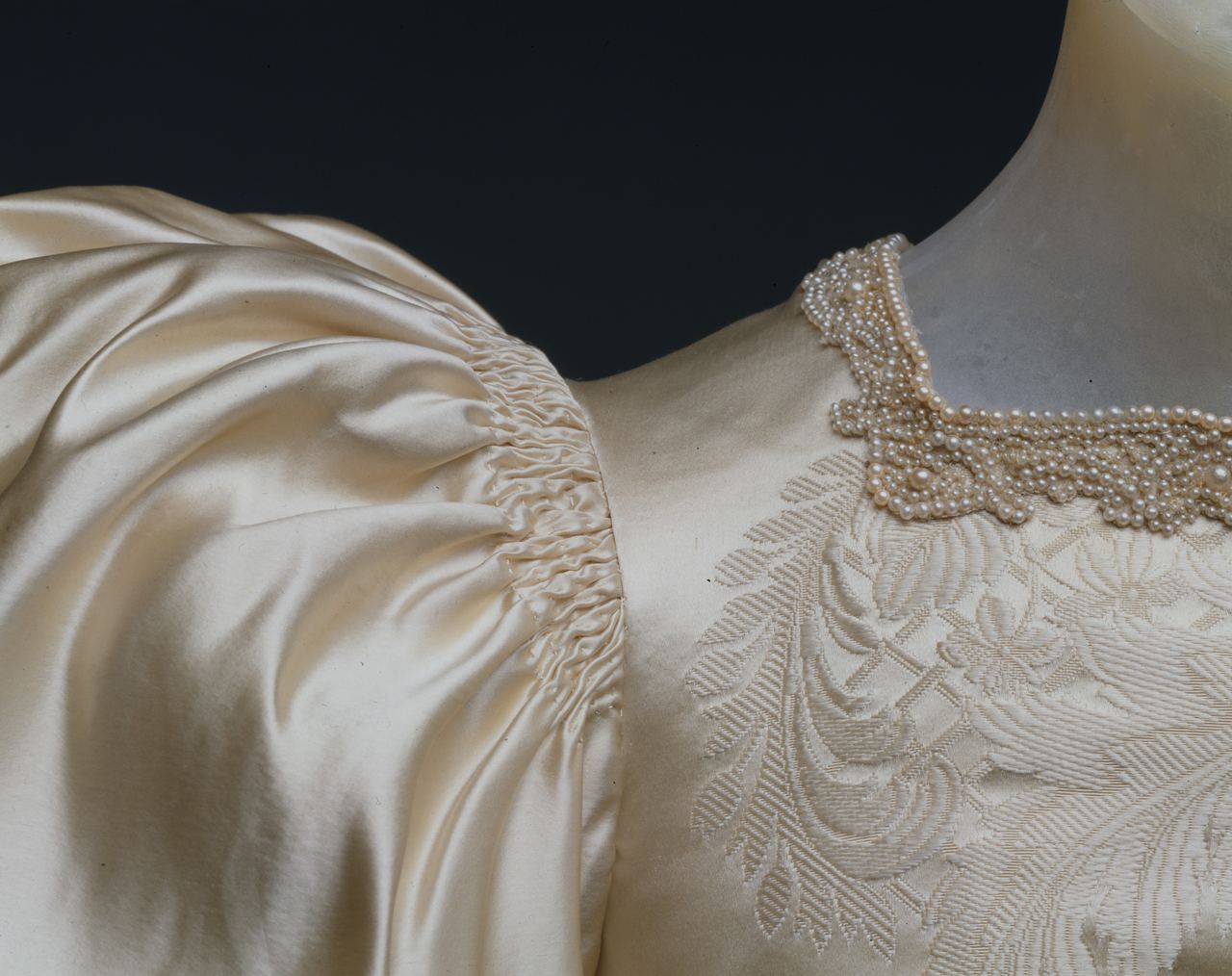
- Wedding dress, House of Worth, 1896 (C.I.41.14.1). The Metropolitan Museum of Art. Record read via the Met Collection API (silk, pearl; isPublicDomain true). Sleeve-head detail image inspected. Accessed November 11, 2026.
- Dress, 1846, Alsace (O1791553). Victoria and Albert Museum. Record read via api.vam.ac.uk: skirt of 5 widths of about 31 in, cartridge pleated into the waist. Accessed November 11, 2026.
- Dress, 1836-37, England, block-printed wool (O1304908). Victoria and Albert Museum. Record read via api.vam.ac.uk: skirt of four widths of 69.5 cm plus one of 38 cm; deep cartridge pleating either side of centre back; cartridge pleats in upper sleeves. Accessed November 11, 2026.
- Dress, 1844-46, France, moiré silk (O1500958). Victoria and Albert Museum. Record read via api.vam.ac.uk: very full skirt cartridge-pleated at the waist seam. Accessed November 11, 2026.
- Mourning dress, 1845-1850, Great Britain (O84553). Victoria and Albert Museum. Record read via api.vam.ac.uk: black silk satin; skirt gathered at the waist with cartridge pleats. Accessed November 11, 2026.
- Dress, ca. 1855, England (O142931). Victoria and Albert Museum. Record read via api.vam.ac.uk: skirt attached in unpressed box pleats except at the waist back, where it is cartridge pleated. Accessed November 11, 2026.
- Sleeve, 1650-1675, Great Britain (O1289654). Victoria and Albert Museum. Record read via api.vam.ac.uk: upper edge cartridge-pleated, held with two lines of stitching and a narrow bias-cut linen strip. Accessed November 11, 2026.
- Bodice, 1660-1669, England (O137794). Victoria and Albert Museum. Record read via api.vam.ac.uk: short, full, cartridge-pleated sleeves typical of 1660s fashion. Accessed November 11, 2026.
- Jeanette E. Davis, ed. Cora M. Holahan, The Elements of Modern Dressmaking (New York, 1894). Cassell Publishing Co. (Internet Archive). Full OCR text read, pp. 103-106: ungored skirts of six or seven breadths stocked into the waist-belt; take two, miss four; stitch lengths; top edge of each groove seamed to the belt, two stitches per gather; back-breadths only; smocking quote. Accessed November 11, 2026.
- Guide to Dressmaking (Boston, 1876). J. Henry Symonds (Internet Archive). Full OCR text read, pp. 26-28: gauging or gathering; 'before the great plaits came in'; gauged at the back plait; skirts sewn in fold by fold; slip-stitches about an inch below; waxed cotton, silk preferable. Accessed November 11, 2026.
- The Workwoman's Guide, by a Lady (London, 1838). Simpkin, Marshall and Co. (Internet Archive). Full OCR text read: 'Gathering' (quarters with pins, stroke gathers down, sew on one at a time) and 'Gaging'. Accessed November 11, 2026.
- S. F. A. Caulfeild and B. C. Saward, The Dictionary of Needlework (London; preface dated June 1882; this copy catalogued 1885). L. Upcott Gill (Internet Archive). Full OCR text read: 'Gauging or Gaging', 'Gauging and Gathering Machine' (Heberling, 2,500 stitches a minute) and 'Shirred'. Accessed November 11, 2026.
- Art & Architecture Thesaurus: cartridge pleats (300228430), gauging (300257514), knife pleats (300228444), box pleats (300228368), gathering (300231237). Getty Research Institute. Scope notes read via the Getty SPARQL endpoint (vocab.getty.edu/sparql). Accessed November 11, 2026.
- How-to: Cartridge Pleating (Abigail Weiner, rev. Kass McGann). Reconstructing History. Full page read: hem/line top edge; dots spaced at pleat depth, second row 1/4 in below; two needles; pleats stitched twice to the band; yardage formula and ruff example; threads may stay in. Maker's guide, used for method only. Accessed November 11, 2026.
- Cartridge Pleating demo (Tammie L. Dupuis, 2006). Renaissance Tailor. Full page read: skirts and breeches; 75-120 in skirts; spacing arithmetic (120 in skirt, 28 in waist, halved to about 1.5 in); two needles for thick fabric; two tacking stitches per pleat. Maker's guide, used for method only. Accessed November 11, 2026.
- En volume ! Donner corps à la mode (12.12.2026-17.10.2027). Palais Galliera, Paris Musées. Official exhibition page read in full: dates, 300+ works, 17th century to today, Second Empire crinoline dress. No mention of cartridge pleats. Accessed November 11, 2026.
- Exposition En volume ! - Palais Galliera. L'Officiel des spectacles. Listing read: dates 12 December 2026 to 17 October 2027; techniques that give volume to clothing, including pleating. Second confirmation of the dates. Accessed November 11, 2026.
Glossary
Last updated · Markdown · Report an error