Underpinnings
Under the Dress: What Built the Silhouette
What did women wear under their dresses? Stays, hoops, cage crinolines and bustles built the silhouette; museum records show how, and which corset stories survive the evidence.
Under a fashionable dress, from the 1500s to the early 1900s, a second structure did the shaping: stiffened bodices called stays and later corsets for the torso, and hoops, rolls, cages or pads for the skirt. The cage crinoline of the late 1850s was the lightest skirt frame of all, a set of spring-steel hoops that replaced layers of heavy petticoats.
The Metropolitan Museum's Costume Art runs to January 10, 2027. According to press coverage, it is organized around kinds of body, with sections that include the Aging Body and the Abstract Body, and its curator, Andrew Bolton, describes fashion as "the dressed body." This is not a review but groundwork for a question any costume gallery raises: what was under the dress, and which famous stories about it survive a look at the evidence?
What did women wear under a dress in the 1700s?
In the eighteenth century a gown sat on layers: a fine linen shift against the skin, stiffened stays over it, and, for the skirt, a hoop or pad tied at the waist under the petticoat. The V&A's catalogue gives the order: the shift first, then the linen stays "heavily reinforced with strips of whalebone," then the hoops.
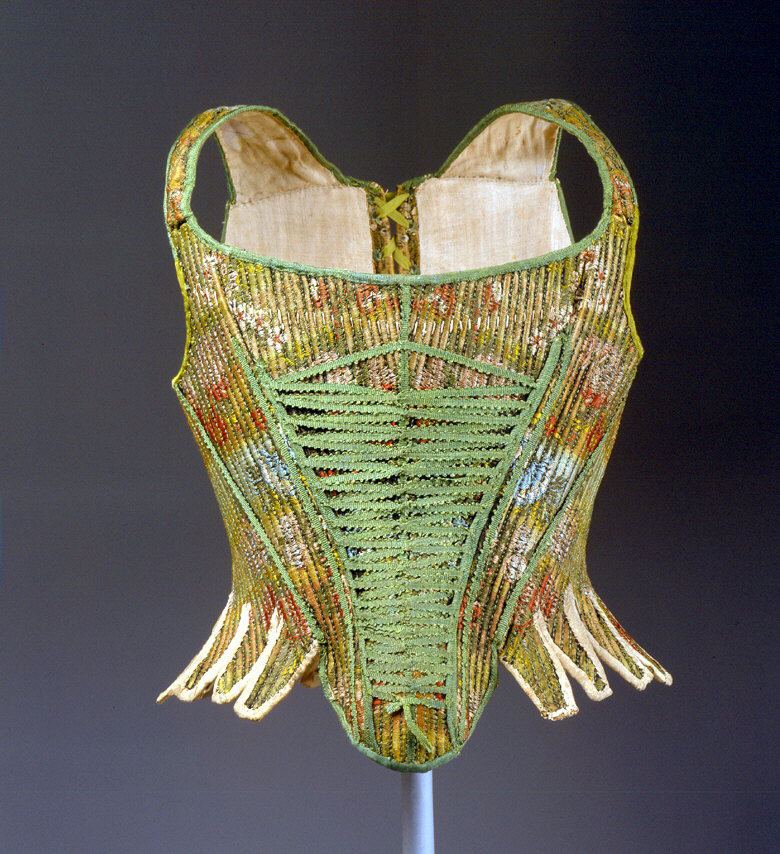
A British pair of the 1780s in the V&A is cut in eight pieces of wool and linen, with baleen (whalebone) slipped into stitched channels about an eighth of an inch wide and running into the skirts below the waist. It laces at the back, with a flat baleen busk at the front. The record notes that baleen is less rigid than it looks: it softens with the heat of the wearer's body and molds to her shape. It also corrects a common assumption. By the 1780s the fashionable torso was an inverted cone, and a smooth profile and firm contour were the primary function of stays "rather than emphasising the bust or constricting the waist."
The Met's French pair from the late 1760s shows the same engineering in silk, with cut tabs at the lower edge that splay over the hips. These stays had a different shape and job from the nineteenth-century corset, which curved in at the waist. The Stay-Maker, published on February 1, 1782, shows a fitting. Its inscription says it was etched by Joseph Haynes, a pupil of Mortimer, from an oil sketch by Hogarth then owned by Samuel Ireland. A man kneels to adjust the point of a laced bodice on a standing woman, with a family group on the right. Hogarth died in 1764, so the scene is older than the print.
| Support | What it shaped | Materials in the records | Example |
|---|---|---|---|
| Spanish farthingale | Cone-shaped skirt | Hoops of supple wood, later whalebone | Earliest depiction, per FIT: ca. 1470 (Benabarre retable) |
| Stays | Conical torso | Silk or wool, linen, baleen, leather | Met C.I.50.8.2 (late 1760s); V&A T.192-1929 (1780s) |
| Panniers | Skirt wide at the hips, flat front and back | Cane, metal, silk, linen | Met 2008.297a, b (1760–70); V&A T.120-1969 (bought 1778) |
| Cage crinoline | Bell, then round skirt | Spring-steel hoops, cotton tapes | Patented 1856; V&A T.16-1979 (1858); Met 2009.300.2250 (1862–63) |
| Bustle | Shelf of fullness behind | Horsehair, steel, cotton | V&A T.168-1937 (1870–75); Met C.I.63.12.1 (ca. 1885) |
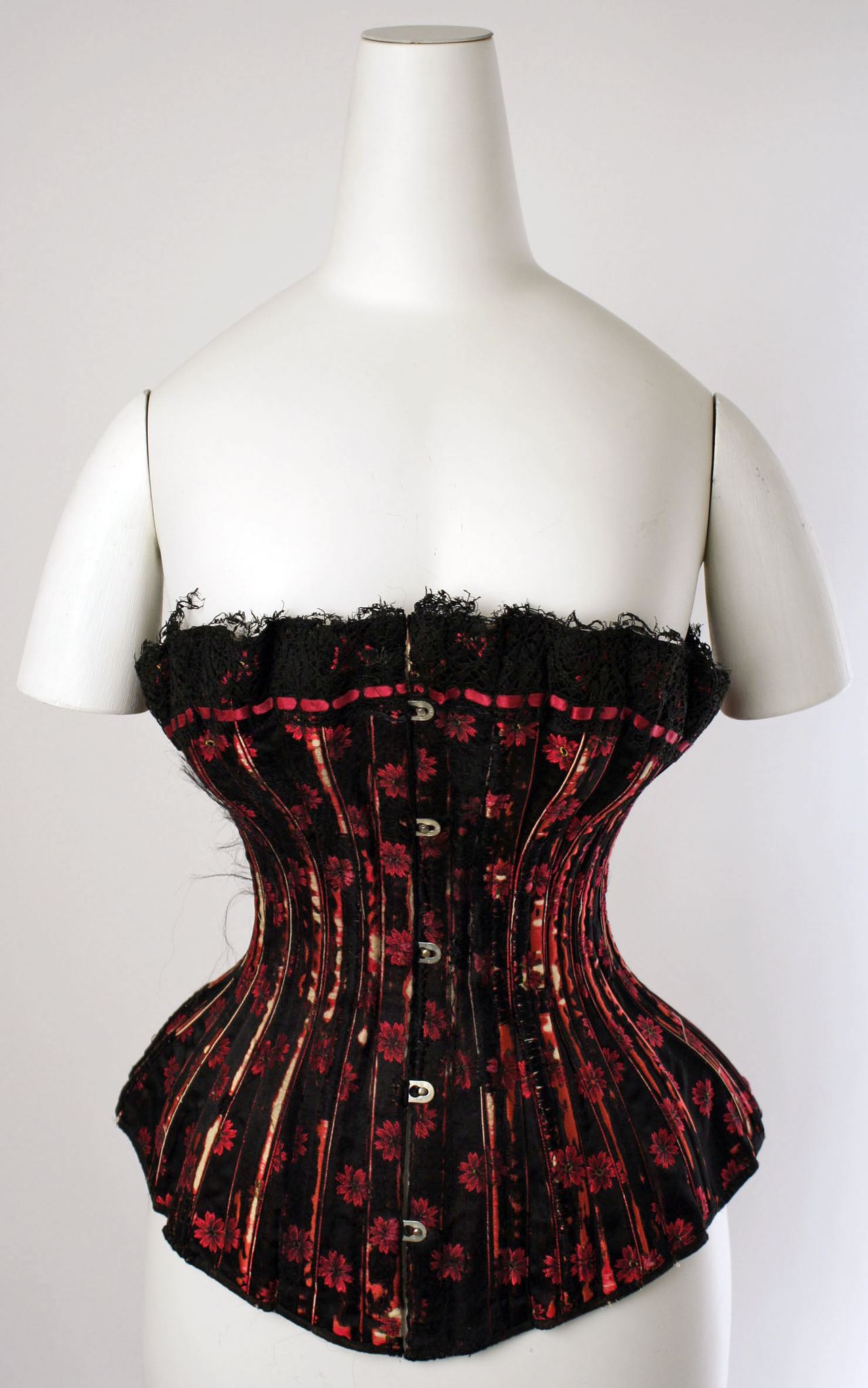
| Corset | Curved hourglass torso | Silk, cotton, steel boning | Met C.I.59.40a, b (1880s) |
How did a farthingale and a pannier hold a skirt out?
A farthingale was a conical underskirt stiffened with hoops, and a pannier was a pair of side frames at the hips. The first came from Spain in the later fifteenth century. The second belonged to the eighteenth, when skirts were widened sideways but kept shallow front to back.
The Fashion Institute of Technology's student-written history points to the retable of St. John the Baptist by Pedro García de Benabarre, about 1470, as the earliest depiction of the Spanish farthingale, with the hoops showing on the outside of the dress. The Royal Museums Greenwich credit Catherine of Aragon with bringing the farthingale to the English court, and say that from about the 1580s Elizabeth I popularized the French or drum version, "designed to display as much expensive fabric as possible."
The hooped petticoat returned in the early 1700s. A four-page verse broadside printed in London in 1711, "The farthingale reviv'd: or, more work for the cooper," is catalogued as a panegyric on "the late, but most admirable invention of the hoop-petticoat," written at Bath. A cooper is a barrel-maker, and the joke appears to be that hoops were now needed for women as well as casks.
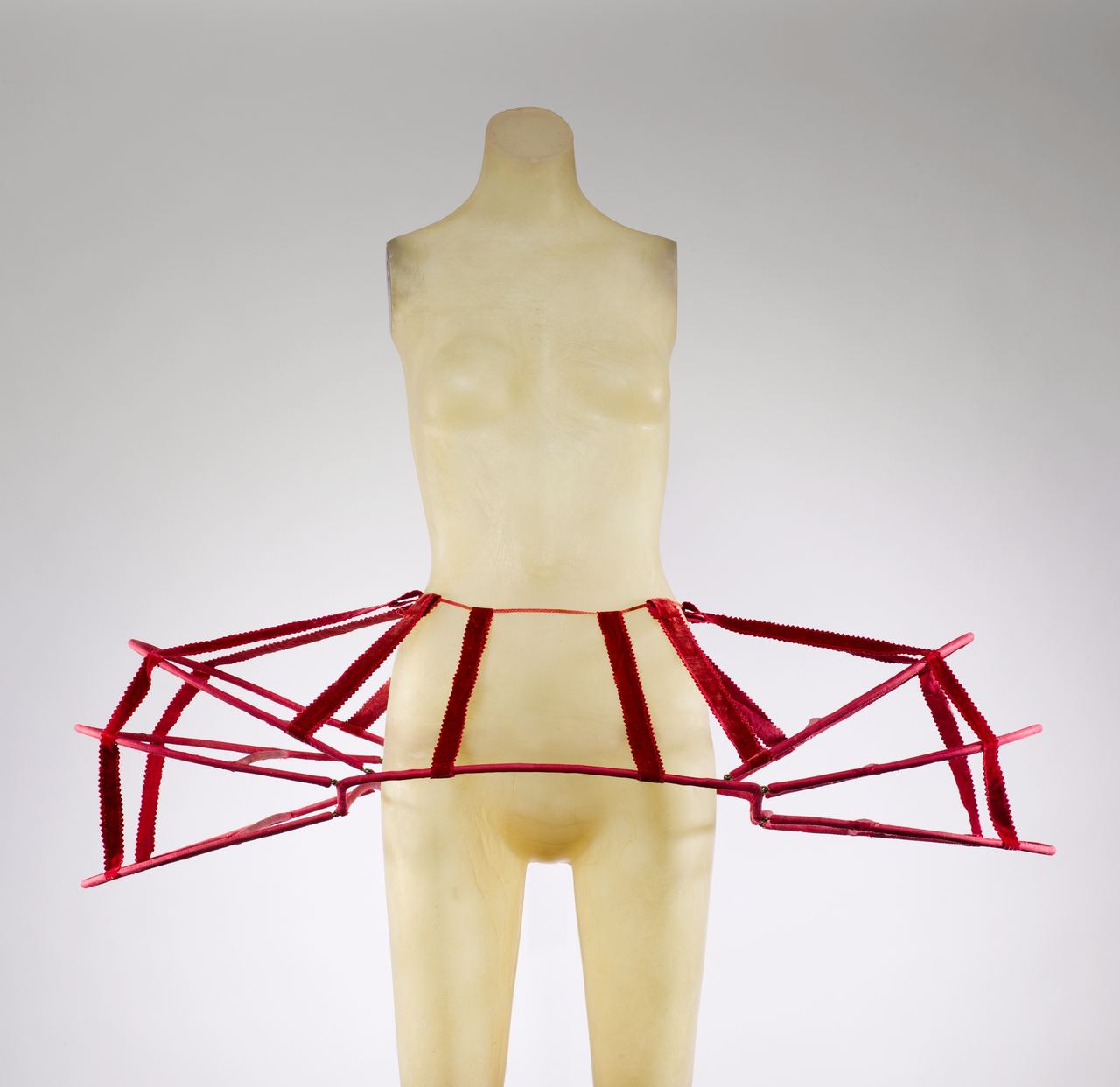
By the middle of the century the hoop had split into two baskets. The Met's French panniers of 1760–70 are cane and metal frames joined by a band and straps. The Fashion Institute's history describes the arrangement as two baskets of whalebone or cane at the hips, with hinges in some examples so that the sides could be folded to pass through a door. A British court dress of about 1750 in the Met, in blue silk with metallic thread, shows the effect at full strength, a skirt wide enough to serve as a display panel for the trimming. A V&A hoop shows what ordinary customers could buy: its record includes the original bill, dated February 16, 1778, from a Covent Garden maker of riding habits and robes, for "a Pink Holland Hoop" at ten shillings and sixpence.
Padding did the same job on a smaller scale. The Bum Shop, published in London on July 11, 1785, is a mock advertisement in which "Derriere" offers "improved" or "dried bums" to those to whom nature has been "niggardly in her distribution of certain lovely Endowments." Pads hang from the walls like hats while customers are fitted. It is satire, so it suggests that false rumps were common enough to mock, not that every woman wore one.
How did a cage crinoline work, and who invented it?
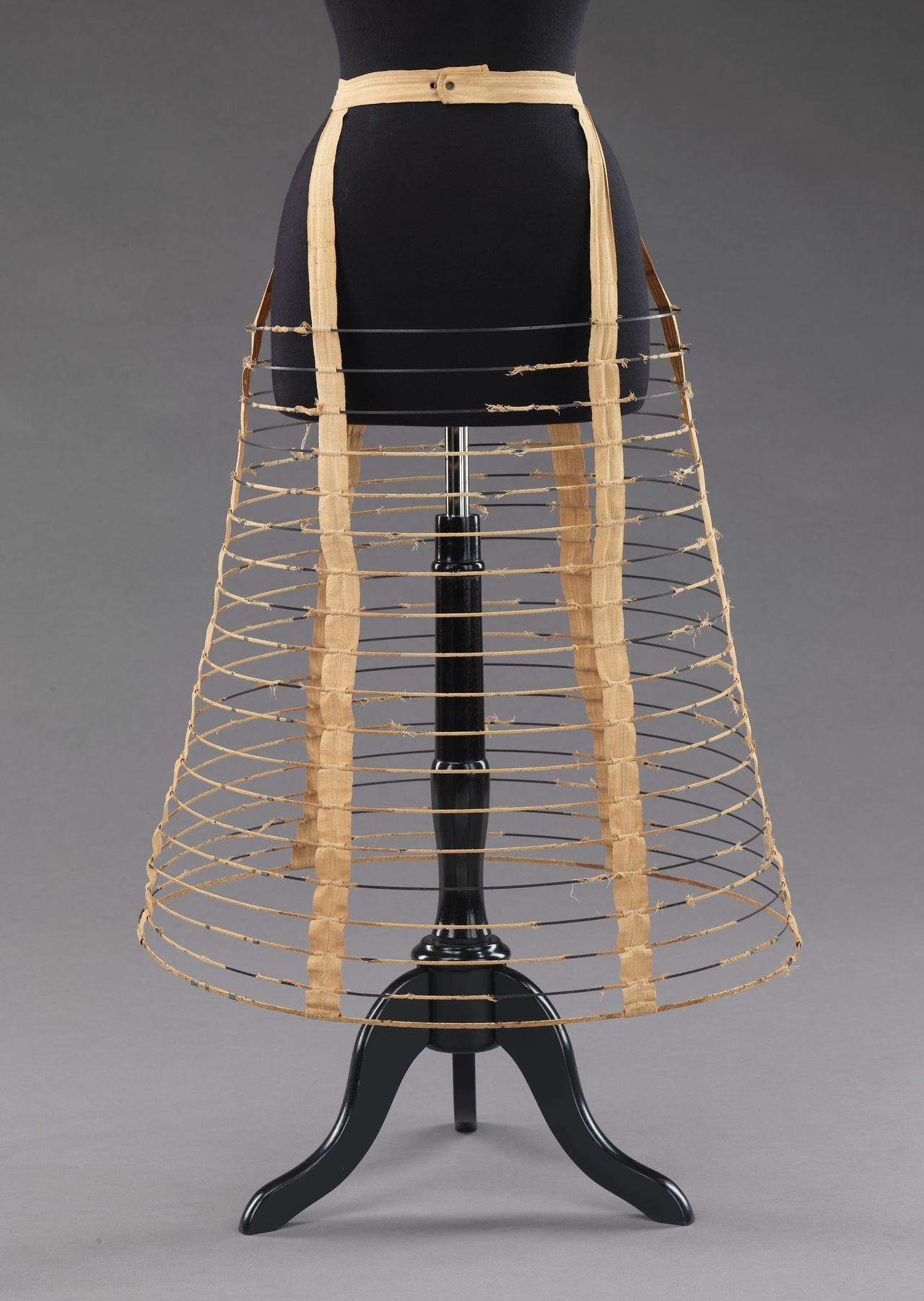
A cage crinoline was a set of graduated spring-steel hoops, narrow at the waist and wide at the hem, joined by vertical cloth tapes and hung from a waistband. It held a skirt out in a bell without the weight of the petticoats it replaced, which the V&A says could number eight. A French maker, Angélique Caroline Milliet, patented a steel skeleton petticoat in 1856, according to a 2020 study, and the V&A dates the cage's appearance to 1857.
The word came first. In the 1840s, the V&A explains, "crinoline" meant a stiff fabric of horsehair (French crin) and linen used to line petticoats. By 1856 the weight of those petticoats had become very uncomfortable, and designers tried other solutions, among them inflatable rubber tubes, which failed when punctured. The cage appeared as "a welcome and more practical alternative."
Dirk-Jan List, writing in the journal Costume in 2020, argues that Milliet invented the first steel skeleton petticoat in 1856, patented it in France, Belgium and England, and in 1861 sold the patents to the American Thomson brothers, whose firm improved the design and made cages popular in the 1860s. Thomson is sometimes credited with the invention; in List's account the family bought Milliet's patents and improved her design. The V&A's 1857 and the 1856 patent do not conflict: one dates the invention, the other the shop window. The earliest cages were bell-shaped, and the hoops numbered nine to eighteen depending on how formal the dress was.
The scale was industrial. The V&A reports that Thomson's London plant employed over a thousand people and made more than four thousand crinolines a day, and that Sheffield made enough crinoline wire each week for over half a million. In 1862 Thomson's advertised itself as holder of the only crinoline medal at that year's International Exhibition, as Rebecca Mitchell notes in a 2016 article.
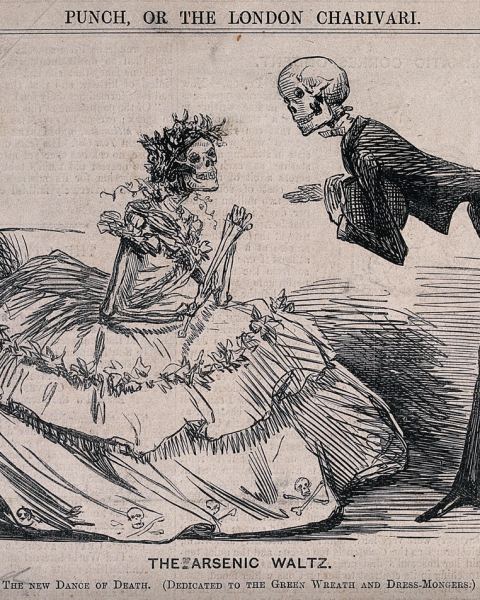
Was it lighter than the petticoats it replaced? Contemporaries argued both ways: Mitchell cites an 1864 writer who held that older petticoats were "heavier than crinolines," and the V&A says the frame "replaced heavy layers of petticoats." Was it dangerous? In specific ways, yes. The V&A's record of an 1858 cage lists being blown over in wind, trapped in the hoops, and, most often, accidents from sparks from open fires, made worse by flammable muslin and tulle. How many died is not settled. Florence Nightingale wrote in Notes on Nursing (1859): "I wish the Registrar-General would tell us the exact number of deaths by burning occasioned by this absurd and hideous custom." Mitchell reports a London coroner, Edwin Lankester, calling such deaths "very much more numerous than the public generally supposed," without a London total. I found no reliable count in any source I could open. For another Victorian fashion legend tested against the record, see Arsenic Green: Did Victorian Dresses Really Kill?.
Why did the skirt move to the back?
By 1865, the V&A says, the outline of the fashionable dress had altered: the back grew more exaggerated and the front flattened, and crinolettes, or half-crinolines, marked the midpoint between the cage and the bustle.
The bustle appeared in the late 1860s as part of the crinolette, which used the excess fabric of the once bell-shaped skirt, and by the 1870s it was a separate undergarment. Victorian ladies considered the word "bustle" vulgar, the V&A notes, so the new form was known as a tournure or dress-improver. The V&A's records include a bustle of 1870–75 of horsehair and linen folds on steels, and a "New Phantom" of 1887–88 by Stapley & Smith of London, whose steel wires pivoted so they folded when the wearer sat and sprang back when she rose. The same record adds that a novelty bustle made for Queen Victoria's Golden Jubilee contained a musical box that played "God Save the Queen" each time the wearer sat down.
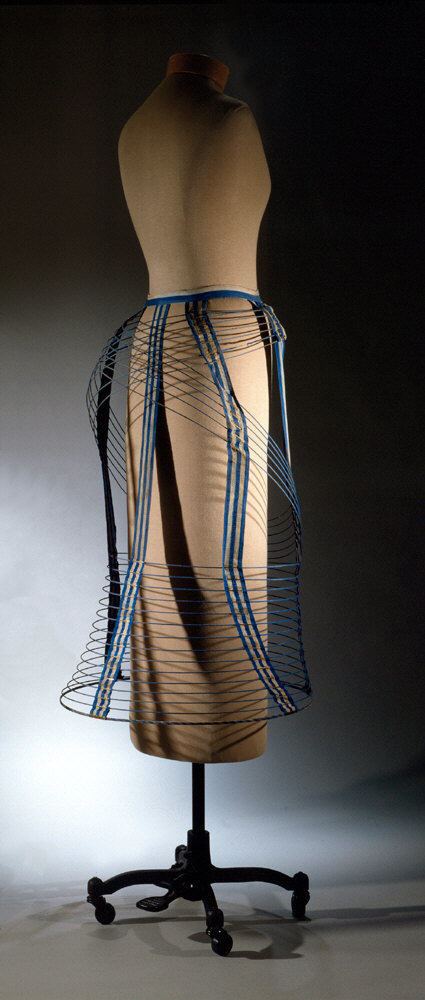
The Met's American cage bustle of about 1885, in cotton and steel, strips the idea down to its engineering: wire hoops that are narrow in front and sweep out in a shelf behind the hips. It replaced the bell of the crinoline with a different silhouette, one of the main clues for dating a portrait; for a method that uses them, see How to Date a Painting by the Clothing.
How small were waists, and was tightlacing real?
Tightlacing was a real practice, but the typical reduction was modest. The extreme numbers come mostly from letters and press claims, not garments.
Valerie Steele, author of The Corset: A Cultural History and then director and chief curator of the Museum at FIT, told Collectors Weekly in 2012: "You can reduce it 4 inches or so, but most women were not going to be doing any more than that." She added that "most corsets were no smaller than in the 20s," meaning inches of waist. The contemporary record is more dramatic. A Medical Times passage that the corset-maker Roxey Caplin reprinted among press notices dated 1846 (in the third edition of her book, 1864) claims that a well-formed waist runs 27 to 29 inches, that the majority were within 24, "thousands are compressed to twenty-two; and some even to less than twenty inches." Caplin's book, Health and Beauty; or, Corsets and Clothing, was a showcase for her own design, so condemning lacing suited her argument.
| Claim | Source | Kind of evidence |
|---|---|---|
| Typical reduction of about 2 to 4 inches; most corsets 20 inches or more | Valerie Steele, interview, Collectors Weekly, 2012 | Scholar's reading of surviving corsets |
| Waists as small as 14 inches | Letters in the Englishwoman's Domestic Magazine, as summarized by Gizmodo, 2014 | Self-reported letters |
| About 1,000 dress waistbands measured, none under 20 inches | Doris Langley Moore, as summarized by Gizmodo, 2014 | Measured garments (secondary report) |
| Majority within 24 inches, thousands to 22, some under 20 | Medical Times passage in Caplin, 1864 edition | Medical journalism, no method given |
The most precise numbers are the weakest. W. B. Lord's The Corset and the Crinoline (1868) collects letters in praise of tightlacing, among them one to The Queen in 1863 from a writer who reports a waist of sixteen and a half inches. Such letters show that people wrote them, not what the average woman did. Surviving garments are a selection, too, but in the sources I read the garments and the measured dress waistbands agree with each other and the letters do not.
Did Catherine de' Medici start the tiny waist?
I found no sixteenth-century source for it. The earliest version of the story I could trace is in a book of 1868.
Lord's 1868 book states that "a thick waist was an abomination" to her, that "thirteen inches waist measure" was the standard of elegance, and that she introduced a severe form of corset. It illustrates the point with a steel corset-cover captioned as of her time. Elizabeth McFadden of the Wellcome Collection, writing in 2021 on iron corsets, notes that Catherine appears in that 1868 caption and that a very similar corset at the Fashion Institute of Technology is now considered a late-nineteenth- or early-twentieth-century forgery. Real iron corsets exist, about fifteen in museum collections; McFadden calls the view that they were remedial more widely held, citing Ambroise Paré's 1575 description of a perforated metal brace for spinal deformity.
A famous figure appears in a nineteenth-century book of letters in praise of tightlacing and is later repeated as history. That is worth remembering with any waist number.
Were ribs removed, and did corsets make women faint?
There is no evidence that women had ribs removed to fit a corset. Fainting is a different matter: corsets could limit breathing, but the evidence for fainting as a common fashionable condition is thin.
On the ribs, nothing I read describes the operation. Samuel Thomas von Soemmerring, an anatomist whose treatise on stays appeared in a revised edition in 1793, describes compressed lungs, a diaphragm driven upward, a squeezed stomach and a liver reshaped by lacing, of which he cites a drawing by the anatomist Mascagni and says he had seen several himself. That is displacement, not removal; Caplin and Lord do not mention rib removal either. Gizmodo's 2014 summary of the research reports that Steele, working with a cardiologist, found no confirmation of it. Steele told Collectors Weekly that livers vary a great deal in shape, which she believes led doctors to blame corsets for odd-looking ones.
On fainting, the contemporary debate was already running. Lord complains that whenever a lady faints at a ball or a theater, the cry of "Tight-lacing!" goes up, and asks whether men never faint from overheat. Colleen Gau's study with reenactors, summarized by Gizmodo, found that subjects laced three inches below their natural waist lost on average 9 percent of tidal volume, with a range of 2 to 29 percent, and that shortness of breath eased with rest. A review of Steele's book says a few of the harms claimed by Victorian doctors, such as shallow breathing, fainting and constipation, were "not wide of the mark." The fair conclusion is that hard lacing could make some wearers breathless and a few faint, while claims that corsets caused cancer, tuberculosis or scoliosis are not supported. Steele said as much in the same interview.
Did men wear corsets too?
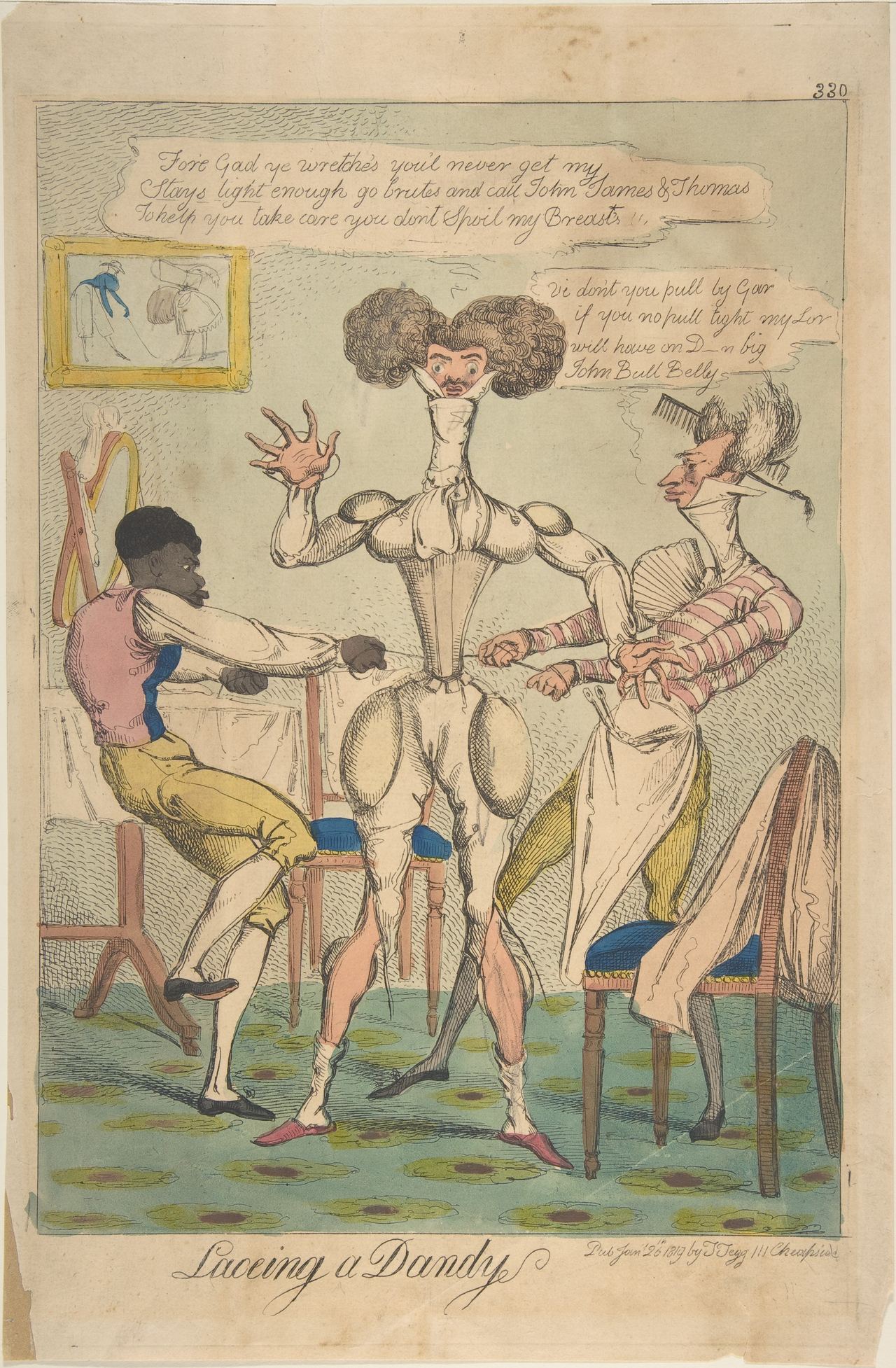
Yes, in the eighteenth and early nineteenth centuries some men wore stays, though how many is unclear and most of the visual evidence is satire. A hand-colored print published by T. Tegg of Cheapside on January 26, 1819, Laceing a Dandy, shows the idea with exaggeration: a thin-waisted man in a laced bodice complains to the two men pulling his laces that they will "never get my Stays" tight enough and tells them to "call John James & Thomas to help you."
Other sources are plainer. Soemmerring writes that from about 1760 to 1770 it became fashionable in Berlin and elsewhere in Germany, and in Holland a few years before, to put boys in stays; families began to abandon the practice when unlaced children grew straight and laced ones came out with a high shoulder or a hump. Lord reports that near the end of George III's reign tailors advertised "Codrington corsets" and "Petersham stiffners" for gentlemen of fashion, and that a London corset-maker told him of orders for real corsets "strongly boned, steeled, and made to lace behind." That is an advocate's book, so these are claims, not records. The dress historian Hilary Davidson says on the London Guided Walks podcast that "there were corsets for men, corsets or stays as they were called," sometimes used for riding or sport, and that dandies were satirized for wasp waists like women's. Whether a particular famous man wore one usually rests on caricature.
What should you look for in a museum?
Look at the structure, not the silk.
Check how it fastens: eighteenth-century stays lace through eyelets at the back or front, as in the V&A's 1780s pair, while the Met's 1880s corset closes with a row of metal fasteners down the front. Look for the stitched channels that mark where baleen or steel went, count the hoops on a crinoline, and check a pannier for hinges.
To place a piece you meet, How to Date a Garment from Its Construction explains which clues give a floor and which only look old.
Open The Bum Shop at full size on the Met's site: its long mock-advertising caption is part of the joke.
Sources
- Stays, French, late 1760s, C.I.50.8.2. The Metropolitan Museum of Art. Primary. Object record via the Met API (CC0): silk, linen, leather, wood, baleen. Image inspected. Accessed November 4, 2026.
- Stays, 1780s, T.192-1929. Victoria and Albert Museum. Primary. Catalogue record read in full via the V&A API: eight pieces, baleen channels, back lacing, conical torso statement. Accessed November 4, 2026.
- Side hoop petticoat, 1780s, T.120-1969. Victoria and Albert Museum. Primary. Catalogue record read in full, including the 1778 bill (Pink Holland Hoop, 10s 6d) and the note on shift, stays and hoops. Accessed November 4, 2026.
- Panniers, French, 1760–70, 2008.297a, b. The Metropolitan Museum of Art. Primary. Object record via the Met API (CC0); image inspected. Accessed November 4, 2026.
- Court dress, British, ca. 1750 (Met object 82426). The Metropolitan Museum of Art. Primary. Object record via the Met API (CC0): silk, metallic thread; image inspected. Accessed November 4, 2026.
- Cage crinoline, "A Favorite Of The Empress", 1860-65, T.150-1986. Victoria and Albert Museum. Primary. Catalogue record read in full via the V&A API: crinoline fabric in the 1840s, up to eight petticoats, cage of 1857, bell shape, hoop numbers. The same text appears on the V&A record for a Thomson's Empress cage (O58913). Accessed November 4, 2026.
- Covered cage crinoline, 1858, T.16-1979. Victoria and Albert Museum. Primary. Catalogue record read in full: hazards of the cage, fires and flammable fabrics. Accessed November 4, 2026.
- Cage crinoline, Worcester Skirt Company, 1862–63, 2009.300.2250. The Metropolitan Museum of Art. Primary. Object record via the Met API (CC0); image inspected. Accessed November 4, 2026.
- Bustle, 1870–75, T.168-1937; "The New Phantom" bustle, 1887–88, T.131C-1919; Crinolette, 1870s, T.775C-1913. Victoria and Albert Museum. Primary. Three catalogue records read in full via the V&A API (O128005, O73542, O58891): origin of the bustle, the word "bustle", Jubilee novelty, crinolette as midpoint. Accessed November 4, 2026.
- Bustle, American, ca. 1885, C.I.63.12.1. The Metropolitan Museum of Art. Primary. Object record via the Met API (CC0); image inspected. Accessed November 4, 2026.
- Corset, British, 1880s, C.I.59.40a, b. The Metropolitan Museum of Art. Primary. Object record via the Met API (CC0); image inspected. Accessed November 4, 2026.
- The Stay-Maker, Joseph Haynes, February 1, 1782, 32.35(149). The Metropolitan Museum of Art. Primary. Object record (CC0). Inscription read at full size: etched by Jos. Haynes, pupil to the late Mr Mortimer, from an original sketch in oil by Hogarth in the possession of Mr Sam Ireland, published Feb. 1, 1782. Accessed November 4, 2026.
- A Rake's Progress, Plate 3, William Hogarth (artist dates 1697–1764). The Metropolitan Museum of Art. Primary. Met record used only for Hogarth's dates (London 1697–1764). Accessed November 4, 2026.
- The Bum Shop, R. Rushworth, July 11, 1785, 1970.541.12. The Metropolitan Museum of Art. Primary. Object record (CC0). Inscription read at full size: published London July 11, 1785 by S. W. Fores, No. 3 Piccadilly; "Derriere" mock advertisement. Accessed November 4, 2026.
- Laceing [sic] a Dandy, January 26, 1819, 69.524.35. The Metropolitan Museum of Art. Primary. Object record (CC0). Speech balloon and imprint (T. Tegg, 111 Cheapside, Jan. 26, 1819) read at full size. Accessed November 4, 2026.
- W. B. L. (W. B. Lord), The Corset and the Crinoline: a book of modes and costumes (London: Ward, Lock and Tyler, 1868). Internet Archive. Primary, full text read. Source of the Catherine de' Medici thirteen-inch claim and its steel corset-cover illustration, the 1863 letter to The Queen, the fainting remarks, and the claims about men's corsets. A collection of letters and opinion, used as evidence of what was claimed, not of what was typical. Accessed November 4, 2026.
- Roxey Ann Caplin, Health and Beauty; or, Corsets and Clothing (3rd ed., 1864). Internet Archive (Google scan). Primary, full text read. The Medical Times passage on waist sizes among the press notices (dated 1846 in the book). Accessed November 4, 2026.
- S. Th. Soemmerring, Über die Wirkungen der Schnürbrüste (revised edition, 1793). Internet Archive. Primary, full text read (OCR, German). Compression of lungs, stomach and liver; boys put in stays in Berlin around 1760–70. No mention of rib removal. Accessed November 4, 2026.
- Florence Nightingale, Notes on Nursing: What It Is, and What It Is Not (first published 1859; Appleton 1898 reprint). Project Gutenberg. Primary, full text read: footnote on crinolines and deaths by burning. Edition read is the 1898 reprint; 1859 date of first publication from Mitchell (2016). Accessed November 4, 2026.
- "The farthingale reviv'd: or, more work for the cooper" (London, 1711), ESTC T35405. Grub Street Project. Primary (catalogue record of a 1711 broadside) read in full: title, imprint, "late, but most admirable invention of the hoop-petticoat", written at Bath. The poem text itself was not read except as quoted by Lord. Accessed November 4, 2026.
- Dirk-Jan List, "Mademoiselle Angélique Caroline Milliet: Did She Invent the Steel Skeleton Petticoat?", Costume 54.1 (2020), 81–107. Edinburgh University Press, via Crossref. Scholarly. Abstract read via the Crossref record; full article not read. States the 1856 invention, patents in France, Belgium and England, and the 1861 sale to the Thomson brothers. Accessed November 4, 2026.
- Rebecca N. Mitchell, "15 August 1862: The Rise and Fall of the Cage Crinoline", BRANCH (2016). BRANCH: Britain, Representation and Nineteenth-Century History. Scholarly. Full text read: Thomson's 1862 medal, Sheffield wire, "heavier than crinolines", Lankester and Nightingale on burning deaths. Accessed November 4, 2026.
- Lisa Hix, "Everything You Know About Corsets Is False" (interview with Valerie Steele). Collectors Weekly. Full text read (January 17, 2012). Steele on waist reduction, corsets in the 20s, health claims, livers. Accessed November 4, 2026.
- Lauren Davis, "No, corsets did not destroy the health of Victorian women" (March 17, 2014). Gizmodo (io9). Full text read. Secondary summary of Gau (reenactor lung study), Doris Langley Moore's waistband survey, Steele on ribs. The underlying studies were not opened; claims are attributed to this summary. Accessed November 4, 2026.
- Eve Auchincloss, review of Valerie Steele, The Corset: A Cultural History. The Wilson Quarterly. Full text read. Review's characterization of Steele on claimed harms ("not wide of the mark"). Accessed November 4, 2026.
- Elizabeth McFadden, "Revealing the iron corset" (January 12, 2021). Wellcome Collection. Full text read. Catherine de' Medici appears in an 1868 caption; FIT corset considered a forgery; remedial reading, Paré 1575; about 15 known. Accessed November 4, 2026.
- Tudor fashion. Royal Museums Greenwich. Full text read: Catherine of Aragon and the Spanish farthingale; drum farthingale from about the 1580s. Accessed November 4, 2026.
- Spanish farthingale (student-written entry), Fashion History Timeline. Fashion Institute of Technology. Full text read. Student-written; used for the late fifteenth-century date and the Benabarre retable (ca. 1470), flagged as FIT's own attribution. Accessed November 4, 2026.
- Panniers (student-written entry), Fashion History Timeline. Fashion Institute of Technology. Full text read. Student-written; used for the description of panniers and hinged examples (citing Black and Payne). Accessed November 4, 2026.
- Hilary Davidson on men's corsets, "Myths of Regency Dress", London Guided Walks podcast, episode 49. London Guided Walks. Podcast page read (episode summary and quoted passage). Air date not shown (about November 2021). Accessed November 4, 2026.
- Costume Art, The Costume Institute, review. The Art Newspaper. Full text read: runs until January 10, 2027; organized by body typologies (Aging Body, Abstract Body among them). Accessed November 4, 2026.
- Costume Art opening coverage. Wallpaper. Full text read: May 10, 2026 to January 10, 2027; Bolton, "the dressed body"; sections incl. Aging Body, Abstract Body. The Met's own exhibition page could not be opened from this environment (HTTP 429), so the dates rest on these two sources. Accessed November 4, 2026.
Glossary
Last updated · Markdown · Report an error