Hands in a Muff: The Fur Tube Men Carried Too
Why did people carry muffs, and did men use them? From about 1600 a tube of fur, feathers or silk warmed both hands, held a purse or a lapdog, and grew and shrank with fashion. Samuel Pepys borrowed his wife's.
A muff is a padded tube, usually of fur, into which both hands are pushed to keep them warm. Europeans carried muffs from about 1600 into the 20th century, and for much of the 1600s and 1700s men carried them too: Samuel Pepys wore his first one, his wife's old muff, in November 1662.
What is a muff, and when did it appear?
A muff is an open-ended cylinder of fur, feathers or padded cloth that holds both hands at once. In England it appears in records in the decades around 1600, first as a rich embroidered accessory, and from the start men owned them as well as women; by the 1640s the muffs in prints are almost all fur.
Two older costume histories, F. W. Fairholt's Costume in England and Alice Morse Earle's Two Centuries of Costume in America (1903), both quote the wardrobe accounts of Henry, Prince of Wales, for 1608: two muffs, one of cloth of silver embroidered with silver and gold, the other of black satin embroidered with black silk and bugles. Both also cite a drawing by Caspar (or Gaspar) Rutz of an Englishwoman with a small muff hanging from her girdle, though they disagree on its date: Fairholt gives 1588, Earle 1598. Earle adds that the earliest muffs seem seldom to have been fur, and were more often rich cloth trimmed with ribbon.
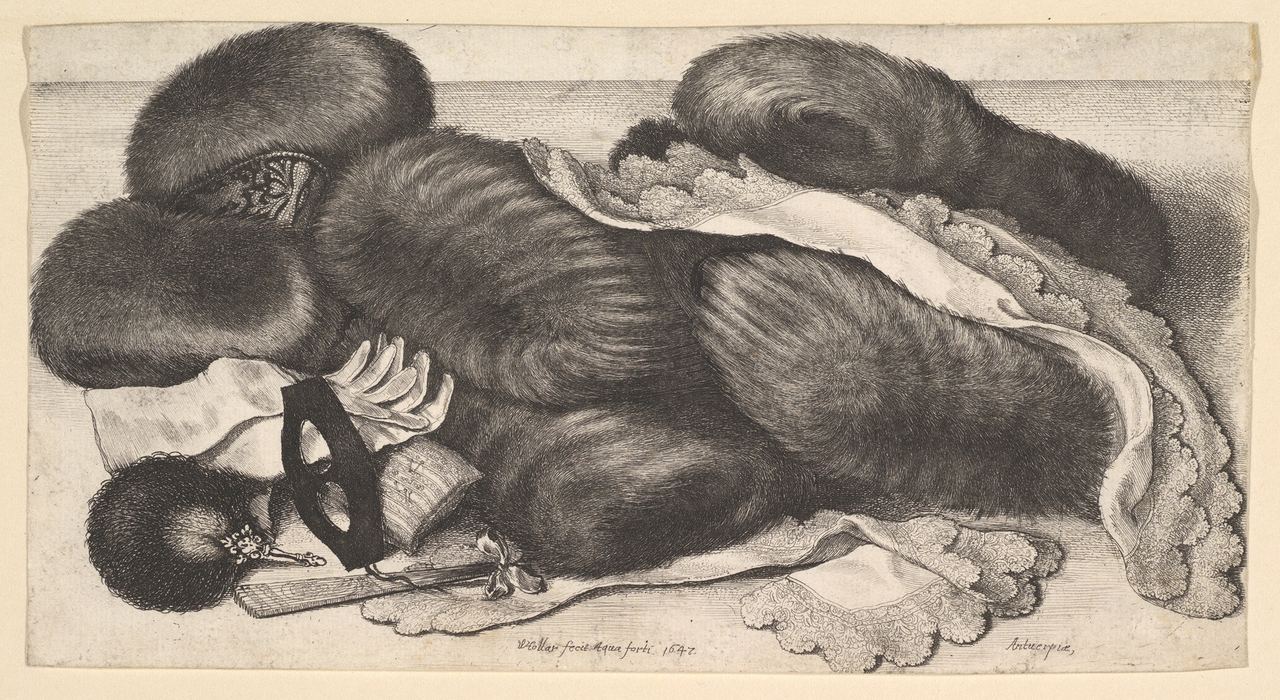
Fur won. When Wenceslaus Hollar etched still lifes of winter accessories in the 1640s, the muffs he drew were deep, glossy and almost animal, heaped among gloves, fans and masks.
Did men carry muffs?
Yes, openly and for more than a century. On Sunday, November 30, 1662, a "bitter cold" day, Samuel Pepys wrote in his diary: "This day I first did wear a muffe, being my wife's last year's muffe, and now I have bought her a new one, this serves me very well."
The French lexicographer Antoine Furetière recorded the same shift. His dictionary, published in 1690 after his death, defines the manchon as a fur worn in winter to keep the hands warm and adds that muffs used to be only for women, but that men now carry them. Country muffs for gentlemen on horseback, he notes, were made of otter or "tiger".
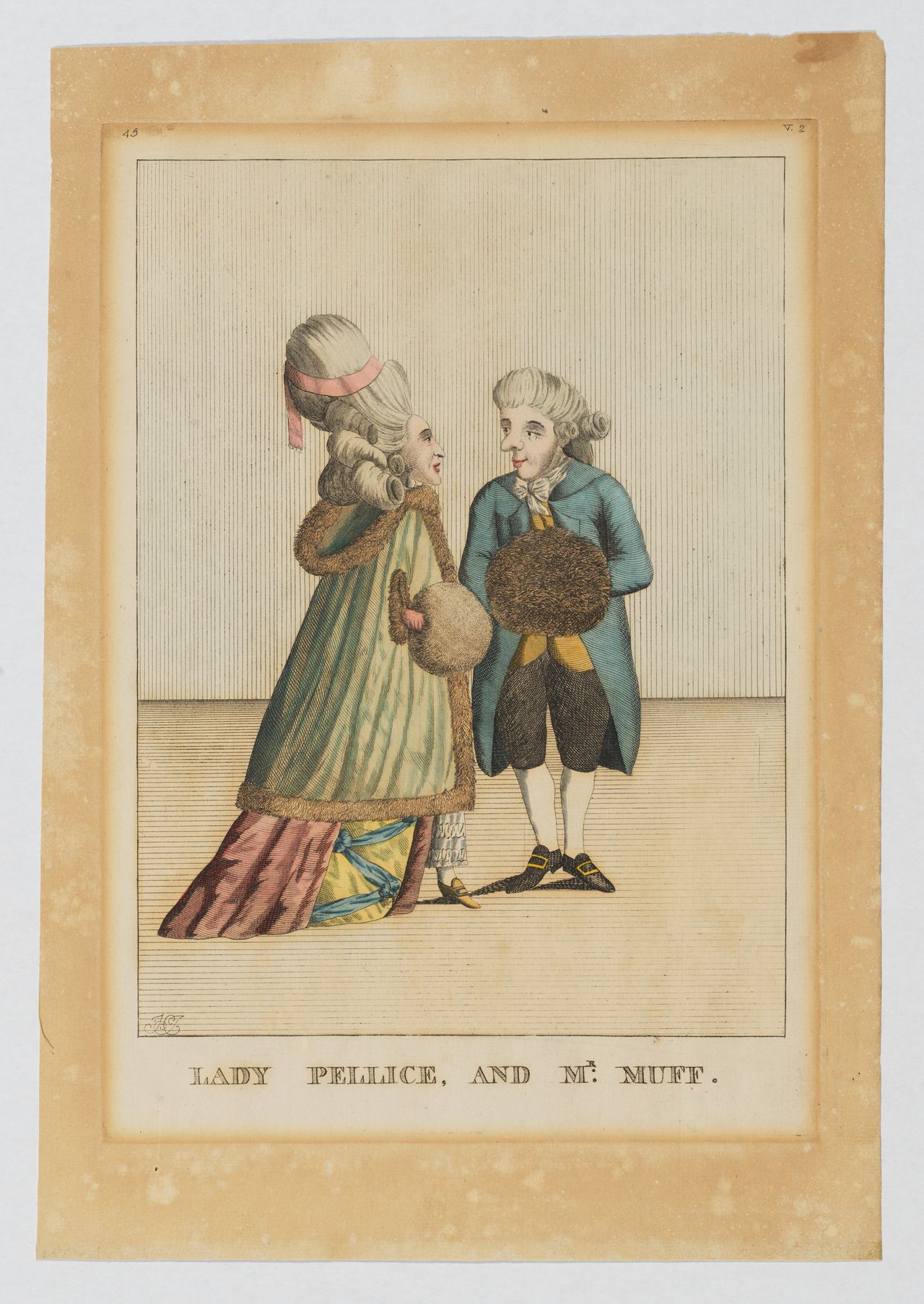
The fashion lasted well into the 18th century, and so did the jokes about it. In Christopher Anstey's New Bath Guide (1766), the would-be dandy Simkin writes home proudly that he rides in a chair "with my hands in a muff" and has bought a silk coat with an embroidered cuff. Two years later, in Isaac Bickerstaffe's comic opera Lionel and Clarissa, a colonel sings his contempt for a fop "who shrugs and takes snuff, and carries a muff". A British print of 1778 pairs "Lady Pellice", in a fur-trimmed pelisse, with "Mr. Muff", a man in a powdered wig clutching a fur muff nearly as wide as his chest.
Sources differ on when men gave the habit up. Beatrice Behlen of the London Museum writes that by the end of the 18th century muffs were again mostly carried by women; Earle says big muffs stayed in fashion for women from 1790 to 1820, "and part of the time for men".
What were muffs made of?
Fur came first among the materials. Furetière ranked the materials: the finest muffs were sable; common ones were miniver, dog or cat. In 1711 The Spectator, praising the trade that met at London's Royal Exchange, noted that "the muff and the fan come together from the different ends of the earth".
Feathers had their turn too. Anstey's 1766 catalogue of a fashionable lady's finery ends with "feather'd muffs", and one of his characters calls for her "muff from downy breast of swan", the swansdown that stayed popular into the 19th century. The Met holds a French muff of the early 19th century made of bright red feathers and wool. In December 1865, Godey's Lady's Book offered ermine tipped with swansdown, sealskin edged with sable, and grebe, as quoted by the dress historian Ingrid Mida. Later in the 19th century makers used whole animals: an American muff of about 1886 at the Met, of wool and silk, is trimmed with what appears to be a whole bird, and a fur muff of about 1899 is finished with a small animal head and tail.
Was a muff only for warmth?
No. It was also a bag. The Dictionary of Fashion History (Cumming, Cunnington and Cunnington) dates a pocket for a card case and purse inside women's muffs to the 1880s, and the Fairchild Dictionary of Fashion describes muff-handbags of that decade. Before that, women had carried their things in a tie-on pocket under the skirt; a muff with a purse inside put them back in the hand.
It could also hold a dog. Furetière's dictionary defines a petit chien de manchon, a "muff dog", as a little dog that ladies could carry in their muff, and under bichon calls those small long-haired white dogs "chiens de manchon". The French writer Octave Uzanne repeated the definition in his 1883 history of the muff.
How big was a muff?
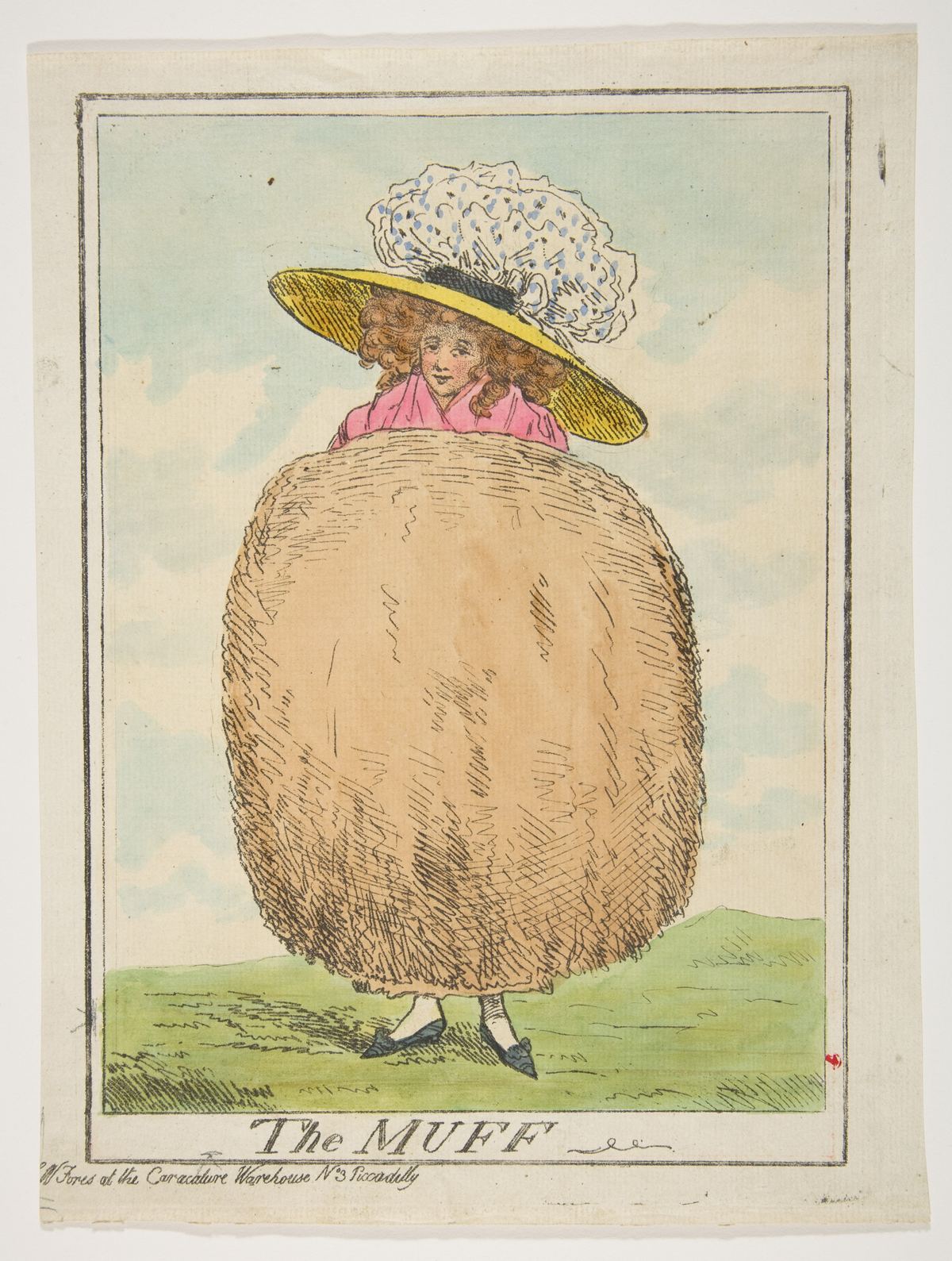
Size followed the silhouette. In March 1711 The Spectator received a letter asking it to be "very satirical upon the little muff that is now in fashion". By the 1780s the muff had swollen: Behlen reads the many caricatures of that decade as one of the major peaks in muff size, and the Fairchild Dictionary lists large muffs for very stylish men in the 1770s and 1780s. The 1787 print at the top of this page hides a woman entirely behind hers. Earle puts the largest muffs around 1810, some of them two feet long, covering the arms to the elbow.
From the 1830s until the First World War, Behlen writes, muffs grew smaller without growing less popular; larger ones came back in the 1910s. Debenhams photographed a model with a matching coat and muff in 1935, and Fairchild records fur muffs for little girls as recently as the 1960s. By then, Behlen suggests, the demure stance a muff demands no longer fit the way women moved.
| Clue | What it suggests | Source |
|---|---|---|
| Very large, round or barrel-shaped | 1770s–1810s, or the 1910s | London Museum; Earle; Fairchild |
| Small | 1830s to about 1910 | London Museum |
| Inner pocket for purse or card case | 1880s or later | Dictionary of Fashion History |
| Swansdown, feathers, whole birds or animal heads | Swansdown is recorded by 1766; the Met's bird and animal-head muffs date from the 1880s and 1890s | Anstey; Met records |
| Cord or ribbon to hang it from the neck | Not a date marker on its own: recorded in the 1680s and the 1800s | Fairholt; Mida |
Museum dates are often broad. The Met dates its bird muff "ca. 1886" but records it as made between 1881 and 1891. For construction clues that apply to whole garments, see how to date a garment from its construction.
Where can you see one?
The Metropolitan Museum of Art has open-access images of the red feather muff, the bird muff of about 1886, the fur muff of about 1899 and a late 19th-century muff of fur and silk. Hollar's Winter Habit of an English Gentlewoman (1644) shows a masked woman carrying a fur muff. Behlen's history of muffs at the London Museum includes two fur muffs that belonged to Queen Victoria's daughter Princess Louise. For the muff's opposite, an accessory that kept the fingers free, see the mitt.
Sources
- Sunday 30 November 1662. The Diary of Samuel Pepys (pepysdiary.com, Wheatley text). Full entry read: 'bitter cold frost'; first wore a muff, his wife's last year's muff (quoted, 26 words). Date and wording confirmed by the London Museum blog. Accessed November 26, 2026.
- A history of muffs: A forgotten fashion accessory. London Museum (Beatrice Behlen, blog). Full text read: Pepys 1662; both sexes through the 18th century; 1780s size peak; mainly women by c.1800; smaller 1830s-WWI; larger in the 1910s; Debenhams 1935; Princess Louise's muffs; 1960s-70s decline. Accessed November 26, 2026.
- Muff; Snuftkin. F. W. Fairholt, Costume in England, 4th ed. (ed. H. A. Dillon), vol. 2 Glossary, London: Bell, 1885/1896 (archive.org). Full OCR text read: Rutz drawing dated 1588; Prince Henry's 1608 muffs; men's muffs hung by ribbon (1683); feathered muffs in Anstey; snuftkin/snoskyn. Accessed November 26, 2026.
- Chapters on the Tudors, Stuarts and 18th century. F. W. Fairholt, Costume in England, vol. 1 (archive.org). OCR text read: snuftkin as a small muff; man's muff hung round the neck by a ribbon (c.1683); Spectator No. 16; Simkin in the New Bath Guide. Accessed November 26, 2026.
- Chapter XVII: Two Masculine Vanities, Muffs and Ear-rings. Alice Morse Earle, Two Centuries of Costume in America, vol. 2, New York: Macmillan, 1903 (archive.org). Full chapter read: Rutz drawing dated 1598; Prince Henry 1608; early muffs seldom fur; 1790-1820 great muffs for women 'and part of the time for men', biggest c.1810, some two feet long; barrel-muffs. Accessed November 26, 2026.
- MANCHON; BICHON. Antoine Furetière, Dictionaire universel, tome 2 (L-Z), The Hague/Rotterdam: Leers, 1691 ed. (archive.org). Entries read in OCR (French): muffs once only for women, now men carry them; sable finest, petit-gris/dog/cat common; cavaliers' otter or tiger; 'petit chien de manchon'. Bichon entry in another 1691 copy (bub_gb_1InorWz9N1IC): 'chiens de manchon'. First edition 1690 (archive.org records fre_b2062762, bub_gb_w1s3b1geGFoC). Accessed November 26, 2026.
- The New Bath Guide; or, Memoirs of the B-n-r-d Family. Christopher Anstey, The New Bath Guide (1766), 1788 edition (archive.org). Text read: 'feather'd muffs' in the list of finery; 'Muff from downy breast of swan'; Simkin 'ride in a chair, with my hands in a muff' and silk coat with embroidered cuff. 1766 first edition confirmed by archive.org records and Fairholt. Accessed November 26, 2026.
- Lionel and Clarissa: A Comic Opera. Isaac Bickerstaffe, Lionel and Clarissa, London: W. Griffin, 1768 (archive.org). 1768 printed text read: Col. Oldboy's song 'Who shrugs and takes snuff, And carries a muff'; Mr. Jessamy calls for his muff. Accessed November 26, 2026.
- No. 16 (March 19, 1710-11) and No. 69 (May 19, 1711). The Spectator, vol. 1 (archive.org). Text read: No. 16 'the little muff that is now in fashion'; No. 69 'The muff and the fan come together from the different ends of the earth'. Accessed November 26, 2026.
- muff (Caroline Haein Lee, 2017, updated 2025). Fashion History Timeline, Fashion Institute of Technology. Full page read; used for its quotations of Cumming, Dictionary of Fashion History (pocket for card case and purse in 1880s muffs) and Calasibetta and Tortora, Fairchild Dictionary of Fashion (large muffs for stylish men 1690s and 1770s-80s; 1880s muff-handbags; girls' fur muffs into the 1960s). The dictionaries themselves were not opened. Accessed November 26, 2026.
- The Muff (2013). Toronto Metropolitan University Fashion Research Collection (Ingrid Mida). PDF read in full: quotes Godey's Lady's Book, December 1865 (ermine tipped with swan's-down, seal-skin edged with sable, grebe); 19th-century muffs as handbags, sometimes on a neck cord. Accessed November 26, 2026.
- The Muff. Octave Uzanne, The Sunshade, the Glove, the Muff, London: Nimmo, 1883 (archive.org). Text read: translation of Furetière's muff entry including the muff dog; used as a second source for that definition. Accessed November 26, 2026.
- The Muff, attributed to Henry Kingsbury, February 16, 1787, 69.524.40. The Metropolitan Museum of Art. Collection API record read (attribution, date, medium, CC0); image inspected at full size; publisher line 'S. W. Fores at the Caricature Warehouse No 3 Piccadilly' read on the print. Accessed November 26, 2026.
- Wenceslaus Hollar, Still-life with a group of muffs, a pair of gloves, fans, mask and two kerchiefs, 1647, 17.34.9. The Metropolitan Museum of Art. API record read; image inspected in crops; date 1647 and 'Antverpiae' read on the plate. Accessed November 26, 2026.
- Lady Pellice and Mr. Muff, after H. J., January 20, 1778, 2022.309.32. The Metropolitan Museum of Art. API record read; image inspected in crops; title lettering read. Accessed November 26, 2026.
- Muff, French, early 19th century, feathers and wool, 2009.300.1397. The Metropolitan Museum of Art. API record read (CC0); image viewed. Accessed November 26, 2026.
- Muff, American, ca. 1886 (1881-1891), wool and silk, 1979.346.231. The Metropolitan Museum of Art. API record read (begin/end dates 1881-1891; tag Birds); image viewed. Accessed November 26, 2026.
- Muff, American, ca. 1899, fur, 1973.137.3. The Metropolitan Museum of Art. API record read; image viewed (animal head and tail). Accessed November 26, 2026.
- Muff, American, late 19th century, fur and silk, C.I.X.54.15.9. The Metropolitan Museum of Art. API record read (CC0). Accessed November 26, 2026.
- Wenceslaus Hollar, The Winter Habit of an English Gentlewoman, 1644, 23.65.35. The Metropolitan Museum of Art. API record read; image viewed (mask, fur muff, date on plate). Accessed November 26, 2026.
Glossary
Last updated · Markdown · Report an error