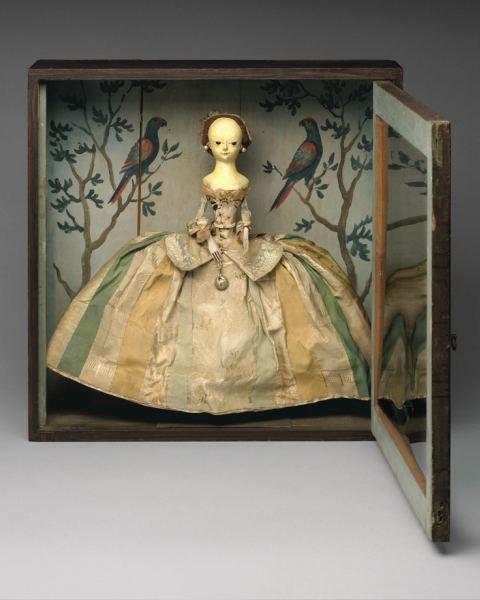
Fingers Free: The Long Life of the Mitt
For women whose sleeves stopped at the elbow, a mitt covered the forearm and left the fingers free to sew, write and work. The museums that hold them show silk, linen and cotton, knitted and cut.
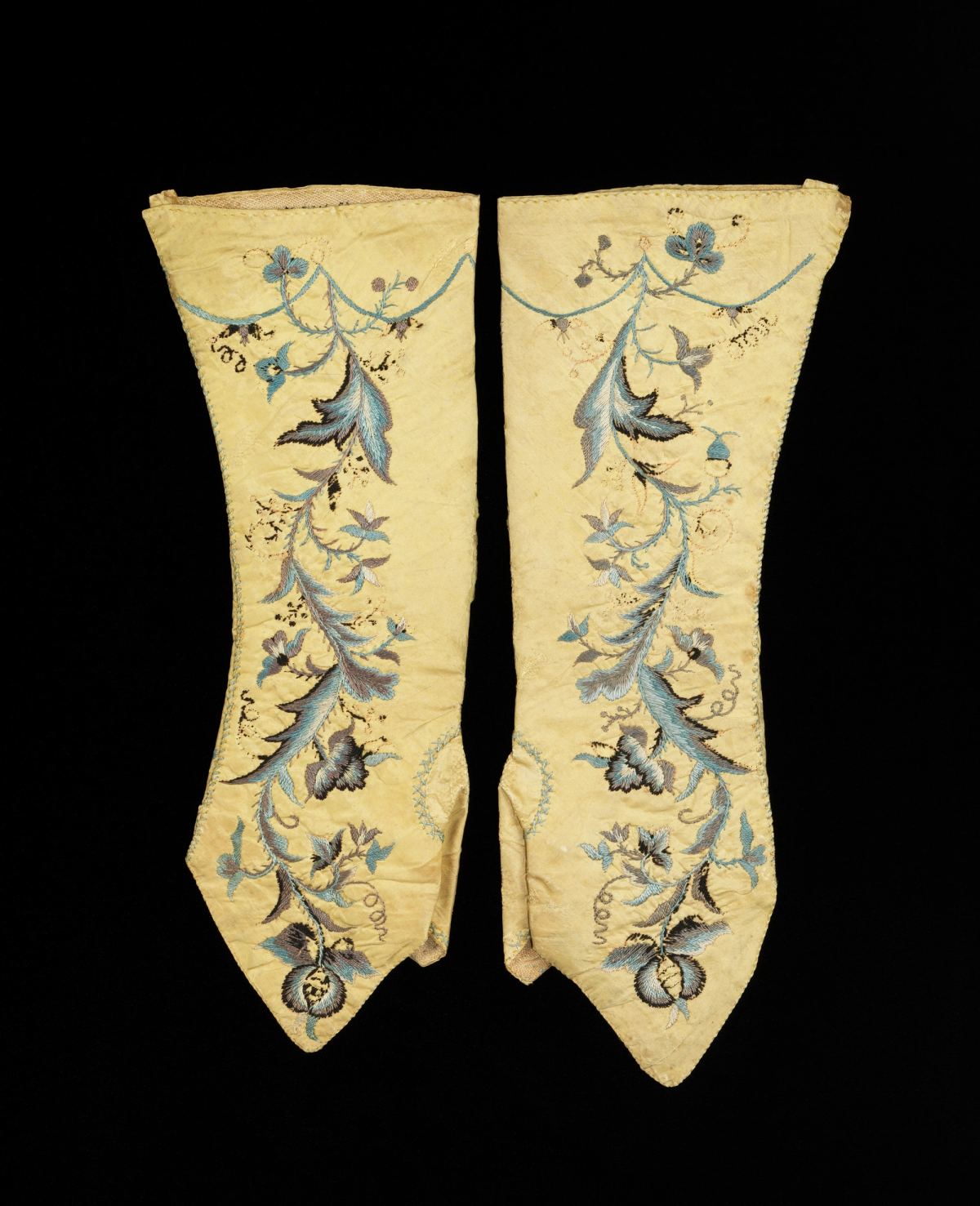
A mitt is a glove with the fingers left out: it covers the forearm and the back and palm of the hand, and some have a thumb piece while others leave the thumb open. For women in the 18th century, when sleeves stopped around the elbow, mitts were the accessory that finished the arm.
What was a mitt for?
The practical answer is that it covered the part of the arm that the sleeve did not. Susan Holloway Scott, writing about a pair she was shown at Colonial Williamsburg, notes that most women's garments in the 18th century had sleeves ending around the elbow, and that mitts covered the forearm while leaving the fingers free. They could be cut and sewn from cloth or knitted.
Leaving the fingers free mattered for what women did with their hands. The Rijksmuseum, describing a Dutch pair, puts it directly: for daily use in the house, mitts were extremely practical because women could do household chores and other activities while keeping their lower arms covered.
What did the finest ones look like?
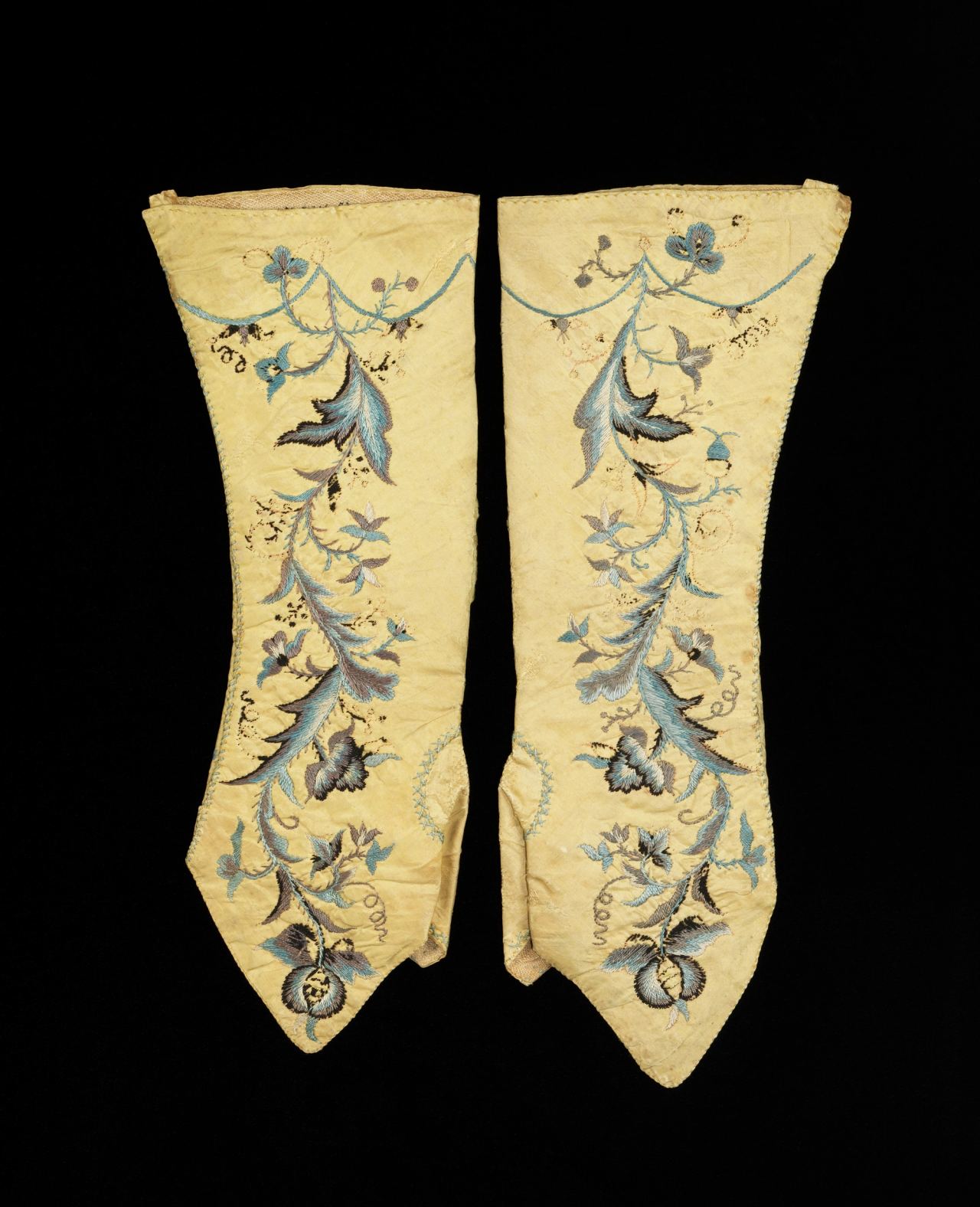
The pair above, in the Metropolitan Museum of Art, is catalogued as British, first quarter of the 18th century, in silk. Each mitt is embroidered with a spray of blue and grey leaves and flowers running up the arm and ends in a pointed flap. The 18th Century Notebook, a compilation of research on mitts, quotes the Met's note on the pair: the design is worked in a naturalistic style, with gradated colour that adds depth and richness, and the underside of the V-shaped extension, which would not have been visible, carries its own floral embroidery.
That detail is worth pausing on. Someone embroidered a part of the mitt that nobody was meant to see.
How were mitts made?
Both ways, and the sources show two quite different crafts. The mitts at Colonial Williamsburg, shown to Scott by the museum's associate curator, were hand-knitted in very fine linen thread on very small needles, at a gauge of about 22 stitches per inch. They were knitted seamlessly, with decreases to narrow the wrist and further decreases and increases to make the open thumb and the pointed flap over the back of the hand. Scott points out that modern knitters will understand how delicate that is, and that needles and yarn of that size are no longer commercially available.
Cloth mitts were cut and sewn. The 18th Century Notebook reproduces the diagrams for leather mitts from Diderot and d'Alembert's Encyclopédie of 1765: a main piece, a lining for the point, and a separate thumb, with the finished plain mitt and a finished embroidered one.
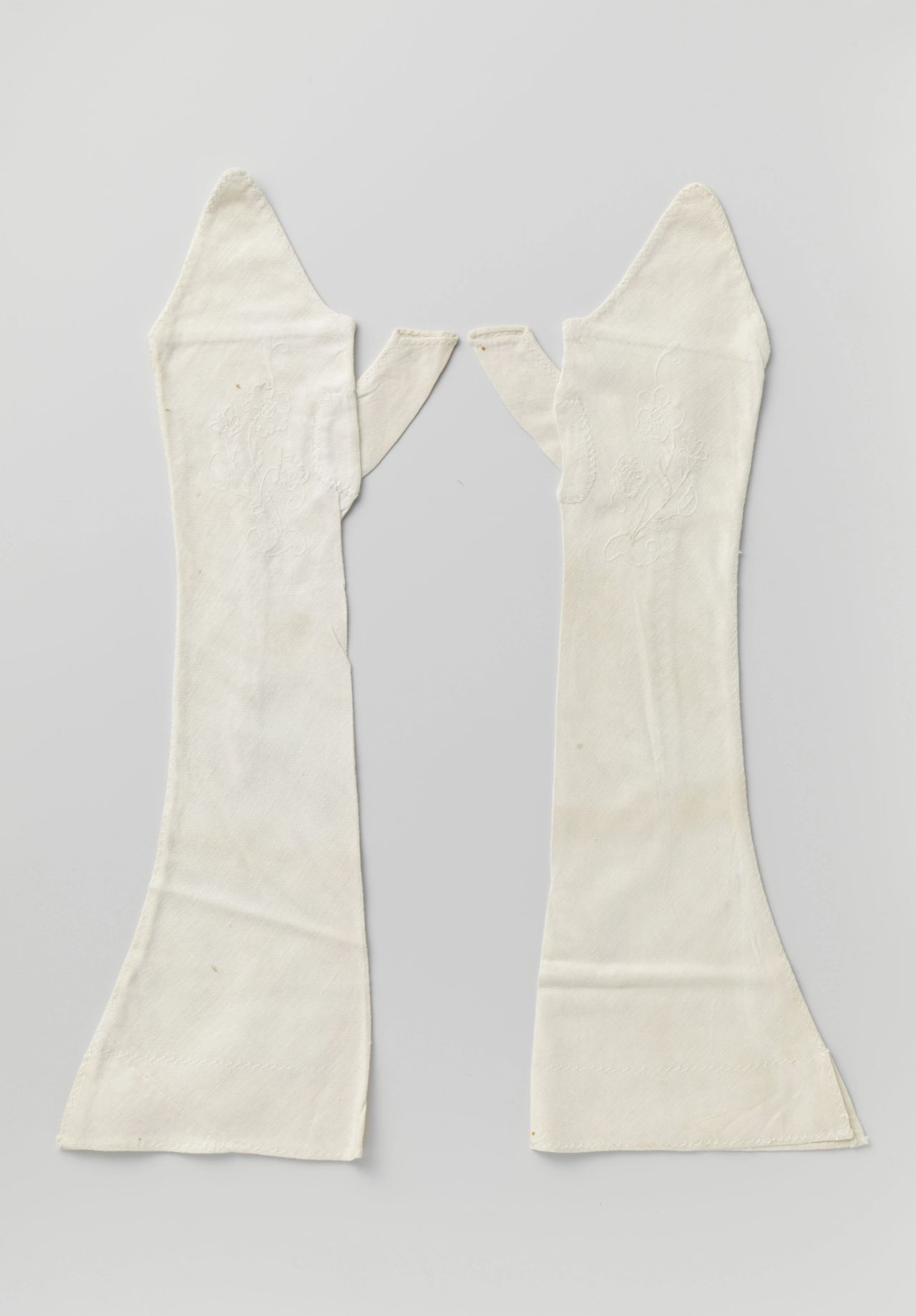
The Rijksmuseum's Dutch pair, from about 1807 to 1825, shows the cut-and-sewn kind. The museum's catalogue describes them as white twill cotton embroidered with white floss silk in a floral motif, with flannel stitch, a decorative stitch, cut from one piece with a separately set thumb. The second of the pair measures 43 centimetres long by 16 wide. The museum notes that cotton was chosen because it was easy to wash, and that such mitts were worn summer and winter.
Who wore them, and where did they buy them?
The Notebook cites a 1786 Philadelphia advertisement that offered "Women and girls black and coloured worsted gloves and mitts" alongside lamb gloves and mitts and black and coloured silk gloves and mitts, which suggests that mitts were sold in several grades of material at once. The Notebook adds, without citing a source, that different styles seem to be associated with different sorts of women, and that simpler linen or cotton pairs were linked with Quakers; treat that as a lead, not a finding.
Initials are another sign of ownership. The Colonial Williamsburg pair has initials worked in cross-stitch in silk thread at the top of each mitt: AS, for Abagail Steere Fowler (1775–1860), who was the original owner and possibly the maker. If she knitted them herself, Scott observes, she was both industrious and had the leisure to spend on a fashionable accessory. For the matching story of pockets marked with names, see Tied On, Not Sewn In.
Did mitts survive into the 19th century?
Yes, and they got longer. The Met's pair of American evening mitts from 1888 is silk and reaches far up the arm, each with a small thumb opening near the top, a different object from the short, pointed mitts of the 1700s but the same idea of covering the arm and leaving the hand free.
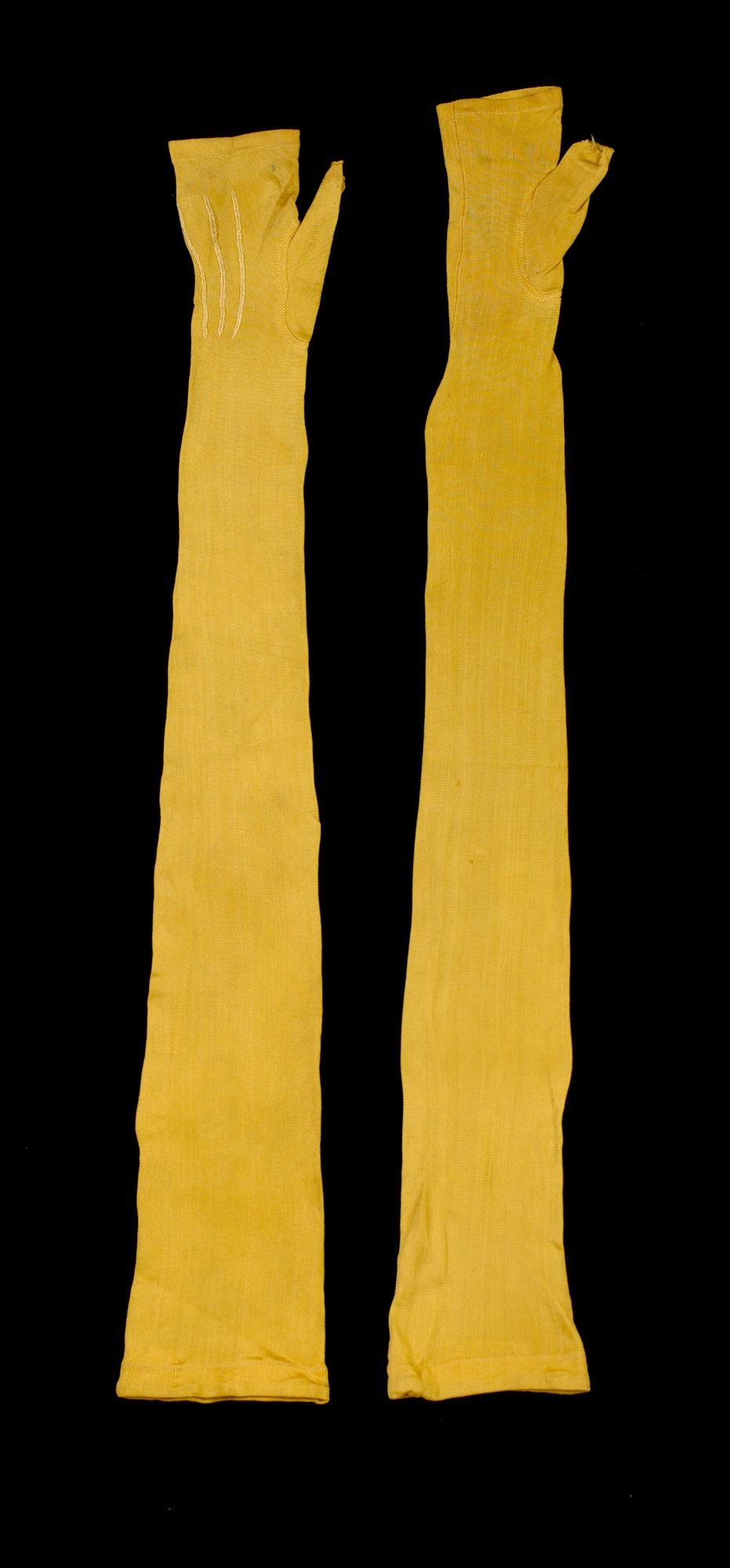
Later still, the Rijksmuseum catalogues a knitted white cotton glove with open fingertips from about 1850 to 1900, western European, 40 centimetres long and 11 centimetres wide. The museum's description notes three double lines on the back of the hand.
| Object | Date | Material | Holder |
|---|---|---|---|
| Mitts, British | first quarter of the 18th century | Silk, embroidered | The Met, 2009.300.2673a, b |
| Mitts, Colonial Williamsburg | date not given in the source | Hand-knitted linen, about 22 stitches per inch | Colonial Williamsburg |
| Mitaines, Dutch | about 1807–1825 | White cotton twill, silk embroidery | Rijksmuseum, BK-KOG-88-A/B |
| Evening mitts, American | 1888 | Silk | The Met, 2009.300.4870a, b |
| Glove with open fingertips, western European | about 1850–1900 | Knitted white cotton | Rijksmuseum, BK-NM-10304 |
Where can you see them?
The Met's mitts have open-access images online, and the Rijksmuseum publishes its mitts as public-domain images. For another accessory that said something about the woman wearing it, see A Lady's Apron Was Not for Work.
Sources
- Pair of mittens (mitaines), c. 1807–1825, BK-KOG-88-A and B. Rijksmuseum (linked-art record; CC0 data). Use for daily household work, cotton for washing, summer and winter; materials, construction, dimensions Accessed October 15, 2026.
- Knitted Mitts, and the 18thc Women Who Wore (and Didn't Wear) Them. Susan Holloway Scott (author blog, reporting a Colonial Williamsburg object shown by its associate curator). Elbow-length sleeves; forearm cover, fingers free; linen at about 22 stitches per inch; initials AS Accessed October 15, 2026.
- 18th Century Women's Mitts. 18th Century Notebook (research compilation). Encyclopédie (1765) diagrams; 1786 Philadelphia advertisement; Met note on 2009.300.2673a, b (secondary quotation) Accessed October 15, 2026.
- Mitts, British, first quarter of the 18th century (2009.300.2673a, b). The Metropolitan Museum of Art. Date, material, credit Accessed October 15, 2026.
- Evening mitts, American, 1888 (2009.300.4870a, b). The Metropolitan Museum of Art. Date, material, credit Accessed October 15, 2026.
- Glove with open fingertips, c. 1850–1900 (BK-NM-10304). Rijksmuseum. Knitted white cotton, dimensions Accessed October 15, 2026.
Glossary
Last updated · Markdown · Report an error