Dress
Did Queen Victoria Invent the White Wedding Dress?
Did Queen Victoria start the white wedding dress trend? No: brides wore white and cream decades before 1840. Her plain white satin and Honiton lace gave the custom its most famous example.
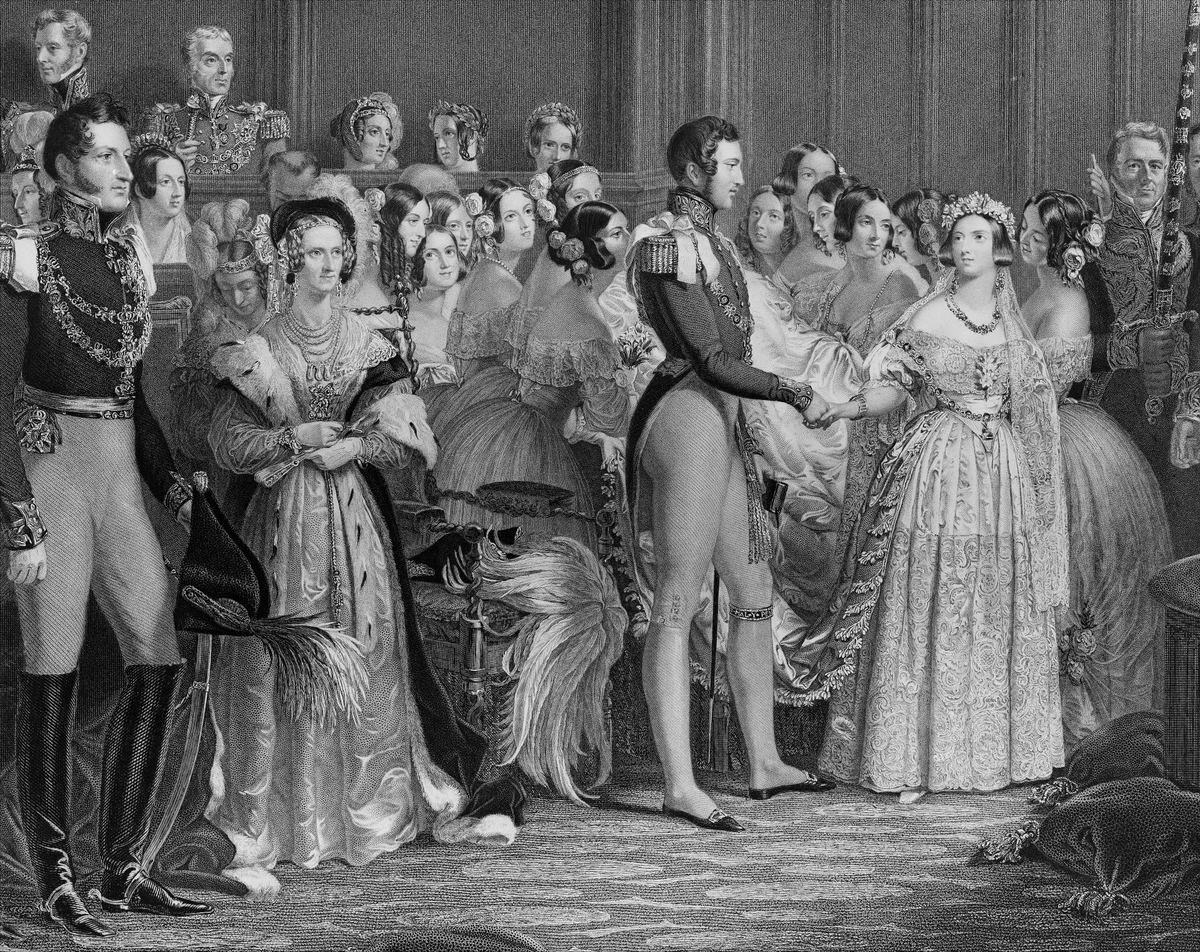
No. Brides who could afford it were marrying in white or cream decades before Queen Victoria married Prince Albert on 10 February 1840, and earlier royal brides had worn white too, often worked with silver or gold. What Victoria changed was the example: a reigning queen in plain white satin and English lace, reported in newspapers on both sides of the Atlantic and reproduced in prints.
Did Queen Victoria start the white wedding dress?
She did not start it, but she gave it its most famous example. The Victoria and Albert Museum notes that white muslin wedding dresses were especially fashionable from 1790 to 1810, which helped establish white as the proper choice for well-to-do young women marrying for the first time. Surviving dresses bear this out, and several are dated by the wedding they were worn at.
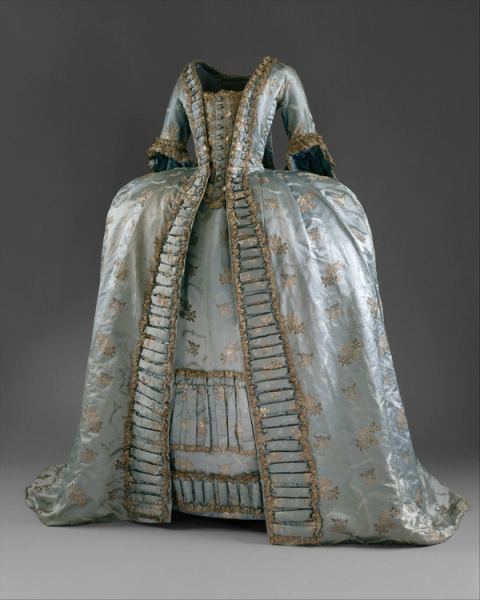
Mary Dalton Norcliffe wore embroidered white muslin to marry in York on 11 June 1807. Eliza Larken wore a white striped silk to marry in London on 8 May 1828, and the V&A calls her color "a fashionable choice." The Metropolitan Museum of Art holds a cream silk wedding dress dated 1824, trimmed with sheer leaf shapes. All three predate Victoria's wedding by twelve years or more.
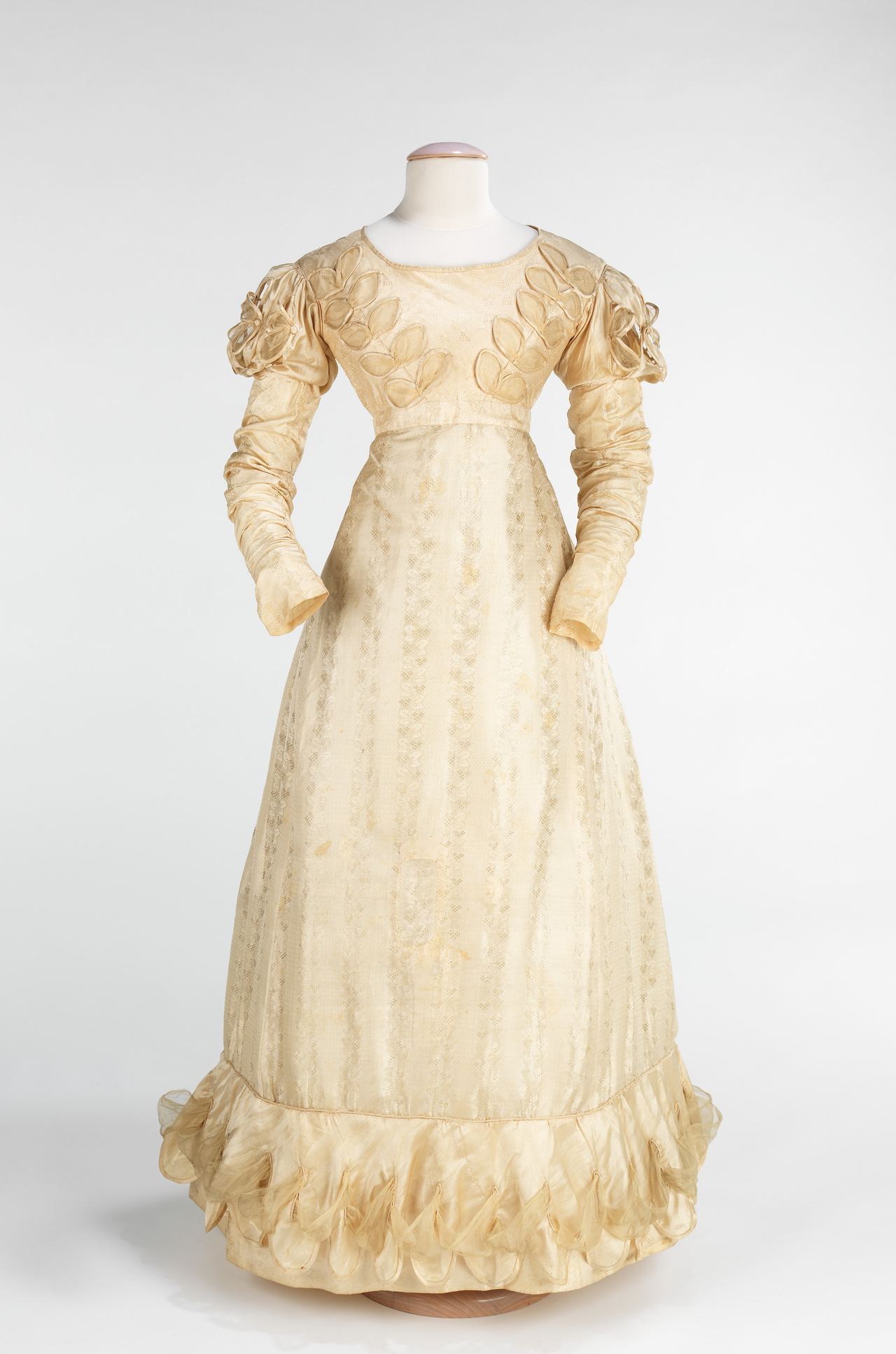
Why white? The V&A's answer is that it implied "purity, cleanliness and social refinement." It was also hard to keep. The Fashion History Timeline of the Fashion Institute of Technology argues that white signaled wealth precisely because it was impractical to keep clean, and keeping white linen white took the weekly labor described in Monday Was Wash Day.
Not every bride chose it. The V&A observes that widows, older brides and women with less money often chose colored gowns that could be worn as Sunday best afterward. Its collection includes a printed cotton dress worn at a Lincolnshire wedding on 27 July 1841, which the museum reads as the kind of dress a rural laborer's wife might choose. Earlier, in 1776, an American bride married in the fawn-colored patterned silk now at the Met.
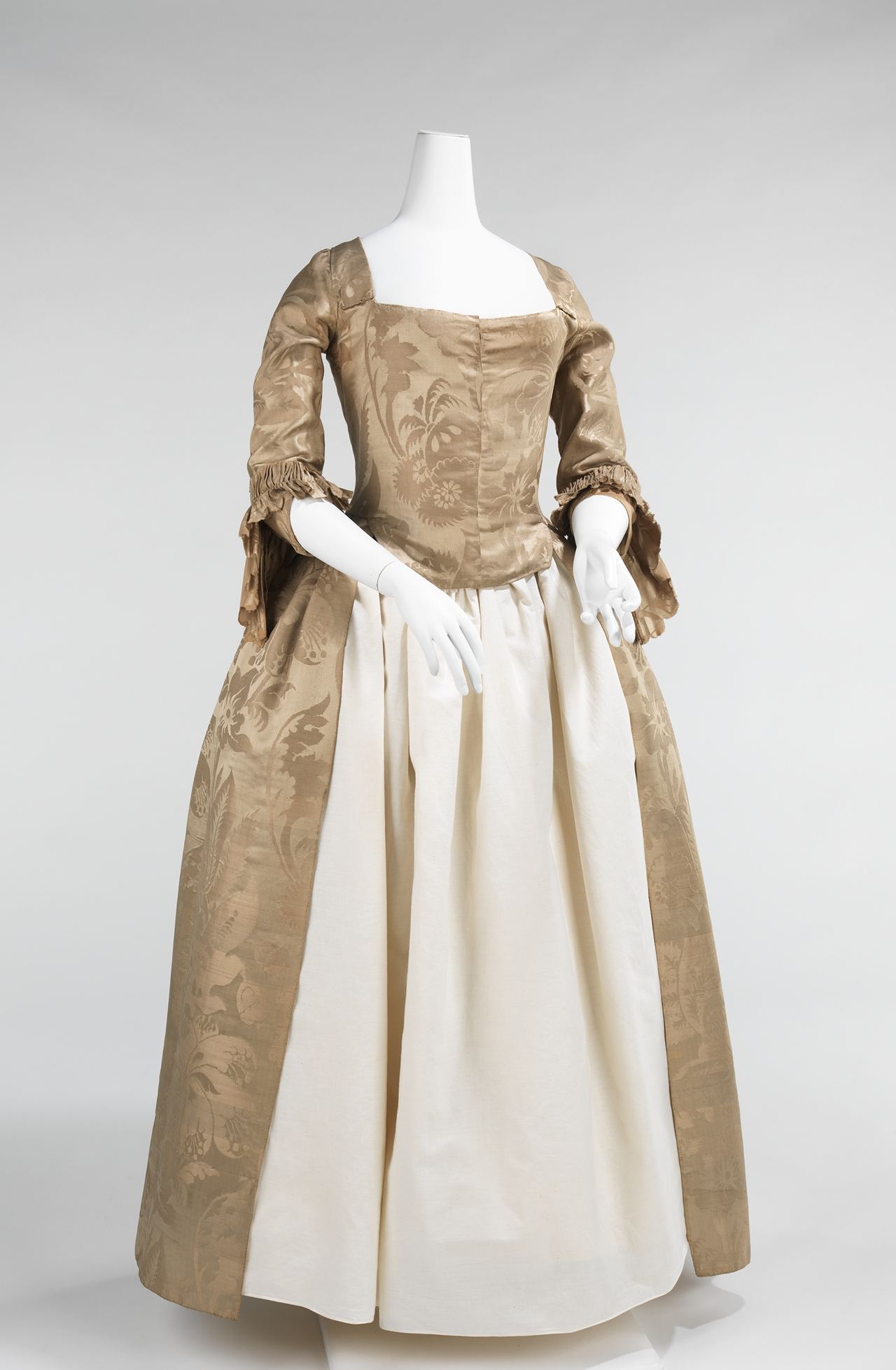
What did royal brides wear before Victoria?
Mostly silver, sometimes white. The closest precedent was Princess Charlotte of Wales, the "presumptive Heiress" to the throne in the words of the British Lady's Magazine, who married Prince Leopold of Saxe-Coburg at Carlton House on 2 May 1816. Contemporary descriptions dressed her almost entirely in silver.
The magazine's June 1816 issue described a net of "silver lama" over "a rich silver tissue slip," a border of silver embroidery "forming shells and bouquets," point Brussels lace on the bodice and sleeves, and a mantle of silver tissue lined with white satin. The dress survives in the Royal Collection, which describes it as the only royal wedding dress to survive from the Georgian period, though its skirts and train may not be original to it.
White itself was not new for royal brides either. The V&A notes that earlier royal brides had worn white, but in dresses often woven or heavily embroidered with gold or silver. The best-known case is Mary, Queen of Scots, who married the French dauphin at Notre-Dame in Paris on 24 April 1558. In Agnes Strickland's 1850 translation of the official account, she wore "a robe whiter than the lily," with a mantle and train of bluish-gray velvet embroidered with white silk and pearls.
What did Victoria actually wear?
She wore white silk satin with a deep flounce of English handmade lace and a wreath of orange flowers. Her journal for the wedding day reads: "I wore a white satin gown with a very deep flounce of Honiton lace, imitation of old." She added her Turkish diamond necklace and earrings and a sapphire brooch from Albert.
Her twelve train-bearers, she wrote, were "dressed all in white with white roses." The press added detail. A report reprinted in American newspapers that spring said the satin "was manufactured in Spitalfields," London's old silk-weaving district, and that "the cost of the lace alone on the Queen's dress was £1000." The train was white satin lined with white satin and trimmed with orange blossoms.
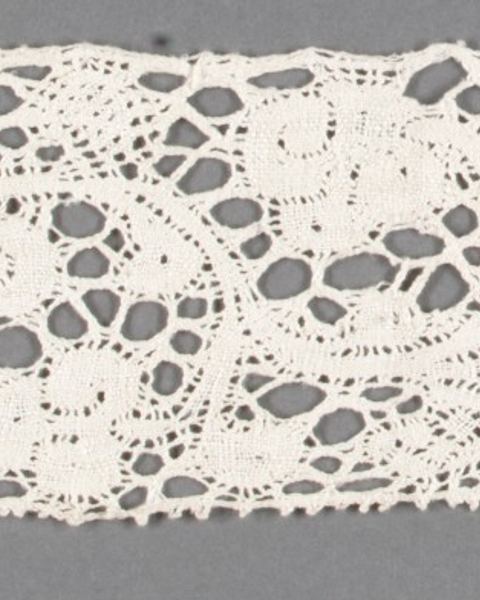
The lace was the political part. Honiton lace is a bobbin lace from east Devon, and the Royal Collection notes that Victoria commissioned it when Brussels lace was the fashion, reviving a struggling local trade. The Royal Collection describes the lace design as partly by the painter William Dyce, and the dress as probably made by Mary Bettans, her longest-serving dressmaker. According to Mrs. Bury Palliser's History of Lace, the necessary number of workers could be found only with difficulty. The work was undertaken by Miss Jane Bidney and carried out in the fishing village of Beer and its surroundings, and the patterns were destroyed as soon as it was done. For how to tell handmade lace like this from machine imitations, see Handmade or Machine? How to Read a Piece of Lace.
One detail complicates the picture of a dazzling white gown. Victoria and the press called the satin white, but the Royal Collection now catalogs the surviving dress as cream silk satin, and the V&A calls it ivory.
How did white become the rule?
Through print, and slowly. Within weeks, American papers carried the description of "The Queen's Dress": The Phenix of Bristol, Rhode Island, on 14 March 1840, the Herald of the Times in Newport on 26 March, and the Hawk-eye and Iowa Patriot in Burlington, Iowa Territory, on 2 April. Engravings followed, such as the 1844 print of the ceremony by Charles Eden Wagstaff after Sir George Hayter, shown at the top of this page.
By August 1849, Godey's Lady's Book in Philadelphia gave American readers the rule outright: "Custom has decided, from the earliest ages, that white is the most fitting hue, whatever may be the material." The same column noted that orange flowers had "recently driven all other floral competitors from the throne." The magazine credited ancient custom, not the queen, though orange blossoms were exactly what Victoria had worn.
The V&A puts the effect carefully: after 1840, white "became established as a fashionable colour for bridal gowns." Fashionable is not universal. The museum adds that many 19th-century brides still chose colored day dresses they could wear again, and its later dresses show the range: a pale gold silk velvet bought at the London department store Debenham & Freebody for a wedding in January 1926, and a blue figured silk worn by Lady Cornwallis at her second marriage in February 1948. Our sources do not pin down a single decade when white became the near-universal default, so we do not offer one.
Victoria also kept her own example in view. The Royal Collection notes that she reused the lace design throughout her life and insisted that Honiton lace trim the wedding dresses of her daughters-in-law. Palliser records Honiton lace on the bridal dresses of the Princess Royal, Princess Alice and the Princess of Wales. A royal habit repeated for decades is easy to mistake for an invention.
Where can you see these dresses?
Victoria's dress is in the Royal Collection (RCIN 71975), with an online record at the Royal Collection Trust. The 1824 and 1776 wedding dresses shown here are in the Brooklyn Museum Costume Collection at The Metropolitan Museum of Art. The 1807, 1828 and 1841 dresses are at the V&A in London. For more white wedding dresses made before 1840, the Met's costume records are a good place to start: a French white cotton wedding dress of about 1837 is among them.
Sources
- The Girlhood of Queen Victoria, vol. 2 (ed. Viscount Esher, 1912), pp. 318–319: journal for 10 February 1840. John Murray / Internet Archive. Full text read (djvu text of the 1912 edition): white satin gown, deep flounce of Honiton lace 'imitation of old', orange-flower wreath, jewels, twelve train-bearers in white with white roses. Accessed October 22, 2026.
- Mary Bettans, Queen Victoria's wedding dress, 1840 (RCIN 71975). Royal Collection Trust. Full record read: cream silk satin with Honiton lace; Honiton chosen over fashionable Brussels lace, reviving the trade; lace partly designed by William Dyce; design reused; Honiton for daughters-in-law; probably made by Mary Bettans. Text adapted from Kay Staniland, In Royal Fashion (1997). Accessed October 22, 2026.
- The Phenix (Bristol, R.I.), 14 March 1840, p. 3: 'The Queen's Dress'. Library of Congress, Chronicling America. OCR text read: white satin, Honiton lace, orange blossoms, lace £1000, satin 'manufactured in Spitalfields'. Accessed October 22, 2026.
- Herald of the Times (Newport, R.I.), 26 March 1840, p. 4: 'The Queen's Wedding Dress'. Library of Congress, Chronicling America. OCR text read: same paragraph as The Phenix, reprinted. Accessed October 22, 2026.
- The Hawk-eye and Iowa Patriot (Burlington, Iowa Territory), 2 April 1840, p. 3. Library of Congress, Chronicling America. OCR text read (poor OCR): the same 'Queen's Dress' paragraph, incl. Spitalfields. Accessed October 22, 2026.
- The Gentleman's Magazine, March 1840 (vol. 13), Historical Chronicle, Feb. 10. Internet Archive. Full text read: marriage solemnized at the Chapel Royal, St James's, 10 February 1840. Accessed October 22, 2026.
- The British Lady's Magazine, June 1816: 'Wedding Dresses' and 'Marriage of the Princess Charlotte'. Internet Archive. Full text read: Princess Charlotte's silver lama net over silver tissue, silver embroidery, Brussels point lace, manteau of silver tissue lined with white satin; 'presumptive Heiress'. Accessed October 22, 2026.
- The Gentleman's Magazine, May 1816 (vol. 86), Domestic Occurrences. Internet Archive. Full text read: marriage of Princess Charlotte and Prince Leopold at Carlton House, Thursday 2 May 1816. Accessed October 22, 2026.
- Princess Charlotte's sparkling silver wedding gown goes on display at Buckingham Palace (April 2023). The Court Jeweller. Article read: quotes the Royal Collection ('the only royal wedding dress that survives from the Georgian period'; skirts and train may not be original); date 2 May 1816. Accessed October 22, 2026.
- Agnes Strickland, Lives of the Queens of Scotland, vol. 3 (1850), p. 78. Internet Archive. Full text read: wedding of Mary Stuart, 24 April 1558, Notre-Dame; her translation of the Hôtel de Ville chronicler: 'a robe whiter than the lily', bluish grey velvet mantle with white silk and pearls. Original 1558 Discours not reachable (NLS captcha); claim attributed to Strickland's translation. Accessed October 22, 2026.
- 24 April 1558 – The marriage of Mary, Queen of Scots and the Dauphin of France. The Tudor Society. Article read: date 24 April 1558, Notre-Dame, Paris (second source for the date; its dress description derives from Strickland). Accessed October 22, 2026.
- Godey's Lady's Book, vol. 39, August 1849, p. 156: 'Etiquette of Trousseau: The Bride's Dress'. Internet Archive. Full text read (scan OCR): 'Custom has decided, from the earliest ages, that white is the most fitting hue, whatever may be the material'; orange flowers 'recently driven all other floral competitors from the throne'. Note: the often-quoted 'emblem of the purity and innocence' reverses the original 'innocence and purity'; not quoted. Accessed October 22, 2026.
- Mrs. Bury Palliser, History of Lace (revised by M. Jourdain and A. Dryden, 1902), pp. 406–409. Project Gutenberg (eBook #57009). Full text read: workers hard to find; Miss Jane Bidney; Beer and its environs; dress cost £1,000; patterns destroyed; Honiton for Princess Royal, Alice, Princess of Wales. Accessed October 22, 2026.
- Wedding dress, 1865, T.43-1947. Victoria and Albert Museum. Record read (web and API): white or cream usual by 1800, 'purity, cleanliness and social refinement'; Victoria's 'simple ivory satin dress'; earlier royal brides wore white woven or embroidered with gold or silver; widows, older and less well-off brides chose colored gowns. Accessed October 22, 2026.
- Wedding dress, ca. 1807, worn by Mary Dalton Norcliffe, T.12-2013. Victoria and Albert Museum. API record read: white muslin wedding dresses fashionable 1790–1810; York wedding 11 June 1807. Accessed October 22, 2026.
- Wedding dress, 1828, worn by Eliza Larken, T.124-2009. Victoria and Albert Museum. API record read: white striped silk; London wedding 8 May 1828; 'a fashionable choice'. Accessed October 22, 2026.
- Wedding dress, 1841, worn by Sarah Maria Wright. Victoria and Albert Museum. API record read: block-printed cotton, Skirbeck, Lincolnshire, 27 July 1841; rural laborer's wife. Accessed October 22, 2026.
- Wedding dress, 1843, T.30-1945. Victoria and Albert Museum. API record read: after 1840 white 'became established as a fashionable colour for bridal gowns'; many brides chose colored day dresses. Accessed October 22, 2026.
- Wedding dress, 1926, worn by Erica Ferguson. Victoria and Albert Museum. API record read: pale gold silk chiffon velvet, Debenham & Freebody, wedding 14 January 1926. Accessed October 22, 2026.
- Wedding dress, 1947–48, worn by Lady Cornwallis, T.295-1984. Victoria and Albert Museum. API record read: blue (faded) figured silk; second marriage, 26 February 1948. Accessed October 22, 2026.
- Charles Eden Wagstaff after Sir George Hayter, Marriage of Queen Victoria, February 10, 1840 (1844), 47.95.48. The Metropolitan Museum of Art. API record read: date, media, publisher Henry Graves & Co., public domain. Accessed October 22, 2026.
- Wedding dress, American, 1824, 2009.300.918. The Metropolitan Museum of Art. API record read; image inspected. Accessed October 22, 2026.
- Wedding dress, American, 1776, 2009.300.731. The Metropolitan Museum of Art. API record read; image inspected. Accessed October 22, 2026.
- Wedding dress, French, ca. 1837, 15.149.1a–c. The Metropolitan Museum of Art. API record read; image inspected (white cotton). Accessed October 22, 2026.
- Summer Lee, '1840 – Queen Victoria's Wedding Dress'. Fashion History Timeline, Fashion Institute of Technology. Article read: Spitalfields silk; white signaled wealth as impractical to keep clean; earlier royal brides silver or gold; used for leads (Godey's 1849, Strickland 1840). Accessed October 22, 2026.
- Queen Victoria's Wedding Lace. Textile Research Centre, Leiden (TRC Needles). Entry read: Western Times, 15 February 1840 (as quoted) on Spitalfields satin, Beer, Jane Bidney, lace cost £1000. Accessed October 22, 2026.
- Queen Victoria's Wedding Dress, 1840. White House Historical Association. Caption read: Victoria's gown 'was not the sole origin of the white wedding dress'. Accessed October 22, 2026.
- Wedding dress of Queen Victoria. Wikipedia. Used to locate references only. Accessed October 22, 2026.
Glossary
Last updated · Markdown · Report an error