Technique
Handmade or Machine? How to Read a Piece of Lace
How can you tell if lace is handmade or machine made? A field guide to threads, grounds, edges and outlines, from needle and bobbin lace to Leavers net, Schiffli embroidery and chemical lace.
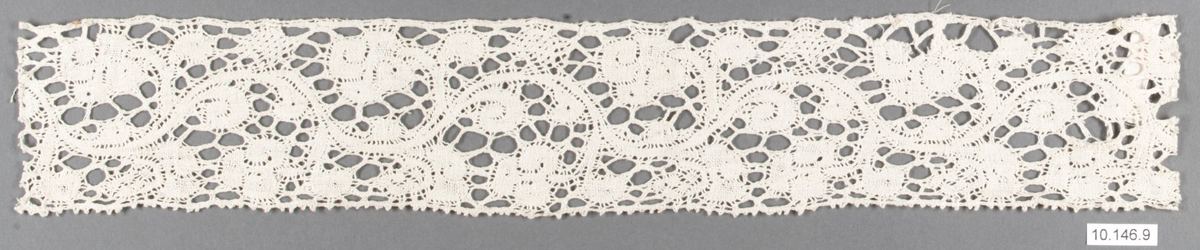
To tell handmade lace from machine lace, follow the threads. In handmade lace they trace the shapes of the pattern, and the edge grows together with the piece. In a machine imitation the threads tend to run in parallel, the meshes repeat identically, and the edge or outline is often added separately. No single sign settles the question, and the Textile Research Centre in Leiden warns that good imitations can be very difficult to tell from their handmade models.
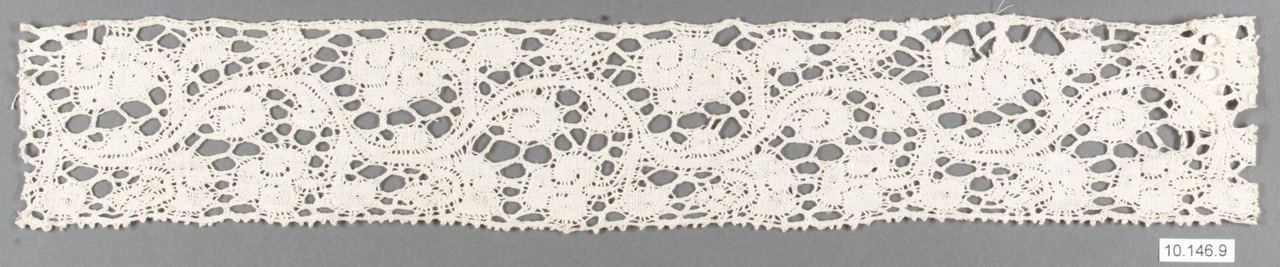
The question has a date attached. From 14 November 2026 to 11 April 2027, The Bowes Museum in County Durham shows Lace and Legacy, built on the Blackborne Collection: the stock and study collection of the Victorian dealers Anthony and Arthur Blackborne, given to the museum in 2006. The Leiden centre counts some 7,000 pieces and notes that the firm sold modern lace as well as antique lace. A dealer had to know which was which. This guide shows how to look, using Met objects you can zoom into yourself.
What is the difference between needle lace, bobbin lace and machine lace?
Needle lace is made with a single thread and one needle. Bobbin lace is made by manipulating many threads wound on bobbins. These are the two main families of handmade lace. Machine lace, made on powered equipment, appeared from the end of the eighteenth century and imitates both.
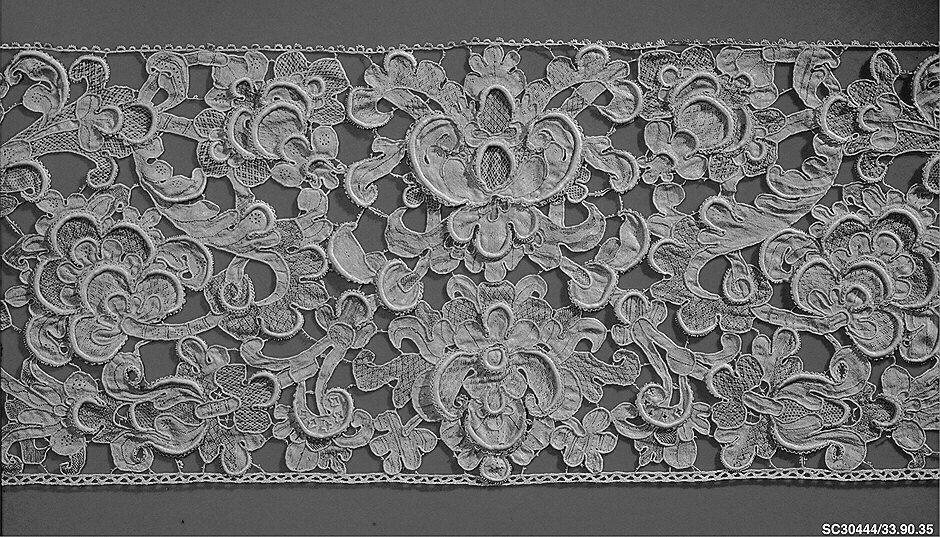
Needle lace is built from looped stitches, mostly buttonhole stitch, and its motifs are often outlined with a raised rim. A nineteenth-century needlework dictionary describes that rim as closely buttonholed over a padding of coarse thread, so its thickness depends on how much padding was run in. Bobbin lace is made over a pattern drawn on card and pricked with holes, pinned to a pillow. The lacemaker twists and crosses pairs of bobbins, setting pins as the work grows. It comes in two main forms: continuous lace, where ground and motifs are worked in one go, and non-continuous lace, where separate sprigs are made and then joined by bars or sewn onto a mesh.
How did machines learn to imitate handmade lace?
The first machine laces were plain net made from one continuous thread, with the pattern added by hand. Patterned machine lace followed from around 1840 and could imitate handwork closely. The sequence is worth knowing, because each machine leaves its own mark on the cloth.
| Date | What happened | What it leaves behind |
|---|---|---|
| 1808–09 | John Heathcoat patents a bobbin net machine; an improved version of 1809 is known as the "Old Loughborough" | Machine-made net with a regular mesh |
| 1813 | John Levers builds a single-tier version in a Nottingham garret; it is never patented | The [Leavers machine](glossary:glossary-leavers-lace), which imitates bobbin lace |
| c. 1835–40 | Jacquard punched cards and pierced bars let machines make patterned lace | Net and pattern made in one process |
| 1863–64 | Isaak Gröbli builds the first [Schiffli](glossary:glossary-schiffli-embroidery-machine) embroidery machine in Switzerland | Machine embroidery with a lockstitch |
| 1880s | Embroidery on a dissolvable ground becomes [chemical lace](glossary:glossary-chemical-lace) | Lace with no net or ground thread at all |
Heathcoat's story has a violent chapter. On the night of 28 June 1816 an armed gang attacked his Loughborough factory, destroyed fifty-five frames and burned the lace on them. He moved the business to a mill at Tiverton in Devon. Levers, by contrast, worked secretly and did not patent his machine, according to William Felkin's 1867 history of the trade. Felkin also records how good the best nets became: he calls one 1822 machine net "scarcely distinguishable from pillow work in the mesh."
What should you look for under a loupe?
Check five things: the filling, the outline thread (gimp), the ground, the edge and the two sides. These are the categories the Textile Research Centre uses in a digital exhibition that sets seven handmade laces beside machine copies. Use a loupe or a phone's macro mode, good light and a dark cloth behind the lace.
| Feature | Handmade bobbin lace | Machine imitation |
|---|---|---|
| Solid areas (filling) | Clear passage of threads that follow the shape; pinholes around the solid parts | Threads more parallel, V-shaped movements, hard to trace, no pinholes |
| Outline (gimp) | Outlines the pattern and shows on both sides | Often absent, or only on the front; may have been darned in by hand |
| Ground | Slightly irregular, with a twist in the hexagonal mesh | Meshes look identical across large plain areas; one side of each mesh may be a V-shaped stitch |
| Edge | Scallops and picots made together with the lace | Straight, produced separately and added later |
| Sides | Same on both sides | A distinct front and back, shown by a raised gimp |
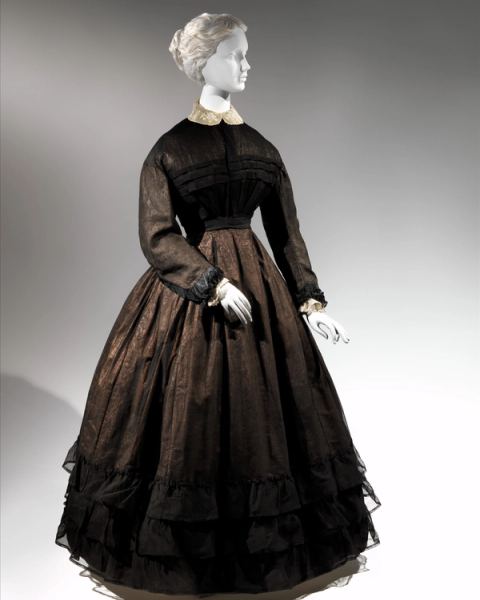
Read the table as odds, not rules. The Leiden curators also record a black Chantilly copy made on the Pusher machine, which "perfectly imitates" the handmade ground and looks the same from both sides, and an outline darned in by hand that looks like the real thing. Where black lace like this was worn, see Victorian mourning dress, whose later stages admitted lace. Repeats are a weak test too. Bobbin lacemakers work from a pricked pattern, so a motif recurs by design. Look instead at what happens inside each repeat.
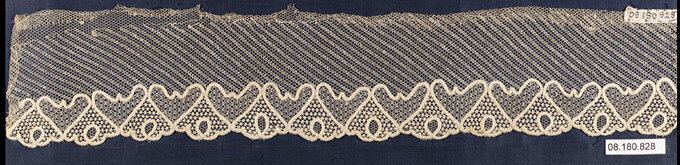
The machine net above is catalogued by the Met as "Tulle", and a tulle ground can be machine made or handmade, according to Leiden. Its even mesh runs in diagonal bands. That regularity over a wide plain area is the kind of evidence to look for, and handmade grounds tend to be less even.
How do you spot Schiffli and chemical lace?
Chemical lace, also called burnt-out or Swiss lace, is machine embroidery on a ground that is later dissolved. It was developed in Germany and Switzerland in the 1880s. A cotton design is stitched on silk, and caustic soda or chlorine removes the silk, leaving the cotton design behind. The Fitzwilliam Museum catalogues a fragment dated about 1880 to 1899 as chemical lace.
The tell is the stitch. Needle lace is made of buttonhole stitches. The embroidery machine instead makes small zigzag lockstitches, because the Schiffli machine, built by Gröbli in 1863–64, carries a continuous needle thread on top and a bobbin in a shuttle underneath. Leiden describes chemical lace as looking neat from a distance but fuzzy at the outlines under magnification, with no clear stitches or individual threads to follow.
In Leiden's pairs, a handmade Venetian-style needle lace has bars that look "solid and regular", with even buttonhole edges, while the chemical lace's bars are loose and lack a common structure. The raised work in the machine copy is rows of dense stitches lying on the same surface as the rest of the pattern. In the handmade piece it is a separate layer on top. The sides test is unreliable here: one of Leiden's chemical laces has a distinct front, another does not.
What do ground, toile, cordonnet and picot mean?
- Ground: the groundwork of the lace, which supports and surrounds the pattern. A nineteenth-century dictionary gives the French terms fond and champ for it, and a mesh ground is a réseau.
- Toile: in lace, the solid pattern worked on the ground. The word has a different meaning in tailoring, where a toile is a trial garment.
- Cordonnet and gimp: the thread that outlines the motifs. In needle lace it is a raised, buttonholed cordonnet. Leiden uses gimp for the outline thread seen mostly in bobbin lace.
- Picot: a small loop on the edge of lace. A picot can be made as part of the lace or sewn on separately, which is why its construction helps date and identify a piece.
What can fool you?
Hybrids are the main trap. Leiden's reference pages describe hand-stitched designs on machine net, and its exhibition shows machine lace with a hand-darned outline.
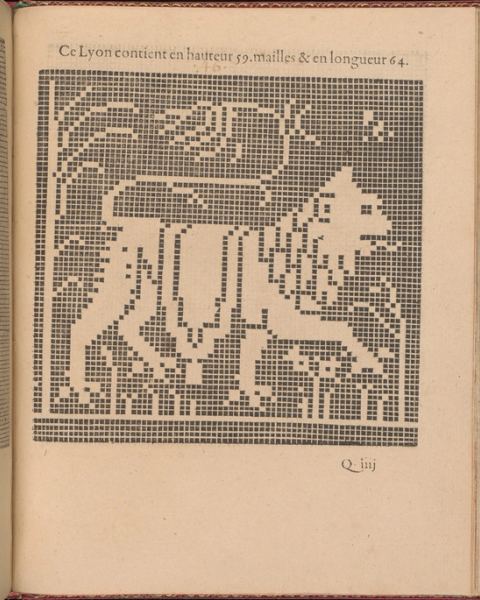
- Handwork on machine net. Embroidered net laces such as Limerick and Coggeshall use machine-made net with a hand-worked design. The net itself may be hand-knotted filet instead, the same net as in the pattern chart discussed in This Lion Is 59 Meshes Tall, also known as lacis.
- Appliqué on net. In appliqué net lace, handmade motifs are stitched onto a net. Early examples used handmade net, later ones tend to use machine net, and machine copies of muslin appliqué were widely made in Switzerland by the later nineteenth century.
- Tape lace. In North America, tape lace made from machine-woven tape is sometimes called Honiton. Real Honiton lace, Leiden notes, is made with bobbins.
- Alterations. The Bowes Museum calls a 1635 cloak band "thought to be the only example of this style that is genuine and unaltered", Alteration is a fair question to ask of any old piece.
- Photographs. The two Met pieces below are both sheer nets with floral sprays. The Met catalogs the first as machine net and the second as bobbin lace. Both carry a "Purchase by subscription, 1909" credit, and the records give only the medium and a century. From a photograph alone you cannot tell what did the work in the flowers; the lace in your hand can.
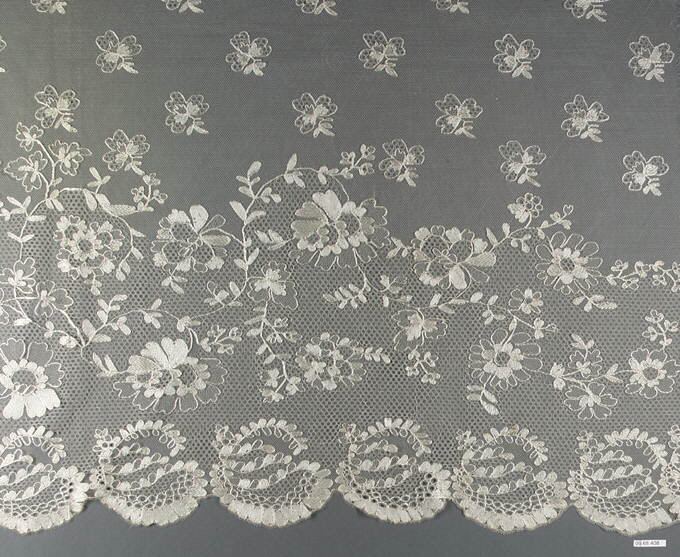
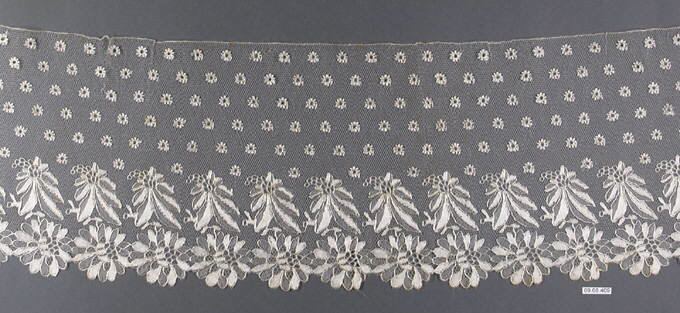
The Met's 1909 subscription is connected to the Blackborne story: its Bulletin of that year reports that the museum acquired the Blackborne Collection soon after a subscription list opened. The object records for these two pieces do not name the dealer, so no link is claimed here.
What is a quick checklist for handmade or machine?
- Turn it over. Does the outline thread show on both sides, or only the front? Equal sides point to bobbin lace, though some machine laces and chemical laces also look the same on both sides.
- Trace a thread. In a solid area, can you follow single threads around the shape? Parallel, V-shaped runs point to a machine.
- Look for pinholes. Small holes around the edges of solid parts suggest bobbin lace worked on a pricked pattern.
- Check the stitches. Buttonhole loops suggest needle lace. Small even lockstitches and a fuzzy outline suggest chemical lace.
- Compare the mesh. Identical meshes across a large plain area favor a machine. Slight irregularity favors a hand, but machines copied that too.
- Inspect the edge. Picots grown with the piece favor handwork. A straight edge attached separately favors a machine.
- Ask whether the outline was darned in. If one part looks handmade and the rest does not, you may have a hybrid.
- Weigh the evidence. Two or three consistent signs are a good indication. Mixed signs mean a hybrid, a repair or a case for a specialist.
Where can you see handmade and machine lace side by side?
The Textile Research Centre's online exhibition Lace Identification: 7 Examples pairs a handmade and a machine-made lace in each case, with detail photographs. The Bowes Museum's Lace and Legacy runs until 11 April 2027. The Met's online collection includes many lace records with public-domain images, including the needle, bobbin and machine pieces shown here.
Sources
- Lace Identification: 7 Examples (cover page, chapters 1-7, terminology). Textile Research Centre, Leiden. Read in full: the seven handmade/machine pairs, the five categories (filling, gimp, ground, edge, sides) and the terminology page. Accessed October 17, 2026.
- A History of the Machine-Wrought Hosiery and Lace Manufactures (1867). William Felkin. Primary. Full text on archive.org searched and read: Heathcoat's patents, Levers 1813, the Luddite attack of 28 June 1816, the move to Tiverton, Jacquard fancy lace from 1835, the 1822 net 'scarcely distinguishable from pillow work in the mesh'. Accessed October 17, 2026.
- The Dictionary of Needlework (1882). Caulfeild and Saward. Primary. Full text read: Cord/Cordonnet, Edge, Fond, Toile, Picot, Entoilage. Accessed October 17, 2026.
- Bobbin lace; Appliqué net lace; Embroidered net lace; Tape lace; Lace. Textile Research Centre, Leiden. Pages read in full (based on Earnshaw, A Dictionary of Lace): pricking pattern and pins, continuous and non-continuous bobbin lace, appliqué net lace, embroidered net lace on machine net, tape lace and Honiton. Accessed October 17, 2026.
- 1625 Chemical lace. Textile Research Centre, Leiden. Read: development in the 1880s, process, fuzziness, buttonhole versus zigzag lockstitch. Accessed October 17, 2026.
- Fragment of chemical lace, T.60-1974. Fitzwilliam Museum, Cambridge. Object record read: c. 1880-1899; background dissolved by chlorine or caustic soda. Accessed October 17, 2026.
- Gröbli, Isaak. Historisches Lexikon der Schweiz. Entry read: first Schifflistickmaschine 1863-64 at Benninger, Uzwil. Accessed October 17, 2026.
- Schiffli Embroidery Machine. Textile Research Centre, Leiden. Read: Gröbli 1863, shuttle and needle thread, imitation lace forms. Accessed October 17, 2026.
- John Heathcoat 1783-1861. Knitting Together (Heathcoat Fabrics). Read: 1808 and 1809 patents, 28 June 1816 attack, move to Tiverton. Second source for Heathcoat dates. Accessed October 17, 2026.
- Lace and Legacy: Fashion Treasures from The Blackborne Collection. The Bowes Museum. Read: dates 14 November 2026 to 11 April 2027. Accessed October 17, 2026.
- The Blackborne Lace Collection. The Bowes Museum. Read: the stock of Anthony and Arthur Blackborne; the 1635 cloak band 'thought to be the only example of this style that is genuine and unaltered'. Accessed October 17, 2026.
- A. Blackborne & Company. Textile Research Centre, Leiden. Read: Anthony (1824-1878) and Arthur (1856-1952), sold modern and antique lace, 2006 gift of some 7000 pieces. Accessed October 17, 2026.
- The Blackborne Collection of Lace (May 1909). Bulletin of the Metropolitan Museum of Art. Primary. Full text read: the Museum acquired the Blackborne Collection soon after a subscription list was opened. Accessed October 17, 2026.
- Bobbin lace, 10.146.3-.6, .9. The Metropolitan Museum of Art. Object record read via the Met API (CC0); image inspected. Accessed October 17, 2026.
- Gros point needle lace border, 33.90.35. The Metropolitan Museum of Art. Object record read via the Met API (CC0); image inspected. Accessed October 17, 2026.
- Tulle, 08.180.828. The Metropolitan Museum of Art. Object record read via the Met API (CC0); image inspected. Accessed October 17, 2026.
- Flounce, 09.68.408. The Metropolitan Museum of Art. Object record read via the Met API (CC0); image inspected. Accessed October 17, 2026.
- Silk bobbin lace border, 09.68.409. The Metropolitan Museum of Art. Object record read via the Met API (CC0); image inspected. Accessed October 17, 2026.
- Lace machine; Bobbinet. Wikipedia. Used to locate references (Felkin, Earnshaw, Farrell); no claim rests on it. Accessed October 17, 2026.
Glossary
- Needle lace
- Bobbin lace
- Tulle
- Chantilly lace
- Lacis
- Cordonnet
- Picot
- Leavers lace
- Chemical lace
- Schiffli embroidery machine
Last updated · Markdown · Report an error