Tailoring
Why Did Tailors Sit Cross-Legged on the Table?
Why did tailors sit cross-legged? To hold heavy cloth up to the eye. Period doctors, dictionaries and prints show the posture, what it cost the body, and the muscle named for it.
Tailors sat cross-legged on a raised board so they could hold heavy cloth close to their eyes, with the garment resting on their lap and the table. The surgeon Charles Turner Thackrah put it plainly in 1832: on an ordinary seat a tailor could not lift the cloth high enough to see his needle.
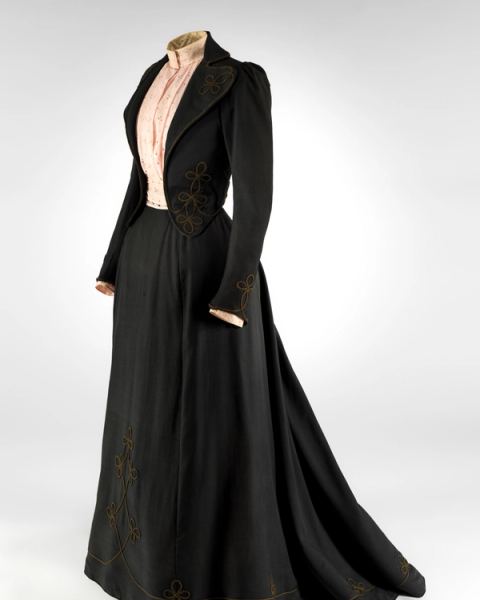
On December 12, 2026, the Palais Galliera in Paris opens Crafting Volume! Embodying Fashion, built on three pillars of fashion making: tailleur, flou and maille, or tailoring, draping and knit. The first two also name the two kinds of atelier in a couture house. The show includes tools as well as clothes, but for most of the history of tailoring one fixture of the workroom will not fit in a vitrine: the tailor himself, sitting on the table with his legs folded under him.
Why did tailors sit cross-legged?
Tailors sat cross-legged on the board because it brought the work up to the eyes. On a chair, a man sewing a heavy wool coat must lift the cloth or stoop over it; on the table, the coat lies across his knees and the board around him, leaving both hands free.
The clearest statement comes from Charles Turner Thackrah, a Leeds surgeon, in the 1832 edition of The Effects of Arts, Trades, and Professions on Health and Longevity. The tailor, he wrote, "now sits cross-legged on a board; because in the ordinary sitting posture he could not hold a heavy piece of cloth high enough for his eyes to direct his needle." Eyesight was the point: R. Campbell's The London Tradesman of 1747 says a tailor "ought to have a strong sharp Sight, which is much tryed by working at Candlelight."
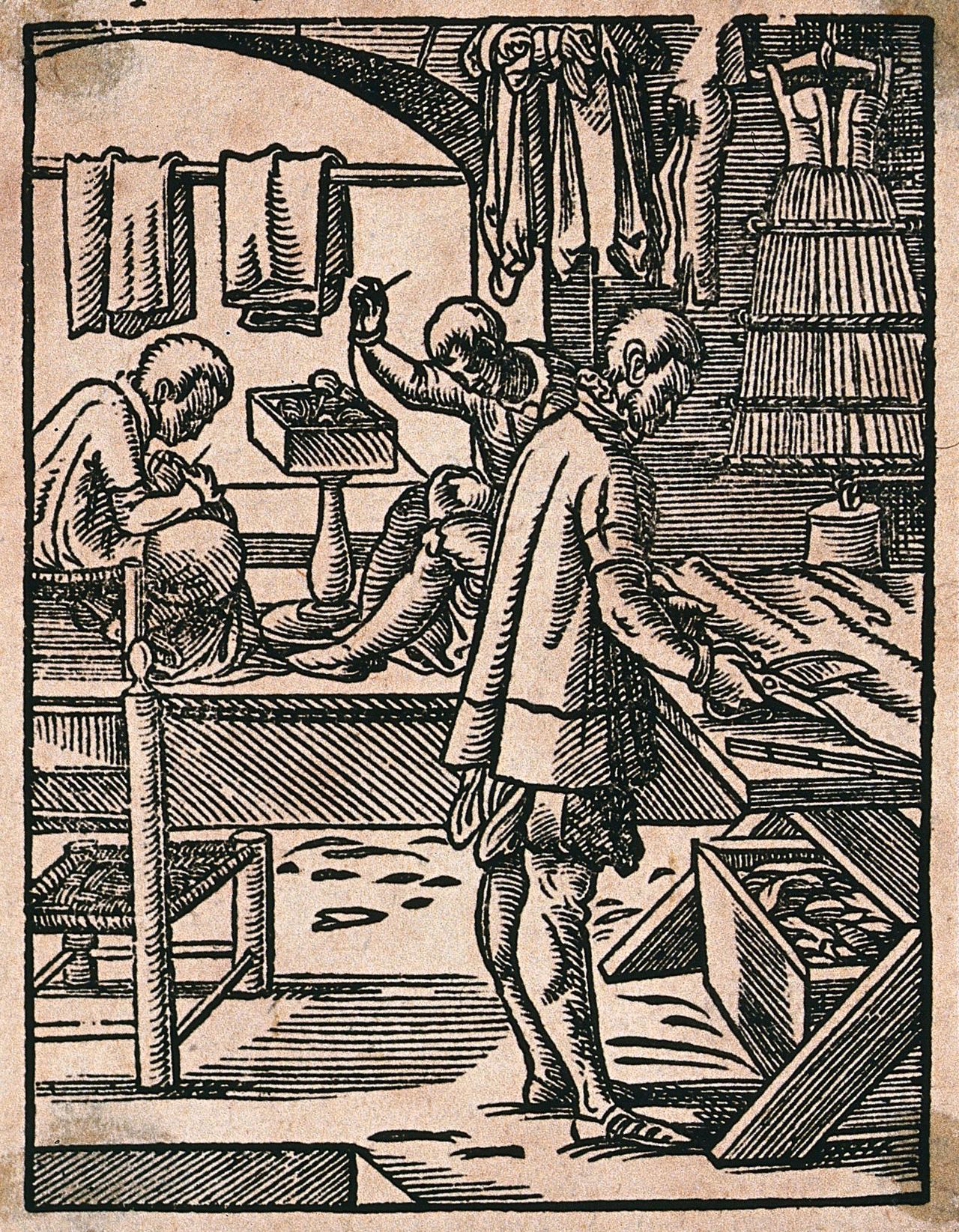
Pictures show the arrangement long before anyone explained it. In Jost Amman's woodcut of a tailor's shop, published in Frankfurt in 1568, the master stands with the shears while two journeymen appear to sit up on the long table to sew. A London painting of about 1780 in the London Museum shows apprentices and journeymen "sitting cross-legged on a bench, drinking from mugs as they sew."
What did the board look like in a working shop?
The board was a long, strong table, wide enough to cut on and to sit on. In the pictures, cutting and sewing share one surface: the cutter stands, the sewers sit.
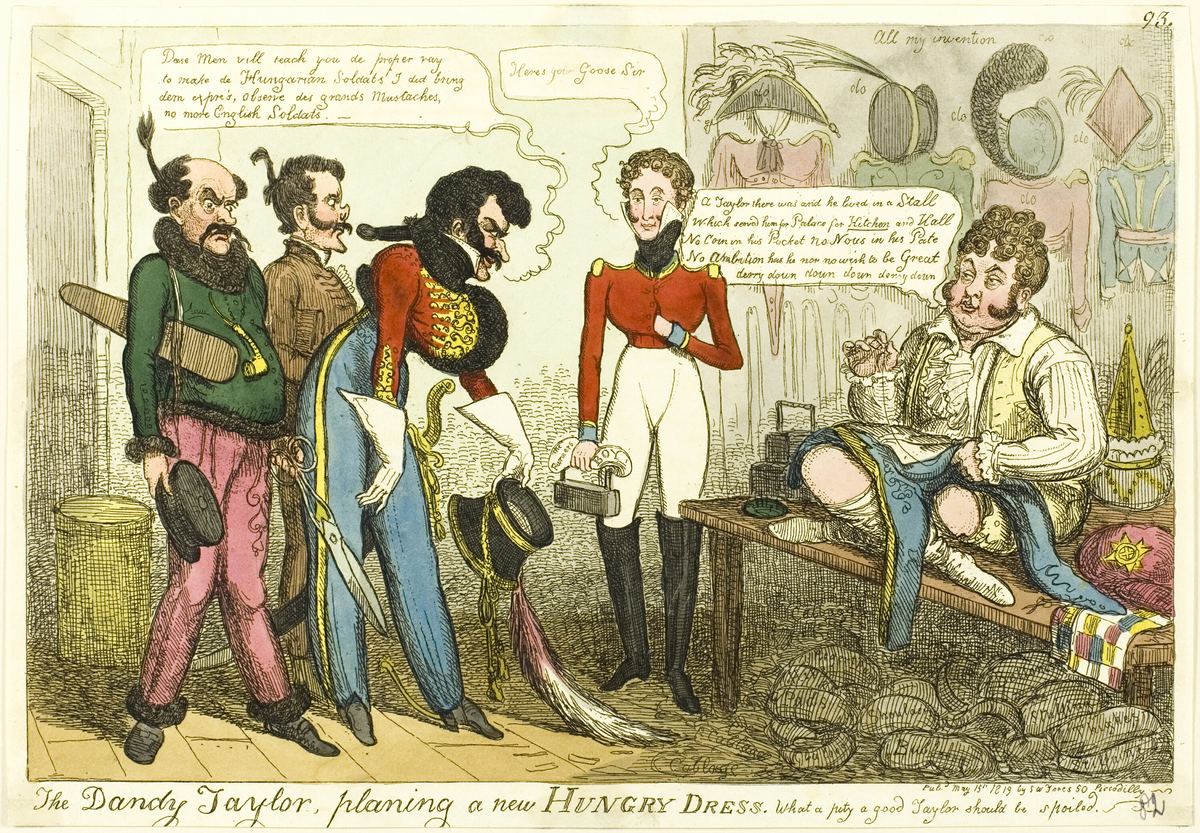
Satirists used the scene as shorthand. In The Dandy Taylor, published by S. W. Fores in London on May 15, 1819 and cataloged by the Art Institute of Chicago as the work of Isaac Robert Cruikshank, a curly-haired tailor sits up on his bench with his knees raised and a blue coat across his lap. An officer hands him an iron with the words "Heres your Goose Sir." A goose was a tailor's smoothing iron, so called, Webster's 1828 dictionary explains, because its handle resembles a goose's neck.
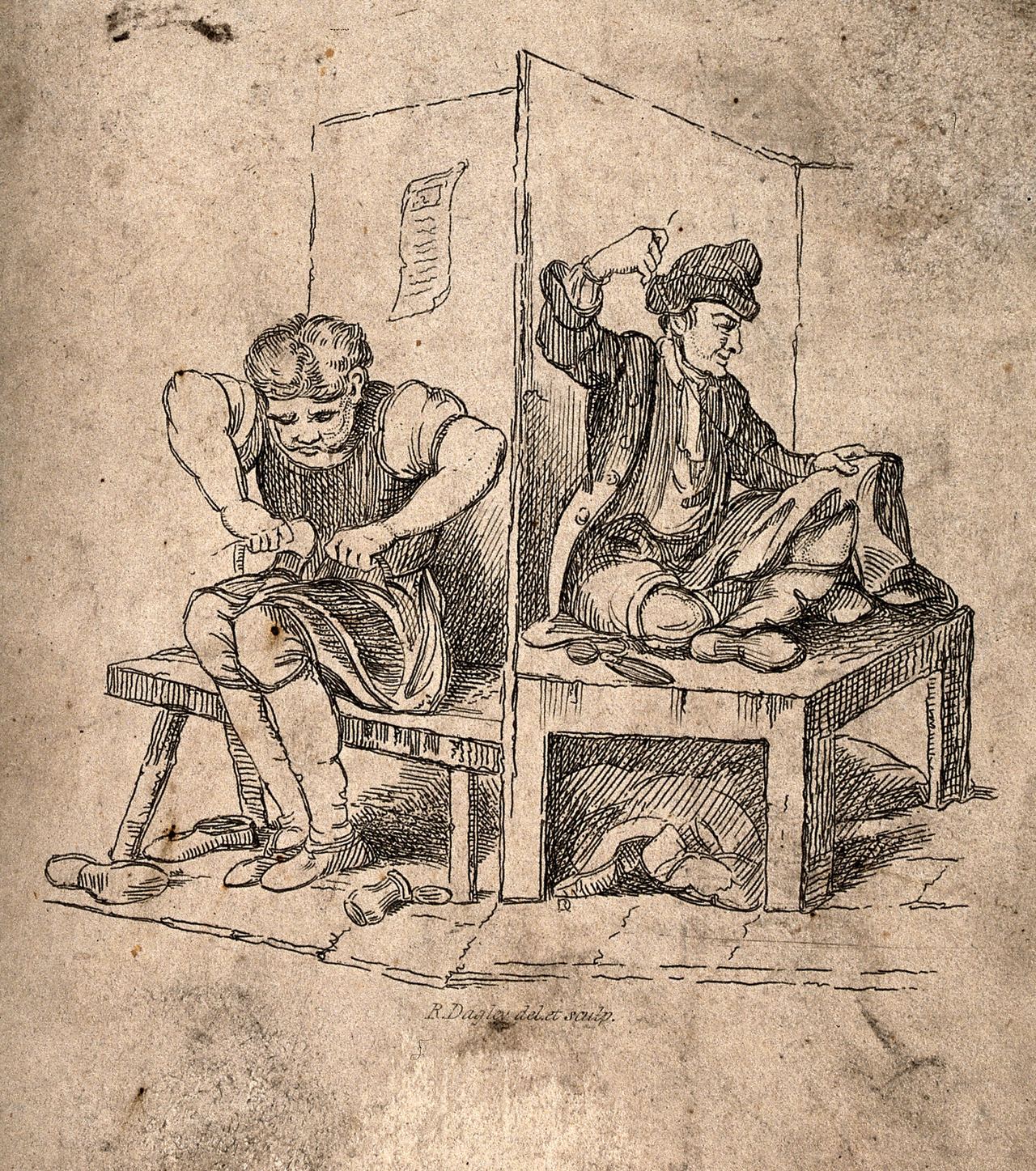
Richard Dagley's etching of a cobbler and a tailor, cataloged by the Wellcome Collection as about 1821, makes the contrast almost diagrammatic. The cobbler sits on a low bench, feet on the floor. The tailor, beyond the partition, is up on the table with his legs crossed beneath him and the garment over his lap.
What did the posture do to a tailor's body?
For at least two centuries doctors treated the tailor's seat as an occupational hazard, blaming it for numb legs, a bent back, weak lungs and poor digestion. Even a foot complaint, the tailor's bunion, is traditionally explained by it.
Bernardino Ramazzini, whose De morbis artificum of 1700 is often described as the first book on work-related disease, put tailors among the trades that work sitting. The English translation of 1705 says that tailors, "being oblig'd to clap their Feet to their Thighs when they work," often suffered "a Numbness in the Legs, a Lameness, and the Sciatica." Campbell, in 1747, blamed "the Custom of sitting cross-legg'd, always in one Posture, bending their Body" for coughs and consumption.
Thackrah described tailors sitting all day "with the legs crossed and the spine bowed" in crowded rooms, and linked it to stomach complaints and lung disease. Workmen at one large London firm, in a report he quoted, blamed the body "bent for 13 hours a day" and the heat of the shop.
Bunionette, the bony bump at the base of the little toe, is widely called tailor's bunion. A 2024 review in Advances in Orthopedics and Cleveland Clinic both say the name comes from tailors pressing the outer edge of the foot down as they sat cross-legged. Neither cites an early record of the name, so treat it as the traditional account.
Why is the sartorius called the tailor's muscle?
The sartorius, the long muscle that runs diagonally across the front of the thigh, takes its name from Latin sartor, tailor. It helps turn the thigh outward and bend the knee, bringing one leg across the other, and older dictionaries say outright that the name comes from the tailor's cross-legged seat.
The Encyclopédie of Diderot and d'Alembert, in Louis de Jaucourt's entry for couturier, the older French name of the muscle, says that when the leg is bent the muscle makes it cross over the other, "roughly as tailors do when they work seated," and adds, in our translation: "That is where it gets the name couturier, and in Latin that of sartorius." Robert Hooper's London medical dictionary of 1802 gives the same reason in English, "because taylors cross their legs with it," and Robley Dunglison's Medical Lexicon of 1845 repeats it. Merriam-Webster's medical dictionary still says it "assists in rotating the leg to the cross-legged position." None of these sources names who first used the term.
When did tailors stop sitting on the table?
There was no single date. Thackrah wanted to change the seat as early as 1832, the sewing machine reshaped the cheap end of the trade from the 1860s, and yet hand tailors in London were still described "sitting on the boards" in 1893. The habit seems to have faded with hand sewing itself.
Thackrah's own remedy was a hole cut in the board "of the circumference of his body," with the tailor's seat set below it, so that his eyes and hands stayed close to the work while his spine stayed straight. He expected old workmen to resist it.
Where there was no board, the posture went with the tailor anyway. Reporting on London's cheap "slop" trade for the Morning Chronicle in November 1849, Henry Mayhew climbed to a back room about eight feet square and found seven workmen "with their coats and shoes off, seated cross-legged on the floor," the floor strewn with sleeve-boards, irons and snips of cloth.
Charles Booth's Life and Labour of the People in London shows both worlds in its 1893 volume on the trades. Beatrice Potter describes East End coat-making split among basters, fellers, machinists, buttonhole hands and pressers, a change of the previous thirty years she ties to "the sewing machine and sub-divided labour." A few chapters on, James Macdonald pictures the West End journeyman taking his meals in the workroom, "sitting on the boards with his work lying at his side and the newspaper in front of him."
Artists went on drawing the old seat. A French etching of about 1900 by Paul Louis Poseler, Mon Tailleur, now in the Victoria and Albert Museum, is cataloged as a tailor "seated cross legged and working in a window."
Machine stitching is one of the clues in How to Date a Garment from Its Construction; what the tailor's craft did for women in the same decades is told in The Tailor-Made: How Women Got the Suit.
Where can you see it?
The Dandy Taylor is online at the Art Institute of Chicago; the Amman woodcut and the Dagley etching at the Wellcome Collection; the workshop painting at the London Museum. In Paris, Crafting Volume! Embodying Fashion runs at the Palais Galliera from December 12, 2026 to October 17, 2027, organized around tailoring, draping and knit.
Sources
- The Effects of Arts, Trades, and Professions on Health and Longevity, 2nd ed. (1832), pp. 25-28. Charles Turner Thackrah; Longman, London; Wellcome Library copy on Internet Archive. Full text read (OCR): tailors sit 'with the legs crossed and the spine bowed'; 'He now sits cross-legged on a board; because in the ordinary sitting posture he could not hold a heavy piece of cloth high enough for his eyes to direct his needle'; proposed hole in the board; Shultz and Co. report (body bent 13 hours a day, heat of the shop). First edition 1831 also cataloged on Internet Archive (effectsofprincip00thac). Accessed November 24, 2026.
- The London Tradesman (1747), 'Taylor', pp. 192-193. R. Campbell; T. Gardner, London; Wellcome Library copy on Internet Archive. Full text read (OCR) and checked against a second 1747 copy (archive.org/details/TheLondonTradesman): 'the Custom of sitting cross-legg'd, always in one Posture, bending their Body' causes coughs and consumptions; a tailor 'ought to have a strong sharp Sight, which is much tryed by working at Candlelight'; journeymen sew seams and 'cast the Button Holes'. Accessed November 24, 2026.
- A Treatise of the Diseases of Tradesmen (1705), 'Of the Diseases of such Tradesmen as sit much', pp. 193-194. Bernardino Ramazzini, English translation; Internet Archive (ECCO copy). Full text read (OCR): 'The Taylors being oblig'd to clap their Feet to their Thighs when they work, are oftentimes troubled with a Numbness in the Legs, a Lameness, and the Sciatica.' Same passage in the 1746 translation (archive.org/details/dissertationonen00hoff). Accessed November 24, 2026.
- Noise-induced hearing loss in the pre-industrial era: early contributions in De Morbis Artificum by Bernardino Ramazzini (1633-1714), J Laryngol Otol 2024. Paladino ME, Belingheri M, Mazzagatti R, Riva MA (Europe PMC, PMC10772019). Full text read: Ramazzini 'published the treatise De Morbis Artificum in 1700, which is the first publication on work-related health problems in different occupations'. Date also given as 1700 in titles of Pathologica 2000 (PMID 11234307) and Medicina nei secoli 2011 (1700-1713, PMID 22214095). Accessed November 24, 2026.
- Morning Chronicle: Labour and the Poor, Letter VI, Tuesday, November 6, 1849. Henry Mayhew; transcription on Victorian London (victorianlondon.org). Full letter read: slopworkers' room 'about eight feet square', seven workmen 'with their coats and shoes off, seated cross-legged on the floor'; floor strewn with sleeve-boards, irons and snips of cloth. Series dates (from 18 October 1849, through 1850) confirmed on Spartacus Educational, https://spartacus-educational.com/Jmayhew.htm. Accessed November 24, 2026.
- Life and Labour of the People in London, vol. 4 (1893): Beatrice Potter, 'The Tailoring Trade' (ch. III), and James Macdonald, 'West End Tailoring (Men)', pp. 142-143. Charles Booth (ed.); Macmillan; Google-digitized copy on Internet Archive. Full text read (OCR): Potter on fixers, basters, fellers, machinists, button-hole hands and pressers; transformation of the trade over the last thirty years effected 'by the introduction of the sewing machine and sub-divided labour'. Macdonald: meals 'nearly always taken by the tailor sitting on the boards with his work lying at his side and the newspaper in front of him'. Contents page gives chapter authors. Accessed November 24, 2026.
- COUTURIER (Anat.), L'Encyclopédie, 1st ed., vol. 4. Louis de Jaucourt; Wikisource transcription. Entry read in French: the muscle crosses the bent leg over the other 'à-peu-près comme font les tailleurs d'habits lorsqu'ils travaillent étant assis. Voilà d'où lui vient le nom de couturier, & en latin celui de sartorius.' Translation in the text is ours. Accessed November 24, 2026.
- Quincy's Lexicon Medicum, new ed. by Robert Hooper (1802), 'Sartorius'. Robert Hooper; Longman and Rees, London; Wellcome Library copy on Internet Archive. Entry read (OCR): 'Sartorius (... from sartor, a taylor, because taylors cross their legs with it)'. Accessed November 24, 2026.
- Medical Lexicon (1845), 'Sartorius'. Robley Dunglison; Lea and Blanchard, Philadelphia; Internet Archive. Entry read (OCR): 'SARTORIUS, from Sartor, a tailor, because used in crossing the legs.' Accessed November 24, 2026.
- sartorius (medical dictionary). Merriam-Webster. Entry read: 'assists in rotating the leg to the cross-legged position'; etymology New Latin from Medieval Latin sartor, tailor. Accessed November 24, 2026.
- From Etiology to Intervention: A Holistic Review of Bunion Pathophysiology and Care, Advances in Orthopedics 2024. Barnes D, et al. (doi 10.1155/2024/9910410; Europe PMC PMC11489004). Section 2.5 read: the term 'tailor's bunion' is 'historically derived from the increased frequency in which the deformity was seen in tailors who frequently place pressure on the lateral aspect of the foot while sitting with their legs crossed'. No historical source for the naming is given. Accessed November 24, 2026.
- Tailor's Bunion (Bunionette). Cleveland Clinic. Page read (last updated 05/03/2024): name from the way tailors sat, cross-legged with the outside edges of the feet pressed down. Accessed November 24, 2026.
- The Dandy Tailor, Planing a New Hungry Dress, published May 15, 1819 (1928.1428). Art Institute of Chicago (API record). Record read: Isaac Robert Cruikshank, published by S. W. Fores, hand-colored etching, public domain. Image inspected at 3000 px: imprint 'Pub. May 15 1819 by S W Fores 50 Piccadilly'; speech balloon 'Heres your Goose Sir'. Accessed November 24, 2026.
- goose. Webster's American Dictionary of the English Language (1828), online edition. Entry read: goose, 'A tailor's smoothing iron, so called from its handle which resembles the neck of a goose'. Merriam-Webster (goose, sense 3: 'a tailor's smoothing iron with a gooseneck handle', plural gooses) agrees: https://www.merriam-webster.com/dictionary/goose Accessed November 24, 2026.
- A tailor cutting cloth with scissors while his colleagues sew at a bench. Woodcut by J. Amman (34979i). Wellcome Collection (catalogue API record). Record read: Jost Amman, [Frankfurt am Main]: [S. Feyerabend], [1568]; woodcut, 8 x 6 cm; Public Domain Mark. Image inspected and enlarged. Book date and place confirmed by German Wikisource edition of Eygentliche Beschreibung aller Stände auff Erden (Hans Sachs, woodcuts by Jost Amman, Frankfurt 1568), which includes 'Der Schneider'. Accessed November 24, 2026.
- A shoemender and a tailor sitting on benches repairing old shoes and clothes. Etching by R. Dagley (29998i). Wellcome Collection (catalogue API record). Record read: Richard Dagley, [London]: [John Warren], [1821] (bracketed, cataloged date); etching; Public Domain Mark. Image inspected and enlarged; plate signed 'R. Dagley del. et sculp.' Accessed November 24, 2026.
- Interior of a tailor's shop, c. 1780 (2002.179). London Museum. Record read: oil on canvas, unknown artist; 'Young apprentices and older journeymen are sitting cross-legged on a bench, drinking from mugs as they sew.' Image not used (rights not open). Accessed November 24, 2026.
- Mon Tailleur, Paul Louis Poseler, ca. 1900 (E.5-1906). Victoria and Albert Museum (API record). Record read: 'Etching of a tailor, seated cross legged and working in a window.' Lettered 'Imp. Louis Fort Paris'. Image not used (V&A licence not open). Accessed November 24, 2026.
- Crafting Volume! Embodying Fashion, 12.12.2026 to 17.10.2027. Palais Galliera, musée de la Mode de Paris. Page read: dates; three pillars tailleur (tailoring), flou (draping), maille (knitwear); over 300 pieces including tools. Accessed November 24, 2026.
Glossary
Last updated · Markdown · Report an error