The Tailor-Made: How Women Got the Suit
When did women start wearing tailored suits? A jacket and skirt cut by men's tailors was advertised by 1873 and sold by mail by 1902, and the evidence for who invented it is thinner than the legend.
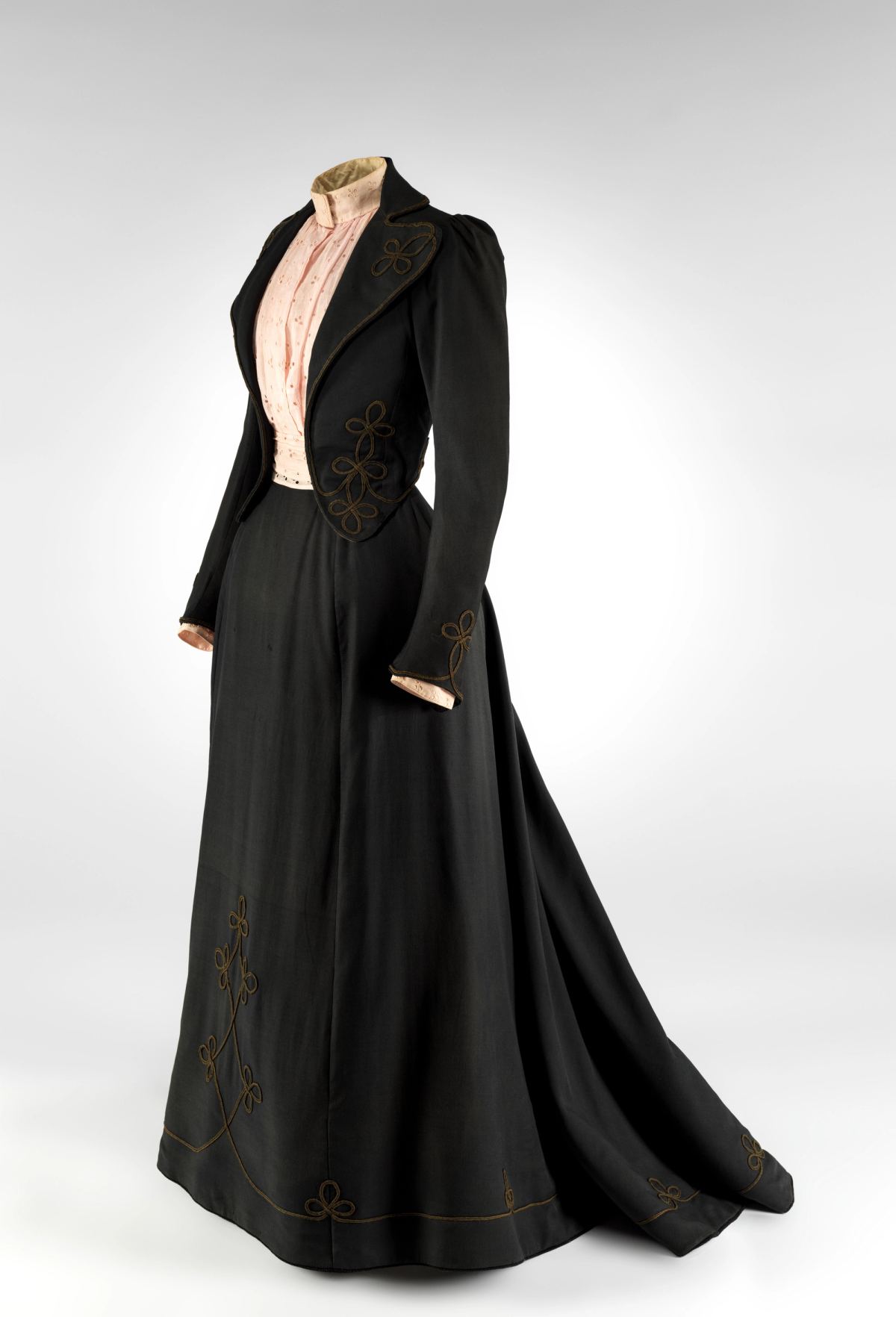
Women began wearing tailor-made suits in the 1870s. On 20 September 1873 London's Punch joked about an advertisement headed "Tailor-Made Costumes for Ladies," and by 1893 the New York Times called the tailor gown "the most suitable all-around costume yet invented for women." The idea was older, because men's tailors cut riding habits for women.
When did women start wearing tailored suits?
In Britain the jacket-and-skirt suit that women called a tailor-made was being advertised by 1873, and in Britain and the United States it was an ordinary fashionable choice by the mid-1880s. Women had worn tailor-cut riding habits for much longer, so the 1870s mark the moment that cut moved from the saddle to the street, the pier and the railway carriage.
This autumn the Palais Galliera in Paris is showing Un vestiaire à soi (26 September 2026 to 14 February 2027), which pairs nineteenth-century riding habits, trousers, tailored suits, ties and top hats. The museum's description argues that the "masculinisation of 19th-century women's fashion acted as a challenge to established gender binaries." That is one way to read the suit. The magazines, manuals and catalogs of the period suggest another: a garment that was cut, priced and advertised like any other, and that one 1885 magazine defined by fit and finish, not by whom it imitated.
This article follows the dated evidence, in order, and tests the usual story that one tailor on the Isle of Wight invented the whole thing.
What did Pepys see in 1666?
On 12 June 1666 Samuel Pepys saw the Ladies of Honour at Whitehall dressed for riding, in coats and doublets with deep skirts, buttoned up the breast, with periwigs and hats. He thought them "just for all the world like mine," and said that only a long petticoat dragging under "their men's coats" showed they were women. He did not like the sight.
That diary entry is the oldest date in this story, and it matters for one reason. Riding was the place where women's clothes were allowed to borrow from men's, and it stayed that way. The Victoria and Albert Museum puts it plainly: the trend for tailor-made garments for women "began in sportswear with riding habits made by their husband's tailor." A British example of 1880–83, credited to J Busvine & Co., shows the form: a fitted, buttoned jacket over a very long skirt.
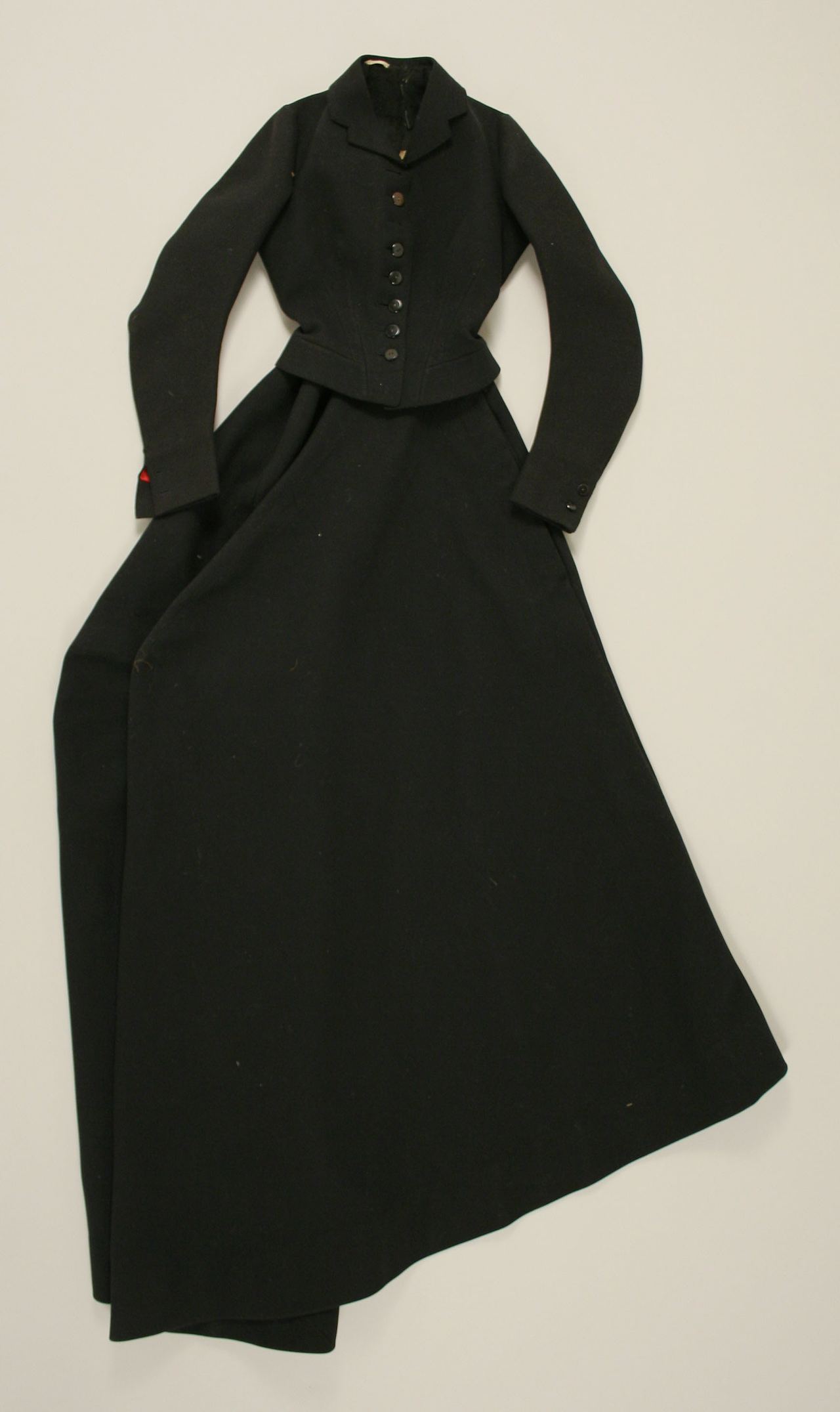
A riding habit is the precursor, not the subject. What changed in the 1870s was that the same tailors, and the same cut, began to be used for clothes with no horse in them.
When did the word "tailor-made" enter use?
The earliest use I could read is a joke. On 20 September 1873 Punch (vol. 65, p. 112) had a nervous bachelor shudder at a newspaper advertisement headed "Tailor-Made Costumes for Ladies" and fret that ladies who employed tailors to cut their costumes would soon be wearing masculine attire. The advertiser is not named in the passage I read. The phrase was already a selling line.
By 1880 it was common enough to appear in a draper's letter to The World of Fashion, a monthly priced at one shilling. The draper wrote that his country customers liked "tailor-made" garments, that he kept a cutter supplied with the magazine's patterns, and that he wanted another for a riding habit. In its February 1880 plates the same magazine described a black cloth "Orleans" visiting costume as made entirely by a tailor, then told readers it could easily be made at home, because the trimming was only double rows of machine stitching. The tailored look was already a thing to copy with a sewing machine and a fashion plate.
Within five years the word needed explaining. The Delineator, a pattern magazine priced in both pence and cents, noted in February 1885 that "tailor-made" no longer necessarily meant a plainly finished garment, and that the "severity of finish" that had first been the trying feature of tailor-made suits had yielded to a more decorative finish. In August 1885 it answered a reader's question directly: a tailor-made suit was a cloth or flannel costume in which "perfection of fit and finish, with a certain simplicity of decoration, is more aimed at than elaboration."
By 1888 the phrase had turned into a type of person. The Delineator reported in July that "tailor-made girl" had become current slang, and in the same year Scribner's published The Tailor-Made Girl: Her Friends, Her Fashions, and Her Follies, a book of satirical dialogues by Philip H. Welch with illustrations by C. Jay Taylor. The New York Times reviewed it on 20 May 1888 and judged the dialogue a faithful portrait of its subjects' vacuity. In the book, the tailor-made girl is a figure of fashionable society.
Did John Redfern invent the tailor-made?
Probably not alone, and the surviving record does not allow anyone to prove it. The Victoria and Albert Museum says the popularization of the ladies' tailor-made "is widely attributed" to John Redfern of Cowes. Susan North, who wrote the scholarly history of his firm, left the question of its invention open.
Redfern began as a tailor and draper at Cowes on the Isle of Wight. Sources date the start of his business anywhere from the late 1840s to 1855. North's 2008 article in the journal Costume traces how he went from draper to the leading ladies' tailor in Britain and France by 1892. I could not open the article itself, but a Wikidata record for the firm quotes two of its sentences. One says Redfern's first advertisements in The Queen in 1873 were for cloth, his specialty "Isle of Wight Serge." The other says that whether "John Morgan or John Redfern" invented the tailor-made "will perhaps never be known."
That one-line caution is the honest summary. The popular version says Redfern turned out tailored yachting costumes for the Cowes regattas in the 1870s and women adopted them for the street. It is plausible. It is also repeated in modern accounts, at least one of which gives no citation for the date, and I could not find a dated 1870s document showing a Redfern costume. The 1873 Punch joke shows the label circulating in advertising before any garment claim for Redfern can be documented.
Other details differ between accounts. Lillie Langtry's 1879 appearance in Redfern clothes is described in one source as a jersey traveling dress and in another as a tailor-made worn to the Cowes regatta. Royal patronage is dated to 1882 in one account and to 1888 in another. Two tidy anecdotes, a duke who ordered a tweed suit for his wife and a Princess of Wales who cut down her riding habit, are retold in a popular costume-history article, and I found no contemporary document for either.
By the mid-1880s the name was established. A navy flannel riding jacket made by Redfern in 1885–86, now at the V&A, is braided in the manner of a regimental patrol jacket, and the museum notes that The Queen praised Redfern's braided designs on 10 May 1884. In May 1893 the New York Times used a Redfern design to show what the "strict tailor gown" should look like.
What made a woman's suit "tailor-made"?
The cut and the cutter. A tailor-made was drafted by the tailor's system and finished with menswear parts: lapels, a waistcoat, braid. By the 1890s it also mattered less whether the cutter was a man, because manuals were teaching women to do the job.
One of them is The Parisian Tailor, a guide to ladies' tailoring published in Philadelphia in 1895 by Paul A. Fourier. Its introduction says that "a demand has sprung up all over the country" for instruction in ladies' tailoring, and the preface promises that a reader can qualify as a cutter in "a high-class trade." It names Martin, Redfern, Felix and Worth as the "gentlemen dressmakers and cutters" who use the tailor system. Its drafts include a blazer, reefers and a single-breasted "Prince Albert" skirted jacket, its price list of tailor-cut patterns adds Norfolk and Newmarket jackets, and it describes collars interlined with buckram. Two Philadelphia merchant tailors, D. M. Rattay and John Stilz & Son, endorse the system because it applies the same principles they use "in cutting gentlemen's clothing."
The home dressmaker could borrow the tailor's tricks without the tailor. In December 1884 The Delineator showed how to simulate buttonholes on a tailor-made sleeve with heavy twist, "the process being one that is often followed by tailors." Its January 1885 note on fashionable mufflers observed that the liking for tailor-made coats and costumes had produced "further encroachment upon the domain of the sterner sex." By 1893 the New York Times could describe the full set: a jacket with revers over a waistcoat, a stiff shirt front, a high collar and a four-in-hand tie.
Not every walking suit was a plain wool tailor-made. Paris houses cut them too, in softer cloth. This ensemble by the House of Worth, about 1889, is silk, with black ribbon trim and a lace jabot, but it shares the fitted jacket and long skirt.
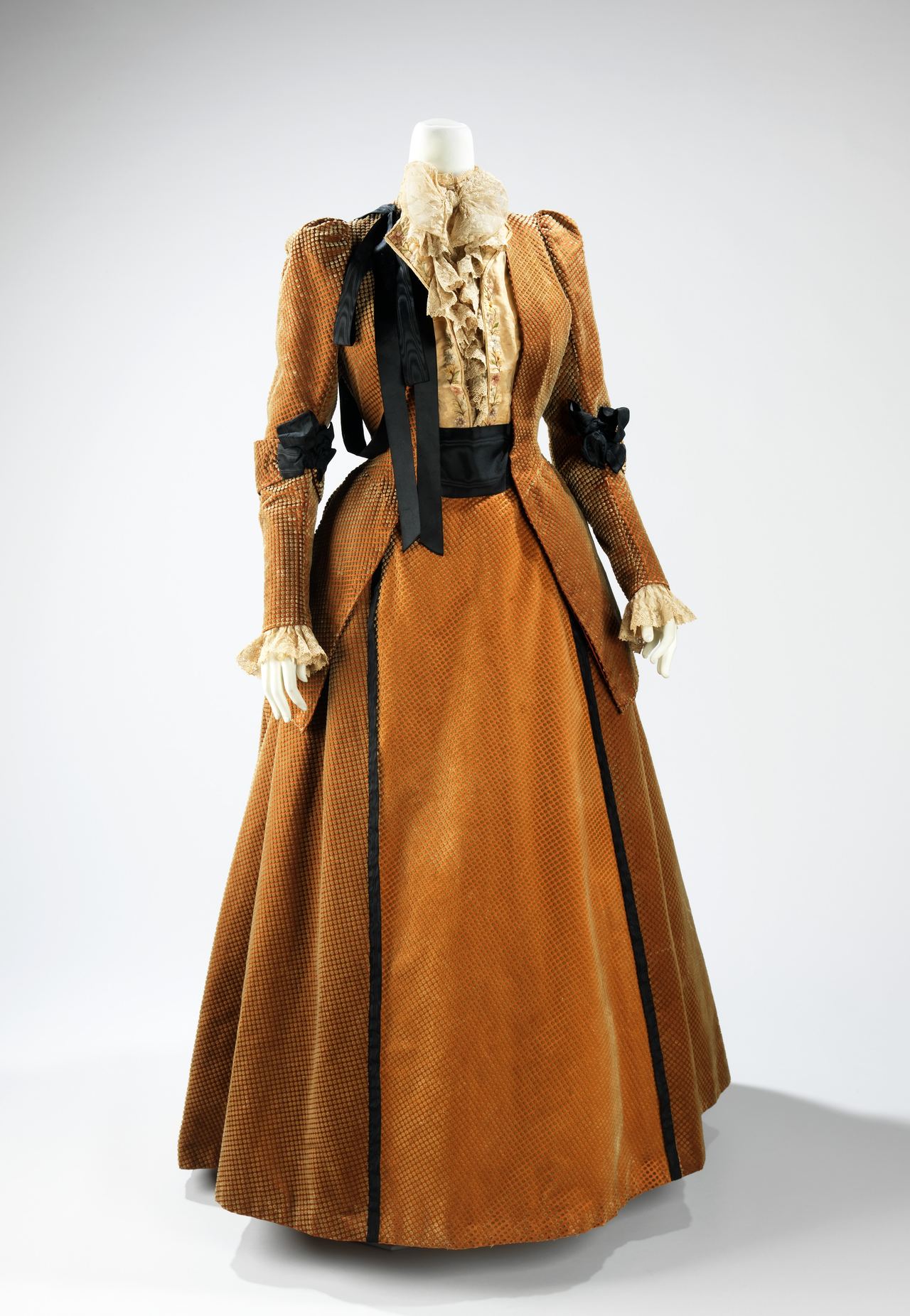
Later examples make the borrowing explicit in detail. A black silk velvet coat and skirt made by Redfern about 1909, now at the V&A, has a low wide lapel and two hip pockets with flaps, a long way from the tie-on pocket that women had carried separately for centuries.
What does the dated evidence show?
Put in order, the record is thin at the start and fills in during the 1880s. I read every row in a period page, a museum record or a catalog; rows marked "via" are quoted in a record, not read in the original.
| Date | Source | What it shows |
|---|---|---|
| 12 June 1666 | Pepys, Diary | Ladies of Honour in riding coats and doublets "like mine" |
| 20 Sept 1873 | Punch, p. 112 | "Tailor-Made Costumes for Ladies" as an advertisement headline |
| 1873 | The Queen, via North | Redfern's first advertisements there are for cloth, not garments |
| February 1880 | The World of Fashion | Plate caption: costume "made by a Tailor," copyable at home |
| 10 May 1884 | The Queen, via the V&A | Praise for Redfern's braided designs |
| February and August 1885 | The Delineator | The term is no longer "plain," and is defined by fit and finish |
| 1888 | The Delineator; New York Times | "Tailor-made girl" is current slang and a satirical book |
| 21 May 1893 | New York Times | The tailor gown is "the most suitable all-around costume" for women |
| 1895 | Fourier, The Parisian Tailor | A manual teaches women to cut ladies' tailor garments |
| Spring 1902 | Sears, Roebuck & Co. catalog | Ladies' tailor-made suits for $5.75 to $10.50 |
Who wore it, and what did people think?
Fashionable women first, and the reactions were mixed. Critics saw masculinity creeping in, as the 1873 Punch joke and the 1885 "encroachment" remark both show. Magazines stressed practicality. In May 1893 the New York Times recommended the tailor gown for women heading to the World's Fair with little luggage, since a change from waistcoat to a silk shirtwaist and some lace or a jeweled girdle would make it look new.
That article should be read for what it is. It directs readers to a sketch of one of Redfern's latest designs, so it is part advertisement. But it is also a dated, public statement that the tailor-made had become the standard practical suit.
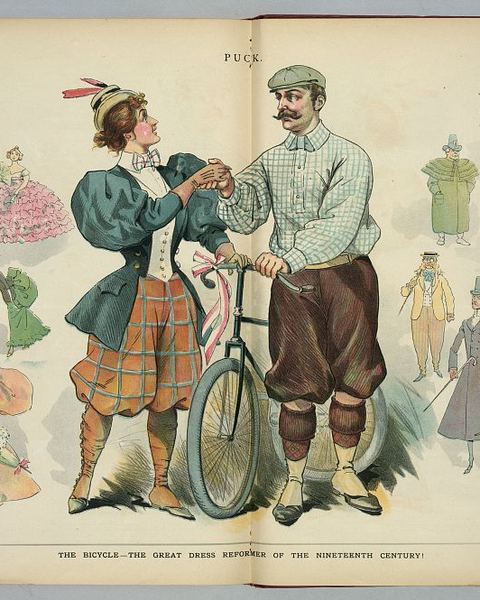
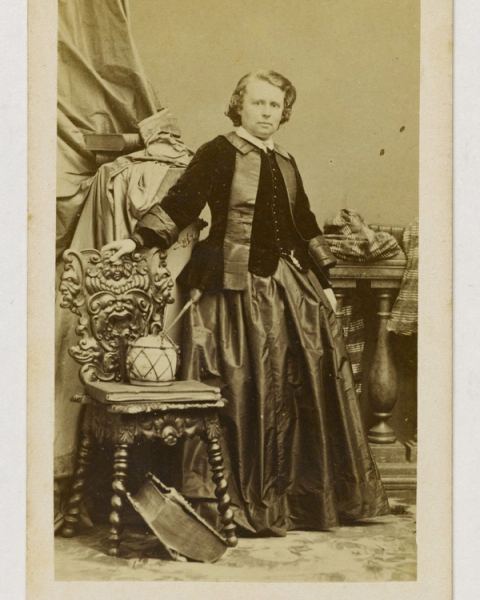
The suit's meaning differed from the meaning of trousers. The tailor-made kept a skirt, and the argument it started was about taste and imitation, not law. The other nineteenth-century route by which men's clothes reached women's wardrobes, the bicycle, ran straight into ordinances and ridicule: that story is in Trousers, Bicycles and the Divided Skirt. Trousers are also where Rosa Bonheur needed a police permit in Paris.
How did the suit reach ordinary shoppers?
By mail order and by pattern. In its Spring 1902 catalog Sears, Roebuck & Co. listed ladies' tailor-made suits from $5.75 to $10.50, in stock sizes from 32 to 42 inches around the bust, with jackets described as having a "coat shaped collar and lapels." The tailored suit had become a catalog line.
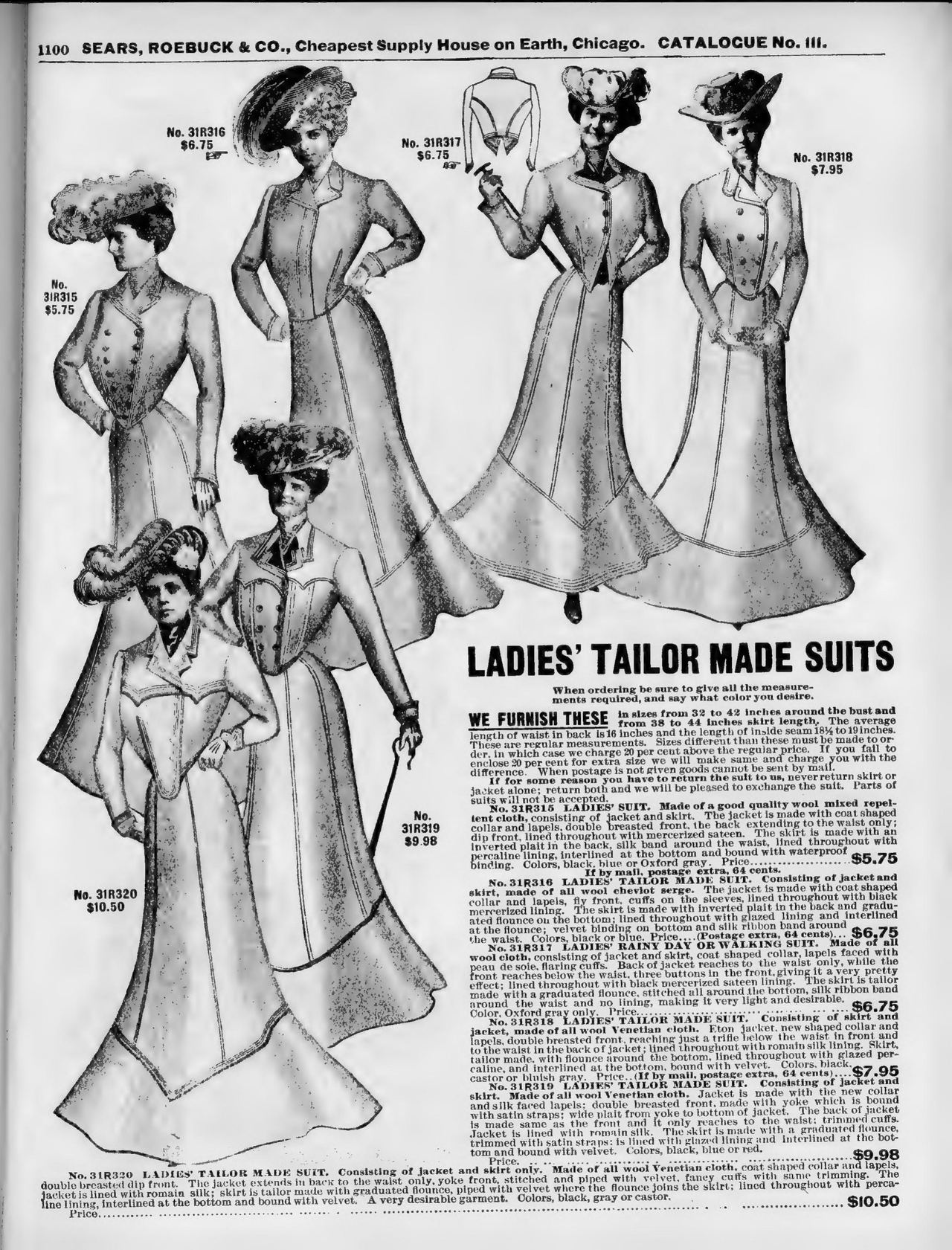
The catalog page is specific about construction. The $6.75 suit in all-wool cheviot serge has a jacket with a "fly front" and cuffs, lined with mercerized lining, and a skirt lined with glazed lining and interlined at the flounce. Sizes outside the stock range cost 20 percent more, and the buyer was told to return jacket and skirt together if sending a suit back. The cheapest, at $5.75, was a wool jacket and skirt with an inverted plait at the back.
That is what the catalog shows. It says nothing about who bought the suits, so I do not claim they were office or shop uniforms, a common line in later histories that I could not verify in period sources.
Where can you see tailor-made suits?
The Metropolitan Museum of Art has open-access photographs of the 1892 suit at the top of this page (C.I.53.72.9a–c), the Busvine riding habit (C.I.40.106.34a, b) and the Worth walking suit (2009.300.73a, b). The Victoria and Albert Museum holds the Redfern jacket (T.430-1990) and the Redfern velvet coat and skirt (T.42&A-1960) described here. In Paris, the Palais Galliera exhibition runs until 14 February 2027.
For further reading, start with Susan North's two articles in Costume: "John Redfern and Sons, 1847 to 1892" (vol. 42, 2008) and "Redfern Limited, 1892 to 1940" (vol. 43, 2009). For the trade's own voice, The Parisian Tailor is scanned in full on the Internet Archive.
Sources
- The Diary of Samuel Pepys, 12 June 1666. Project Gutenberg (eBook #4171). Primary. Full text read; Ladies of Honour in riding garb, Whitehall. Accessed October 23, 2026.
- Punch, or the London Charivari, vol. 65, 20 September 1873, p. 112. Internet Archive (scan). Primary. Full-text OCR read (jumbled column layout): advertisement headline 'Tailor-Made Costumes for Ladies' and the narrator's reaction. Accessed October 23, 2026.
- The World of Fashion, 1879-1880. Internet Archive (scan). Primary. OCR read: February 1880 plate caption (Orleans Visiting Costume, 'made by a Tailor') and a country draper's letter using 'tailor-made'. Accessed October 23, 2026.
- The Delineator, volumes 1884-1888. Internet Archive (Google Books scans). Primary. OCR read: December 1884 sleeve note; January 1885 mufflers note; February 1885 'does not now necessarily refer to a plain finished garment'; August 1885 'A Subscriber' definition; July 1888 'tailor-made girl' slang. Accessed October 23, 2026.
- New York Times, 21 May 1893, 'Tailor-Made Costumes'. Internet Archive (scan). Primary. OCR read: the tailor gown as 'the most suitable all-around costume yet invented for women'; Redfern sketch; waistcoat, shirt bosom, four-in-hand tie. Promotional in tone. Accessed October 23, 2026.
- New York Times, 20 May 1888, review of 'The Tailor-Made Girl' (Welch and Taylor); The Sunday School Times, 7 April 1888. Internet Archive (scans). Primary. OCR read: book title, authors, publisher, the reviewer's judgment; Sunday School Times describes the satirical aim. Accessed October 23, 2026.
- Paul A. Fourier, The Parisian Tailor: complete instructor and practical guide to ladies' tailoring (Philadelphia, 1895). Internet Archive (scan; Library of Congress: no known copyright restrictions). Primary trade manual. Full-text OCR read: introduction, preface, drafts, pattern price list, merchant tailors' testimonial. Accessed October 23, 2026.
- Sears, Roebuck and Co., Catalogue No. 111, Spring 1902, p. 1100, 'Ladies' Tailor Made Suits'. Internet Archive (scan; Public Domain Mark 1.0). Primary. Page image viewed and OCR read: suits 31R315 to 31R320, prices, sizes, construction. Accessed October 23, 2026.
- Walking costume, John Redfern, ca. 1909 (T.42&A-1960). Victoria and Albert Museum. Museum record read via the V&A API: description of the coat and skirt; text on tailor-made origins in riding habits and on Redfern. Accessed October 23, 2026.
- Riding habit jacket, John Redfern & Sons, 1885-86 (T.430-1990). Victoria and Albert Museum. Museum record read: navy flannel, mohair braid after a regimental patrol jacket; The Queen, 10 May 1884. Accessed October 23, 2026.
- Susan North, 'John Redfern and Sons, 1847 to 1892', Costume 42 (2008), pp. 145-68. Taylor & Francis / Costume Society (DOI 10.1179/174963008x285241). Scholarly. Abstract only (Crossref record); full article not opened. Two sentences from pp. 146-147 are quoted in the Wikidata record below. Accessed October 23, 2026.
- Redfern (Q7305826), Wikidata record. Wikidata. Read. Quotes North pp. 146-147 (first Queen advertisements in 1873 were for cloth; John Morgan or John Redfern 'will perhaps never be known'). Used for those quotations and to locate the article. Accessed October 23, 2026.
- Suit, American, 1892 (C.I.53.72.9a-c); Riding habit, J Busvine & Co., 1880-83 (C.I.40.106.34a, b); Walking suit, House of Worth, ca. 1889 (2009.300.73a, b). The Metropolitan Museum of Art. Object records read via the Met Open Access API (isPublicDomain true); images viewed and, for the 1892 suit, cropped and enlarged. Accessed October 23, 2026.
- Un vestiaire à soi. Féminités dissidentes au 19e siècle (A Wardrobe of One's Own). Paris Musées / Palais Galliera. Museum exhibition page read: dates, scope (riding habits, trousers, tailored suits, ties, top hats), the 'masculinisation' sentence. Not a review; the show was not seen. Accessed October 23, 2026.
- Evangeline Holland, 'The Tailor-Made', Edwardian Promenade (2008, updated 2009). Edwardian Promenade. Secondary blog, read in full. Source of the duke and Princess of Wales anecdotes and one version of the 1879 Langtry story; no contemporary document cited for them. Accessed October 23, 2026.
- Redfern (couture), Wikipedia. Wikipedia. Used to locate references (Callan 1998; North 2008, 2009). Read for the 1855 start, the 1879 jersey dress and the 1888 royal appointment, which conflict with other accounts and are presented as such. Accessed October 23, 2026.
- Cassidy Percoco, 'Redfern Ltd. (ca. 1855-1940)', Mimic of Modes (2014, updated 2024). Mimic of Modes. Secondary blog, read. Gives 1882 for 'Tailors by Appointment' to the Princess of Wales and notes that early sources conflict. Accessed October 23, 2026.
Glossary
Last updated · Markdown · Report an error