Scarlet Was a Cloth Before It Was a Color
Why is it called scarlet? In the Middle Ages the word named a luxury woolen cloth dyed with kermes insects, and only later the red. What the town accounts show, and what is still disputed.
Scarlet was a cloth before it was a color. In medieval Europe the word named a luxury woolen broadcloth dyed in kermes, a costly insect dye, and the red came to stand for the whole thing only later. Where the word itself comes from is still argued, and so is how many colors "scarlet" ever really came in.
Was scarlet a fabric before it was a color?
Yes. Merriam-Webster still lists "scarlet cloth or clothes" as the first sense of the noun, with a first known use in the 13th century, and "any of various bright reds" second. The economic historian John Munro, who read the cloth purchases of Flemish towns, puts it flatly: "all medieval scarlets, without exception, were luxury-quality woollens that were dyed, wholly or partially, 'in grain'—in kermes."
The old reference books noticed the shift. The 1911 Encyclopaedia Britannica says the cloth "was frequently scarlet in colour, and hence its name became applied to the colour." The change is visible in English texts. In the General Prologue of Chaucer's Canterbury Tales, the Wife of Bath wears hosen "of fyn scarlet reed": fine scarlet, red. A modern reader hears a repeat. The Flemish accounts Munro read name "roode scaerlakenen," red scarlets, so color could still be stated separately. One line of verse proves nothing alone, but it fits. By 1533 an English Act "for Reformation of Excess in Apparel" barred lower-ranked men with less than £5 a year in lands or rents from wearing "cloth of the colour of scarlet crimson or violet engrained." In law, at least, scarlet was by then a color. In his edition of the Act, Noel Cox glosses the dye term: ingrained red on wool is always scarlet, and on silk always crimson.
Why was scarlet so expensive?
The dye cost more than the weaving. Kermes comes from dried insects that, according to Munro, were called "grain" (granum) because they looked like grains. At Mechelen between 1361 and 1415 a cloth of 40 ells, about 27.6 meters, took between 10.6 and 18.2 kilograms of kermes. In five-year averages that was roughly a third to a half of the price the town paid. Dyeing and shearing labor together came to about 2 to 3.5 percent.
Shearing, the finishing that cuts the fuzzy nap from the cloth, was not the cost either. At Ghent in 1350–51 shearing a scarlet, a deep blue and a murrey cloth cost exactly the same, 2.92 shillings per cloth of 35 ells (24.5 meters). A scarlet bought at Bruges in 1351 cost £8.75 groot Flemish, so shearing was under 2 percent of that.
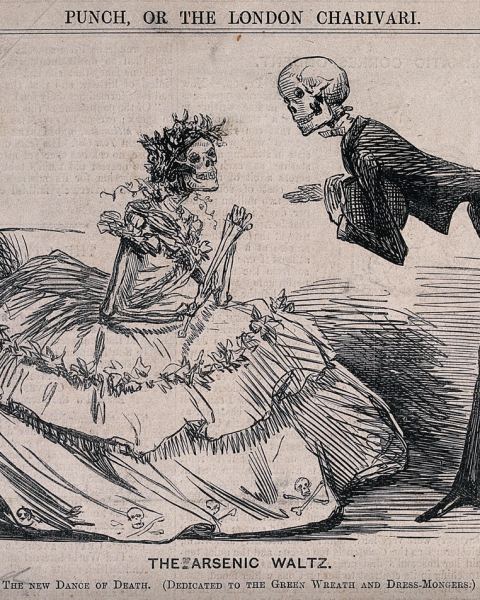
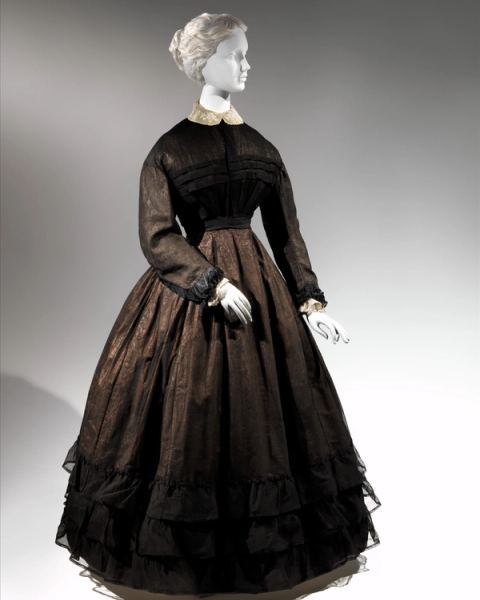
The other expense was the wool, the best English fleeces. After the Spanish conquests of the 1500s, Munro adds, Mexican cochineal offered a stronger scarlet dye. Madder, a plant root, was the common red, but Cox notes that kermes and cochineal gave a much richer color. Color as a marker of rank did not end with scarlet: see the arsenic green of Victorian ballrooms, or the strict grammar of Victorian mourning dress.
Did scarlet come in other colors?
Sometimes, but less often than the usual claim says. Records do mention white, green and brown scarlets, and for a long time historians took that to mean the cloth came in every color. Munro argues the colors describe the cloth before it reached the dye pot. A "white" scarlet was undyed broadcloth ordered to be dyed in grain, to become a red one.
Browns and purples did exist. Wool was often dyed blue with woad before weaving, because woad needs no mordant and the alum used for other dyes made wool harder to comb, card and spin. Redyed in kermes, those blue cloths came out brown, a gray-purple called perse, or murrey, a mulberry shade. Munro finds green scarlets only rarely, and no black ones. Prices did not vary by color: the real divide was between scarlets and everything else. He also says the shades of the brown, perse and murrey scarlets are unknown.
Where does the word scarlet come from?
Nobody is sure. English took it from Old French escarlate, which came from Medieval Latin scarlatum. Merriam-Webster and the 1911 Britannica trace it to a Persian word for a rich cloth. Munro, in a hypothesis he sets out as one, derives it from the Arabic siklat, a kermes-dyed silk first known from the ninth or tenth century, probably a descendant of the Late Roman sigillatus, cloth with seal-like patterns. On that account the first scarlets were silk, and the word moved to woolen cloth dyed with the same dye. He dates the Latin word to about 1050.
A rival theory, floated by the historian Henri Pirenne and set out by Jean-Baptiste Weckerlin in 1905, held that the name meant highly sheared cloth, from Flemish words for shearing and cloth. The Ghent figures above are Munro's answer: scarlet was not sheared more than other fine cloth. He accepts that the Germanic words for scarlet, such as scharlaken, come from an Old High German scarlachen, which appears in an early 11th-century text as a gloss for a shaved or smoothed cloth. The origin of the word is open; the dye behind it is not.
Where can you see it?
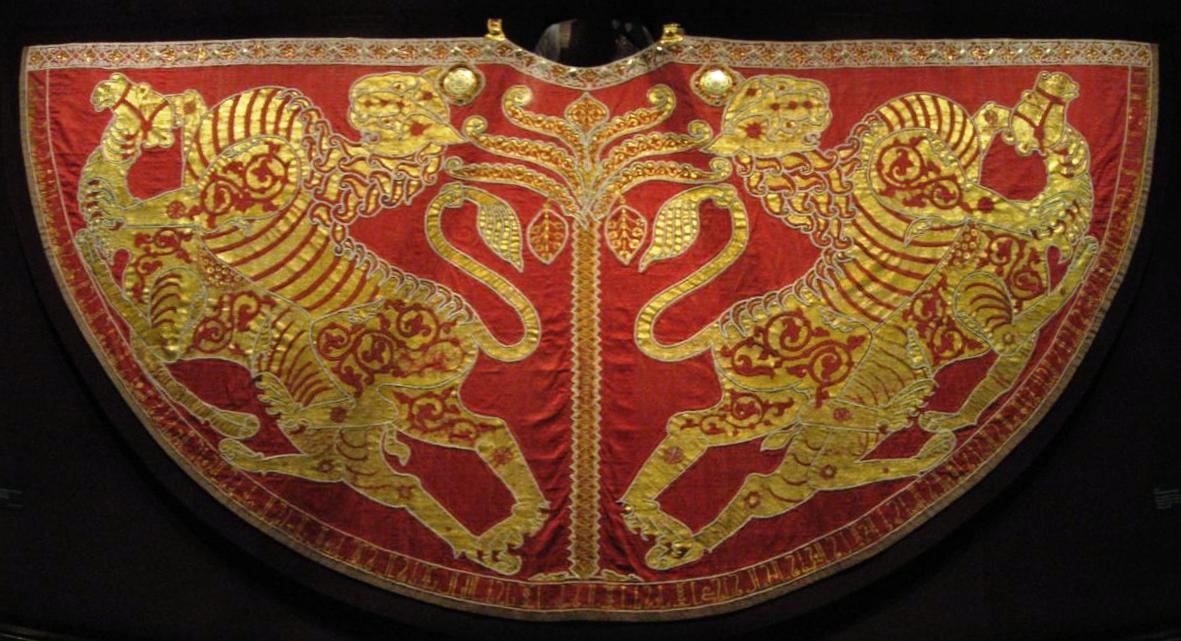
The Imperial Treasury in Vienna shows the coronation mantle of Roger II of Sicily. The Kunsthistorisches Museum dates it to 1133–34, the year given in the Arabic inscription on its hem, and describes it as patterned samite dyed with kermes, embroidered in gold with pearls and enamel. It is silk, not wool, and the museum does not call it scarlet. It is a textile of the kind Munro describes.
Also in Vienna, the Wien Museum's True Colors: Viennese Fashion across Four Centuries runs until 28 March 2027. Its listings describe about 350 garments, with color treated as a marker of status and power. Nothing there is said to be medieval scarlet, but the question it asks is the one scarlet raised first: who was allowed to wear which color, and who could afford it.
Sources
- John H. Munro, "The Anti-Red Shift – to the 'Dark Side': Colour Changes in Flemish Luxury Woollens, 1300–1550". University of Toronto / Medieval Clothing and Textiles 3 (Boydell, 2007); MPRA preprint. Primary scholarly. Full text read (pdftotext of the MPRA PDF, identical in content to the book chapter in MCT 3): definition of medieval scarlets, kermes price shares at Mechelen 1361-1415, Ghent 1350-51 shearing costs, colour terms (white/blue/murrey/perse scarlets), etymology hypothesis (Arabic siklat; OHG scarlachen c. 1007-32; Latin scarlatum c. 1050). Accessed October 19, 2026.
- Der Krönungsmantel (Coronation Mantle of Roger II), WS XIII 14. Kunsthistorisches Museum Wien. Object record read in full: 1133/1134, Palermo royal workshops, "Gemusterter Samit (Kermesfärbung)", H. 146 cm, W. 345 cm, Kufic inscription giving year 528, on view in the Imperial Treasury. Accessed October 19, 2026.
- scarlet (noun, adjective). Merriam-Webster. Entry read: noun sense 1 'scarlet cloth or clothes', sense 2 'any of various bright reds'; first known use 13th century (sense 1); etymology via Persian saqalat. Read directly with curl. Accessed October 19, 2026.
- Scarlet. Wikisource (1911 Encyclopaedia Britannica, vol. 24). Full short entry read: Persian origin, 'frequently scarlet in colour, and hence its name became applied to the colour'. Dated source: the Persian derivation has since been questioned (see Munro). Accessed October 19, 2026.
- Geoffrey Chaucer, The Canterbury Tales, General Prologue, line 456 (Wife of Bath). Wikisource (Skeat edition). Primary text read: 'Hir hosen weren of fyn scarlet reed'. Accessed October 19, 2026.
- Noel Cox, "Tudor Sumptuary Laws and Academical Dress: An Act against Wearing of Costly Apparel 1509 and An Act for Reformation of Excess in Apparel 1533". Transactions of the Burgon Society 6 (2006). Full text read (PDF): transcription of 24 Henry VIII c 13 (1533) with the 'cloth of the colour of scarlet crimson or violet engrained' clause for men below a £5 income, and Cox's footnotes on 'ingrained' dyes (kermes/cochineal) and on scarlet (wool) vs crimson (silk). Accessed October 19, 2026.
- True Colors – Viennese Fashion across Four Centuries (Farbenspiel). Wien Museum / WienTourismus / ORF. Read the museum event page, the wien.info listing and ORF report: about 350 garments, color as a social force, runs until 28 March 2027. Start date differs between listings (1 or 20 October 2026), so the text gives only the closing date. Accessed October 19, 2026.
- File:Weltliche_Schatzkammer_Wienc.jpg. Wikimedia Commons. File page read: author Gryffindor (stitched by Marku1988); the uploader released the work into the public domain worldwide; image 1,181 x 641 px. Accessed October 19, 2026.
Glossary
Last updated · Markdown · Report an error