Color
Arsenic Green: Did Victorian Dresses Really Kill?
A vivid copper-and-arsenic pigment colored Victorian wreaths, wallpaper and ball gowns. The clearest victims were the workers who made them; wearers got eye, throat and skin trouble, not mass poisoning. What the period sources show, and where to see color at Vienna's Wien Museum until March 2027.
Some Victorian green dresses and wreaths really did carry poison, and a few wearers fell ill. The people most clearly harmed, though, were the young workers who made artificial leaves and flowers. The famous warning, that one ball dress could kill the admirers of half a dozen ballrooms, was a journalist's flourish, and the record supports a smaller, more local kind of harm.
What was arsenic green?
Arsenic green is a family of bright copper-and-arsenic pigments. Scheele's green is copper arsenite. Schweinfurt green, which came later and is also called Paris green or emerald green, is a copper acetoarsenite. Both were used on wallpaper, paint, toys, cloth and the powder dusted onto artificial leaves, and period writers often blurred the two together.
The dates are less tidy than the usual retelling. Wikipedia and the Paris Review give 1775 for the invention of Scheele's green by the Swedish chemist Carl Wilhelm Scheele; Wikipedia adds that he published his method in 1778, which is the date the Victoria and Albert Museum uses for the discovery. The improved green is usually credited to the Schweinfurt makers Wilhelm Sattler and Friedrich Russ, who began commercial production in 1814. Its recipe was published by Justus von Liebig and André Braconnot, in 1822 or 1823 depending on the reference. The V&A calls the later green "more durable", and Wikipedia says it was meant to darken less around sulfides than Scheele's.
Where did the green end up?
On far more than ball gowns. The Paris Review lists dresses, waistcoats, shoes, gloves and trousers among the things Scheele's green colored, along with wallpaper and artificial foliage. The V&A adds paints, wine-bottle stoppers, sweets and children's toys.
In dress it appeared in two forms: the color of the cloth, and the leaves on the flowers that women pinned to their hair and skirts. The cloth most often named in later complaints is green tarlatan, a sheer cotton fabric in open plain weave, usually heavily sized for stiffness (Merriam-Webster), used for ball gowns and close in spirit to tulle. An article on arsenic as a domestic poison in the Massachusetts State Board of Health's supplement to its report for 1883 said the arsenical pigment was "so loosely applied to the cloth" that a portion of it easily separated upon the slightest motion. A report of 1878 adds a twist: it found the green on some tarlatan was held more firmly by gum arabic and starch. How much came off depended on the cloth and the maker.
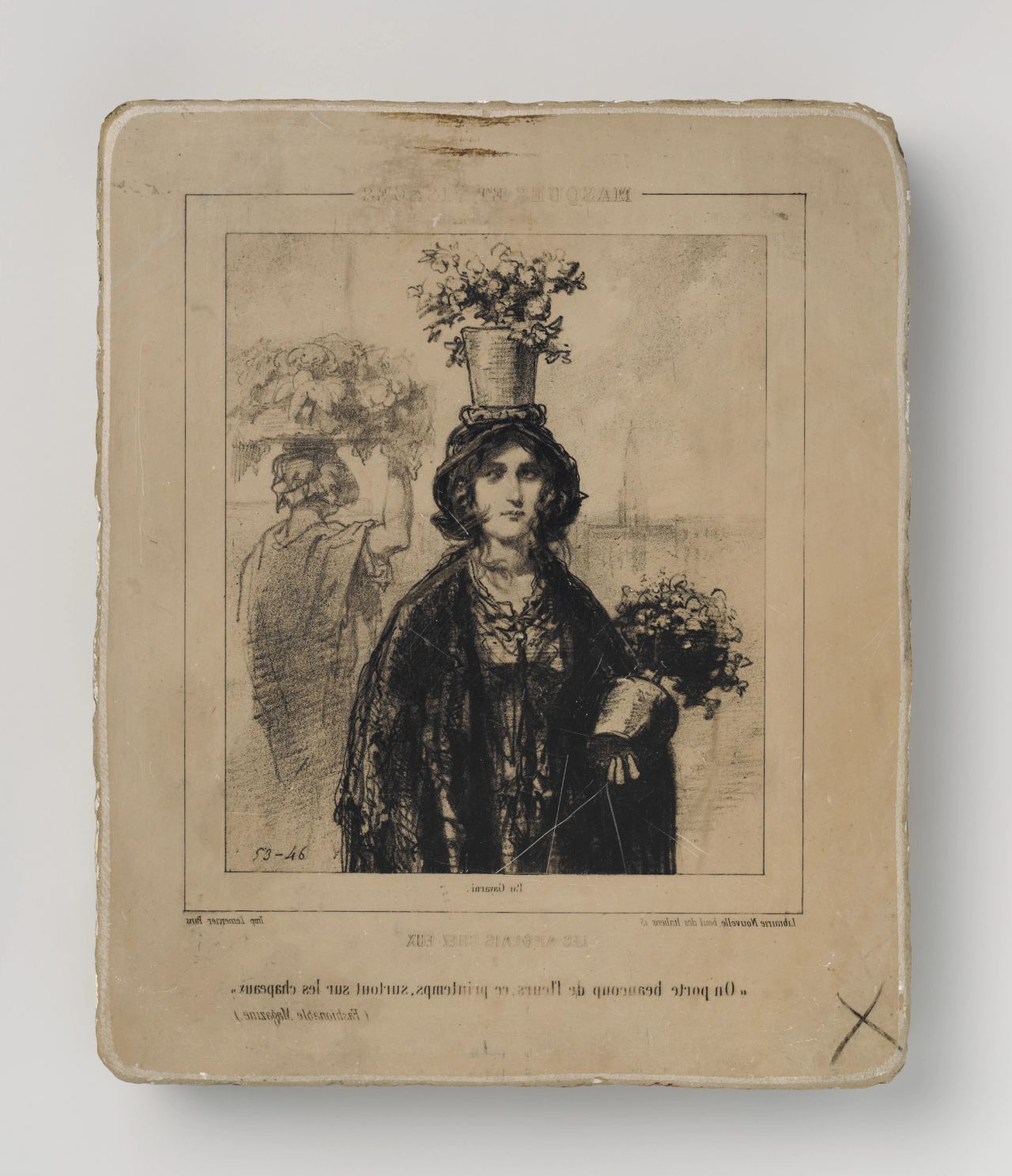
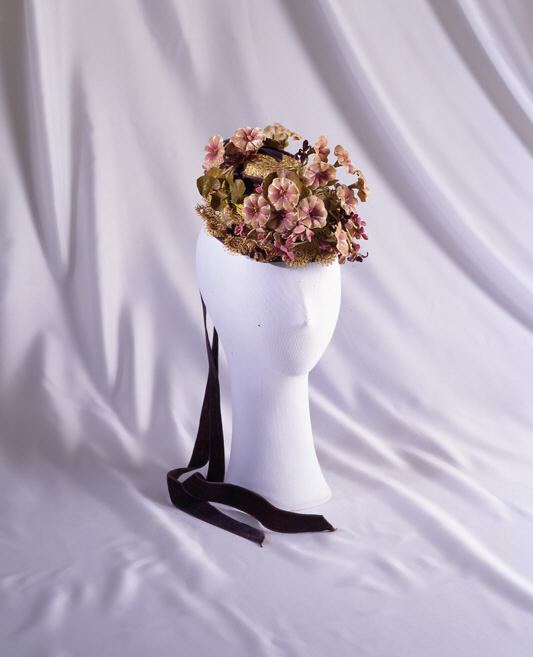
The fashion for green was also a fashion for foliage. Wreaths, sprays and trimmings of artificial flowers were worn in the hair, on bonnets and on skirts in the 1850s and 1860s. A lithographic stone of 1853 by Paul Gavarni in the Metropolitan Museum's collection carries a caption the museum translates as "We're wearing lots of flowers this spring, especially on hats." The Met's hat of about 1868 is crowned with artificial blossoms and leaves. Nothing in the museum's records says how those leaves were colored, so they illustrate the trade rather than prove the poison.
Who actually died?
The documented victims were workers. The best-known case is Matilda Scheurer, a 19-year-old artificial-flower maker in London who, according to the historian Alison Matthews David and the Paris Review, died on 20 November 1861. The Northampton Mercury of 30 November 1861, reprinted on a modern blog, reported the inquest, which was held by a Mr. Brent. Her mother told the court she had been vomiting a greenish matter. A surgeon, James Thomas Paul, said he had treated her four times in 18 months for the same cause, and that at post-mortem the lungs showed arsenite of copper and the liver was "highly impregnated." A sister, the report said, had died under similar circumstances.
Her employer testified that he had 98 girls at work in his warehouse. He had suggested masks, which the girls refused because they were hot, so they wore muslin over their mouths. A juror said the use of arsenite of copper in such manufactures was prohibited in France. The jury found she died accidentally from the effects of arsenite of copper used in her employment.
Punch was unimpressed by the verdict. In "Pretty Poison-Wreaths," in its issue of 7 December 1861, it wrote that the jury had blamed "arsenite of copper used in her employment," and that "death is evidently about as accidental as it is when resulting from a railway collision occasioned by arrangements known to be faulty." Matthews David adds that the press described the death in grisly detail, including green vomit and her telling her doctor that everything she looked at was green; the inquest report quoted here mentions only a greenish vomit.
The wider evidence comes from physicians. A report of the Medical Officer to the Privy Council for 1862, quoted in Henry Carr's book Our Domestic Poisons, describes Dr. Guy examining about a hundred young women who made artificial leaves. Skin disease hardly any of them escaped, he found, and of twenty-five examined nearly all showed signs of chronic arsenical poisoning: thirst, nausea, vomiting, weakness, fever and headache. Matthews David's argument, as summarized in popular coverage, is that arsenic fashions, like the mercury of hatmaking, were most dangerous to the people who manufactured them.
How did a dress become a headline?
Through a chain of events in early 1862. After Scheurer's death, the Ladies' Sanitary Association asked the chemist A. W. Hofmann to analyze artificial leaves from a ladies' headdress. He published his findings in The Times on 1 February 1862 under the title "The Dance of Death," reporting that green dresses, wreaths and artificial flowers colored with copper arsenite or acetoarsenite were toxic. A reprint in the Chicago Medical Examiner of September 1862 gives his analysis: about ten grains of white arsenic in a dozen leaves, and, since a ball wreath contained roughly fifty leaves, more than forty grains in a lady's hair, "sufficient to poison twenty persons" if taken in appropriate doses.
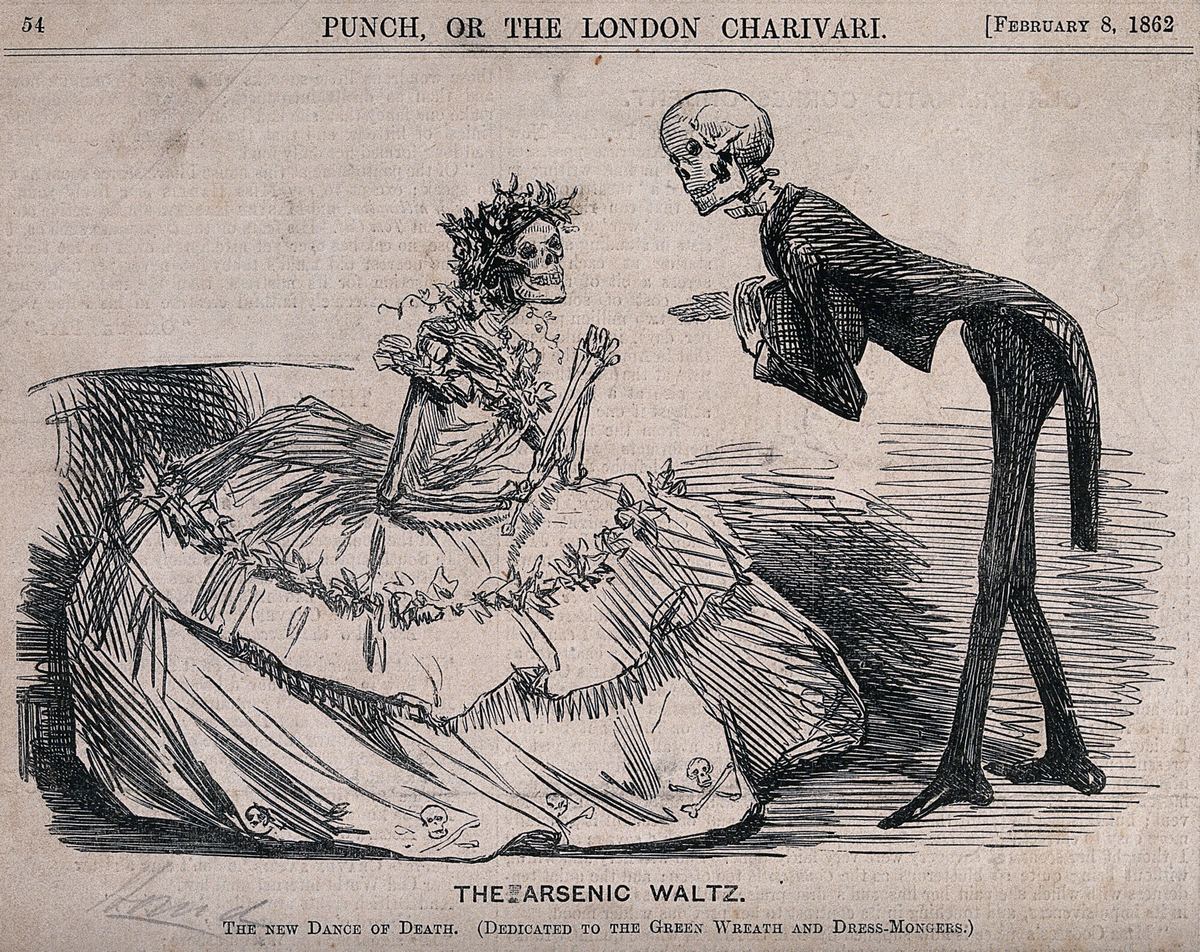
A week later, on 8 February 1862, Punch printed "The Arsenic Waltz" on page 54: a skeleton in evening dress bowing to a skeleton in a crinoline and leaf wreath, lettered "The new Dance of Death" and "dedicated to the green wreath and dress-mongers." The Wellcome Collection, which holds the print, describes it as a wood engraving and notes a tentative attribution to John Leech; the Science in the Nineteenth-Century Periodical index lists it as anonymous. On 15 November 1862 (page 197) Punch ran an essay called "Poisoners and Polkas." If ladies persisted in wearing arsenic dresses, it argued, a ball would become as deadly as a cannon ball, and that a dress "may prove as deadly as the shirt of Nessus."
| Date | Event | Source |
|---|---|---|
| 1775 / 1778 | Scheele's green invented / method published | Wikipedia (locating references), V&A, Paris Review |
| 1814 | Schweinfurt green produced commercially | WebExhibits, Wikipedia, V&A |
| 1822 or 1823 | Liebig publishes a recipe | Wikipedia (1822), WebExhibits (1823) |
| 20 Nov 1861 | Matilda Scheurer dies in London | Paris Review, Matthews David; inquest in Northampton Mercury, 30 Nov |
| 7 Dec 1861 | Punch, "Pretty Poison-Wreaths" | Punch 41, p. 233 (archive.org scan) |
| 1 Feb 1862 | Hofmann, "The Dance of Death," The Times | Wellcome record; UAL caption |
| 8 Feb 1862 | Punch prints "The Arsenic Waltz" | Wellcome record; Punch 42 index, p. 54 |
| Sept 1862 | Hofmann's leaf analysis reprinted | Chicago Medical Examiner 3 (9): 537 |
| 15 Nov 1862 | Punch, "Poisoners and Polkas" | Punch 43, p. 197 (archive.org scan) |
| 1 May 1882 | German ordinance on poisonous colors, in force 1 Apr 1883 | Reichsgesetzblatt 1882, no. 11 |
| 1883 | Massachusetts board's report supplement: green tarlatan dresses now "very rare" | Fifth Annual Report, Supplement (archive.org) |
Could one ball gown really poison a room?
No, and nothing in the surviving record says one did. The line is a satirist's exaggeration built on a real mechanism: a loose powder on a light, open fabric, shaken free by dancing. Matthews David quotes the British Medical Journal a week after Hofmann's letter: a green-clad woman "carries in her skirts poison enough to slay the whole of the admirers she may meet with in half a dozen ball-rooms." She also reports that Hofmann found green tarlatan carried as much as half its weight in arsenic, and that a Berlin doctor judged that no less than 60 grains powdered off from a dress of this kind in a single evening. The Massachusetts supplement gives Hofmann's estimate as twenty or thirty grains of pigment per hour from a dress worn in a ballroom. The legend then grows with the telling: a University of Virginia article repeats a report that one woman's gown could poison people in seven ballrooms.
An 1878 item in the Buffalo Medical and Surgical Journal, relaying a British Medical Journal report on analyses by Professor A. P. Kerley, found large amounts of aceto-arsenite of copper in all six samples of green tarlatan tested, with more arsenic in the dearer cloths. That shows what the cloth could hold, not what a wearer absorbed.
What the physicians did record were smaller harms. The Massachusetts supplement describes a blue-striped dress that caused conjunctivitis, nasal catarrh and a sore throat, and, citing The Lancet of 22 May 1880, a dark-green dress trimmed with light-green leaves, bought from a well-known Parisian atelier, that caused a pustular rash on the neck and arms; the dress was found to contain "a large percentage of arsenic." Henry Carr's book prints a case from Dr. Arthur Gamgee, who traced an outbreak of conjunctivitis and tonsillitis among ballet girls at the Alhambra to their gossamer green tarlatan dresses, which were found "loaded with arsenic"; the costumes were changed and the girls recovered. Carr also reproduces a doctor's account of a pair of "bronze green" silk gloves that left a woman's hands swollen for weeks. Matthews David adds a lady who bought green gloves in 1871 and suffered repeated ulcers at the fingernails until arsenic salts were found. The Massachusetts supplement mentions one child, unnamed, who died after wearing stockings colored with an arsenical pigment.
The cautious reading, then, is that arsenic greens could shed, that wearers could suffer eye, throat and skin trouble, and that the dose in any single dress is not something the surviving sources let anyone calculate. Dismissing the danger because the famous number is a joke would be as careless as repeating it.
Do surviving green dresses still contain arsenic?
Some do, some do not. Ingrid Mida of the Fashion Research Collection at Toronto Metropolitan University recognized the color of a silk dress of about the 1860s with braid and fringe, and she and Matthews David tested it in the university's physics lab on 5 September 2014. It did contain arsenic. It was later shown at the Bata Shoe Museum in the exhibition Fashion Victims.
Others tested clean. The University of Virginia's Historic Clothing Collection checked a pair of mid-nineteenth-century bodices that are "arsenic green" and found no arsenic in them. The Houston Museum of Natural Science tested a Victorian dress it dated tentatively to the 1870s and got a negative, but the curators said the sample, taken from inside a seam, had been soaked only a few minutes, and that a 24-hour soak might change the result.
The mismatch is itself informative. Color alone does not prove arsenic, and a pigment that sheds easily may have shed over a century and a half of handling, cleaning and storage. A negative result on one garment says little about the trade. A positive one shows that the pigment was used on cloth someone wore.
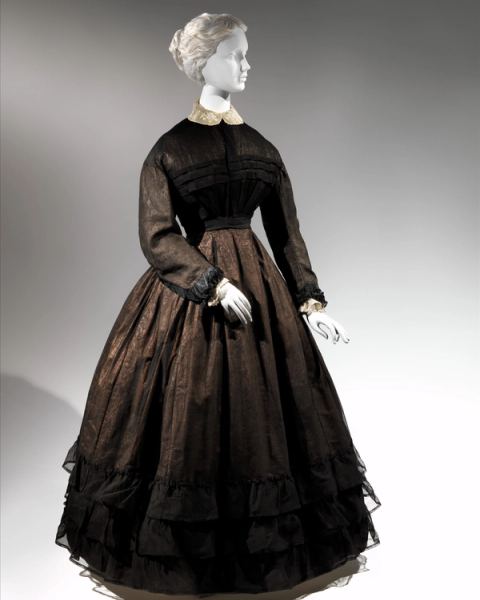
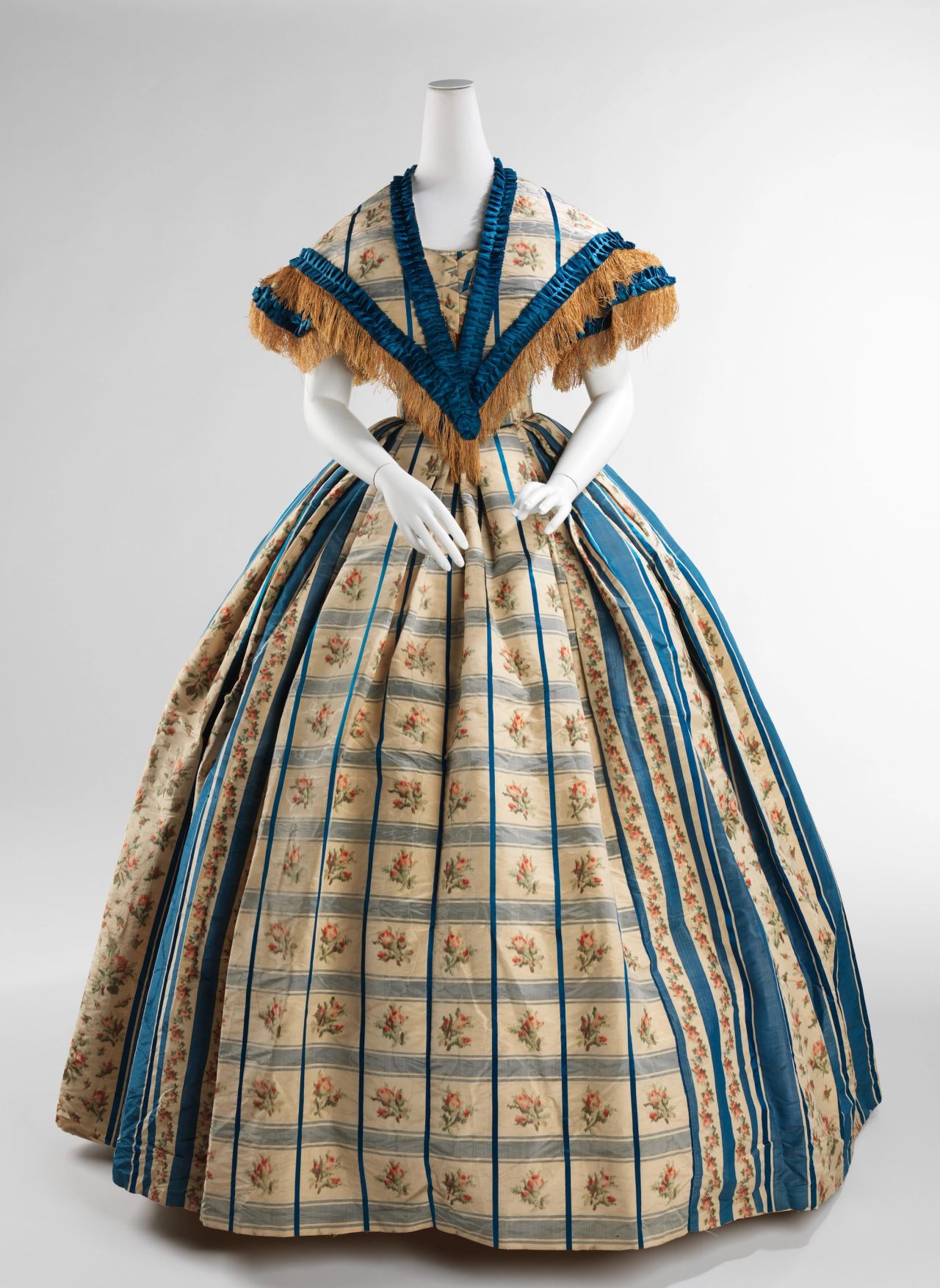
The Met's costume records do not settle the question either. The entry for the American evening dress of 1857 to 1860 shown here gives its date, culture and fabric, not its dye chemistry, and none of the objects pictured in this story has been shown to contain arsenic.
How did arsenic green go out of fashion?
Through law abroad, pressure at home, and a change of taste. Matthews David writes that the French and German governments passed legislation against these pigments and that the British government took no action. Britain had regulated the sale of arsenic since its Arsenic Act of 1851, but, she writes, large-scale industrial use stayed unregulated. A juror at the Scheurer inquest said France already prohibited arsenite of copper in such manufacturing.
Germany's ordinance of 1 May 1882, published in the Reichsgesetzblatt and in force from 1 April 1883, is explicit. Its fourth paragraph forbids arsenic-based colors for wallpaper and also forbids copper colors made with arsenic, and fabrics containing them, in the making of clothing. A fashion-law commentator states that Britain never passed a statute prohibiting arsenical dyes in clothing and that the color faded through press coverage, medical writing and consumer pressure. That is one commentator's account, but it fits Matthews David's.
Shoppers were also given a way to check. The V&A's conservation blog, citing James Whorton's The Arsenic Century, describes a test published in The Times: ladies were advised to carry a phial of ammonia "instead of the usual scent bottle," because a drop on an arsenic green would turn blue, the sign of copper. By the 1883 report the Massachusetts board could call green tarlatan dresses "very rare." There is no single date on which arsenic green ended in dress; it left the ballroom as warnings accumulated, makers advertised freedom from arsenic, and fashion moved on.
What do the sources not show?
Three things. They do not show how much arsenic any wearer absorbed from a single dress; the figures quoted above are estimates of what could shed, not measurements of what was taken in. They record no named wearer who died of a dress, only local illnesses and, in the Massachusetts supplement, an unnamed child and stockings. And Hofmann's letter in The Times is known here through the Wellcome Collection record, a university caption and a reprint of his analysis, not from the newspaper itself.
That is a good reason to keep two ideas apart: the documented, severe harm to workers, and the less severe, less quantified harm to wearers. The satirists of 1862 merged them because a ballroom made a better picture than a workshop.
Where can you see it?
The Wien Museum in Vienna is showing True Colors: Viennese Fashion across Four Centuries (in German, Farbenspiel) from 1 October 2026 to 28 March 2027. The museum's listing describes about 350 garments from its fashion collection, tracing color from the tightly regulated eighteenth century to the present, and press coverage names the curator as Michaela Lindinger. Nothing in those listings says the show deals with arsenic, so go for the color, not for the poison.
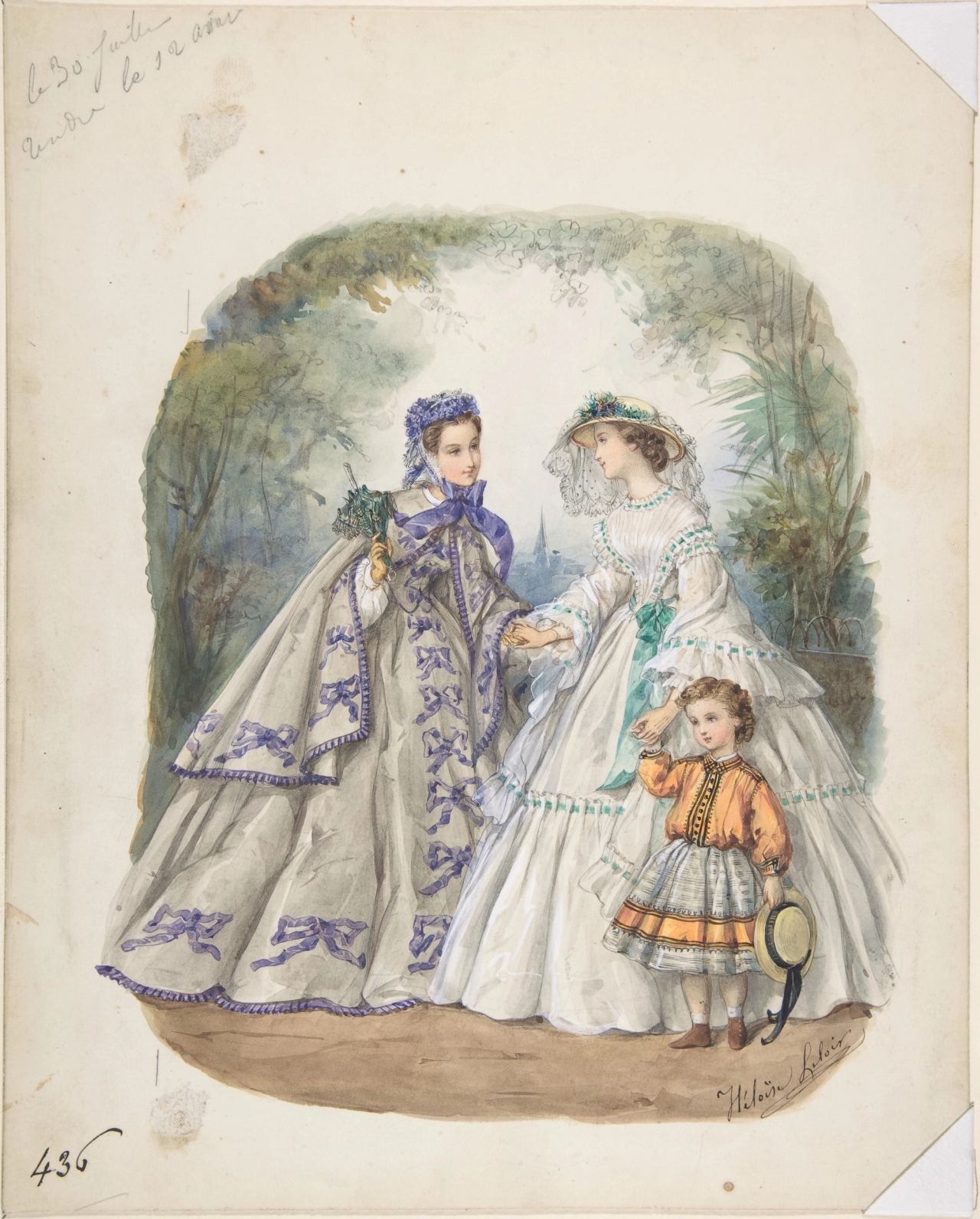
For the look of 1860s dress, the Metropolitan Museum's open-access collection includes the watercolor fashion illustration by Hélöise Leloir (ca. 1862), the evening dress of 1857 to 1860 and the hat with artificial blossoms shown in this story. The Wellcome Collection holds the Punch print of 8 February 1862. For the history of how fashion made its victims, Alison Matthews David's Fashion Victims and James Whorton's The Arsenic Century are the two books to start with.
For other stories on how color and cloth shaped bodies and trades, read Black, and Not Just Black: Victorian Mourning Dress, which includes the period's complaints about poisonous dyes in crape, and Printed Cloth, Block to Screen on how color reached the fabric. The wide bell skirts in the evening dress shown here were held out by the crinoline, and the flowers and wreaths of the period were trimmings for the milliner and the dressmaker alike.
Sources
- The arsenic waltz. The new dance of death (Punch, 8 Feb 1862, p. 54), wood engraving, ref. 36772i. Wellcome Collection. Primary. Record and API read: date, lettering, Hofmann/Times note, licence PDM; cataloguer query 'possibly John Leech' Accessed October 16, 2026.
- Illustration for a French fashion magazine, ca. 1862, Helöise Leloir (53.664.31). The Metropolitan Museum of Art. Primary. Object record read via Met API Accessed October 16, 2026.
- We're wearing lots of flowers this spring, especially on hats, Paul Gavarni, 1853 (2018.48). The Metropolitan Museum of Art. Primary. Object record read via Met API Accessed October 16, 2026.
- Evening dress, American, 1857-60 (2009.300.953a, b). The Metropolitan Museum of Art. Primary. Object record read via Met API Accessed October 16, 2026.
- Hat, American, ca. 1868 (C.I.66.52). The Metropolitan Museum of Art. Primary. Object record read via Met API Accessed October 16, 2026.
- Dangerous Fashionable Folly: Green Artificial Flowers, Chicago Medical Examiner 3(9): 537 (Sept 1862). PubMed Central / Europe PMC. Primary period text, full text read via Europe PMC: Hofmann's analysis for the Ladies' Sanitary Association Accessed October 16, 2026.
- Arsenic in Wall-Papers and Dresses, Buffalo Medical and Surgical Journal 17(6): 221-222 (Jan 1878). PubMed Central / Europe PMC. Primary period text, full text read: Kerley's analyses, six green tarlatan samples Accessed October 16, 2026.
- Fifth Annual Report of the State Board of Health, Lunacy, and Charity of Massachusetts (1883), Supplement (published 1884), 'Arsenic as a Domestic Poison', pp. 217-222. Internet Archive (State Library of Massachusetts copy). Primary. Full text read: green tarlatan, Hofmann estimate, dress cases, stockings Accessed October 16, 2026.
- Our Domestic Poisons; or, the Poisonous Effects of Certain Dyes & Colours, 3rd ed. (1883), Henry Carr. Internet Archive (Wellcome Library copy). Primary period text, full text read: Privy Council 1862 (Guy), Gamgee, gloves Accessed October 16, 2026.
- Verordnung, betreffend die Verwendung giftiger Farben, 1 May 1882 (Reichsgesetzblatt 1882, no. 11, pp. 55-56). Wikisource. Primary legal text, read: para. 4 on wallpaper and clothing; in force 1 Apr 1883 Accessed October 16, 2026.
- Death from artificial flowers (Northampton Mercury, 30 Nov 1861), reprinted. Jack the Ripper Tour blog. Primary newspaper report via modern reprint, read in full; original not seen Accessed October 16, 2026.
- Pretty Poison-Wreaths, Punch, 7 Dec 1861 (vol. 41, p. 233). Internet Archive (Punch 1861, vol. 41). Primary. Text read in OCR scan Accessed October 16, 2026.
- Poisoners and Polkas, Punch, 15 Nov 1862 (vol. 43, p. 197). Internet Archive (Punch 1862-11-15). Primary. Read in OCR scan; opening lines are illegible, so only legible phrases are quoted Accessed October 16, 2026.
- The Arsenic Waltz, Punch, 8 Feb 1862 (vol. 42, p. 54). Internet Archive (Punch 1862, vol. 42). Primary. Title and page confirmed in the volume index and scan; image seen via Wellcome Accessed October 16, 2026.
- Illustrated captions (note on Hofmann's 'The Dance of Death', The Times, 1 Feb 1862; Punch, 8 Feb 1862, p. 54). University of the Arts London research repository. Read: date of the Times article and Punch page Accessed October 16, 2026.
- The Arsenic Dress: How Poisonous Green Pigments Terrorized Victorian Fashion (excerpt from Alison Matthews David, Fashion Victims, 2015). Jezebel. Read in full: Scheurer, Punch and BMJ quotations, Hofmann, 1871 gloves, legislation Accessed October 16, 2026.
- Scheele's Green: The Color of Fake Foliage and Death. The Paris Review. Read via Wayback copy: 1775, items colored, Scheurer 20 Nov 1861 Accessed October 16, 2026.
- Scheele's Green. Wikipedia. Used to locate references. Read: 1775 invention, 1778 publication Accessed October 16, 2026.
- Paris green. Wikipedia. Used to locate references. Read: Sattler and Russ 1814; recipe published 1822 Accessed October 16, 2026.
- History of Emerald green. WebExhibits. Read: Sattler firm 1814; Liebig paper 1823 Accessed October 16, 2026.
- This Week's Post: Free From Arsenic. Victoria and Albert Museum. Read: Scheele's green 1778, emerald green 1814, ammonia test in The Times, via Whorton Accessed October 16, 2026.
- Arsenic Green Dress (Ingrid Mida, 24 Nov 2015). Toronto Metropolitan University, Fashion Research Collection. Read: ca. 1860s silk dress tested 5 Sept 2014, arsenic found; Bata Shoe Museum Accessed October 16, 2026.
- Killer outfits: UVA collection spotlights deadly designs through history. UVA Today. Read: two mid-1800s bodices, no arsenic; 'seven ballrooms' claim Accessed October 16, 2026.
- The Deadly Dress Test!. Houston Museum of Natural Science, Beyond Bones blog. Read via Wayback copy: dress tentatively 1870s, negative, seam sample, short soak Accessed October 16, 2026.
- Arsenic and Old Lace. Fashion Law Journal. Read: claim that Britain never legislated on arsenical dyes in clothing; blog, single source Accessed October 16, 2026.
- Farbenspiel / True Colors: Viennese Fashion across Four Centuries (exhibitions page and event listing). Wien Museum. Read: 1 Oct 2026 - 28 Mar 2027; event listing wienmuseum.at/event/3289 Accessed October 16, 2026.
- True Colors. Viennese Fashion across Four Centuries. Vienna Tourist Board (wien.info). Read: about 350 garments, 18th century to the present Accessed October 16, 2026.
- True Colors at the Wien Museum. Fashion.at. Read: curator Michaela Lindinger; dates; about 350 garments Accessed October 16, 2026.
- The Arsenic Century: How Victorian Britain Was Poisoned at Home, Work, and Play (James C. Whorton). Book; not read, cited only via the V&A blog Accessed October 16, 2026.
- Arsenic Act 1851 (14 & 15 Vict. c. 13), 'An Act to regulate the Sale of Arsenic'. Wikipedia. Used to locate references; title and royal assent 5 June 1851 read Accessed October 16, 2026.
- Tarlatan. Merriam-Webster. Read: sheer cotton fabric in open plain weave, usually heavily sized for stiffness Accessed October 16, 2026.
- Fashion Victims: The Dangers of Dress Past and Present (Alison Matthews David, Bloomsbury, 2015). Book; not read, cited via the Jezebel excerpt Accessed October 16, 2026.
Glossary
Last updated · Markdown · Report an error