Making
Juan de Alcega, the Tailor Who Printed Patterns
What was the first printed sewing pattern book? For tailors it is a Madrid book of 1580 by Juan de Alcega: 135 woodcut layouts showing how to fit a cloak, a doublet or a farthingale onto a measured length of cloth.
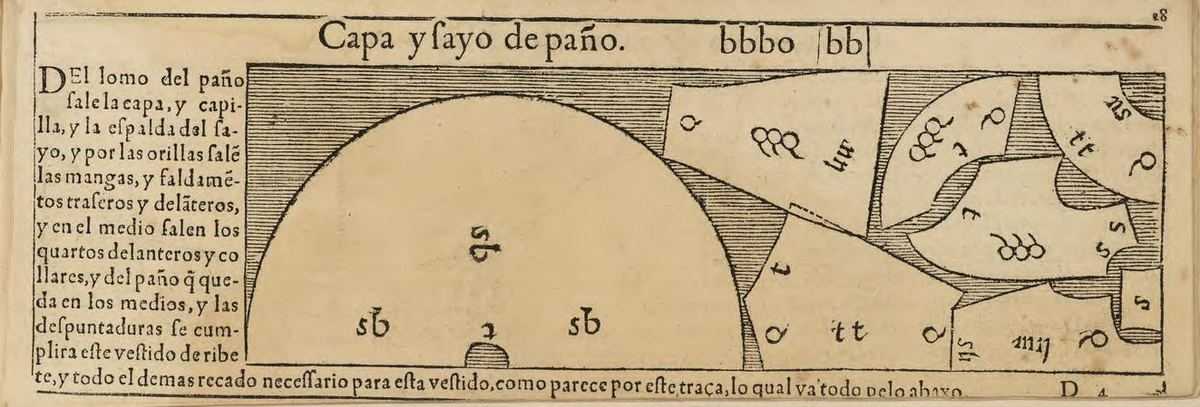
The earliest known printed book of tailoring patterns is the Libro de geometría, práctica y traça by Juan de Alcega, a tailor from the Basque province of Guipúzcoa, printed in Madrid in 1580 and again in 1589. Its 135 woodcuts do not show a body or a size chart. They show something more practical: how to fit every piece of a garment onto a length of cloth of a stated width, and how much cloth to buy.
What was the first printed sewing pattern book?
For garments, the answer most catalogs give is Alcega's book of 1580. The Library of Congress describes it as the first treatise on tailoring published in Spain, and the Thinking 3D research project calls it the first printed book of tailoring patterns. Printed pattern books for needlework are older, so the claim holds for cutting, not for decoration.
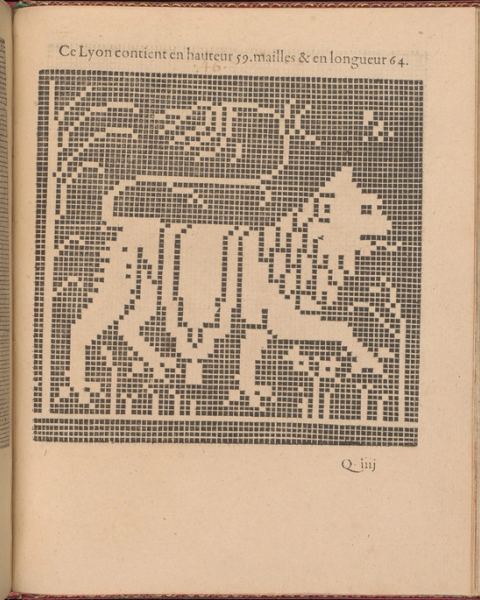
Embroiderers and lacemakers had their own printed model books decades earlier. The Metropolitan Museum of Art holds Johann Schönsperger the Younger's Ein new Modelbuch, dated October 22, 1524, and Teazle has looked at a page from Federico de Vinciolo's lace pattern book, first published in Paris in 1587, in This Lion Is 59 Meshes Tall. Those books give motifs to copy onto cloth. Alcega's book does something else: it tells a tailor where to put the scissors.
The book came out in two editions from the same Madrid printer, Guillermo Drouy. The first, of 1580, is an oblong volume, wider than it is tall; the Library of Congress hosts a scan of the Biblioteca Nacional de España's copy. The second, of 1589, is the one most museums own: the Met's copy (accession 41.7) and the Victoria and Albert Museum's (L.588-1879) are both dated 1589 and measure about 30 by 21 centimeters closed. Catalog records for the 1979 English facsimile, Tailor's Pattern Book 1589, describe its source as the second edition, Madrid, 1589.
These hidden stages of dressmaking are having a moment. The Palais Galliera in Paris opens En volume ! Donner corps à la mode on December 12, 2026 (until October 17, 2027), an exhibition that promises the design and making stages, patterns, toiles and prototypes that usually stay out of sight. Alcega's book is where that hidden layer first reached print.
Who was Juan de Alcega?
Almost everything known about Alcega comes from his own book. He was a working tailor from Guipúzcoa, in the Basque Country. The Library of Congress and the Met both record that birthplace; the Basque encyclopedia Auñamendi suggests, with a "probably," the town of Hondarribia. His birth and death dates are unknown.
The front matter of the book carries most of his biography. According to the Library of Congress description, Alcega dedicated it to a theologian named Tejada and called it "something brand new, never seen so far in our Spain." Two court tailors examined both the book and its author: Hernán Gutiérrez, tailor to the princess of Portugal, and Juan López de Burgete, tailor to the Duke of Alba. On August 21, 1579, they reported that the book was "quite good, useful and beneficial," and the king granted a license to print on September 13, 1579.
The preface also explains why the book nearly did not appear. In the Library of Congress translation, Alcega says he almost gave up, both because of "the costs and several patterns that were necessary" and because of "so many contradictions and disputes I faced in the Royal Advice on the printing of this book." "Royal Advice" is the catalog's literal rendering of the Spanish consejo, council: the disputes were argued before a royal council.
That passage has grown in the retelling. Popular accounts say tailors' guilds fought the book because it gave away trade secrets. The words quoted from the preface name no guild and give no reason for the disputes. A later case points the other way: in Seville in 1588, the tailors' own guild officers approved another tailoring book (see below). The safe reading is narrower: printing the book cost Alcega money and a dispute before a royal council, and he does not say who opposed him.
How do Alcega's diagrams work?
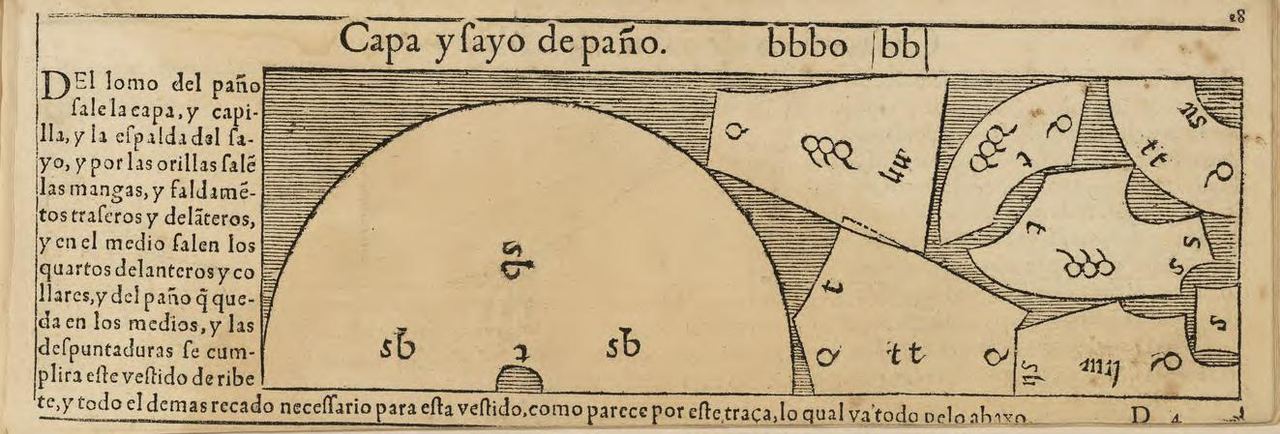
Each diagram is a cutting layout. A long, narrow rectangle stands for a length of cloth, and the outlines inside it are the pieces of one garment, packed as tightly as they will go. Coded letters in the heading give the length of cloth needed and its width; letters inside each piece give its measurements in fractions of the vara, the Castilian yard.
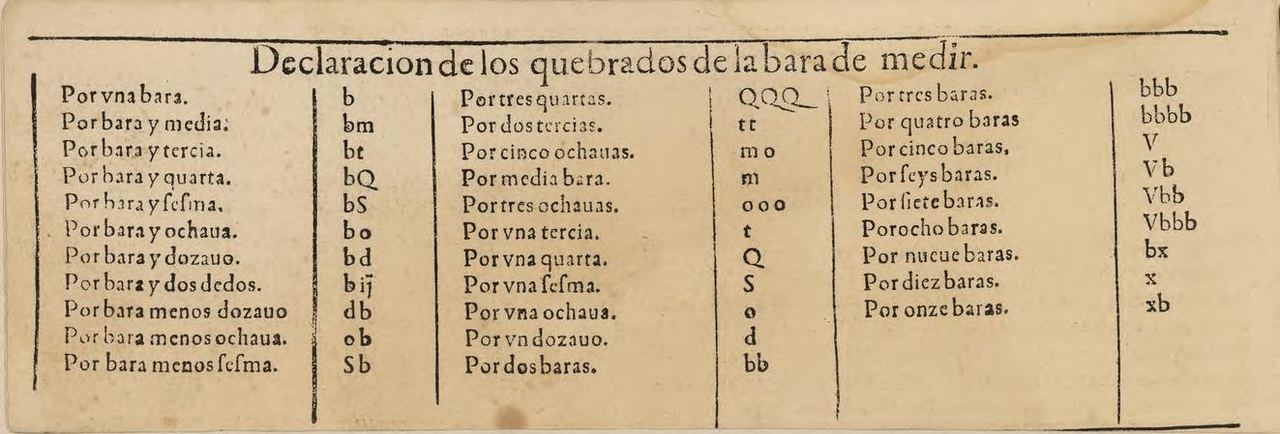
Alcega explains the system in his own words. Above each layout is the name of the garment, then a cross; after the cross come the varas of cloth the garment takes, and after them, "between two lines," the width of the cloth. The letters are a shorthand: b for one vara, bb for two, m for half a vara, t for a third, Q for a quarter, S for a sixth, o for an eighth, d for a twelfth. A letter after the b adds to the vara and a letter before it subtracts, so bm is a vara and a half and Sb is a vara less a sixth.
Read the cloak layout above with that key. "Capa y sayo de paño," a cloak and a sayo (a man's coat with skirts) in woolen cloth, is headed bbbo, three and one-eighth varas, then bb, cloth two varas wide. The cloth is folded, and the text beside the diagram tells the order of cutting: the cloak and its hood come from the fold, the sleeves and skirts from the selvages, the front quarters and collars from the middle, and the trimmings left over supply the binding (ribete). It ends with a reminder that everything is laid "pelo abaxo," with the nap running down.
The book's measure itself gets a chapter. Alcega traces the vara back to the dedo, the width of four barley grains laid side by side, and says the old Roman foot is a third of the Castilian vara. He praises the vara because it divides cleanly into halves, thirds, quarters, sixths, eighths and twelfths, and not into fifths, sevenths or ninths, which is why his whole shorthand uses those fractions. According to the US National Institute of Standards and Technology, Philip II made the vara of Burgos the standard in 1568, and a Spanish table of 1852 gives it as 0.835905 meters: about 84 centimeters, or 33 inches.
Why did saving cloth matter so much?
Because cloth was bought by length in fixed widths, and a mistake in ordering only showed at the cutting table, as a garment cut short or cloth left over. Alcega says that silks woven in Castile were two-thirds of a vara wide, about 56 centimeters, while fine woolens of Segovia were usually two varas wide, about 1.7 meters. Converting between them was where tailors went wrong.
He is blunt about it. Many tailors, he writes, did not know how to convert varas of wide cloth into varas of narrow cloth, so they ordered wrongly, and at cutting time the garment came out short or with cloth to spare. The first part of the book is 22 short chapters of conversions, so that any tailor could order cloth "without either wasting or running short," in the Library of Congress summary.
The layouts are full of small economies of the same kind. For a silk doublet with open sleeves (three varas of two-thirds-wide silk), the sleeves are cut "pie a cabeça," head to foot, laid in opposite directions over the front pieces, and the collars come from what is left. Damask needs half a vara more than other silks because its woven pattern has to be matched across the seams, and Alcega warns that some damasks shrink in the handling. A doublet that is to be covered in rows of backstitching (pespunte) should be cut longer, he adds, because the stitching draws it up by three fingers' width.
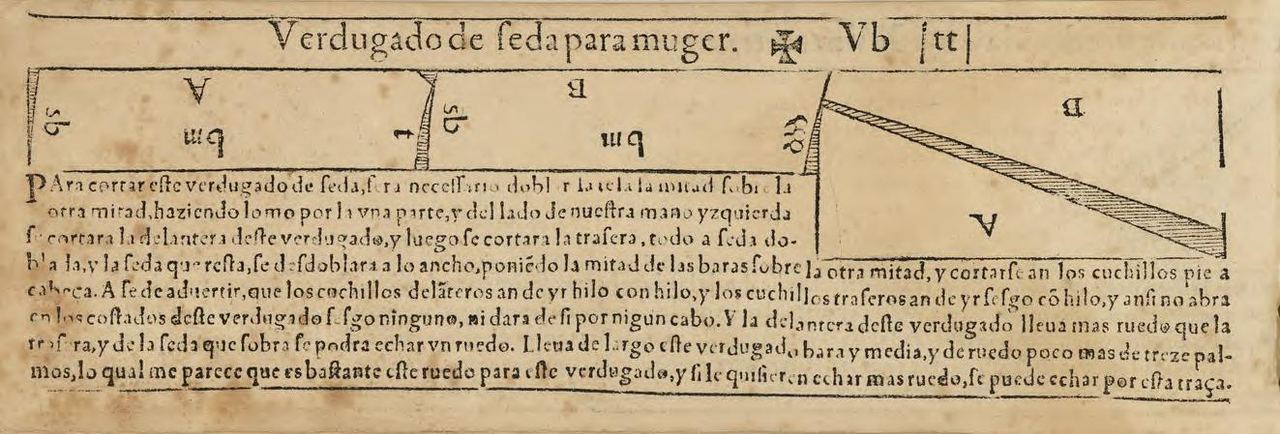
The farthingale layout shows the same care with grain. The "Verdugado de seda para muger," a silk farthingale for a woman, takes six varas of two-thirds-wide silk. The front and back are cut from the folded silk; the rest is refolded end to end and cut into gores, head to foot. The front gores run straight grain to straight grain and the back gores bias to straight, so that, Alcega says, the sides have no bias at all and the farthingale will not stretch anywhere. It is a vara and a half long and a little over thirteen palmos (spans) around the hem.
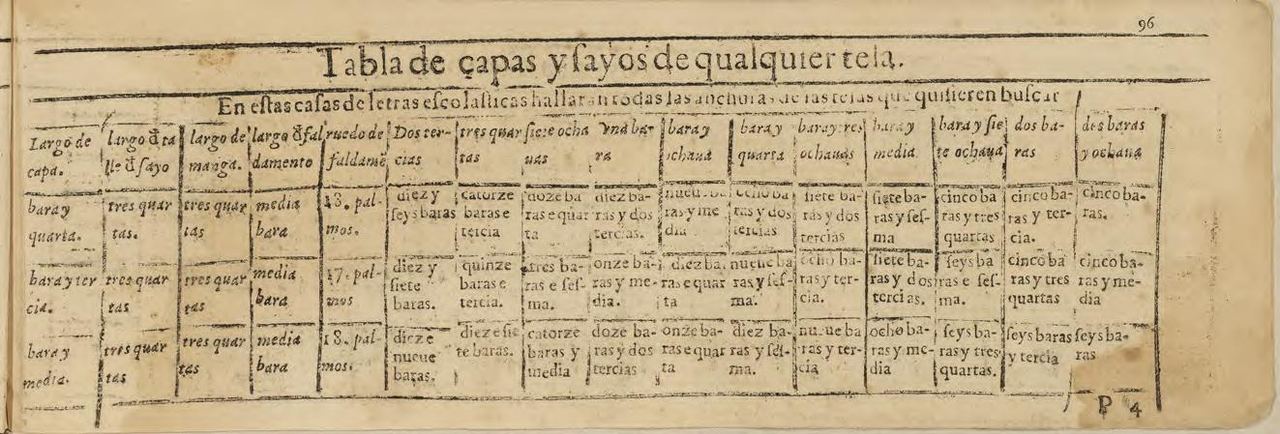
The third part of the book turns all of this into lookup tables. Each table pairs garment lengths with a row of cloth widths and gives the cloth to buy in every box. In the table of cloaks and sayos for men, a cloak a vara less a sixth long needs nine and a third varas of cloth two-thirds wide, but only three and one-eighth varas of cloth two varas wide. That second figure is exactly the bbbo of the cloak layout: the diagram and the table check each other.
What is the book not?
It is not a set of full-size patterns, not a system of graded sizes, and not a method for drafting from body measurements. The woodcuts are small diagrams of a layout, and the tailor had to scale them up to the cloth and to the customer. The Thinking 3D study notes that the patterns are too small to use directly.
The garments are named by wearer and material, only occasionally by build (Thinking 3D cites a silk kirtle "for a fat woman"): a silk doublet for a man, a woolen gown for a woman, a cloak for a cleric, a bishop's mantle, costumes for jousts and reed games, even war banners. The tables vary lengths (three cloak lengths in the cloak table), not girth. Fit came from the tailor's own measure of the client; the doublet instructions speak of cutting "longer than the measure," which assumes that measure was already taken.
So Alcega sits between two later ideas that Teazle has explained in Draping or Drafting? Two Ways Cloth Becomes a Pattern. He does not shape cloth on a figure, and he does not plot a pattern from a set of body measurements, as nineteenth-century pattern drafting systems did. His geometry is about the cloth, not the body: where each piece lies, which way the grain and nap run, and how little is left over. Cut and construction are also evidence in surviving garments, the subject of our guide to dating a garment from its construction; if you want to do the same arithmetic yourself, our fabric pieces planner works out how many pieces fit across a given width and how much length to buy.
Who followed Alcega?
Spain produced a short run of tailoring books after him. Diego de Freyle published his in Seville in 1588, Francisco de la Rocha Burguen his in Valencia in 1618, and Martín de Andújar his in Madrid in 1640, with 320 layouts. The Centre de Documentació i Museu Tèxtil in Catalonia, which owns a copy of Andújar, lists the earlier three in that order.
Freyle's title page calls him a native of Granada and a resident of Seville, "examinado del dicho oficio," examined in the trade, that is, a qualified master, and his book is oblong like Alcega's first edition. Its front matter includes an approval of June 1, 1588, signed by two officers of the Seville tailors' guild, who found the book well made and useful to masters present and future. Rocha Burguen's Geometría y traça perteneciente al oficio de sastres, printed by Pedro Patricio Mey, promises Spanish garments and also some French and Turkish ones. Andújar's title page promises 320 layouts, "Spanish, French, Hungarian and of other nations," old and current.
| Date | Event | Source |
|---|---|---|
| October 22, 1524 | Johann Schönsperger the Younger's needlework model book (date of the Met's copy) | Met 29.71 |
| August 21, 1579 | Court tailors Hernán Gutiérrez and Juan López de Burgete approve Alcega's book | Library of Congress description |
| September 13, 1579 | Royal license to print | Library of Congress description |
| 1580 | First edition, Madrid, Guillermo Drouy, oblong format | Library of Congress; Thinking 3D; CDMT |
| June 1, 1588 | Seville guild officers approve Diego de Freyle's book | Freyle, front matter |
| 1588 | Freyle, *Geometría y traça para el oficio de los sastres*, Seville | Freyle, title page; Thinking 3D |
| 1589 | Second edition of Alcega, Madrid, Guillermo Drouy | Met 41.7; V&A L.588-1879 |
| 1618 | Francisco de la Rocha Burguen, *Geometría y traça*, Valencia | BNE and BnF catalogs |
| 1640 | Martín de Andújar, *Geometría y trazas*, Madrid, 320 layouts | Andújar, title page; CDMT |
| 1979 | English facsimile, *Tailor's Pattern Book 1589*, Ruth Bean, Carlton, Bedford | Open Library catalog |
Where can you see Alcega's book?
The easiest way is online. The Library of Congress hosts the complete World Digital Library scan of the Biblioteca Nacional de España's 1580 copy, which begins at the chapter on the vara (the preliminary leaves are not in the scan), so every layout and table can be read page by page.
Copies of the 1589 edition are held by the Metropolitan Museum of Art in New York, where the title-page woodcut shows Alcega himself, and by the Victoria and Albert Museum in London. The Library of Congress scan is free to browse. For English readers, the 1979 facsimile with a translation by Jean Pain and Cecilia Bainton and notes by J. L. Nevinson was reprinted in New York in 1999.
And from December 12, 2026, the Palais Galliera puts patterns and toiles on the gallery wall. Alcega's woodcuts are a reminder of how old that hidden layer of fashion is, and how much of it was always about a single question: how much cloth to buy.
Sources
- Book on Geometry, Practice, and Patterns (Libro de geometría, práctica y traça), item 2021666766. Library of Congress (World Digital Library). Catalog record read via loc.gov JSON API: summary (Guipúzcoa birth, dedication to Tejada, examiners Gutiérrez and López de Burgete 21 Aug 1579, royal license 13 Sep 1579, Madrid 1580, preface quotes on costs and disputes in the 'Royal Advice', three parts, 22 conversion chapters, 135 traças, tables of three lengths x 14 widths); rights statement; original at BNE. Accessed November 24, 2026.
- Libro de geometría, práctica y traça, Madrid 1580: full page scan (WDL 7333). Juan de Alcega / Biblioteca Nacional de España, via Library of Congress. Primary text read page by page from the scan (PDF and IIIF): chapter on the origin of the vara (dedo of four barley grains; Roman foot = third of a vara; divisions), cloth widths (silk two-thirds, Segovia cloth two varas), ordering errors, damask half vara extra and shrinkage, nap, the key to the heading and the fraction shorthand, layouts for the capa y sayo, jubón de seda, verdugado, and the cloak table. The scan lacks the preliminary leaves. Accessed November 24, 2026.
- Libro de Geometría, Práctica y Traça, 1589 (41.7). The Metropolitan Museum of Art. Collection API record read (objects/344686): date 1589, publisher Guillermo Drouy, Madrid, author bio 'Spanish, born Guipúzcoa', woodcut portrait of Alcega as sitter, dimensions 30 x 21.5 cm, credit Rogers Fund, public domain, Wikidata Q21043151. Web page returned 429; images host returned 403, so no Met image used. Accessed November 24, 2026.
- Libro de geometria, pratica, y traça, Madrid, 1589 (L.588-1879). Victoria and Albert Museum. V&A API record read: 1589, Madrid, limp vellum, 296 x 210 mm, accessioned 1879. Accessed November 24, 2026.
- Juan de Alcega's Libro de Geometria, Práctica y Traça. Thinking 3D (Noam Andrews). Full page read: editions 1580 and 1589, 'first printed book of tailoring patterns', 135 woodcut patterns named by wearer/material/size ('silk kirtle for a fat woman'), too small to use directly, oblong first edition like Freyle 1588 (Folger copy), frontispiece portrait with compass and ruler, Met copy 41.7. Accessed November 24, 2026.
- Geometría y traça para el oficio de los sastres (Seville, 1588), scan on Internet Archive. Diego de Freyle. Primary text read in the OCR text file of a user-uploaded scan: title page (native of Granada, resident of Seville, 'examinado del dicho oficio', Seville 1588), approval of the Seville alcaldes y veedores of the tailors' trade dated 1 June 1588. Date and place cross-checked with Thinking 3D (Folger copy). Accessed November 24, 2026.
- Geometría y trazas pertenecientes al oficio de sastres (Madrid, 1640). Martín de Andújar / Centre de Documentació i Museu Tèxtil, via Memòria Digital de Catalunya. Record read via the Europeana API and title page viewed (IIIF): Madrid, Imprenta del Reino, 1640, 320 trazas 'Españolas, Francesas, Vngaras, y de otras Naciones'; description lists Alcega (1580), Freyle (1588), Rocha Burguen (1618) as earlier. Accessed November 24, 2026.
- Rocha Burguen, Geometria y traça perteneciente al oficio de sastres, Valencia, Pedro Patricio Mey, 1618 (bdh0000052415). Biblioteca Nacional de España, via Europeana. Catalog record read via the Europeana API (BNE site blocks automated access): 1618, Valencia, title mentions Spanish, French and Turkish garments. Cross-checked with the BnF record (Gallica bpt6k8549738, P. P. Mey, Valencia, 1618) and the CDMT description. Accessed November 24, 2026.
- Johann Schönsperger the Younger, Ein new Modelbuch, October 22, 1524 (29.71(1-31)). The Metropolitan Museum of Art. Collection API record read: date October 22, 1524; woodcut. Accessed November 24, 2026.
- The Vara: A Standard of Length With a Not-So-Standard History (Marcos A. Reyes-Martinez, 2019). National Institute of Standards and Technology. Full text read: vara of Burgos made Spain's official standard by Philip II in 1568; 0.8359 m (32.909 in). Accessed November 24, 2026.
- Real Orden de 9 de diciembre de 1852: tablas de correspondencia entre medidas métricas y las en uso. Centro Español de Metrología. PDF text read: vara de Burgos = 0.835905 m. Accessed November 24, 2026.
- Tailor's pattern book, 1589 (R. Bean, Carlton, Bedford, 1979; Costume & Fashion Press, New York, 1999). Open Library. Edition records read via API: translation by Jean Pain and Cecilia Bainton, introduction and notes by J. L. Nevinson; notes 'Originally published... 2nd. ed. Madrid, 1589'. Book itself not accessible (Internet Archive copy is print-disabled only). Accessed November 24, 2026.
- Alcega, Juan de. Auñamendi Eusko Entziklopedia. Entry read via WebFetch summary (site blocks direct download): Gipuzkoa, probably born in Hondarribia; 1580 first edition, 1589 reprint. Its death year 1580 is not used: no primary evidence supports it. Accessed November 24, 2026.
- Upcoming exhibitions: Crafting Volume! Embodying Fashion (En volume ! Donner corps à la mode). Palais Galliera. Page read: dates 12 December 2026 to 17 October 2027; patterns, toiles and prototypes shown. Accessed November 24, 2026.
- Juan de Alcega (English and Spanish articles). Wikipedia. Used to locate references only; source of the popular 'guild resistance' claim discussed (and not adopted) in the text. Accessed November 24, 2026.
Glossary
On the Workbench
Last updated · Markdown · Report an error