Pieces-on-Fabric Planner
Work out how much fabric N same-size rectangles need: pieces per row, rows, cut length and yardage rounded up to 1/8 yd, from the finished or cut size, seam allowance, fabric width and selvedge trim, with a one-way option and a to-scale layout. Everything runs in your browser and nothing is uploaded.
Decimals or fractions: 10, 10.5, 10 1/2. Width is the side laid across the fabric.
Taken off the width before any piece is placed. 1 in total is a common allowance; 0 uses the full width.
How it is calculated
The planner handles one job: N identical rectangles on one length of fabric. First the cut size: if you give the finished size, each side grows by two seam allowances, so a 10 in square with a 1/4 in seam allowance is cut at 10 + 2 x 0.25 = 10.5 in. If you choose “cut size” the numbers are used as typed. Then the width: usable = fabric width − selvedge trim, so 44 in fabric with 1 in of trim leaves 43 in.
| Step | Formula | Example |
|---|---|---|
| Per row | floor(usable / piece width across the fabric) | floor(43 / 10.5) = floor(4.095) = 4 |
| Rows | ceil(N / per row) | ceil(20 / 4) = 5 |
| Length | rows x piece length | 5 x 10.5 = 52.5 in |
| Yardage | length / 36, rounded up to 1/8 yd | 52.5 / 36 = 1.458 yd, so 1 1/2 yd |
| Metres | length in cm / 100, rounded up to 0.1 m | 52.5 x 2.54 = 133.35 cm, so 1.4 m |
| Waste | 1 − (N x piece area) / (fabric width x length) | 1 − 2,205 / 2,310 = 4.5% |
Turning the pieces
Unless “one way” is on, the planner tries the piece both ways: width across the fabric, and the piece turned a quarter turn. It keeps the layout with the shorter length. If the lengths are equal it keeps the one with fewer rows, and if those are equal too, the piece as entered. For example, 9 pieces cut 7 x 14 in on 43 in usable width: as entered, 6 fit across and 2 rows make 28 in; turned, 3 fit across and 3 rows make 21 in.
Rounding
Everything is rounded up: buying a hair too much is harmless, a hair too little is not. Yardage goes up to the next 1/8 yd and metres to the next 10 cm, because that is how fabric is usually cut. Exact lengths are shown beside. The “waste” figure is for the cut length at full width, so the selvedge trim counts as waste; a second figure shows it after the rounding up.
What this tool does not know
- Rectangles only, all the same size, in a straight grid. Triangles, circles, curved patterns and mixed sizes need a marker or a proper pattern layout.
- No allowance for shrinkage, a fabric that is off-grain, matching a print repeat, or fussy cutting. Add length yourself, or wash and press first and measure the width you actually have.
- The pieces are laid in one block of whole rows. A real layout may use leftover strips for other parts, which this tool does not plan.
- Every piece is laid the same way round. The planner never mixes turned and straight pieces in one layout, so with “one way” off it still gives a single orientation for all of them.
- Fabric width and trim are not standardised. Measure the bolt or your piece, selvedge to selvedge, and use that.
The arithmetic is plain division and rounding, written out above and checked by hand-worked unit tests.
To find the fabric for N same-size pieces, work out how many fit across the usable width, divide N by that to get rows, multiply the rows by the piece length, and round the length up to the next 1/8 yard. Twenty 10 in squares with a 1/4 in seam allowance, cut from 44 in fabric, need 1 1/2 yd.
How do you turn a finished size into a cut size?
The cut size is the finished size plus a seam allowance on every side. A finished 10 in square with a 1/4 in seam allowance is cut at 10 + 2 x 0.25 = 10.5 in, because each of the two opposite sides gives up one allowance. Commercial home-sewing patterns use allowances from 1/4 to 5/8 in, according to Wikipedia's entry on the seam allowance, so the number is yours to set; the planner takes it per side.
The same sum applies to hems. A tutorial for double-sided napkins from Fiddlehead Artisan Supply notes that 1/2 in seam allowances make a napkin 1 in smaller than the square you cut. Sew4Home cuts 21 in squares for 20 in napkins, turning a 1/4 in double fold (1/2 in) on each side. If you already have the cut size, for example from a pattern, choose “cut size” in the tool and the seam allowance is ignored.
How wide is the fabric you can actually use?
Quilting cotton is commonly sold at 44 or 45 in, a standard that Quilt Batting's guide to fabric widths calls the quilting world's “unofficial gold standard.” You cannot use all of it. The selvage is the self-finished edge where the weft turns back, and it runs parallel to the warp, along the length of the cloth. Wikipedia notes that the fabric near it is often discarded, and that quilters trim it because it can pucker after laundering.
Published figures for what is left disagree, so the planner asks you for the trim instead of assuming one. The Missouri Star blog says quilting cotton is sold at 42 in but only about 40 in is usable after trimming the selvages. Quilt Batting says about 42 to 44 in remain from 45 in fabric. The default here is 1 in in total, so 44 in fabric leaves 43 in. If your selvages are wide or the cloth is uneven, enter more.
An inch of width can cost far more than an inch of fabric, because it decides how many pieces fit across. The table is the planner's result for 20 squares cut at 10.5 in, on 44 in fabric with different amounts of trim.
| Usable width | Per row | Rows | Length | Yardage |
|---|---|---|---|---|
| 43 in (1 in trim) | 4 | 5 | 52.5 in | 1 1/2 yd |
| 42 in (2 in trim) | 4 | 5 | 52.5 in | 1 1/2 yd |
| 41 in (3 in trim) | 3 | 7 | 73.5 in | 2 1/8 yd |
| 40 in (4 in trim) | 3 | 7 | 73.5 in | 2 1/8 yd |
Four squares of 10.5 in need exactly 42 in. At 41 in the fourth square no longer fits, so one more inch of trim adds 21 in of length, and the purchase grows from 1 1/2 yd to 2 1/8 yd.
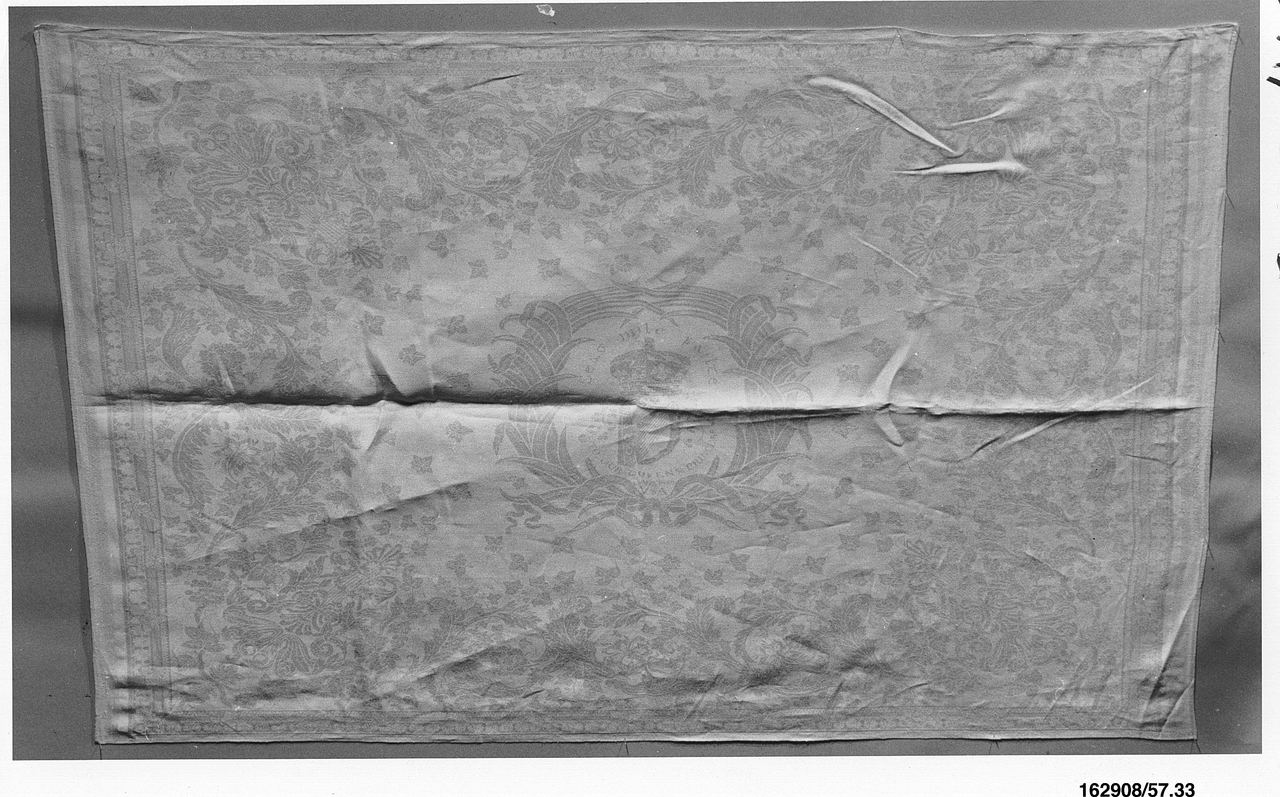
The same constraint is old. The Met's record for an 1849 linen dinner napkin gives its height as 26 1/2 in and the loom width as 26 1/2 in, so the napkin is as tall as the cloth was woven wide. The width of the cloth sets what can be cut across it.
How do pieces per row, rows and length work?
There are three steps, each a single division or multiplication. Take the 20 squares of 10.5 in on 43 in of usable width.
- Pieces per row: floor(43 / 10.5) = floor(4.095) = 4. Floor means round down, because a piece that does not fit does not count.
- Rows: ceil(20 / 4) = 5. Ceil means round up, because a part-filled row still takes a full row of length.
- Length: 5 x 10.5 = 52.5 in.
The pieces sit in one block of whole rows, so the last row can be short. With 21 squares the answer is 6 rows, 63 in and 1 3/4 yd, and the last row holds a single square. The planner states how many places are empty, and the waste figure (1 minus the piece area divided by the area of the full-width cut) includes them, along with the trim and the strip left beside the pieces. For the 20 squares it is 1 − 2,205 / 2,310 = 4.5%.
Why round up to an eighth of a yard?
Fabric is cut by the fraction of a yard. A chart in Dummies lists the common cuts from 1/8 yd (4.5 x 44 in) up to a full yard, each 44 in wide. The length of 52.5 in is 52.5 / 36 = 1.458 yd, which is 11.67 eighths. Rounding up gives 12 eighths, so 1 1/2 yd, and you are never short. Some sources round more coarsely: the Missouri Star method for quilt backing rounds up to the next 1/4 yd. If you are buying from a shop that cuts in quarters, take the next quarter above the planner's figure.
The metric answer rounds up to the next 10 cm. The international yard is defined as exactly 0.9144 m, according to Wikipedia's entry on the international yard and pound, so 52.5 in is 133.35 cm, which rounds up to 1.4 m. Counting is done in the unit you type, and only the length is converted at the end, so a metric layout is not disturbed by conversion rounding.
When does turning the pieces save fabric?
For a rectangle that is not square, the piece can be laid with either side across the width. The planner works out both and keeps the one with the shorter length; on a tie it keeps the one with fewer rows. Take 9 pieces cut 7 x 14 in on 43 in of usable width:
| Layout | Per row | Rows | Length | Yardage |
|---|---|---|---|---|
| 7 in across | 6 | 2 | 28 in | 7/8 yd |
| 14 in across (turned) | 3 | 3 | 21 in | 5/8 yd |
Turning saves a quarter of a yard here. It is not always allowed. A fabric with a nap has a direction, and Wikipedia notes that the nap direction is often matched across seams and that patterns warn when more fabric will be needed for a napped cloth. The same goes for a directional print or a stripe. Switch on “one way” and the planner keeps every piece as entered, so the 28 in layout is the answer. Estimates of the extra fabric a one-way layout needs, expressed as a flat percentage, are rules of thumb; the arithmetic of your own pieces is better.
Does the planner agree with published tutorials?
Three published examples are a check on the arithmetic.
- Sew4Home's mix-and-match napkins use 21 in squares on 44 to 45 in fabric. Two squares fit across, so one row of 21 in makes two napkins. The planner gives 21 in, or 5/8 yd. The tutorial recommends 3/4 yd, which leaves room above the 21 in minimum.
- Fiddlehead's double-sided napkins use 17 in squares, one from each of two fabrics per napkin. On 44 in fabric, a 1 yd cut of each holds 4 squares, 2 across in 2 rows, which is 34 in of the 36. The planner agrees: 34 in rounds up to 1 yd. The tutorial says two yard cuts of 44 in fabric make four 16 in napkins.
- On 54 in fabric, 6 squares go 3 across in 2 rows, again 34 in and 1 yd. The tutorial says two yard cuts of 54 in fabric make six napkins. The wider cloth wastes far less: 5.6% against 22.7% on the 44 in fabric.
Eight napkins finished at 20 in and cut at 21 in come to 4 rows of 2 across, 84 in and 2 3/8 yd. Drop the usable width below 42 in and only one piece fits across, so the same eight napkins need 168 in, or 4 3/4 yd.
What does the planner leave out?
It handles identical rectangles in one grid, and nothing else. Triangles, curves, mixed sizes and the shaped pieces of a garment need a proper layout. It does not allow for shrinkage: Quilt Batting says 100% cotton can shrink by 3 to 5% in the first wash, and Fiddlehead's tutorial begins with pre-washing the fabric. Wash and press the fabric first, measure the width you actually have, and enter that. It does not match a print repeat or fuss-cut a motif, and it does not plan the leftover strips for another use; a strip left beside the pieces could, for instance, be cut on the bias for binding with the bias binding planner.
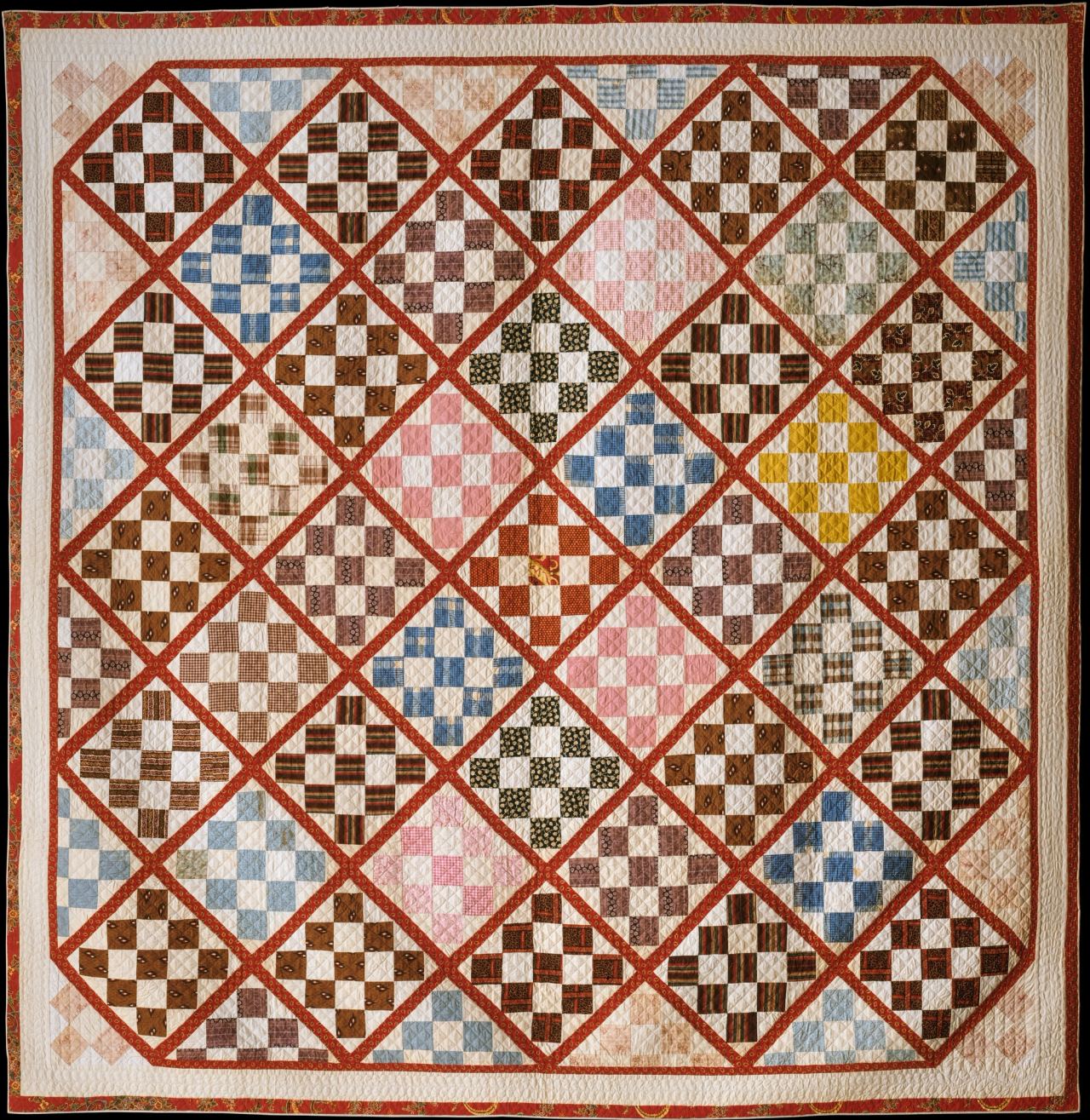
Pieced work is one place where this arithmetic recurs. A quilt such as the one at the top of this page is a grid of squares of one size, and the quilt block cutting calculator covers the triangles that the rectangle planner does not. For what separates a quilt from a coverlet or a counterpane, see the quilt, coverlet and counterpane find.
Where can you see these objects?
Both images are in the Metropolitan Museum of Art's open-access collection: the Nine Patch pattern variation quilt (ca. 1846, 1980.498.2) and the 1849 dinner napkin (57.33).