Illustration
Kate Greenaway, Who Dressed a Generation of Children
Who was Kate Greenaway, and what is the Greenaway style of dress? The illustrator whose 1880s picture books put children in mob caps and high-waisted frocks, and who watched shops copy them.
Kate Greenaway (1846–1901) was an English illustrator whose picture books and cards of the 1870s and 1880s showed children in high-waisted frocks, mob caps, bonnets and aprons, a look based on the dress of about 1800. The "Greenaway style" of dress is that look, which shops and families were copying for real children by the late 1880s.
Who was Kate Greenaway?
Kate Greenaway was born on 17 March 1846 at 1 Cavendish Street, Hoxton, in east London, and died on 6 November 1901 at her house in Hampstead. The daughter of a wood engraver, she trained at South Kensington and, from the late 1870s, became one of the most popular children's illustrators in Britain, France, Germany and the United States.
Her 1905 biographers, M. H. Spielmann and G. S. Layard, give both dates, and so do the Dictionary of National Biography's 1912 supplement and a Gale reference entry. Her father, John Greenaway, was a wood engraver and draughtsman whose work appeared in the early Illustrated London News and Punch. Her mother, Elizabeth Jones, ran a shop in Islington's Upper Street after her husband's publishers failed and he was never paid for a large commission; according to Spielmann and Layard it sold lace, children's dresses and fancy goods. Clothes for children were, in other words, a household trade before they were a subject.
The other formative place was Rolleston, a Nottinghamshire farming village where Kate stayed as a child. Spielmann and Layard say that in her first card designs she adopted the dress she had seen there, because older costumes survived in the village long after they had disappeared from towns.
What is the Kate Greenaway style of dress?
The Greenaway style is the clothing of her drawings: long, straight, high-waisted frocks tied with a sash, frilled caps and bonnets, short capes, pelisses, wide-brimmed hats, aprons and flat shoes. It looked back to the years around 1800, and it was a picture of clothing more than a record of it.
Spielmann and Layard describe the aim in plain terms. Smart dress for children, as society practiced it, was repellent to her, so she devised frocks, aprons, hats and breeches "in the style of 1800", neat and prim, adding comfort to grace. They also say her wardrobe of garments was "partly conjured up from memory and partly invented". They add that when her brother John was born, Kate was six and remembered everything he wore: a scarlet pelisse and white felt hat with feathers, then a drab pelisse and hat, then a pale blue frock with a white jacket and a white Leghorn hat. All of it, they say, reappeared in her picture books.
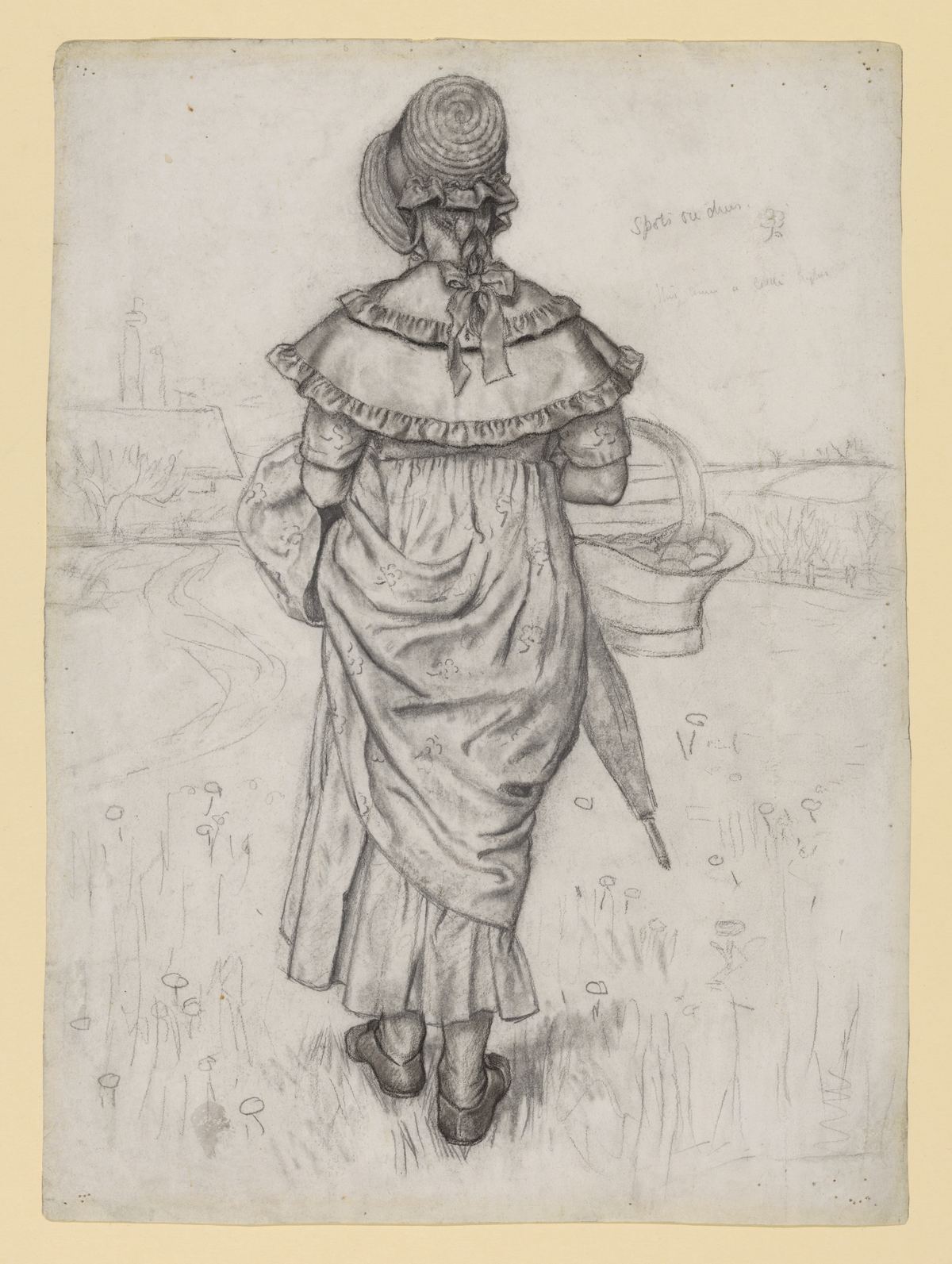
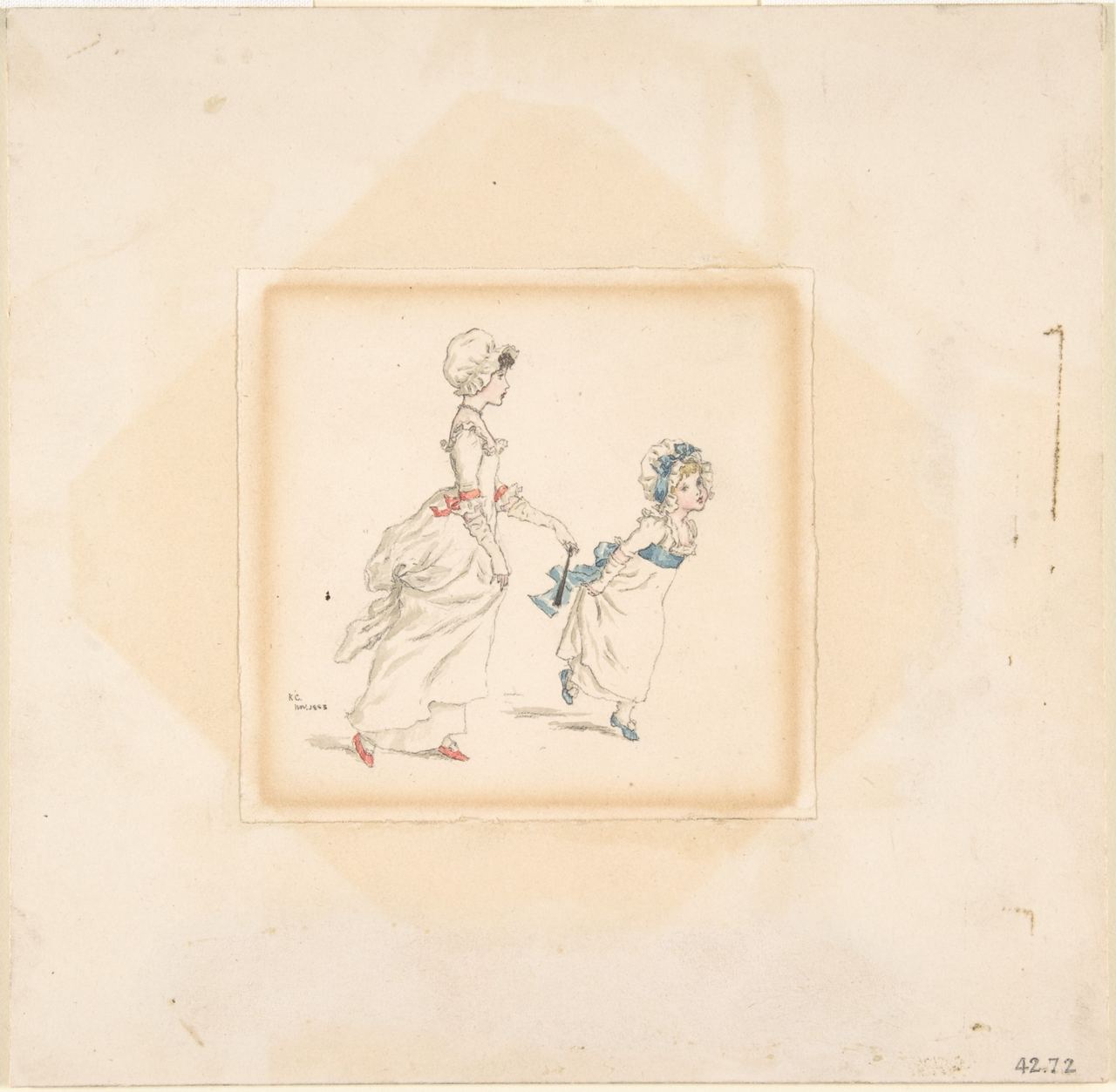
You can see the look in two Met drawings. In the 1878 pencil study that opens this article, a figure seen from behind wears a straw bonnet, a frilled shoulder cape and a long gathered frock, and carries a basket and a furled umbrella. The Met titles the sheet a study for Under the Window, her first big book. In a small 1883 drawing, a woman in a frilled cap and a long gown with a red sash hurries along with a girl in a bonnet and blue sash.
The mob cap was a real garment, not an invention. The V&A holds a child's mob cap of embroidered net with flaps for tying under the chin, dated 1800 to 1850. Merriam-Webster dates the word to 1785.
Did she make the clothes herself?
She began by making them. Spielmann and Layard report that she did not simply copy an old costume book: she started from the beginning, fashioning dresses with her own hands and dressing her models and lay figures in them until the effect lived and moved as it would have a century earlier.
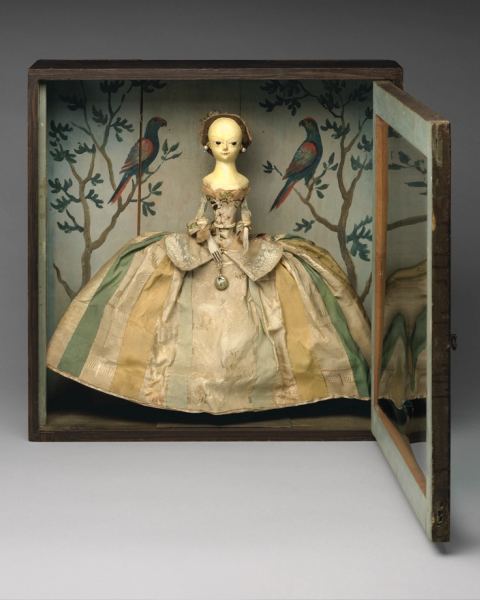
The same biography says she chose her child models carefully, sometimes by visiting schools, and that her nephew Eddie sat for many of the books. Ruskin's letters show the idea of the lay-figure and the costume plate in circulation around her. In a letter dated 23 January 1887, he wrote that he had a cupboard full of dolls for lay figures and five hundred plates of costume "to be Kate Greenawayed", using her name as a verb. A dressed figure used to test how a garment falls is an old workshop tool; for the long history of the dressed doll, see A Doll Is a Dress Rehearsal.
She did not become a dressmaker. Late in her career, when her earnings were falling, she planned a large dressmaking business under her own name, with herself as designer, but Spielmann and Layard say it never got beyond talk, mostly with her sister Fanny. Ruskin, too, hoped to get her to sketch "a pattern frock or two" for needlework teaching at Whitelands College; the biography mentions no such drawings.
How did a picture-book look reach real children?
It spread first through paper, then through shops. Edmund Evans, the color printer, bought about fifty of her drawings with verses around 1877–78 and printed a first edition of 20,000 copies of Under the Window, which his publishers thought a risk for a six-shilling book. By his account it sold out and was reprinted until 70,000 copies had been printed. The Dictionary of National Biography gives nearly 70,000 copies in England plus 30,000 French and German copies.
Sources differ on the date. Spielmann and Layard say the book was published at the end of 1878 and list it under 1878; Evans, quoted in the same biography, recalled the autumn of 1879, and the Dictionary of National Biography also says 1879. We use 1878, which matches the Met's dating of the study.
The look was already a recognizable phrase by about 1879. W. J. Loftie recalled meeting her at a private view that year, laughing at what a lady had just told her about some country cousins: they "spoil their good looks, you know, by dressing in that absurd Kate Greenaway style". On 10 December 1881, by Spielmann and Layard's account, Punch ran a full-page cartoon of Christmas cards in which the royal family, apart from the Queen, appeared in Greenaway costume. The same biography passes on an anecdote that a visitor to the painter Jules Breton in Normandy found all the children dressed in Greenaway costumes. It is hearsay, and we give it as such.
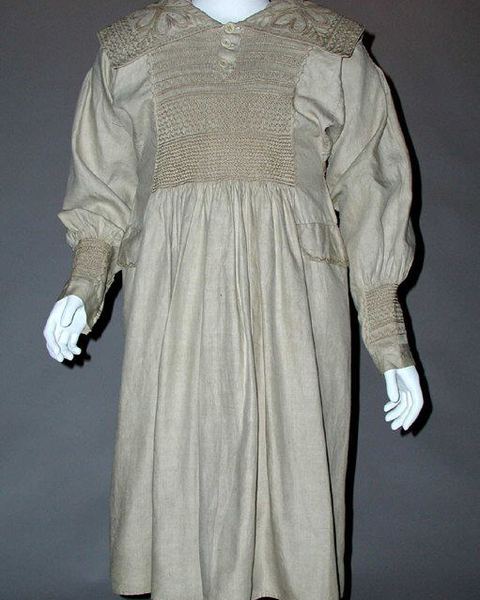
The clearest commercial link is Liberty of London. According to the Totnes Fashion and Textiles Museum, Liberty began a costume department in 1884 under the architect E. W. Godwin and opened a children's department in 1887 with clothes in the style of her drawings. A reference entry on the firm adds that smocking was a striking feature of the Greenaway-influenced "artistic" dress for children, and that these clothes were popular with Liberty's customers from the late 1880s. The date of the children's department rests on that one museum page, so treat 1887 as the museum's date. For how the stitch works, see Smocking: Gathering Cloth into Structure.
The smock-frock was part of this story, though not a Greenaway invention. The V&A's record for a child's embroidered wool smock of the 1880s says the farm worker's garment was adopted by the Aesthetic and Arts and Crafts movements and used to inspire fashionable dress for girls. That record does not mention Greenaway, and we do not claim the smock is "Greenaway".
Her pictures were copied well beyond clothing. A V&A nursery wallpaper of 1893, "The Months", was adapted from her Almanack, and the museum notes that her drawings were often copied or adapted to other uses. Spielmann and Layard also tell of workers in a Budapest majolica factory copying her book line for line onto plates.
What did Ruskin make of her costumes?
Ruskin, her most famous correspondent, loved the drawings and quarreled with the clothes. On 6 January 1880 (the biography corrects his "1879") he asked whether she could only draw pretty children out of her head. The children in his parish school were prettier, he said, but "in costumes neither graceful nor comic", more like "very ill-dressed Angels". Could she draw them as they were?
He kept needling her. In a letter of late December 1882, just before they first met, he wrote that he wished some children had bare feet and that the others' shoes were not "so like mussel-shells". Her diary for 29 December 1882 records: "Mr. Ruskin came. First time I ever saw him."
His praise was lavish too. In a lecture published in The Art of England he said her drawings showed "the radiance and innocence of reinstated infant divinity" among English flowers. Both responses are worth keeping in view: the dress was admired as a vision and doubted as documentation, even by its greatest admirer.
What are the key dates in her life?
| Date | Event | Source |
|---|---|---|
| 17 March 1846 | Born at 1 Cavendish Street, Hoxton | Spielmann and Layard; DNB |
| 1868 | Shows "Kilmeny" at the Dudley Gallery, her first public showing | Spielmann and Layard |
| 1871 | Designing Christmas cards for Marcus Ward of Belfast | Spielmann and Layard |
| 1877–78 | Takes about fifty drawings with verses to Edmund Evans | Evans, in Spielmann and Layard |
| End of 1878 | *Under the Window* published (some sources say 1879) | Spielmann and Layard; DNB |
| 1880 | *Kate Greenaway's Birthday Book for Children* | DNB |
| 29 December 1882 | First meeting with Ruskin | Spielmann and Layard |
| 1883 | First of her annual *Almanacks* (to 1895, with a last one in 1897) | DNB; V&A |
| 1884 | Liberty opens a costume department | Totnes museum; reference entry |
| 16 February 1885 | Moves into 39 Frognal, Hampstead, a house by Norman Shaw | Spielmann and Layard |
| 1885–86 | *Marigold Garden* and *A Apple Pie* | DNB |
| 1887 | Liberty's children's department, per Totnes museum | Totnes museum |
| 6 November 1901 | Dies at 39 Frognal | Spielmann and Layard; DNB |
Why did the fashion fade, and what is left of it?
Greenaway did not enjoy the imitators. Spielmann and Layard say that imitation annoyed her and did her reputation harm, because her copyists out-Greenawayed her in caricature and many people could not tell one from the other. In Belgium, they add, her illustrations were copied onto handkerchiefs, plates and vases. Late in life she was, in their words, firmly persuaded that she was well-nigh forgotten. In August 1901 she turned down the editorship of a new children's magazine, citing her health. She died on 6 November 1901 at 39 Frognal and was cremated at Woking on 12 November, and her casket was buried at Hampstead Cemetery the next day. A Gale reference entry gives breast cancer as the cause, and the Victorian Web agrees.
A memorial committee raised money for a cot at the Great Ormond Street Hospital for Children. Arthur Lasenby Liberty, whose Regent Street shop, according to the Victorian Web, helped make the Greenaway look "all the rage", was its honorary treasurer.
At her exhibition at the Fine Art Society in 1891, a critic named Lionel Robinson asked, according to Spielmann and Layard, whether she had founded a school or only started a fashion. The clothing suggests it was a fashion that lasted: the Totnes museum holds a child's blue smocked dress of about 1900 that it describes as "very much in the Kate Greenaway style", and the V&A holds a Liberty girl's smocked dress of about 1930.
Where can you see her work?
The Metropolitan Museum of Art offers many of its Greenaway drawings and Marcus Ward valentines as open access images; the 1878 study (2025.707) and the 1883 drawing (42.72) are both in the public domain. The V&A holds her Almanack wallpaper (E.1823-1934) and drawings for the Language of Flowers. Spielmann and Layard's 1905 biography, with her letters, is free to read at the Internet Archive.
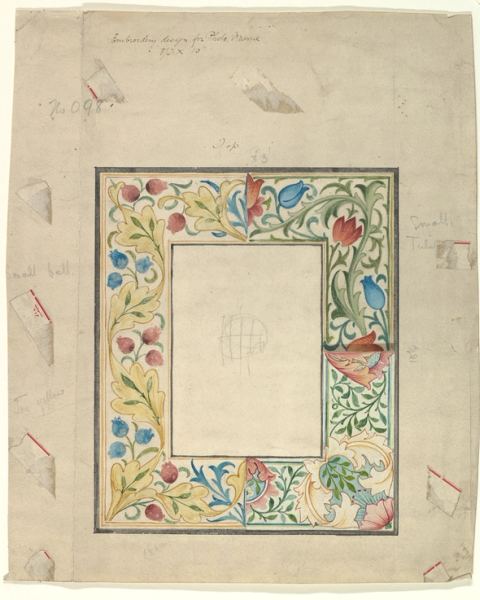
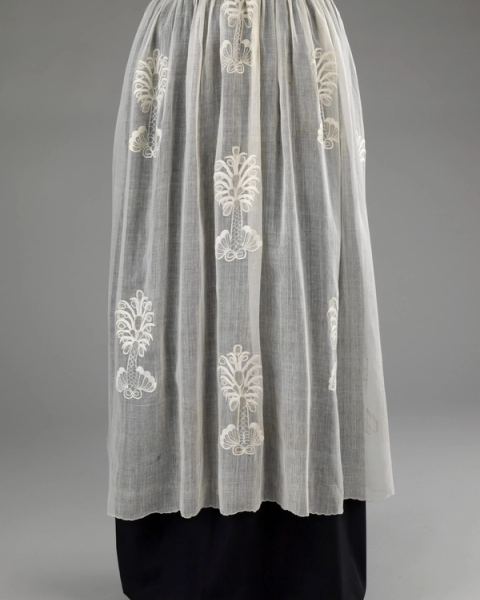
For a contemporary who worked in thread rather than print, see May Morris, who took over the Morris & Co. embroidery department in 1885. For the apron's earlier history, see A Lady's Apron Was Not for Work.
Sources
- M. H. Spielmann and G. S. Layard, Kate Greenaway (London: A. & C. Black, 1905). Internet Archive. Primary biography with her letters and Ruskin's. Full OCR text of the Cornell scan read: birth and death, family and mother's shop, Rolleston, her own dressmaking of costumes, models, Evans's account of Under the Window, Loftie anecdote, Punch, Ruskin letters (6 Jan 1880, 27 Dec 1882, 23 Jan 1887, the Whitelands remark), imitators, death and burial, memorial committee, bibliography. Accessed October 23, 2026.
- Greenaway, Catherine or Kate (1846-1901). Wikisource (Dictionary of National Biography, 1912 supplement). Read in full: dates, South Kensington, Under the Window sales, bibliography, death at 39 Frognal. It names Spielmann and Layard as its chief authority, so it does not count as independent of source 1. Accessed October 23, 2026.
- Greenaway, Kate (1846-1901). Encyclopedia.com (Gale, Women in World History). Read the opening entry: birth 17 March 1846 Hoxton, death 6 November 1901 Frognal, Hampstead, of breast cancer; works list. Accessed October 23, 2026.
- Kate Greenaway: biography. The Victorian Web. Read in full: confirms 1846 and 1901, breast cancer, Hampstead house by Norman Shaw, Liberty's support. It gives no exact dates. Accessed October 23, 2026.
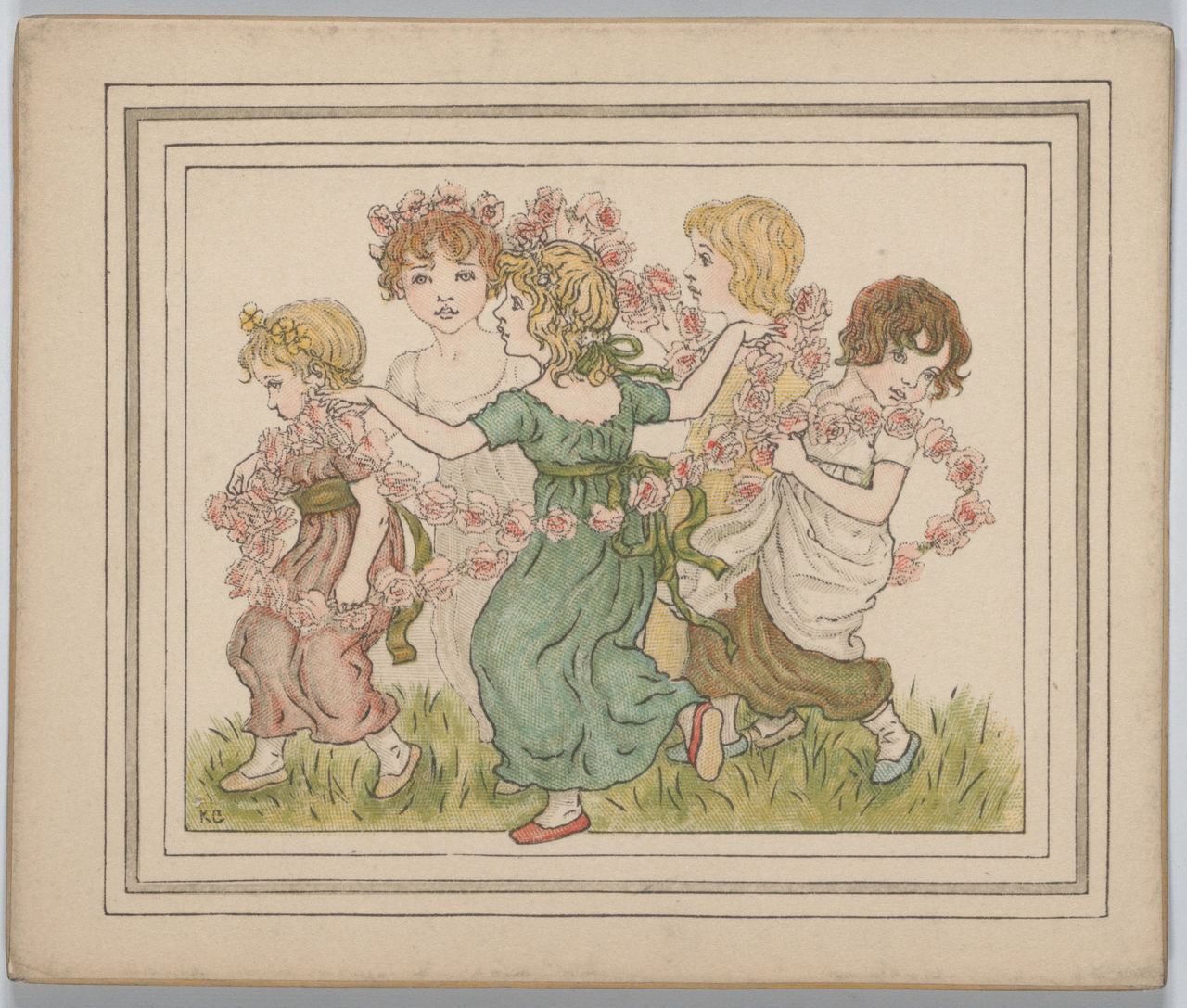
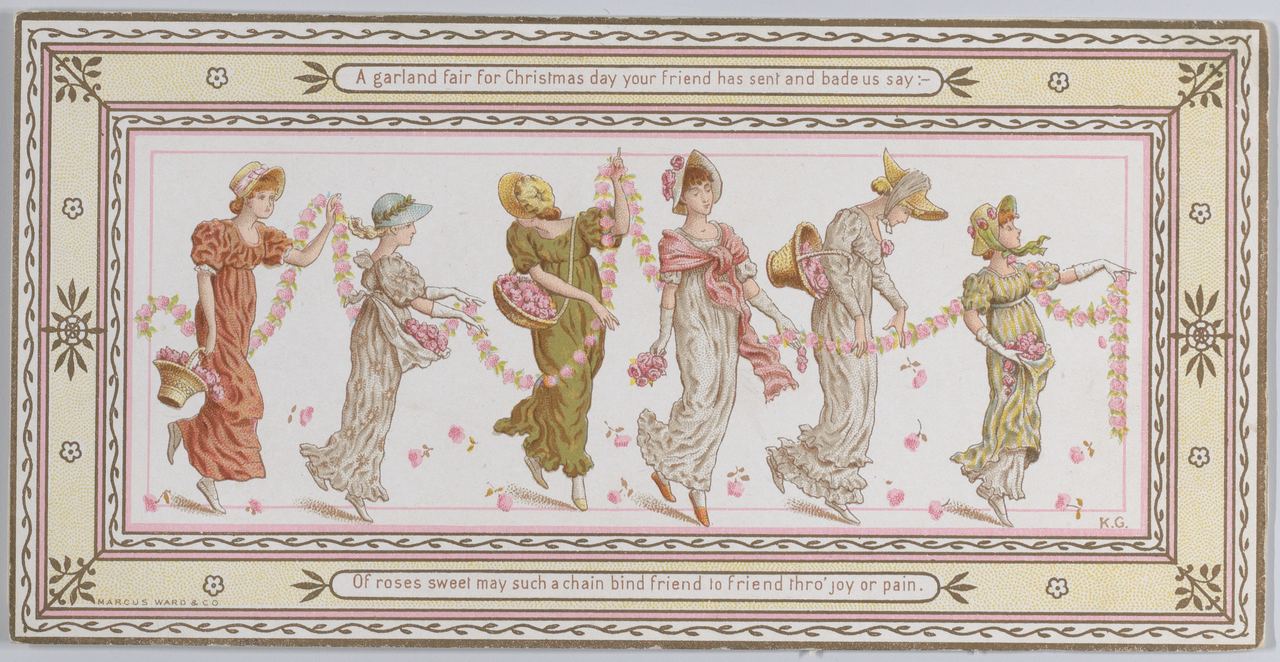
- Study for Under the Window (2025.707); Woman and Child (42.72); two Kate Greenaway cards (1981.1136.782, .785). The Metropolitan Museum of Art. Object records read via the Met API (v1 objects): artist, date, medium, dimensions, credit line, isPublicDomain true for all four. Images viewed and described from the files. Accessed October 23, 2026.
- Nursery wallpaper, The Months, 1893 (E.1823-1934). Victoria and Albert Museum. Record read via the V&A API: adapted from Greenaway's Almanack; her drawings often copied or adapted to other uses. Accessed October 23, 2026.
- Mob cap, child's, embroidered net, 1800-1850 (T.963-1913). Victoria and Albert Museum. Record read via the V&A API. Accessed October 23, 2026.
- Child's smock, embroidered in wools, England, 1880s (B.3-2018). Victoria and Albert Museum. Record read via the V&A API: smock adopted by the Aesthetic and Arts and Crafts movements and used to inspire fashionable dress for girls. Does not mention Greenaway. Accessed October 23, 2026.
- Little girl's smocked dress of printed lawn, Liberty & Co, c1930 (B.300-1996). Victoria and Albert Museum. Record read via the V&A API (title and date). Accessed October 23, 2026.
- Liberty garments in the collection. Totnes Fashion & Textiles Museum. Read in full: costume department 1884 under E. W. Godwin; children's department 1887 in the style of Kate Greenaway drawings; child's smocked dress c.1900 'very much in the Kate Greenaway style'. The page spells her name 'Greenway'. Accessed October 23, 2026.
- Liberty of London. Encyclopedia.com (Liberty of London). Read the passages on the costume department (1884), smocking as a feature of Kate Greenaway-influenced artistic dress for children, popularity from the late 1880s. Accessed October 23, 2026.
- mobcap. Merriam-Webster. Read: definition and first known use 1785. Accessed October 23, 2026.
Glossary
Last updated · Markdown · Report an error