Design
May Morris: She Ran Morris & Co.'s Embroidery Studio
Who was May Morris, and what is Arts and Crafts embroidery? The designer who took over her father's embroidery department at 23, and what she made, taught and wrote.
May Morris (1862–1938) was William Morris's younger daughter, a designer and embroiderer who took over the embroidery department of Morris & Co. in 1885, aged 23, and ran it until her father's death in 1896. Arts and Crafts embroidery, the kind she designed, taught and wrote about, treated needlework as a design art: motifs drawn from nature but flattened into pattern, a few ordinary stitches, and medieval work as the model.
Who was May Morris?
May Morris was born on 25 March 1862 at the Red House, the home her father had built near Bexley Heath, Kent. She was the younger of William and Jane Morris's two daughters, and she became the designer in the family who made a career of needlework. For years her work was credited to her father; museum records and exhibitions now credit her.
Nick Salmon's chronology on the William Morris Internet Archive notes that she was born on Lady Day, which is why she was named Mary. Her embroidery training began at home. According to the V&A, her mother, Jane, and her aunt Bessie Burden taught her large-scale crewelwork in wool when she was a child, based on her father's medieval models, and she was encouraged to design for herself. The same chronology says she enrolled in 1881 at the National Art Training School in South Kensington, the forerunner of the Royal College of Art, with embroidery as her special subject. One biography gives 1878 for her enrollment, so the date is not settled.
How did she come to run the Morris & Co. embroidery department?
In 1885, at 23, May Morris took over the embroidery section of her father's firm, Morris & Co. The V&A, the Ashmolean Museum and the exhibition at the Lady Lever Art Gallery all give that year and age. She held the post until William Morris died in 1896, then stayed on as an adviser.
The V&A blog says she took responsibility for new designs and for the larger commissions, such as wall hangings and altar cloths. The Ashmolean's account is a little different and more precise: she designed kits and special commissions for British and overseas clients and supervised a small team. She was not the only designer. The Ashmolean shows a screen panel designed by John Henry Dearle, another Morris & Co. designer, that May Morris herself stitched.
The department was a business. The V&A holds a "Rose Bush" panel designed by May Morris around 1890, bought as an embroidery kit. The firm sold embroideries finished, as kits with the ground marked and silks supplied, and, most popularly according to the museum, as a panel with one corner worked so a buyer could see the stitches to follow. In October 1888, the first Arts and Crafts Exhibition Society show opened at the New Gallery in London, and Morris & Co. exhibited embroideries among its furniture, fabrics and carpets.
What did she design?
She designed at every scale, but the V&A says the firm is best known for large, showy hangings, which is one reason her work has been underrated. Her designs for Morris & Co. include many practical domestic items: cushion covers, firescreens, tablecloths, table runners, bedspreads, card cases and sachets. The Ashmolean holds more than 300 of her designs, from rough sketches to finished outline patterns, among them wall hangings, portières, photograph frames, tea cosies, book covers and church embroidery.
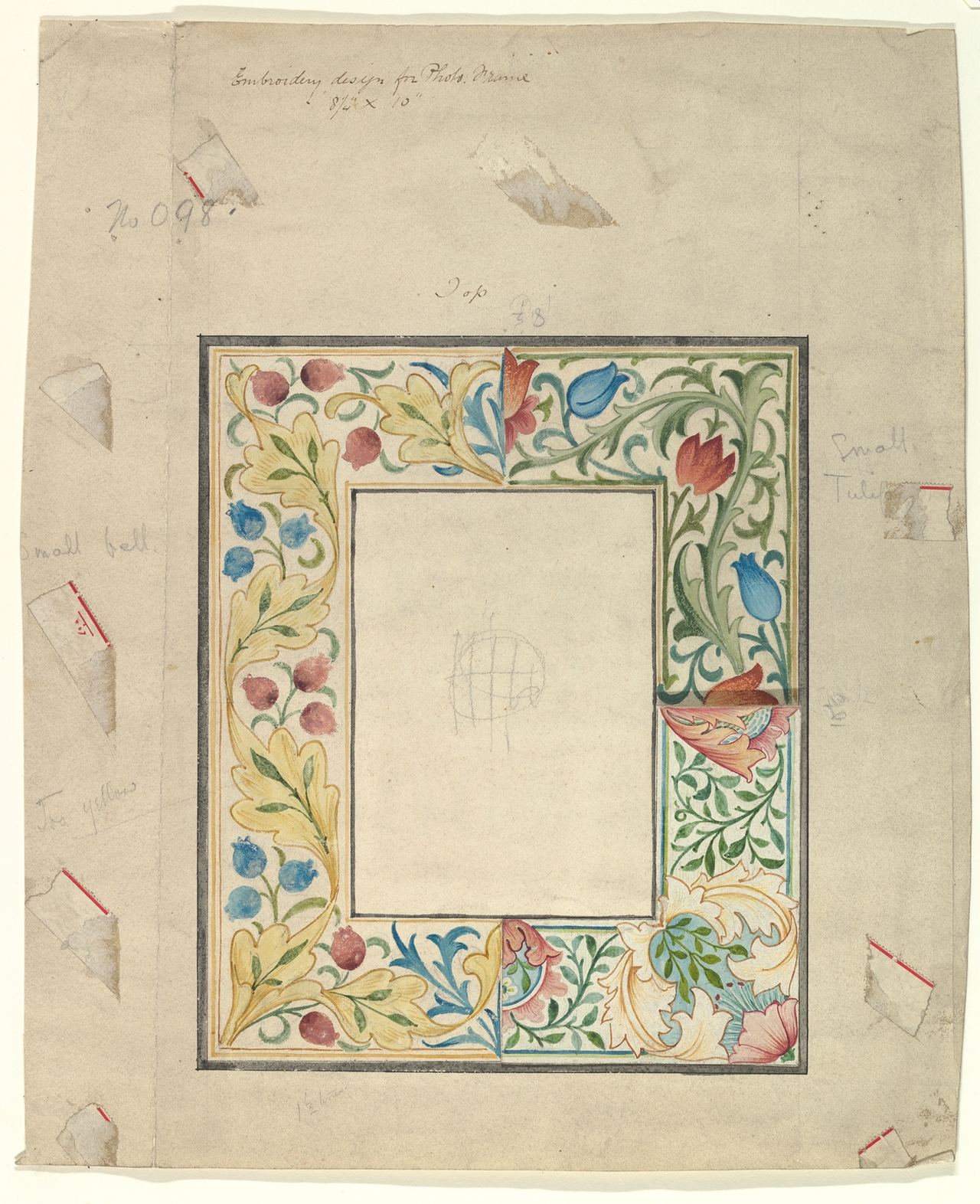
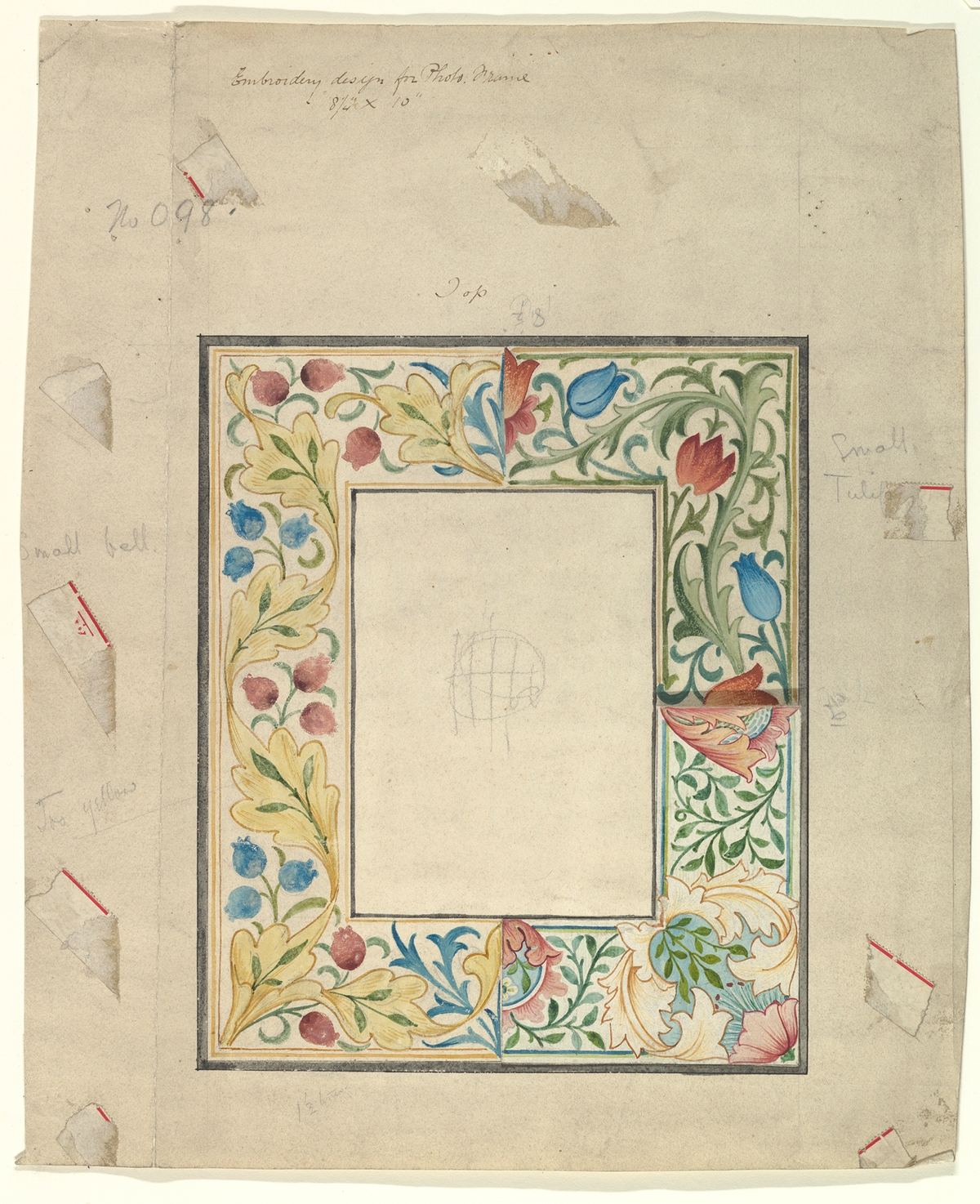
The sheet above is a reminder of the kind of object involved. The Metropolitan Museum credits it to Morris & Company, not to a named designer, so it is not evidence of May Morris's own hand. It is, however, an embroidery design for a photograph frame, one of the small domestic items the Ashmolean lists among hers.
The V&A's "Vine Leaf" is a tablecloth of silk embroidery on linen that the museum says was probably designed by May Morris in 1896. It was probably bought for Laurence Hodson's house, Compton Hall in Wolverhampton, whose decoration Morris & Co. completed that year; the museum says it was possibly stitched by Mrs Hodson or in the firm's workshops, in darning, stem and satin stitch. The V&A calls it one of her finest designs for a plain domestic purpose.
She also designed wallpaper. The V&A records "Honeysuckle", a woodblock-printed wallpaper of 1883, as designed by May Morris and printed by Morris & Co.; a design from the year she turned 21, two years before she took over the embroidery department. The V&A also lists "Arcadia", from about 1886. For years "Honeysuckle" was credited to her father. The organizers of the Lady Lever exhibition say that, in her lifetime, her designs were often misattributed to him. The V&A's own file on an embroidery design bequeathed by May Morris carries the note that it was "originally acquired as a William Morris design."
From around 1900 she also designed jewelry. The V&A has a silver girdle, set with freshwater pearls, garnets and chrysoprase, that it dates to about 1906.
What is Arts and Crafts embroidery?
Arts and Crafts embroidery, sometimes called art embroidery, is needlework that a designer plans as art and stitches by hand with a small stock of ordinary stitches, using nature simplified into pattern and old textiles as models. The movement it belonged to was, as the BBC puts it, a reaction against mass production.
May Morris set out the principles herself in Decorative Needlework, published in London in 1893 by Joseph Hughes. She wrote it, she says in the dedicatory note, for readers with "a love for" embroidery but little knowledge of it. Her central claim is about design: "design is the very soul and essence of beautiful embroidery," she writes, and good work on a poor design is "labour lost." On nature she was exact. A designer's own work, she says, "should merely recall nature, not absolutely copy it," with forms simplified, leaves arranged flat and stems bent into flowing curves to fill the space.
Her models were old. She recommended ancient over modern work for study because, in medieval ornament, "the work is not lacking in the essential qualities of good design." Lynn Hulse, writing for the Ashmolean, adds that she drew on illuminated manuscripts, on herbals her father had given her, and on Turkish and Iranian textiles.
The stitches were few. The Ashmolean lists the principal ones in art embroidery as long and short, satin, stem, split, darning, couching, laid work and French knot. Morris & Co.'s house style, in the museum's phrase, was darning with a stem stitch outline, in natural dyed silks on cotton or silk grounds. Her own treatment of couching shows how she thought. Some writers, she says, limit the term to gold and silver thread, but she prefers a wider sense: the laying of threads on the surface, caught down at intervals, in cheap materials or costly ones. In the book she places the simple flat laying at one end and raised, moulded goldwork at the other.
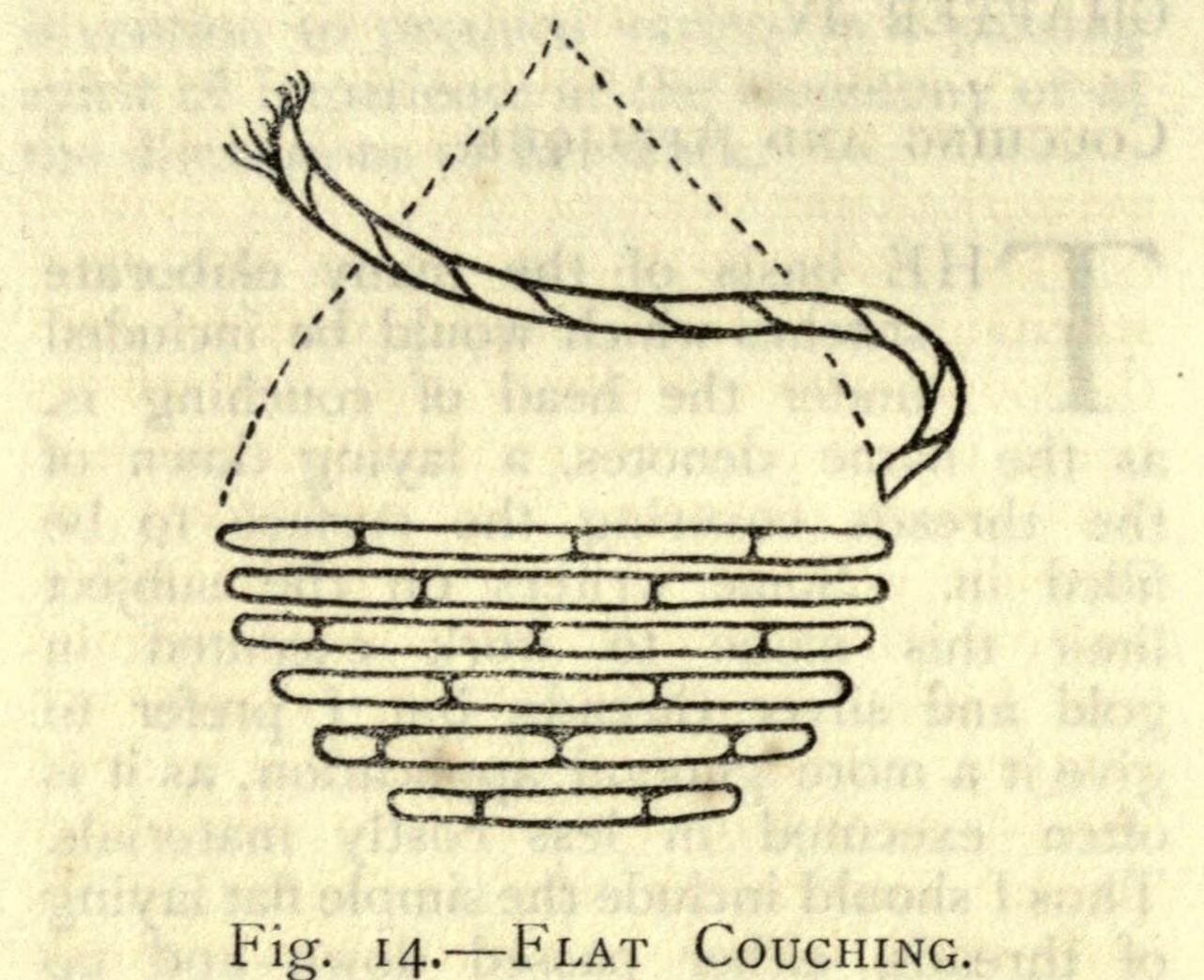
The same chapter treats appliqué as a close relative of couching, and she advises the beginner to choose a method to suit the scale of the work. For a bold wall hanging in wool on serge, she says, the cut edges can be covered with a broad gimp; fine work in silk and gold needs its edges tucked away. The Lady Lever exhibition sets her work beside 17th-century English embroideries from its own collection, to show how historic needlework influenced her; our article on stumpwork covers one of the best-known kinds from that period.

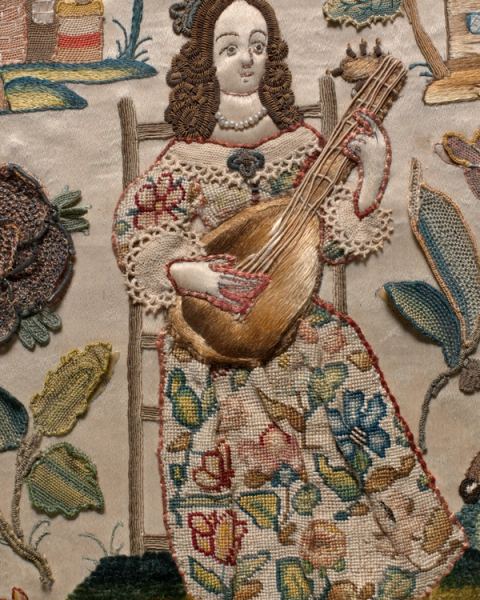
Above, a border embroidered in silk on a blue-green ground shows the look the movement favored: curling stems that fill the space evenly, with flat, stylized flowers. The Met credits it to Morris & Company, with a date range of 1875 to 1899, and does not name a designer.
How did she treat the women who stitched for her?
The exhibition's organizers say May Morris offered fair pay and shorter working hours at a time when the Victorian textile trade was notorious for exploitation, and that she recruited women from varied backgrounds and offered apprenticeships to working-class girls from a London school. That is the museum's account, and the surviving records do not say how her pay compared with other workrooms.
Her own book shows where her sympathies lay. In its first chapter she mocks the "very fine lady" who collects dainty linen, "wrought by what under-paid work-girl she does not know or care." A diary entry quoted in Salmon's chronology gives one actual figure: on 10 December 1888, Elizabeth Yeats recorded that her sister had just been paid ten shillings for a week's embroidery at Kelmscott House, the Morris home in Hammersmith.
Her private life was also bound up with the firm's circle. On 14 June 1890 she married Henry Halliday Sparling, a fellow Socialist Leaguer; they lived at 8 Hammersmith Terrace, near Kelmscott House, and divorced in February 1898.
What did she do after her father died?
After 1896 May Morris moved from managing a workroom to teaching, writing and organizing. According to biographer Sarah Harkness, she became a visiting tutor at the Central School of Arts and Crafts in London in 1897 and headed its embroidery department from 1899 to 1905. A set of her notes and sketches for embroidery lectures, now at the William Morris Gallery, dates from her teaching at Birmingham and at the Central School.
In 1907 she co-founded the Women's Guild of Arts, a professional body for women artists. The Art Workers' Guild did not admit women, according to the Ashmolean and to Zoe Thomas's doctoral study of the guild, which says it grew to about sixty members.
In October 1909 she arrived in New York for a lecture tour of the United States that lasted about five months. Natasha Thoreson's paper on the tour says she attended suffrage rallies in New York and lived for a month at Hull House in Chicago. The Lady Lever exhibition says her lectures covered the history of jewelry and of medieval embroidery.
From 1910 she edited The Collected Works of William Morris, in 24 volumes from Longmans, Green, each with an introduction by her. The front matter of the first volume states that the edition was limited to 1,050 copies, 1,000 for sale. In 1936 she published William Morris: Artist, Writer, Socialist, a study of her father.
Her last home was Kelmscott Manor, in Oxfordshire. The manor had been bought for Jane Morris in 1913; Jane died in January 1914 and it passed to May, who moved there permanently in 1923. She died there in October 1938. Her companion was Mary Lobb. In the village she founded an early Women's Institute branch, ran a soup kitchen and gave coal to families, according to the exhibition; the V&A says she built a memorial hall to her father there. Her will left the manor first to Mary Lobb and then to Oxford University, on conditions that included no electricity and no modernization; in 1962 the university went to court to be released from them, and the manor passed to the Society of Antiquaries of London.
When did it happen? A May Morris timeline
| Date | Event | Source |
|---|---|---|
| 25 March 1862 | Born at the Red House | Salmon chronology |
| 1881 | Enrolls at the National Art Training School (one source says 1878) | Salmon chronology |
| 1883 | "Honeysuckle" wallpaper designed | V&A |
| 1885 | Takes over the Morris & Co. embroidery department, aged 23 | V&A; Ashmolean |
| 14 June 1890 | Marries Henry Halliday Sparling | Salmon chronology |
| 1893 | Publishes Decorative Needlework | Internet Archive scan of the book |
| 1896 | Her father dies; she steps down as head of the department | V&A; Ashmolean |
| 1897 | Begins teaching at the Central School of Arts and Crafts | Harkness |
| February 1898 | Divorced from Sparling | Salmon chronology |
| 1907 | Co-founds the Women's Guild of Arts | Ashmolean; Thomas |
| October 1909 | Arrives in New York for a five-month lecture tour | Thoreson |
| 1910 | First volume of the Collected Works appears | Internet Archive scan |
| January 1914 | Jane Morris dies; Kelmscott Manor passes to May | Kelmscott Manor |
| 1923 | Moves to Kelmscott Manor permanently | Kelmscott Manor |
| 1936 | Publishes William Morris: Artist, Writer, Socialist | V&A |
| October 1938 | Dies at Kelmscott Manor | Kelmscott Manor |
| 1962 | Manor passes to the Society of Antiquaries | Kelmscott Manor |
Where can you see her work?
May Morris: Crafting a Legacy at the Lady Lever Art Gallery in Port Sunlight opened in late April 2026 and runs until 1 November 2026. It is free and shows around 50 objects, organized with the William Morris Society, with loans from the William Morris Gallery, the V&A and other collections, as well as 17th-century English embroideries from the Lady Lever's own holdings.
The Ashmolean's Western Art Print Room shows its May Morris drawings and embroidery patterns by appointment, and the V&A's Prints and Drawings Study Room does the same for the works on paper it holds. The Metropolitan Museum owns two of her silk embroideries, a valance and a "Lotus" bedcover, both given in 2017. Kelmscott Manor, where she lived from 1923 until her death, passed to the Society of Antiquaries of London, and the manor's website gives visiting details.
For another woman who led a workroom of seamstresses, see our profile of the Vienna couture salon run by Emilie Flöge.
Sources
- May Morris, Decorative Needlework (London: Joseph Hughes, 1893). Internet Archive. Primary. Full OCR text read and the page scans viewed: dedicatory note, ch. I (under-paid work-girl), ch. IV (couching, p. 45-46, Fig. 14), ch. VII (design, nature, medieval study). Accessed October 19, 2026.
- Embroidery design by May Morris, E.50-1940 (summary of her life and the embroidery section). Victoria and Albert Museum. Primary. Object record read via the V&A API: childhood crewelwork lessons from her mother and aunt; took over the embroidery section in 1885; designs carried out in part at the Royal School of Needlework. Accessed October 19, 2026.
- Panel, Rose Bush embroidery kit, CIRC.301-1960. Victoria and Albert Museum. Primary. Record read via the V&A API: kits and partly worked panels sold by Morris & Co.; May Morris managed the embroidery section from 1885 until about 1896. Accessed October 19, 2026.
- Tablecloth, 'Vine Leaf', T.426-1993. Victoria and Albert Museum. Primary. Record read via the V&A API: probably designed by May Morris 1896; Hodson commission; stitches; list of her domestic designs; why her work is under-appreciated. Accessed October 19, 2026.
- 'Honeysuckle' wallpaper, designed by May Morris, E.532-1919 and CIRC.9-1954. Victoria and Albert Museum. Primary. Records read via the V&A API: designer Mary (May) Morris, 1883, woodblock print. Also 'Arcadia' about 1886 (O248687). Accessed October 19, 2026.
- Unsung Artists: May Morris (1862-1938), V&A Blog. Victoria and Albert Museum. Read in full: South Kensington training, 1885, her design role, directional stitches, teaching, US tour, Women's Guild of Arts, Collected Works, memorial hall, will. Accessed October 19, 2026.
- The Many Talents of May Morris (Lynn Hulse). Ashmolean Museum. Read in full: 1885, 'ran the studio', more than 300 designs, stitches, house style, Dearle panel stitched by May, medieval and Turkish/Iranian models, Women's Guild of Arts, print room access. Accessed October 19, 2026.
- Chronology (Nick Salmon; additions by Graham Seaman). William Morris Internet Archive. Full page text read; entries for 25 March 1862, 1881, 4 Oct 1888, 10 Dec 1888, 14 June 1890, 1893, Feb 1898 (divorce). Secondary compilation that cites period sources. Accessed October 19, 2026.
- May Morris: Crafting a Legacy (Lady Lever Art Gallery, 2026). National Museums Liverpool / Culture Liverpool / VisitLiverpool. Read in full (VisitLiverpool press text, 12 Feb 2026) and the Culture Liverpool listing (https://cultureliverpool.co.uk/events/may-morris-crafting-a-legacy/): around 50 objects, William Morris Society partnership, loans, working conditions claims, Kelmscott WI. The listing gives 26 April as the opening date, the press text 25 April; the text says 'late April'. The National Museums Liverpool page itself returned only navigation text. Accessed October 19, 2026.
- Popular William Morris pattern that was actually his daughter's work (25 May 2026). BBC News. Read in full: Honeysuckle attribution, exhibition until November, curator quote; used for the Arts and Crafts 'reaction against mass production' wording. Accessed October 19, 2026.
- History of Kelmscott Manor. Kelmscott Manor. Read in full: manor bought 1913 for Jane Morris, her death in January 1914, May's move in 1923, death 1938, Mary Lobb, will conditions, 1962 transfer to the Society of Antiquaries. Accessed October 19, 2026.
- Natasha Thoreson, The Reluctant Reformer: May Morris' United States Lecture Tour of 1909-1910 (abstract). Textile Society of America. Abstract read: arrived New York October 1909, five-month tour, suffrage rallies, a month at Hull House. Full paper (PDF) returned 403. Accessed October 19, 2026.
- Zoe Thomas, The Women's Guild of Arts: Gender, space, and professional identity in London, 1870-1930 (PhD abstract). Royal Holloway, University of London. Abstract read: established 1907 by May Morris; about sixty women; founded because women could not join the Art Workers' Guild. Accessed October 19, 2026.
- May Morris's notes and sketches for embroidery lectures (J561vi). William Morris Gallery. Record read: c. 1899-1902 notes from her teaching at Birmingham and the Central School of Arts and Crafts. Accessed October 19, 2026.
- Nelly and May: Parallel lives. Sarah Harkness (author's Substack). Read: Central School visiting tutor 1897, head of embroidery department 1899-1905. Secondary (a biographer's blog); the same dates appear in Wikipedia citing Jan Marsh (2019), used only to locate references. Hence the text attributes the headship dates to Harkness. Accessed October 19, 2026.
- The Collected Works of William Morris, with introductions by his daughter May Morris, vol. 1 (London: Longmans, Green, 1910). Internet Archive. Primary. Front matter read in the OCR text: 'twenty-four volumes ... limited to one thousand and fifty copies, of which one thousand only are for sale'; Longmans, Green, 1910. Accessed October 19, 2026.
- William Morris, artist, writer, socialist (book, 1936), O1543023. Victoria and Albert Museum. Record read via the V&A API: author May Morris, 1936. Accessed October 19, 2026.
- Design for a photograph frame (64.682.345), border (2021.7.4), valance (2017.178.2) and 'Lotus' bedcover (2017.178.1). The Metropolitan Museum of Art. Object records read via the Met API (v1 objects): maker/artist 'Morris & Company' for the two images; May Morris as artist for the valance and bedcover; public-domain flag true for the two images used, false for the May Morris objects. Accessed October 19, 2026.
Glossary
Last updated · Markdown · Report an error