Silk
Philippe de Lasalle, Who Wove a Portrait in Silk
Who was Philippe de Lasalle and what did he design? Flowers and birds for the walls of palaces, a portrait of Catherine II woven like a cameo, and a drawloom whose pattern could be lifted off and put back.
Philippe de Lasalle (1723–1804) was a silk designer, manufacturer and mechanic in Lyon who drew flowers and birds so exactly that woven furnishing silk began to compete with painting. In 1771 he wove a portrait of Catherine II of Russia, and he rebuilt the figured loom so that a pattern could be taken off it and put back.
Who was Philippe de Lasalle?
Philippe de Lasalle was a designer, merchant-manufacturer and mechanic of the Lyon silk industry, the body of trades known as the Grande Fabrique. He was born at Seyssel, then a French enclave on the edge of Savoy, in September 1723, and died in Lyon on February 27, 1804. He designed and manufactured furnishing silks: wall hangings, chair covers, borders, and the woven portraits that made his name abroad.
Sources disagree about the day he was born. The archival study by Marie-Jo de Chaignon, of the Musée des Tissus in Lyon, gives September 2, 1723; the Biographie lyonnaise of 1839 gives September 23. They agree on the year, on the place, and on the date of his death. Museum records disagree too: the Metropolitan Museum of Art and the Musée des Tissus give 1723–1804, the Cleveland Museum of Art gives 1723–1805, and the Art Institute of Chicago hedges with "1723–1803/5."
His father, a receiver-general of the Savoy customs farms, died when the boy was one. A maternal uncle in Lyon took him in at about fourteen, and he entered the usual course for a future silk designer: first a painter's studio, then Paris, then the loom.
| Date | Event |
|---|---|
| 1723 | Born at Seyssel (Ain) in September; sources give the 2nd or the 23rd |
| July 29, 1744 | Apprenticeship contract in Lyon with the master manufacturer Jean Mazancieu, to learn the working of the loom and the mise en carte |
| May 7, 1748 | Marries Élisabeth Charryé, daughter of the manufacturer François Charryé |
| 1749 | Partner in Charryé père et fils, and its first designer |
| September 8, 1758 | Receives his first state pension, 600 livres a year |
| 1760 | Begins work on a loom whose pattern could be changed in a minute, by way of a removable semple; the intendant of Lyon calls him "the first designer of Lyon" |
| 1762 | Authorized to use a distinctive mark against counterfeits |
| June 22, 1770 | The prince de Condé praises the silks supplied for the Palais Bourbon and asks for his pension to be raised |
| 1771 | Weaves portraits of reigning princes, Catherine II among them; Voltaire describes one in a letter of May 15 |
| October 20, 1772 | Presents his new loom to the Bureau de la Fabrique in Lyon |
| July 29, 1775 | The Académie des Sciences reports on the loom; the report is signed by Condorcet |
| August 21, 1775 | The king grants a pension of 6,000 livres |
| November 29, 1775 | Ennobled and given the cordon of the Order of Saint-Michel |
| December 19, 1781 | Tours installs one of his drawlooms |
| 1793 | The siege of Lyon: his house at Oullins is sacked and his collection of designs and machines is lost; he leaves for Sens |
| June 21, 1801 | Lyon gives him two rooms at the Grand Collège to show his looms working |
| April 8, 1803 | Rooms at the Palais Saint-Pierre for his machines and himself |
| February 27, 1804 | Dies at the Palais Saint-Pierre, Lyon |
How did a boy from Seyssel become the first designer of Lyon?
By learning both halves of the job: drawing, and the loom. His apprenticeship contract of July 29, 1744 binds him to a master manufacturer to learn the working of the loom and the mise en carte, the squaring-up of a design onto ruled paper so that it can be executed thread by thread.
Most accounts send him first to the Lyon painter Daniel Sarrabat and then to Paris, to François Boucher and others; de Chaignon warns that no document confirms the Sarrabat apprenticeship, and the Lyon museum's exhibition notes add Charles-Gilles Dutillieu where Cleveland's catalogue names only Boucher. What is documented is what he did with the training. In 1765 he set out a four-part teaching program for silk designers: copy from engravings and botanical plates, draw from the living flower, learn the mise en carte, then composition. A painter, he wrote, will draw a bouquet very well, but ask him for a design for a satin, a taffeta, a velvet or a gold ground and "he will see no difference, and he will be lost."
He also had to earn a living in a trade that paid designers badly. The usual route was a state pension, granted for services to the glory of the city; his first came in 1758. By January 1760 the intendant of Lyon was telling Paris that Lasalle was regarded as the first designer of the city.
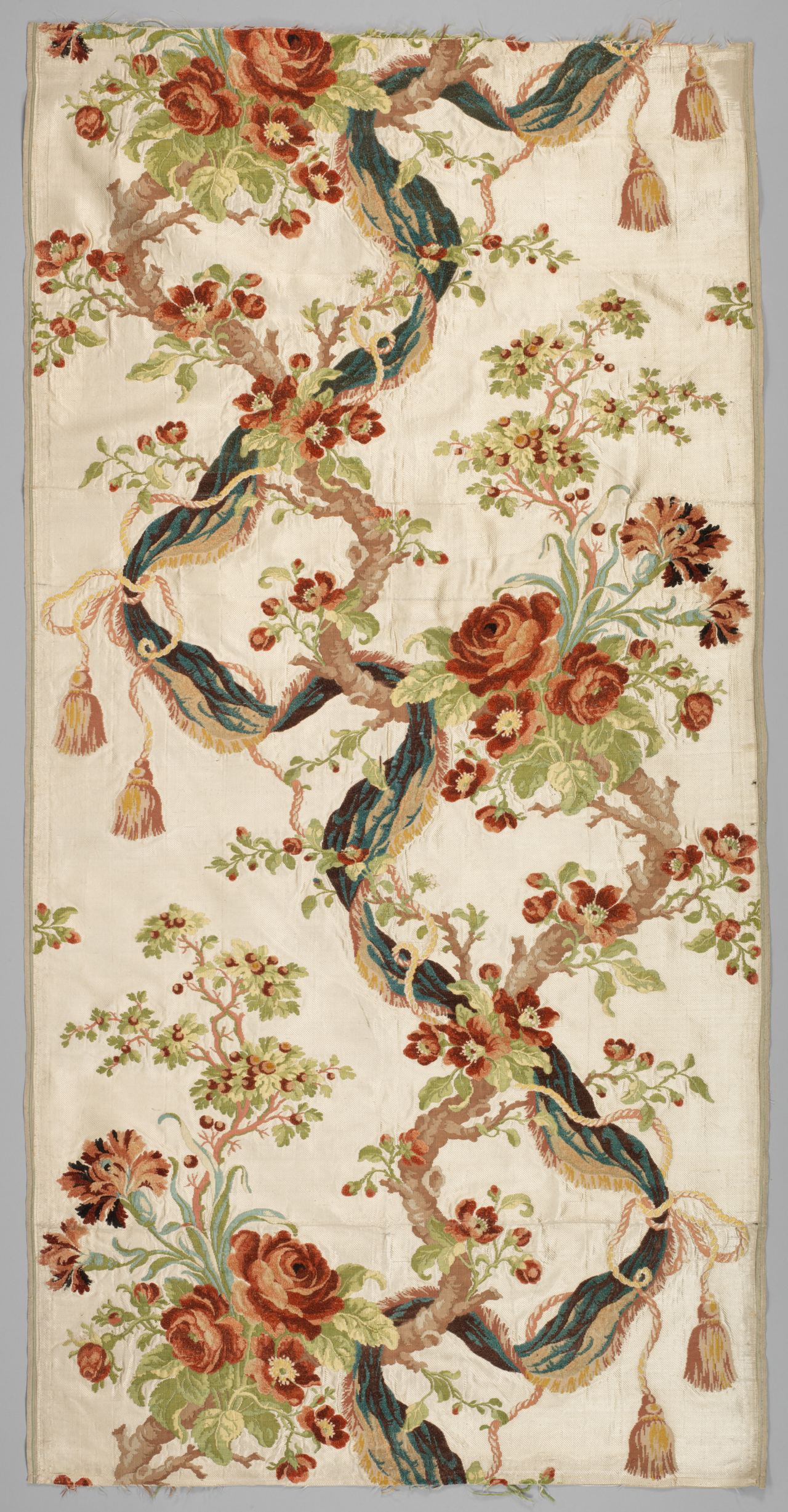
What do his silks actually look like?
Flowers and birds, drawn from life and shaded like painting, on a scale no one else was weaving. He favored the lampas, a figured silk in which the pattern is made by weft floats tied by a binding warp over a separate ground weave, and he added brocade wefts that run only across the motif they color. He used chenille, a fuzzy caterpillar-like thread, to give petals and plumage a velvety third dimension, and he worked at repeats that could reach about 148 centimeters, roughly the height of the whole design before it starts again.
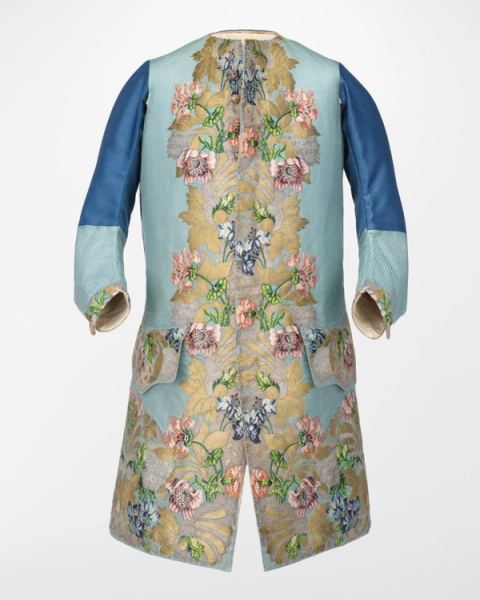
The surviving pieces are mostly furnishing silks, because that is what he specialized in: one of his early innovations, according to de Chaignon, was precisely to separate fabrics for furniture from fabrics for dress. The Metropolitan Museum's length of about 1760–65 shows the manner before the great hangings: red roses, pink blossom and berried sprays climbing a knotted branch on a cream ground, with a teal ribbon looping around it and ending in tassels, in a brocaded lampas with a twill foundation. The Cleveland and Art Institute of Chicago records of his pieces read like structural analyses — satin grounds, supplementary binding warps, brocading wefts tied in twill — which is a fair description of how the illusion is made.
What did he change on the loom?
He made the pattern removable. A drawloom stores its figure in a bundle of cords: the semple, hung at the side of the loom, carries the loops that are pulled in order to lift the chosen warp threads. Before Lasalle, preparing that bundle took a long time and it was destroyed when the pattern changed. From 1760 he worked on a loom in which the semple could be detached and replaced while the cloth was still on the loom, and kept for the next time the same silk was wanted.
Jean-Marie Roland de la Platière, who described French manufactures for the Encyclopédie méthodique, listed three advantages: a simple way of attaching and detaching the parts of a design held in a semple loaded with its cords; a separate machine for reading the design and making those cords, so that the work need not stop; and an "équipage" that let the woman pulling the cords do it sitting down. The loom still needed her. What it saved was setup, storage and repetition.
Officialdom agreed. He presented the loom to Lyon's Bureau de la Fabrique on October 20, 1772, after commissioners of the Académie des Sciences had examined it in Paris; their report of July 29, 1775, signed by Condorcet among others, says his discoveries "appear made to produce a happy revolution in the manufacture and the commerce of fabrics." Three weeks later the king granted him a pension of 6,000 livres, with a bounty of 300 livres for each of the first hundred and fifty looms distributed in Lyon; in November he was ennobled and given the cordon of Saint-Michel. Tours installed one of his looms in December 1781.
How do you weave a portrait?
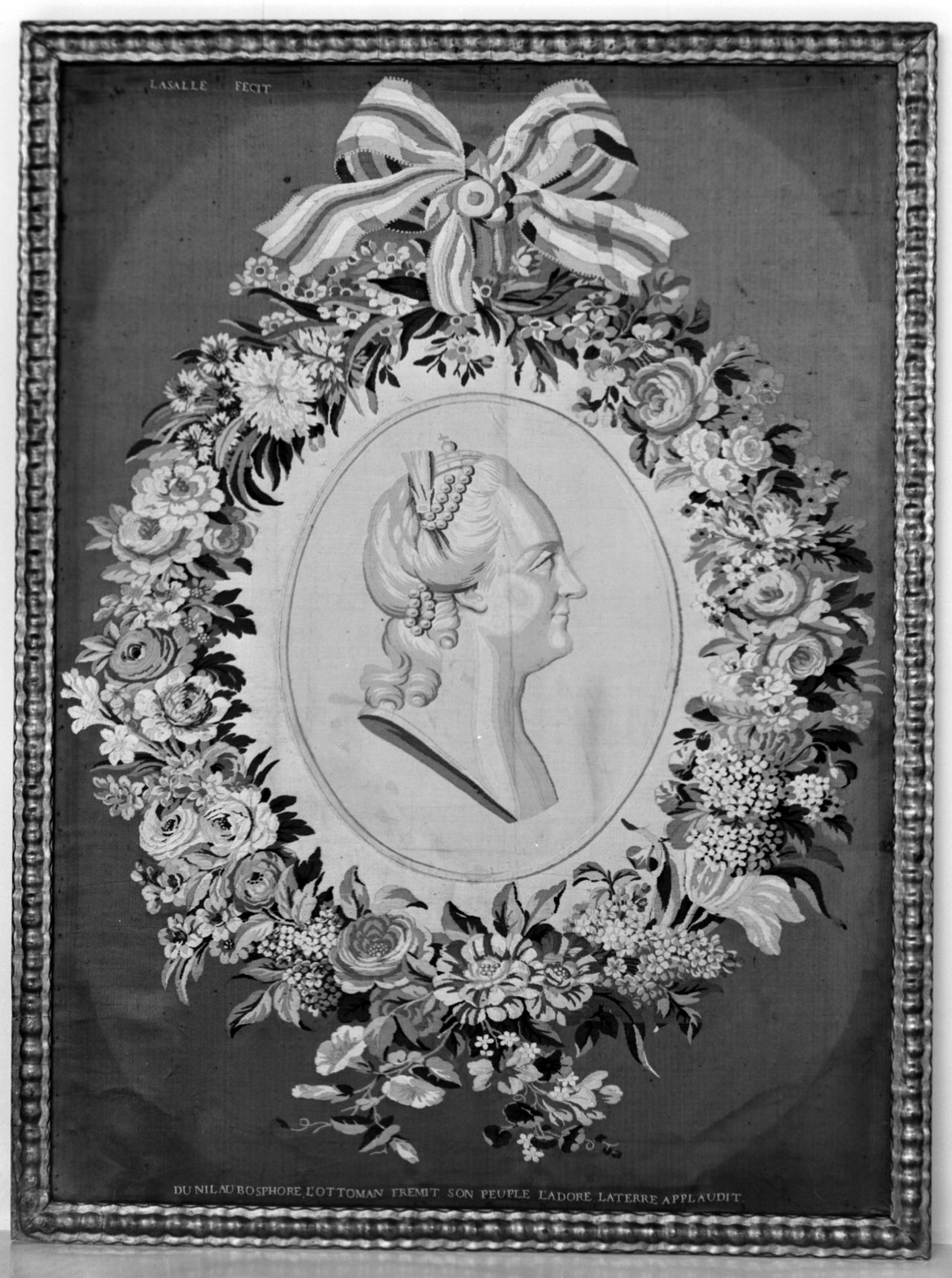
In 1771 Lasalle used the new loom to weave something nobody had woven before: a portrait that imitated a painting in camaïeu, a head in profile shaded in tones of one color like a cameo. The Musée des Tissus, which holds the series and the preparatory mises en carte, describes the trick that made it practical: the medallion and the surrounding wreath of flowers were woven separately, and the medallion was then applied to the ground by embroidery. One wreath could serve several faces.
Look closely at the shading and you can see the method. The Lyon museum's mise en carte for the Catherine II head shows what de Chaignon calls mixed coloring: one pass of a pure tone alternating with two passes of mixed tones, so that the cheek turns toward the nose in gradual steps rather than in bands.
The sitters were Louis XV, the comte and comtesse de Provence, Catherine II, and a young prince long called the duc de Berry, the future Louis XVI, though de Chaignon notes that identification is unconfirmed and the head may be the comte d'Artois, whose portrait the Lyon museum dates to 1773. Several are signed, in embroidery and in Latin, "LASALLE FECIT" — Lasalle made it — the way a painter signs a canvas.
Why did the empress of Russia buy Lyon silk?
Because Voltaire hung her portrait in his drawing room at Ferney and showed it to his visitors. Writing to Catherine from Ferney on May 15, 1771, he reports that Princess Dashkova had just been to see him: as soon as she entered the drawing room, she recognized "your portrait in mezzotint, made with the shuttle on a satin, surrounded by a garland of flowers." Your Imperial Majesty, he adds, must have received it from "le sieur Lasale"; it is a masterpiece of the arts practiced in the city of Lyon.
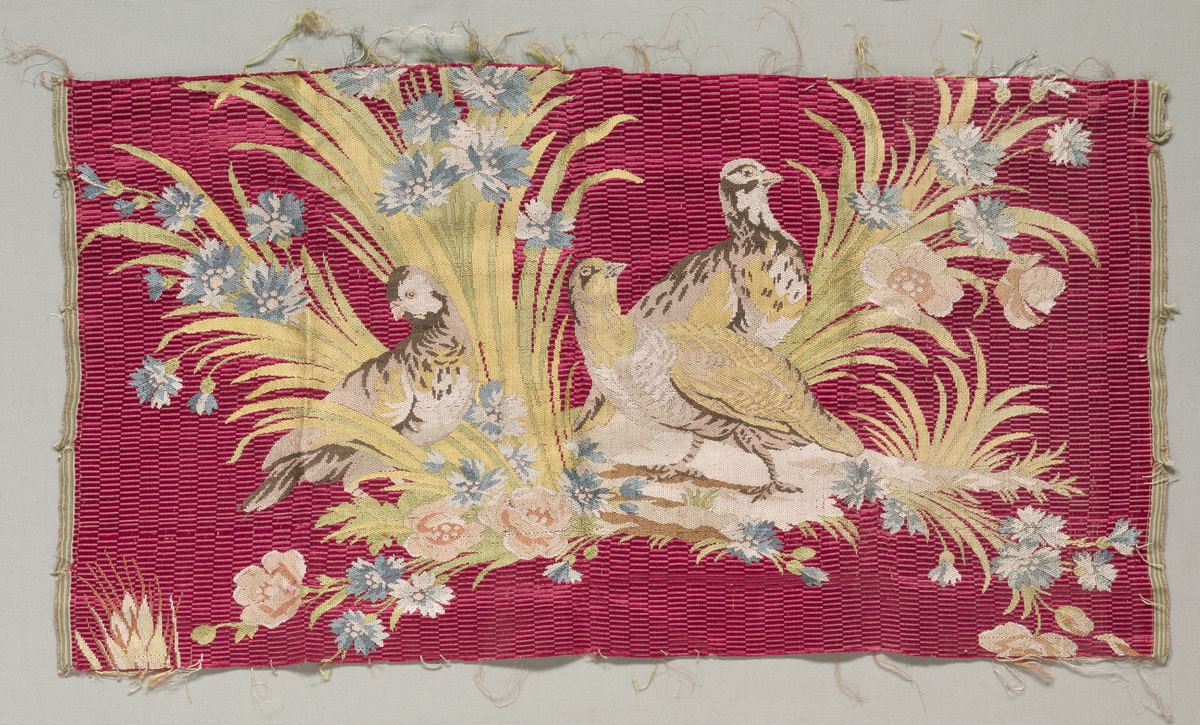
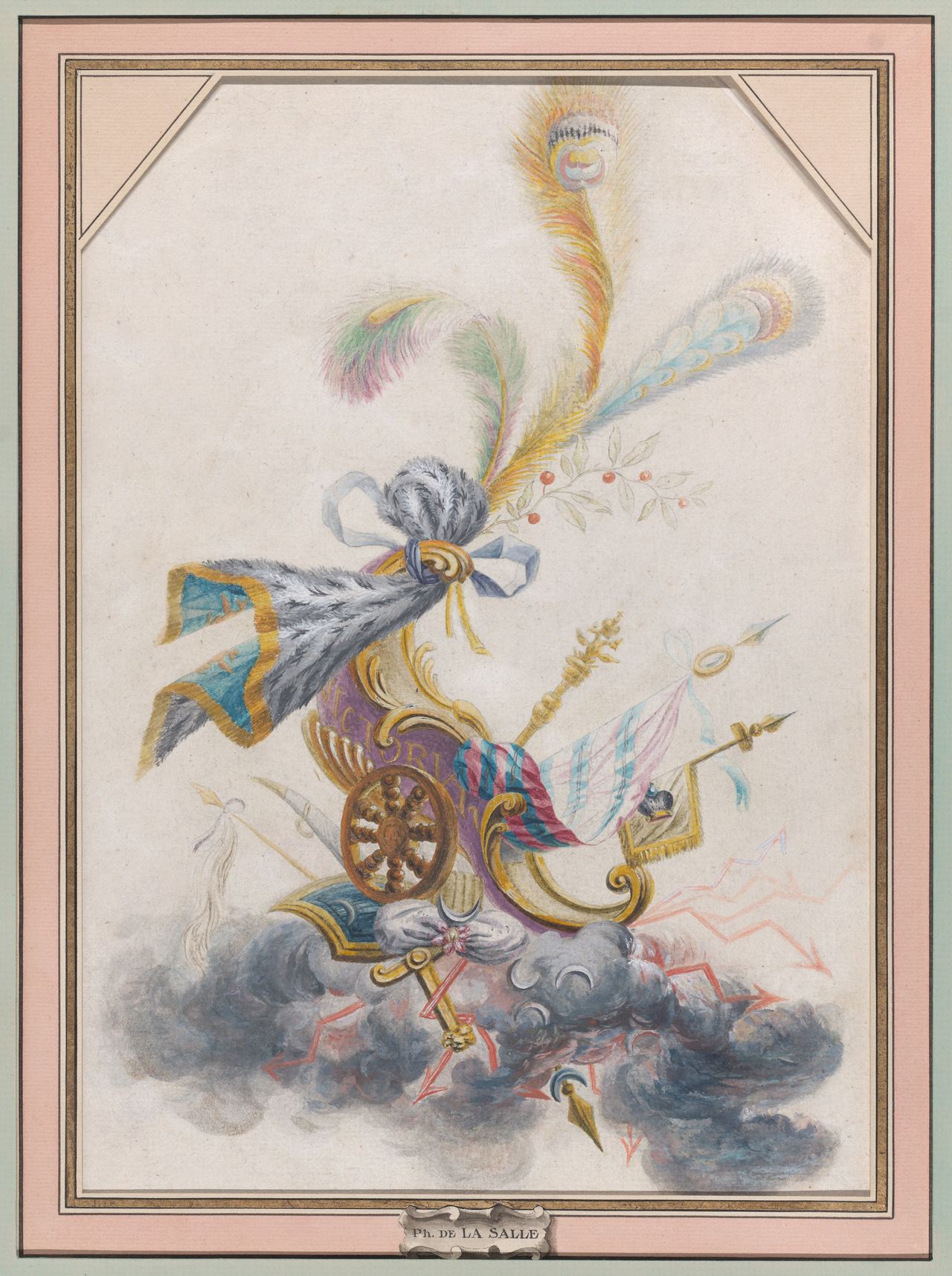
The Metropolitan's version of the portrait carries an embroidered inscription along the bottom — DU NIL AU BOSPHORE L'OTTOMAN FREMIT. SON PEUPLE L'ADORE. LA TERRE APPLAUDIT. — "From the Nile to the Bosphorus the Ottoman trembles; her people adore her, the world applauds," which the museum's record says Voltaire wrote for it. The empress became a customer. The Lyon museum dates his greatest deliveries to Russia to 1773, 1776, 1778 and 1780, and the Met's catalogue text connects particular designs to particular rooms: the partridge silk, first ordered in the early 1770s for a salon in the Palais Bourbon in Paris, reused in the 1780s in a boudoir at the Grand Palace at Peterhof, with walls, curtains and furniture all in the same cloth; a hanging commemorating a military victory for the Chesma Palace; peacocks and pheasants for the room at Tsarskoye Selo known as the Lyon Drawing Room.
The French court is a more complicated story than the legend allows. De Chaignon found that Lasalle's name never appears in the Garde-Meuble's official commissions for the royal residences, and that the deliveries recorded under his name are ordinary goods: plain pekins, painted linens with birds and fruit, taffetas, mostly for the apartments of household staff at Fontainebleau, Compiègne, Rambouillet and Choisy. He was presented at court — three times to Louis XVI, by her count — and the Musée des Tissus says he was chosen to weave ornaments for the coronation of Louis XVI and to design a new habit for the Order of the Holy Spirit. His most lavish documented French patron was a prince of the blood: the prince de Condé, writing to the controller-general on June 22, 1770, declares himself very pleased with the furnishings supplied for the Palais Bourbon. A fragment of the partridge silk now in Cleveland is recorded in the 1779 inventory of the duc de Bourbon for the Palais Bourbon.
Was his loom a step toward the Jacquard?
Not directly. The two inventions solve different problems. Lasalle made the stored pattern portable and reusable; the Jacquard mechanism, perfected in Lyon in the first years of the nineteenth century, replaced the person who pulled the cords with punched cards, and that is the change our guide to woven patterns traces. The line of descent for the punched card runs through Bouchon's pierced paper band of 1725, Falcon's chain of cards of 1728 and Vaucanson's self-acting loom of 1745, as E. A. Posselt set it out in his 1888 textbook on the Jacquard machine.
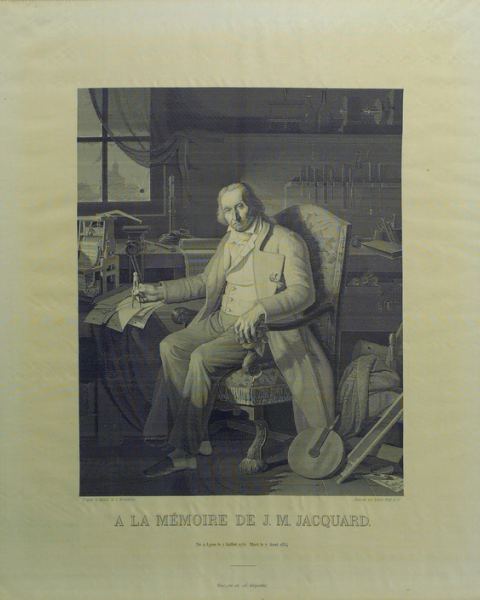
The dates of the two men nearly touch. Posselt says Jacquard returned to Lyon in 1804 to take charge of the workhouse and finished his machine there. Lasalle died in February 1804, in rooms the city had given him for his machines and himself, two years after setting his loom beside an ordinary one so that manufacturers could compare the cloth. The Lyon museum puts the two side by side in the Napoleonic settlement: pensions for the glories of the old regime, such as Lasalle, and encouragement for innovation, such as Jacquard's.
What did the Revolution do to him, and where can you see his work?
It took his archive. He and his wife spent six months with their daughter's family in Montpellier in 1789 and then returned; in 1793, during the siege of Lyon, his house at Oullins was sacked and he lost his collection of designs — which, a letter from his son-in-law says, he had refused to sell to Russia in order to keep it in France — along with his machines and his furniture. He went to Sens, and there, in poor health, rebuilt the machines he judged most useful to the silk trade. Lyon brought him back: two rooms at the Grand Collège in 1801 to demonstrate his loom beside an ordinary one, then an apartment and workshop at the Palais Saint-Pierre in 1803, where he died the next February, across a square from the street where he had drawn his first patterns.
His widow gave framed samples of his silks to the city, and those are the root of the Lyon holdings. The Musée des Tissus in Lyon has the largest collection — portraits, hangings, borders, mises en carte — but the hôtel de Lacroix-Laval has been under restoration since January 2021 and the museum's own collections are not currently on display. In the meantime the open-access museums are the easiest way to see his work: the Metropolitan Museum of Art in New York (the Catherine II portrait, 41.78; the partridge panel, 50.8a; the design drawing, 2019.282.5), the Cleveland Museum of Art, the Art Institute of Chicago, and the Victoria and Albert Museum in London, whose panel "The Partridges" (T.187-1931) was identified in 1931 from a companion piece in Lyon.
For the designer's side of the eighteenth-century silk trade in another city, see Anna Maria Garthwaite, who drew Spitalfields silk; for what the colors of these silks meant at court, Color as Rank.
Sources
- Marie-Jo de Chaignon, "Philippe de Lasalle, dessinateur et fabricant d'étoffes de soie à Lyon au XVIIIe siècle", Le Monde alpin et rhodanien 19 (1991), pp. 65-84. Le Monde alpin et rhodanien, via Persée. Primary-archival. Full text read page by page on Persée (pp. 65-84). Source for: birth at Seyssel 2 September 1723 and the father's post; apprenticeship contract 29 July 1744 with Jean Mazancieu (ADR 3 E 7888); marriage 7 May 1748; partnership of 1749; pension of 600 livres 8 September 1758 (AN F12 1448 A); work from 1760 on the removable semple and La Michodière's letter of 18 January 1760 (AN F12 2199); mark of 1762; the 1765 teaching memorandum and the quotation about the painter (ADR 1 C 201); Condé's letter of 22 June 1770; presentation of the loom 20 October 1772; Roland de la Platière's three points (Encyclopédie méthodique, tome second, section VII, p. 104); the Académie des Sciences report of 29 July 1775 signed by Condorcet; pension of 6,000 livres 21 August 1775 and bounty of 300 livres per loom; ennoblement and cordon of Saint-Michel 29 November 1775; Tours 19 December 1781; the Garde-Meuble deliveries of ordinary fabrics; refuge of 1789, the sack of Oullins and loss of designs and machines at the siege of 1793, Sens; rooms at the Grand Collège 21 June 1801 and the Palais Saint-Pierre 8 April 1803; death 8 ventôse an XII (27 February 1804); the lexicon of CIETA terms (lampas, semple, lacs, métier à la tire). Accessed November 13, 2026.
- Philippe de Lasalle, l'artiste des Lumières (exhibition dossier, Au cœur du XVIIIe siècle). Musée des Tissus, Lyon. Five-page PDF read in full (no text layer; pages rendered and read as images). Source for: birth 1723 at Seyssel, orphan, maternal uncle in Lyon, Sarrabat then Boucher and Charles-Gilles Dutillieu; return to Lyon 1744 to work for François Charrier; the loom whose semple can be changed during weaving, at the turn of the 1770s; Catherine II's commissions delivered 1773, 1776, 1778, 1780; reception at Versailles twice, coronation ornaments of Louis XVI, habit of the Order of the Holy Spirit, ennoblement and cordon of Saint-Michel; the 1771 portrait made on the 'métier à semple mobile', the embroidered LASALLE FECIT and the Voltaire verses; medallions woven separately and applied by embroidery; the siege of Lyon and his death in 1804; the museum's holdings. Accessed November 13, 2026.
- Voltaire to Catherine II, Ferney, 15 May 1771, in Œuvres complètes de Voltaire, vol. 47 (Correspondance, année 1771), p. 43. Internet Archive (Garnier edition, 1877). Primary. OCR text read: Princess Dashkova recognizes 'votre portrait en mezzo-tinto, fait à la navette sur un satin, entouré d'une guirlande de fleurs', received from 'le sieur Lasale', 'un chef-d'œuvre des arts que l'on exerce dans la ville de Lyon'. Translated in the article; the French is quoted in part. Accessed November 13, 2026.
- Catherine II of Russia, 41.78; Panel 'Les Perdrix', 50.8a; Design for a Lampas Silk with a Triumphal Chariot, 2019.282.5; Length, 2012.544. The Metropolitan Museum of Art. Records read through the Collection API (metmuseum.org web pages returned HTTP 429 all day; the same catalogue texts were also read in the museum's own mirrors on archive.org, items mma_catherine_ii_of_russia_198713 and mma_panel_227482). Source for: isPublicDomain true on each object used; Lasalle's dates as the Met gives them (1723-1804); the inscription written by Voltaire for the woven portrait; the partridge design commissioned in the early 1770s for a salon in the Palais Bourbon and reused in the 1780s at Peterhof en suite, the Chesme Palace hanging and the Lyon Drawing Room at Tsarskoye Selo; the structure 'brocaded lampas with twill foundation weave'. Accessed November 13, 2026.
- Silk Fragment, 1956.125; Wall Covering with Classical Figure, 1945.97. The Cleveland Museum of Art. Records read through the Open Access API. 1956.125: lampas weave with cannetillé ground, brocaded, before 1779, 'listed in 1779 inventory of Duc de Bourbon for Palais Bourbon, Paris', share_license_status CC0. 1945.97 gives Lasalle's dates as 1723-1805 and calls him chief designer for Camille Pernon & Cie, trained as a painter by Boucher - used for the disagreement over his death year, not for the Boucher claim on its own. Accessed November 13, 2026.
- Panel 'The Partridges', T.187-1931. Victoria and Albert Museum. Record read through the V&A API. Brocaded silk on a cannellé ground, red ground with partridges and wreaths; Catherine II acquired the design and used it with a blue ground; bought in 1931 and identified from a companion piece in the Musée Historique des Tissus; notes that contemporaries admired the exact representation of nature achieved in weaving. Accessed November 13, 2026.
- Bréghot du Lut and Péricaud aîné, Biographie lyonnaise: catalogue des Lyonnais dignes de mémoire (1839), entry 'Lassalle (Philippe de)'. Internet Archive. Nineteenth-century Lyon reference work; OCR text read. Entry: 'célèbre dessinateur et mécanicien, né à Seyssel, le 23 septembre 1723, mort à Lyon le 27 février 1804', citing Grognier's notice on Jacquard, the Biographie des contemporains and the Bulletin de Lyon of 16 ventôse an XII. Used for the second attestation of the death date and for the disagreement over the day of birth. Accessed November 13, 2026.
- E. A. Posselt, The Jacquard Machine Analyzed and Explained (1888), history chapter. Project Gutenberg. Read for the descent of the punched card: Bouchon 1725, Falcon 1728, Vaucanson 1745 who 'suppressed altogether the cumbrous tail-cards of the draw-loom'; Jacquard returned to Lyon in 1804 and finished his machine there. Accessed November 13, 2026.
- Les travaux de rénovation (museum page on the closure and restoration). Musée des Tissus, Lyon. Read for the museum's current state: restoration of the hôtel de Lacroix-Laval begun in January 2021, the building open exceptionally for the 18th Lyon Biennale, and 'the museum's own collections are not currently on display'. No reopening date is given. Accessed November 13, 2026.
- Lesley Ellis Miller, "Entrepreneurship and Control in Eighteenth Century Silk Manufacture: The Case of Philippe Lasalle" (Textile Society of America, 8th Biennial Symposium, 2002). DigitalCommons, University of Nebraska-Lincoln. Abstract read in full on the landing page; the PDF itself returned HTTP 403. Used only for context: Lasalle sought state subsidies from the late 1750s, was rewarded in the 1770s for improvements to the drawloom, took the titles of inventor and Chevalier de l'Ordre de Saint-Michel in that decade, and was praised by the abbé Bertholon in 1787. Accessed November 13, 2026.
- Objects designed by Philippe de LaSalle (64496, 102154, 100731, 148678 and others). Art Institute of Chicago. Records read through the AIC API. All public domain. Used for the structural descriptions of his silks (satin grounds, supplementary binding warps, brocading wefts tied in twill) and for the museum's cautious artist dates, 1723-1803/5. Accessed November 13, 2026.
- Évelyne Gaudry, "Philippe de Lasalle (1723-1804)". Encyclopædia Universalis. Free portion of the article read (the rest is behind a subscription). Used as a second attestation of the 1775 honours: in 1775 Turgot obtained for him the cordon of the Order of Saint-Michel and a pension of 6,000 livres, and Louis XVI later granted letters of nobility. Also gives birth at Seyssel in Bugey in 1723, apprenticeship with Sarrabat, then Boucher and Bachelier, the Gobelins and the Savonnerie, marriage to Élisabeth Charrye in 1748, and Catherine II's commissions (tenture au faisan, tenture aux colombes, Tchesmé and Crimea hangings, a camaïeu portrait). The author is identified as an assistant at the musée historique des Tissus, Lyon. Accessed November 13, 2026.
Glossary
Last updated · Markdown · Report an error