Design
Anna Maria Garthwaite, Who Drew Spitalfields Silk
Who designed 18th-century Spitalfields silks? One of the best documented was a clergyman's daughter who began in middle age and sold dated, named patterns to London's master weavers.
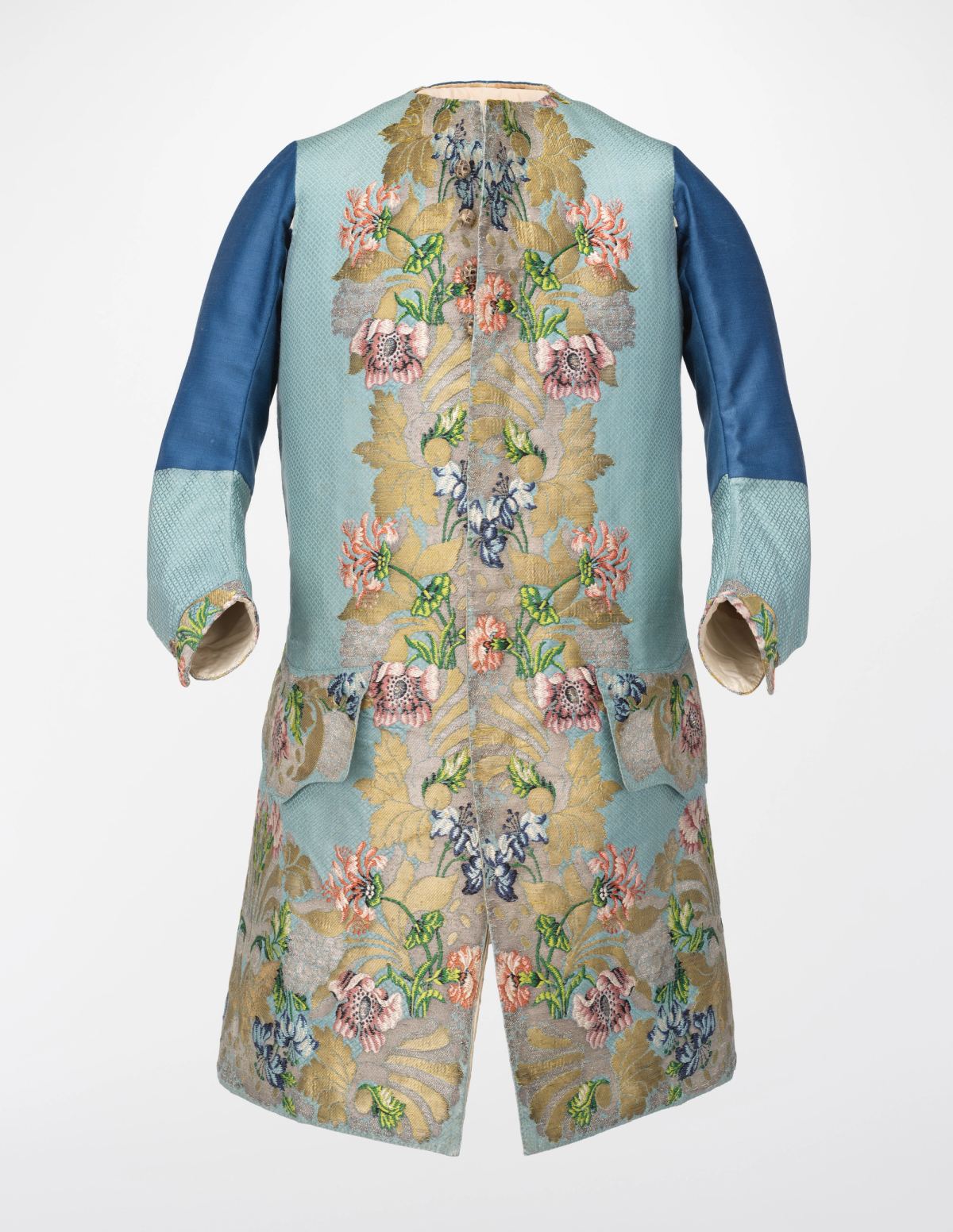
One of the best-documented designers of the flowered silks woven in Spitalfields, then the center of England's silk industry, was Anna Maria Garthwaite, a clergyman's daughter who turned to silk design in middle age. From about 1730 to her death in 1763 she sold patterns to the area's master weavers, up to 80 a year, and hundreds of her dated, named drawings survive at the Victoria and Albert Museum.
Who was Anna Maria Garthwaite?
Anna Maria Garthwaite was an English designer of woven silks who lived and worked in Spitalfields from about 1730 until 1763. She was not a weaver. She painted patterns, sold them on commission to master weavers and mercers, and kept her drawings, most of them inscribed with a customer's name and a date. That archive is why her working life can be followed in unusual detail.
Her birth year is disputed. The historian Zara Anishanslin, who built a book around one of her silks, gives 1688. The V&A's catalog records and the English Heritage blue plaque give 1690. The published sources disagree, so both years are given here.
Her family is better documented. Lincolnshire Pedigrees, published by the Harleian Society in 1903, lists Anna Maria among the children of the Reverend Ephraim Garthwaite and names her as co-executrix of his will of 1715. Ephraim had been educated at Grantham Grammar School and Christ's College, Cambridge, and held the rectory of Harston in Leicestershire from the early 1670s and that of Ropsley in Lincolnshire from 1692; his will was proved in 1719. V&A records give Grantham as her birthplace. English Heritage describes her as a Lincolnshire rector's daughter with an early interest in botanical drawing, and judges it unlikely that she had any formal training for the trade she entered.
| Date | Event |
|---|---|
| 1688 or 1690 | Born; Anishanslin gives 1688, the V&A and English Heritage 1690 |
| 1715 | Named co-executrix in her father's will, proved in 1719 |
| 1726–1729 | Early designs, later filed under "before I came to London" |
| 1 June 1728 | Tracing inscribed "For Mr Le Pine" |
| About 1730 | Settles at 2 Princes (now Princelet) Street, Spitalfields |
| About 1732 | Postlethwayt's date for designers bringing "the principles of painting" into the loom |
| 1742 | Designs inscribed for Julin, Captain Baker, Gregory and Vautier |
| Summer 1743 | Designs the silk later worn by Anne Shippen Willing, for Simon Julins |
| 1746 | Robert Feke paints Willing in that silk |
| 23 October 1747 | Waistcoat design for Mr Lekeux |
| 1752 | Silk woven by John Sabatier, now at the Met |
| 24 October 1763 | Her will declared at Princes Street |
| 1998 | English Heritage blue plaque at 2 Princelet Street |
How did she get from Lincolnshire to Spitalfields?
Her career began in the north. The V&A holds a series of early drawings whose original cover was labeled "before I came to London." Most date from 1726 to 1728, and three carry the date 1729. The textile historian Natalie Rothstein, quoted in the museum's records, concluded that Garthwaite was first working in Yorkshire. One drawing of about 1727 or 1728 is inscribed "This was sent to London with the rul'd paper before I came up." A tracing reads "For Mr Le Pine June 1 1728," which Rothstein suggested might be her first commission after arriving; several Spitalfields weavers were named Lepine or De Le Pine at the time.
Anishanslin places the move at the end of the 1720s: two sisters in their early forties, one a widow and one unmarried, left York for a newly built terrace in Princes Street, now Princelet Street, near Nicholas Hawksmoor's Christ Church, completed in 1729. English Heritage names the widowed sister as Mary Dannye and adds their niece, Mary Bacon, whom Anishanslin calls the sisters' young ward. Their house was No. 2, on a corner. Anishanslin describes it as well suited to trade: a second door on the side street opened into a ground-floor room closed off from the family's rooms, so callers on business could come and go without disturbing the household. She believes the first-floor drawing room, with its large windows, was the studio.
How did a silk design get from paper to the loom?
An eighteenth-century flowered silk began as a painted drawing and ended on a drawloom, a hand loom with an extra harness of cords for lifting the threads that formed the pattern. The designer had to turn a picture into something a weaver could set up, and Garthwaite's drawings show both stages.
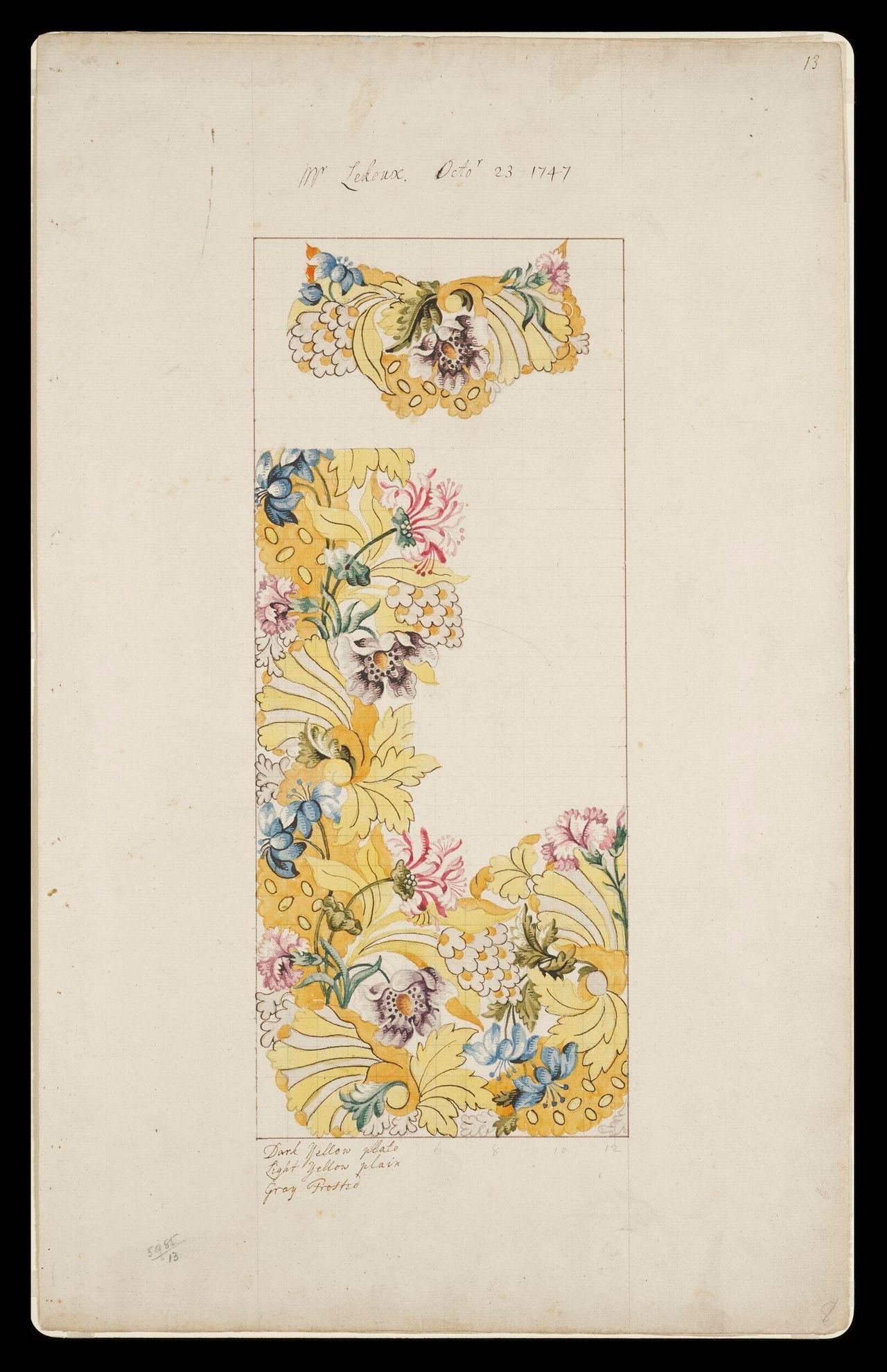
First came the watercolor. Then the motif was transferred to point paper, squared paper on which, as an 1888 weaving manual explains, the spaces between the vertical lines stand for warp threads and those between the horizontal lines for the weft. The V&A describes her 1747 design for a waistcoat as "squared up in pencil and numbered for cords and dezines." In the museum's words about a Lyon example, such a drawing acted as instructions for how to tie up the threads on the loom and then weave in the pattern. On a drawloom, the Getty Art & Architecture Thesaurus notes, the pattern cords were pulled by drawboys seated on top of the loom.
Her inscriptions record the business. Most name the customer and the date, such as "Mr Godin. Feb. 9. 1747." Some add notes for the weaver: "Capn. Baker. June 12. 1742. Point & Comber / 4 shuttles." The waistcoat design carries a key to three kinds of metal thread: "Dark yellow plate / Light yellow plain / Gray Frosted."
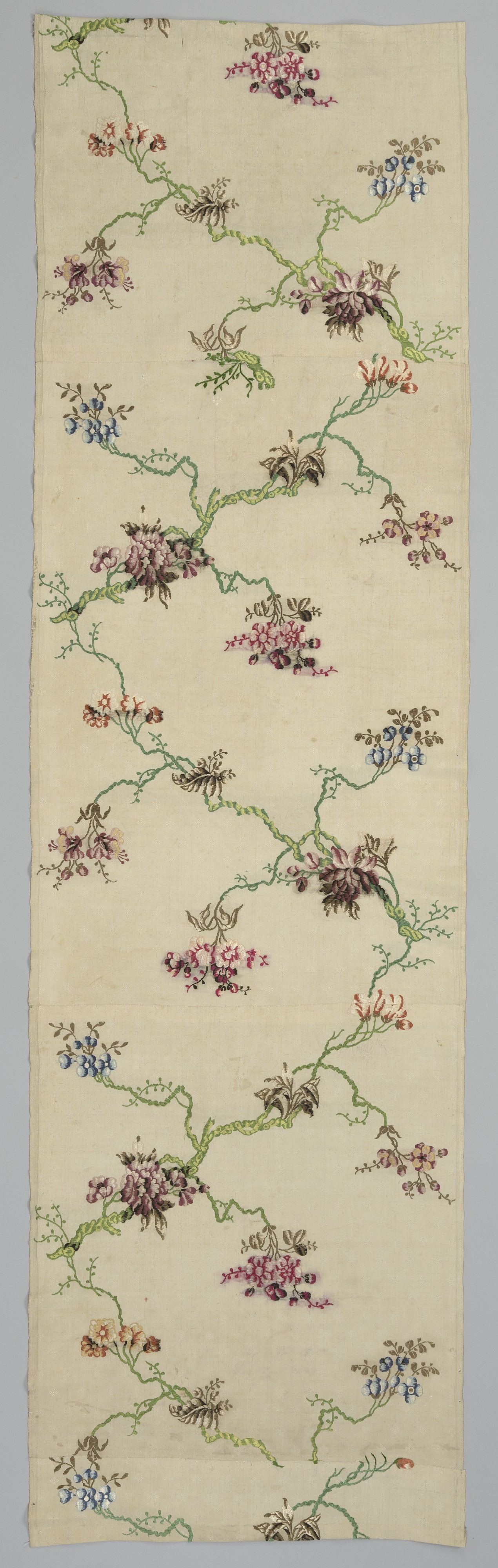
Patterned silks were made to order in short runs. The V&A notes that brocaded silks of this kind were woven on the drawloom in batches equal to about four dress lengths; Anishanslin says a flowered silk was usually limited to four pieces from a single design. Fashion therefore needed a steady supply of new patterns. Both the V&A and English Heritage say that at her peak Garthwaite produced about 80 designs a year. For the machine that later did the drawboy's work, see Dobby, Jacquard, Plain: How a Pattern Gets Woven In.
Who were the weavers she drew for?
Her customers were the master weavers of Spitalfields, many from families of French Protestant refugees. English Heritage dates the arrival of the Huguenots to the 1680s, and Malachy Postlethwayt's Universal Dictionary of Trade and Commerce says that after the Revolution "the French refugees settled the silk manufactures in London, and particularly the flowered silks." Anishanslin points out that Garthwaite was English in a trade where many known designers were of Huguenot descent.
V&A records name several of her regular clients:
- Captain Peter Lekeux, called one of the most prominent master weavers in the English silk industry, bought at least 18 designs from her, some to be brocaded entirely in metal thread.
- A Mr Gregory commissioned at least 40, including patterns for brocaded lustrings, damasks, tissues and satins.
- John Sabatier came from a Huguenot family that probably originated in Lyon. Apprenticed to his father in 1716, he became one of the most important figures in the English silk industry.
- "Mr Vautier" was probably Daniel Vautier of Steward Street, from a family originally of Luneray in Normandy.
- Simon Julins specialized in silk damasks and was still listed as a master weaver in Booth Street in a directory of 1763.
- Captain John Baker wove a silk to her 1744 design that survives in a gown given to the V&A.
The closest match between paper and cloth is the waistcoat at the top of this page. Garthwaite inscribed its design "Mr Lekeux. Octor 23 1747," and the V&A record notes that a waistcoat woven from it is in the Costume Institute of the Metropolitan Museum of Art, which credits the weaving to Peter Lekeux. On the pale blue silk, flowers in colored silks sit among large leaves in gold- and silver-colored metal thread, and the pattern follows the fronts and pocket flaps of a man's waistcoat.
What made her flowers different?
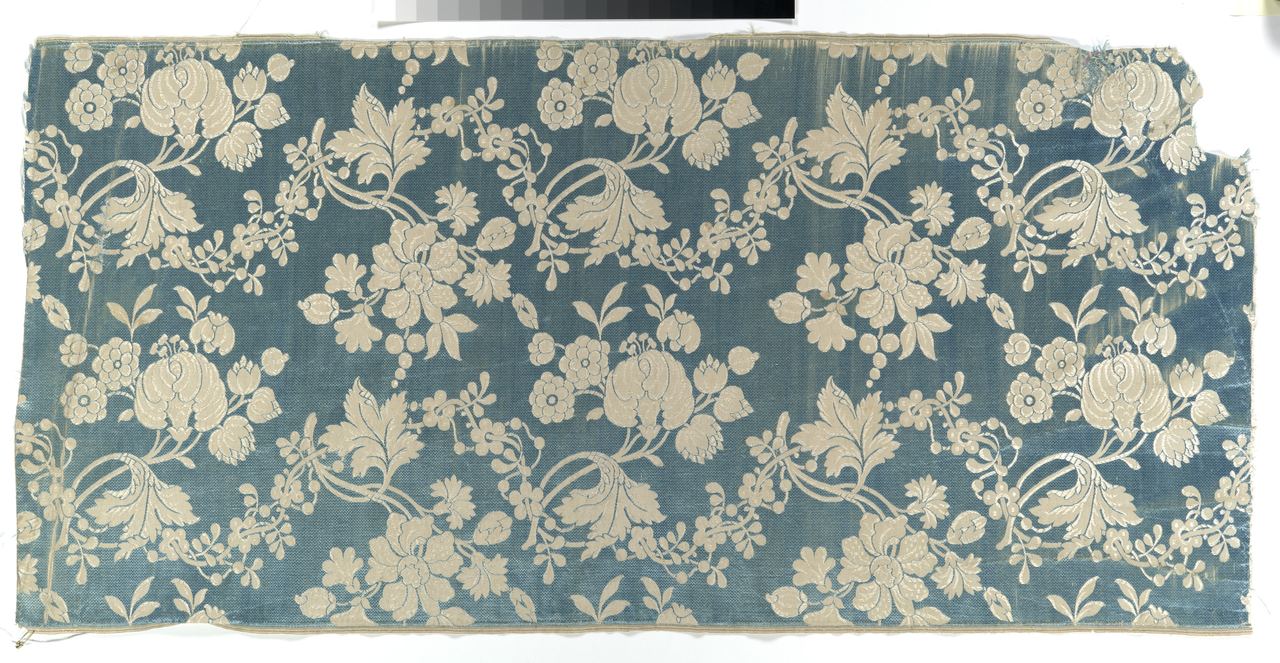
Postlethwayt says that early in the century neither French nor English designers observed "any of the principles of painting" in their brocades: flowers seldom had more than two colors, were shaded in regular steps, and were drawn flat, as in botanical books. Then, he writes, "about the year 1732 three designers attempted to introduce the principles of painting into the loom, and succeeded." He names John Vansomer, Peter Mazell and "Mrs Anna Maria Garthwaite," and claims that within ten years English design was preferred at home and known abroad as "Le Gout Anglois." He was a commercial writer arguing England's case, and the boast is his; English Heritage repeats the credit to Garthwaite.
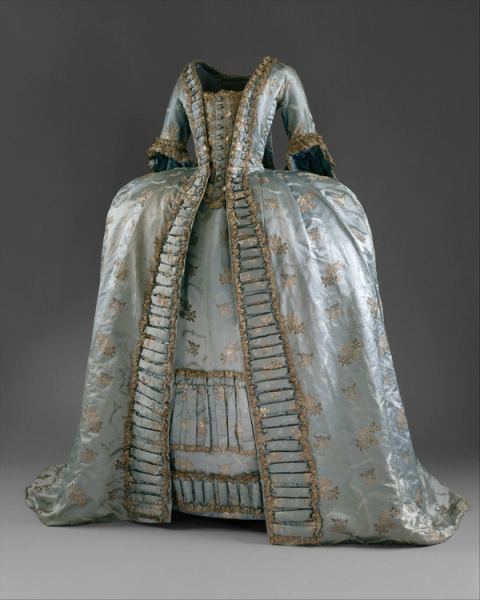
The technical means was points rentrés, the dovetailing of colors so that one shades into the next. The V&A associates the more naturalistic style with the Lyon designer Jean Revel and uses the technique to date a Lyon silk to after 1733. Its description of a Garthwaite silk of 1744 notes flowers "shaded in points rentrés," among them recognizable roses, morning glory and auricula. That silk survives in a gown that was probably first made as a sack, the style also called the robe à la française. Another of her silks, woven in 1749 for Mr Vautier, shows lilies, auricula, convolvulus and sweet peas.
English Heritage suggests that she studied plants in gardens rather than copying the naturalist prints of the day. Anishanslin goes further. She links Garthwaite to London's botanical world through her brother-in-law Vincent Bacon, an apothecary and member of the Royal Society, and finds North American plants in the designs, including mountain laurel and Turk's cap lilies, which the Pennsylvania botanist John Bartram sent to London between 1735 and 1740. She also describes designs in which an aloe is grafted, impossibly but carefully drawn, onto an English rose.
Which of her silks appears in a famous portrait?
In 1746 the itinerant painter Robert Feke portrayed Anne Shippen Willing, wife of the Philadelphia merchant Charles Willing. The canvas, signed and dated "R. Feke Pinx/1746," is at the Winterthur Museum in Delaware, according to the Worcester Art Museum's catalog. Willing, born in 1710, was a granddaughter of Philadelphia's first mayor, Edward Shippen, and had 11 children.
Anishanslin identified the dress she wears as a silk Garthwaite designed in the summer of 1743 for Simon Julins. Within three years the woven silk had crossed the Atlantic and been made up in Philadelphia. Her book Portrait of a Woman in Silk (Yale University Press) follows the four people behind that single object: designer, weaver, wearer and painter. She calls the North American colonies the English silk industry's most important market outside London, and says the same Garthwaite pattern was worn, woven in different colors, by women in New York, Ireland and England. English Heritage adds that her designs have been found in Europe and North America as well as Britain. For the method of dating a sitter by what she wears, see Reading a Portrait: How to Date a Sitter by the Sleeve.
Why are women silk designers so rare in the record?
Anishanslin writes that Garthwaite "is the only woman whose designs survive" among London's eighteenth-century silk designers. Women did work in the silk trade, she notes, but those in skilled crafts such as weaving usually followed a father or husband into it. Garthwaite had no such tie. She never married, had no formal training, and began late. Postlethwayt does name one more woman among the English designers active after 1744, "Mrs Phoebe Wright," praised for "the correctness and elegancy of her drawing and her colouring"; it is Garthwaite's drawings, not hers, that came down as an archive.
Even Garthwaite left little else. Anishanslin found almost no documents beyond her will: no letters, diary or business records. English Heritage says it is unclear exactly when or where she died; her will was declared on 24 October 1763 at Princes Street, and she died unmarried, leaving a modest estate of about £600. According to Anishanslin, she and her sister were buried at Christ Church, Spitalfields. What remains is the work. Anishanslin counts more than eight hundred labeled watercolor designs and reads them "much like a diary."
Where can you see her work?
The largest collection is at the Victoria and Albert Museum in London: her design albums, cataloged in a run of museum numbers from 5970 to 5990, together with dresses and dress lengths woven from them, including a gown made from her design 5986:2 and a length matched to design 5987.1.
In New York, the Metropolitan Museum of Art holds the 1747 Lekeux waistcoat and silk lengths of 1748, 1749 and 1752, all released as open access. Feke's portrait of Anne Shippen Willing is at the Winterthur Museum, Garden and Library in Delaware.
In Spitalfields itself, an English Heritage blue plaque erected in 1998 at 2 Princelet Street reads: "Anna Maria Garthwaite 1690–1763 Designer of Spitalfields Silks lived and worked here." For what the colors of such silks signaled to the people who wore them, see Color as Rank: What Dress Colors Said in the 1700s.
Sources
- Design for woven silk, 5970:8/A (Garthwaite biography; 'before I came to London' series, quoting Natalie Rothstein). Victoria and Albert Museum. Primary catalogue record read in full via the V&A API: born 1690; up to 80 commissioned designs a year for master weavers and mercers; Spitalfields from about 1730 to 1763; Rothstein's notes on the 1726-29 series, 'This was sent to London with the rul'd paper before I came up', 'For Mr Le Pine June 1 1728', first working in Yorkshire. Same summary text also read on 5970:1 (O90693) and 5985:1 (O92405, inscribed 'Mr Godin. Feb. 9. 1747'). Accessed October 22, 2026.
- Design for a woven silk, 5985:13, inscribed 'Mr Lekeux. Octor 23 1747'. Victoria and Albert Museum. Primary. Record read via the V&A API: squared up in pencil and numbered for cords and dezines; colour key for three metal threads; waistcoat woven from it in the Costume Institute, Met. Image 2024NT1924 inspected at full size; inscriptions read at zoom. Accessed October 22, 2026.
- Dress silk, T.81-1938 (Captain Peter Lekeux). Victoria and Albert Museum. Record read via the V&A API: Lekeux bought at least 18 designs, some brocaded only in metal thread; one of the most prominent master weavers; born Grantham 1690 (objectHistory). Accessed October 22, 2026.
- Woman's gown, T.264-1966 (Mr Gregory; points rentrés). Victoria and Albert Museum. Record read via the V&A API: at least 40 commissions from Mr Gregory (lustrings, damasks, tissues, satins); 1744 design 5982.10; flowers shaded in points rentrés; roses, morning glory, auricula; probably first made as a sack. Accessed October 22, 2026.
- Dress fabric, T.10-1962 (John Sabatier). Victoria and Albert Museum. Record read via the V&A API: Sabatier from a Huguenot family probably from Lyon, apprenticed to his father 1716, one of the most important figures in the English silk industry; 1752. Accessed October 22, 2026.
- Dress fabric, T.192-1996, and T.392-1988 (Mr Vautier). Victoria and Albert Museum. Both records read via the V&A API (second: https://collections.vam.ac.uk/item/O84541/): design 5987.1 dated March 1 1749 for Mr Vautier; flowers lilies, auricula, convolvulus, sweet peas; probably Daniel Vautier of Steward Street, family from Luneray, Normandy; T.392-1988 design inscribed 'Mr Palmer. Mr Vautier. Aprill 3 1745'. Accessed October 22, 2026.
- Dress fabric, T.346A-1975, and fancy dress T.36-1973 (Simon Julins). Victoria and Albert Museum. Both records read via the V&A API (second: https://collections.vam.ac.uk/item/O361528/): Julins specialised in damasks; listed at Booth Street in a 1763 directory, 61 years after his apprenticeship; design 5989.8 woven by Julins, 1752. Accessed October 22, 2026.
- Woman's gown, CIRC.85-1951 (Captain John Baker); gown T.706-1913 (design 5986:2). Victoria and Albert Museum. Records read via the V&A API (second: https://collections.vam.ac.uk/item/O354299/): silk woven by Captain John Baker to a Garthwaite design; gown from design 5986:2, 1747. Design inscriptions for 1742 (5981 series, e.g. 'Capn. Baker. June 12. 1742. Point & Comber / 4 shuttles', 'Mr Julin. July 28 1742') read from the API records of the 5981 series. Accessed October 22, 2026.
- Loom-width of brocaded silk, T.170-1965 (Lyon, about 1735-40). Victoria and Albert Museum. Record read via the V&A API: Jean Revel and naturalism; points rentrés dates the silk after 1733; brocaded silks woven on the drawloom in batches equal to four dress lengths, not mass-produced. Accessed October 22, 2026.
- Design for woven silk on point paper, T.417-1972 (L. Gallien et cie, Lyon, 1771). Victoria and Albert Museum. Record read via the V&A API: point paper design as instructions for tying up the loom and weaving the pattern; 1,577 designs of one Lyon firm. Accessed October 22, 2026.
- Anna Maria Garthwaite blue plaque. English Heritage. Full page read: dates 1690-1763; plaque 1998 at 2 Princelet (formerly Princes) Street; inscription; lived there from 1730; Lincolnshire rector's daughter; sister Mary Dannye and niece Mary Bacon; Huguenots arrived 1680s; 80 designs a year at her peak; 'principles of painting'; designs found in Europe and North America; botanical gardens; will declared 24 Oct 1763; estate about £600. Accessed October 22, 2026.
- Anna Maria Garthwaite, Silk Designer (by Zara Anishanslin). Spitalfields Life. Read in full (17 Jan 2017; author's own summary of her research): 1688; move from York at end of 1720s; Princes Street house and studio; flowered silks limited to four pieces; only woman whose designs survive; minimal archive; more than 800 labeled designs; Vincent Bacon; Bartram plants; aloes; American market; burial at Christ Church. Accessed October 22, 2026.
- Zara Anishanslin on Portrait of a Woman in Silk. The Panorama (SHEAR). Read in full (23 Jan 2017): Anne Shippen Willing (1710-91), six of eleven children by 1746; silk designed summer 1743 for Simon Julins (c. 1686/8-1778); crossed the Atlantic within three years; Feke (c. 1707-c. 1752). Accessed October 22, 2026.
- Malachy Postlethwayt, The Universal Dictionary of Trade and Commerce, 4th ed., vol. 1 (London, 1774). Internet Archive. Primary. OCR full text read and the passage on English silk design located (pages headed ENG): French refugees after the Revolution; earlier lack of 'principles of painting'; 'about the year 1732' Vansomer, Garthwaite, Mazell; 'Le Gout Anglois'; Mrs Phoebe Wright after 1744. The 1751 first edition was not available to us; the article does not date the passage to 1751. Accessed October 22, 2026.
- A. R. Maddison (ed.), Lincolnshire Pedigrees, vol. 2 (Harleian Society 51, 1903), p. 391, Garthwaite. Internet Archive. Primary compilation. OCR read: Rev. Ephraim Garthwaite bapt. Barkstone 1647, Grantham school, Christ's College, rector of Harston, Leics. (instituted 17 Dec 1671) and Ropsley, Lincs. (1692), died 1719, will dated 20 Dec 1715, proved 5 Oct 1719; daughter Anna Maria mentioned in her father's will, co-executrix. Accessed October 22, 2026.
- J. Venn and J. A. Venn, Alumni Cantabrigienses, part I, vol. 2 (1922), 'Garthwaite, Ephraim'. Internet Archive. Entry read in OCR text: Christ's 1664, Grantham school, R. of Harston, Leics., 1672-1719, R. of Ropsley, Lincs., 1692-1719, will proved Oct. 5, 1719. Confirms the father's career; does not name his children. Accessed October 22, 2026.
- Charles Willing (discussion), Early American Portraits catalogue. Worcester Art Museum. Read in full: Anne Shippen (1710-1791), granddaughter of Edward Shippen, Philadelphia's first mayor; eleven children listed; her three-quarter-length portrait at Winterthur signed and dated 'R. Feke Pinx/1746'; Charles Willing's will mentions portraits by 'Feake'. Accessed October 22, 2026.
- Open Access records: Waistcoat C.I.66.14.2; Lengths 62.136.1, 2004.415, 2004.416. The Metropolitan Museum of Art. Read via the Collection API (object pages return 429 to bots): dates, makers (Peter Lekeux, Thomas Brant, John Sabatier), media, dimensions, credit lines, isPublicDomain true. Images inspected at full size; waistcoat detail enlarged. Accessed October 22, 2026.
- Art & Architecture Thesaurus: draw looms (300423711); point paper (300263238). Getty Research Institute. Scope notes read through the Getty SPARQL endpoint: cords pulled by drawboys seated on top of the loom; point paper definition. Accessed October 22, 2026.
- E. A. Posselt, The Jacquard Machine Analyzed and Explained (1888). Project Gutenberg. Passage on squared designing paper read: spaces between vertical lines indicate warp threads, between horizontal lines the filling. Accessed October 22, 2026.
- Anna Maria Garthwaite. Wikipedia. Used only to locate references (ODNB, Postlethwayt, Rothstein). Its baptism date of 14 March 1688/9 (citing ODNB and a genealogy page) and burial details could not be opened and are not used. Accessed October 22, 2026.
Glossary
Last updated · Markdown · Report an error