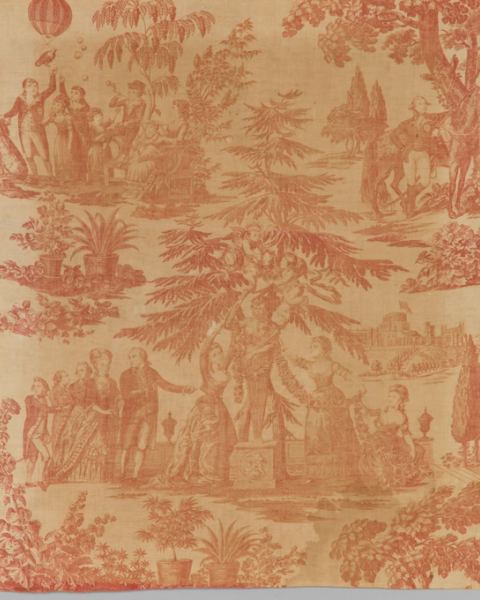
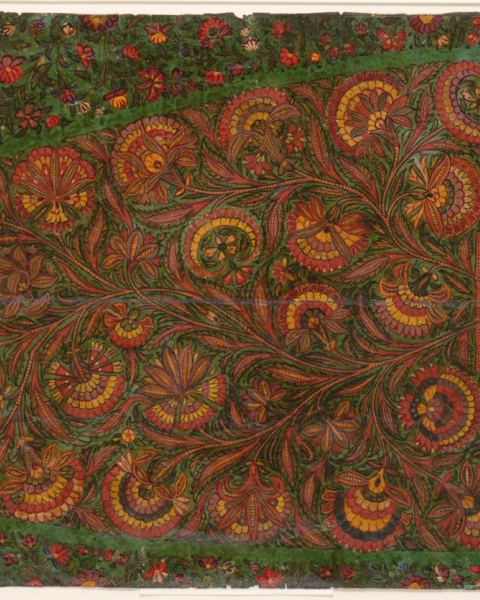
Weaving
Dobby, Jacquard, Plain: How a Pattern Gets Woven In
Plain weave, dobby and jacquard are three ways a loom chooses which threads to lift. What each can draw, how a pegged chain differs from a punched card, and how to read the difference in cloth.
Plain weave, dobby and jacquard are three ways a loom decides which warp threads go up. Plain weave needs only two shafts lifting alternately. A dobby lifts a limited set of shafts in a pegged sequence, which gives small repeating figures, while a Jacquard head reads punched cards and lifts threads through separate hooks, so the size of the design is no longer capped by the number of shafts.
What is plain weave, and what does the loom do to make it?
Plain weave is the structure in which each weft thread passes alternately over and under every warp thread, and the next row does the opposite. The Getty vocabulary adds that both sides are structurally identical. Pratt Institute's textile library calls it the simplest woven structure, strong and without stretch, and lists canvas, chambray, chiffon, muslin, poplin and voile among its fabrics.
On the loom, each warp thread is drawn through a heddle, and the heddles are carried on frames called shafts (British mill books say "heald shafts"). Raising a shaft lifts its threads and leaves a gap, called the shed, for the weft. Raise the other shaft and the gap reverses. Two shafts are enough for plain weave. A mill manual from 1883 adds a practical wrinkle: mills commonly hung four leaves of heddles for plain weaving, tied in pairs and moved as one, so the heddles did not crowd on the shafts.
Plain cloth is not necessarily plain looking. E. A. Posselt's 1888 textbook describes the first step toward figuring it as varying the thickness of the warp or weft threads, as in repp cloths and in the borders of cambric handkerchiefs, and the next as arranging colors, which, with a one-color weft, gives stripes, as in ginghams. In both cases the loom is still lifting alternate threads. The design lives in the yarn, not in the lifting.
What is a dobby, and what do the pegs do?
A dobby is a shedding mechanism that lifts a chosen set of shafts for each row of weft, following a sequence set in advance. Thomas Roberts's 1912 manual, Tappet and Dobby Looms, sorts looms into three classes: tappet, dobby and jacquard. Tappet looms took from two to eight shafts, or up to twelve with outside tappets, and suited cloth that repeats in no more than twelve picks. Dobbies, he writes, are made for up to 48 shafts, though 16, 24 and 36 were the common sizes.
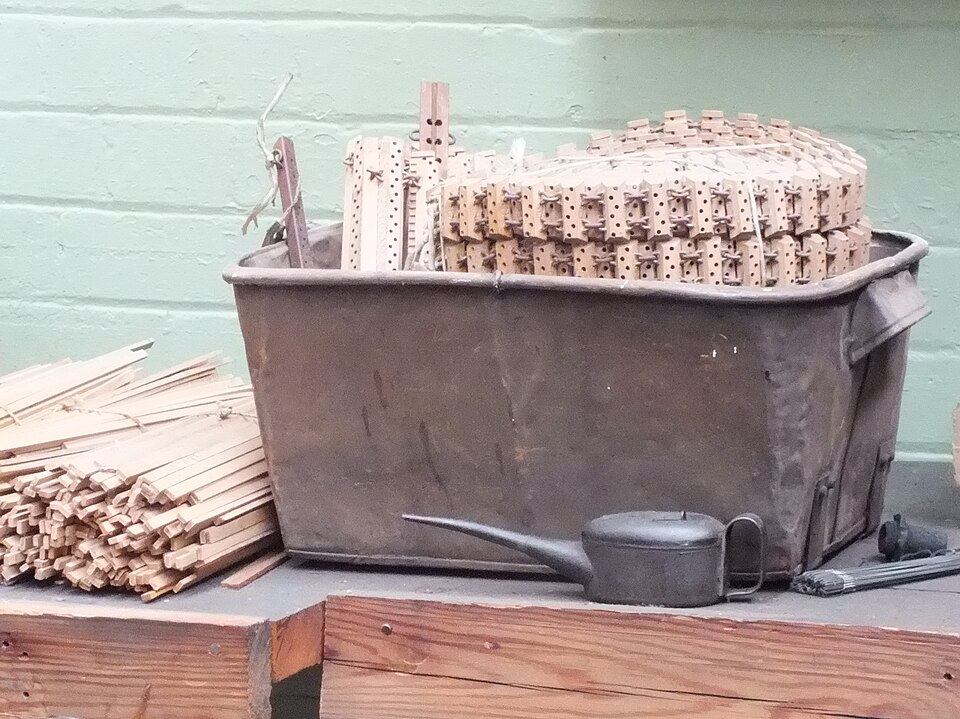
The sequence is stored as pegs. The Getty vocabulary describes a dobby loom as having a series of lattices into which pegs are inserted to lift the heald shafts in a pre-established order, and a 1917 trade manual says the shafts are pulled down again by springs. In Roberts's account of one design, a peg under a lever lowers a needle, a hook drops onto the lifting knife and the shaft rises on the next stroke; where a lag carries no peg, the lever falls and the shaft is not lifted. To keep a shaft up for two picks in a row, you peg the next lag as well. The chain of lags is, in effect, the pattern written in wood: one lag for each row of weft, then back to the start.
Getty's entry for dobby weave states the result: an all-over figured fabric of simple, small geometric figures, repeated frequently, and fairly inexpensive to produce. Roberts lists what mills wove on dobby looms: fancy coatings, trouserings, fancy dress goods, mantle cloths, cap tweeds and rugs. Proper Cloth, a custom shirtmaker, says dobby fabrics often have colored threads woven into stripes and grids, and that solid colors usually carry a tonal pattern, "like a white-on-white grid."
The history is less tidy than the mechanism. Merriam-Webster dates the word to 1878 and gives its origin as "perhaps from Dobby, nickname for Robert." A widely repeated explanation, that dobby is a corruption of "draw boy," the helper who pulled the cords on older looms, does not appear in that entry, and the Wikipedia article that states it cites nothing for it, so it stays out of the argument here. Grace's Guide's timeline for the Keighley loom makers George Hattersley and Sons lists a dobby mechanism patented in 1867, and Roberts could write in 1912 that one form of tappet was "now being superseded by the dobby."
How does a Jacquard loom control every thread?
A Jacquard head puts a hook, a cord and a heddle on each warp thread, or on a small group of them, and uses a card to decide which hooks rise. Posselt, writing in 1888 for American mills, explains why. When a fabric has a great many warp threads bound differently, guiding them by harness frames is "too cumbrous and inefficient," so the warp must be raised thread by thread with hook and leash.
The mechanism works like this. A design is prepared in advance, and holes are punched in the cards for each warp thread that must rise. The card is pressed against a row of spring-loaded needles. Where there is a hole, the needle passes through and its hook stays in place over a lifting bar, which then rises and takes the thread with it. Where the card is blank, the needle is pushed back, the hook is knocked clear and the thread stays down. A new card comes up for each pick, and the cards are laced together into an endless chain. In Posselt's list the usual machines had 100, 200, 400, 600, 900 or 1,200 hooks. A fabric-maker's explainer from Duvaltex adds that each cord may serve one, two or sometimes four warp yarns, so "every thread" is the principle, not always the count.
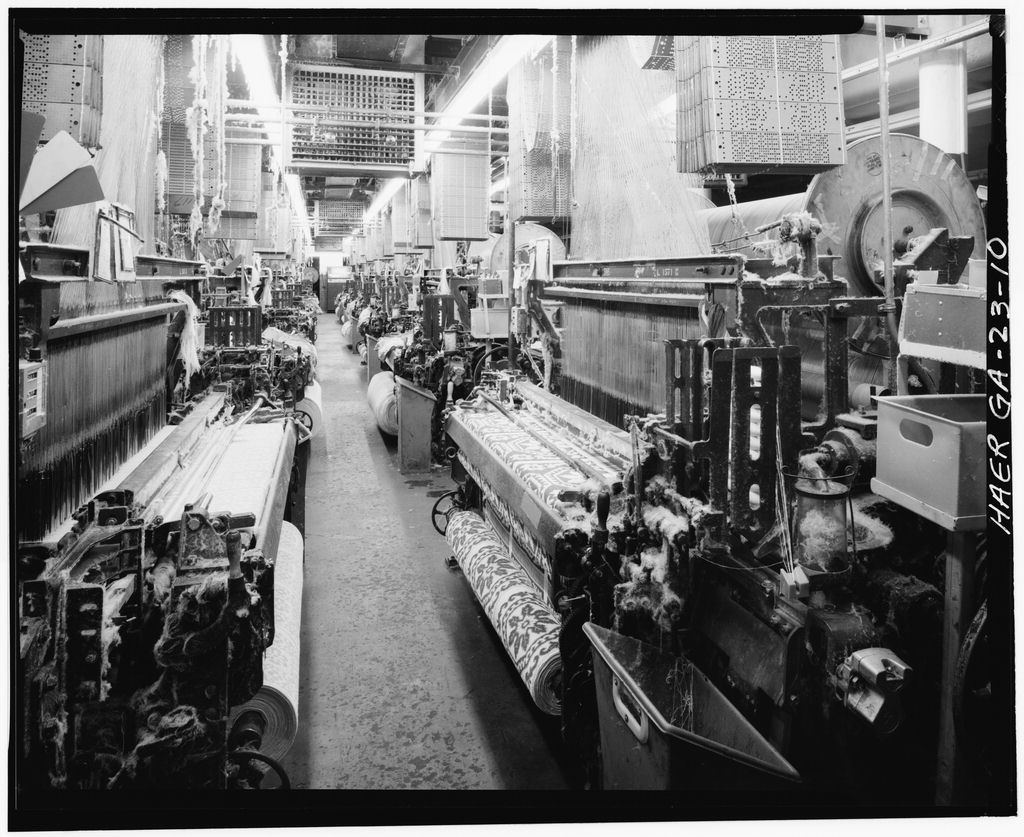
Roberts states the consequence: with a Jacquard the number of threads a design may occupy is "practically unlimited," and he lists fancy vestings, figured dress goods, tapestries, plushes and carpets as its fabrics.
Who invented it?
Joseph Marie Jacquard did not invent the idea from nothing, and sources disagree on the dates around him. Posselt says Jacquard studied the earlier machines of Bouchon, Falcon and Vaucanson, combined the best parts of them, and was the first to reach an arrangement practical enough for general use. The Computer History Museum names the same predecessors.
| Date | Event | Source |
|---|---|---|
| 1725 | Basile Bouchon works the loom from a band of pierced paper | Posselt (1888); Grace's Guide |
| 1728 | Jean-Baptiste Falcon replaces the paper band with a chain of cards | Posselt; Grace's Guide |
| 1745 | Jacques de Vaucanson puts the pierced paper or card on a cylinder and makes the loom self-acting | Posselt; Computer History Museum |
| 1801 | Jacquard shows his loom at the Paris industrial exposition and wins a bronze medal | Getty vocabulary; Encyclopedia.com; Chandler |
| 1803–05 | He is called to the Conservatoire in Paris and perfects the card machine; sources differ on the year | Posselt; Encyclopedia.com |
| 1806 | The invention becomes public property of Lyon; Jacquard receives a pension | Posselt; Encyclopedia.com; Chandler |
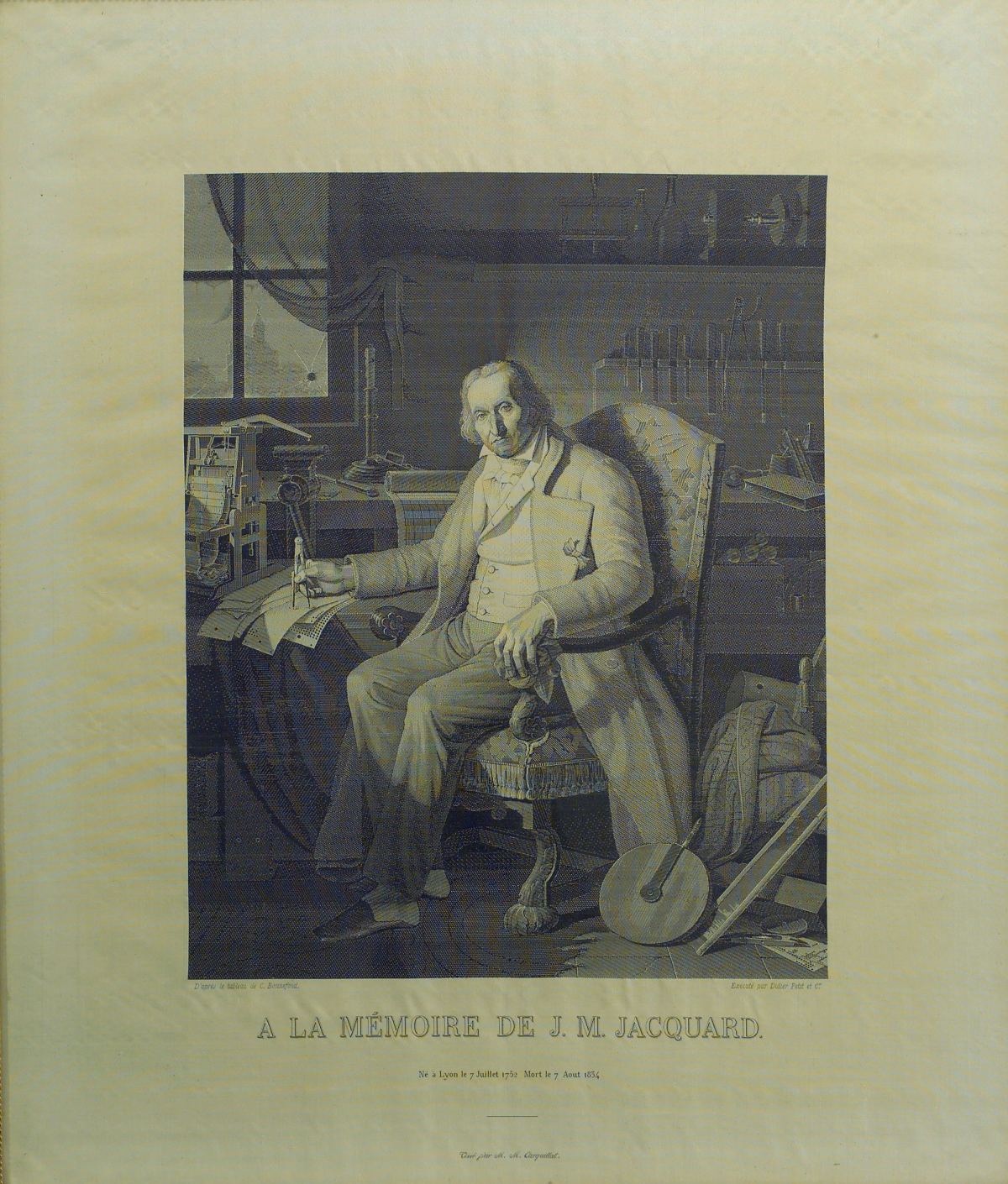
Even that table hides arguments. Posselt gives the pension as 3,000 francs, while Encyclopedia.com adds a royalty on each machine. Both agree on the hostility: Posselt says the Conseil des Prud'hommes broke up his machines in public and that he left Lyon to save his life, and Encyclopedia.com says weavers burned machines and attacked him. The vindication is told in different numbers. Posselt reports a statue where the model was destroyed and more than 30,000 Jacquard machines running in Lyon when Jacquard died on August 7, 1834, while Encyclopedia.com counts 11,000 looms in France by 1812. The birth date, July 7, 1752, appears in Posselt, in Encyclopedia.com and in the woven portrait at the top of this page, whose inscription also gives the death date.
The Getty definition of the machine puts it simply: a device to control individual warp yarns through punched cards, "first demonstrated in 1801." What the loom did to the price of copying a pattern is part of the story of paisley and Kashmir shawls.
What did a portrait woven in silk have to do with computing?
The portrait at the top of this page was woven, not printed. The Met's record gives its maker as the manufactory Didier, Petit et Cie, with a date of 1839. Enlarged, its inscriptions read "D'après le tableau de C. Bonnefond" at lower left, "Exécuté par Didier Petit et Cie" at lower right, and "Tissé par M. M. Carquillat" beneath, along with Jacquard's birth and death dates. The Computer History Museum, describing its own copy, says the silk copies were commissioned around 1839 from the weaver Michel-Marie Carquillat after Claude Bonnefond's painting, and quotes a donor's description of it as woven on a programmable loom with 24,000 punched cards. That number comes from the museum's blog post, not from the Met's record, so treat it as the museum's figure.
The most vivid evidence comes from Babbage's memoir, Passages from the Life of a Philosopher (1864). He hung a copy in his drawing-room, and describes it as "a sheet of woven silk, framed and glazed, but looking so perfectly like an engraving" that two members of the Royal Academy had taken it for one. When he showed it to Prince Albert, the Duke of Wellington, who was in the party, asked "that engraving?" and the Prince corrected him: "it is not an engraving." Babbage also records going to Lyon to watch the loom in which the portrait was woven.
Is the link to computing real? The people involved said so themselves. In his 1842 account of Babbage's Analytical Engine, the military engineer L. F. Menabrea wrote that the solution to making the machine act on its own "has been taken from Jacquard's apparatus." Ada Lovelace, who translated and annotated it, added the line so often quoted since: the Analytical Engine "weaves algebraical patterns just as the Jacquard-loom weaves flowers and leaves." What these sources document is a borrowed principle, cards that tell a machine what to do next. They do not call the loom a computer.
How can you tell which one is in a garment?
Start with the repeat. Plain cloth carries its pattern in the yarn. Dobby cloth carries a small structural pattern. Jacquard cloth can carry a pattern of almost any size. Pratt describes dobby as a small geometric texture, and says the fabric is flexible and a bit thicker than plain weave. Getty's wording is "simple, small geometric figures" repeated often. For jacquard, Pratt notes that the pattern shows on both the face and the reverse, and Kent State University Museum's note on American coverlets says Jacquard attachments could "create curvilinear designs and lettering mechanically."
| Plain weave | Dobby | Jacquard | |
|---|---|---|---|
| What controls the shed | Two shafts (or four tied in pairs) | A chain of pegged lags lifting up to dozens of shafts | Punched cards selecting hooks |
| Typical look | Even grid, same on both sides; pattern only from yarn color or thickness | Small repeating geometry: grids, stripes and small figures, often tonal | Curves, florals, pictures, lettering, large or complex repeats |
| Look for | Threads crossing one by one | A small motif that repeats again and again | Curved or pictorial motifs, lettering, and a pattern that also shows on the reverse |
| Common examples | Muslin, poplin, canvas, chambray | Shirting with white-on-white grids | Brocade, damask, upholstery |
Treat this as a way of narrowing the field, not a verdict. Roberts noted that with so many terms in use "no definite line of demarcation can be drawn," and Posselt's 1888 glossary describes dobbies, index machines and witches as "small Jacquard machines, or machines constructed upon its principles." A small figure made on a small Jacquard, or a larger one on a big dobby, can fool you. The loom leaves no label on the finished cloth, but the structure leaves clues.
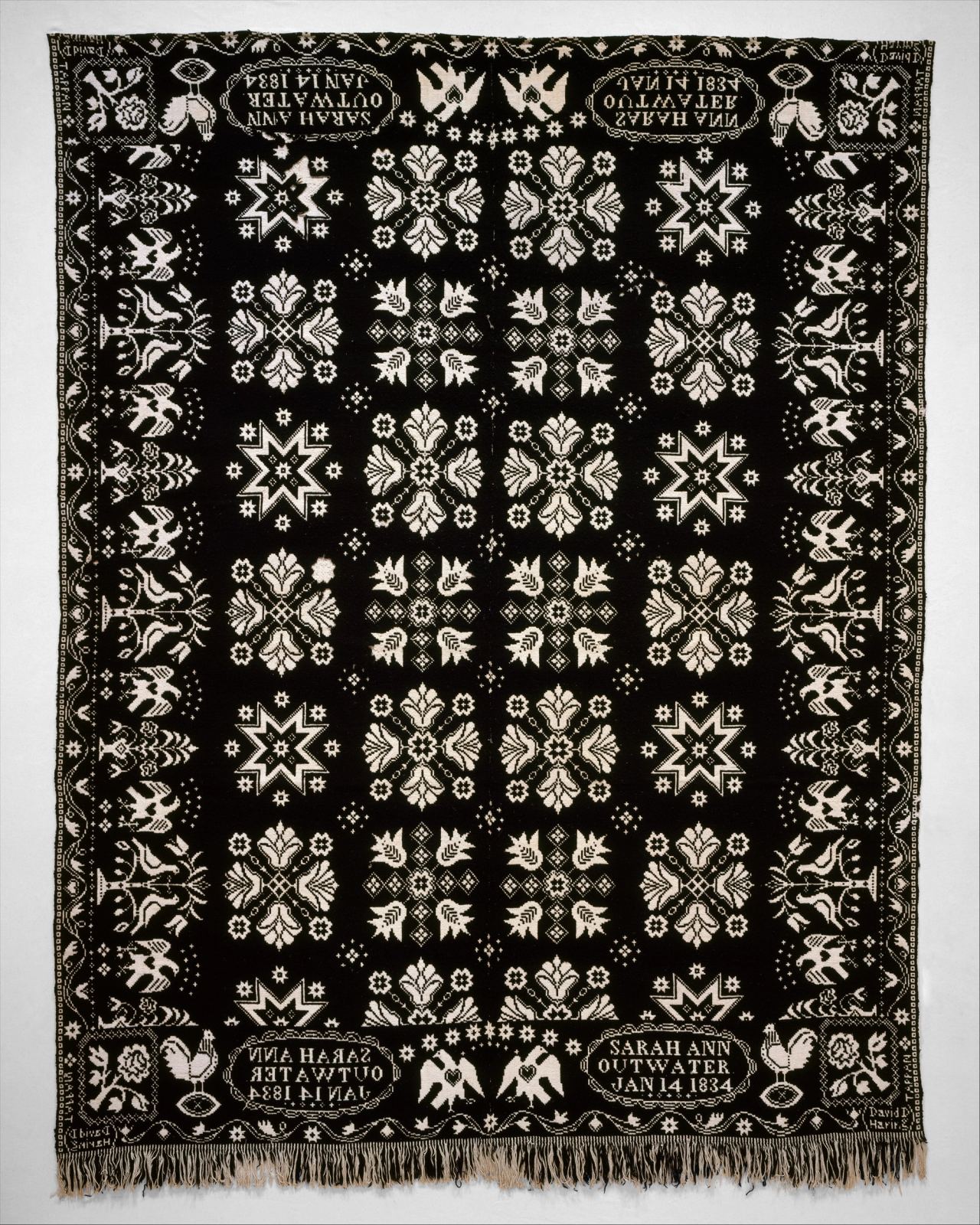
A coverlet like the Met's, woven in 1834 by David Daniel Haring of Bergen County, New Jersey, is catalogued as doublecloth "woven on a hand-loom with a Jacquard attachment." It shows what the attachment bought: stars, birds, flowering plants, and a name and date in lettering. Kent State's museum says the Jacquard loom is thought to have arrived in America and been fitted for coverlet weaving by 1825.
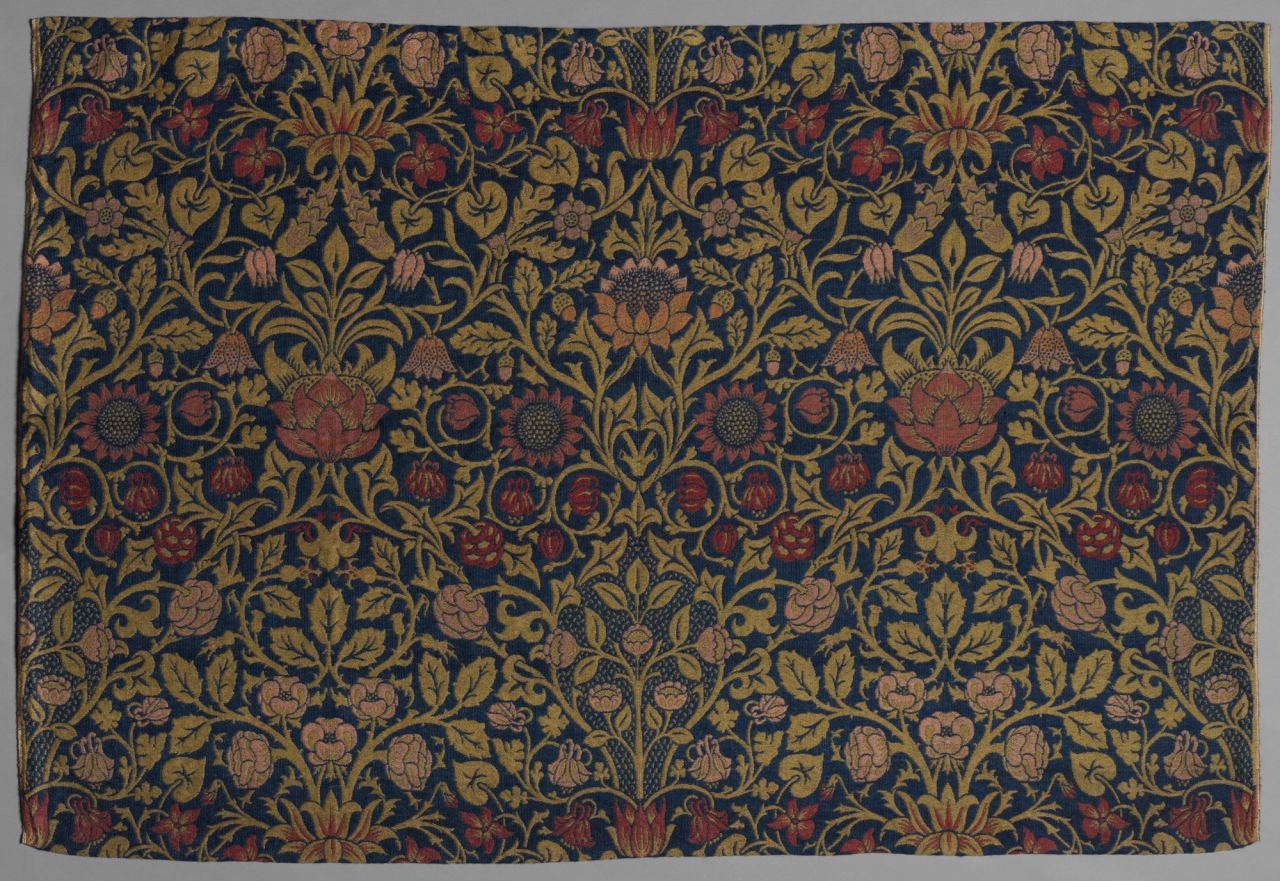
William Morris's Violet and Columbine, a wool and mohair double cloth catalogued by the Cleveland Museum of Art as woven on a Jacquard loom in 1883, is the other end of the range: a dense, curving pattern of the kind a dobby, limited to small geometric figures, does not produce, repeated more than once across the width of the cloth.
What do they mean for cost, drape and care?
For cost, the mechanism shows up in the weaving and in the cards. Menabrea explained that before Jacquard a workman had to regulate the movements of the threads himself, and "thence arose the high price of this description of stuffs." Getty calls dobby weaves fairly inexpensive to produce, and Pratt says jacquard is costly because the weaving process is "time consuming and laborious." A Jacquard design also has to be drawn and its cards punched, a step Babbage described. We found no reliable price-per-yard comparison, so the cost difference is a statement about process, not a number.
For drape, the loom matters less than the yarn and the density. Proper Cloth says dobby shirtings range from very thin, easily mistaken for broadcloth, to thick textures closer to twills, and are naturally resistant to wrinkling and slightly shinier than many other fabrics. Pratt says jacquard is durable, wrinkle resistant and frequently heavy.
For care, the useful clue is the float. Where a thread skips over several others to make a pattern, the skipped stretch sits loose on the surface or the back. Pratt notes that satin weaves snag easily because of their large warp floats; the same logic would apply to a jacquard whose reverse is covered in long floats, which is our inference, not a test result. None of the sources we opened gives laundering rules for dobby or jacquard cloth as a class, so follow the garment's care label. What the weave can tell you is where to expect wear: at the loose threads on the back.
Where can you see them?
The Met holds the silk portrait (31.124) and American coverlets woven with Jacquard attachments, among them 1988.127. The Cleveland Museum of Art has Violet and Columbine in two examples (1934.329 and 1953.329). The Science Museum Group lists a woven portrait of Jacquard dated 1839 (1942-59), and the Computer History Museum holds another copy. The wooden lags in our photograph are in the collection of Queen Street Mill in Burnley, Lancashire.
For woven versus printed pattern, our guide to printed cloth, block to screen covers the other way of getting a design onto cloth.
Sources
- The Jacquard Machine Analyzed and Explained (1888), history chapter and chapters on the harness, cards and hooks. E. A. Posselt, via Project Gutenberg. Full text of the history chapter and the mechanism chapters read: Bouchon, Falcon, Vaucanson, Jacquard's career, 1806 annuity, opposition in Lyon, hooks, needles, cards, hook counts, harness cords; glossary entry calling dobbies small Jacquard machines. 1888 American textbook; date and anecdotal details cross-checked. Accessed October 18, 2026.
- Tappet and Dobby Looms: Their Mechanism and Management (1912), chapter I and the dobby mechanism. Thomas Roberts (Manchester: Emmott & Co.), via Internet Archive. Full text read: classification of looms into tappet, dobby and jacquard; shaft counts (tappet 2-12, dobby up to 48, usual 16, 24, 36); pegs, lags, needles, tumblers and draw hooks; 'no definite line of demarcation'. Accessed October 18, 2026.
- Technology of Textile Design (1888), foundation weaves and fancy effects with the plain weave. E. A. Posselt, via Internet Archive. Pages on the plain weave read: plain weave as a foundation weave, figuring plain cloth with thread thickness and color arrangement (repp, handkerchief borders, ginghams). Accessed October 18, 2026.
- A Practical Treatise on the Construction of the Power-Loom and the Art of Weaving (1883), 'Draughts and treading of a plain web'. Alexander Brown (Dundee), via Internet Archive. Passage read: four leaves of heddles generally used for plain weaving, two fixed together and raised and sunk as one. Accessed October 18, 2026.
- Piece Goods Manual (1917), entry 'Dobbie, or Dobby'. A. E. Blanco, Statistical Department, Inspectorate General of Customs, Shanghai, via Project Gutenberg. Full entry read: lattices with pegs control the lifting of heald shafts, springs pull them down; dobby-woven stripes and figures in shirtings. Accessed October 18, 2026.
- Art & Architecture Thesaurus: dobby looms (300423550), dobby weave (300417868), jacquard looms (300023516), plain weave (300312167), heddles (300024953). Getty Research Institute. Scope notes read through the Getty SPARQL endpoint: dobby weave limited to simple small geometric figures and fairly inexpensive; dobby lifts shafts, Jacquard lifts individual warp threads; Jacquard loom first demonstrated 1801; plain weave sides structurally identical; heddle definition. Accessed October 18, 2026.
- Sketch of the Analytical Engine, with notes by the translator Ada Augusta, Countess of Lovelace (Menabrea, 1842). Fourmilab (English translation with Lovelace's notes). First 100,000 characters read, including Menabrea's passage on Jacquard's apparatus and Note A with the 'weaves algebraical patterns' sentence. Accessed October 18, 2026.
- Passages from the Life of a Philosopher (1864). Charles Babbage, via Project Gutenberg. Passages read: the woven portrait of Jacquard in his drawing-room, Wilkie and the Royal Academicians, Prince Albert and the Duke of Wellington, his visit to Lyon, the Jacquard loom described for the Engine. Accessed October 18, 2026.
- Joseph Marie Jacquard (Encyclopedia of World Biography; Science and Its Times). Encyclopedia.com (Gale). Both entries read: birth, 1801 exposition and bronze medal, 1803-05 Conservatoire, 1806 public property and pension, royalty, burning of machines, looms in use. Entries disagree on some dates; the text says so. Accessed October 18, 2026.
- Napoleonic Expositions (1801, 1802, 1806). Arthur Chandler. Read: Jacquard's loom at the 1801 exposition awarded a bronze medal; government took possession in 1806 with a lifetime pension. Accessed October 18, 2026.
- Artifact Adopted! Preserving the Legend of J. M. Jacquard. Computer History Museum. Read: the woven portrait copies (about 1839, Didier Petit et Cie, weaver Michel-Marie Carquillat, after Claude Bonnefond), donor's description of 24,000 punched cards, Vaucanson 1745, Bouchon and Falcon. Date inside the post is inconsistent (1830 vs ca. 1839/1840); the text uses 1839 from the Met and Science Museum records. Accessed October 18, 2026.
- Jean-Baptiste Falcon; G. Hattersley and Sons. Grace's Guide to British Industrial History. Both pages read: Bouchon 1725 pierced paper, Falcon 1728 punch cards; Hattersley timeline entry 'Dobby mechanism patented' 1867. Compiled secondary source, used only for these dated entries. Accessed October 18, 2026.
- dobby; Jacquard (dictionary entries). Merriam-Webster. Read: dobby, first known use 1878, etymology 'perhaps from Dobby, nickname for Robert'; Jacquard named after Joseph-Marie Jacquard. Accessed October 18, 2026.
- TRL - Wovens. Textile Resource Library, Fashion Design, Pratt Institute. Read: plain weave (simplest, strong, no stretch, examples), dobby (small geometric texture, flexible, a bit thicker, inexpensive), jacquard (pattern on face and reverse, durable, frequently heavy, costly), satin floats snag. Accessed October 18, 2026.
- Dobby Dress Shirt Fabrics. Proper Cloth (custom shirtmaker, commercial source). Read: dobby shirtings with woven stripes and grids, tonal white-on-white grids, thin to thick, wrinkle resistant, slightly shinier. Retailer; used for description of shirtings only. Accessed October 18, 2026.
- Dobby vs. Jacquard: A Tale of Two Looms (Aug 16, 2023). Duvaltex (upholstery fabric maker, commercial source). Read: dobby controls warp yarns in groups moved by harnesses; on a Jacquard each harness connects to one, two or sometimes four warp yarns. Used only for that point. Accessed October 18, 2026.
- Figured and Fancy Coverlets in the Kent State University Museum Collection. Kent State University Museum. Read: Jacquard loom thought to have arrived in America and been fitted for coverlet and carpet weaving by 1825; attachments could create curvilinear designs and lettering mechanically. Accessed October 18, 2026.
- A la memoire de J.M. Jacquard, woven picture, 1839 (object 1942-59). Science Museum Group. Object record read: Jacquard-woven picture, 1839, after the original by C. Bonnefond, made in Lyons, object number 1942-59. Accessed October 18, 2026.
- Open Access records: Joseph Marie Jacquard (31.124); Coverlet by David Daniel Haring (1988.127). The Metropolitan Museum of Art. Titles, dates, media, makers, dimensions, credit lines and CC0 status read from the Collection API (object pages return 429 to bots); both images inspected at full size, inscriptions read at zoom. Accessed October 18, 2026.
- Violet and Columbine (1953.329). The Cleveland Museum of Art. Open Access API record read: designed by William Morris, 1883, Merton Abbey, jacquard loom woven weft-faced twill, double cloth, wool and mohair, CC0. Accessed October 18, 2026.
- Jacquard looms in Muscogee Mills weave patterned cloth (HAER GA,108-COLM,2--11). Library of Congress, Prints and Photographs Division (David Sharpe, HAER, 1977). Record read via loc.gov JSON: rights 'No known restrictions on images made by the U.S. Government'; image inspected and the punched-card stack at upper right enlarged. Accessed October 18, 2026.
- File:QSMM Dobby lags and pegs 2624c.JPG. Wikimedia Commons (Clem Rutter, CC BY 3.0). File metadata read through the Commons API: author Clem Rutter, own work, CC BY 3.0, item in the collection of Queen Street Mill, Burnley, 2013-03-21. Accessed October 18, 2026.
- Dobby loom; Dobby (cloth); Jacquard machine. Wikipedia. Used only to locate references. Its '1843' date and 'draw boy' etymology carry no citation and are not used. Accessed October 18, 2026.
Glossary
Last updated · Markdown · Report an error