Trousers, Bicycles and the Divided Skirt
When did women start wearing trousers, and why was it controversial? From the bloomer costume of 1851 to the cycling suits of the 1890s, and what the Paris "trouser ban" really was.
Women in Europe and America wore trousers in public in small, scandalous numbers from about 1850, and in large numbers only in the twentieth century. The first organized attempt was the American "bloomer" costume of 1851, which was mocked out of fashion within a few years. Trousers came back in the 1880s and 1890s through the bicycle, usually disguised as a divided skirt.
Who started the bloomer costume in 1851?
Elizabeth Smith Miller designed it and Amelia Bloomer made it famous. Miller, the daughter of the reformer Gerrit Smith, described her design in her own words as "Turkish trousers to the ankle with a skirt reaching some four inches below the knee." She wore it to Seneca Falls, New York, in early 1851, to visit her cousin Elizabeth Cady Stanton. Bloomer, who edited the temperance paper The Lily, followed Stanton a few days later and announced the fact to her readers.
Bloomer told the story herself in a late memoir, published in 1895, a year after her death. By her account, a Seneca Falls newspaper, the Courier, had run an editorial in January or February 1851 advocating "Turkish pantaloons and a skirt reaching a little below the knee." Bloomer teased its editor in The Lily. Miller then appeared on the street in the costume, which she had already worn for two or three months. Stanton came out in a copy of it within days, and Bloomer did the same. She wrote that she had no thought of setting a fashion, and that letters then arrived "by hundreds" asking for patterns. Her subscription list "ran up amazingly into the thousands," and later accounts put the paper's circulation at about 500 before and between 3,000 and 4,000 after, depending on the source. Stanton, looking back, wrote: "What incredible freedom I enjoyed for two years!"
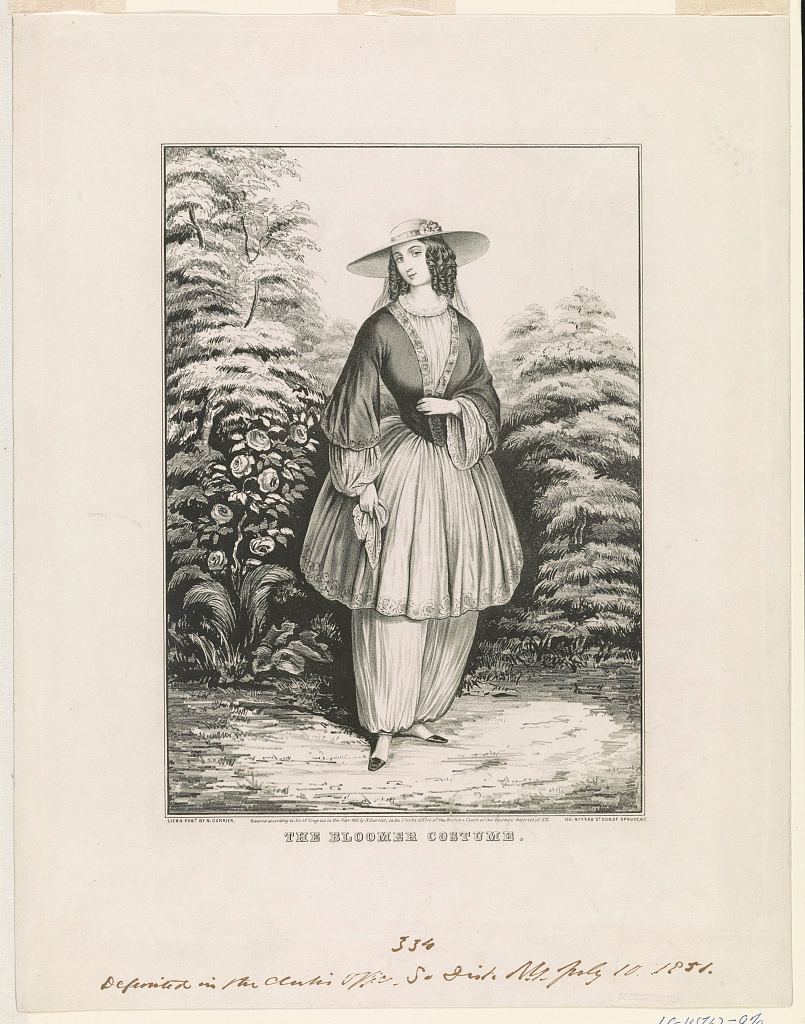
Neither woman invented the idea. Britannica notes that the actress Fanny Kemble and the reformer Lydia Sayer (Hasbrouck) had worn similar clothes as early as 1849, and Bloomer herself defended Kemble in The Lily against newspapers that called her loose dress and pantalettes "man's clothes." The name was not Bloomer's choice. She wrote that newspapers headed their squibs "Bloomerism" and "Bloomerites," that someone then wrote "the Bloomer Costume," and that the name stuck "in spite of my repeatedly disclaiming all right to it." Late in life she told an interviewer that she hoped she would not always be remembered just for the clothes.
I worked hard for temperance and woman suffrage and hope that I shall not always be remembered just because I wore short skirts and trousers.
Why did the bloomer costume fade?
It faded because each woman paid for it herself. The press that had first reported the costume with interest turned hostile. The New York Herald called its wearers "lunatic and crotchety old maids and widows" who had put on breeches, and London theaters staged "The Bloomer Costume" at the Strand and "Bloomerism; or The Follies of the Day" at the Adelphi in 1851, as the Victoria and Albert Museum notes in its record of a Staffordshire figure of "Mrs Amelia Bloomer." Not even all women's rights activists adopted the costume: Lucretia Mott, Ernestine Rose and Antoinette Brown did not, and Brown, in a later interview, thought it a mistaken emphasis to cause so much discussion about mere clothes.
Stanton wrote that wearers "soon found that the physical freedom enjoyed did not compensate for the persistent persecution and petty annoyances suffered at every turn." In early 1854 she urged Lucy Stone to "lay aside the shorts," and Susan B. Anthony let down her dresses that March. Anthony later called the costume "a physical comfort but a mental crucifixion." Miller wore it for seven years, according to the Winning the Vote biography, and it survived in gymnasiums and sanitariums.
Bloomer gave her own reasons for stopping. In a letter of 1865 she wrote that the high winds of her new home in Iowa turned her short skirts over her head. Then hoops arrived, "doing away with the necessity for heavy underskirts (which was my greatest objection to long dresses)," and keeping two wardrobes, long and short, was inconvenient and costly. She also wrote that the dress was drawing attention from the more important questions of education, employment, pay and the ballot, and that in some minds the short dress and women's rights were "inseparably connected." In the 1865 letter she said she had not worn it "for the last six years or more." The cage crinoline, which made heavy petticoats unnecessary, thus helped end the first run of trousers for women.
What was the Rational Dress Society?
It was a London organization, founded in 1881, that judged women's clothes by health and freedom of movement. It protested, in its own words, against any fashion that "deforms the figure, impedes the movements of the body, or in any way tends to injure the health," and it named tight corsets, high heels, heavy skirts and tie-down cloaks. According to Wikipedia, which cites the society's inaugural exhibition catalog, it listed five attributes of perfect dress, the last of which is the most telling for this story: "Not departing too conspicuously from the ordinary dress of the time." Rational dress was a program to be sold to the public, and not only a statement.
Florence, Viscountess Harberton, is the society's best-known figure. Accounts differ on her part: Wikipedia says she became its president in 1883 and "possibly co-founded" it in 1881, while The Chap and the Fashion History Museum call her a co-founder, and The Chap names Emily King as the other. Constance Wilde edited the society's occasional magazine, and Mary Eliza Haweis is named among its leading members. Harberton advocated divided skirts. At a lecture in Westminster Hall in 1887, The Chap reports, she said: "The dresses that men have invented for women have never been a success, whether it be the fashionable garments devised by Worth or the nurse's dress."
How did the bicycle change the argument?
The bicycle made trousers a practical question rather than a political one. A Cambridge chapter on the New Woman dates the "bicycle craze" from the late 1880s, with a peak in the mid-1890s. It credits the chain-driven safety bicycle, developed from 1884 and fitted with pneumatic tires from 1887, for making cycling available across classes and genders. The Henry Ford museum notes that when the craze began in the United States, about 1890, most American women still preferred long skirts, which tangled in the chain. Those who defied convention wore divided skirts or short bloomers that cinched below the knee, and bystanders jeered.
The ride that tested the point in Britain was Tessie Reynolds's. On 10 September 1893, at sixteen, she rode from Brighton to London and back, 120 miles, in 8 hours 38 minutes, in knee-length knickerbockers and a long jacket made by her sister. Brighton & Hove Museums, whose account is by the historian Sheila Hanlon, notes that the craze was "still a few years away" and that women's cycle sport was frowned upon. The magazine Cycling called her outfit "of a most unnecessarily masculine nature and scantiness." Bicycling News called it "suitable and graceful." The racing authorities refused to recognize her record.
Two famous Americans tied the bicycle to women's rights. Frances Willard learned to ride at fifty-three and wrote in A Wheel Within a Wheel (1895) that she suffered from "the impedimenta that result from the unnatural style of dress." She predicted that women who rode would have to dress more rationally, and that "an ounce of practice is worth a ton of theory." Her own cycling costume was a tweed skirt and blouse, the skirt three inches from the ground, with gaiters. Susan B. Anthony, interviewed by Nellie Bly for the New York World of 2 February 1896, said of cycling: "I think it has done more to emancipate women than anything else in the world." Asked about bloomers, she answered that "safety, as well as modesty, demands bloomers or extremely short skirts." She had worn short dresses herself forty years earlier and told Bly it had taught her "you can't carry two thoughts before the people at the same time."
What did the clothes look like?
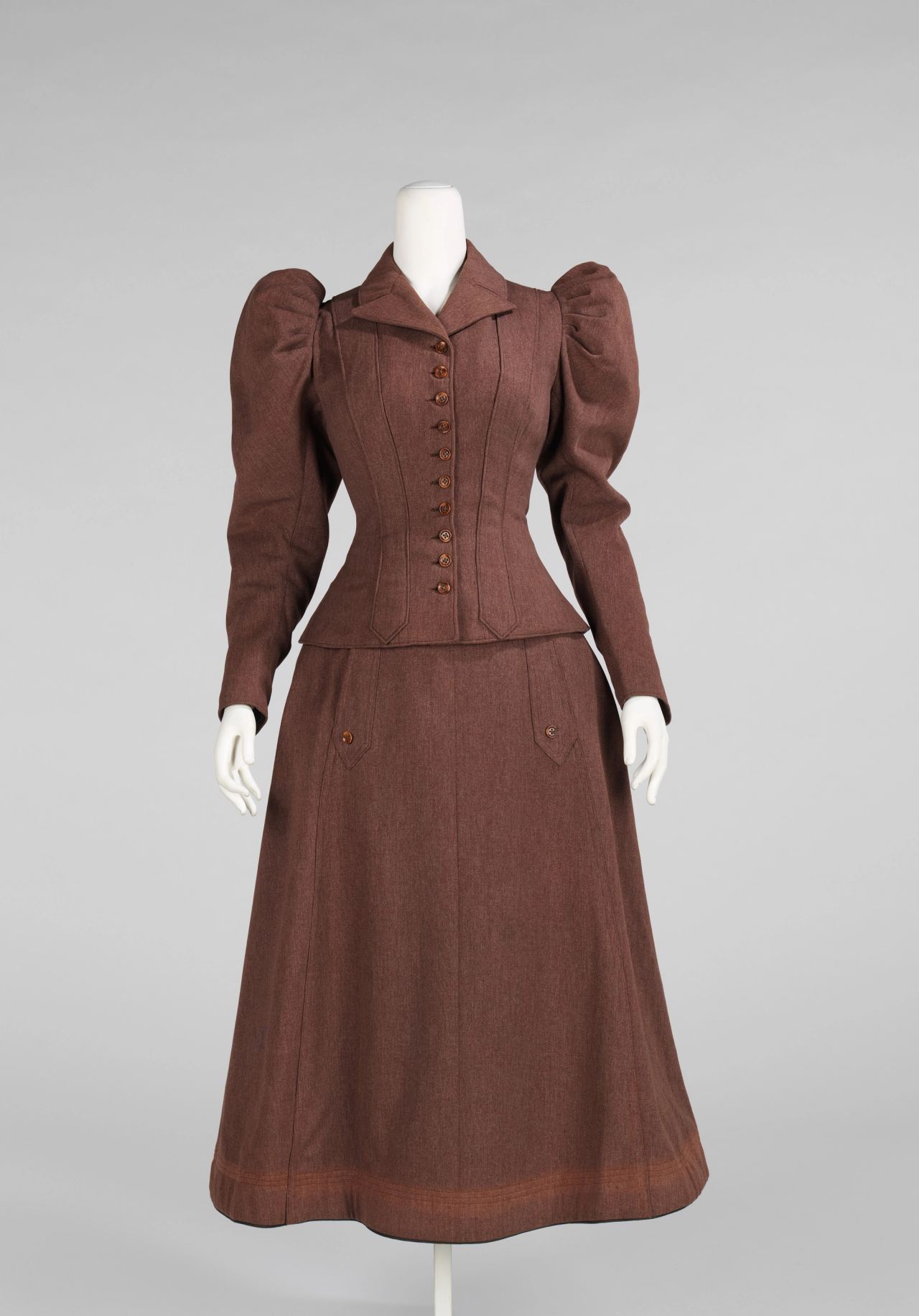
The Metropolitan Museum's cycling suits are more cautious than the legend suggests. The suit of 1896, by the maker credited as Trouville, is a fitted wool jacket with very large puffed sleeves and a flared skirt that ends well above the floor. Nothing about it says "trousers" at a glance.
Another suit, of 1896–98, has a jacket with flap pockets, a skirt fastened down the front with two rows of buttons, and buttoned leggings that show below the hem, close to Willard's description of her own tweed and gaiters. The pockets are worth noticing, since the lost pocket is a long-running subject in women's dress.
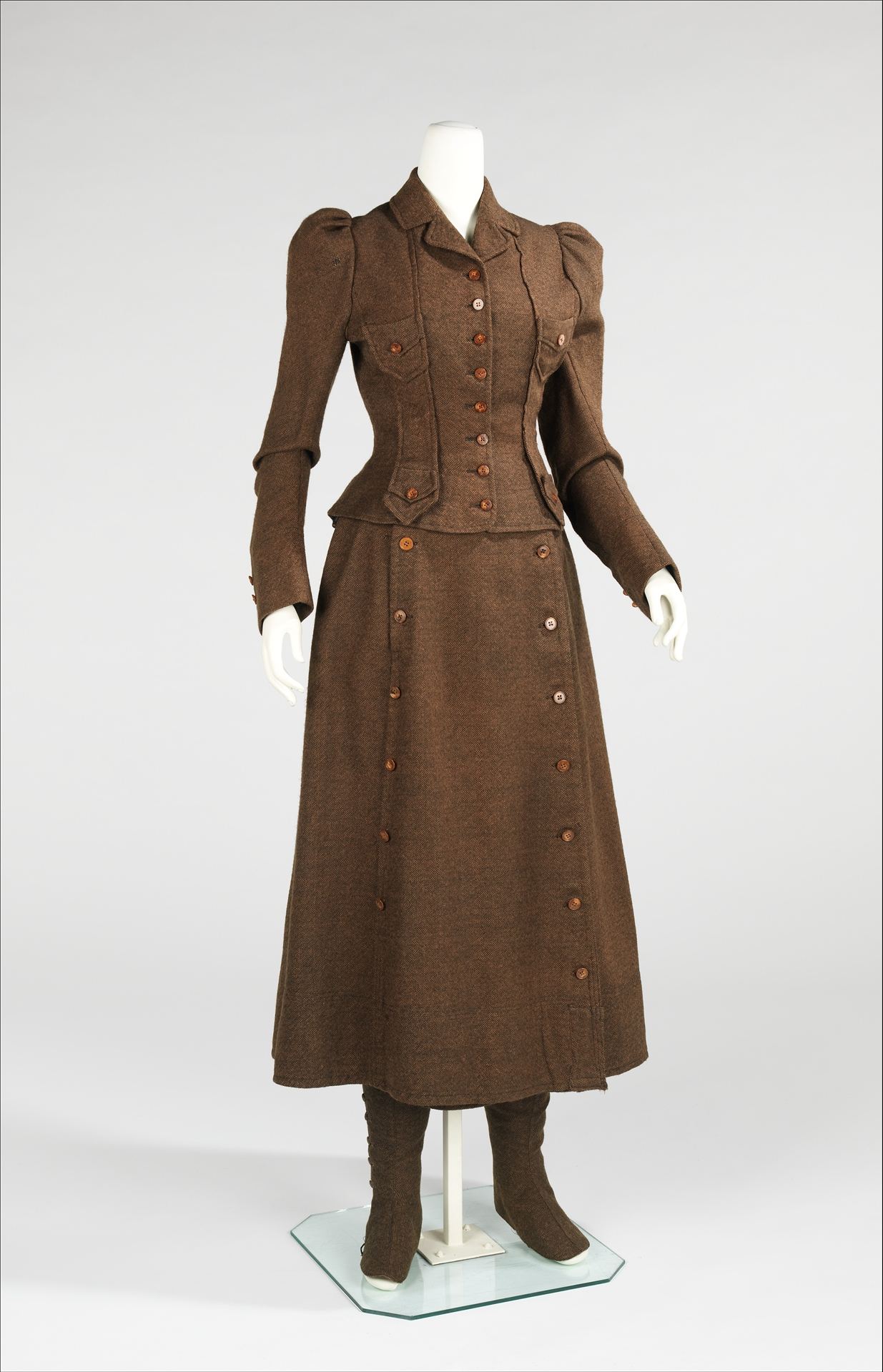
Caitlin Cohn's 2016 dissertation, Wheelwomen, finds that riders who persuaded others of their legitimacy dressed "sufficiently modified to make cycling physically possible, but not so modified as to appear too out of place when the rider was off the machine." These suits fit that description.
What is the difference between a divided skirt, bloomers and knickerbockers?
A divided skirt is a skirt split between the legs; bloomers are full, gathered trousers; knickerbockers are knee-length breeches. In practice the words overlapped. An 1897 advertisement in The Graphic shows a woman in garments that Wikipedia says were called "rationals," "knickerbockers" or "bloomers," and a whole outfit was a "bicycle suit." The table gives the sense most often found in the sources.
| Garment | What it is | Where it appears in this story |
|---|---|---|
| Bloomers | Full, gathered trousers; in 1851 worn under a short skirt, in the 1890s often short and cinched below the knee | The 1851 costume; a bathing costume of 1895–1900 |
| Divided skirt | A skirt split between the legs, cut to look like a skirt at rest | Harberton and the Rational Dress Society; a late-1890s linen example at the Henry Ford |
| Knickerbockers | Knee-length breeches, worn with a long jacket | Tessie Reynolds, 1893; the Puck cartoons of 1895 |
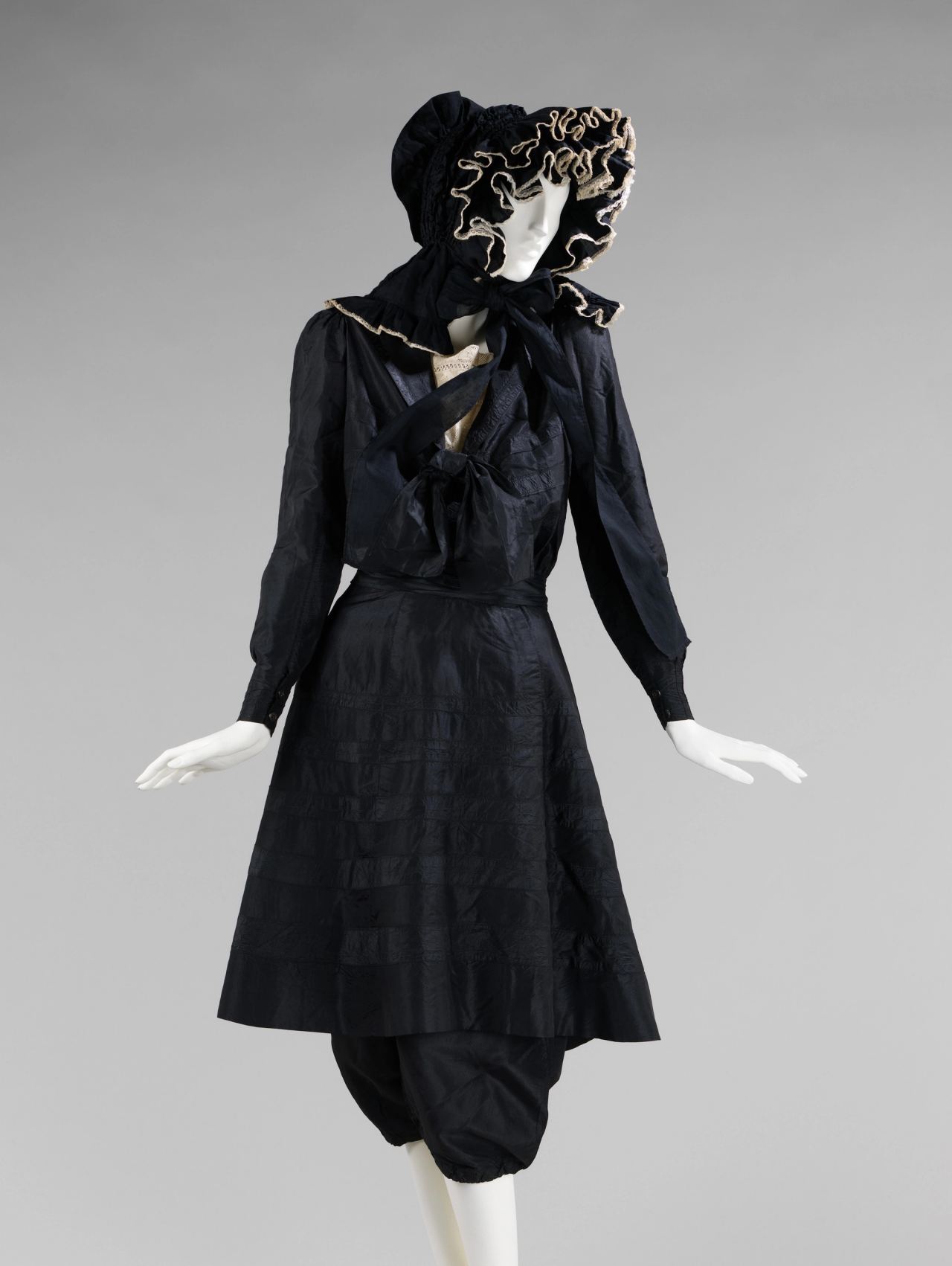
The Met's bathing costume of 1895–1900 keeps the bloomer idea out of sight. A black silk blouse and a knee-length skirt hide full, gathered trousers that appear only below the hem.
How was it mocked, and what did riders face?
The mockery was constant and became a subject in its own right. Patricia Marks's Bicycles, Bangs, and Bloomers: The New Woman in the Popular Press (University Press of Kentucky, 1990) surveys satires and caricatures from British and American periodicals of the 1880s and 1890s. It finds that humorists set the "New Woman" in "rational" dress against the traditional "womanly woman," and that not every commentator attacked her.
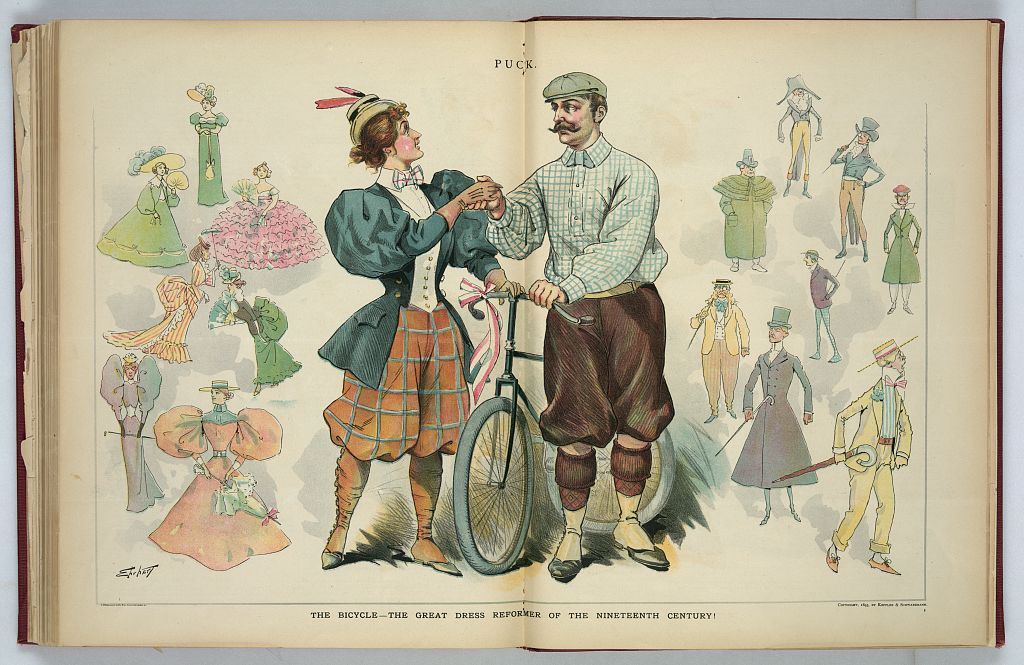
The American humor weekly Puck shows both tones in 1895. In June, F. Opper drew "The 'New Woman' and Her Bicycle," in which a bespectacled woman in puffed sleeves and plaid knickerbockers stands with her hands in her pockets, three mice at her feet, among vignettes of servant girls, washerwomen and widows on wheels. In August, S. D. Ehrhart drew "The Bicycle: The Great Dress Reformer of the Nineteenth Century!," in which a woman and a man in knickerbockers shake hands across a bicycle while earlier fashions fill the margins. In Britain, Punch printed verse against the costume, according to The Chap, that complained of "a masculine coldness, a brusqueness, a boldness" in "all this novel costume."
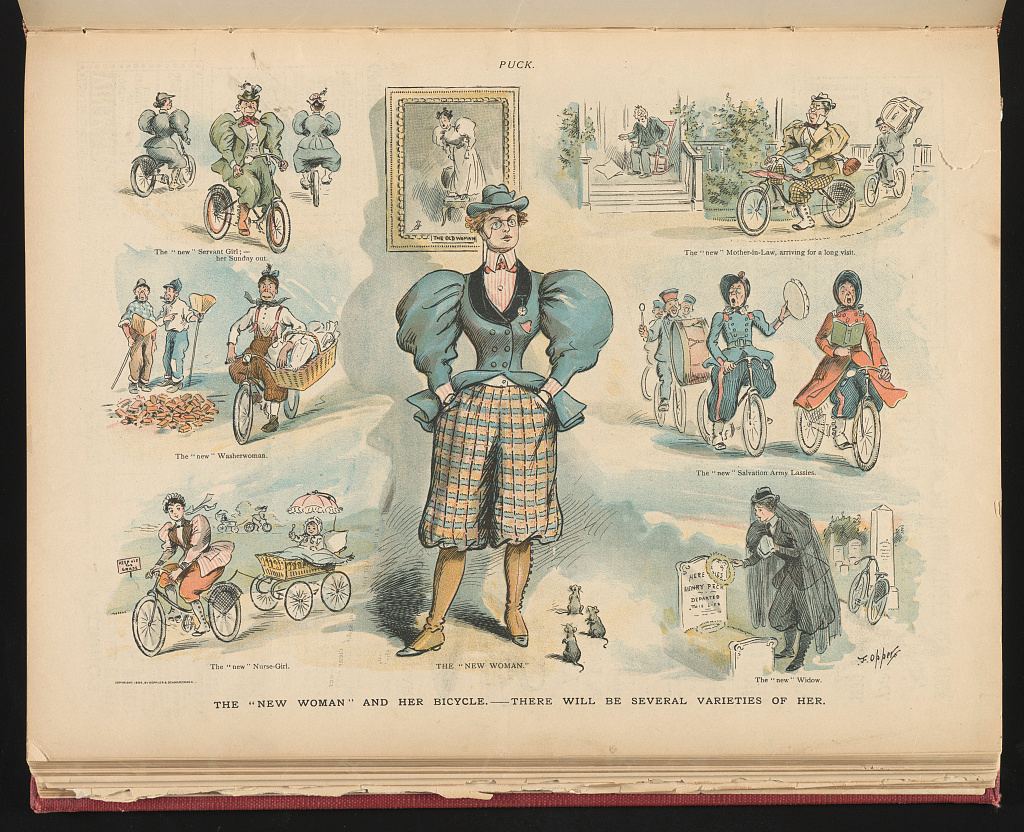
The ridicule was sometimes physical. The Chap reports that cyclists in rational dress were called names and had stones thrown at them.
Lady Harberton's own case came the following year. In October 1898 she was refused entry to the coffee room of the Hautboy Hotel in Ockham, Surrey, for wearing "rationals," baggy knickerbockers and a jacket, and was offered the bar parlor instead. She complained to the Cyclists' Touring Club, which prosecuted the landlady, Martha Sprague, under the licensing laws. Regina v Sprague was heard at the Kingston Quarter Sessions on 5 April 1899, and the jury found for Mrs. Sprague. The Times concluded, as The Chap quotes it, that "the only thing really decided was that the bar parlour at the Hautboy is a decent and proper room for a lady with or without 'rationals' to lunch in." Wikipedia gives a different account, in which Harberton herself sued, but The Chap and Cycling UK both say the club brought the case.
Was it ever illegal for women to wear trousers?
Not in the way the internet says. The best-known claim is that a Paris ordinance forbade women to wear trousers until 2013. The historian Christine Bard, in La Vie des idées (2013), gives the facts. The text is ordinance no. 22 of the Paris police prefect Dubois, dated 16 brumaire year IX (7 November 1800), "concerning the cross-dressing of women." It required any woman who wished to dress as a man to apply to the prefecture, with a health officer's certificate. It was a police ordinance, not a law, and it applied to Paris.
It was rarely a barrier, according to The Local, which reports that only a couple of hundred permits were ever issued, and that the painter Rosa Bonheur obtained one in 1857. Bard also notes that in 1930 the police ordinance was used as an argument against the athlete Violette Morris, who was expelled from a women's sports federation after a court case over her right to wear trousers. On 31 January 2013, answering a Senate question, the women's rights ministry declared the ordinance "implicitly abrogated," a "piece of archives." Bard argues that the authorities were taking credit for a change that women had made themselves.
Two popular details do not stand up. The first is the supposed exception for women holding a bicycle handlebar or horse reins. Bard calls the two circulars on which the exception rests, dated 1892 and 1909 in the press, "urban legend, 1900 version," and so no exception is claimed here. The second is Marlene Dietrich's "arrest" in Paris in 1933. The Local reports that the American press said she was arrested, but there is no official record and the French press never mentioned one.
How long did it take for trousers to become ordinary?
It took roughly a century after the bloomer costume, in stages, each with resistance. The Met's records include pajamas of 1926–27 by the couture house Callot Soeurs, so trousers were inside high fashion by the late 1920s. Yves Saint Laurent called his first Le Smoking, a woman's evening suit that copied a man's tuxedo, a work of 1966, and the New York Times of 5 August 1966, as Wikipedia cites it, described his black-tie trouser suit. The socialite Nan Kempner was turned away from a Manhattan restaurant while wearing one, in a story told several ways: Women's Wear Daily says she took off the trousers and wore the jacket as a minidress at "another fashionable Manhattan restaurant," while Wikipedia names La Côte Basque. No source seen gives a date.
The rule survived in public life for decades. Until 1993 women did not wear trousers on the floor of the United States Senate. The norm was enforced by doorkeepers following a written policy manual that told women to wear "business attire, i.e., dress, skirt and blouse or business suit." After Carol Moseley Braun and Barbara Mikulski wore pantsuits there, the sergeant at arms, Martha Pope, amended the manual to add a "coordinated pantsuit." In France, Bard notes, the first parliamentarian in trousers was the communist deputy Chantal Leblanc in 1978.
| Date | Event | Source type |
|---|---|---|
| 7 Nov 1800 | Paris police prefect's ordinance requires a permit for women dressing as men | Bard, La Vie des idées |
| Early 1851 | Miller at Seneca Falls; Stanton and Bloomer follow | Bloomer, Life and Writings |
| 1851 | Press ridicule; London theaters stage Bloomer plays | New York Herald; V&A record |
| 1881 | Rational Dress Society formed in London | Wikipedia; The Chap |
| 10 Sep 1893 | Tessie Reynolds rides Brighton–London–Brighton in knickerbockers | Brighton & Hove Museums |
| 1895 | Willard's A Wheel Within a Wheel; Puck cartoons | Book; Library of Congress |
| 2 Feb 1896 | Anthony interviewed by Nellie Bly | New York World |
| Oct 1898 | Lady Harberton refused at the Hautboy Hotel | The Chap; Cycling UK |
| 5 Apr 1899 | Regina v Sprague, Kingston Quarter Sessions; jury finds for the landlady | The Chap; Fashion History Museum |
| 1966 | Saint Laurent's Le Smoking | Women's Wear Daily; Wikipedia |
| 1993 | Moseley Braun and Mikulski wear pants on the Senate floor | Mental Floss |
| 31 Jan 2013 | French ministry: 1800 ordinance "implicitly abrogated" | Bard |
Where can you see it?
The Metropolitan Museum holds cycling suits and a bathing costume of the years described here, with open-access images: the suits of 1896 and 1896–98 and the beachwear of 1895–1900, all from the Brooklyn Museum Costume Collection. Whether they are on view depends on the rotation, so check the museum's pages first. The Library of Congress holds the Currier lithograph and the two Puck pages, which can be viewed online.
In Paris, the Palais Galliera's Un vestiaire à soi (in English, A Wardrobe of One's Own: Dissident Femininities in the 19th Century) runs from 26 September 2026 to 14 February 2027, according to three listings. The museum's own page describes almost five hundred works, including Rosa Bonheur's wardrobe "in its entirety," and examines how the adoption of male dress codes went with a wish to change women's place in society, in France and in the Anglo-Saxon world. The exhibition has not been seen for this article.
For two other pieces of women's dress shaped by what was expected of them, see A Lady's Apron Was Not for Work and Black, and Not Just Black: Victorian Mourning Dress.
Sources
- Cycling suit, 1896, 2009.300.547a, b. The Metropolitan Museum of Art. Primary. Object record read via Met API (public domain); image viewed. Accessed October 16, 2026.
- Cycling suit, 1896-98, 2009.300.532a-d. The Metropolitan Museum of Art. Primary. Object record read via Met API (public domain); image viewed. Accessed October 16, 2026.
- Beachwear, 1895-1900, 2009.300.1331a-e. The Metropolitan Museum of Art. Primary. Object record read via Met API (public domain); image viewed. Accessed October 16, 2026.
- Pajamas, 1926-27, Callot Soeurs, C.I.44.64.19a-d. The Metropolitan Museum of Art. Primary. Record title, date and maker read via Met API; image not public domain, not used. Accessed October 16, 2026.
- The bloomer costume (N. Currier, 1851), LC-DIG-pga-06193. Library of Congress, Prints and Photographs Division. Primary. Item record read; rights advisory "No known restrictions on publication"; image viewed. Accessed October 16, 2026.
- The "new woman" and her bicycle (F. Opper, Puck, 19 June 1895), LC-DIG-ds-18403. Library of Congress, Prints and Photographs Division. Primary. Item record read; rights advisory "No known restrictions on publication"; image viewed. Accessed October 16, 2026.
- The bicycle - the great dress reformer of the nineteenth century! (S. D. Ehrhart, Puck, 7 August 1895), LC-DIG-ppmsca-29031. Library of Congress, Prints and Photographs Division. Primary. Item record read; rights advisory "No known restrictions on publication"; image viewed. Accessed October 16, 2026.
- Life and Writings of Amelia Bloomer (1895), full text. Internet Archive. Primary. Read in full text (OCR). Compiled by her husband after her death; her account of 1851 was written decades later. Accessed October 16, 2026.
- A Wheel Within a Wheel: How I Learned to Ride the Bicycle (Frances E. Willard, 1895), full text. Internet Archive. Primary. Read in full text (OCR); quotations checked. Accessed October 16, 2026.
- "Champion of Her Sex" (Nellie Bly interviews Susan B. Anthony, New York World, 2 February 1896), complete transcription. Ignorance is Blixt (transcription). Primary text via a complete transcription; quoted lines cross-checked against Wikiquote and The Chap. The newspaper scan was not reached. Accessed October 16, 2026.
- Nellie Bly interview with Susan B. Anthony (The World, 2 February 1896, p. 10). RareNewspapers.com. Dealer page. Read: confirms issue, page 10, headline "Champion of Her Sex". Accessed October 16, 2026.
- Le droit au pantalon (Christine Bard, La Vie des idées, 1 March 2013). La Vie des idées. Scholarship. Read in full (French); quotations translated for the draft. Accessed October 16, 2026.
- Elizabeth Smith Miller. Winning the Vote. Read. Miller's own words on her design; wore it seven years. Accessed October 16, 2026.
- The Bloomer Movement (Susan Higginbotham). Susan Higginbotham, History Refreshed. Read. Blog essay citing Kesselman, Gordon (Stanton and Anthony papers) and Harper; used for quoted Stanton and Anthony passages and the Herald quotation. Accessed October 16, 2026.
- Amelia Bloomer. Encyclopaedia Britannica. Read via Wayback Machine copy (live page 403). Kemble and Hasbrouck by 1849. Accessed October 16, 2026.
- 9 Fascinating Facts About Amelia Bloomer. Mental Floss. Read. Circulation 500 to 4,000. Accessed October 16, 2026.
- Bloomers. Wikipedia. Read; used to locate references. Circulation 500 to 3,000. Accessed October 16, 2026.
- Mrs Amelia Bloomer (figure), O149903. Victoria and Albert Museum. Primary (museum record). Read: London plays of 1851. Accessed October 16, 2026.
- On Bloomers (Sara Catterall). Belt Publishing. Read. Biographer's essay; late-life Bloomer quotation. Accessed October 16, 2026.
- The Rational Women (Sara Harris). The Chap. Read. Popular-history article; used for the Hautboy case, the society's founding, Harberton's quotation, the Punch verse. Its claim that Bloomer "created" the costume is not used. Accessed October 16, 2026.
- The Bicycle Bloomer Brouhaha of the 1890s. Fashion History Museum. Read. Secondary; Harberton co-founder and advocate of divided skirts; Hautboy. Accessed October 16, 2026.
- Rational Dress Society. Wikipedia. Read; used to locate references (cites Rockliff-Stein; ODNB via Levitt). Protest wording and five attributes, attributed in the text. Accessed October 16, 2026.
- Florence Wallace Pomeroy, Viscountess Harberton. Wikipedia. Read; used to locate references (cites ODNB). President 1883; version of the Hautboy case that differs. Accessed October 16, 2026.
- Women's cycling fashion from the 1870s onwards (Sheila Hanlon). Cycling UK. Read. Hautboy Hotel 1898; the club took the hotel to court. Accessed October 16, 2026.
- Record breaking Brighton cyclist, Tessie Reynolds (Sheila Hanlon). Brighton & Hove Museums. Read. Accessed October 16, 2026.
- Dressing for Bicycling Success. The Henry Ford. Read. Accessed October 16, 2026.
- The Freedom Machine: The New Woman and the Bicycle (Gender, Technology and the New Woman, ch. 3). Cambridge University Press. Scholarship. Chapter introduction read. Accessed October 16, 2026.
- Wheelwomen: Women's Dress in a Transatlantic Cycling Culture, 1868-1900 (Caitlin Cohn, 2016). University of Minnesota Conservancy. Scholarship. Abstract read via repository API; thesis not read in full. Accessed October 16, 2026.
- Bicycles, Bangs, and Bloomers: The New Woman in the Popular Press (Patricia Marks, 1990). University Press of Kentucky (UKnowledge). Scholarship. Publisher description read; the book itself not read, and only the description is relied on. Accessed October 16, 2026.
- French history myths: was it illegal for women in France to wear trousers until 2013?. The Local France. Read. Permits, Bonheur 1857, Dietrich. Accessed October 16, 2026.
- Why women couldn't wear pants on the Senate floor until 1993. Mental Floss. Read. Secondary. Accessed October 16, 2026.
- Yves Saint Laurent: still smoking after all these years. Women's Wear Daily. Read. Saint Laurent dates his first smoking to 1966; Kempner anecdote without date. Accessed October 16, 2026.
- Le Smoking. Wikipedia. Read; used to locate references. 1966; NYT 5 Aug 1966 cited there, not seen. Accessed October 16, 2026.
- Nan Kempner. Wikipedia. Read; used to locate references. Names La Cote Basque; no date. Accessed October 16, 2026.
- A Wardrobe of One's Own: Dissident Femininities in the 19th century. Palais Galliera. Primary (museum page). Read. The page text shows no run dates. Accessed October 16, 2026.
- A Wardrobe of One's Own: Dissident Femininities in the 19th Century (listing). Visit Paris Region. Listing. Read: 26/09/2026 to 14/02/2027 in practical info; the prose has an apparent typo (14 September 2027). Accessed October 16, 2026.
- Palais Galliera showcases masculinization of womenswear in the 19th century. FashionUnited. Trade coverage. Read: 26 Sep 2026 to 14 Feb 2027. Accessed October 16, 2026.
- Un vestiaire a soi (ticket page). Paris je t'aime. Listing. Read: September 26th 2026 to February 14th 2027. Accessed October 16, 2026.
Glossary
Last updated · Markdown · Report an error