Care
Clothes Moths: Spot the Damage, Stop It Like a Museum
How do you get rid of clothes moths in wool clothes? Museums inspect, isolate, freeze and monitor. Here is their method for a home freezer, with the protocols compared and what cedar, lavender and mothballs can and cannot do.
To get rid of clothes moths in wool, find every infested piece, seal it in a plastic bag where it lies, and kill the larvae: freeze the bag at −18 °C (0 °F) or colder for one to two weeks, or wash or dry-clean what the care label allows. Then clean the closet, set pheromone traps to watch for survivors, and store clean wool sealed.
November is when winter wools come out of the closet and the small, irregular holes turn up. Museums fight the same insects every year; this guide adapts their published methods to a home freezer.
What is actually eating your sweaters?
The larvae of two small moths, not the moths themselves. The webbing clothes moth (Tineola bisselliella) and the casemaking clothes moth (Tinea pellionella) lay eggs on animal fibers, and their caterpillars eat wool, fur, feathers and hair. Adults do not feed at all. Damage concentrates where cloth is dark, soiled and left undisturbed.
The MuseumPests.net fact sheet on the webbing species says only the larvae damage materials, because the adults lack functional chewing mouthparts. A 1908 U.S. Department of Agriculture circular by C. L. Marlatt already called them rudimentary. Swatting adults does little; the eggs and larvae are already in the cloth.
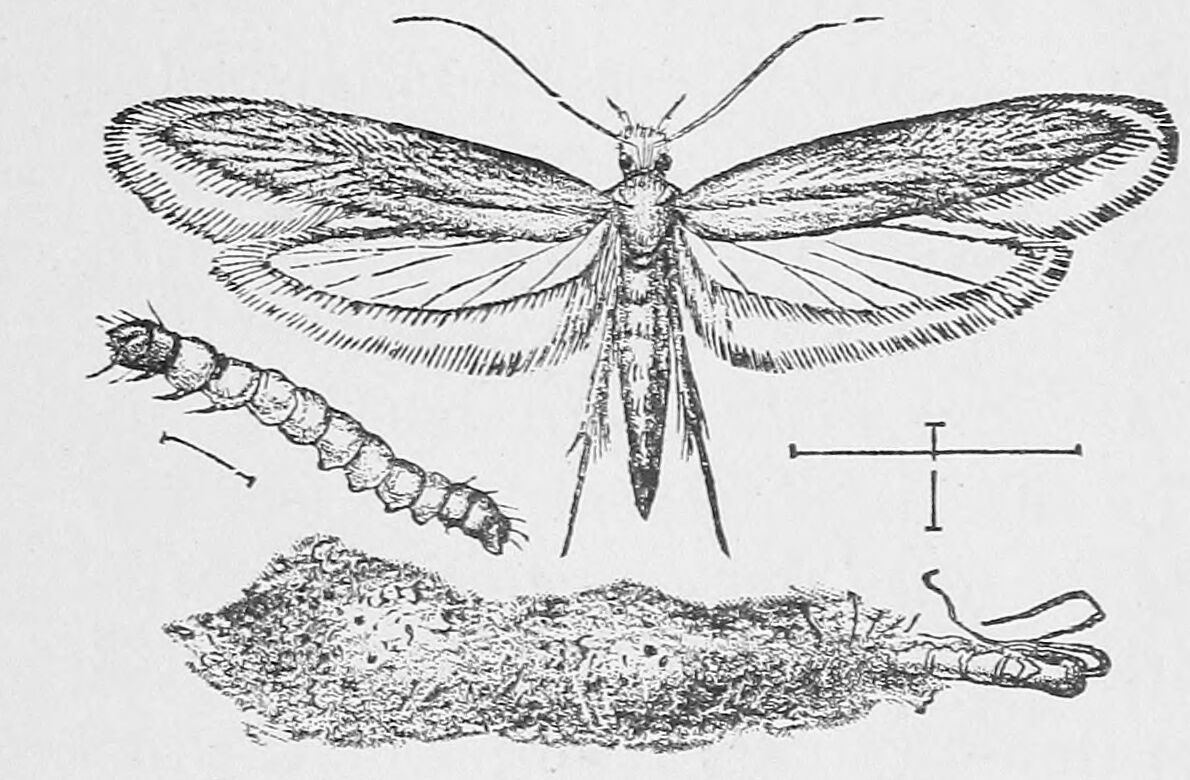
UC IPM describes both adults as about 1/4 inch (6 mm) long at rest, and both larvae as shiny white with a dark head. The webbing larva spins silk tubes over the cloth; the casemaking larva carries a portable silk case that takes the color of what it eats.
Their food is keratin, the tough protein of wool, hair, fur and feathers. A 2021 study of the webbing moth's gut notes that the larvae's growth on keratin-rich food depends on B vitamins and sterols, which is why they usually feed on materials soiled with dirt and sweat (Schwabe et al., 2021). English Heritage adds that larvae also attack silk, particularly when stained with sweat, while clean cotton is not normally attacked.
The other condition is stillness. An Oregon State University Extension guide says clothing worn two or three times a week is rarely damaged, as Marlatt observed in 1908. The danger is the coat left unworn from March to November.
How do you tell moth damage from carpet beetle damage?
Look for silk. Clothes moth larvae leave webbing, feeding tubes or cases; carpet beetle larvae leave none, but shed bristly brown skins. Moth holes tend to be small and scattered, while carpet beetles more often eat out one area. Both leave frass, tiny pellets of excrement.
Carpet beetle larvae ("woolly bears") eat the same woolens. UC IPM's carpet beetle note gives the distinctions below, and warns that damage alone does not always reveal the culprit. Where to look matters too: English Heritage's clothes moth guideline points to creases, collars, lapels, pockets, trouser turn-ups and anything folded.
| Clue | Clothes moth larvae | Carpet beetle larvae |
|---|---|---|
| Silk | Webbing, tubes, or portable cases | None |
| Shed skins | Look for silk instead | Brown, bristly cast skins, often the first sign |
| Holes | Small, scattered over the garment | More often concentrated in one area |
| Larva | Shiny white, dark head, up to about 1/2 inch (11 mm) | Short, hairy, banded; wanders between objects |
| Frass | Granular pellets, often the color of the fiber eaten | Pellets about the size of a grain of salt |
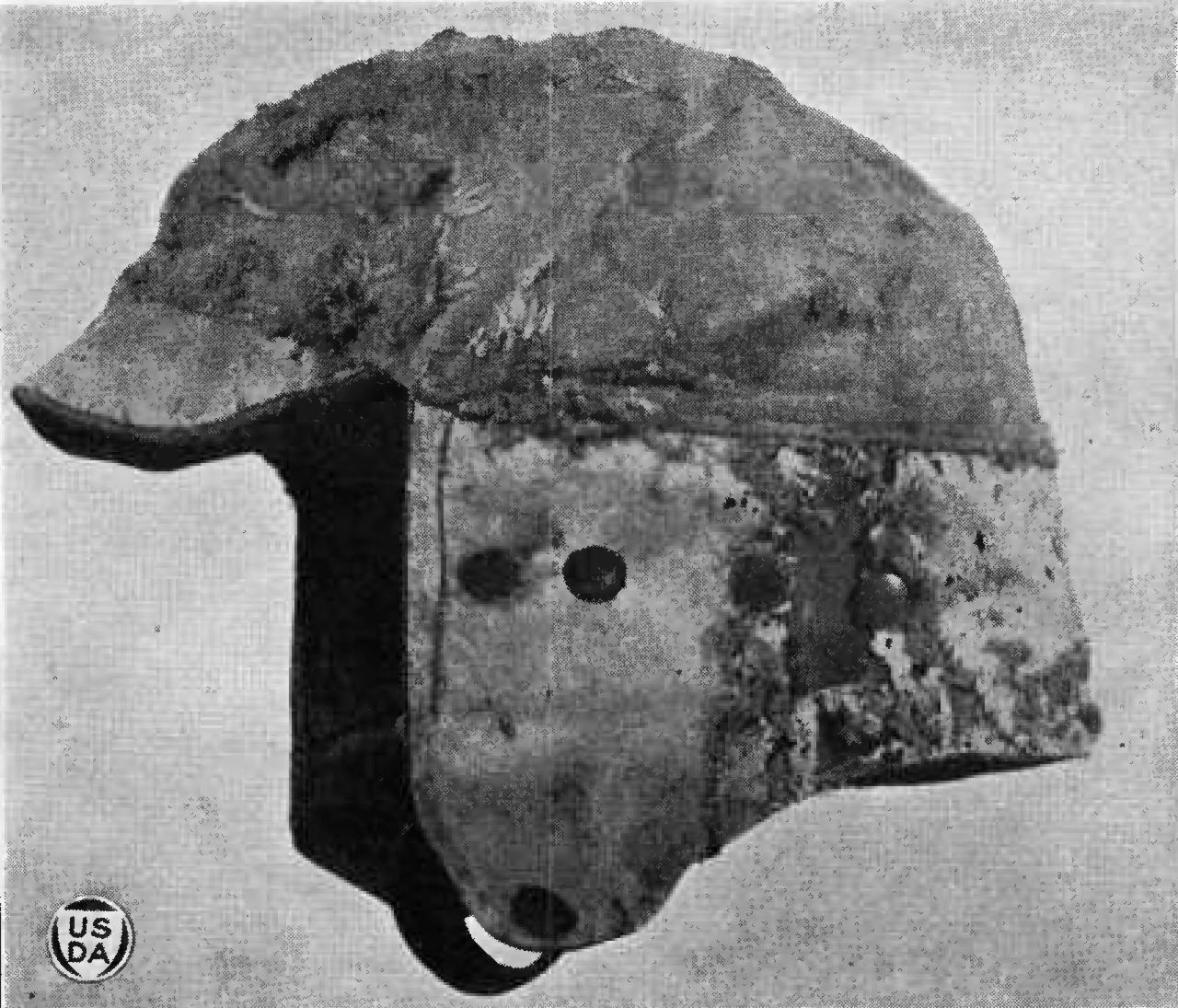
Sarah Gordon, a conservation technician at the Art Institute of Chicago, writes that frass is often the color of the fiber eaten, because larvae digest the nutritious part and excrete the rest, dyes included, which sets it apart from dust. On napped cloth, larvae often graze the surface: a 1923 USDA bulletin shows a heavy cloth with its nap eaten down to the warp beside a larva's silk tube.
What should you do first?
Contain before you treat. Museums practice integrated pest management: find the source, isolate it, kill the insects in the affected pieces only, then monitor and fix what let them in. At home that is five steps.
The Canadian Conservation Institute's (CCI) note on low-temperature control begins with inspection and with bagging infested items before moving them. English Heritage's freezing guidelines, by Dee Lauder and David Pinniger, add a point that runs against instinct: do not clean infested items before freezing. Bag, freeze, then clean, so you do not spread eggs and larvae.
| Step | What to do | Why |
|---|---|---|
| 1. Inspect | Lay out every wool, fur, feather and silk piece in good light. Check collars, cuffs, seams, folds, pockets and the bottoms of stacks. | Larvae hide in dark, undisturbed creases. |
| 2. Isolate | Seal each infested piece in a polyethylene bag where you find it. | Stops eggs and larvae spreading to clean wool. |
| 3. Clean or freeze | Freeze the sealed bags, or wash or dry-clean what the label allows. Vacuum the closet, drawers and carpet edges; empty the vacuum promptly. | Kills all stages in the cloth and removes food in the dust. |
| 4. Monitor | Set pheromone traps near the wool and check them monthly. Watch treated pieces for a few weeks. | Shows whether adults are still emerging. |
| 5. Store | Store only clean wool, in sealed bags or lidded boxes, and check it on a schedule. | Moths cannot lay eggs on what they cannot reach. |
Look beyond the closet: English Heritage names wool carpets under furniture, wool- or horsehair-stuffed upholstery, feather cushions, and old bird nests in chimneys and eaves.
How do you kill clothes moths by freezing?
Seal the item in a polyethylene bag, put it in a freezer that holds −18 °C (0 °F) or colder, and leave it for one to two weeks; colder freezers need less time. Then let the bag warm to room temperature for at least 24 hours before opening it, so condensation forms on the plastic, not the wool.
Freezing uses no chemicals. The National Park Service's Conserve O Gram 3/6 explains that the webbing clothes moth is freeze-sensitive. The sources agree on the principle and differ on the numbers.
| Source | Temperature | Time | Notes |
|---|---|---|---|
| CCI Notes 3/3 (Thomas Strang) | −20 °C (−4 °F) or colder | At least one week | As cold, fast and long as possible; nothing gained below −40 °C |
| English Heritage freezing guidelines (2019) | −18 to −20 °C (0 to −4 °F) | 14 days | Or 3 days at −30 °C (−22 °F) |
| English Heritage clothes moth guideline | −18 °C (0 °F) | At least two weeks | Written for households |
| NPS Conserve O Gram 3/6 (1994) | −20 °C (−4 °F) minimum | Two cycles of at least 48 hours, 24 hours' warming between | Cites 6 to 10 days at −20 °C from the literature |
| UC IPM Pest Notes 7435 (2013) | Below 18 °F (about −8 °C) | Several days | The warmest figure here |
Our reading: two weeks at −18 °C satisfies every source above, and one week is enough if your freezer reliably holds −20 °C. We would not rely on the warmest figure. USDA experiments reported in 1908 and 1923 found that larvae survived a steady 18 °F for a long time; the swing from cold to warmer and back killed them, an idea that survives in the Park Service's two cycles. CCI and the Park Service both advise a thermometer in the freezer.
Bagging. Use clear polyethylene, well sealed. English Heritage wraps items in acid-free tissue first and pads metal buttons and zips against condensation. On air, the sources split: the Park Service says to evacuate as much as possible, while CCI says reducing it is usually unnecessary, overly tight bags can damage fragile objects, and you should never suck air out with a straw. For a sweater, pressing out loose air by hand satisfies both.
Loading. Lay pieces flat rather than rolled; CCI notes that halving an object's thickness cuts its cooling time to a quarter. The Park Service and English Heritage say not to use a frost-free freezer, whose warming cycles undermine the treatment, though the Park Service allows one in an emergency. CCI relies on the sealed bag to protect objects from defrost-cycle humidity.
Afterwards. Leave the bags closed at room temperature for at least 24 hours (English Heritage says 48 for dense items), then brush or vacuum away dead larvae, frass and webbing. CCI adds that wool kept somewhere cold should spend about a month at room temperature before freezing, so the insects lose their cold protection, and that treated items should be watched for three weeks or more for anything hatching. If live insects appear, freeze again.
What not to freeze. The Park Service limits freezing to dry objects made entirely of textile, leather, wood and paper, and excludes wet or unstable pieces and composites with glass, ceramic or metal. A beaded jacket or a fragile heirloom is a question for a conservator.
Can washing, dry cleaning or heat do the job instead?
Yes, for pieces that can take it. UC IPM calls laundering washable items for 20 to 30 minutes in water of at least 120 °F (49 °C) the most effective method, and says dry cleaning may be the only option for many woolens. The catch: hot water and agitation are what shrink and felt wool.
Wool fibers carry overlapping scales, and a 2019 review by Mohammad Hassan and Christopher Carr (Journal of Advanced Research) explains that these make wool garments felt and shrink in the wash, sometimes until they are unusable. (our guide to steeking explains that grip). So the care label decides, and for a good sweater the freezer is the safer tool.
Heat kills larvae fast: E. A. Back's 1923 USDA bulletin reported deaths in 6 minutes at 128 °F (53 °C) and praised "the old-time custom of sunning clothing." UC IPM still suggests sunning and brushing woolens. For rugs, carpets and upholstery, English Heritage points to a commercial freezer or a controlled heat process.
Do pheromone traps get rid of clothes moths?
No. Pheromone traps catch only adult males, drawn by a lure that imitates the female's sex pheromone, so they do nothing about larvae in the cloth. Museums use them to detect moths and find where they come from. A full trap is a warning, not a cure.
English Heritage's guideline is explicit: the lures attract only male moths, so traps will not control an infestation. UC IPM is slightly more generous, noting that trapped males cannot mate, but pairs traps with cleaning or laundering. CCI's note on preventing infestations values them for catching the first adults to emerge.
A 2013 V&A blog post describes gallery lures checked monthly. At home, if a trap keeps catching moths after everything has been treated, something infested is still hiding. English Heritage notes two moth generations a year in heated buildings.
Do cedar, lavender and mothballs work?
Scents are weak and short-lived: at best they discourage adults, and they do nothing to larvae already in the cloth. Mothballs do kill moths, but only in airtight containers, and their vapors are toxic. Neither replaces cleaning, inspection and sealed storage.
The skepticism is old. Marlatt wrote in 1908 that repellents such as camphor, naphthalene and cedar had "a certain value" only if the garments were not already stocked with eggs or larvae. A 1936 USDA press release was headed "Mere odors do not faze clothes moths."
Cedar. The sources disagree. Back's 1923 bulletin, citing a USDA study, said red cedar heartwood kills newly hatched larvae but not older ones, eggs or adults. UC IPM says much the same, adding that the effect fades after several years and a tight chest matters more than the wood. Oregon State says cedar chips or balls "do nothing to repel clothes moths," and English Heritage gives cedar balls three months at most. Our storage guide adds that wood releases acids, so line a chest before fine textiles go in.
Lavender. English Heritage lists dried lavender with cedar balls as safer repellents for adult moths, to be replaced every three months at most, with no effect on larvae inside clothes. We found no source that credits it with more.
Mothballs. They contain naphthalene or paradichlorobenzene, solids that slowly turn into a toxic gas. The National Pesticide Information Center says labels typically require a tightly closed container. Its naphthalene fact sheet warns that smelling mothballs means inhaling the pesticide, that heavy exposure can cause hemolytic anemia, that infants have become anemic from clothing stored with mothballs and not washed, and that the EPA classifies naphthalene as a possible human carcinogen. English Heritage says many old formulations are now banned or not recommended, yet Back's 1923 bulletin had called both chemicals "very safe."
How should you store wool so moths never come back?
Clean, sealed and checked. Store wool only after washing or dry cleaning it, in sealed bags or lidded boxes, somewhere dry. Then open the boxes and look a few times a year, because sealed storage is only as good as the last inspection.
English Heritage recommends plastic bags, preferably vacuum-sealed, or boxes with lids, and for full protection cleaning, bagging and freezing woolens before summer. Oregon State gives the same order.
Seals fail. CCI warns that larvae can chew through heavy polyethylene, usually at the bottom or along seams, so check there. It also says bagged material carries no mold risk if it was dry (below 65% relative humidity) when sealed and does not sit on a cold floor in a warm room. For what should touch the cloth, see our guide to storing a quilt or vintage garment.
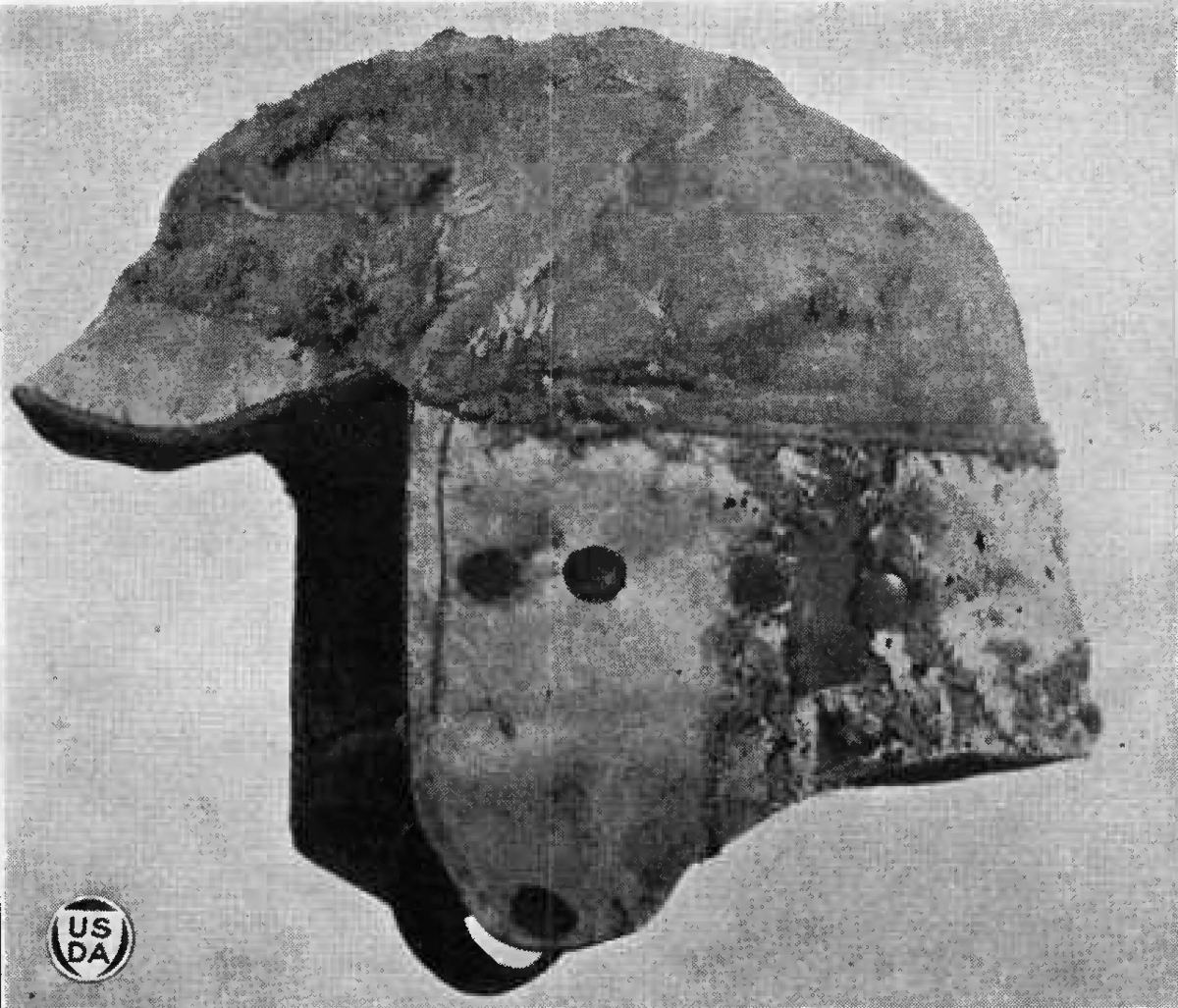
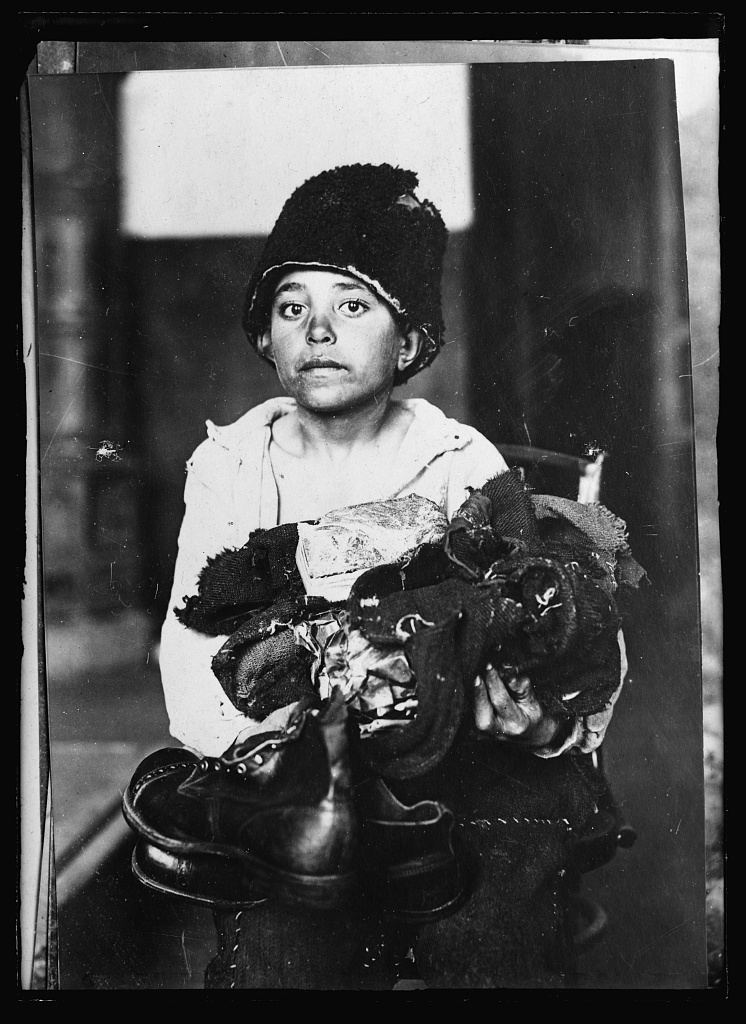
Moths have shaped what survives. As our Find on why so few old clothes survive reports, wool was the everyday fabric of the 17th to 19th centuries yet is scarce in museums, probably in part because of moth damage. Everyday wardrobes suffered too: in 1919 an American Red Cross caption card described a refugee boy's hat "that the moths wouldn't let alone."
Further reading
The freezing guidance comes from CCI Notes 3/3, English Heritage and the Park Service, all linked above. The historical USDA bulletins are on the Internet Archive: Marlatt's The True Clothes Moths (1908) and Back's Clothes Moths and Their Control (1923). For a valuable or fragile piece, the American Institute for Conservation lists professional textile conservators.
Sources
- Controlling Insect Pests with Low Temperature (CCI Notes 3/3). Canadian Conservation Institute (Thomas J. K. Strang), 1997, web page 2019. Page read via fetch tool (curl to canada.ca times out from this session): −20 °C for at least one week; −30 to −40 °C most effective; no benefit below −40 °C; thickness and cooling time; bagging; air reduction usually unnecessary, no straw; preconditioning ~1 month; 1 day warming; 3-week watch; repeat cooling history 1890s–1930s; rubber/vinyl brittle; mold risk below 65% RH. Accessed November 11, 2026.
- Freezing guidelines for controlling an insect pest infestation. English Heritage (Dee Lauder and David Pinniger), May 2019. Full PDF text read: −18 to −20 °C for 14 days or −30 °C for 3 days; do not clean before freezing; acid-free tissue, extra tissue on metal parts; remove excess air; no auto-defrost freezers; 24 h (dense 48 h) before unwrapping; clean afterwards. Accessed November 11, 2026.
- Conserve O Gram 3/6: An Insect Pest Control Procedure: The Freezing Process. National Park Service (Toby Raphael), July 1994. Full PDF text read: two 48-hour cycles at −20 °C minimum; 6–10 days from Strang 1992; freeze-sensitive moth; evacuate air; no frost-free (emergency OK); 24 h warming; list of objects never to freeze; dry textile/leather/wood/paper only. Accessed November 11, 2026.
- Clothes moths: prevention and control. English Heritage. Full PDF text read: pheromone traps attract males only and will not control; where damage hides; soiled textiles preferred; storage in bags/boxes; −18 °C at least two weeks; lavender and cedar balls repel adults, ≤3 months, no effect on larvae; old mothball formulations banned or not recommended; commercial freezer or controlled heat for large items; bird nests. Accessed November 11, 2026.
- Pest fact sheets 4 (Webbing clothes moth), 5 (Case-bearing clothes moth) and 1 (Varied carpet beetle). English Heritage (David Pinniger). All three PDFs read in full (sheet 5: …/case-bearing_clothes_moth_-_fact_sheet_5.pdf; sheet 1: …/varied_carpet_beetle_-_fact_sheet_1.pdf): silk attacked when sweat-stained, clean cotton not normally; generations in heated buildings; woolly bears, cast skins, frass, wandering larvae. Accessed November 11, 2026.
- Webbing Clothes Moth and Casemaking Clothes Moth fact sheets. MuseumPests.net, 2016 and 2019. Both PDFs read in full: adults lack functional chewing mouthparts; larvae to 11 mm; 40–50 eggs; larval stage 35 days to 2 years; stains attract; cotton/synthetics damaged only next to wool; not attracted to light. Accessed November 11, 2026.
- Pest Notes: Clothes Moths (Publication 7435). UC IPM, University of California (D. H. Choe), updated March 2013. Page read via fetch tool: species, sizes, larvae, laundering 20–30 min at ≥120 °F, dry cleaning, freezing below 18 °F several days, pheromone traps (males, some control), cedar kills small larvae only and fades, 1,4-dichlorobenzene cautions, sun and brushing. Accessed November 11, 2026.
- Pest Notes: Carpet Beetles (Publication 7436). UC IPM, University of California (D. H. Choe), updated April 2020. Page read via fetch tool: cast skins and no webbing, concentrated damage vs scattered moth holes, pellets the size of a grain of salt, damage alone not always diagnostic. Accessed November 11, 2026.
- Mothballs: Proper use and alternative controls for clothes moths (PNW 606). Oregon State University Extension (Dave Stone and Tim Stock), 2008, reviewed 2026. Full page read: clothing worn 2–3 times a week rarely damaged; IPM; mothballs only airtight, never open closet; cedar chips or balls do nothing to repel; clean then airtight containers. Accessed November 11, 2026.
- Naphthalene General Fact Sheet; Regulation, Proper Uses, and Alternatives of Mothballs. National Pesticide Information Center (Oregon State University and U.S. EPA), updated 2025. Both pages read in full (regulation page: https://www.npic.orst.edu/ingred/ptype/mothball/regulation.html): smelling = inhaling; hemolytic anemia; infants and unwashed stored clothing; IARC/EPA possible carcinogen; candy-like risk; tightly closed containers. Accessed November 11, 2026.
- Next-Generation Sequencing Analysis of the Tineola bisselliella Larval Gut Transcriptome Reveals Candidate Enzymes for Keratin Digestion. Schwabe et al., Genes 12(8):1113, 2021. Introduction read in full text (Europe PMC XML): adults do not feed; keratin digestion; growth depends on B vitamins and sterols, hence soiled materials. Accessed November 11, 2026.
- A review of the sustainable methods in imparting shrink resistance to wool fabrics. Hassan and Carr, Journal of Advanced Research 18, 2019. Full text read (Europe PMC XML, PMC6369147): scales responsible for felting shrinkage; garments can become unusable; wool is a keratin fiber. Accessed November 11, 2026.
- Moth Seeks Wool: A Tale of Desire, Pheromones, and All That Frass. Sarah Gordon, Art Institute of Chicago. Full text read via AIC public API (api.artic.edu/api/v1/articles/798; the page blocks the fetch tool): IPM, frass colored like the fiber, pheromone lures added to monthly glue-trap monitoring, freezing. Accessed November 11, 2026.
- Unwelcome flying visitors to the Museum. Victoria and Albert Museum blog (James Sutton), 16 July 2013. Page read via fetch tool: gallery lures emitting female pheromone, checked monthly; low-temperature treatment. Accessed November 11, 2026.
- Preventing Infestations: Control Strategies and Detection Methods (CCI Notes 3/1). Canadian Conservation Institute (Thomas J. K. Strang). Page read via fetch tool: pheromone traps detect first emergence; polyethylene chewed at bottom and seams; quarantine; five stages. Accessed November 11, 2026.
- The True Clothes Moths (Circular 36, second series, revised). C. L. Marlatt, USDA Bureau of Entomology, issued 15 January 1908. Full OCR text read and pages viewed: rudimentary mouthparts, attracted to lamps, articles in daily use not affected, repellents "a certain value" only without eggs/larvae, cedar odor fades, Howard's sealed boxes, Read's 18 °F experiments. Accessed November 11, 2026.
- Clothes Moths and Their Control (Farmers' Bulletin 1353). E. A. Back, USDA, July 1923. Full OCR text read and figures viewed: figs. 5 and 12; 18 °F survival and temperature swings; cedar heartwood kills only young larvae (citing Back and Rabak 1922); heat 6 min at 128 °F, 31 min at 110 °F; "old-time custom of sunning"; naphthalene and PDB "very safe"; carbon tetrachloride trunk fumigation. Accessed November 11, 2026.
- Mere Odors Do Not Faze Clothes Moths (press release no. 70). USDA, 15 June 1936. Full OCR text read (one page). Accessed November 11, 2026.
- The War, the Moths, and Michael (photograph, caption card). American National Red Cross photograph collection, Library of Congress, LC-DIG-anrc-04862. Record read via loc.gov JSON: caption card text, date received 4 December 1919, "No known restrictions on publication." Accessed November 11, 2026.
Glossary
Last updated · Markdown · Report an error