Knitting
Steeking: Why Knitters Cut Their Own Work
Steeking means cutting a knitted tube open on purpose. Why it works, how to secure the cut, which wools to trust, and what the history does and does not tell us.
Steeking means knitting a garment as a closed tube and cutting the openings afterward. The knitter adds a strip of extra stitches, called a steek, wherever an armhole, neckline or cardigan front will go, finishes the tube, then cuts straight up the middle of the strip. The cut does not run because wool fibers grip one another and the edge is usually secured first, by crochet, machine stitching or hand sewing. With the right wool, some knitters skip that step.
What is steeking, and why would you cut your own knitting?
The steek is the spare strip of fabric the cut edge is finished against: it is cast on where an armhole, neckline or cardigan front will be, and cut open once the tube is finished.
The reason is mostly comfort. Hazel Tindall, who designs Shetland and Fair Isle patterns, writes that steeks let you knit in the round and so avoid purling, which in Fair Isle work means the right side always faces the knitter and the pattern is easy to watch taking shape. Quince & Co. puts the same point from the other side: steeking avoids working stranded colorwork flat, back and forth. Knit Picks adds that working in the round leaves fewer yarn ends to weave in from color changes.
Steek widths vary: the tutorials I read use six, about eight, or seven to nine stitches, while Mary Jane Mucklestone's Sólbein cardigan uses two, and she says Icelandic knitters will often use a single purl stitch. The wider the strip, the more fabric there is to hold the edge.
Does a cut steek really not unravel?
Mostly it does not, but the reason is friction, not magic. A knitted fabric is a chain of interlocking loops, and cutting one frees the yarn to run if it can slide. Wool resists that because its fibers grip each other, and a secured edge holds the cut ends. Every maker I read who cuts with confidence either reinforces the steek first or relies on one particular wool.
The grip has a known cause. A paper on shrink-resist treatments by Mohammad Hassan and Christopher Carr (2019) explains that wool's surface scales let fibers move in only one direction: the scale edge of one fiber locks into the gap between scales on another, which is why wool felts and shrinks under moisture, heat and agitation. Steekers lean on the same property, though that link is the knitters' reasoning, not the paper's. Knit Picks says non-superwash wool knit at a fine gauge in stranded colorwork will felt together along a cut edge, and that traditional steeked sweaters used "sticky," not especially soft wool so the strands cling to each other.
How far can you trust that? Kate Davies, who prefers crochet reinforcement, says the chain seems to grab the cut edges and tuck them away, leaving no raw edges. At the other end, Tindall says that with Shetland wool there is no need to secure the steek before cutting. Meg Swansen of Schoolhouse Press, in a 2017 reply on her blog, says that if you change colors inside a steek and leave the yarn ends, a crocheted steek will not work properly and you must machine-stitch instead, unless you trust the felting property of 100% pure Shetland wool enough to cut with no preparation. She adds a joke about needing Great Purity of Thought. Knit Picks suggests alternating the two colors on every steek stitch, which it says helps keep the strip from unraveling.
An unreinforced cut is a bet on your yarn; a reinforced one is a much safer bet.
How do you secure a steek?
There are four common ways: a crocheted chain on each side of the cut, a line or two of machine stitching, hand sewing, and needle felting. Some knitters use none, but only with a yarn they trust.
| Method | How it works | Strength | Trade-off | Read in |
|---|---|---|---|---|
| Crochet chain | A slip or single crochet chain runs up each side of the cut, catching the legs of two adjacent stitches | Neat, flexible, and the chain grabs the cut edge | Adds bulk; edges can wave; needs a thin, strong yarn and a smaller hook | Davies 2012; Quince & Co. 2016; Mucklestone in Templer 2018 |
| Machine stitching | One or two lines of straight or zigzag stitches on each side, then cut between them | Locks every strand without extra bulk; what Mucklestone says is most often seen in Iceland | Needs a sewing machine; test a swatch first, especially on slippery yarn | Mucklestone in Templer 2018; Swansen 2017; a comment on Tin Can Knits |
| Hand sewing | A running stitch, then a backstitch back down, one stitch either side of the cut, catching the floats | No special tools; a ribbon can be sewn over the edge afterward | Slow, and takes care to look neat | Knit Picks 2009; Mucklestone in Templer 2018 |
| Needle felting | A felting needle meshes the fibers of the strip before it is cut | No crochet or machine work; Swansen reports it felted well in three wools | Slightly thicker facing; best shown on wool that felts | Swansen 2018 |
Two practical details recur. Crochet adds bulk, so Mucklestone suggests a finer yarn in a color that blends with the garment, and Davies uses a hook a size or two smaller than her knitting needle with a strong sock yarn. Davies writes her chain as "double (American single) crochet," so check which crochet terms a tutorial uses before you copy it.
On needle felting, Swansen says Gretchen Funk taught the method and credits Alice Adams of Duluth. She finished three sweaters in Shetland Jumperweight, Unspun Icelandic and Canadian Regal wools, and in all three the steeks felted well. The method is recent. One commenter on Swansen's post reports it also worked on washable wool and cotton, but that is a single report.
On superwash, one tester on Make magazine's blog in 2011 found blanket stitch felt more secure than crochet when picking up placket stitches, but that was a single judgment by feel, without washing.
Which wools can you trust to steek?
Non-superwash wool with some grip is the safe choice, and Shetland is the traditional one. Superwash needs reinforcement and a swatch. Cotton and acrylic are poor candidates, because they do not mesh the way wool does. Gauge matters too: Knit Picks and Mucklestone both advise reinforcing when the knitting is looser than traditional colorwork.
| Yarn | What sources report | Reinforce? | Read in |
|---|---|---|---|
| Shetland, non-superwash | The traditional steeking wool; Tindall cuts it without securing; Swansen ties unprepared cutting to pure Shetland | Optional for experienced knitters; safest if secured | Tindall 2015; Swansen 2017 |
| Other woolly, non-superwash (for example tweed) | Berroco's Emily O'Neil used a tweed yarn and writes that it works well for steeks because its woolly stitches stay in place; edges rolled in slightly after cutting | Yes (crochet used) | O'Neil 2016 |
| Soft, lofty wools | TECHknitting says soft wools are more delicate than long-fiber, rustic wools, and rates grabbiness by brand | Yes, and handle the cut edge gently | TECHknitter 2013 |
| Unspun Icelandic or Léttlopi | Swansen's steeks felted well; Mucklestone advises reinforcing at Léttlopi's loose gauge | Yes at loose gauge | Swansen 2018; Templer 2018 |
| Superwash wool | Quince & Co. does not recommend it; Knit Picks says it needs reinforcement; Tin Can Knits reports crochet-reinforced superwash steeks went fine, with a tight chain | Always | Quince & Co. 2016; Knit Picks 2009; Tin Can Knits 2014 |
| Cotton, acrylic and other non-wool | Described as unsuitable because the fibers do not mesh | Not advised | Quince & Co. 2016; Tin Can Knits comments |
Why is superwash different? Hassan and Carr describe chlorine treatment followed by a resin coating as the most widely used way to make wool machine washable, and estimate that about 70% of fully machine-washable wool is treated this way. It stops the scales catching one another, which is the opposite of what a steek needs. Their paper does not test steeks, so the knitting advice rests on makers' experience.
What makes Shetland wool special here? The Shetland Sheep Society describes the fleece as fine and crimped, says the fiber felts well, and lists Fair Isle knitwear among its uses. The Defra specification for protected Native Shetland Wool says the staple combines long guard hairs with very fine lower hairs. For help with weight and fiber on a label, see Reading a Yarn Label.
Whatever the yarn, knit a swatch with a steek and cut it. Tin Can Knits recommends this if you are worried about a yarn, and it costs an evening.
How do you cut and finish the edge?
Use sharp scissors and cut up the center of the middle steek stitch, working slowly and checking for stray strands of stranded yarn. Then cover the raw edge: pick up stitches along it and knit a band, or fold the edge to the inside and sew it down.
Quince & Co. describes cutting through the center of the middle stitch from the cast-on edge to the bind-off, then folding the crochet chain so it sits between two stitch legs and picking up through both legs together. Tin Can Knits suggests working the button bands before cutting, which it says is a little tidier and puts less stress on the cut stitches. Berroco's design team advises picking up one stitch in from the crochet chain and trimming the frayed edges from the wrong side.
Stitches may roll in a little after cutting. A reader on the Berroco post found her single crochet steek waved too much; the design team suggested a thinner crochet yarn and noted that button bands or other edgings can reduce it. Quince & Co. says loose ends can be whip-stitched to the wrong side or hidden behind a ribbon.
Tindall's approach for Shetland wool is the opposite of heavy finishing. With no securing step, she picks up from the adjacent steek and body stitches with a thin needle, one stitch per round followed by a decrease round, and says the steek curls to the back at the right place. She calls this the neatest method.
Where did steeking come from?
No source I could open dates the first steek. The word is old Scots, the technique is tied to Fair Isle and Shetland knitting by most makers, and Norwegian knitters are often named as users of cut-open sweaters.
The word first. Jamieson's Scottish dictionary of 1808 glosses "steek" and "steik" as to shut or close, so it was a plain Scots verb before it was a knitting term. The sources I read do not say when knitters began using it for the strip they cut.
Fair Isle itself is younger than its legend. A 2026 lecture abstract by Helen Wyld of National Museums Scotland says early Fair Isle examples are rare, documentary evidence is scarce, and much writing concentrates on twentieth-century fashion. The museum's collection includes groups of objects dated to the 1850s, 1870s and 1880s, and Wyld traces the craft's mythology to its first public appearance at the Great Exhibition of 1851. The Victoria and Albert Museum says early Fair Isle knitters made stockings, caps and scarves, and that sweaters in the Fair Isle style "as it's known today" were not produced until the First World War. It describes the Armada shipwreck story as a legend and notes evidence of Scandinavian influence. Deborah Pulliam's 2004 conference paper, known to me only by its abstract, argues the patterning came from northern and eastern Europe rather than the western Mediterranean. The 1920s vogue came partly, the V&A says, from the Prince of Wales, who wore a Fair Isle sweater for golf. If the V&A is right about the First World War, a steeked Fair Isle sweater cannot be much older, but I found no record of the first one.
What about Norway? Swansen writes that before steeks, Schoolhouse Press's own sweaters without yokes were knitted entirely in the round, with armholes, necks and cardigan fronts machine-stitched and cut open "in the classic Norwegian manner." That is a teacher describing a method she and her circle used and naming where it came from. It is not a museum record of Norwegian practice, and the Norwegian reference sources I read do not describe cutting. Store norske leksikon says the Setesdal lusekofte began around 1840 as a pullover, that jackets open all the way down the front were not part of traditional Setesdal dress and were launched in the 1920s, and that many old jackets were machine-knitted. It does not say how the front openings were made. Nothing I read ties Selbu's famous patterns to cutting.
The English-language print history is clearer, because Swansen traces it. Sarah Don's 1979 book described a wrapped method for cutting openings but never used the word steek. Sheila McGregor's 1981 book on Fair Isle knitting introduced the word to this literature, though Swansen calls its details sparse. Elizabeth Zimmermann used a version of the wrapped method in three vests published in March 1981, and Michael Pearson's 1984 book still lacked specifics. Alice Starmore's website describes her 1988 book as the first time instructions for stranded knitting with steeks appeared in print, which fits an account in which earlier descriptions were thin.
The crochet reinforcement that most current patterns assume is newer still. In Swansen's account, a Knitting Camper developed the method of replacing machine stitching with single crochet on each side of the cut, in a year she cannot place. Amy Detjen then simplified it to a flat chain, and Janine Bajus and Katherine Misegades added refinements. I could not open Starmore's, McGregor's or Zimmermann's books, which are only on loan, so this paragraph relies on Swansen and Starmore's own site.
Where can you see Fair Isle knitwear?
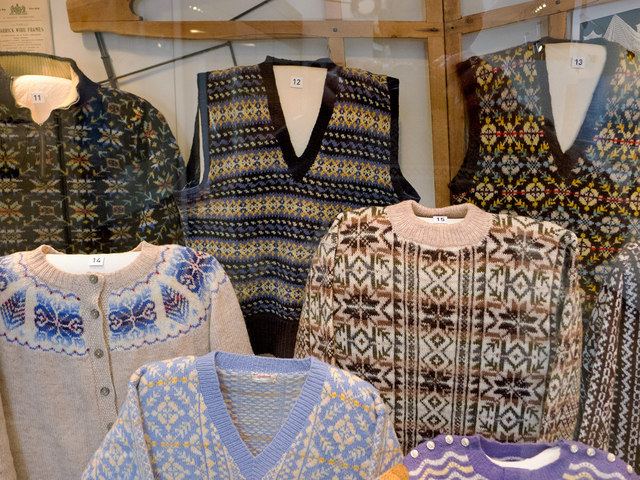
The Shetland Museum and Archives in Lerwick has displays of Shetland knitting on its top floor, as the photograph at the top shows. National Museums Scotland holds the Fair Isle collection Wyld discusses, and the V&A in London has a Shetland golf jumper of the 1920s (T.185-1982). For technique, start with the tutorials by Kate Davies, Quince & Co. and Tin Can Knits, and Meg Swansen's posts at Schoolhouse Press.
Sources
- Blog #10: Meg Swansen on Securing and Cutting Steeks (1 Mar 2017), with Swansen's reply comment. Schoolhouse Press. Full page and comments read: history of steek in English-language books, Norwegian method, crochet steek, color changes, pure Shetland comment Accessed November 1, 2026.
- Blog #22: Meg Swansen on the Surprise Pattern and Steeks (13 Dec 2018). Schoolhouse Press. Full page read: needle-felted steeks in Shetland Jumperweight, Unspun Icelandic, Canadian Regal Accessed November 1, 2026.
- Techniques: Steeking (Leila Raabe, 8 Dec 2016). Quince & Co.. Full page read: crochet method, cutting, wool and superwash advice Accessed November 1, 2026.
- Steeks (Hazel Tindall, 28 Jul 2015). Hazel Tindall. Full page read: purpose of steeks in Fair Isle, Shetland wool needs no securing, hand pick-up Accessed November 1, 2026.
- steeks 2: reinforcing and cutting (Kate Davies, 29 Apr 2012). Kate Davies Designs. Full page read: crochet reinforcement, hook size, yarn Accessed November 1, 2026.
- Steekalong prep: more than one way to knit a steek (Karen Templer, 21 Dec 2018), interview with Mary Jane Mucklestone. KT's Slow Closet. Full page read: machine, crochet and hand-sewn steeks, Icelandic practice, Sólbein Accessed November 1, 2026.
- Steeking tutorial (Knit Picks, 30 Nov 2009). Knit Picks. Full page read: hand-sewn reinforcement, alternating colors, felting, superwash Accessed November 1, 2026.
- How to Steek (Alexa Ludeman, 18 Sep 2014) and comments. Tin Can Knits. Full page and comments read: crochet method, band before cutting, superwash, swatching Accessed November 1, 2026.
- Steeks BETA part 2 (TECHknitter, 6 Nov 2013). TECHknitting. Full page read: faced steek, wool grabbiness Accessed November 1, 2026.
- Emily Explains: Cutting the Steek! (Emily O'Neil, 24 Feb 2016). Berroco. Full page and comments read: six-stitch crochet steek, tweed yarn, band pick-up, waving Accessed November 1, 2026.
- Sally Cardigan KAL: the steek (testpirate, 20 May 2011). Make. Full page read: crochet vs blanket stitch on a superwash sample Accessed November 1, 2026.
- A review of the sustainable methods in imparting shrink resistance to wool fabrics (Hassan and Carr, 2019). Journal of Advanced Research 18:39-60. Read the first 100,000 of 147,000 characters: scale locking, chlorine-Hercosett, 70% estimate Accessed November 1, 2026.
- Shetland Wool. Shetland Sheep Society. Full page read: fiber, felting, uses Accessed November 1, 2026.
- Native Shetland Wool: PDO specification (Council Regulation (EC) 510/2006). UK Defra. PDF text read: staple of long guard hairs and very fine lower hairs Accessed November 1, 2026.
- Knitting traditions of the British Isles and Ireland. Victoria and Albert Museum. Full page read: Armada legend, Scandinavian influence, Fair Isle sweaters from WWI, 1920s vogue, T.185-1982 Accessed November 1, 2026.
- The Fair Isle knitting collection at National Museums Scotland: history, craft and identity (Helen Wyld, 2026). National Museums Scotland / Knitting History Forum. Abstract read Accessed November 1, 2026.
- Traveling Stitches: Origins of Fair Isle Knitting (Deborah Pulliam, 2004). Textile Society of America Symposium Proceedings. Abstract only; the full PDF refused automated access Accessed November 1, 2026.
- An Etymological Dictionary of the Scottish Language, vol. 2 (Jamieson, 1808), entries STEEK and STEIK. Internet Archive. Scan text read: steek and steik glossed to shut, to close Accessed November 1, 2026.
- Lusekofte (Barbro Tronhuus Storlien). Store norske leksikon. Full article read in Norwegian: pullover origin c. 1840, term first written 1921, front-opening jackets launched in the 1920s Accessed November 1, 2026.
- Strikkingens historie (Ingun Grimstad Klepp). Store norske leksikon. Full article read: no mention of cutting open knitted tubes Accessed November 1, 2026.
- Alice Starmore's Book of Fair Isle Knitting. Alice Starmore. Page read; the first-in-print claim is the author's own and is attributed as such Accessed November 1, 2026.
- Fair Isle knitwear in the Shetland Museum (Julian Paren, 9 Apr 2014). Geograph Britain and Ireland. Photo page read; CC BY-SA 2.0 Accessed November 1, 2026.
Glossary
Last updated · Markdown · Report an error