Circle Skirt Calculator
Work out a full, three-quarter, half or quarter circle skirt: waist and hem radius from your waist and length, cut radii with seam and hem allowances, panels, and the fabric it takes on your fabric width, with a to-scale cutting layout, in inches or centimeters. Everything runs in your browser and nothing is uploaded.
Skirt
Your waist measurement plus any ease you want. Decimals or fractions: 28, 28.5, 28 1/2.
From the waist seam to the finished hem, measured down the side.
Cutting
Pieces of equal angle. 1 full circle = one piece cut on fabric folded in four; 2 = two halves with two side seams.
Taken off the waist radius and added along both straight edges of each panel.
Added to the hem radius. A narrow rolled or machine hem needs little; leave extra if you level the hem after it hangs.
Selvage to selvage, minus the selvages you trim off.
Keeps every panel the same way up, so the alternating layouts are skipped.
How it is calculated
A circle skirt is a ring cut from flat cloth: the hole is the waist and the outer edge is the hem. Everything follows from one radius. The skirt type is the share of a full circle, f: 1 for a full circle, 0.75, 0.5 for a half circle, 0.25 for a quarter circle.
| Step | Formula | Example |
|---|---|---|
| Waist radius | r = waist / (2 x π x f) | 28 / 6.283 = 4.456 in |
| Hem radius | R = r + length | 4.456 + 22 = 26.456 in |
| Cut waist radius | r − seam allowance | 4.456 − 0.625 = 3.831 in |
| Cut hem radius | R + hem allowance | 26.456 + 1 = 27.456 in |
| Panel angle | 360° x f / panels | 360° in one piece, no side seams |
| Fabric | shortest layout that fits (below) | a square 2 x 27.456 = 54.913 in, so 1 5/8 yd |
| Hem circumference | 2 x π x R x f | 2 x π x 26.456 = 166.23 in |
In centimeters: a 70 cm waist gives r = 70 / 6.283 = 11.141 cm. With 60 cm of length, 1.5 cm seam allowance and 2 cm hem allowance, the cut radii are 9.641 and 73.141 cm, and the full circle needs a square of 146.28 cm, which fits 150 cm wide fabric.
Assumptions this calculator makes
- The waist you type is the seam line. Add any ease before you type it. The seam allowance is then cut away inside the waist curve, and the hem allowance added outside the hem line.
- Panels are equal slices. Each gets the seam allowance as a strip along both straight edges. A full circle in one piece has no straight edges, so no side seams.
- A short, fixed set of layouts. Panels in a grid with the panel center on the lengthwise grain, with one seam edge on the lengthwise grain, with the center on the crossgrain, or with one edge on the crossgrain; panels alternating up and down across the width; and panels on the crossgrain alternating from one selvage to the other down the length. The shortest one that fits is used and all of them are listed. This is not optimal nesting: a cutting-room marker can sometimes do better.
- Alternating layouts are only tried for panels of 180° or less, never for one-way fabric. The touching distance is computed on an outline drawn slightly outside the true arc, so it is never short.
- Nothing is scaled to fit. If no layout fits the width, the result says so and gives the smallest number of panels that would.
- Fabric is rounded up to the next 1/8 yd and the next 10 cm.
What this tool does not know
- How your fabric behaves on the bias. Parts of every circle hem are cut on the bias and drop; let the skirt hang before you level the hem.
- Waistbands, pockets, facings and plackets: cut those separately.
- Shrinkage, straightening the grain, or matching a print. Add extra length for those.
- Your body below the waist: the radius is set by the waist alone, so check the hip fits a quarter circle before you cut.
The arithmetic is checked by hand-worked unit tests, including the layouts.
Divide your waist by 2π for a full circle skirt, by π for a half circle, and by π/2 for a quarter circle. That gives the waist radius; add the skirt length to get the hem radius. A 70 cm waist makes a full circle with an 11.14 cm waist radius, and a 60 cm long skirt then needs a square of cloth about 146 cm on each side.
How do you calculate a circle skirt radius?
A circle skirt is a ring of cloth: the hole is the waist and the outer edge is the hem. The waist measurement is the circumference of the hole, so the waist radius is the waist divided by 2π, about 6.28. For a full circle, r = W / 2π; the hem radius is r plus the finished length.
Gretchen Hirsch's circle skirt for SewStylish, a Threads magazine special, puts it plainly: picture a doughnut, and divide the waist by 3.14 and by 2. She drafts a quarter circle and cuts the skirt in two pieces on the fold, from 2 to 2 1/2 yards of fabric.
With a 70 cm waist the arithmetic runs like this: 70 / 6.283 = 11.141 cm to the waist seam line. A 60 cm skirt adds 60 cm, so the finished hem lies 71.141 cm from the center. Draw both arcs from the same point; Hirsch pins a tape measure at the corner as a compass.
Add any ease before you divide: the calculator treats the waist you type as the seam line.
How do half and quarter circle skirts change the formula?
A half circle uses half a ring, so the same waist has to fit around half as much arc: the radius doubles. Divide the waist by π instead of 2π. A quarter circle uses a quarter of the ring, so divide by π/2, about 1.57. In general, r = W / (2π × f), where f is 1, 0.75, 0.5 or 0.25.
Hannah-Rose Smith's half-circle tutorial for Bernina writes the same rule as (2 × waist) ÷ 2π. Her worked example starts from a 58 cm waist, adds two 1.5 cm allowances for the center-back zip seam to make 61 cm, and arrives at a 19.42 cm radius before the waist allowance comes off. The calculator gives the same 19.417 cm for a 61 cm half circle.
Less circle means less flare. A full circle with a 71.14 cm hem radius has a hem 447 cm around; a quarter circle with the same 70 cm waist and 60 cm length has a 44.56 cm waist radius and a hem only about 164 cm around.
Where do the seam and hem allowances go?
The waist seam allowance goes inside the waist curve, so the cut waist radius is smaller than the seam-line radius: r minus the allowance. The hem allowance goes outside, so the cut hem radius is the hem radius plus the allowance. Side seams get the allowance along both straight edges of each panel.
This is the logic in both published drafts. Smith subtracts her 1 cm waist seam allowance from the radius: (2 × 61) ÷ 2π − 1 = 18.42 cm. Hirsch draws the waist on the seam line and then adds 5/8 inch to the waistline and the side seam. In the 70 cm example, a 1.5 cm allowance gives a cut waist radius of 11.141 − 1.5 = 9.641 cm, and a 2 cm hem allowance gives a cut hem radius of 71.141 + 2 = 73.141 cm.
Smith builds her zip-seam allowances into the waist measurement; the calculator adds them as strips along the straight edges instead. Do one, not both.
The hem allowance should be small. New Mexico State University's extension guide to hems gives 1/2 to 1 inch (1.3 to 2.5 cm) for flared or circular edges, against 2 to 3 inches for straight ones, and suggests easing the fullness of a curved hem with a line of stitching 1/4 inch from the cut edge.
Why does a circle skirt hem drop?
A circle cuts across every direction of the weave. Where the hem meets the lengthwise or crosswise grain, the cloth hardly stretches; halfway between, the hem is on the true bias, the 45-degree line between warp and weft, and the bias stretches under its own weight. On a full circle that happens at four points around the hem, and the edge comes out uneven.
The cure is time. Hirsch's last step is to let the skirt hang overnight so the bias portions can stretch out, then mark and sew a narrow hem. Marcy Harriell's faced-hem method in Threads no. 215 says the same: sew the skirt, leave the hem unfinished, let it hang overnight so the bias portions stretch and settle, then even the edge. The New Mexico State guide asks for 24 hours on a cushioned hanger before marking, especially when much of the garment is cut on the bias.
The hem allowance gives you the cloth to trim when you level it.
How much fabric does a circle skirt need?
A full circle in one piece needs a square twice the cut hem radius on each side, folded in four and cut as a quarter. If that square is wider than your fabric, cut the skirt in panels with side seams. Wider fabric, a shorter skirt or more panels solve it; nothing about the radius changes.
The 70 cm, 60 cm example needs 2 × 73.141 = 146.28 cm. On 150 cm fabric that is one square, 1.5 m. On 140 cm fabric the circle does not fit, and the calculator says so and asks for at least two panels. Two half circles, each with its straight edge along a selvage, fit at 74.64 cm wide; laid one after the other they take 292.56 cm. Set alternately against the left and the right selvage, so the curve of one sits beside the flat side of the next, they take 197.56 cm: just under 2 m.
Use the usable width, after the selvages come off, not the width printed on the bolt. A fabric with nap or a one-way print cannot have half its panels turned upside down, so the alternating layouts are out; tick one-way and the calculator skips them.
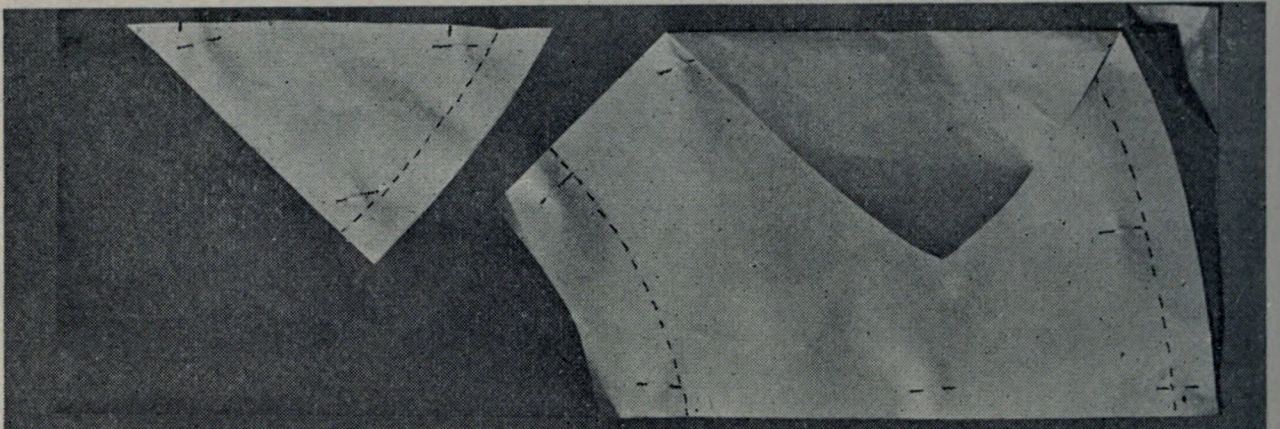
None of this is new. Laura I. Baldt's 1916 manual Clothing for Women shows a circular skirt pattern laid on cloth for cutting, and tells the reader, if the cloth is narrow, to piece it at the back. She also notes that material with an "up and down" takes more fabric than the same pattern on cloth without one.
What does the calculator assume?
It works from your waist seam line and finished length, cuts every panel as an equal slice of the circle, and adds side-seam allowances as strips along the straight edges. It tries six simple layouts, uses the shortest that fits, lists the others, and never scales the skirt to fit the fabric.
It is not optimal nesting, and waistbands, facings and pockets are cut separately. To bind a curved hem, the Bias Binding & Strip Planner works out the strips; for another way of putting a lot of cloth into a small waist, see cartridge pleating.
Sources and further reading
Gretchen Hirsch, "Festive Circle Skirts", SewStylish (Threads), Winter 2011, pp. 61–65: the radius formula, the quarter-circle draft and hanging overnight.
Hannah-Rose Smith, "How to Draft a Half Circle Skirt", Bernina: the half-circle formula and the 61 cm worked example.
Marcy Harriell, "Shortcut to a Faced Hem", Threads no. 215: letting the skirt hang before leveling.
Wendy Hamilton (rev.), "Making Perfect Garment Hems", Guide C-314, New Mexico State University, 2019: 24 hours before marking, narrow hems on circular edges.
Haley Glenn, "A Guide to Working on the Bias", Seamwork, 2014: the true bias and why it stretches.
Laura I. Baldt, Clothing for Women, J. B. Lippincott, 1916, on the Internet Archive: the circular skirt on the cloth, shown above.