Tablecloth & Table Runner Fabric Planner
Work out the fabric for a tablecloth or runner: finished and cut size from the table, drop and hem allowance, then the seam layout (full-width centre panel plus side panels) and yardage for rectangular, oval and round cloths, in inches or centimetres. Everything runs in your browser and nothing is uploaded.
Decimals or fractions: 84, 84.5, 84 1/2. Measure the tabletop, not the cloth you own.
Extra fabric beyond the finished edge, on every edge. A double-turned hem that finishes 1/2 in deep takes 1 in (two 1/2 in turns); 0 means a raw or serged edge.
Between the selvedges. If you cut the selvedges off, measure after that.
How it is calculated
This is plain arithmetic, written out so you can check it. The rules below are this planner's assumptions, not an industry standard: other makers lay out seams differently.
| Step | Formula | Example |
|---|---|---|
| Finished size | table size + 2 x drop (a runner: length + 2 x drop, width as typed) | 60 + 20 = 80 in; 84 + 20 = 104 in |
| Cut size | finished size + 2 x hem allowance | 80 + 2 = 82 in; 104 + 2 = 106 in |
| Seams needed? | the shorter cut side against the fabric width | 82 in is wider than 54 in, so yes |
| Side panel width | (cut width + 4 x seam x k − fabric width) / (2 x k), smallest k that gives a panel no wider than the fabric | k = 1: (82 + 2 − 54) / 2 = 15 in |
| Check | fabric width + 2k x panel − 2 x seam x number of seams | 54 + 30 − 2 = 82 in |
| Lengths of fabric | 1 (centre) + ceil(2k / floor(fabric width / panel width)) | 1 + ceil(2 / floor(54 / 15)) = 1 + ceil(2 / 3) = 2 |
| Fabric length | lengths x longer cut side | 2 x 106 = 212 in |
| Yardage | length / 36, rounded up to 1/8 yd | 212 / 36 = 5.89 yd, so 6 yd |
| Metres | length in cm / 100, rounded up to 0.1 m | 212 x 2.54 = 538.48 cm, so 5.4 m |
Layout rules this planner assumes
- The longer side of the cloth runs along the fabric and the shorter side across it, so any seams run parallel to the long edge. “Allow turning” also tries the other way round and keeps the version with fewer seams, then the shorter length.
- One full-width panel in the centre, no centre seam, with equal side panels on each side. If one side panel would be wider than the fabric, the number per side goes up (2, 3, ...) until each fits.
- Each seam costs the seam allowance twice: once from each panel it joins. That is why the side panels are cut a little wider than half of what is missing.
- Side panels are cut side by side from a length of fabric when they fit (for example three 15 in panels on 54 in fabric). The tool counts the lengths for them; it does not nest anything else.
- Round and oval cloths are cut from their bounding rectangle. A round cloth is a square of the cut diameter, so the length equals the diameter. The curve is not patterned and the corners are not reused.
- Hem allowance is the extra fabric on every edge. It is not the finished hem depth. A rounded corner or a curved edge also needs its own pressing and easing, which this planner ignores.
- Everything is rounded up. Yardage to the next 1/8 yd and metres to the next 10 cm. Exact lengths are shown beside.
What this tool does not know
- Pattern repeats, stripes and plaids to match, directional prints and nap. Add the length for matching yourself, using the repeat printed on your fabric.
- Shrinkage, fabric off grain, and flaws. Wash and press first, then measure the width you really have.
- Mitred or shaped corners, lace or trim, and linings.
- Standard sizes. Table sizes and drops vary by country and by use: measure your own table and decide the drop you like.
The arithmetic is division, addition and rounding, checked by hand-worked unit tests.
To find the fabric for a tablecloth, add twice the drop to each table dimension, add a hem allowance on every edge, and compare the cut width with the width of your fabric. If it fits, the length of the cloth is the length of fabric you buy. If not, you need seams, and the usual way is a full-width panel down the middle with two equal narrower panels at the sides. A 60 x 84 in table with a 10 in drop, a 1 in hem allowance and a 1/2 in seam allowance, on 54 in fabric, needs 212 in, which rounds up to 6 yd.
How do you work out the size of a tablecloth?
Start with the table, not the cloth you own. The drop is the distance from the edge of the table to the bottom edge of the cloth, and it is the same on every side. The finished cloth is the table plus two drops in each direction: for a 60 x 84 in table with a 10 in drop, that is 60 + 2 x 10 = 80 in by 84 + 2 x 10 = 104 in. SINGER's sewing guide gives the same rule for a rectangular cloth, the length and width of the tabletop plus twice the drop.
A round cloth uses one number. A 48 in round table with a 12 in drop needs 48 + 2 x 12 = 72 in across. For an oval, SINGER says to join widths into a rectangular cloth the length of the tabletop plus twice the drop, so the first sum is the same as for a rectangle. A runner is the exception, because it overhangs the table at the two ends only, as Wikipedia's entry on the tablecloth puts it: its length is the table length plus two drops, and its width is whatever you choose.
How long should the drop be?
There is no single standard, and published guides disagree. Wikipedia gives a general range of 6 to 15 in on each side, shorter for casual meals and longer for formal ones, citing Suzanne von Drachenfels's The Art of the Table. A SINGER guide lists three common lengths: short, 10 to 12 in; mid-length, 16 to 24 in; and floor-length, 28 to 29 in. KOVI Fabrics, a fabric retailer, gives the same mid-length and floor-length ranges but starts the short drop at 8 in.
The drop is a choice, so the planner takes it as a number. What the choice costs is easy to see. The table below uses the planner for a 60 x 84 in table, 1 in hem allowance, 1/2 in seam allowance and 54 in fabric.
| Drop | Cut size | Side panel (cut width) | Fabric length | Yardage, rounded up to 1/8 yd |
|---|---|---|---|---|
| 8 in | 78 x 102 in | 13 in | 2 x 102 = 204 in | 5 3/4 yd |
| 10 in | 82 x 106 in | 15 in | 2 x 106 = 212 in | 6 yd |
| 12 in | 86 x 110 in | 17 in | 2 x 110 = 220 in | 6 1/8 yd |
| 15 in | 92 x 116 in | 20 in | 2 x 116 = 232 in | 6 1/2 yd |
What is the hem allowance, and how much do you add?
The hem allowance here is the extra fabric you add beyond the finished edge, on every edge, to be turned under. Sources set it differently. KOVI says the safest choice is to add 1 in of fabric on all sides. SINGER adds 1 in in total to a dimension for a narrow hem and 2 1/2 in for a wide one, which is 1/2 in and 1 1/4 in on each edge. Neither is wrong; they are different definitions. Check which one a pattern or tutorial means before you mix numbers.
The planner's hem allowance is per edge, so a double-turned hem that finishes 1/2 in deep takes two 1/2 in turns, or 1 in, and you type 1. For SINGER's narrow hem, type 1/2. For an oval, SINGER advises the narrow hem as the simplest way to finish the curved edge. The hem itself is finished the way you prefer, and the arithmetic does not change.
What if the cloth is wider than the fabric?
Most cloths are. SINGER's guide says most tablecloths are wider than one fabric width, so you must seam widths together, and that you avoid a center seam by using a full fabric width in the center and stitching narrower side panels to it. KOVI makes the same point: a seam down the middle looks unsightly, so piece the fabric on the sides.
The planner follows that rule, and the arithmetic is short. Each seam takes the seam allowance from both panels it joins, which is why side panels are cut a little wider than half of what is missing. For the 60 x 84 in table with a 10 in drop and 1 in hem allowance, the cut size is 82 x 106 in. The 82 in side is wider than 54 in fabric, so:
- The centre panel is the full 54 in, with no seam down the middle.
- Each side panel is cut (82 + 4 x 0.5 x 1 - 54) / (2 x 1) = 15 in wide.
- Check: 54 + 2 x 15 - 2 x 2 x 0.5 = 82 in, the cut width.
- Three 15 in panels fit in 54 in, so the two side panels come out of one length of fabric. With the centre panel that is 2 lengths of 106 in, or 212 in.
- 212 / 36 = 5.89 yd, which rounds up to 6 yd. In metres, 212 x 2.54 = 538.48 cm, which rounds up to 5.4 m.
KOVI's rule of thumb is to double the yardage when the table is wider than 44 in. In this case the result agrees: twice the cut length is 212 in. It will not hold if the side panels are too wide to share a length, so the planner counts the lengths instead.
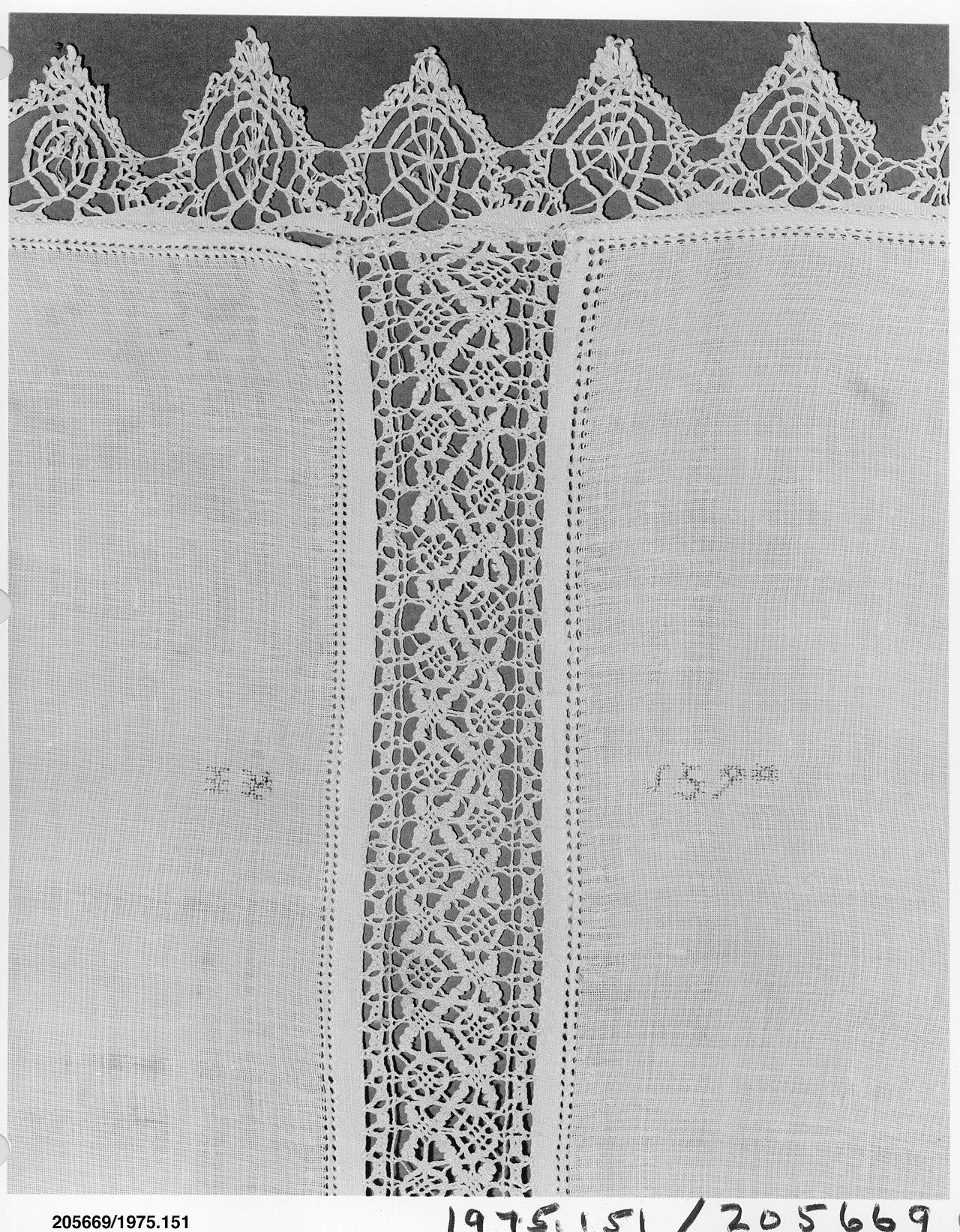
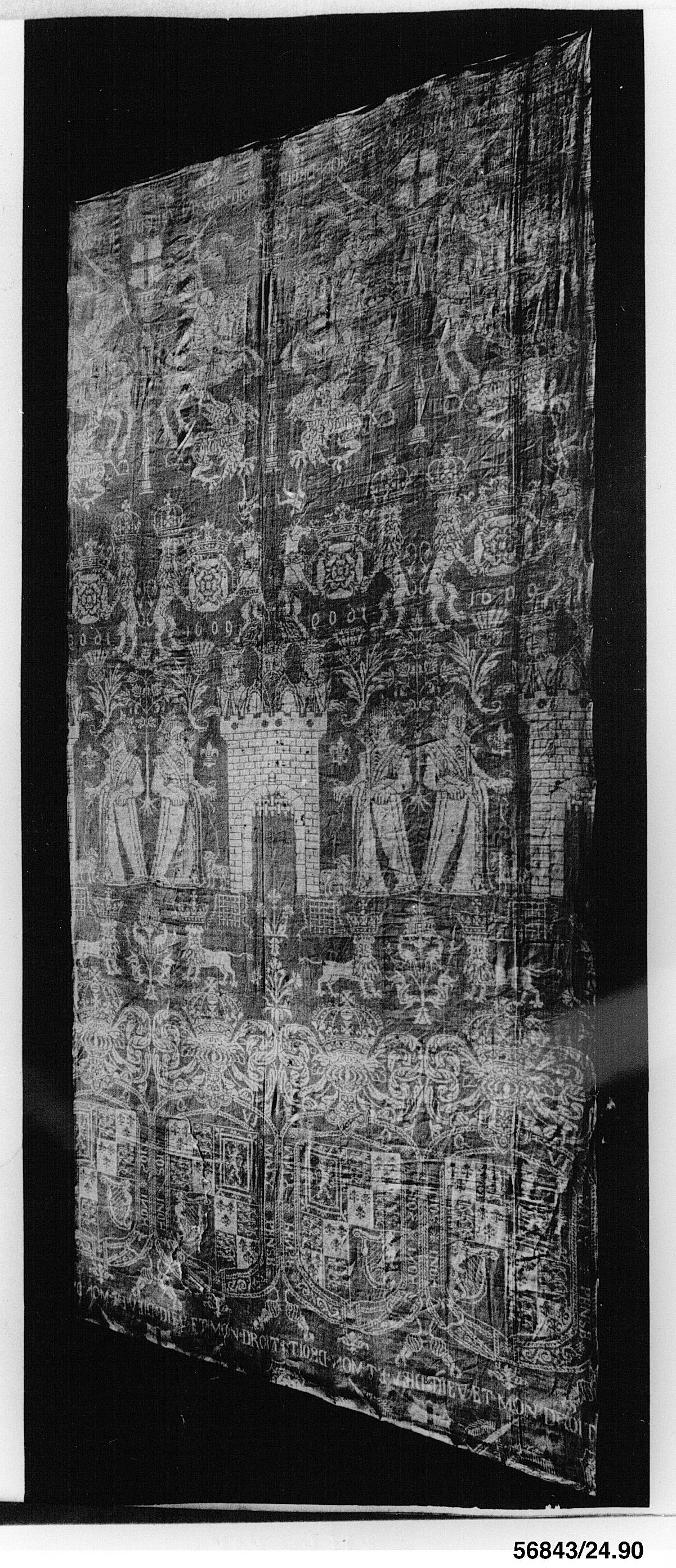
Museum cloths show how large a tablecloth can get. The Metropolitan Museum's linen tablecloth dated 1590 (1975.151) is recorded at 204 in long by 78 in wide, and in the detail at the top of this page two linen panels are joined by a band of lace. A woven linen cloth dated 1609 (24.90) is 127 x 80 in. The Met's records do not say how wide the looms were or how the cloths were cut, so they cannot tell us what a maker in 1590 or 1609 would have done with a given width. What they give is size, and the planner's arithmetic works at any size: a 204 in cloth is the same sum as a 106 in one.
Does the width of the fabric change the answer?
Greatly. Fabric widths vary, and the planner takes yours. KOVI notes that sheeting and decorator fabrics are available at 60 in, and that quilt backing fabric is usually 108 in wide. On 60 in fabric, the 82 in side needs side panels of (82 + 2 - 60) / 2 = 12 in, but there are still 2 lengths, so the answer is the same 212 in. On 108 in fabric, 82 in fits across with no seams at all, and you need only the 106 in length: 106 / 36 = 2.94 yd, which rounds up to 3 yd. Half the fabric and no seams, for a plain cloth.
That is why the planner has an "allow turning" option. It tries the cloth the other way round on the fabric and keeps the layout with fewer seams, then the shorter length. A cloth turned like this runs the grain across the table. For a directional print or a nap that is not acceptable, so it is off by default.
How much fabric does a round cloth need?
A round cloth is cut from a square of its cut diameter. For a 48 in table with a 12 in drop and a 1 in hem allowance, the finished diameter is 48 + 24 = 72 in and the cut diameter is 72 + 2 = 74 in. That is wider than 54 in fabric, so the planner uses the same centre panel and two sides: (74 + 2 - 54) / 2 = 11 in each side, 4 of those fit in a length (floor(54 / 11) = 4), so 2 lengths of 74 in is 148 in, or 4 1/8 yd (148 / 36 = 4.11). You then cut the circle from the pieced square. SINGER's formula for a round cloth is the table size plus twice the drop plus the hem allowance, which is the same sum.
The corners of the square are waste. The planner does not try to use them, and it does not draw a pattern for the curve.
What about a table runner?
A runner is the simplest case. For a 72 in table, a 14 in wide runner, an 8 in drop at each end and a 1 in hem allowance, the finished length is 72 + 2 x 8 = 88 in, and the cut size is 90 x 16 in. A 16 in width fits across any fabric that is at least that wide, so there are no seams and the length you buy is 90 in, which is exactly 2 1/2 yd (90 / 36 = 2.5), or 2.3 m.
The Met holds a table runner of 1860-69 recorded at 95 in long and 17 1/4 in wide (1975.173.3), made of wool, chenille, wrapped metal, silk, sequins and cotton. It is a useful size check: a runner of that length is a single length of cloth, with no seams on any normal fabric width.
What does the planner leave out?
It is plain arithmetic, so it leaves out what arithmetic cannot know. It ignores pattern repeats, plaids and stripes to match: KOVI advises doubling the yardage when you join printed pieces so the pattern repeat can be matched, and that is a judgment about your fabric. It does not allow for shrinkage, so wash and press first and measure the width you really have. It ignores the selvage unless you take it off the width yourself, and it does not nest anything else into the leftover fabric. Oval cloths are treated as their bounding rectangle. If you plan to bind the edge with bias strips instead of hemming it, use the Bias Binding planner for the strips. For napkins to match, the Pieces-on-Fabric Planner works out squares on a length of fabric.
If the cloth is for a holiday table, work back from the date. Thanksgiving in the United States falls on the fourth Thursday of November, a date fixed by Congress in 1941, and Christmas is December 25; wash and press the fabric before you measure and cut.
Try your own table in the Tablecloth & Table Runner Fabric Planner: it shows the arithmetic step by step, and the link you copy from it restores your numbers.