Dress
The Gigot Sleeve: How 1830s Sleeves Grew So Wide
For about a decade women's sleeves swelled until the upper arm outsized the waist. What the gigot, or leg-of-mutton, sleeve was, how it kept its shape, and how it dates a dress.
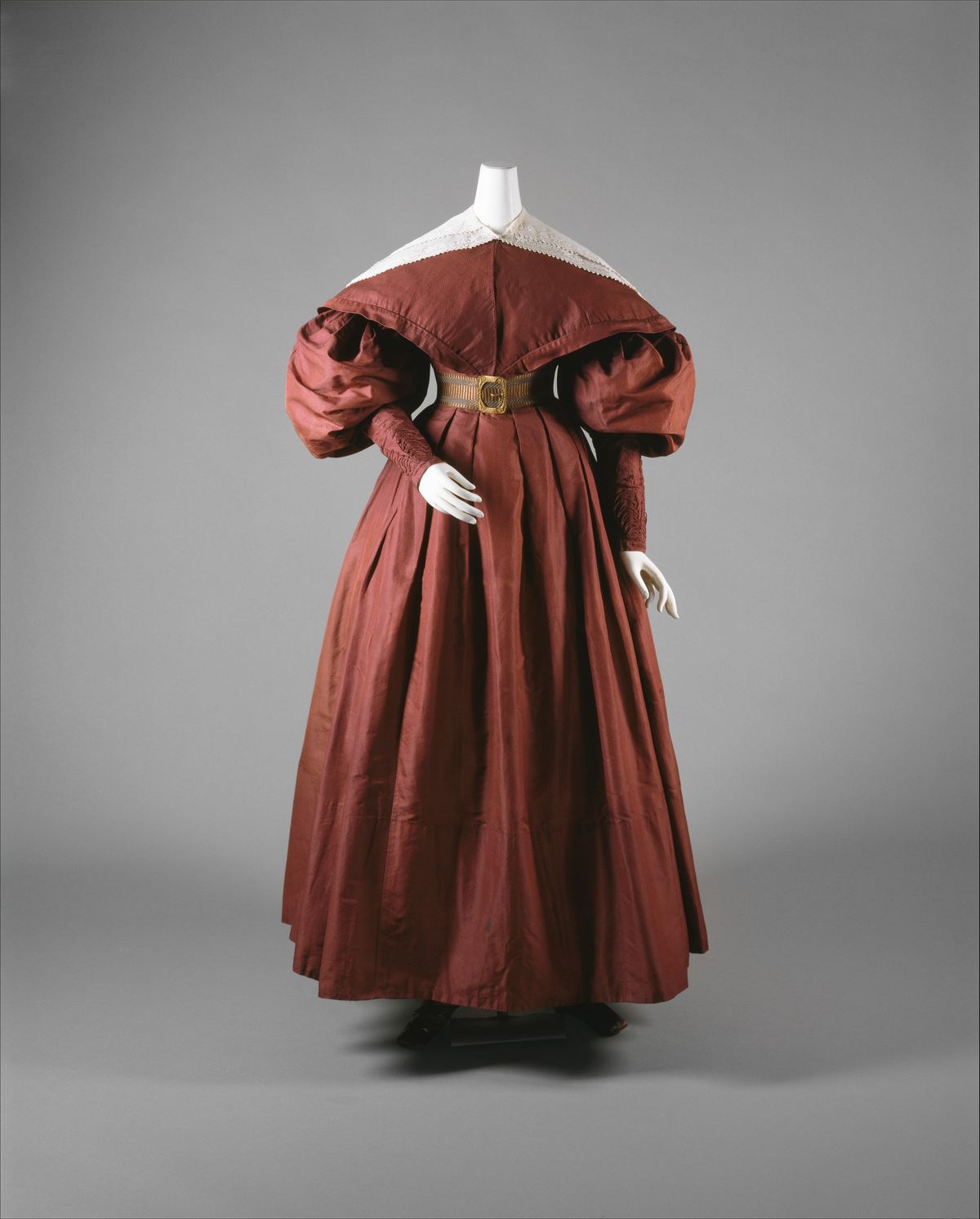
A gigot sleeve is very full at the shoulder and upper arm and tight from elbow to wrist. English speakers also called it the leg-of-mutton sleeve. It peaked in the early 1830s and kept its shape with help: stiff linings, whalebone hoops and down-filled pads tied to the arm under the dress.
It is a good season to look at one. From 12 December 2026 to 17 October 2027 the Palais Galliera in Paris is showing En volume !, an exhibition about the techniques that turn flat cloth into a three-dimensional garment. The 1830s sleeve is one of fashion's clearest cases of volume that had to be engineered.
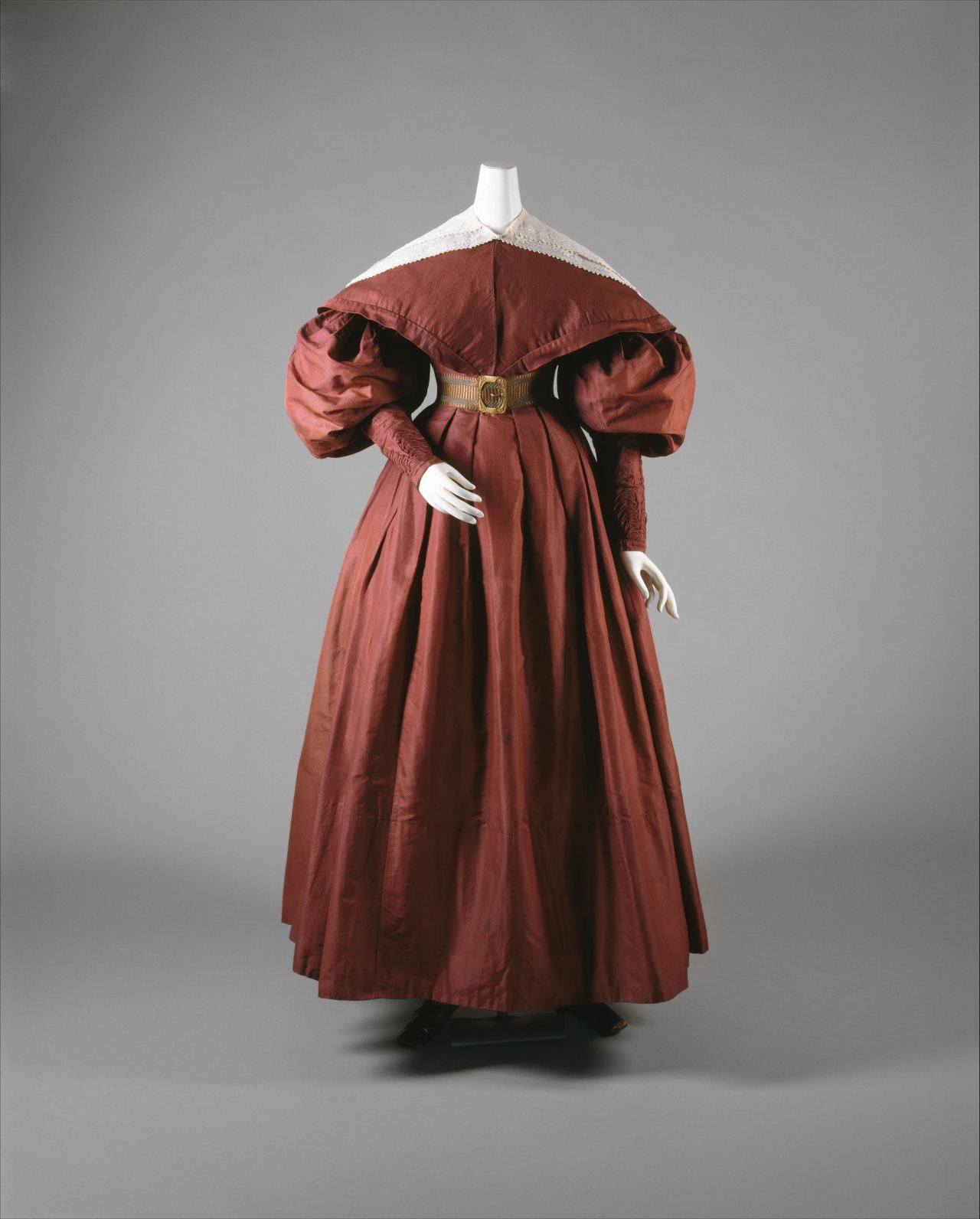
What is a gigot sleeve, and what else was it called?
The name is culinary. The Workwoman's Guide, a London manual for home sewing published in 1838, gives a pattern for a long sleeve and adds that it "is called the gigot, or gigot de mouton sleeve, from its likeness to a leg of mutton." Gigot is French for a leg of mutton, and Littré's nineteenth-century French dictionary gives manches à gigot a meaning of their own: dress sleeves that were very full at the top and held out by whalebone or gummed calico.
The fashion press of the time used several more names. The 1831 issues of the London monthly The World of Fashion describe sleeves "of the demi-gigot form," sleeves "of the imbecille kind," and, for evening, "beret sleeves, very short and full." Museums still use these terms. The Victoria and Albert Museum describes imbecile sleeves on its fashion plates as "very full sleeves from the shoulder to wrist with fitted cuffs," and says they took the name from the sleeves of jackets used to restrain asylum patients. It uses "beret sleeves" for evening dress, as on a ballgown in the Petit Courrier des Dames of 25 December 1834.
When did sleeves grow, and when did they collapse?
The growth took about a decade. A wedding dress of 1824 at The Metropolitan Museum of Art has only a modest puff at the head of a long, fitted sleeve. According to the Fashion History Timeline of the Fashion Institute of Technology (FIT), sleeves had become true gigots by 1827, and by the end of the decade the upper arm could be twice the size of the waist. FIT places the peak between 1830 and 1833. A French caricature of 1829, Encore un dégré de perfection: Modes de 1830, now at the Met, already shows a woman whose green sleeves are wider than she is.
Then the shape fell. FIT dates the collapse to about 1836, and the Dictionary of Fashion History (as quoted by FIT) gives the gigot's first run as 1824 to 1836. In the late 1830s the fullness slid down the arm. The upper sleeve was pleated or banded tight, and what volume remained sat at the elbow. A V&A dress of 1836 to 1838 has sleeves "tightly pleated below the shoulder," with tapes inside to stop the puff slipping down. The Met's cream silk dress of 1837 to 1840 shows the same arrangement. By about 1842, FIT says, the dominant sleeve was narrow and tightly fitted, set in below the shoulder; the V&A's tartan silk dress of about 1845 has long, tight sleeves.
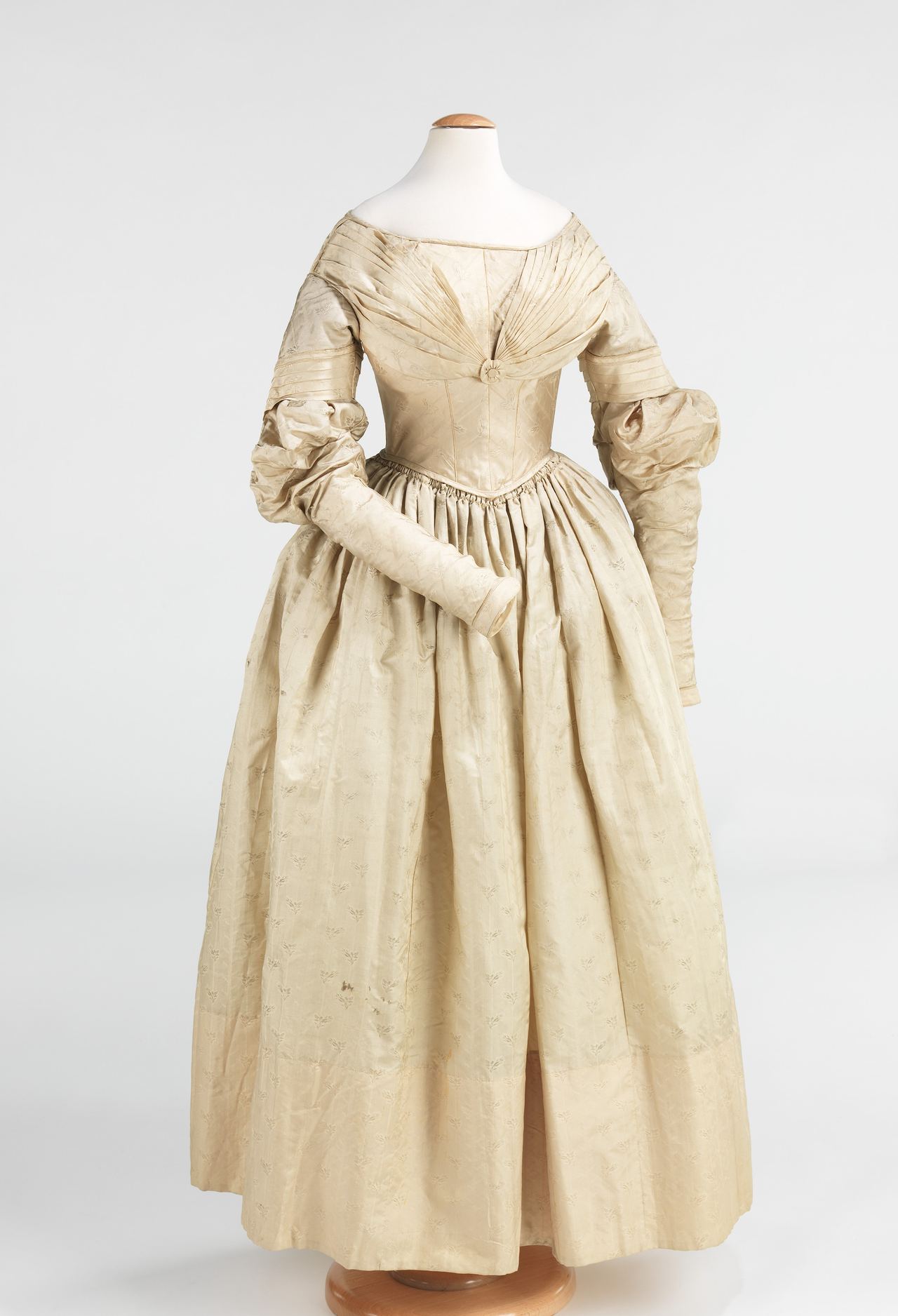
| Date | Sleeve | Example |
|---|---|---|
| 1824 | Puff at the shoulder, long fitted sleeve | Met wedding dress, 2009.300.918 |
| c. 1827–29 | True gigot; upper arm up to double the waist | FIT, after C. W. Cunnington |
| 1830–33 | Peak size; demi-gigot, imbecile and beret variants | *The World of Fashion*, 1831 |
| c. 1836 | Collapse; fullness moves toward the elbow | V&A dress, 1836–38 |
| 1837–40 | Upper sleeve pleated tight, puff at the elbow | Met dress, 2009.300.3324 |
| c. 1842–45 | Narrow, tight sleeve set below the shoulder | V&A dress, ca. 1845 |
How did a sleeve that size keep its shape?
Partly through cut. The V&A notes that the gigot sleeves on its printed cotton dress of 1830 to 1834 are made in two pieces, with the pattern matched across the front seam so that the join barely shows. Cloth alone, though, especially thin muslin or silk, would have collapsed against the arm. Three kinds of help appear in the sources.
The first was a stiff lining or undersleeve. In October 1831 The World of Fashion reported that short sleeves were being covered with "a thin stiff gauze" rather than held out by an undersleeve of buckram, "which is apt to rub against the shoulders." A month later it praised short, wide sleeves "lined with a stiffened material, instead of having an under sleeve." Littré's whalebone and gummed calico describe the same idea.
The second was a hoop. The Dictionary of Fashion History records that in 1827 the top of the sleeve was sometimes stiffened with whalebone hoops. The Met holds a British pair of sleeve supports of about 1828, catalogued as cotton and baleen (whalebone).
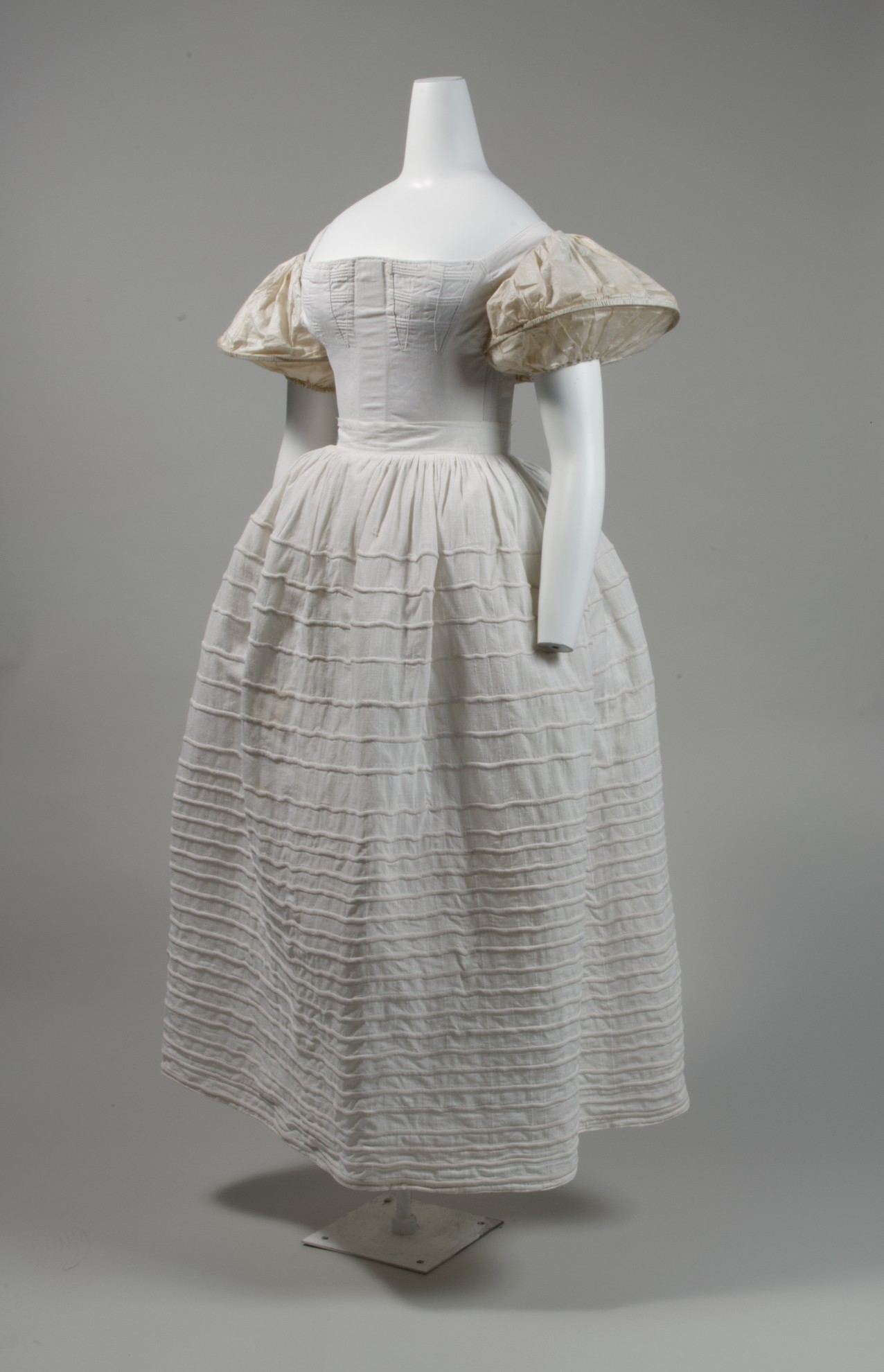
The third, and the most comfortable, was a pillow. Separate sleeve puffs, also called plumpers, were tied around the upper arm under the dress. The V&A has an English cotton sleeve puff of the 1820s or 1830s stuffed with down, and the Museum at FIT holds a crescent-shaped pair of about 1829, also filled with down. The V&A suggests that the wearer of its unlined 1830s dress probably tied such a pad to each arm, since feathers can be squeezed through a narrow armhole. FIT's timeline adds that supports could also be made of buckram or wire.
Why did the sleeve come back in the 1890s?
Big sleeves returned sixty years later. The V&A, describing a bodice made in New York in 1895, says gigot sleeves were highly fashionable between 1894 and 1896, that their basic shape was similar to that of the 1830s, and that, like the earlier sleeves, they shrank quickly. The Dictionary of Fashion History has the sleeve reaching an extreme size in 1895 and collapsing in 1896. The support came back too: the Met has cotton sleeve supports dated to the 1890s, gathered cotton bags with ties.
How can you date a dress by its sleeve?
Because the shape appeared twice, the sleeve alone cannot date a dress. Read it with the rest of the garment.
- Fullness at the top, a waist at or just above the natural line and a skirt widened over petticoats: around 1827 to 1835.
- The upper sleeve pleated tight and the puff at or below the elbow: late 1830s.
- A narrow sleeve set in below the shoulder: 1840s.
- A huge sleeve with a nipped waist and a bell-shaped skirt gored smooth over the hips: the 1890s, as our guide to dating a portrait by the sleeve explains in more detail.
Look inside as well. The V&A's 1836–38 wool dress has stitch marks on its sleeves, which its curators read as a sign that they were cut down from an earlier, fuller style to keep up with fashion. A sleeve is the easiest part of a dress to remake, so the construction of a garment, its seams, linings and alterations, can show more than one date. The puffs and hoops belong with the other padding of the period, the corset and the full petticoat, described in Under the Dress.
Where can you see gigot sleeves?
The Met's online collection shows the walking ensemble of about 1835, the 1837–40 dress, the 1824 wedding dress, and both pairs of supports, from about 1828 and the 1890s. The V&A's records include the down-filled sleeve puff, the printed cotton dress of 1830–34 and the altered wool dress of 1836–38. For the shape on paper, look at a fashion plate of 1829 to 1835: the sleeve is often the widest thing in it, wider than the bodice it is set into. Online records are not the same as gallery displays; check what is on view before you travel.
Sources
- Walking ensemble, ca. 1835, 26.250.1a, b. The Metropolitan Museum of Art. Collection API record read (date, culture, silk, credit, isPublicDomain true); image inspected at full size. Object page returned 429. Accessed November 13, 2026.
- Sleeve supports, ca. 1828, C.I.66.38.5a, b. The Metropolitan Museum of Art. Collection API record read: British, ca. 1828, cotton, baleen, CC0; image inspected and cropped. Accessed November 13, 2026.
- Dress, 1837–40, 2009.300.3324. The Metropolitan Museum of Art. Collection API record read; image inspected and cropped (pleated upper sleeve, puff at elbow). Accessed November 13, 2026.
- Wedding dress, 1824, 2009.300.918. The Metropolitan Museum of Art. Collection API record read; image inspected (modest puff at sleeve head). Accessed November 13, 2026.
- Sleeve supports, 1890s, C.I.43.40.59a, b. The Metropolitan Museum of Art. Collection API record read (1890s, cotton); both images inspected. Accessed November 13, 2026.
- Encore un dégré de perfection: Modes de 1830, 1829, 1971.564.193. The Metropolitan Museum of Art. Collection API record read (anonymous French hand-colored lithograph, 1829); image inspected. Accessed November 13, 2026.
- The Workwoman's Guide (London, 1838). Internet Archive (Simpkin, Marshall and Co., 1838). Full-text OCR read: long-sleeve pattern, 'called the gigot, or gigot de mouton sleeve, from its likeness to a leg of mutton'. Accessed November 13, 2026.
- The World of Fashion and Continental Feuilletons, vols. VIII–IX (1831–32). Internet Archive (Google Books scan). Full-text OCR read: demi-gigot, 'imbecille' and beret sleeves (1831 issues); Oct. 1831 passage on stiff gauze vs. buckram undersleeve; Nov. 1831 passage on stiffened linings. Accessed November 13, 2026.
- gigot. Littré, Dictionnaire de la langue française. Entry read in full: sense 1 leg of mutton; sense 5 dress sleeves very full at the top, held out by whalebone or gummed calico. Accessed November 13, 2026.
- Sleeve puff, ca. 1830 (O224503). Victoria and Albert Museum. V&A API record read: cotton, down stuffing; English, 1820s–1830s. Accessed November 13, 2026.
- Dress and cape, 1830–34 (O117715). Victoria and Albert Museum. V&A API record read: two-piece gigot sleeves matched at the seam; buckram undersleeves or hoops; unlined, so probably worn over down-filled pads. Accessed November 13, 2026.
- Dress, 1836–38 (O13833). Victoria and Albert Museum. V&A API record read: puff moving to elbow, sleeves set low and pleated, stiffened with calico, tapes; stitch marks suggest reworking. Accessed November 13, 2026.
- Bodice by L. Guiquin, New York, 1895 (O117725). Victoria and Albert Museum. V&A API record read: gigot sleeves fashionable 1894–96, shape similar to the 1830s, rapidly diminished. Accessed November 13, 2026.
- Fashion plate, Costumes Parisiens, 1829 (O576845); Petit Courrier des Dames ballgown, 25 Dec. 1834 (O576739). Victoria and Albert Museum. V&A API records read: definition and name origin of imbecile sleeves (V&A cataloguers); 'evening dress with beret sleeves'. Accessed November 13, 2026.
- Dress, ca. 1845 (O13837). Victoria and Albert Museum. V&A API record read: long, tight sleeves typical of the mid-1840s. Accessed November 13, 2026.
- gigot sleeve. FIT Fashion History Timeline. Full page read: Dictionary of Fashion History dates (1824–1836, 1890–96), whalebone hoops 1827, extreme 1895 and collapse 1896; Pendergast on the name. Accessed November 13, 2026.
- 1820–1829. FIT Fashion History Timeline. Full page read: true gigots by 1827; upper arm double the waist (Cunnington); imbecile sleeve; down-filled sleeve supporters. Accessed November 13, 2026.
- 1830–1839. FIT Fashion History Timeline. Full page read: peak 1830–33; supports filled with feathers, buckram or wire; collapse by 1836; fullness shifts to lower arm. Accessed November 13, 2026.
- 1840–1849. FIT Fashion History Timeline. Full page read: narrow tightly fitted sleeve by about 1842, set in below the shoulder. Accessed November 13, 2026.
- 1890–1899. FIT Fashion History Timeline. Full page read: sleeve apex 1895; bell-shaped gored skirts; nipped waist. Accessed November 13, 2026.
- Sleeve puffs, c. 1829 (2023.281). The Museum at FIT. Object record read: pair of down-filled cotton sleeve puffs or plumpers, crescent shaped. Accessed November 13, 2026.
- Shaping the Romantic Era. FIDM Museum at ASU. Full article read: plumpers filled with eiderdown; c. 1836–37 dress with shoulders banded in tight pleats. Accessed November 13, 2026.
- En volume ! (Palais Galliera). Offi. Listing read: dates 12 Dec. 2026 – 17 Oct. 2027; techniques from flat surface to volume. Accessed November 13, 2026.
- In 3D! The fashion exhibition that explores technical know-how at the Palais Galliera. Sortiraparis. Article read: same dates and theme; no mention of sleeves (so the piece does not claim the show includes gigot sleeves). Accessed November 13, 2026.
Glossary
Last updated · Markdown · Report an error