Technique
Reading a Portrait: How to Date a Sitter by the Sleeve
Sleeves, collars, waists and hoods changed on a schedule, and painters bent it. A step-by-step method for dating a sitter by dress, with the traps that give the wrong date.
To date a painting by its clothing, match the sleeves, neckline or collar, waist and headwear against dated examples, then report a range, not a year. Dress shows the earliest moment a style could have appeared. Copies, studio costumes, flattery and later overpainting can all pull a portrait away from the date its clothes suggest.
Why can clothes date a portrait at all?
Fashion moved on a schedule that dress historians have mapped from dated garments, prints and pictures, and some features had short, known lives. A cage crinoline frame, for example, was worn for only eleven years, from 1856 to 1867, according to a Hampshire Cultural Trust guide to dating photographs by dress. The same guide notes that women's fashions changed faster than men's, so a woman's portrait usually dates more tightly than a man's.
The Met's Costume Institute show Costume Art, open through January 10, 2027, sets garments from the Costume Institute in conversation with artworks from across the museum's collection (the dates come from the Met's announcement as reported by CBS New York and FashionUnited). The same pairing is the best working method at a desk: set the painted sleeve beside a real, dated one and see what matches.
Which parts of a portrait change fastest?
Start with the parts that moved quickly: sleeves, neckwear, headwear and the shape of the skirt or its back. Fabric and color move less reliably, because painters simplified them (more on that below).
| Years | Feature | What to look for |
|---|---|---|
| c. 1500–1540s | English women's headwear | The gabled hood, a wired, peaked hood, was worn from the 1500s to the 1540s. The rounder French hood reached the English court in the 1530s through Anne Boleyn, and Jane Seymour went back to the gabled hood. |
| 1520s–1530s | English women's sleeves and bodice | A low-cut bodice and large fur oversleeves turned back almost to the shoulder, much like French dress. |
| 1560s–1620s | Neck | The ruff, a separate garment by the mid-1500s, grew with starch from the 1560s and by the 1580s was immense, on a wire frame. |
| 1615–1650 | Neck | The falling ruff, c. 1615–1640. The oval ruff, c. 1625–1650, was worn by women only. |
| c. 1800 | Fabric and cut | White muslin in a simple cut that deliberately evoked ancient Roman dress (Cleveland, on Louis Hersent's Sophie Crouzet, c. 1801). |
| 1830–1833 | Sleeves, hats | Gigot sleeves at their largest; hats and bonnets widest about 1830; the whole look drooped after 1836. |
| 1856–1867 | Skirt | The cage crinoline frame. |
| 1870s–1880s | Back of the skirt | Soft bustles in the early 1870s, fishtail trains c. 1876–1880, stiff angular bustles c. 1881–1886. |
| 1894–1896 | Sleeves | Gigot sleeves again, at their largest in 1895 and collapsing in 1896. |
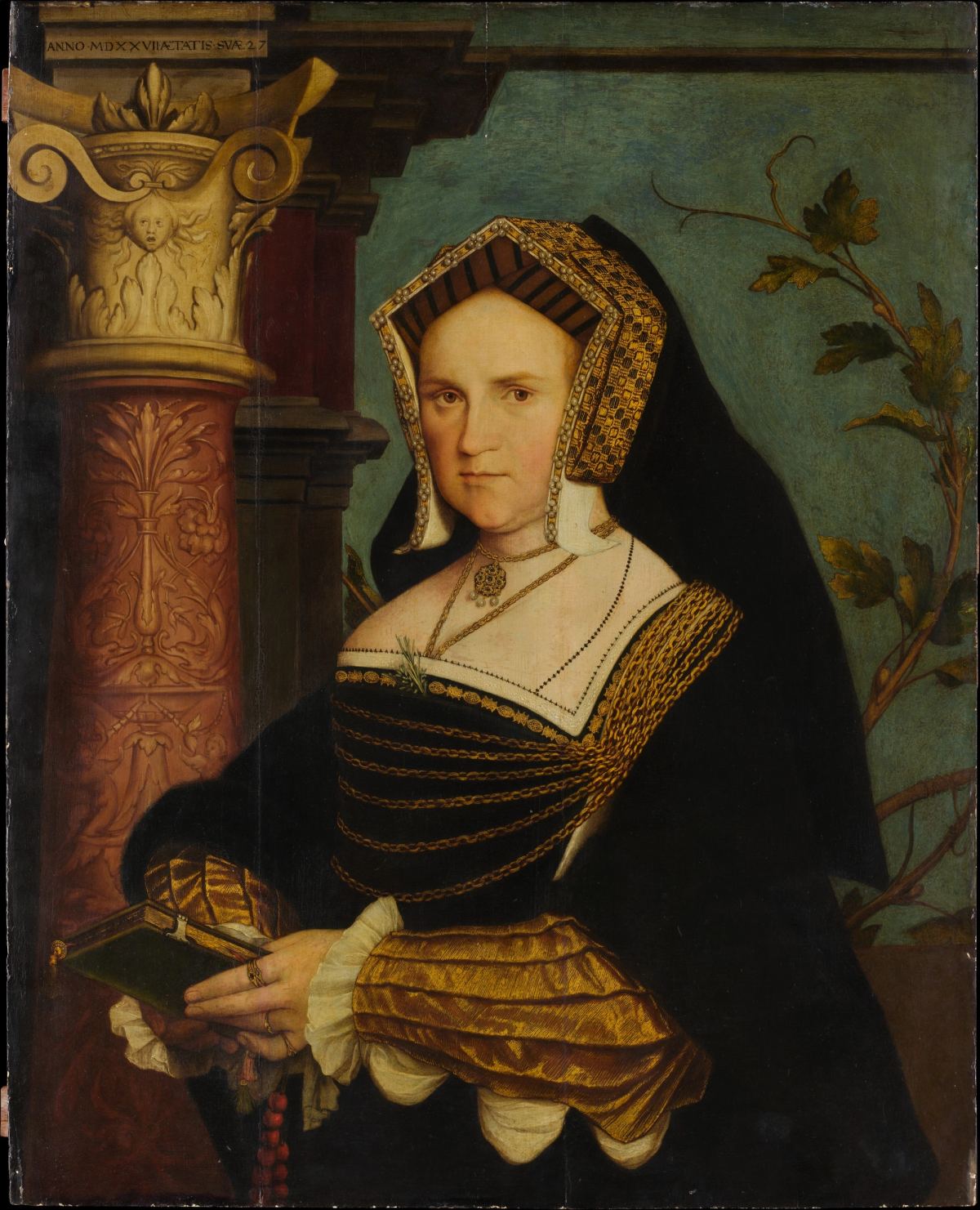
Headwear shows how a feature can mislead as well as date. The gabled hood in the portrait at the top of this page was worn across roughly four decades, and in the 1530s the queen of the day set the style: Anne Boleyn brought in the French hood, and her successor Jane Seymour returned to the gabled one. A hood narrows the date to a generation, not a year.
What does a painted sleeve look like beside a real one?
Asher B. Durand painted Mrs. Winfield Scott in 1831. The Met holds a silk dress dated 1832–33 from the same few years in which, according to FIT's Fashion History Timeline, the gigot sleeve reached its largest size. Put them side by side and the shared logic shows. Both have sleeves that bloom from the shoulder. Both have a defined waist with a wide expanse of skirt below. Durand's sitter pairs puffed upper sleeves with sheer fabric below, a combination close to the puffed sleeve under a transparent oversleeve that FIT records as an evening fashion, and her hair is piled high in loops, a style FIT also lists for the decade.
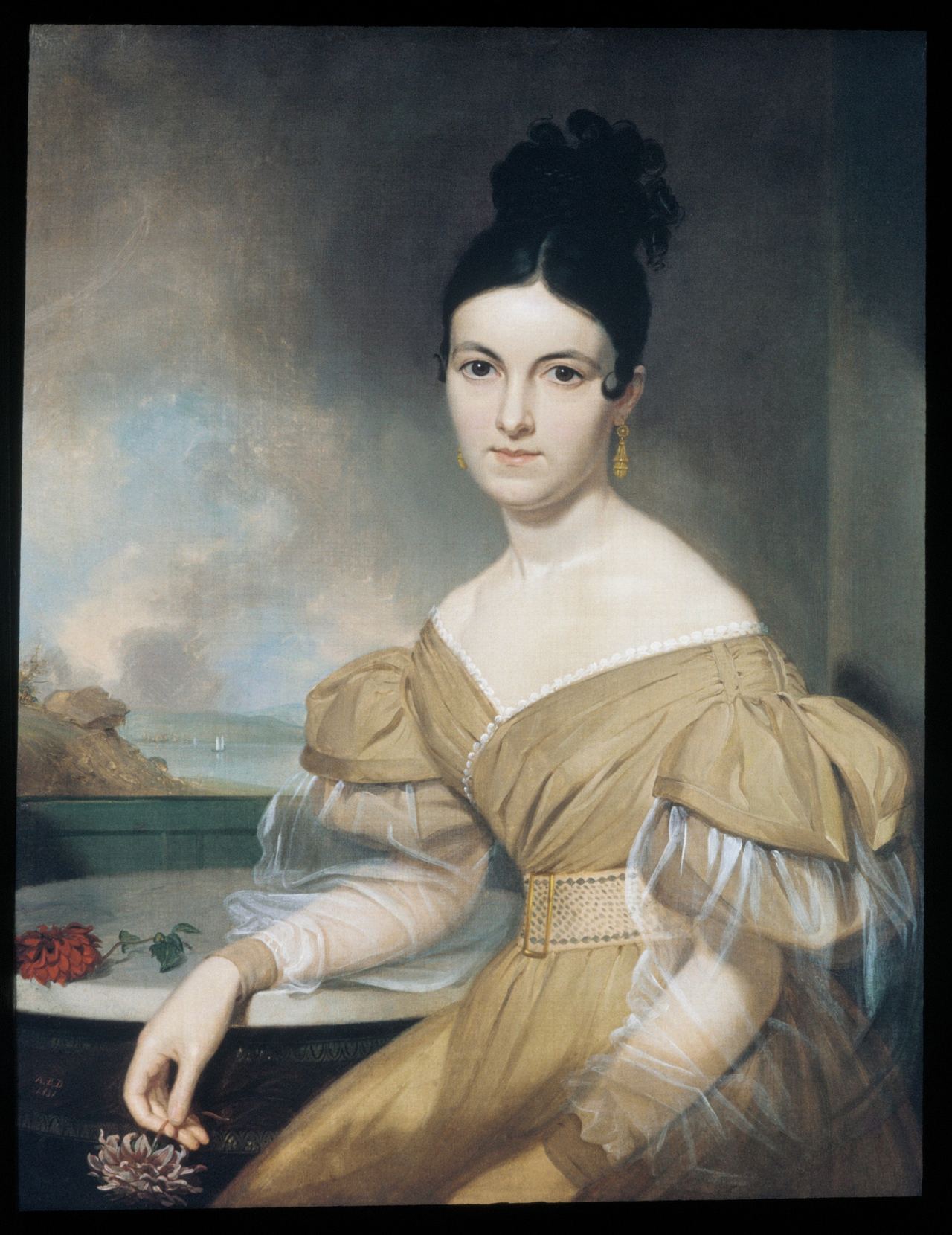
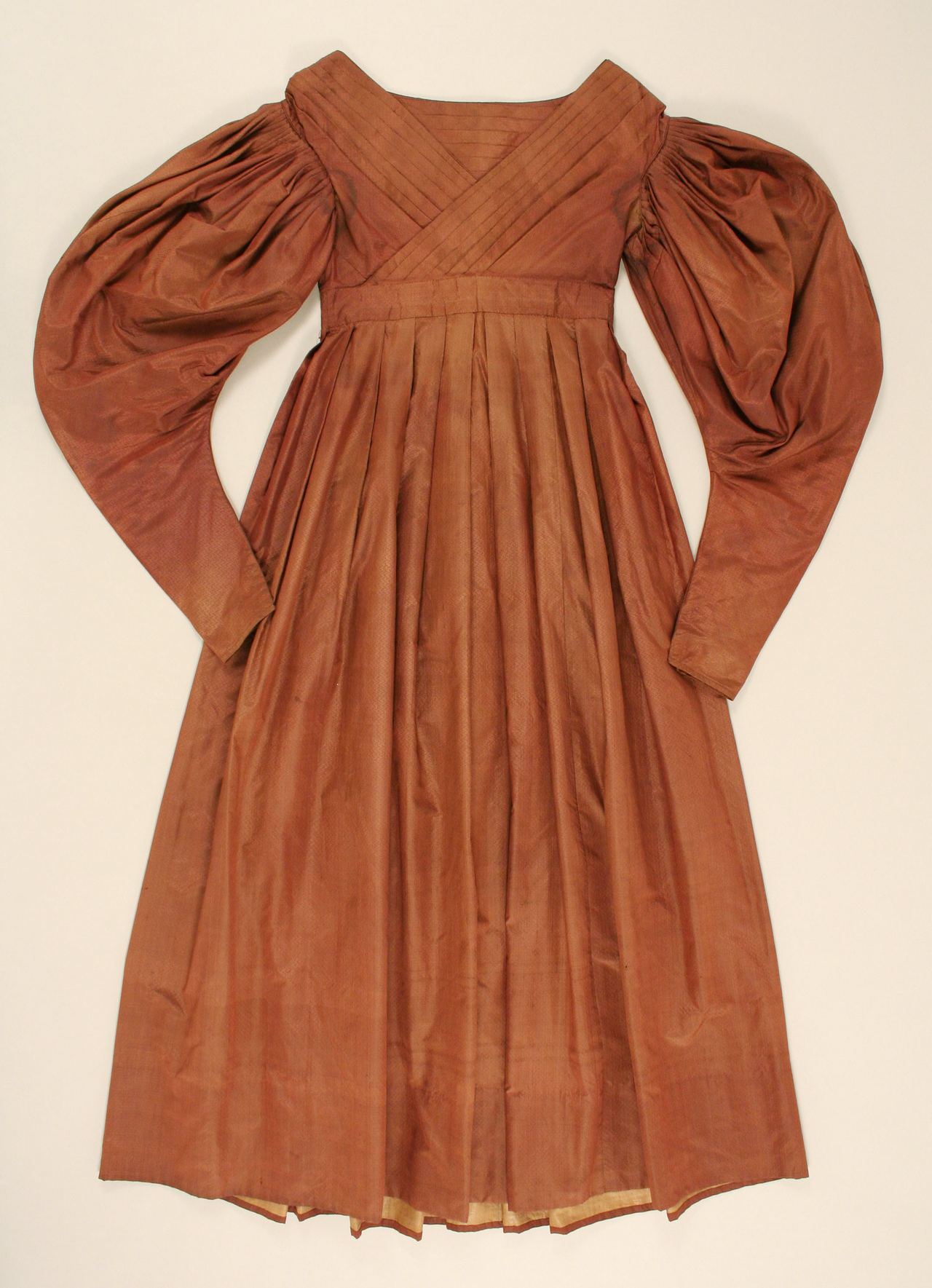
The two do not match exactly. The painted sleeve swells at the upper arm and goes sheer below, while the surviving dress is full to the elbow and narrows to the wrist. That is the point of the exercise: the family resemblance dates both to the early 1830s, and the differences are the part that belongs to one maker, one sitter or one occasion. The painting also shows the things a surviving dress cannot: how the sleeve stood on a living body, and what the hair and neckline did around it.
Why does the same sleeve come back?
Because fashion recycles shapes. The gigot sleeve peaked between 1830 and 1833 and returned in the 1890s, reaching its fullest size about 1895. The V&A, describing a bodice of 1895, says the basic shape was similar to that of 1830s sleeves and that both rapidly shrank after a few years.
A sleeve alone therefore cannot separate 1832 from 1895. Read the rest of the figure. In the 1830s the waist sat just above the natural line and the skirt widened over many petticoats; by 1892, FIT says, the protruding bustle was gone and skirts were bell-shaped, gored to fit smoothly over the hips, with a nipped waist to balance the sleeve. For a surviving garment, construction adds more clues; see How to Date a Garment from Its Construction.
When is the painted dress not the sitter's dress?
Painters had reasons to change what they saw. Five cases come up again and again.
Idealizing. In his 1771 lecture to the Royal Academy, Joshua Reynolds said a portrait painter who wants to raise a subject "changes the dress from a temporary fashion to one more permanent." In 1776 he advised dressing a lady "with the general air of the antique for the sake of dignity" while preserving "something of the modern for the sake of likeness." Yet fashion leaked through. A Wallace Collection essay by Jacqui Ansell points out that in Reynolds's portrait of Elizabeth Carnac, a supposedly timeless white gown bunches at the hips like the polonaise overskirt, which the essay calls "all the rage in 1775," and that the high hairstyle must already have looked outmoded by the 1780s.
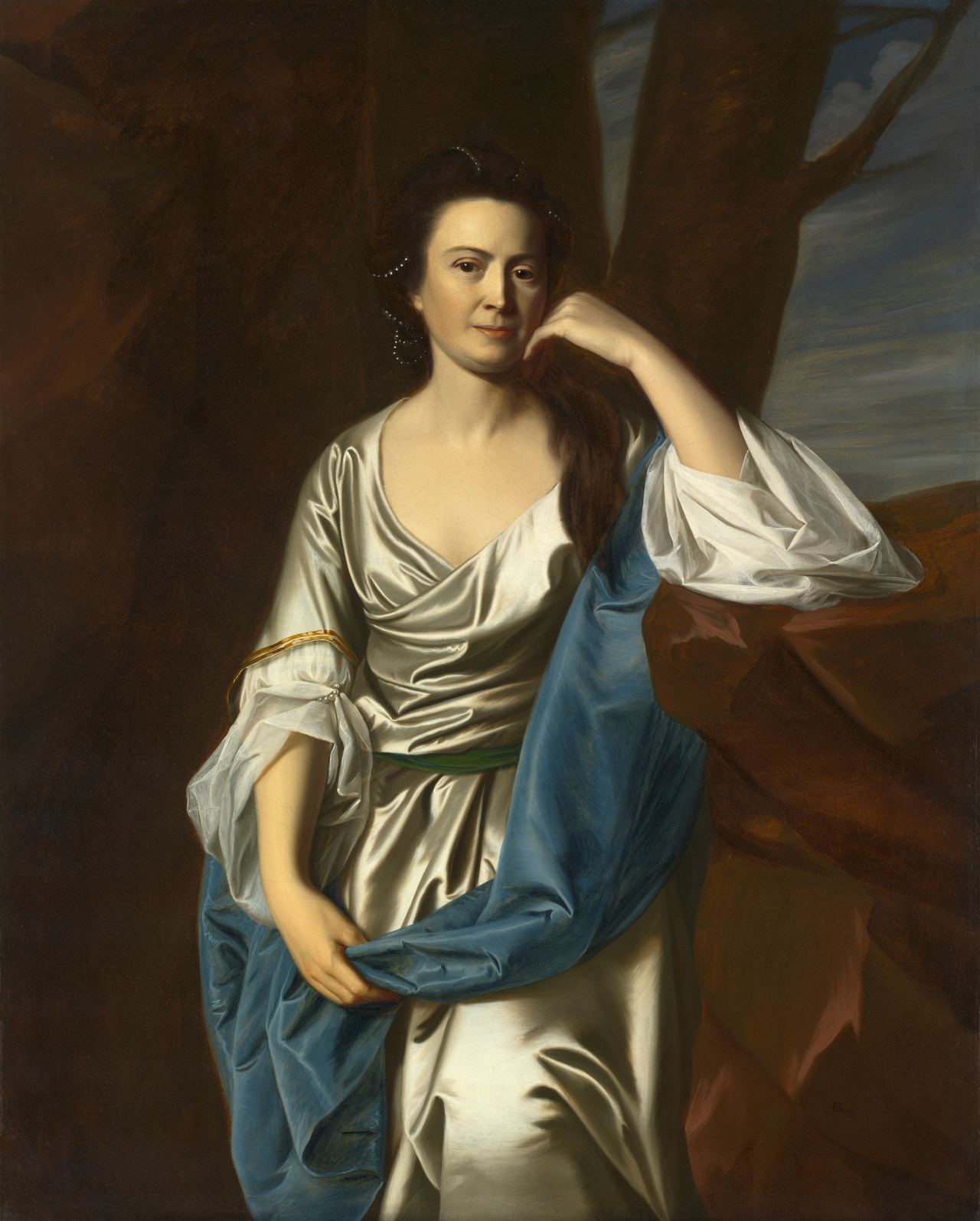
Fancy dress. Cleveland's record for John Singleton Copley's portrait of Catherine Greene, painted in 1769, says she wears a "fanciful costume inspired by ancient styles," takes a pose derived from an English engraving, and pretends to lean on a rock that "looks as insubstantial as a theatrical prop." Her gown tells you about Copley's repertoire, not about a Boston wardrobe.
Studio convention. Emilie Gordenker's study of Van Dyck, published by Brepols, argues that his costume for English sitters "blurred the margins of fact and fancy," and that his conventions held sway in portraiture until the end of the seventeenth century. An essay from Dublin's Edward Worth Library, citing Gordenker, notes that the clothes in Van Dyck's portraits were often not worn in real life, and that he always painted plain satins and silks even though inventories show patterned fabrics were owned. Treat fabric as the weakest clue.
Copies. The Met's picture at the top of this page is catalogued as a copy after Holbein. The Saint Louis Art Museum, which holds the original, catalogued as 1527, notes that before the original surfaced in 1930 the Met picture was believed to be by Holbein, and that the two are often confused. A faithful copy can carry the original's clothing into a later decade, so the dress may date the pattern, not the panel.
Overpaint. A conservator treating Ezra Ames's 1822 portrait of Kitty James for the Colby College Museum of Art found that its sleeves, bodice and hairstyle had been repainted by a different, less experienced hand. An X-ray showed the original bodice and hairstyle underneath. According to a conservators' blog post summarizing her talk, the added 1840s fashion may have been meant to turn the portrait into a likeness of a more prominent relative with the same name, although that explanation is a theory. The paint you see is not always the paint that was applied first.
Two quieter limits matter as well. Fashion could take years to reach the provinces, and older people could keep hairstyles and details from their youth while adopting a new silhouette (Hampshire Cultural Trust). And what survives skews rich. An Aalto University news article on Paula Hohti's research project Refashioning the Renaissance, which ended in 2022, reports that few historical garments or even images of them survive, that survivors are not always original, and that most garments in museums belonged to the upper classes. Hohti has also edited a volume of the same title, published by Manchester University Press in 2025.
How do you date a sitter by the sleeve, step by step?
- Write down what the record says. Note the catalogued date, any inscription, the sitter's name and the attribution. If the picture is a copy or a later version, say so first.
- Fix the sitter's sex, age, class and place. Women's fashion moved faster than men's, and country sitters lagged behind capitals.
- List the fast-changing parts. Sleeves, collar or neckline, headwear, waist and skirt shape come before fabric.
- Find dated comparisons. Look for securely dated portraits and for surviving garments in museum collections, remembering that survivors lean toward the wealthy.
- Use the newest feature as a floor. A style cannot appear before it exists, so the latest-looking feature sets the earliest plausible date.
- Ask whether the dress is real, timeless or costume. Look for pose, props and drapery that repeat from sitter to sitter, which suggests studio costume.
- Check the paint. Ask whether the sleeves or hair could belong to a later hand.
- Write a range. Give an earliest date, a most likely decade and the reasons.
| Trap | Example | Check |
|---|---|---|
| Copy | The Met's Lady Guildford is catalogued as a copy after Holbein | Read the record's attribution and compare the original |
| Fancy dress | Copley's Catherine Greene wears ancient-style costume | See whether the costume recurs in the painter's other portraits |
| Timeless drapery | Reynolds's Elizabeth Carnac still shows the polonaise | Look at the hair and the hips, which usually give the date away |
| Returning shape | Gigot sleeves in the 1830s and the 1890s | Read the skirt, waist and hair together |
| Overpaint | Ames's Kitty James, repainted in 1840s fashion | Look at the paint under raking light and, if you can, in X-ray |
What else should you check before trusting the dress?
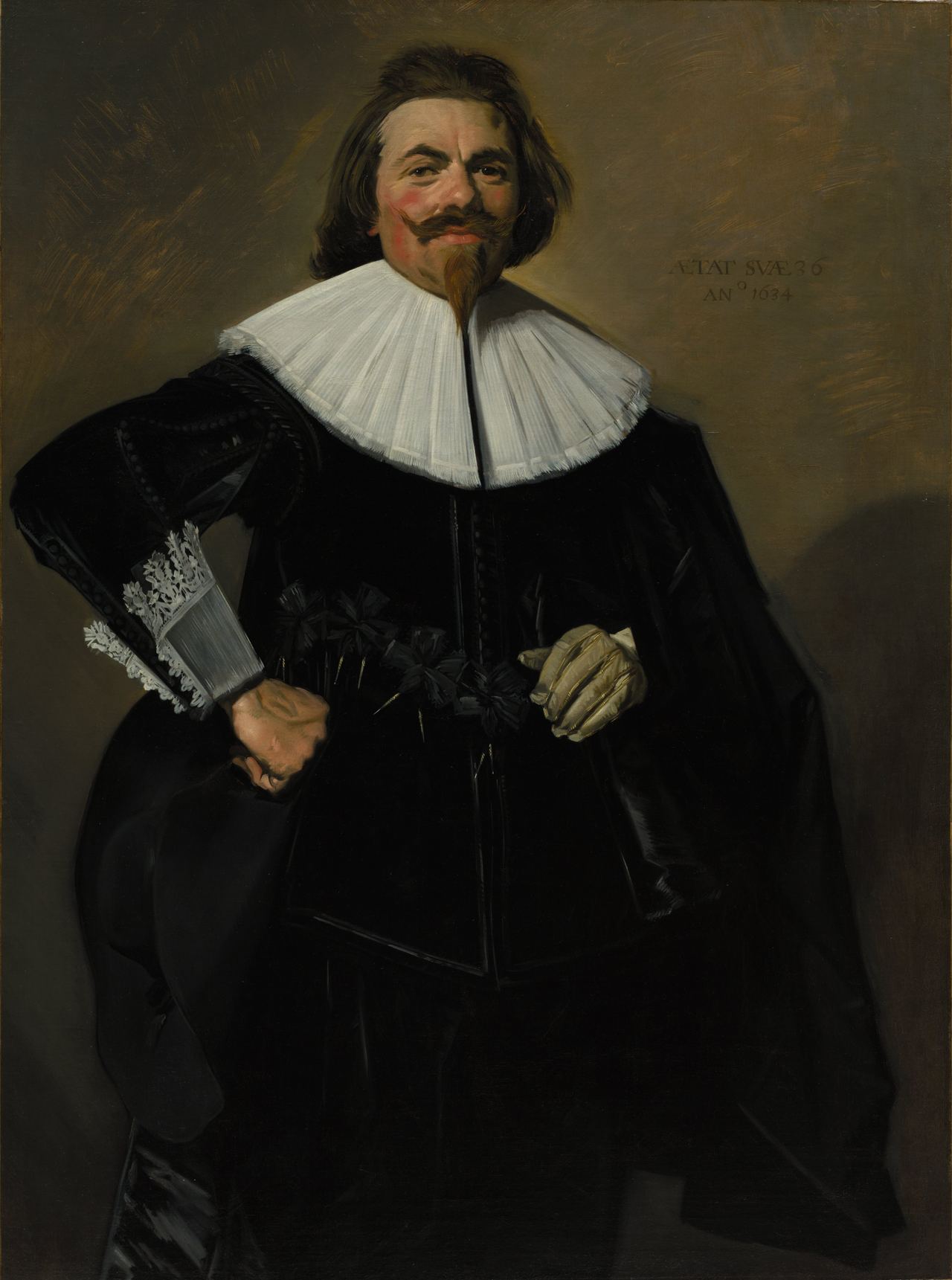
Look for an inscription. Frans Hals's portrait of the Haarlem merchant Tieleman Roosterman carries the lettering AETAT SVAE 36 and AN° 1634, and Cleveland's record says the sitter was 36. That gives you a fixed point: a broad linen collar, braided and buttoned sleeves and lace-edged cuffs, all dated to 1634 and usable as a comparison for undated pictures. Cleveland's c. 1635 Portrait of a Woman with a Dog, by Hendrik Gerritsz. Pot, shows a woman in a starched ruff with sleeves ending in punto in aria lace. A woman in a ruff and a man in a flat collar in the same decade are no contradiction: the dictionary entry quoted by FIT says the oval ruff of c. 1625–1650 was worn by women only. For what lace on a cuff or collar can and cannot tell you, see the lace technique guide.
Then check the wood and the paint. Tate's technical entry on a portrait of a man in a slashed doublet, catalogued as c. 1605 and attributed to Sir William Segar, reports that dendrochronology showed the panel's Polish or Baltic oak could have been painted from 1598, most plausibly from 1604, close to the catalogued date. Dendrochronology gives a floor, not a date: the Art Gallery of New South Wales, dating its Henry VIII portrait, added an estimated 20 to 40 lost sapwood rings to a last measurable ring of 1480 and concluded that the tree could not have been felled before 1500 to 1520. X-radiography, used on Kitty James and in Tate's entries, and infrared reflectography, used in Tate's, can show whether sleeves and hairstyle belong to the first layer of paint.
When dress, inscription and technical evidence agree, the date is solid. When they split, the dress is usually the first thing to doubt, since it is the easiest part to borrow, copy or repaint.
Where can you look at more portraits and clothes together?
The Met's Costume Art is open through January 10, 2027. Online, the Met's records for the 1832–33 dress and Durand's portrait carry full-size images. Cleveland's open-access records include Hals, Pot and Copley, and the Saint Louis Art Museum shows the original Lady Guildford. FIT's Fashion History Timeline lays out dress decade by decade, citing its sources. For more, read Gordenker on Van Dyck and the Hohti volume.
Sources
- Lady Guildford (Mary Wotton, 1499–1558), copy after Hans Holbein the Younger (20.155.4). The Metropolitan Museum of Art. Record read through the Met Collection API (artist prefix 'Copy after', objectBeginDate 1527, isPublicDomain true, credit line as recorded). The web page answered 429, so the catalogue entry text was not read; no claim rests on it. Accessed October 20, 2026.
- Mary, Lady Guildford, Hans Holbein the Younger, 1527 (1:1943). Saint Louis Art Museum. Full record read (WebFetch): date 1527, sitter aged 27, the Met picture is a copy, believed original before 1930, often confused; companion of the Windsor portrait of Sir Henry Guildford. Accessed October 20, 2026.
- Portrait of Tieleman Roosterman, Frans Hals, 1634 (1999.173). The Cleveland Museum of Art. Record read through the Cleveland Open Access API (CC0): description of sleeves, collar, cuffs and age 36. Inscription AETAT SVAE 36 / AN° 1634 read on the full-size image. Accessed October 20, 2026.
- Catherine Greene, John Singleton Copley, 1769 (1915.527). The Cleveland Museum of Art. Record read through the Cleveland Open Access API (CC0): 'fanciful costume inspired by ancient styles', pose from an English engraving, rock like a theatrical prop. Accessed October 20, 2026.
- Portrait of a Woman with a Dog, Hendrik Gerritsz. Pot, c. 1635 (2011.47). The Cleveland Museum of Art. Record read through the Cleveland Open Access API (CC0): starched ruff, sleeves finishing in punto in aria lace. Accessed October 20, 2026.
- Sophie Crouzet, Louis Hersent, c. 1801 (1943.659). The Cleveland Museum of Art. Record read through the Cleveland Open Access API (CC0): white muslin, straightforward cut, deliberate evocation of ancient Roman costume. Accessed October 20, 2026.
- Mrs. Winfield Scott, Asher B. Durand, 1831 (65.69). The Metropolitan Museum of Art. Record read through the Met Collection API (isPublicDomain true); full-size image inspected. Web page answered 429. Accessed October 20, 2026.
- Dress, 1832–33 (C.I.50.15a, b). The Metropolitan Museum of Art. Record read through the Met Collection API (isPublicDomain true); images inspected. Web page answered 429. Accessed October 20, 2026.
- 1830-1839 (Fashion History Timeline). Fashion Institute of Technology. Decade essay read in full: gigot apex 1830-1833, sleeve collapse 1836, hats widest 1830, hair in loops, sheer oversleeves for evening. Student-written, cites Byrde, Tarrant and others. Accessed October 20, 2026.
- 1890-1899 (Fashion History Timeline). Fashion Institute of Technology. Decade essay read: gigot apex 1895, bell-shaped skirt, bustle gone by 1892, nipped waist. Accessed October 20, 2026.
- gigot sleeve (Fashion History Timeline). Fashion Institute of Technology. Full page read: Dictionary of Fashion History period 1824-1836, 1862, 1890-96; collapse 1896. Accessed October 20, 2026.
- ruff (Fashion History Timeline). Fashion Institute of Technology. Full page read: Dictionary of Fashion History on falling ruff c. 1615-1640 and oval ruff c. 1625-1650 (women only); Vincent on starch from the 1560s and size by the 1580s. Accessed October 20, 2026.
- gabled hood (Fashion History Timeline). Fashion Institute of Technology. Full page read: Fairchild dictionary definition (worn from the 1500s to the 1540s); the page uses the Saint Louis Lady Guildford as its example. Accessed October 20, 2026.
- 1520-1529 and 1530-1539 (Fashion History Timeline). Fashion Institute of Technology. Both decade essays read: English dress close to French under Henry VIII, large fur oversleeves turned back, low-cut bodice (1520s); Anne Boleyn and the French hood, Jane Seymour back to the gabled hood (1530s). Accessed October 20, 2026.
- Bodice with gigot sleeves, 1895 (V&A O117725). Victoria and Albert Museum. Record read through the V&A API: sleeves highly fashionable 1894-1896, basic shape similar to the 1830s, rapidly diminished after a few years. Accessed October 20, 2026.
- Dating Victorian photographs: dress detail. Hampshire Cultural Trust. Full page read: earliest possible date logic, provincial time lag, older people keeping features from youth, men's fashions subtler than women's, crinoline 1856-1867, bustle dates. About photographs; the same dress evidence applies to paintings. Accessed October 20, 2026.
- Reynolds and Fashion (Jacqui Ansell). The Wallace Collection. Full page read: Reynolds on drapery (1771) and dress (1776), Elizabeth Carnac and the polonaise, Nelly O'Brien. Accessed October 20, 2026.
- Seven Discourses on Art (Discourses of 1771 and 1776). Sir Joshua Reynolds, ed. Henry Morley, Project Gutenberg #2176. Full text downloaded and read: 1771 discourse ('changes the dress from a temporary fashion to one more permanent'); 1776 discourse ('the general air of the antique for the sake of dignity... something of the modern for the sake of likeness'). Accessed October 20, 2026.
- Van Dyck and the Representation of Dress in Seventeenth-Century Portraiture (E. Gordenker). Brepols. Publisher page read: description ('blurred the margins of fact and fancy'; conventions held until the end of the century) and review excerpts. Book itself not read. Accessed October 20, 2026.
- Van Dyck: Addressing the Dress. Edward Worth Library, Dublin. Full essay read: clothes in Van Dyck's portraits often not worn in real life; plain satins and silks despite patterned fabrics in inventories. Cites Gordenker. Secondary. Accessed October 20, 2026.
- 45th Annual Meeting, Paintings Session: 'What the Folk Happened to Kitty James' (Nina Roth-Wells). AIC Conservators Converse. Full page read (meeting summary, second-hand): Ezra Ames 1822, overpaint by a different hand, X-ray, 1840s fashion; the explanation about two Kitty Jameses is presented as a theory. Accessed October 20, 2026.
- Portrait of a Man in a Slashed Doublet c.1605, attributed to Sir William Segar (Tudor and Stuart technical entries). Tate. Full entry read: dendrochronology (Polish/Baltic oak, painted from 1598, most plausibly 1604), X-radiograph, infrared reflectography. Accessed October 20, 2026.
- Dendrochronologists do it with trees. Art Gallery of New South Wales. Full page read: last measurable ring 1480, plus 20-40 lost sapwood rings, earliest possible felling 1500-1520. Accessed October 20, 2026.
- Tutkimushanke herättää renessanssin muodin eloon (Krista Kinnunen). Aalto University. Full article read (in Finnish, 21 Dec 2022): the ERC project Refashioning the Renaissance led by Paula Hohti; few garments or images survive, survivors not always original, museum garments mostly upper-class. Accessed October 20, 2026.
- Refashioning the Renaissance (edited by Paula Hohti). Manchester University Press, via Crossref. Bibliographic record read through Crossref and the DOI chooser: edited book, editor Paula Hohti, Manchester University Press, 28 January 2025. The publisher page and the open-access PDF refused automated access (Cloudflare 403), so the book's text was not read and no claim rests on it. Accessed October 20, 2026.
- The Met Announces Spring 2026 Costume Institute Show (CBS New York report). CBS New York. Full article read: Costume Art, May 10, 2026 to January 10, 2027; quotes the Met's description of a conversation between Costume Institute garments and artworks from across the collection. The Met's own page answered 429. Accessed October 20, 2026.
- The Met unveils spring 2026 exhibition Costume Art. FashionUnited. Full article read: second report of the same dates, citing a Met press release. Accessed October 20, 2026.
Glossary
Last updated · Markdown · Report an error