Why Do We Hang Stockings at Christmas?
Why do we hang Christmas stockings? The custom was first written down in New York in 1809. The St. Nicholas dowry legend is far older, but its stockings are a later addition.
We hang stockings at Christmas because a New York custom of hanging one for St. Nicholas was written down from 1809 and fixed in place by a famous poem in 1823. The popular explanation, that the saint's dowry gold fell into stockings drying by a fire, is a later retelling: the medieval versions we read have no stockings in them.
Every December the question comes back with the first mantel photographs. The answer is shorter on legend and longer on paper than most explanations suggest. What can be documented is a run of New York texts, a Dutch shoe, and a garment that everybody owned.
Where does hanging a stocking first appear in print?
The earliest printed reference we could find is Washington Irving's comic History of New York, published in 1809. Describing the Dutch governor Peter Stuyvesant's household, Irving writes that the day of St. Nicholas was never allowed to pass "without making presents, hanging the stocking in the chimney, and complying with all its other ceremonies."
That line is in the first edition, which we read in a digitized 1809 copy, and it survives in the 1812 edition. By the revised edition of 1848 the idea had grown into a second passage, which calls it a "pious ceremony" of "hanging up a stocking in the chimney on St. Nicholas Eve," a stocking "always found in the morning miraculously filled." Irving was writing satire, so his pages show what New York readers would recognize, not what seventeenth-century settlers actually did.
Two more New York texts follow. In 1821 the publisher William B. Gilley issued The Children's Friend, a small illustrated booklet whose poem "Old Santeclaus" says the visitor has seen "various beds and stockings." Then, on December 23, 1823, the Troy Sentinel printed an anonymous "Account of a Visit from St. Nicholas," with the line most people now quote: "The stockings were hung by the chimney with care." By the end of the poem the saint "fill'd all the stockings." Clement C. Moore later acknowledged the poem and included it in his Poems of 1844.
Did the custom come from the St. Nicholas dowry legend?
Not on the evidence of the legend itself. In the Golden Legend, the thirteenth-century collection of saints' lives compiled by Jacobus de Voragine, Nicholas hears that a poor neighbor may give up his three daughters to prostitution. He throws "a mass of gold wrapped in a cloth" into the house by night, three times, and the father uses it to marry his daughters. There is no stocking and no chimney.
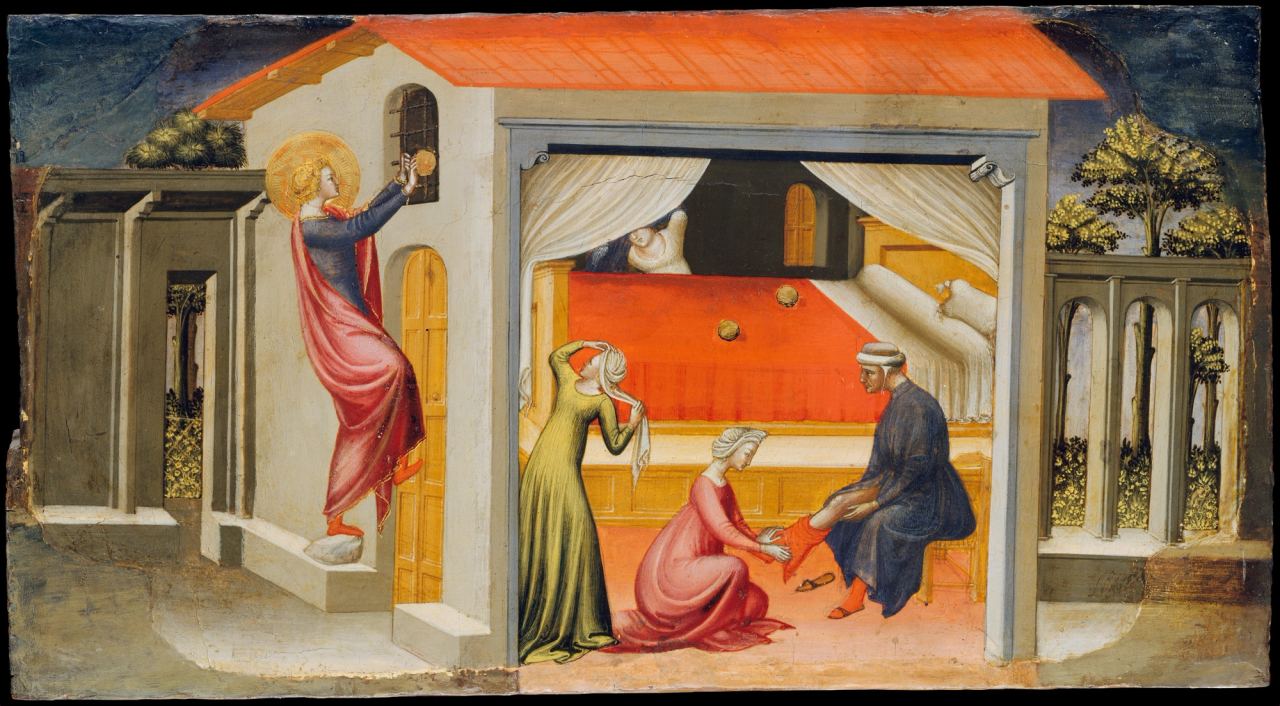
Bicci di Lorenzo's panel of 1433–35, now at the Metropolitan Museum, follows the story closely. The saint stands outside and tosses gold balls through a high window. The only stocking in the scene is on the father's leg: a daughter kneels at his feet and appears to be helping him with a red stocking, while a shoe lies on the floor.
A version often told today, for example by the St. Nicholas Center, says the gold "is said to have landed in stockings left to dry before the fire." We found no medieval or early modern text that includes those stockings, and none of the sources we read dates the detail. It is best treated as a later explanation of an existing custom, not its origin.
Where do Dutch shoes come in?
In the Netherlands the receptacle was a shoe. The language magazine Onze Taal dates the custom of setting out a shoe for Sinterklaas to the sixteenth century. It cites G. A. Bredero's comedy Moortje of 1615, in which a nurse lists the sweets her son found, and a 1600 ban in Delft on stalls that sold St. Nicholas gifts. The Rijksmuseum's description of Jan Steen's *The Feast of St Nicholas* (1665–68) explains the crying boy at left: naughty children "get only a switch (a bundle of twigs) in their shoe."
Shoe and stocking share a December night, a gift-giving saint and a place by the hearth. The printed record we read does not show one turning into the other in New York. Irving, for what it is worth, put both into his Dutch households: a housewife "knitting stockings" by the hearth, and a mistress and her maid who left their shoes at the parlor door and went in "on their stocking feet."
What was a stocking in the 1820s?
A real piece of clothing. Stockings were knitted tubes shaped to the leg and foot, held up by garters, bands fastened around the leg. The Victoria and Albert Museum has a pair of brocaded silk garters of 1840–50 that fasten with bows, and a pair of embroidered silk garters of about 1820–40 fitted with "watch spring elastic."
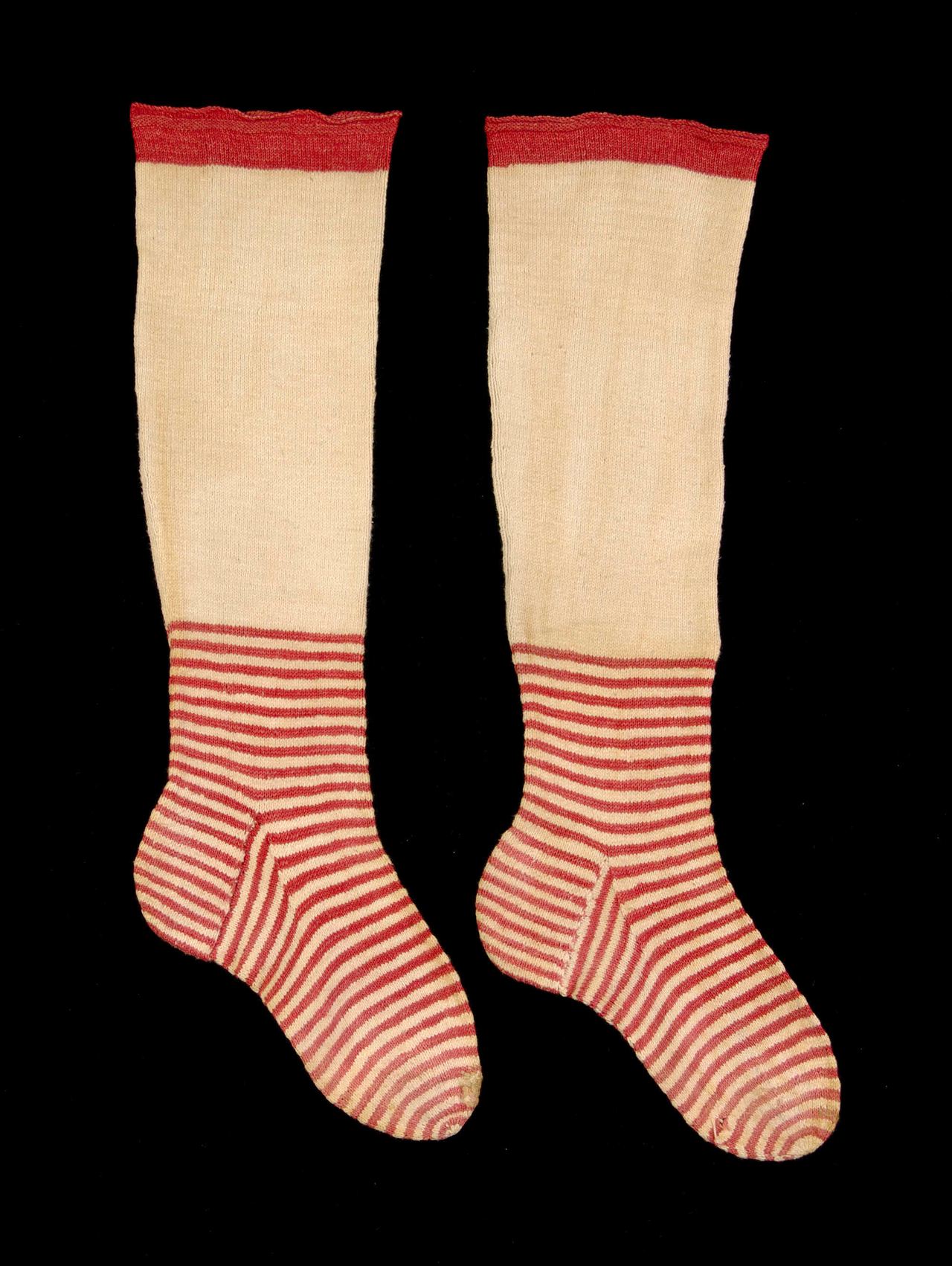
They were made both by hand and by machine. The V&A notes that the stocking frame was invented in the late sixteenth century and the circular frame in the early nineteenth, and that the jury of the 1851 Great Exhibition counted 50,000 stocking frames in the hosiery trade. Its collection also holds stockings knitted by hand, including one said to have been made by a Charlotte Fellows around 1838. A stocking of this period could be wool, cotton or silk, and women's stockings often carried "clocks," patterns worked at the ankle. The women of Irving's imagined Dutch town wore "blue worsted with magnificent red clocks."
None of the early texts says why a stocking was chosen. What the objects show is a garment every household owned, the descendant of medieval hose, made of knitted fabric that stretches around whatever is put inside. Colored stockings had risks of their own: our story on arsenic green notes a Massachusetts report of a child who died after wearing stockings colored with an arsenical pigment.
When did the Christmas stocking become a decoration?
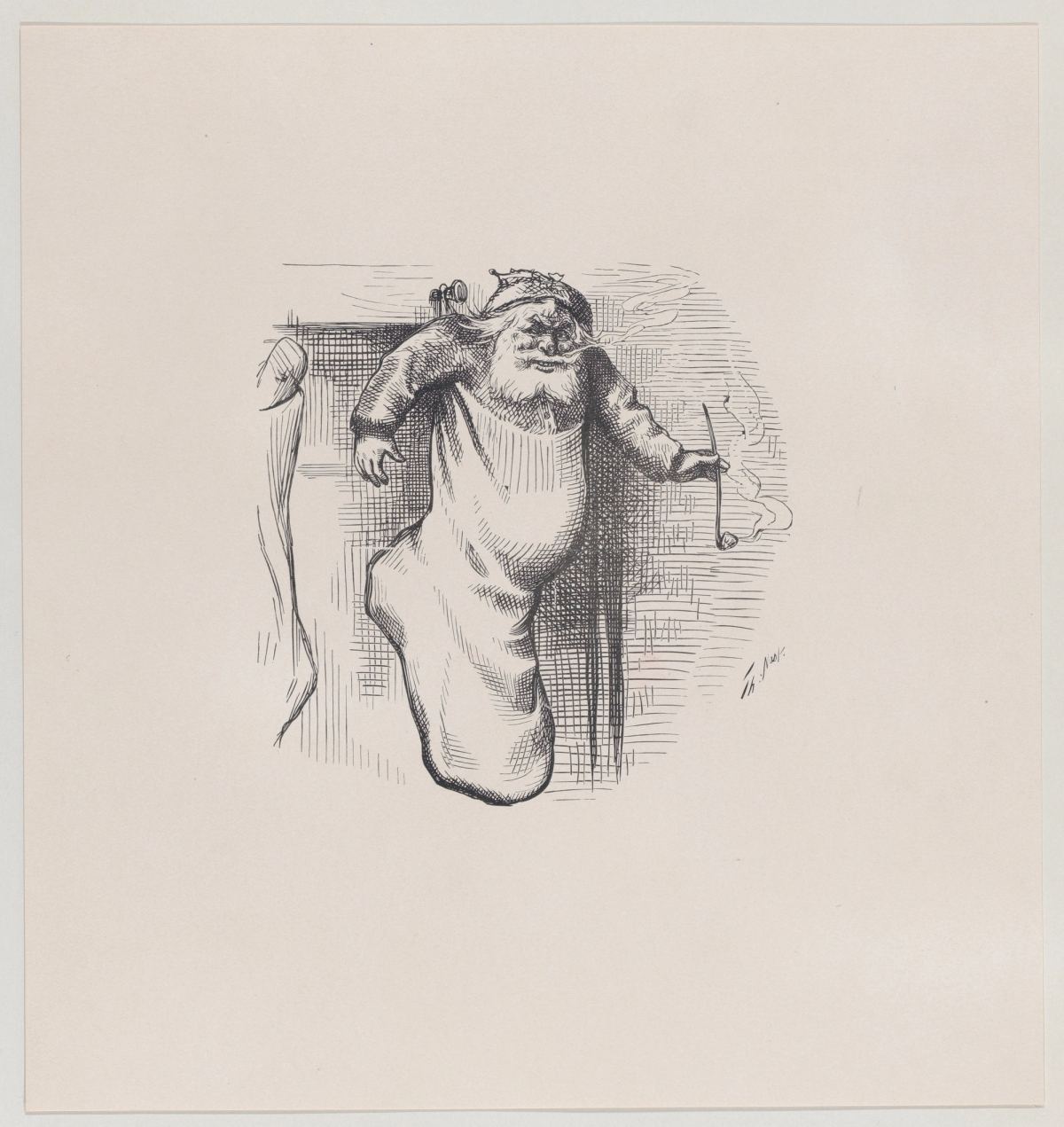
Later, and gradually. By January 4, 1879, when Harper's Weekly printed Thomas Nast's "A Stocking Full," the joke was that Santa himself could fit inside one. Around 1890 the illustrator K. Röger drew Father Christmas for the publisher Ernest Nister dropping a ball into a stocking at the end of a bed, with three more hanging empty on the bedstead, a reminder that stockings went on beds as well as chimneys, as the 1821 poem already suggests.
The V&A's childhood collection holds two English net stockings, dated 1915–29 and 1917–25, that were kept with their small gifts still inside: a miniature croquet set, a picture puzzle, a booklet of verse. Stockings like these were made for Christmas, not for legs. We could not open a dated record that settles when such stockings were first sold, so this piece makes no claim about a first.
Where can you see these objects?
Nast's print, Bicci di Lorenzo's panel and dozens of nineteenth-century stockings are on the Metropolitan Museum's collection site. Jan Steen's painting is in the Rijksmuseum, Amsterdam. The V&A's online collection includes a machine-knitted silk stocking made for the 1851 Great Exhibition by Pope & Plante of London, with the maker's name and motto knitted into the top. For why ordinary garments like these are rare in museums at all, see why so few old clothes survive.
Sources
- A History of New York, vol. 2 (first edition, 1809), p. 252. Inskeep & Bradford, New York; digitized Harvard copy on Internet Archive. Full text read (OCR) and passage checked: Stuyvesant's household never let St. Nicholas's day pass 'without making presents, hanging the stocking in the chimney'. Catalogue: first edition, 1809. Accessed November 12, 2026.
- A History of New York, vol. 1 (first edition, 1809). Inskeep & Bradford, New York; Columbia University Libraries copy on Internet Archive. Full text read (OCR): goede vrouw knitting stockings by the hearth; housewives leave shoes at the door and enter on their stocking feet; stockings of blue worsted with magnificent red clocks. The 1809 chapel passage has no stocking ceremony. Accessed November 12, 2026.
- A History of New-York (1812 edition). Inskeep and Bradford; NYPL copy on Internet Archive. Full text read (OCR): the 'hanging the stocking in the chimney' line is retained; the chapel passage still has no 'St. Nicholas Eve' ceremony. Accessed November 12, 2026.
- Knickerbocker's History of New York (revised text with the Author's Apology dated Sunnyside, 1848). Project Gutenberg #13042 (W. B. Conkey reprint). Full text read: 'pious ceremony... of hanging up a stocking in the chimney on St. Nicholas Eve; which stocking is always found in the morning miraculously filled'. Accessed November 12, 2026.
- Old Santeclaus (The Children's Friend, 1821). Representative Poetry Online, University of Toronto. Page read: source edition New-Year's Present to the Little Ones from Five to Twelve, William Gilley, 1821; line 'And various beds and stockings seen'. Accessed November 12, 2026.
- The Children's friend. Number III. Part III (1821), page 3. Wikimedia Commons, from Beinecke Rare Book and Manuscript Library, Yale. File page read: dated 1821, illustration to verse 3 of 'Old Santeclaus with Much Delight', Beinecke record 3437144. Confirms date and illustrated booklet. Accessed November 12, 2026.
- Account of a Visit from St. Nicholas (Troy Sentinel, December 23, 1823). Wikisource (transcription of the newspaper page). Read: editor's preface ('We know not to whom we are indebted...'), 'The stockings were hung by the chimney with care' and 'And fill'd all the stockings'. Accessed November 12, 2026.
- Account of a Visit from St. Nicholas. Representative Poetry Online, University of Toronto. Read: original text from the Troy Sentinel, December 23, 1823 (via Don Foster, Author Unknown, 2000); stockings lines confirmed. Accessed November 12, 2026.
- The Autograph Copy of the 'Visit from St. Nicholas', Quarterly Bulletin 1917, pp. 111-115. New-York Historical Society, on Internet Archive. Full text read: first published anonymously in the Troy Sentinel on December 23, 1823; authorship acknowledged in the Troy Budget 1838 and in Poems by Clement C. Moore, 1844. Accessed November 12, 2026.
- The Golden Legend, vol. 2: The Life of S. Nicholas the Bishop. Internet Medieval Sourcebook, Fordham University (Caxton's 1483 English, Temple Classics ed. 1900). Read in full: Nicholas throws 'a mass of gold wrapped in a cloth' into the neighbor's house by night, three times; no stockings or chimney. Title page: compiled by Jacobus de Voragine, dated 1275 by that edition. Accessed November 12, 2026.
- Saint Nicholas Providing Dowries, Bicci di Lorenzo, 1433-35 (88.3.89). The Metropolitan Museum of Art (Collection API record). Record read: title, artist, date, medium, public domain. Image inspected at full size. Accessed November 12, 2026.
- St. Nicholas and American Christmas Customs. St. Nicholas Center. Read: the dowry gold 'is said to have landed in stockings left to dry before the fire'. Used only as an example of the modern retelling; it gives no date or early source. Accessed November 12, 2026.
- Hans Beelen and Nicoline van der Sijs, 'Wie zoet is...', Onze Taal 83 (2014), p. 347. DBNL / Onze Taal. Read: shoe-setting for Sinterklaas since the sixteenth century; Bredero, Moortje (1615), the nurse Geertruy lists the sweets in her son's shoe; Delft ban of 1600 on St. Nicholas stalls. Accessed November 12, 2026.
- Jan Havicksz. Steen, The Feast of St Nicholas, 1665-1668 (SK-A-385). Rijksmuseum (linked-data record id.rijksmuseum.nl/2006398). Record read: date 1665-1668, oil on canvas; English label: naughty children 'get only a switch (a bundle of twigs) in their shoe'. Image inspected (Public Domain Mark). Accessed November 12, 2026.
- Stocking, Pope & Plante, 1851 (T.59-1959). Victoria and Albert Museum. Record read in full: stocking frame late 16th century, circular frame early 19th; clocks typical of 19th-century women's stockings; 50,000 stocking frames per the Great Exhibition Jury Report; maker's name and motto knitted in. Accessed November 12, 2026.
- Pair of garters, brocaded silk, 1840-50 (T.207D&E-1915) and Embroidered silk garters, ca. 1820-40 (T.4&A-1925). Victoria and Albert Museum. Records read: brocade garters 'with bows to fasten'; embroidered silk garters (O152900) with 'watch spring elastic'. Accessed November 12, 2026.
- Stocking, knitted, ca. 1838 (CIRC.759-1925). Victoria and Albert Museum. Record read: 'Said to have been knitted by Charlotte Fellows', English, ca. 1838. Accessed November 12, 2026.
- Stockings, American, ca. 1860 (2009.300.7726a, b). The Metropolitan Museum of Art (Collection API record). Record read: cotton, ca. 1860, public domain; image inspected at full size. Accessed November 12, 2026.
- A Stocking Full, Thomas Nast (33.35.85). The Metropolitan Museum of Art (Collection API record). Record read: published in Harper's Weekly, January 4, 1879; relief print and electrotype; public domain; image inspected. Accessed November 12, 2026.
- Harper's Weekly 1879, vol. 23, index. Internet Archive. Index read (OCR): 'Stockingful, A (Santa Claus), 16', confirming publication early in vol. 23 (1879). Accessed November 12, 2026.
- Father Christmas putting a ball into a stocking while children sleep, K. Roger, ca. 1890 (RENIER.393). Victoria and Albert Museum. Record read: watercolour for Ernest Nister; stocking at the end of a bed, three others empty on the bedstead. Accessed November 12, 2026.
- Net stockings with small gifts, England, 1915-1929 (B.342:1 to 13-2012) and 1917-1925 (B.327:1 to 4-2012). Victoria and Albert Museum (Young V&A). Records read: object type 'Christmas stocking'; miniature croquet set, picture puzzle, booklet of verse kept inside. Second record: https://collections.vam.ac.uk/item/O1258871 Accessed November 12, 2026.
Glossary
Last updated · Markdown · Report an error