Why Men's and Women's Buttons Sit on Opposite Sides
Why do men's and women's shirts button on different sides? Nobody has documented the reason. The men's rule is in print by 1751, 18th-century women's garments follow it, and the popular stories do not hold up.
Nobody has documented why. The convention is easier to date than to explain. Men's garments close with the buttons on the right by the mid-18th century, 18th-century women's garments in museum records do the same, and the women's rule reverses only in the 1860s and 1870s. The popular explanations rest on anecdote.
Which side is which?
On a man's shirt or coat the buttons sit on the wearer's right and the buttonhole on the left, so the left front laps over the right. A woman's garment is the reverse: buttons on the wearer's left, buttonholes on the right, the right front on top. The difference runs through every button-front garment, down to the placket of a modern shirt.
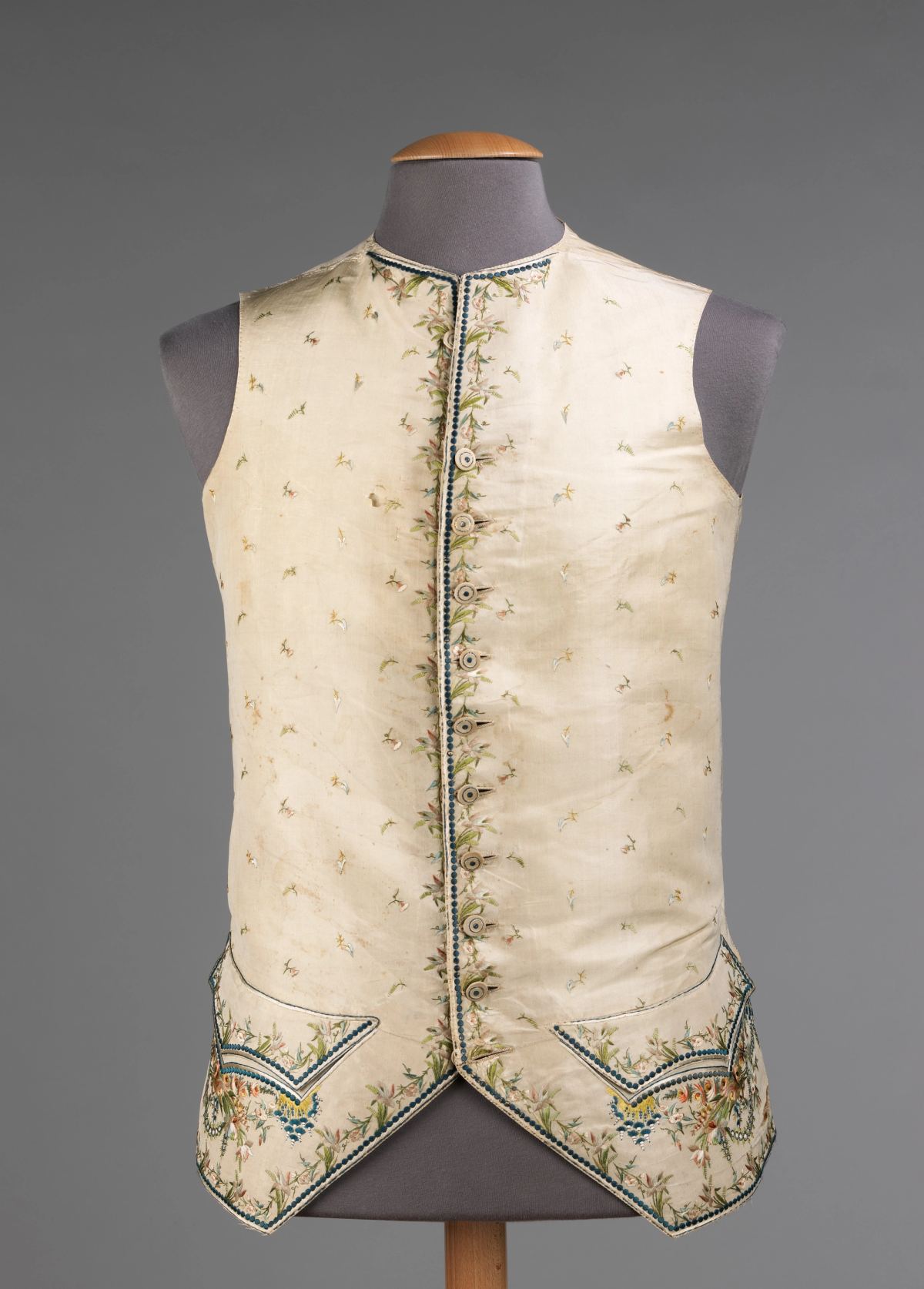
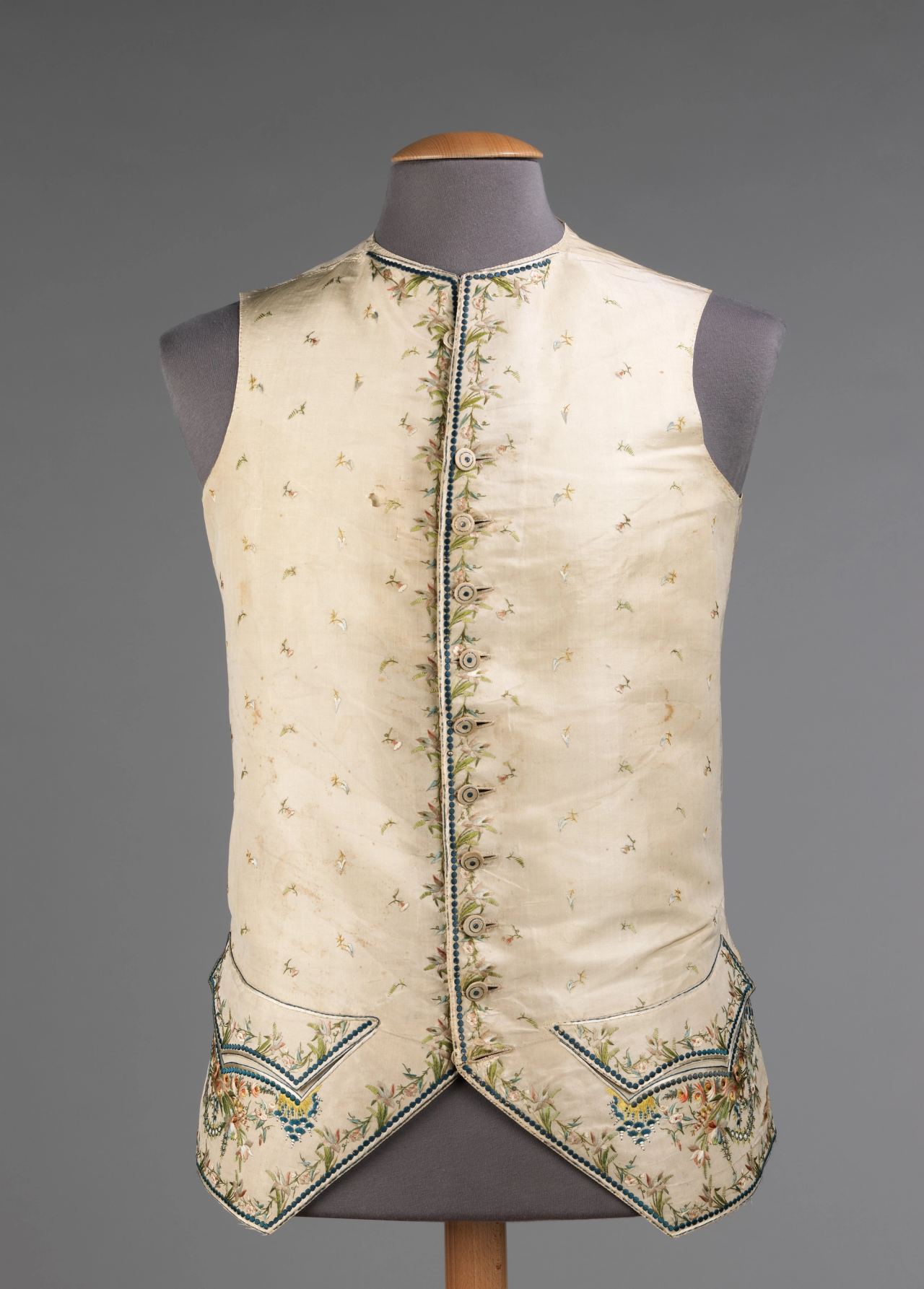
The men's rule is already written down in 1751. The Encyclopédie of Diderot and d'Alembert defines the buttonhole as an opening cut in garments, "d'homme sur-tout" (men's especially), and states: "Le bouton est à droite, & la boutonniere est à gauche" (the button is on the right and the buttonhole on the left). The entry does not say whose right, but museum records of men's waistcoats of the same decades are explicit. The Victoria and Albert Museum counts 12 worked buttonholes along the left front, and the buttons on the right front, of a British waistcoat of 1755–60, and 13 on the left front of a French one of the 1760s. The Met's French silk waistcoat of 1760–70 appears to follow suit: in the museum photograph the buttonholes are cut in the wearer's left front, which laps over the right.
When does the difference first show up for women?
Not in the 18th century. The same V&A records put women's buttons on the men's side. A woman's riding habit of 1770–75 has seven buttons on the right front and the buttonholes on the left. A woman's French Brunswick jacket of 1765–75 has 17 buttons on the right and 17 buttonholes on the left. So do a woman's jacket of the 1780s and women's riding coats of the 1750s, which were cut after men's coats.
The clearest survey of what happened next is by Alexa Bender on marquise.de, a costume-history site. She looked at historical depictions, gives no count, and finds buttons rare on women's dress before the late 18th century. In the 1830s they are rare and split evenly between right and left; in the 1850s left slightly outweighs right; from the late 1860s, when buttons are common on women's dress, all are on the left. She concludes the changeover happened between 1810 and 1860 and was not settled before about 1860.
Treat that as one researcher's reading of pictures. Mary Miley's dress-history blog, relaying unnamed curators, says buttons were seldom used on women's clothes before the 19th century and guesses that the left-hand rule began in the early 20th century with ready-made blouses. A commenter answered with images of buttoned women's clothing from earlier centuries, and Miley softened "almost never" to "seldom".
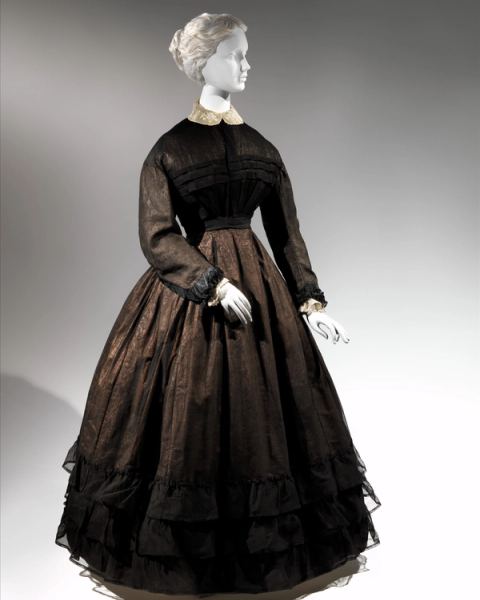
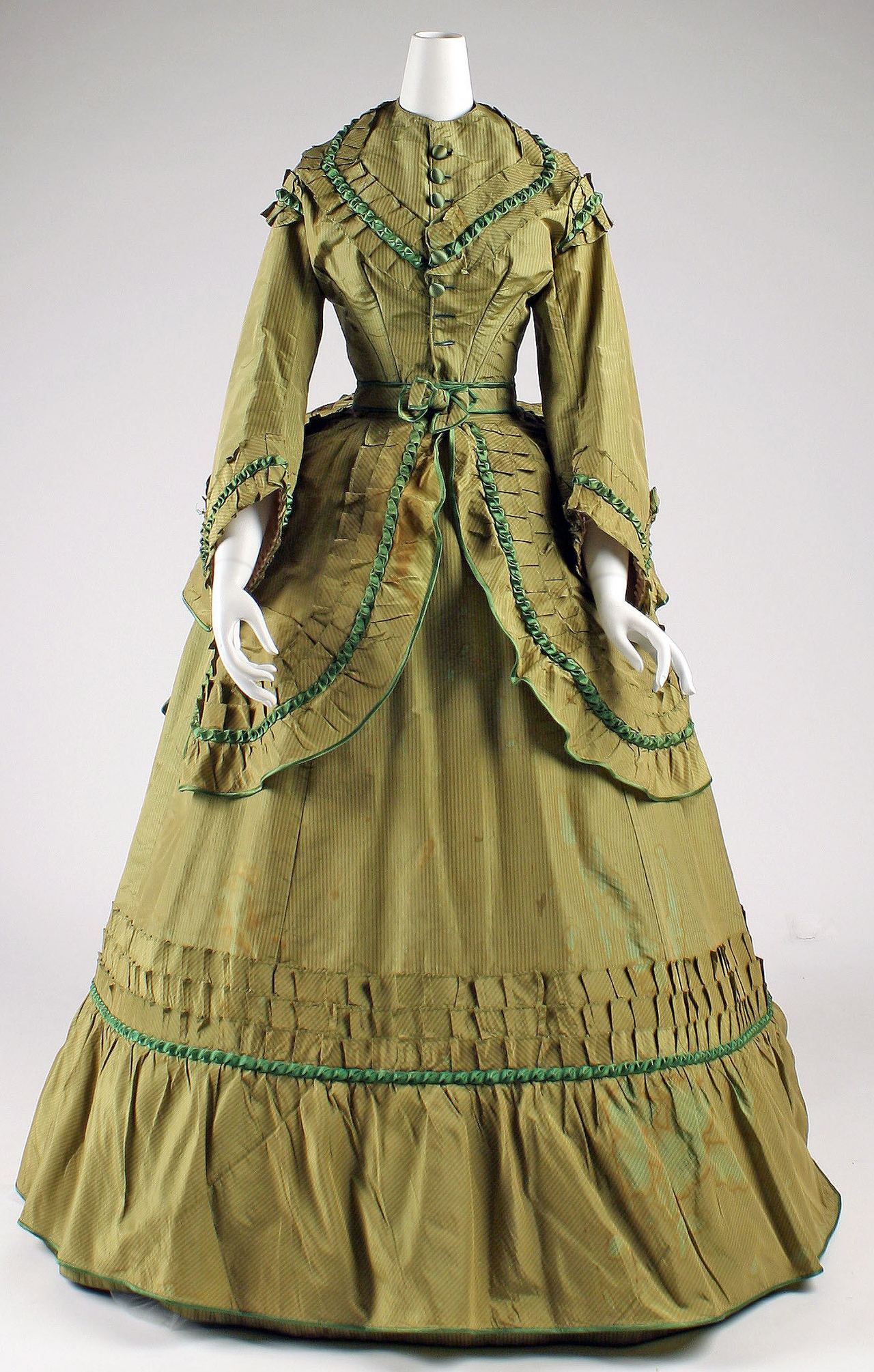
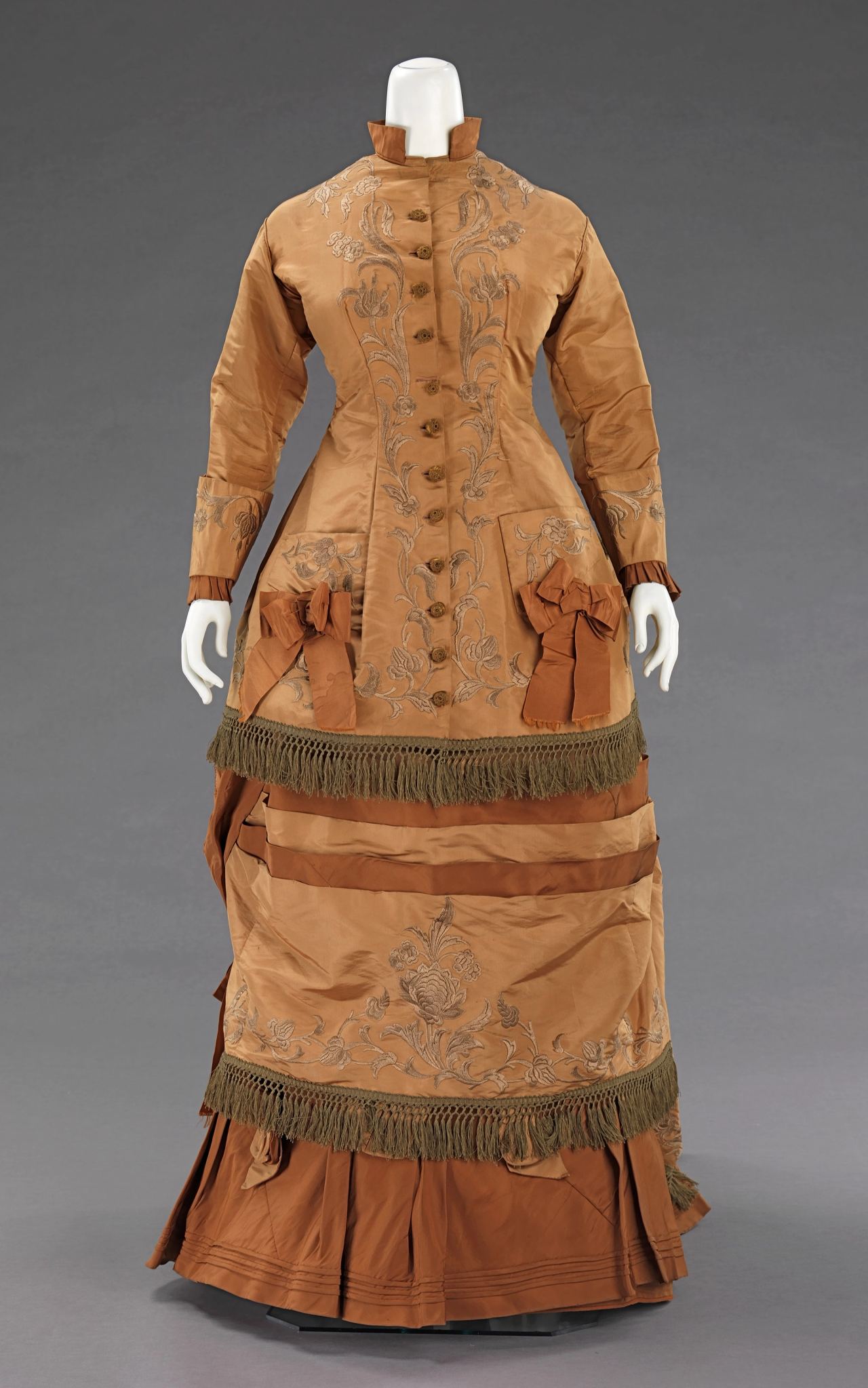
Two Met dresses show how narrow the window is. In the museum photographs, an American silk dress of 1868–70 appears to have its buttonholes down the bodice in the wearer's left front, the male arrangement. An American silk afternoon dress of 1874 appears to have them in the wearer's right front, the female one. Two garments are an anecdote, not a survey. But they fit a convention that was still forming in the late 1860s.
Did maids dictate the side?
The explanation repeated most often is that wealthy women were dressed by servants. A right-handed maid facing her mistress finds buttons on the mistress's left easier. The Smithsonian's and The Conversation's explainers, the latter by JuYoung Lee and Caroline Kobia of Mississippi State University, both present it as among the most common accounts. Wikipedia's Buttonhole article calls it lore and says there appears to be no concrete reference to prove or disprove it.
The dates are the problem. If maids set the rule, women's buttons should have sat on the left in the 1700s, when ladies' maids were common. The museum records show them on the right. Bender asks why the switch would take a century, and notes that men also had servants who closed dozens of waistcoat buttons daily. Marcelo de Araujo, in a 2012 article in the Brazilian journal dObra[s], repeats the maid and sword accounts only as what "is believed", and cites a popular history of Victorian fashion (Chrisp, 2005) for the maid story, not a period source.
What about swords, babies and Napoleon?
Swords. The Smithsonian quotes Paul Keers, author of A Gentleman's Wardrobe, as telling the Guardian in 2011 that a sword worn on the left hip would catch in a jacket lapped right over left, so a swordsman wanted it left over right. The argument addresses only the men's side, and no tailor's statement of that motive was found.
Armor. The Met's 1982 catalog The Art of Chivalry says the plates sewn into a medieval surcoat overlapped from left to right to stop a lance point slipping between them, and adds: "Thus, men's jackets button left to right even to the present day!" The passage cites no source for that last link. Araujo, citing Graeme Donald's Loose Cannons, repeats it.
Babies and saddles. The Smithsonian reports that mothers hold infants on the left arm, and that women riding sidesaddle needed left-side buttons against the breeze, as things "others insist" and "some have argued". The History Facts site calls neither particularly convincing, and no dated garment or period writer was found behind either.
Napoleon. The story says women mocked his hand-in-waistcoat pose and he ordered women's shirts buttoned the opposite way. The Smithsonian lists it among the more far-fetched theories, and History Facts calls it almost certainly apocryphal. The pose appeared in portraits by the 1750s, according to Wikipedia. The 1751 Encyclopédie entry above predates Napoleon, born in 1769, by almost two decades, and the V&A's woman's jacket of the 1780s still has its buttons on the right.
So what is actually known?
| Claim | What the sources show |
|---|---|
| Men's clothes close left over right in the 1700s | Stated in the 1751 Encyclopédie; recorded on V&A waistcoats of 1755–69; visible in the Met's 1760–70 waistcoat |
| Women's buttons began on the men's side | Recorded on V&A women's garments of the 1750s to 1780s; one survey of depictions agrees |
| The left-side rule for women settles | Changeover placed between 1810 and 1860; all buttons on the left from the late 1860s (one survey) |
| Maids, swords, babies, saddles, Napoleon | Repeated in popular articles; no primary source found for any |
The honest answer is that the origin is not documented. The evidence shows a men's rule that is already stated in 1751, women's garments that follow it through the 18th century, and a women's rule that settles about a century later. Once it formed, it stayed: The Conversation notes that when zippers spread in the early 1900s, clothing companies kept the existing customs for each sex.
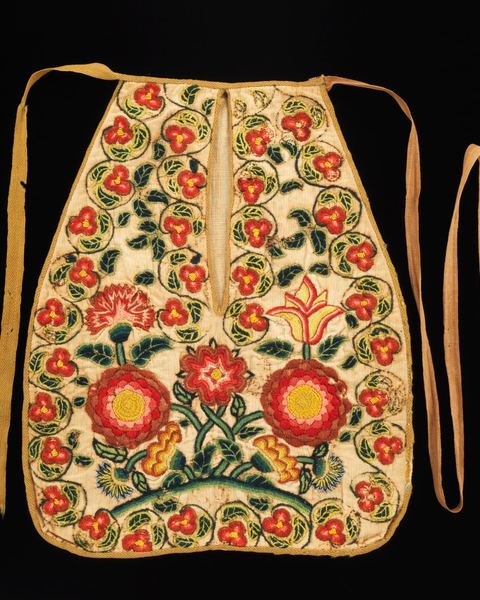
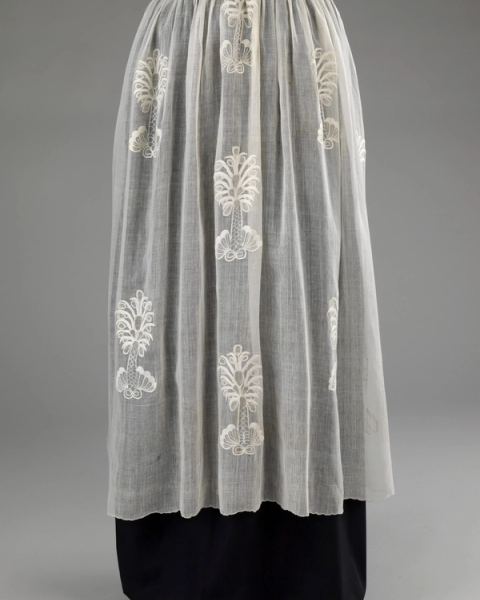
Related reading on other 18th-century garment details: tie-on pockets and a lady's apron.
Where to see them
The three garments in the photographs are in the Costume Institute collection of The Metropolitan Museum of Art: the waistcoat, the 1868–70 dress and the 1874 afternoon dress. The V&A records cited are searchable by their object numbers in its online collection.
Sources
- L'Encyclopédie, 1st ed., vol. 2 (1751), 'BOUTONNIERE' (Wikisource transcription, pp. 385–386). Diderot and d'Alembert (Wikisource transcription). Primary, read in full via the Wikisource API: buttonholes cut in garments 'd'homme sur-tout'; 'Le bouton est à droite, & la boutonniere est à gauche'; button enters from beneath. Transcription, not a facsimile; does not say whose right Accessed October 16, 2026.
- Waistcoat, 1755–1760 (T.158-1975). Victoria and Albert Museum. Record read via the V&A API: man's waistcoat, 12 worked buttonholes on the left front, buttons (missing) on the right front Accessed October 16, 2026.
- Waistcoat, 1760–1769 (T.283-1910). Victoria and Albert Museum. Record read via the V&A API: man's waistcoat, 13 worked buttonholes along the left front, buttons on the right front Accessed October 16, 2026.
- Riding habit, 1770–1775 (269 to B-1890). Victoria and Albert Museum. Record read via the V&A API: woman's riding habit, nine buttons on the right front, buttonholes on the left Accessed October 16, 2026.
- Brunswick, 1765–1775 (T.331-1985). Victoria and Albert Museum. Record read via the V&A API: woman's French jacket, 17 buttons on the right front and 17 buttonholes on the left front Accessed October 16, 2026.
- Jacket, 1780s (T.232-1927). Victoria and Albert Museum. Record read via the V&A API: woman's jacket, four buttons on the right side, four buttonholes on the left Accessed October 16, 2026.
- Riding coat, 1750–1759 (T.554-1993). Victoria and Albert Museum. Record read via the V&A API: woman's riding coat, seven buttons on the right side, seven buttonholes on the left front. Related riding coats T.12-1957 and T.197-1984 (O115761, O115762) read too Accessed October 16, 2026.
- Waistcoat, French, 1760–70 (2009.300.2855). The Metropolitan Museum of Art. Object record via the Met API. Closure read from enlarged crops of the full-size photograph: buttonholes (bound slits) in the wearer's left front Accessed October 16, 2026.
- Dress, American, 1868–70 (C.I.44.92.1a–c). The Metropolitan Museum of Art. Object record via the Met API. Closure read from an enlarged crop: slits in the wearer's left front. Worded 'appears' in the text Accessed October 16, 2026.
- Afternoon dress, American, 1874 (2009.300.777a–c). The Metropolitan Museum of Art. Object record via the Met API. Closure read from enlarged crops: slits in the wearer's right front. Worded 'appears' in the text Accessed October 16, 2026.
- The Art of Chivalry: European Arms and Armor from The Metropolitan Museum of Art (Nickel, Pyhrr and Tarassuk, 1982). The Metropolitan Museum of Art (Internet Archive full text). Read the surcoat passage directly in the full text: plates overlapped left to right; 'Thus, men's jackets button left to right even to the present day!'; no source cited there Accessed October 16, 2026.
- Esquerdo sobre direito (Left over right), Marcelo de Araujo. dObra[s], vol. 5, no. 12 (2012), pp. 68–76. Scholarly article in Portuguese, read in full. Maid, sword and armor accounts given as belief; cites Chrisp 2005 and Donald 2009 Accessed October 16, 2026.
- Buttons Right, Buttons Left, by Alexa Bender. marquise.de. Read in full (page dated 2013). Survey of historical depictions; gives no count or sample size Accessed October 16, 2026.
- Men's Shirts Button on the Right. Why Do Women's Button on the Left? (Danny Lewis, updated by Ellen Wexler). Smithsonian Magazine. Read in full via an Internet Archive copy of 2026-08-31 (live site blocked). Keers is quoted there as speaking to the Guardian in 2011; the Guardian piece itself could not be opened Accessed October 16, 2026.
- Why are buttons and zippers on different sides of men's and women's clothes? (JuYoung Lee and Caroline Kobia). The Conversation. Read in full. Maid theory; zippers keeping the customs Accessed October 16, 2026.
- Revisited Myth #89 (Mary Miley). History Myths (blog). Read in full, including comments. Relies on unnamed curators; commenter's counter-examples Accessed October 16, 2026.
- Why Are Men's and Women's Buttons on Opposite Sides?. History Facts. Read in full. Breastfeeding, sidesaddle and Napoleon theories Accessed October 16, 2026.
- Buttonhole. Wikipedia. Used to locate references. Wikitext read: maid story is 'lore'; 'no concrete reference to prove or disprove' Accessed October 16, 2026.
- Hand-in-waistcoat. Wikipedia. Used to locate references. Pose appeared by the 1750s Accessed October 16, 2026.
- Napoleon I., 1911 Encyclopædia Britannica (Wikisource). Encyclopædia Britannica, 11th ed. (Wikisource). Birth: Ajaccio, 15 August 1769; also in Wikipedia Accessed October 16, 2026.
Glossary
Last updated · Markdown · Report an error