Design
Gertrud Höchsmann: Viennese Couturière of Muted Color
Gertrud Höchsmann (1902–1990) trained under Josef Hoffmann, drew for the Wiener Werkstätte in 1925, then ran a Vienna couture salon for forty years. Her signature: clear lines and muted color.
Gertrud Höchsmann (1902–1990) was a Vienna fashion designer who ran her own couture salon on Mariahilfer Straße from 1927 to 1967 and, from 1959, led the fashion class at what is now the University of Applied Arts Vienna. Austrian sources remember her for clear lines and muted colors.
Who was Gertrud Höchsmann?
She was born in Vienna on 30 September 1902 and trained under Josef Hoffmann, the architect who co-founded the Wiener Werkstätte. For forty years she ran a haute couture salon in the city, and a 2020 motion by councillors of Vienna's Mariahilf district, asking for a memorial plaque at the salon's address, calls her an avant-garde figure of Viennese haute couture. The same motion gives her taste in one line: a preference for clear lines and muted colors.
Her name is back in the news. The Wien Museum's exhibition True Colors – Viennese Fashion across Four Centuries (in German, Farbenspiel) runs from 1 October 2026 to 28 March 2027 and lists her among the Viennese designers on show, next to Adele List, Fred Adlmüller, Helmut Lang, Schella Kann and Susanne Bisovsky. A show about what colors mean in clothing is an unlikely home for a designer known for restraint, and that is a good reason to look at her work.
What follows is what the documents support. Her biography is thinly sourced online, mostly one city encyclopedia entry, one museum-district motion and a 2002 exhibition review, so this profile is shorter than a profile of a better-documented designer would be, and it says where sources differ or run out.
How did a Hoffmann student become a couturière?
According to the Wien Geschichte Wiki, the city's history encyclopedia, she studied at the Vienna Kunstgewerbeschule (School of Applied Arts) from 1920 to 1925, under Rosalia Rothansl and Josef Hoffmann, and spent one year as a guest in the textile department before three years in Hoffmann's specialist class. Other summaries name Hoffmann and the architect Oswald Haerdtl as her teachers instead, and the Wiki records her saying that the two taught her that everything must be functional.
Her first paid design work was for the Wiener Werkstätte. The Wiki dates her time in its design department to October 1925 through March 1926, working on textiles for the firm Haas & Söhne and wallpaper for Max Schmidt. The Museum of Applied Arts (MAK) in Vienna holds a group of her drawings from the Werkstätte archive, donated in 1955: fashion sketches dated 1925 and textile designs; the sheets I opened are signed.
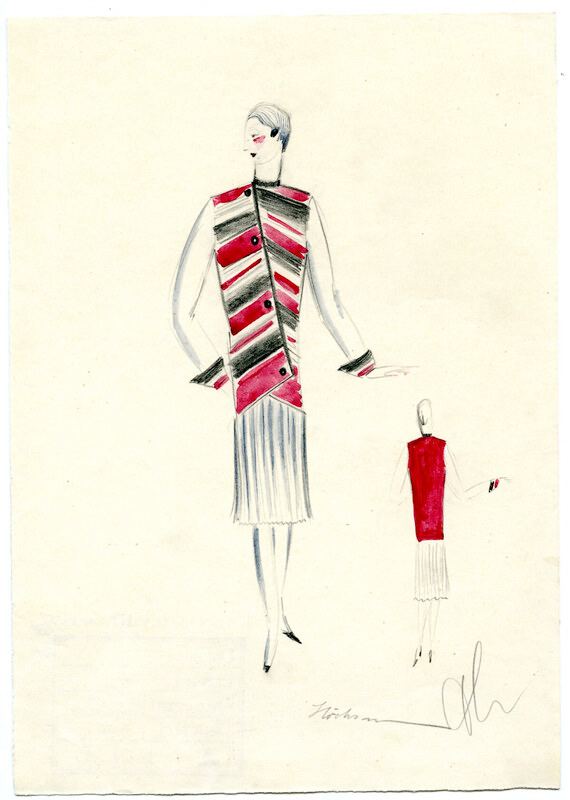
They are not quiet pictures. The suit above has a diagonal front in crimson and black bands over a pleated skirt, with a small second figure showing the back. The textile design below is a thicket of pink blossoms, black leaves and teal shapes. The MAK dates it "before 1925", and the archive stamp on the sheet appears to read 22/10/25, which would fall inside the months the Wiki gives for her Werkstätte job.
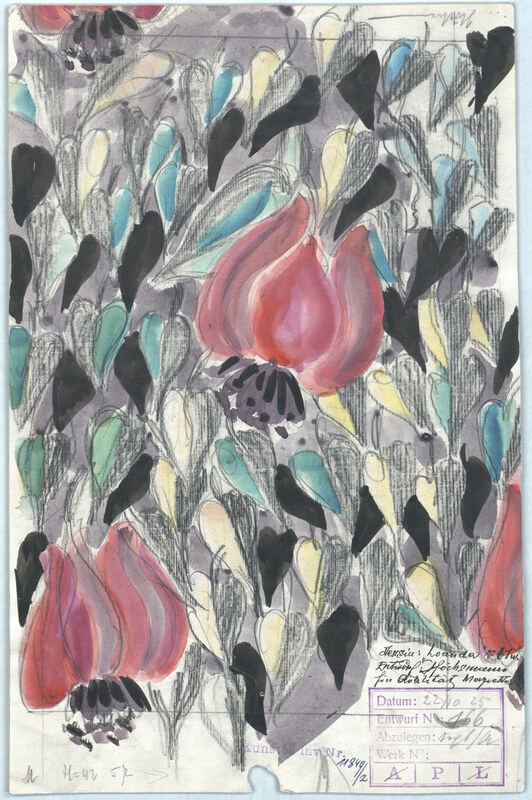
The color in these sheets is a useful reminder not to flatten her. The muted palette that Austrian sources attach to her name describes the salon years, not necessarily the student drawings.
She also learned the trade side of dressmaking. The Wiki says she trained in women's tailoring, taught at a trade school in Mödling, and passed her master's examination in women's and children's clothing in November 1929, two years after she had opened her own salon. The same entry says she was the daughter of Franz Höchsmann, a director of the Südbahn railway company.
What was the Höchsmann salon?
She opened a fashion salon in 1927 and closed it in 1967. The Mariahilf motion and the European Fashion Heritage Association both give those years, and the motion places the salon at Mariahilfer Straße 1c, next door to another famous atelier, that of the Flöge sisters (see Emilie Flöge: More Than Klimt's Muse). The Wiki adds details that no second source confirms: the salon at number 1c from 1929, about 50 staff, and, from 1939, a move into her private flat.
In the 1930s she worked with Fridl Steininger, who is also known as Fridl Loos. The Wiki describes a collaboration from 1929 to 1938 on designs and theater costumes; the critic Iris Meder, reviewing the 2002 retrospective, says the two ran a salon together in the thirties. Both sources agree on the end: Steininger left Austria in 1938, and the Wiki says she and Walter Loos left for political reasons. Meder reports that the two women never spoke about each other again.
Meder's review also paints the salon's circle. In the 1950s and 1960s, she writes, film names such as Najda Tiller and Grace Kelly came for cocktail dresses and suits, but the salon was above all a meeting point for Vienna's cultural figures. Oswald Haerdtl designed elegant modern furniture in 1946 that was shown in the exhibition, and his wife Carmela sketched Höchsmann's models. The painter Hilde Jesser-Schmid and the interior designer Friedl Niedermoser were customers. Meder adds that Höchsmann liked to dress in taupe. This is a single reviewer's account, so treat the client list as reported, not documented.
What did her clothes look like?
The most direct evidence is the clothes themselves. The Wien Museum's online collection lists several Höchsmann pieces and licenses its photographs under CC BY 4.0. Three are worth describing.
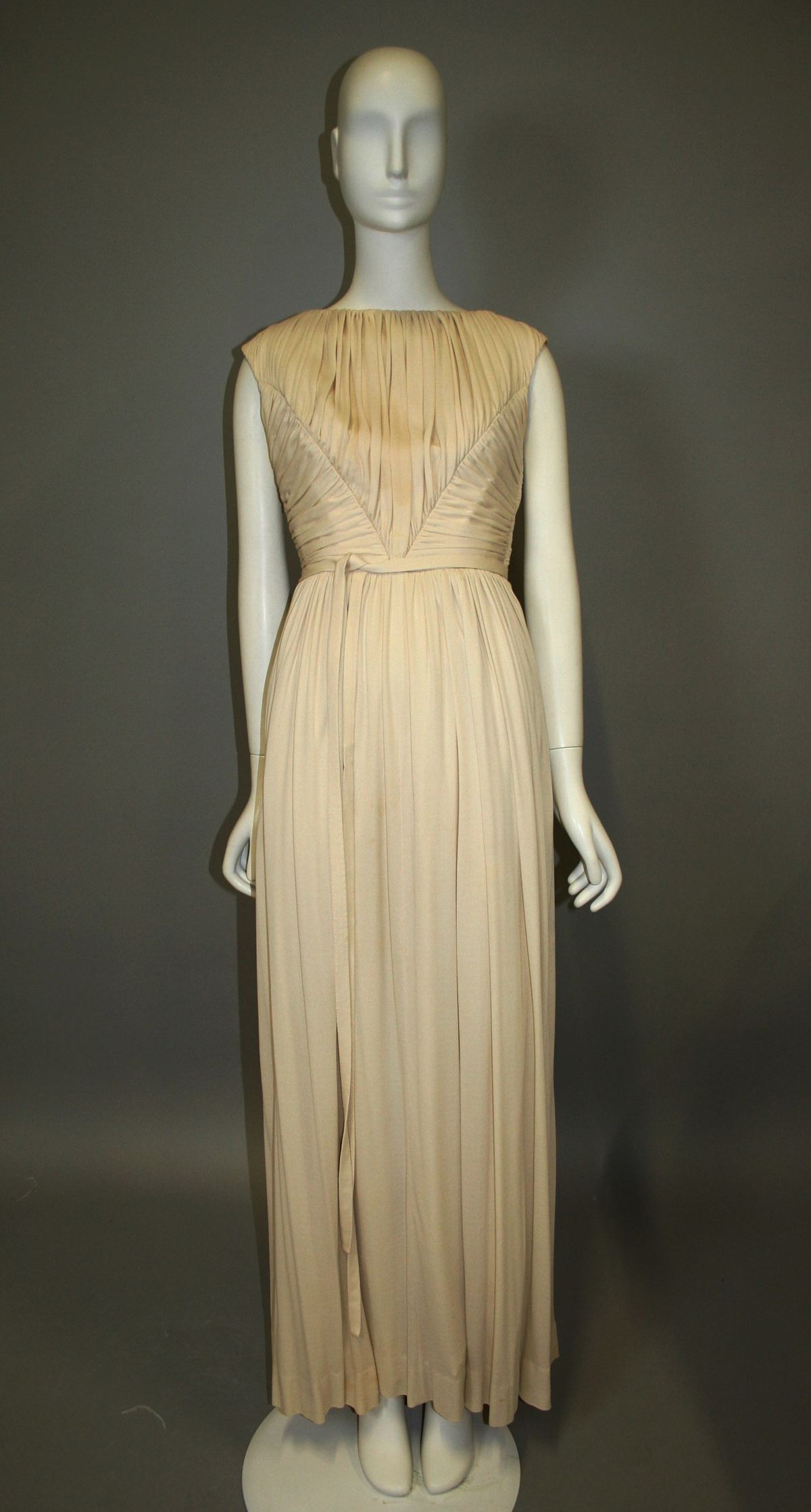
The ball gown at the top of this page, dated 1957–58 (M 20653), is made of silk jersey, rayon satin and silk taffeta, according to the record. In the photograph it is cream, floor-length and sleeveless; the bodice is gathered into folds under a V-shaped panel and a narrow belt ties at the waist. The photograph shows no beading or print; the interest lies in how the cloth is gathered.
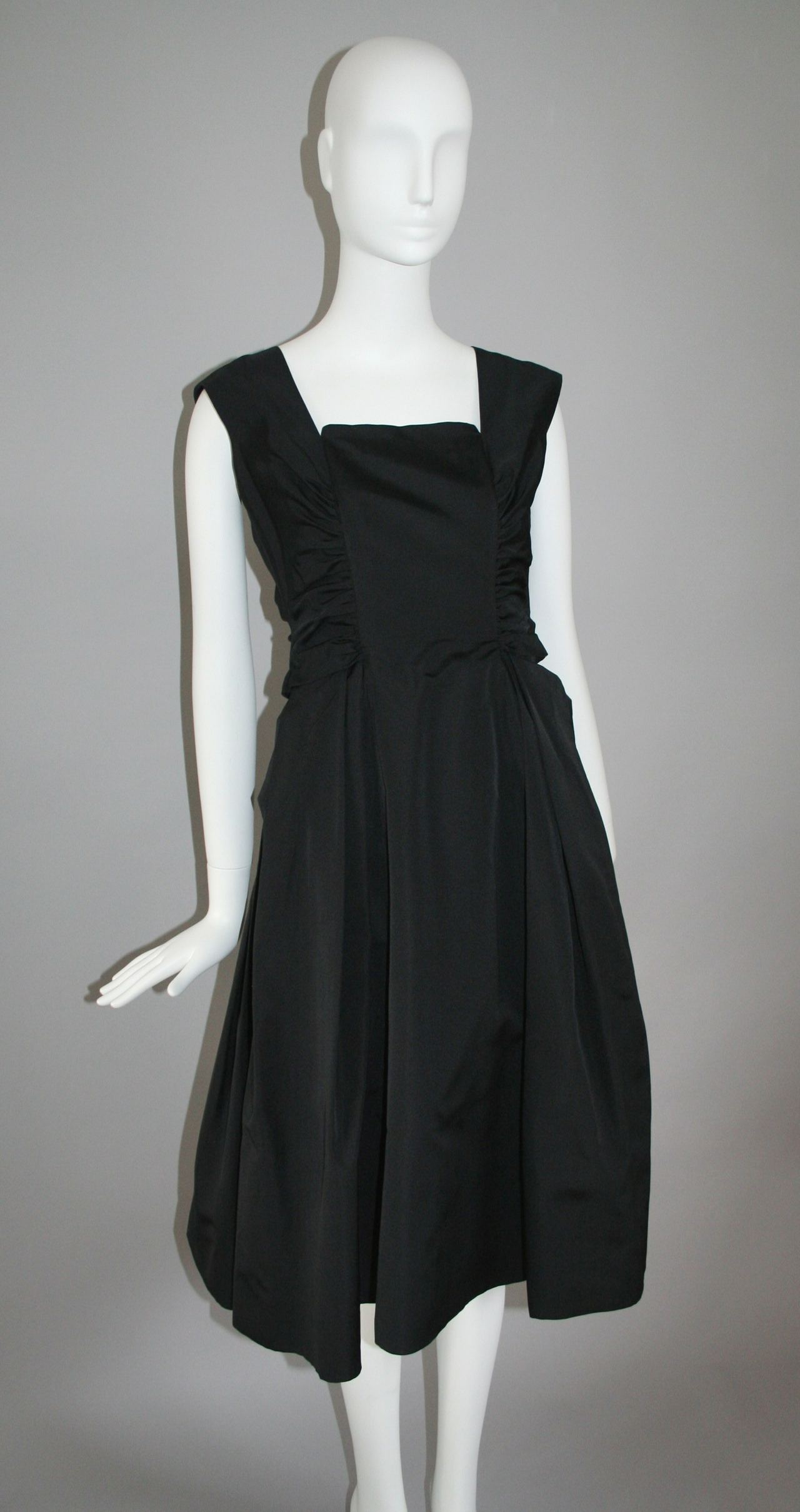
The black dress above (M 23527, around 1960) is silk rep with a square neckline and ruched side panels. The record also lists hand-done bead embroidery, which the photograph does not show. The collection also holds an afternoon dress of silk taffeta dated 1956–59 (M 22618). A 2019 note by the European Fashion Heritage Association, written about a different Höchsmann dress of 1956, sums up her designs as simple and clear-cut, in muted colors, shaped to follow the natural lines of the body.
On the exhibition floor, the Wien Museum shows a dark blue suit of 1950 by her. In the ORF report, the curator Michaela Lindinger calls it the classic "working outfit" for women in Vienna: plain, inconspicuous, wearable anywhere. She sets that against London and Paris and says Viennese fashion is "always rather simple, inconspicuous, has no garish colors" (my translation of immer eher einfach, unauffällig, sie hat keine grellen Farben). That fits a designer who, in Meder's account, summed up her approach in one line: Wo ein Knopf ist, da muss auch ein Knopfloch sein, "Where there is a button, there must be a buttonhole." Meder writes that her passion was a fashion that started from the architectural premises of Viennese modernism.
The pieces above are plain on purpose: a gathered bodice, a tie belt, a pleated skirt. The ornament is cut and drape, the work of an atelier run by a couturière who, the Wiki says, credited Hoffmann and Haerdtl with teaching her that everything must be functional.
What did she teach, and what did she win?
From 1959 she led the master class for fashion and textile work at the Academy of Applied Arts in Vienna, and she held the post until 1972. The Wiki says she became an associate professor (außerordentliche Professorin) in 1962, and that a May 1960 concept paper of hers set goals for the program, including fashion shows and a stronger role for tailoring. The Mariahilf motion and the European Fashion Heritage Association give the start as 1959/60 and the end as her retirement in 1972.
Her honors, per the Wiki: the City of Vienna Prize for Fine Arts in the applied-arts category (1947), a gold medal at the Munich Handwerksmesse (1956), the Austrian state prize for fashion for a model called "Happy End" (1966) and the City of Vienna's silver medal of honor (1978). The 1947 prize and the 1956 medal also appear in the Mariahilf motion; the 1966 and 1978 honors rest on the Wiki alone.
The University of Applied Arts' costume collection holds about 130 of her objects, and the fashion-class archive another 48 of her models, the Wiki says. Meder's review of the 2002 show notes that the dresses worn by the Niedermoser women are now part of that collection.
| Date | Event | Sources |
|---|---|---|
| 30 Sep 1902 | Born in Vienna | Wien Geschichte Wiki; Mariahilf motion (2020) |
| 1920–1925 | Studies at the Kunstgewerbeschule | Wien Geschichte Wiki |
| Oct 1925 – Mar 1926 | Works in the Wiener Werkstätte design department | Wien Geschichte Wiki; MAK records of 1925 drawings |
| 1927 | Opens her fashion salon | Wien Geschichte Wiki; Mariahilf motion; EFHA |
| Nov 1929 | Passes master's examination in women's and children's tailoring | Wien Geschichte Wiki |
| 1929–1938 | Works with Fridl Steininger (Loos); partnership ends when Steininger emigrates in 1938 | Wien Geschichte Wiki; Meder (2002) |
| 1947 | City of Vienna Prize for Fine Arts (applied arts) | Wien Geschichte Wiki; Mariahilf motion |
| 1956 | Gold medal, Munich Handwerksmesse | Wien Geschichte Wiki; Mariahilf motion |
| 1959 | Takes over the fashion class at the Academy of Applied Arts (sources give 1959 or 1959/60) | Wien Geschichte Wiki; Mariahilf motion |
| 1962 | Associate professor | Wien Geschichte Wiki |
| 1966 | State prize for fashion, model "Happy End" | Wien Geschichte Wiki |
| 1967 | Salon closes | Mariahilf motion; EFHA |
| 1972 | Retires from the Academy | Wien Geschichte Wiki; Mariahilf motion |
| Jan 1990 | Dies (16 January in most sources) | Wien Geschichte Wiki; Mariahilf motion; Wikidata |
| 7 Nov 2002 – 25 Jan 2003 | Retrospective "Wiener Couture" at the Heiligenkreuzer Hof, Vienna | artmagazine (Meder); basis wien |
| 1 Oct 2026 – 28 Mar 2027 | Named in the Wien Museum's *True Colors* show | Fashion.at; LEADERSNET; ORF |
Where do the sources disagree?
Death date: the Wien Geschichte Wiki, the Mariahilf motion and English Wikipedia give 16 January 1990. Wikidata carries two death dates for her: 16 January 1990, and a second entry of 1 January 1990 whose precision is set to the year only. That second entry is probably a placeholder meaning "1990", and it may be the source of the "1 January" that circulates. Nothing I opened gives a day other than the 16th.
Death place: the Wiki says Lilienfeld, in Lower Austria; the European Fashion Heritage Association says Vienna. Only the Wiki is specific, and she was buried at Vienna's Zentralfriedhof according to the Wiki and the motion.
Teachers: the Wiki names Rothansl and Hoffmann; the motion, English Wikipedia and the Association name Hoffmann and Haerdtl. The simplest reading is that she met all three, but no source I opened says so.
Her book: the standard monograph is Annemarie Bönsch, Wiener Couture. Gertrud Höchsmann (1902–1990), published by Böhlau. Open Library dates the 244-page edition to November 2002, matching the retrospective; the Wiki gives 2018 for the same title.
What do we not know?
The Wiki states that her conduct during the Nazi era is not documented on its page because that part of her life has not been researched. I found nothing that fills the gap, and the profile does not try to.
Her work in American collections is also outside this article. The Cooper Hewitt in New York is said to hold Wiener Werkstätte drawings by her, but its collection pages refused automated access during research, so I did not use them.
Where can you see her work?
- Wien Museum, Karlsplatz, Vienna: True Colors runs until 28 March 2027, and its online collection lists her gowns and dresses with photographs.
- MAK, Vienna: its online collection holds her 1925 Werkstätte drawings.
- University of Applied Arts Vienna: the costume and fashion collection holds the largest group of her garments, per the Wiki.
- In print: Bönsch's monograph, and the catalog for Farbenspiel, published by Hirmer.
For the surrounding history, see the profile of Emilie Flöge, whose salon was her neighbor on Mariahilfer Straße, and Color as Rank on what clothing colors signaled in the 1700s.
Sources
- Gertrud Höchsmann. Wien Geschichte Wiki (City of Vienna). Read in full (German): dates and places, teachers, Werkstätte period, salon, Steininger collaboration, professorship, prizes, collections, 2002/03 exhibition, bibliography, note that the Nazi-era conduct is unresearched. Used for most dates; single-source items are attributed in the text. Accessed November 1, 2026.
- Antrag: Gedenktafel für Gertrud Höchsmann (Mariahilf district council motion, 17 Dec 2020). Bezirksvertretung Mariahilf, Stadt Wien. PDF read in full (German): birth and death dates, salon 1927-1967 at Mariahilfer Straße 1c next to the Flöge atelier, professorship 1959/60-1972, clear lines and muted colors, 1947 prize, 1956 gold medal, burial at the Zentralfriedhof. Second source for core dates; a party motion, not a scholarly text. Accessed November 1, 2026.
- Wiener Couture - Gertrud Höchsmann (1902-1990): Dialektik des Knopflochs (Iris Meder, 14 Nov 2002). artmagazine. Full review read (German): salon clientele and circle, Haerdtl furniture 1946, Steininger partnership and 1938 emigration, taupe, the button/buttonhole remark, Angewandte collection, exhibition dates 7 Nov 2002-25 Jan 2003. Contemporary review of the retrospective; client names are the reviewer's report. Accessed November 1, 2026.
- Ausstellung zu Wiener Couture / Gertrud Höchsmann. Wiener Couture, 07.11.2002-25.01.2003, Heiligenkreuzer Hof. basis wien. Catalogue record read: exhibition dates and venue (second source for the 2002/03 retrospective). Accessed November 1, 2026.
- Wikidata: Gertrud Höchsmann (Q1515584). Wikidata. Entity JSON read: birth 1902-09-30 (day precision), two death statements: 1990-01-16 (day precision) and 1990-01-01 (year precision), place of death Lilienfeld. Used only to explain the 1 January discrepancy. Accessed November 1, 2026.
- Gertrud Höchsmann. Wikipedia (English). Read in full; used to locate references and as a third statement of birth/death dates, 1927-1967 salon, 1947 prize, professorship 1959-1972. Not used as a stand-alone source. Accessed November 1, 2026.
- EFHA Focus: Silk Dress by Gertrud Höchsmann, 1956 (5 May 2019). European Fashion Heritage Association. Read in full: salon 1927-1967, 1959/1960 fashion class, retirement 1972, 'simple, clear-cut designs in muted colours'. Says she died in Vienna (the Wiki says Lilienfeld). Accessed November 1, 2026.
- Farbenspiel: Wie sechs Farben vier Jahrhunderte Mode erzählen. LEADERSNET. Read: exhibition dates 1 Oct 2026-28 Mar 2027, designers named (Höchsmann, List, Adlmüller, Lang, Kann, Bisovsky), Hirmer catalogue, curators. Accessed November 1, 2026.
- True Colors Wien Museum fashion exhibition. Fashion.at. Read: exhibition run 1 Oct 2026 to 28 Mar 2027 in English; names Höchsmann among the designers. Accessed November 1, 2026.
- Mode im Wien Museum: Warum Gelb die Farbe der Außenseiter war (30 Sep 2026). ORF.at. Read: 'Farbenspiel' on view to 28 March 2027; the dark blue 1950 suit by Höchsmann as 'working outfit' for women in Vienna; curator Michaela Lindinger on plain Viennese fashion. Accessed November 1, 2026.
- True Colors - Viennese Fashion across Four Centuries (event page). Wien Museum. Opened: English exhibition title and a guided-tour date; the page itself carries neither the run dates nor Höchsmann's name, so dates and designers are cited to the three press pieces above. Accessed November 1, 2026.
- Ballkleid, M 20653 (Gertrud Höchsmann, 1957-1958). Wien Museum Online Sammlung. Object record read: designer, date, materials, dimensions, inscription, image licence CC BY 4.0. Photograph downloaded and inspected. Accessed November 1, 2026.
- Kleines Schwarzes, M 23527 (Gertrud Höchsmann, around 1960). Wien Museum Online Sammlung. Object record read: date, material (silk rep), bead embroidery noted, CC BY 4.0. Photograph downloaded and inspected. Accessed November 1, 2026.
- Nachmittagskleid, M 22618 (Gertrud Höchsmann, 1956-1959). Wien Museum Online Sammlung. Object record read: designer, date, material (silk taffeta), CC BY 4.0. Photograph inspected; not used as an illustration. Accessed November 1, 2026.
- Kostüm, KI 11855-21 (design by Gertrud Höchsmann, 1925). MAK - Museum of Applied Arts, Vienna. Object record read: design 1925, graphite, watercolor, design no. 46, signed, donated 1955, image marked Public Domain Mark 1.0 (CC BY-NC-ND 4.0 for the other image tier). Image inspected. Accessed November 1, 2026.
- WW-Stoff 'Loanda', KI 11849-2 (design by Gertrud Höchsmann, before 1925). MAK - Museum of Applied Arts, Vienna. Object record read: 'before 1925', design no. 166, signed, donated 1955. Archive stamp on the sheet inspected at 1,700 px (appears to read 22/10/25). Accessed November 1, 2026.
- Wiener Couture - Gertrud Höchsmann (1902-1990), Annemarie Bönsch (Böhlau, 2002), edition record. Open Library. Edition record read: publisher Böhlau, 244 pages, November 2002. The Wien Geschichte Wiki gives 2018 for the title. Accessed November 1, 2026.
Glossary
Last updated · Markdown · Report an error