Design
Emilie Flöge: More Than Klimt's Muse
Who was Emilie Flöge, and what was reform dress? A Vienna couture salon run by three sisters from 1904 to 1938, a corset-free ideal, and a painter's long shadow.
Emilie Flöge (1874–1952) was a Viennese dressmaker and designer who, with her sisters Pauline and Helene, ran the couture salon Schwestern Flöge from 1904 until 1938. Reform dress, or Reformkleid, was the loose, corset-free dress that artists, doctors and women's groups promoted around 1900. Flöge wore it and showed it, but the Austrian museum that holds part of her estate says most of what her salon made followed mainstream taste.
Who was Emilie Flöge?
Emilie Louise Flöge was born in Vienna on 30 August 1874 and died there on 26 May 1952. She was the youngest of three daughters of Hermann Flöge, a master turner and meerschaum-pipe maker whose business exported as far as England, according to the Austrian Museum of Folk Life and Folk Art. Her link to the painter Gustav Klimt began with a marriage: on 7 September 1891 her sister Helene married Klimt's brother Ernst. Ernst died in December 1892, and Gustav became the guardian of the couple's daughter, also named Helene.
From 1900 Emilie spent summers with Klimt and her family at Lake Attersee; the Wien Geschichte Wiki lists the summers 1900–1912 and 1914–1917. The three sisters had received a thorough but not professional training in tailoring and had worked in the trade before the salon, the folk-life museum notes.
What was the Schwestern Flöge salon?
The Schwestern Flöge ("Flöge Sisters") salon opened on 1 July 1904 on the second floor of the Casa Piccola building at Mariahilfer Straße 1b in Vienna. The Wiener Werkstätte, founded the year before, fitted it out in black and white to designs by Josef Hoffmann and Koloman Moser. The building was named for the coffeehouse on its ground floor.
The sisters divided the work. Emilie was the artistic and craft director, and the folk-life museum adds that she took a leading part in cutting. Helene looked after customers, and Pauline ran the office until her death in 1917. At its peak the house employed more than 80 seamstresses. Emilie traveled to Paris several times a year for fabric samples and fashion news, which were then reworked for what the museum calls the fuller figures of Viennese women. The Leopold Museum and the Wien Geschichte Wiki also report these Paris trips.
The clients came from the wealthy, progressive Viennese upper middle class, many of them from the Jewish industrial families who also supported Klimt. The Klimt Database names Sonja Knips, Hermine Gallia and Eugenia Primavesi among them, and the Wien Geschichte Wiki lists Berta Zuckerkandl and Margarethe Stonborough-Wittgenstein. According to the National Gallery of Victoria, gowns from the salon were mostly made up in Wiener Werkstätte fabrics, and the Leopold Museum describes the salon as working closely with the workshop.
Flöge also collected. The folk-life museum says she displayed examples of textile folk art, mostly embroidery from Slovakia and bobbin lace, in a vitrine in the salon's reception room and used them as inspiration for colors and ornament. The museum keeps 369 pieces from her estate.
What was reform dress, and did Flöge invent it?
No. Reform dress predates her salon by almost two decades. The Victoria and Albert Museum dates the loose "reform dress" to Berlin in 1886 and says that competitions for a new "national dress" in 1898 fed into a more successful "new reform dress" that did away with the corset: a Princess-type dress hanging from the shoulders, with no waistline and long, full sleeves.
The Swiss National Museum adds the arguments. Doctors and women criticized the corset as restrictive and harmful, and a Berlin association for improving women's clothing was founded in 1896. Anna Muthesius, a German designer, attacked the corset in her 1903 book Das Eigenkleid der Frau. Artists then took up the cause: the first exhibition of artistic reform dresses in Germany opened in Krefeld in August 1900, with designs by Henry van de Velde, Alfred Mohrbutter, Richard Riemerschmid and Margarete von Brauchitsch. Reception was mixed. Some women found the loose cut unattractive, and the style was seen as German rather than French. Britain had its own earlier version, covered in our glossary entry on rational dress and in the story of the divided skirt. In Paris the issue was a police permit; see Rosa Bonheur and the police permit to wear trousers.
Vienna's artists took part too: ORF reported that a dark-red reform dress by Koloman Moser, who co-designed the salon's interiors, is on show in the Wien Museum exhibition True Colors. The Leopold Museum's record for one of Flöge's stoles says that by promoting reform dresses in Vienna she "was advocating a corset-free society." That is promotion, not invention.
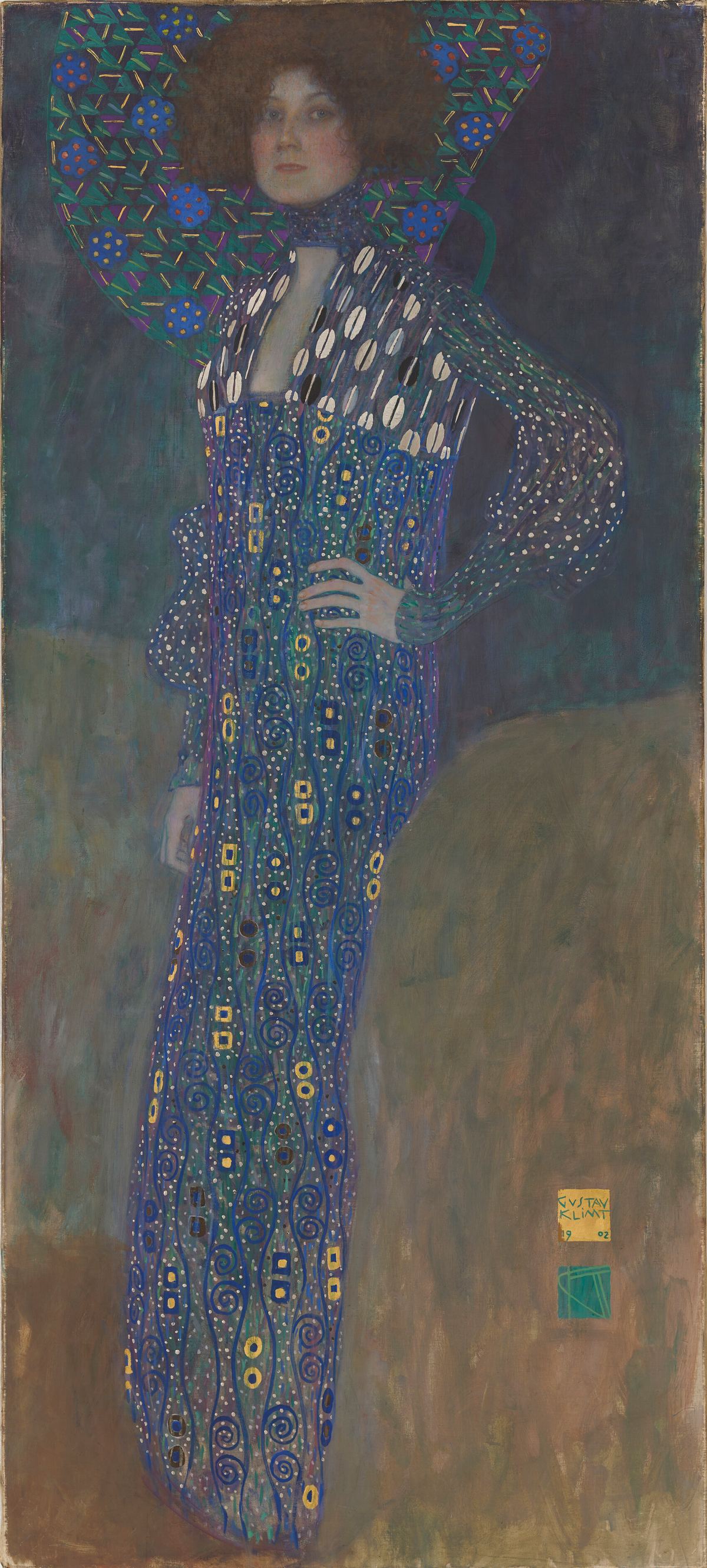
How much of the salon's output was reform dress? Less than the legend says. The folk-life museum writes that Flöge liked to wear reform fashion herself and would probably have liked to sell more of it, but that most of the salon's models followed mainstream taste. Klimt's 1902 portrait of her, at the top of this page, is described as showing a Reformkleid by the magazine Finestre sull'Arte; the Wien Museum's own record says only "lady's dress."
What did Klimt contribute to the salon's dresses?
Less than the legend suggests, and nobody knows exactly how much. The folk-life museum says Klimt's part in the salon's designs is obscure and the subject of speculation. He may occasionally have designed for the house, but it is more likely that he and his idea of the total work of art influenced Emilie, just as her knowledge and design ideas will have influenced him.
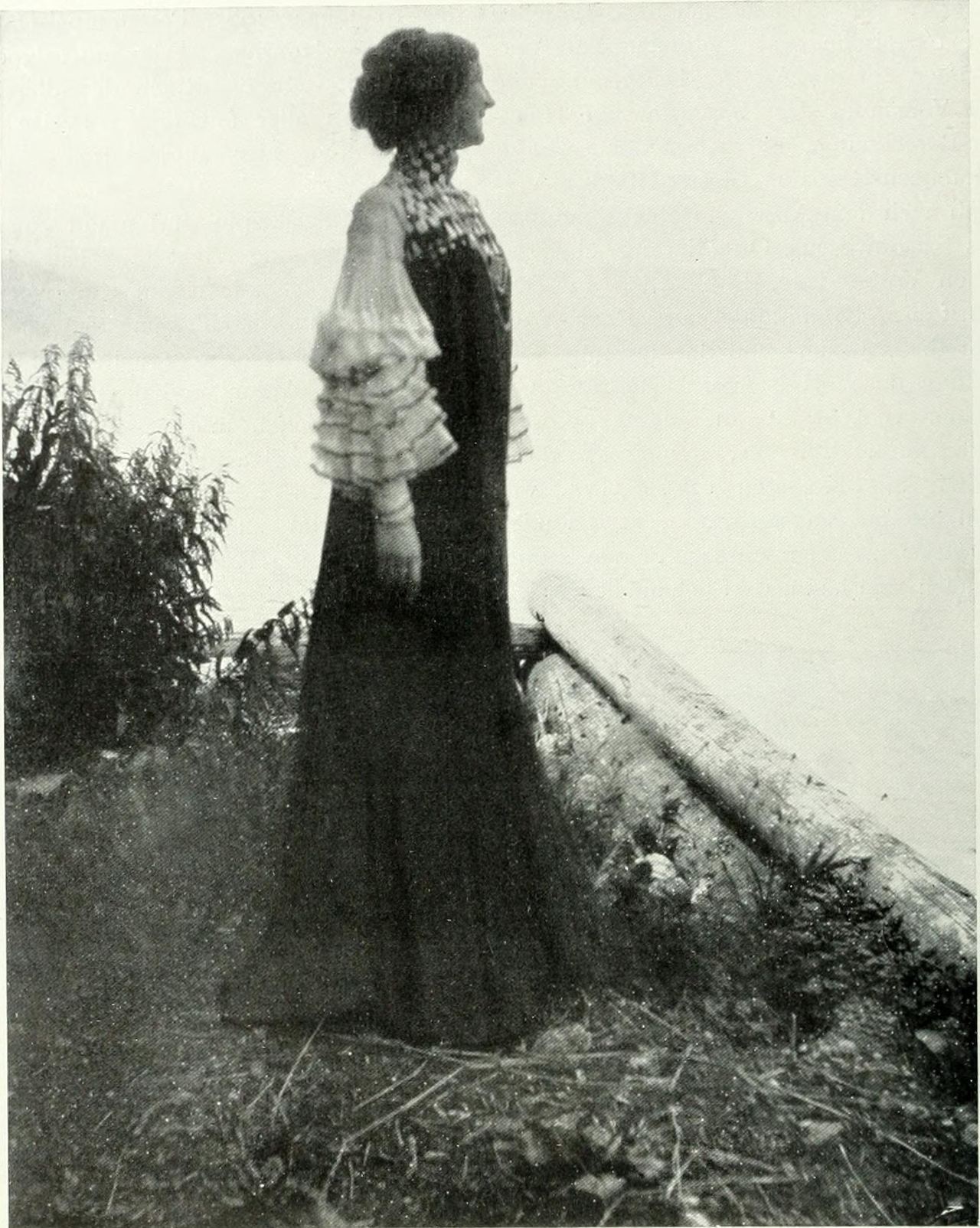
The clearest evidence is a set of photographs. According to the Klimt Database, Klimt photographed Emilie in her designs in summer 1906, and ten of the pictures were published in the magazine Deutsche Kunst und Dekoration. In the scanned volume the plates are credited to "Gustav Klimt, Vienna," with captions such as "Gesellschafts-Kleid" (social dress), "Haus-Kleid" (house dress), "Konzert-Kleid" and "Sommer-Kleid." At least two plates add that all the costumes were made in the sisters' atelier, and they print the name as "Pflüge." The captions do not name the sitter; Wikimedia Commons and other picture archives identify her as Flöge.
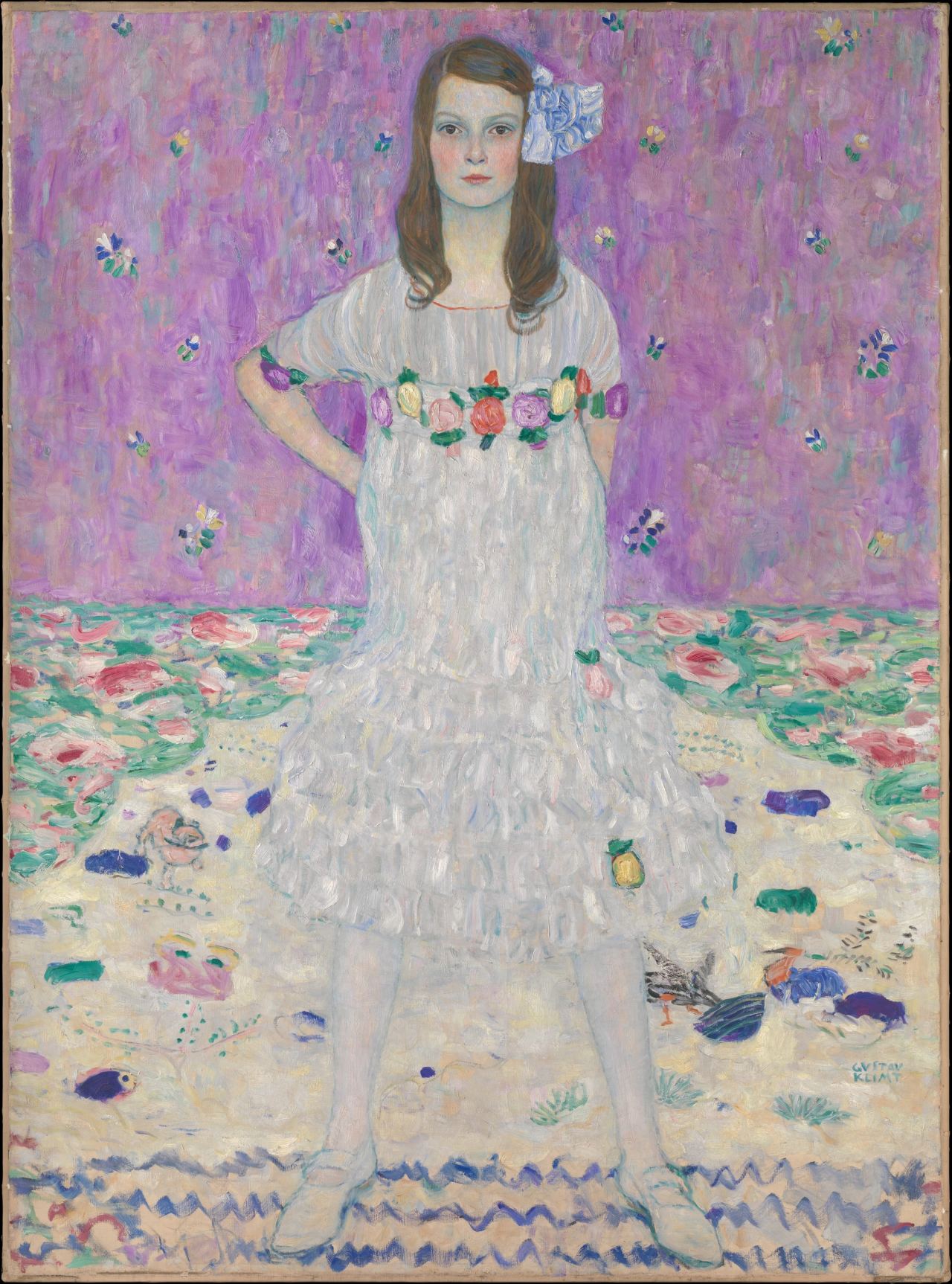
Another documented case runs the other way. The Metropolitan Museum's essay on Klimt's portrait of nine-year-old Mäda Primavesi, published on Google Arts & Culture, says her white dress of lawn was designed by Emilie Flöge at Klimt's suggestion, and that Klimt added a band of brightly colored roses at chest height, presumably for more color. Mäda's mother Eugenia is among the salon clients the Klimt Database names.
Klimt also wrote to her about clothes. When he was in Paris in 1909, he told her, in the Klimt Database's translation: "[H]ere you can take all the chances you want with your costume without attracting attention."
Was she Klimt's muse or an entrepreneur?
Both words appear in the literature, and the record supports the second more firmly. The folk-life museum notes that she is commonly called a muse or a companion (Lebensgefährtin) of Klimt and, more recently, a Lebensmensch, a partner for life. Whether the two were lovers, it says, cannot be settled unless new documents appear. What is certain, it writes, is that they valued each other highly, spent much time together, influenced each other's work and appeared in public as a couple. The Klimt biography on klimt.at calls it a lifelong friendship. Popular accounts also name her as the woman in The Kiss; Finestre sull'Arte calls that unconfirmed, and we found no document that settles it.
The estate is another place where legend runs ahead of the record. Several popular accounts say she inherited half of Klimt's estate after he died on 6 February 1918, a few weeks after a stroke on 11 January. The Klimt Database, which cites the death notice, lists his four living siblings and his niece Helene as the legal heirs and says Emilie, not entitled by law, was not among them. Documents show, however, that important paintings from the estate came into her possession, including The Black Bull, Pear Tree and The Bride; whether she made a claim or her niece shared her portion can no longer be established. Most of Klimt's Asian art collection went to the Flöge family, and she kept it in a room of the Casa Piccola known as the "Klimt room."
Seen from her side, the working life is clearer: a house she helped run for 34 years, with more than 80 seamstresses at its peak, regular buying trips to Paris and a place in the Wiener Werkstätte's circle.
Why did the salon close in 1938, and what survives?
German troops entered Austria on 12 March 1938, and on 13 March a law declared it part of the German Reich, according to the US Holocaust Memorial Museum, which also describes widespread anti-Jewish violence in the weeks that followed. The folk-life museum says the Salon Schwestern Flöge had to stop work in 1938 because its clients, many of them from the Jewish upper middle class, were gone. The Klimt Database says Emilie and her niece were forced to close the shop and give up their apartment, and moved to Ungargasse 39 in Vienna's third district, taking the salon's papers and Klimt memorabilia.
Near the end of the Second World War a fire destroyed that apartment. Accounts differ on what was lost. The Klimt Database says the salon's documentation and many items from Klimt's estate burned. The Wien Geschichte Wiki says most of her folk-costume collection, almost all her furniture and valuable objects from the Klimt estate were lost. The folk-life museum says only that part of her collection may have been destroyed, and how much is unknown. The curator Michaela Lindinger told ORF that the salon archive burned in 1945.
| Date | Event |
|---|---|
| 30 Aug 1874 | Born in Vienna |
| 7 Sep 1891 | Her sister Helene marries Ernst Klimt |
| 1900 | First summers at Attersee with Klimt and the Flöge family |
| 1902 | Klimt paints her full-length portrait |
| 1903 | Wiener Werkstätte founded |
| 1 Jul 1904 | Salon Schwestern Flöge opens, Mariahilfer Straße 1b |
| Summer 1906 | Klimt photographs her in the salon's dresses |
| 1917 | Pauline Flöge dies |
| 6 Feb 1918 | Klimt dies |
| 12–13 Mar 1938 | German troops enter Austria; annexation declared |
| 1938 | Salon closes |
| 1945 | Fire destroys her apartment |
| 26 May 1952 | Dies in Vienna |
Where can you see her work now?
The salon's own records burned, and few of its garments are known. The Wien Museum exhibition True Colors – Viennese Fashion across Four Centuries (German title Farbenspiel) runs from 1 October 2026 to 28 March 2027. ORF reports that it includes a cream promenade dress by the Schwestern Flöge, which the curator called one of the rarest pieces on show, among about 350 pieces. The show is organized by color, not by designer.
The Leopold Museum's Modern Fashion. Wiener Werkstätte & Paris runs from 26 February to 27 June 2027. Its page lists Flöge among the artists whose work will be featured and notes that she traveled regularly to Paris to study trends. The same museum holds stoles from her estate, acquired in 2019 and not currently on display, in its online collection. Klimt's 1902 portrait of her hangs in the Wien Museum's permanent display, in the chapter on Vienna around 1900. The Austrian Museum of Folk Life and Folk Art holds the 369 textile pieces she collected, shown in a 2012 exhibition.
Sources
- Press text: Die Textilmustersammlung Emilie Flöge (exhibition 25 May–2 Dec 2012). Österreichisches Museum für Volkskunde, Vienna. Primary-institutional. Read in full (German): salon 1904, interiors, roles, 80+ seamstresses, Paris trips, reform dress vs mainstream models, Klimt's design role unknown, relationship cannot be settled, 1938, fire, 369 objects. Accessed October 18, 2026.
- The Schwestern Flöge Fashion Salon. Klimt Database (Klimt Foundation). Read in full: opening 1 July 1904, Casa Piccola, Hoffmann and Moser, clients, 1906 photographs (ten in DKD), 1909 Paris letter, 1938 closure, Ungargasse 39, 1945 fire. Accessed October 18, 2026.
- The Flöge Family. Klimt Database (Klimt Foundation). Read in full: family dates, Helene and Ernst Klimt 7 Sep 1891, Ernst d. Dec 1892, Emilie 30 Aug 1874 to 26 May 1952. Accessed October 18, 2026.
- Posthumous fame and legend (chapter Estate). Klimt Database (Klimt Foundation). Read the estate and Klimt room passages: legal heirs per death notice, Emilie not an heir, paintings in her possession, Klimt room, 1938 move, 1945 fire. Accessed October 18, 2026.
- Emilie Flöge. Wien Geschichte Wiki (City of Vienna). Read in full (German): dates, roles, Hoffmann and Moser interiors, 80 seamstresses, clients, Attersee summers, 1902 portrait history, fire at end of WWII. Accessed October 18, 2026.
- Bildnis Emilie Flöge, inv. 45677. Wien Museum Online Sammlung. Read record: Klimt, 1902, oil on canvas, 178×80 cm; image licence CC BY 4.0; on view in 'Wien. Meine Geschichte', chapter 'Wien um 1900'. Accessed October 18, 2026.
- Mode im Wien Museum: Warum Gelb die Farbe der Außenseiter war (ORF.at, 30 Sep 2026). ORF.at. Read in full (German): Farbenspiel to 28 Mar 2027, about 350 pieces, Moser reform dress, cream promenade dress by Schwestern Flöge, curator Lindinger: salon archive burned 1945. Accessed October 18, 2026.
- True Colors – Viennese Fashion across Four Centuries. Fashion.at. Read: dates 1 Oct 2026 to 28 Mar 2027, about 350 garments. Does not mention Flöge. Accessed October 18, 2026.
- MODERN FASHION. Wiener Werkstätte & Paris. Leopold Museum. Read in full: 26 Feb to 27 Jun 2027; Flöge among featured artists; reform dress; van de Velde and Muthesius. Accessed October 18, 2026.
- Green stole from the estate of Emilie Flöge (Inv. 6371) and purple stole (Inv. 6382). Leopold Museum Online Collection. Read both records: c. 1910; accession 2019; not on display; text on reform dress and corset-free society (quoted). Accessed October 18, 2026.
- Wiener Werkstätte fashion. National Gallery of Victoria. Read in full: Flöge gowns mostly in Wiener Werkstätte fabrics; Fashion Department 1910. Accessed October 18, 2026.
- V&A collections record O89091 (E.2380-1930), catalogue text on reform dress. Victoria and Albert Museum. Read in full: reform dress from Berlin 1886; 1898 competitions; Princess-type dress without corset. Accessed October 18, 2026.
- Goodbye corset, hello reform dress (Jasmin Mollet, 6 Aug 2026). Swiss National Museum blog. Read in full: 1896 Berlin association, Muthesius 1903, health arguments, reception. Accessed October 18, 2026.
- Tailored for Freedom: The Artistic Dress in 1900 in Fashion, Art and Society. Kunstmuseen Krefeld via e-flux. Read in full: Krefeld exhibition August 1900 and designers. Accessed October 18, 2026.
- Deutsche Kunst und Dekoration, vol. 19 (Oct 1906–Mar 1907), Klimt plates, pp. 62–73. Internet Archive (University of Toronto Library scan). Primary. Viewed page scan p. 66 and read OCR text of the other plates: captions and the note that all costumes were made in the Flöge atelier. Accessed October 18, 2026.
- Klimt's Portrait of Mäda Primavesi (The Metropolitan Museum of Art). Google Arts & Culture. Read in full: Mäda aged nine; dress of lawn designed by Emilie Flöge at Klimt's suggestion; rose band added by Klimt; parents Otto and Eugenia Primavesi. Accessed October 18, 2026.
- Klimt biography (PDF). klimt.at. Read text (German/English): Attersee summers from 1900, salon 1904, lifelong friendship, stroke 11 Jan 1918, death 6 Feb 1918. Accessed October 18, 2026.
- German annexation of Austria, March 11–13, 1938. United States Holocaust Memorial Museum. Read: troops entered 12 Mar 1938; law of 13 Mar; anti-Jewish violence. Accessed October 18, 2026.
- Story of Emilie Flöge, Gustav Klimt's muse and successful entrepreneur. Finestre sull'Arte. Read in full: 1902 portrait described as showing a Reformkleid; The Kiss identification unconfirmed. Accessed October 18, 2026.
- Wiener Werkstätte (AEIOU Austria-Lexikon, English). Austria-Forum. Read: founded 1903 by Hoffmann and Moser. Accessed October 18, 2026.
- Emilie Louise Flöge. Wikipedia. Used to locate references; read in full. Popular 'half the estate' claim and Klimt's death date 6 Feb 1918 cross-checked against other sources. Accessed October 18, 2026.
- Mäda Primavesi (1903–2000), object 436819. The Metropolitan Museum of Art Open Access API. Read record: 1912–13, oil on canvas, 149.9×110.5 cm, 64.148, isPublicDomain true. Accessed October 18, 2026.
Glossary
Last updated · Markdown · Report an error