Design
Henriette Negrin: The Woman Behind the Delphos Pleats
Who invented the Delphos dress? The V&A now credits Henriette Negrin, Fortuny's partner in Venice, as largely if not wholly responsible. What the 1909 patent note, her own letter and the records show, and where the evidence stops.
Who invented the Delphos dress? The documents point to Henriette Negrin, the French-born partner of Mariano Fortuny in Venice. A handwritten note by Fortuny on a copy of the 1909 pleating patent names her as the inventor, and since October 2021 the V&A has catalogued its Delphos dresses as designed by "Henriette Nigrin, possibly with Mariano Fortuny." How much of the gown beyond the pleats was hers, the surviving evidence does not settle.
Who was Henriette Negrin?
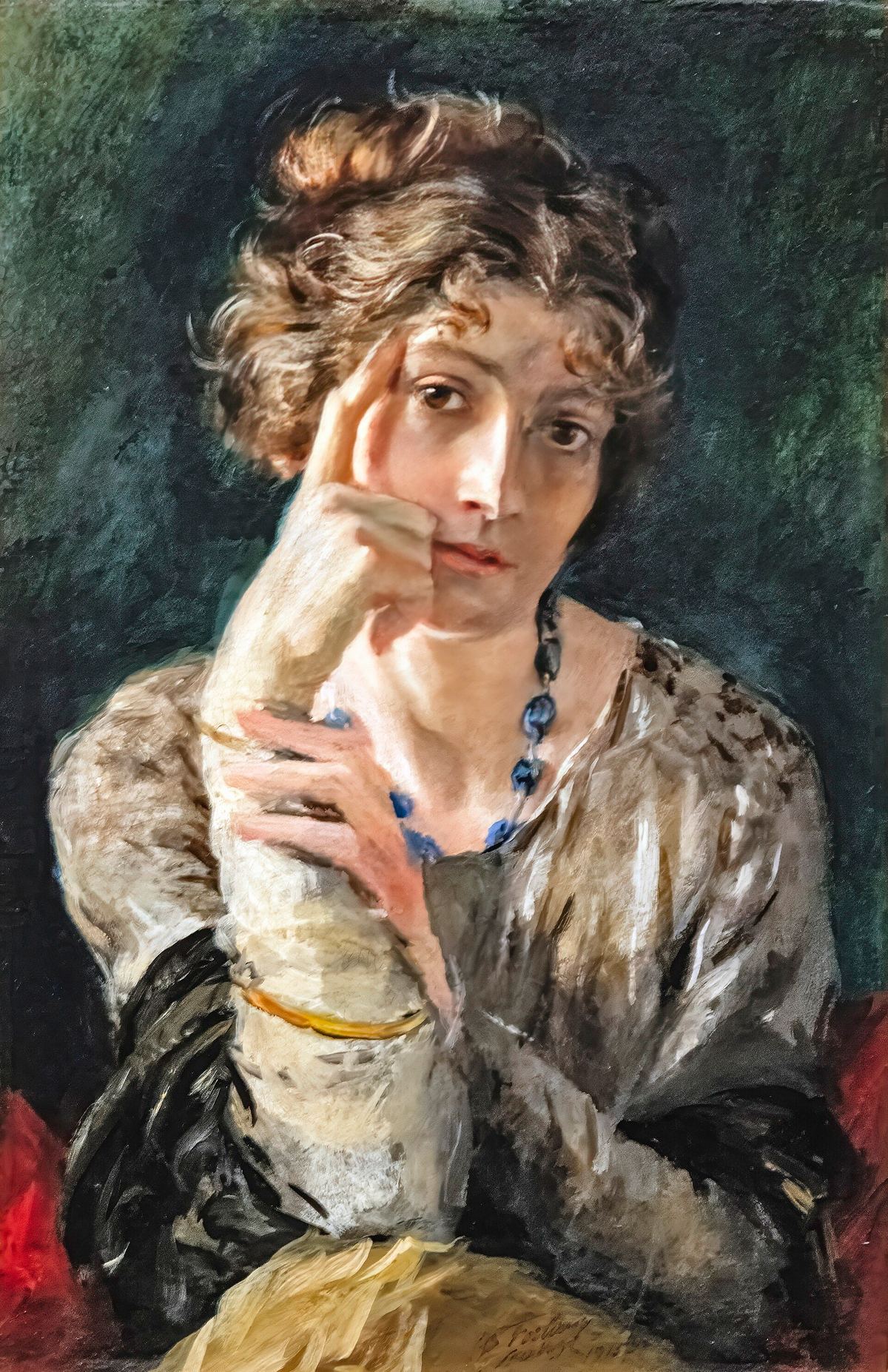
Henriette Negrin, also spelled Nigrin, was a French designer and inventor, born Adèle Henriette Élisabeth in Fontainebleau in 1877. She moved to Venice in 1902 to live with the painter and designer Mariano Fortuny, worked beside him for almost half a century, married him in 1924 and died in 1965. Her biography is thin: the Palazzo Fortuny itself calls the record sparse.
The V&A's catalogue gives the outline. In 1897 she married Jean Eusèbe León Bellorgeot in Fontainebleau; the marriage ended in 1902, the year she went to Venice. She had also lived at Marlotte, and is said to have been an artist's model in Paris. The Palazzo Fortuny's own account says she met Fortuny in Paris in 1902, probably through his cousin Federico "Cocò" de Madrazo. In 1907 the couple began a textile-printing workshop in the attic of the Palazzo Pesaro degli Orfei, first making printed silk shawls and later dresses.
Her job there was not decorative. The same account says she worked alongside Fortuny on printed fabrics and silk lampshades, coordinated the craftsmen they employed, and handled relations with an international clientele; a photograph shows her working on early block-printing experiments for the Knossos scarf. For how the main printing methods differ, see Printed Cloth, Block to Screen.
| Date | Event | Source |
|---|---|---|
| 1877 | Born in Fontainebleau (4 October) | V&A; Palazzo Fortuny |
| 1897 | Marries Jean Eusèbe León Bellorgeot; the marriage ends in 1902 | V&A |
| 1902 | Moves to Venice to be with Fortuny | V&A; Palazzo Fortuny |
| 1907 | Textile-printing workshop begins in the attic of Palazzo Pesaro degli Orfei | Palazzo Fortuny |
| 1909 | French pleating patent filed (10 June); photographs show her in a prototype gown | Google Patents; Palazzo Fortuny |
| 1924 | Marries Fortuny in Paris | V&A |
| 1949 | Fortuny dies; Delphos production stops | V&A; Sanz Álvarez |
| After 1949 | Sells the company to Elsie McNeill, donates works to museums, inventories the palazzo | Palazzo Fortuny |
| 1965 | Dies; the palazzo passes to the city of Venice | V&A; Palazzo Fortuny |
| Oct. 2021 | V&A revises its Delphos records to credit her | V&A |
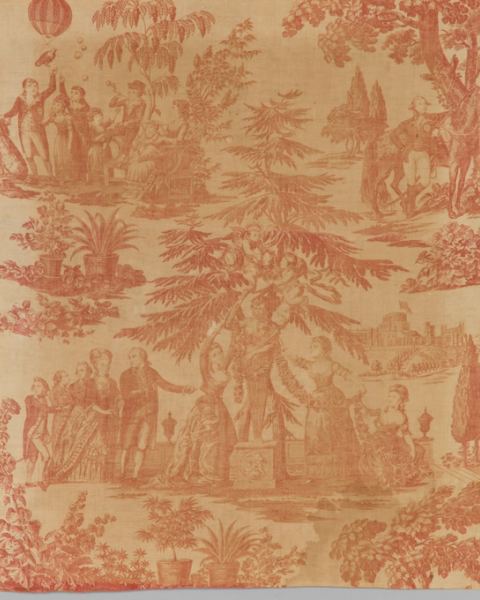
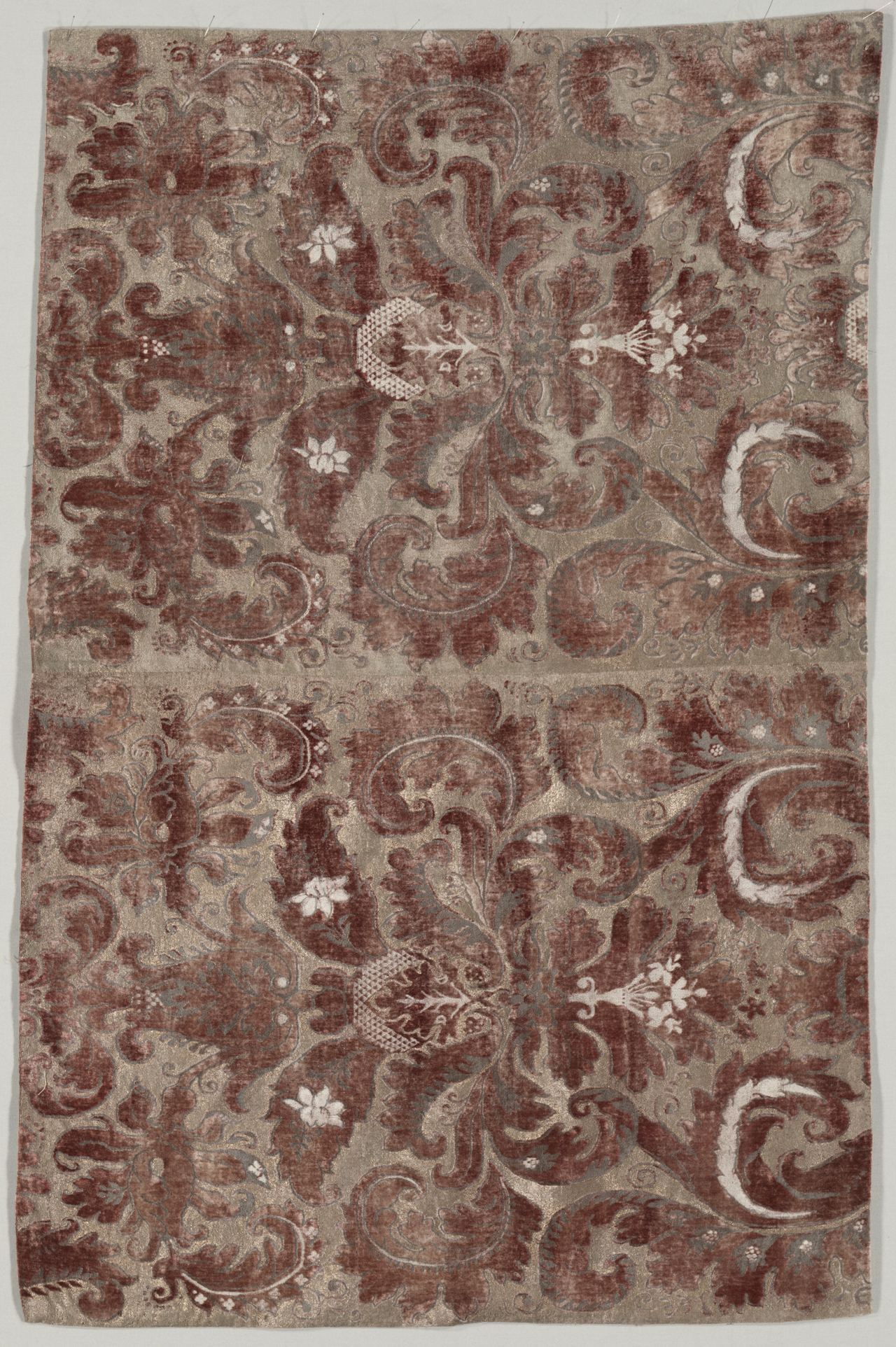
The company she sold is the one that kept Fortuny's fabrics alive. Fortuny's own company history says Elsie McNeill Lee found the fabrics at the Carnavalet Museum in Paris in 1927, became their sole distributor and ran the house for more than forty years; she married Count Alvise Gozzi in 1959. A painted velvet in the Cleveland Museum of Art, given by "Countess Elsie Lee Gozzi," appears to come from that circle and shows the textile side of the house.
What do the documents say about who invented the Delphos?
Three kinds of evidence support crediting Negrin: a note by Fortuny, a letter by Negrin, and the V&A's reading of both. Each is documentary. The reasoning that links them to the whole dress is interpretation, and it is worth keeping the two apart.
The note. A copy of the 1909 patent in the Fondo Mariutti Fortuny at the Biblioteca Nazionale Marciana in Venice carries a handwritten comment by Fortuny. According to the researcher Alba Sanz Álvarez, it states that the patent belongs to Henriette, who is the inventor, and that he filed it in his own name because of the urgency of the deposit. The V&A reads the same comments as naming her, as "Madame Henrietta Brassart," her mother's surname, as inventor of the pleating system.
The letter. Negrin wrote to Elsie McNeill Lee, Fortuny's American distributor, that she had decided to stop all commercial production of the Delphos, and that because the garments were "of my own creation" she did not want anyone else to take them over (as quoted by Sanz Álvarez). The sources we could open do not date the letter.
The museum. The V&A's catalogue entries say that for decades the dresses were thought to be Fortuny's, and that more recent research suggests Negrin was "largely if not wholly responsible." The museum's reasoning goes beyond the patent: the way she described her relationship with the dresses suggests she did more than invent the pleating method. The research it cites is Silvia Bañares, "A Short Biographical Note on Henriette Nigrin, Creator of Delphos," Datatèxtil 36 (2017), pp. 73-84. Teazle could not open that article, so this piece relies on the V&A's summary and on Sanz Álvarez, who says she reached a similar conclusion independently.
What is argument, not record. The Palazzo Fortuny says a 1909 photograph shows Negrin wearing a prototype. Sanz Álvarez reads the studio setting and varied poses as evidence that her modeling was part of the design process. That is a reasonable inference, not a document. Nor does anything we could open divide the labor: who chose the Greek model, who cut the first tunic, who tested the folds. Fortuny was a painter and photographer who built his own garment-making machines, and the Delphos appears in his paintings and photographs. The fair summary is the V&A's own hedge: designed by Nigrin, possibly with Fortuny.
Which patent, and when was it filed?
Published accounts date the Delphos patent to 10 June 1909, yet a patent number that circulates with it, 408.629, belongs to a filing dated 4 November 1909. The bibliographic records in Google Patents, which draw on patent-office data, show why: Fortuny filed two different French patents that year.
| Number | Title | Filed | Published | Listed inventor |
|---|---|---|---|---|
| FR 414,119 | Genre d'étoffe plissée-ondulée (a kind of pleated, waved fabric) | 10 June 1909 | 26 August 1910 | Mariano Fortuny |
| FR 408,629 | Genre de vêtement pour femmes (a kind of garment for women) | 4 November 1909 | 1 April 1910 | Mariano Fortuny |
The 10 June filing is the one the note belongs to. Sanz Álvarez gives the same title, the same date and the Marciana shelfmark (M.8.1.5), and describes a patent that treats the pleating as an independent invention. Number 408.629 is a separate garment patent filed that November. We could not open its text, so we cannot say whether the note appears on it. Both entries list Fortuny alone, which is consistent with his own statement that he filed in his name. The official registers, Espacenet and INPI, refused automated access, so these dates rest on Google Patents' data and Sanz Álvarez, not on the patent documents themselves.
How was Fortuny pleating done?
No verified, step-by-step recipe has been published. One commentator calls the patent's technical language deliberately vague, and Cooper Hewitt notes that Fortuny withheld enough detail that the method has never been fully understood. What museums and researchers report is a hybrid of hand work and heat, with some disagreement on the equipment.
| Account | What it says |
|---|---|
| Palazzo Fortuny | Pleats first made by hand with the thumbnail, secured with stitching and pressed; lengthwise folds, up to 450 per panel; a cross-wise wave added with copper tubes or heated ceramic |
| FIDM Museum | Panels probably finger-pleated while wet, then heat-set; 430 to 450 pleats per panel; scholars suggest thread held the folds during heating; the only physical evidence is a patent-application image of a machine used for part of the process |
| Cooper Hewitt (Susan Brown, 2017) | Irregular pleats likely made by hand, then the fabric was rolled through horizontal heated copper rods to create the wave |
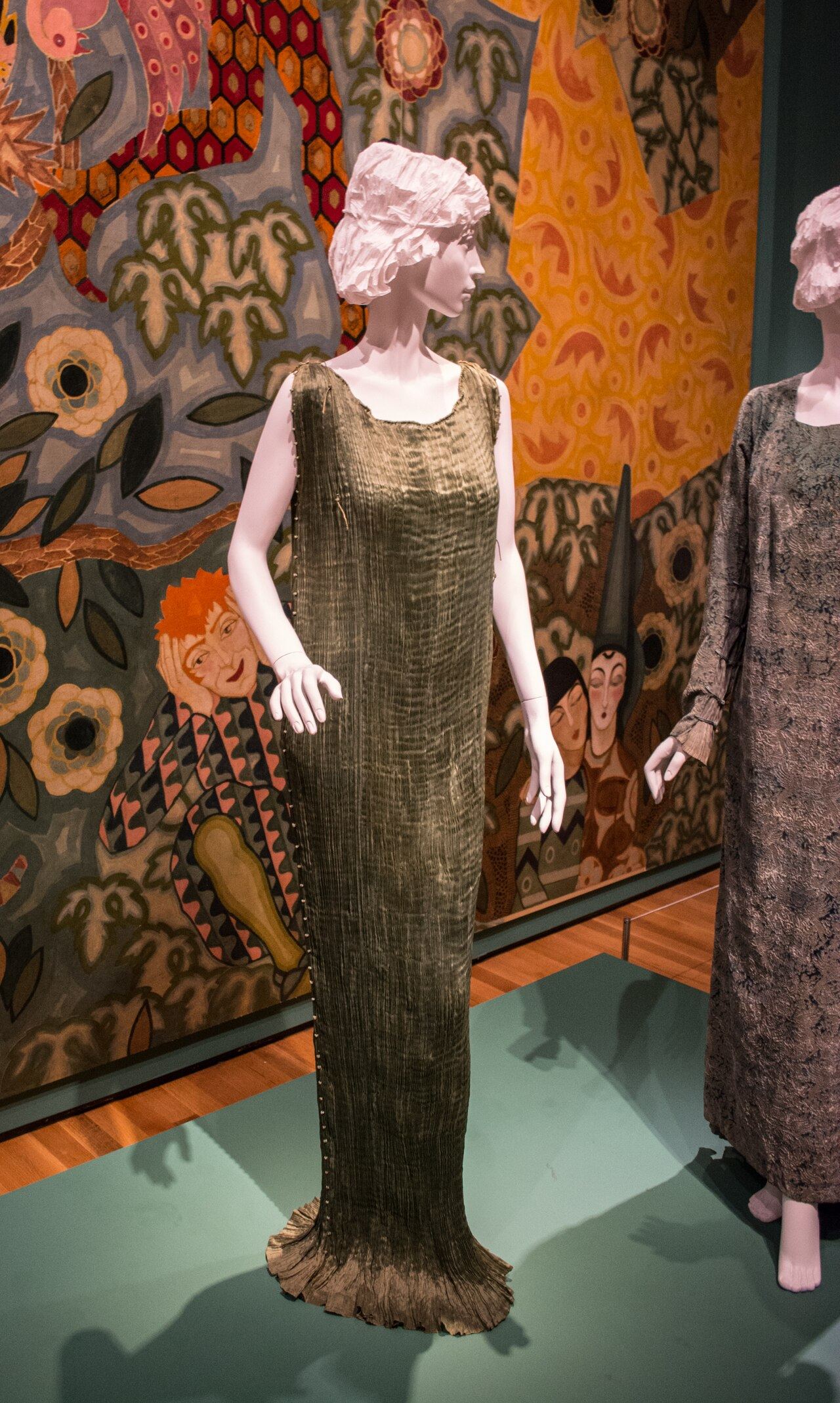
The accounts agree on hand pleating along the length of the cloth and on heat. They differ on whether the wave came from tubes, ceramic or rods. The finished dress is better documented than the method. The V&A describes narrow widths of pleated silk hand-sewn into a tube. The Palazzo Fortuny says early gowns began with four panels and by 1919-20 had five, with cord drawstrings at the neck and sleeves, decorated with Murano glass beads. The cloth was silk, in satin or taffeta, and the V&A says the glass beads were used for decoration, weight and fixings. For the fold itself, see the glossary entry for pleat.
Negrin's part in the process is described in general terms. The V&A calls her the inventor of the pleating system, and FIDM says she helped Fortuny dye his fabric. Which hands did which step is not recorded in anything we could open.
Why did the Delphos catch on?
The Delphos was a column of finely pleated silk that clung without restricting movement. The V&A says its pleats made the dress elastic, "clinging but non-restrictive," and that it was modeled on the chiton of ancient Greece and named after the bronze Charioteer of Delphi. Greek-inspired dress was not new: the V&A notes earlier artistic dress reformers in Britain and the United States had looked to early Greece as well. For that wider movement, see Emilie Flöge: More Than Klimt's Muse.
The dress found its buyers among women with money and nerve. The Palazzo Fortuny says Marchesa Luisa Casati was the first to buy one, in September 1909. The V&A names Sarah Bernhardt and Isadora Duncan among the first wearers, and says the dresses were sold in Fortuny shops in several European capitals and, in Paris, through Babani and Paul Poiret. Daring at first for its informality, it was adopted as an informal tea gown, then became acceptable for evening wear and stayed in fashion until about the 1930s. The Met holds one dated 1936. Production lasted until Fortuny's death in 1949, according to Sanz Álvarez.
How can you tell a real Delphos?
There is no single test. Museum records and curators point to a cluster of features. FIDM describes four or five pleated silk panels about 37 inches wide, a bateau neckline with a drawstring, small glass beads from Murano strung on a narrow silk cord at the side seams, and one-size garments adjusted with sashes.
Marks are less reliable than they sound. The V&A's records for two Delphos dresses, both dated about 1920, describe a mark printed inside the center back seam reading "Made in Italy. Fabrique en Italie. Fortuny Depose." Two other V&A Delphos dresses have no mark recorded at all. A label is a clue, not proof, and its absence proves nothing. Anyone buying or insuring a piece should compare it with museum examples and ask a textile conservator or a specialist, not rely on a seller's description. To care for pleated silk once you own it, see How to Store a Quilt or a Vintage Garment.
Where can you see her work?
- Victoria and Albert Museum, London: Delphos dresses in the collection, T.22-1985 (white silk with amber beads, 1920-23) and T.193&A-1974 (apricot silk, 1909-20), both catalogued as by Nigrin.
- Museo Fortuny (Palazzo Fortuny), Venice: the palazzo Negrin bequeathed to the city, now a museum.
- The Metropolitan Museum of Art, New York: a Delphos dated 1936 (1983.477a, b), listed in the museum's online collection.
- Cleveland Museum of Art: the painted velvet shown above, 1975.253.
Further reading: Silvia Bañares, "A Short Biographical Note on Henriette Nigrin, Creator of Delphos," Datatèxtil 36 (2017); Alba Sanz Álvarez, "Mariano and Henriette Fortuny: Notes on Co-Creating the Delphos Gown," The Fashion Studies Journal (2022); Guillermo de Osma, Mariano Fortuny: His Life and Work (V&A Publishing, 2015).
Sources
- Delphos dress (T.22-1985), Henriette Nigrin. Victoria and Albert Museum. Primary. Read in full (page and V&A API): attribution note of Oct 2021, patent comments crediting Madame Henrietta Brassart, biography of Nigrin (birth, marriage 1897, 1902, 1924), Delphos context, Bañares reference. Accessed October 30, 2026.
- Delphos dress (T.193&A-1974). Victoria and Albert Museum. Primary. Read in full: attribution note, apricot silk dress, Babani and Poiret, patent 1909. Accessed October 30, 2026.
- Delphos dress (T.149-2004). Victoria and Albert Museum. Primary. Read via the V&A API: mark printed inside centre back seam, 'Made in Italy. Fabrique en Italie. Fortuny Depose'. Accessed October 30, 2026.
- Delphos dress (T.423&A-1976). Victoria and Albert Museum. Primary. Read via the V&A API: printed label on centre back seam with the same wording. Accessed October 30, 2026.
- FR414119A, Genre d'étoffe plissée-ondulée (bibliographic record). Google Patents (data from patent offices). Primary-derived. Read: filing date 1909-06-10, publication 1910-08-26, inventor Mariano Fortuny. Espacenet and INPI refused automated access, so the original register entry was not opened. Accessed October 30, 2026.
- FR408629A, Genre de vetement pour femmes (bibliographic record). Google Patents (data from patent offices). Primary-derived. Read: filing date 1909-11-04, publication 1910-04-01, inventor Mariano Fortuny; no full text. Shows that number 408.629 is a garment patent, not the pleating patent. Accessed October 30, 2026.
- Mariano and Henriette Fortuny: Notes on Co-Creating the Delphos Gown. The Fashion Studies Journal (Alba Sanz Álvarez, 22 April 2022). Scholarly. Read in full: Fortuny's note on the patent, 10 June 1909 patent and Marciana reference, Negrin's letter to Elsie McNeill Lee, 1909 prototype photographs, end of production in 1949. Accessed October 30, 2026.
- Henriette Fortuny: portrait of a muse. Google Arts & Culture / Palazzo Fortuny, Fondazione Musei Civici di Venezia. Museum. Read in full: birth 4 Oct 1877, 1902, 1907 workshop, her role, 1909 prototype photo, sale to Elsie McNeill, donations, bequest of the palazzo. Accessed October 30, 2026.
- The Birth of a Unique Gown: The Delphos. Google Arts & Culture / Palazzo Fortuny, Fondazione Musei Civici di Venezia. Museum. Read in full: 1909 creation, Casati's purchase in September 1909, panels, drawstrings, beads, pleating by hand and with copper tubes or heated ceramic. Origin year differs from V&A's 1907. Accessed October 30, 2026.
- Mariano Fortuny. FIDM Museum. Museum. Read in full: probable pleating method, 430-450 pleats per panel, patent-application machine image, construction cues for identifying a Delphos. Accessed October 30, 2026.
- Fortuny's pleats (Susan Brown, 7 April 2017). Cooper Hewitt, Smithsonian Design Museum. Museum. Read in full: hand pleating, heated copper rods, patent withheld detail. Accessed October 30, 2026.
- More Than A Muse: Henriette Negrin, the Inventor Behind Fortuny. Fashion Conservatory. Secondary. Read in full: patent title and 10 June 1909, patent language described as vague, letters to Elsie McNeill Lee. Used as a second account only. Accessed October 30, 2026.
- History. Fortuny (company). Company history. Read: Elsie McNeill Lee discovered the fabrics in 1927, sole distributor, ran the house for 40+ years, married Count Alvise Gozzi in 1959. Accessed October 30, 2026.
- Two Joined Panels of "Fortuny Painted Velvet" (1975.253). The Cleveland Museum of Art. Primary. Read via Cleveland Open Access API: CC0, gift of Countess Elsie Lee Gozzi. Accessed October 30, 2026.
- Delphos (1983.477a, b). The Metropolitan Museum of Art. Primary. Record read via the Met API: dated 1936; not public domain, so no image is used. Accessed October 30, 2026.
- Henriette Negrin. Wikipedia. Used to locate references only. Read in full; no fact depends on it alone. Accessed October 30, 2026.
- File: Portrait of Henriette Fortuny by Mariano Fortuny, 1915 - Fortuny Museum.jpg. Wikimedia Commons. Image record. Read: painting by Mariano Fortuny (d. 1949), Museo Fortuny Fort 0110; photograph by Didier Descouens, CC BY-SA 4.0. Accessed October 30, 2026.
- File: Delphos dress - Mariano Fortuny (38691635635).jpg. Wikimedia Commons. Image record. Read: photograph by Tim Evanson, CC BY-SA 2.0, Flickr licence reviewed on Commons. Accessed October 30, 2026.
Glossary
Last updated · Markdown · Report an error