Millinery
Rose Bertin, Marie Antoinette's “Minister of Fashion”
Who was Rose Bertin, and what did she do for Marie Antoinette? A fashion merchant from Abbeville who trimmed the queen's wardrobe, headed a guild and was mocked as her Minister of Fashion. What the records show, and where sources disagree.
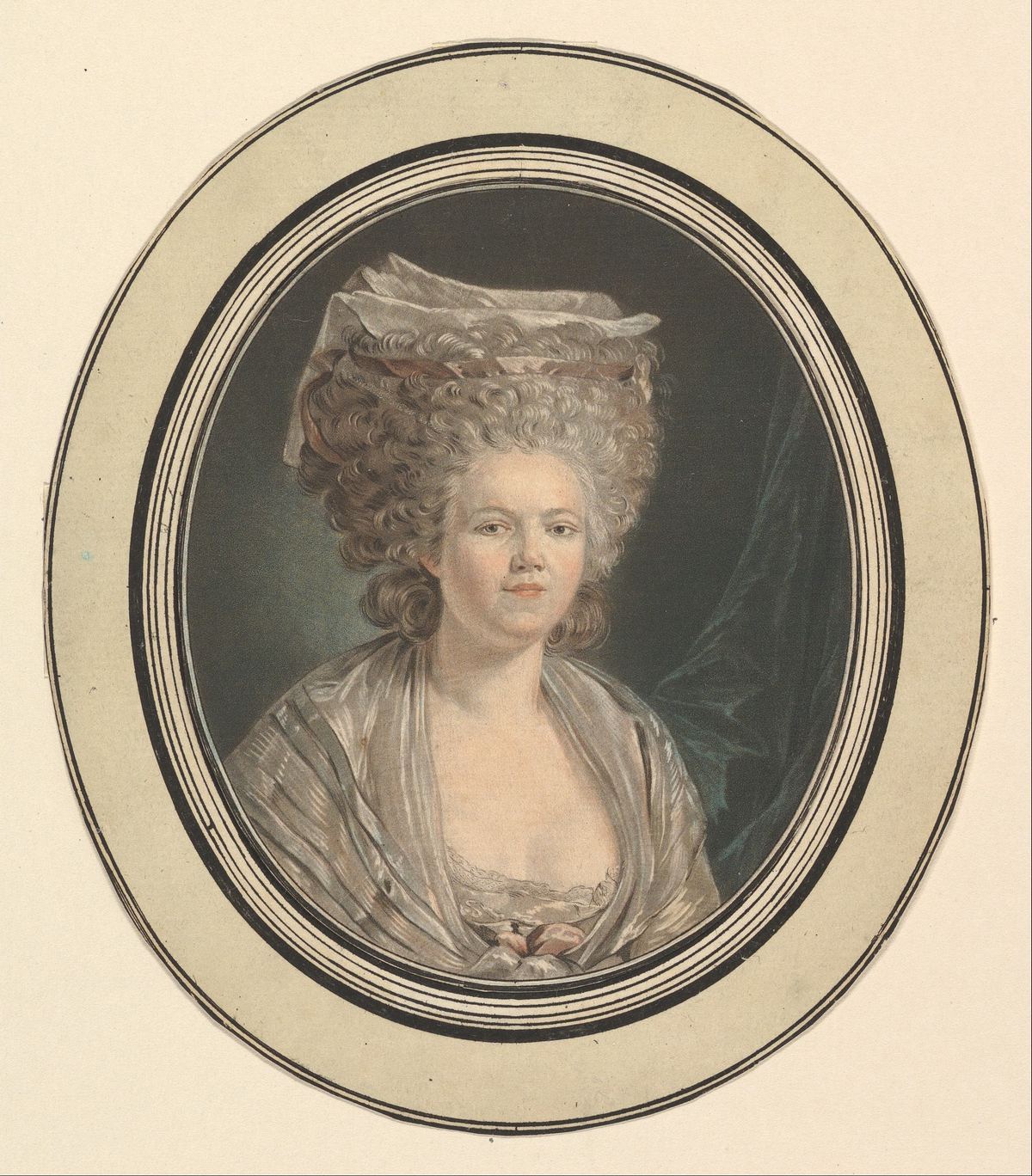
Rose Bertin (1747–1813) was a Paris fashion merchant, a marchande de modes, who supplied Marie Antoinette and hundreds of other clients with headdresses, trimmings and accessories from her shop, the Grand Mogol. She headed the new milliners' guild in 1776, and by 1778 Paris was calling her the queen's "Minister of Fashion." The sources do not credit her with inventing the pouf, and like other fashion merchants she mostly trimmed gowns that other trades had sewn.
Who was Rose Bertin?
Marie-Jeanne Bertin was born on 2 July 1747 in Abbeville, in Picardy, the youngest child of a mounted constable and a nurse. She trained in Paris as a marchande de modes, set up her own shop in the early 1770s, and became the best-known fashion merchant of Louis XVI's reign.
Her birth rests on a register. Pierre de Nouvion and Émile Liez, who published a biography in 1911, transcribed the parish record of Saint-Gilles in Abbeville: born at about two in the afternoon on 2 July 1747, baptized the next day as Marie-Jeanne, daughter of Nicolas Bertin of the maréchaussée (the rural constabulary) and Marie-Marguerite Méquignon. Older reference books gave Amiens and 1744, which they set out to correct. Her mother worked as a sick-nurse; the family had little money.
Abbeville was a cloth-making town. According to the Encyclopædia Universalis, she was apprenticed at about nine, apparently to an aunt, before going to Paris to work at the Trait Galant, a fashion house run by a Mademoiselle Pagelle; the Dictionnaire des créatrices dates her Paris apprenticeship to 1760. Three patronesses took her up: the Princesse de Conti, the Duchesse de Chartres and the Princesse de Lamballe.
Even "Rose" is uncertain. The Dictionnaire des créatrices says the name was "revealed" after her death by a fictional biography that her family rejected; Universalis says she herself later swapped Marie-Jeanne for the more graceful Rose. Either way, the name that made her famous is not the one in the register.
What did a marchande de modes actually do?
A marchande de modes sold and arranged the finishing layer of dress: bonnets, headdresses, ribbons, gauze, lace, feathers, artificial flowers and the trimmings sewn onto a gown. The gown itself was cut and stitched by tailors and seamstresses. "Fashion merchant" is the literal translation. Milliner is the usual English word, but it understates the range.
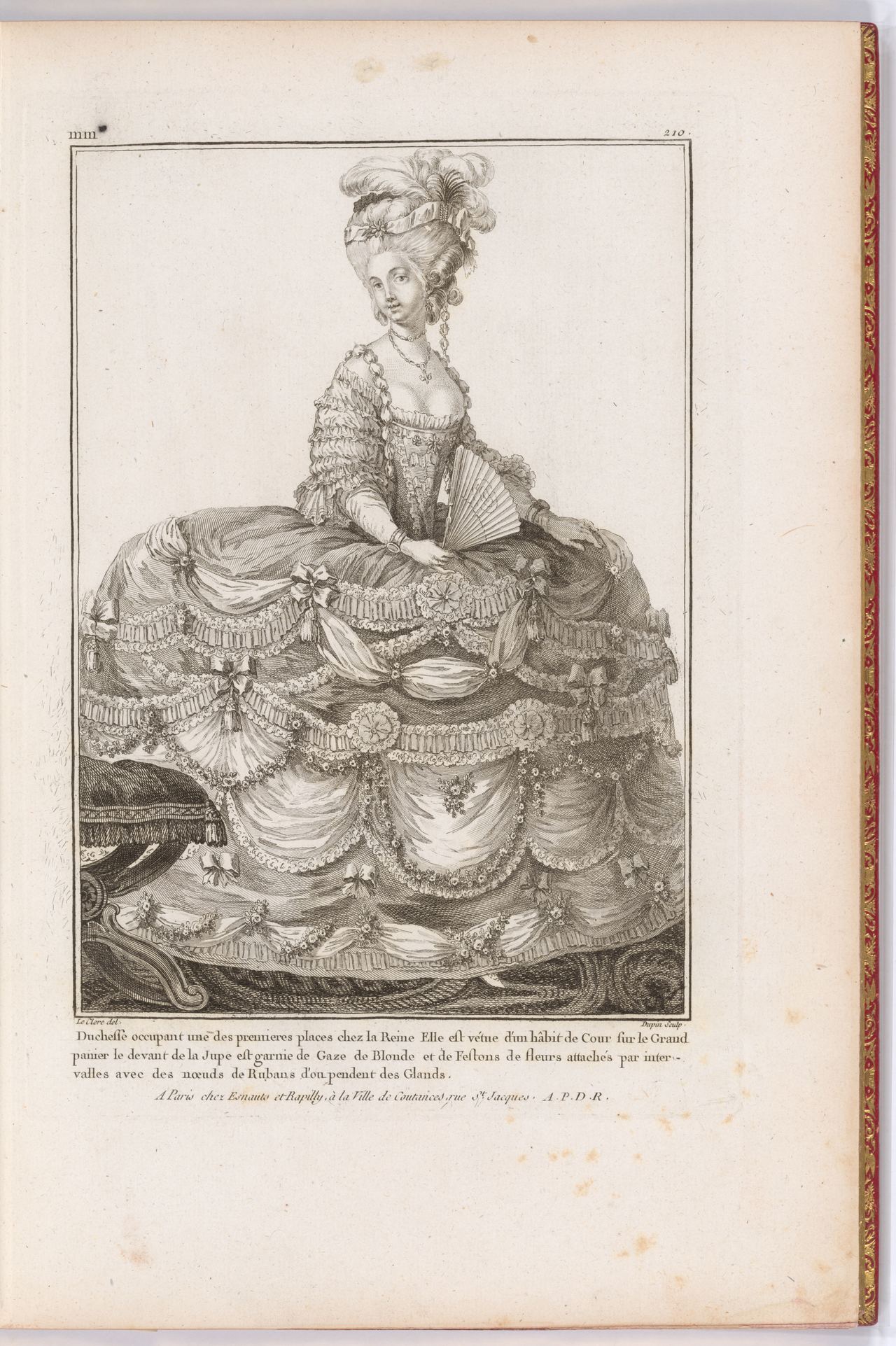
Universalis places the trade between a crowd of suppliers, seamstresses and tailors among them, and the clients, and says fashion merchants generally did not make the dresses but dressed their surface. A shop like Bertin's could supply bonnets, mantelets, pelisses, bows, flounces, collars, embroidered slippers and even jewelry. She was best known for court dress, which she modernized despite the protocol. The Met's print of her calls her a dressmaker, though in the French trade she was a fashion merchant.
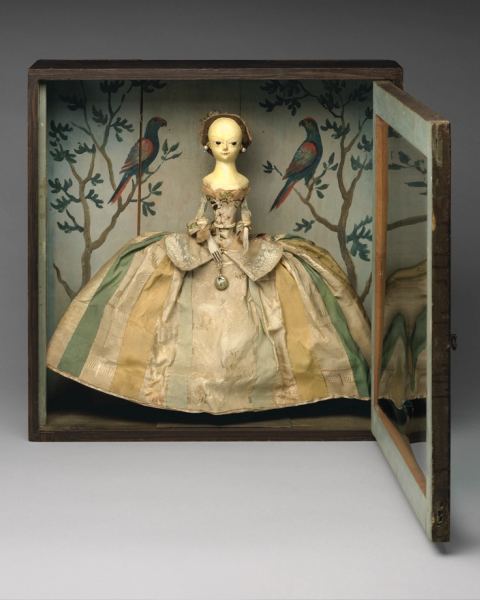
Mercier, in the Tableau de Paris, gave the trade a chapter titled "Les Marchandes de Modes." He wrote of "the gravity of a fashion merchant combining poufs" and giving gauze and flowers a hundredfold value. He also described the famous doll of the rue Saint-Honoré, dressed in the newest mode and sent out to Europe, and he never names Bertin. Our find on fashion dolls before fashion magazines covers the doll. Kimberly Chrisman-Campbell writes that as head of the new guild, Bertin earned the right to dress the life-size doll that toured Europe; we did not find that in a period source.
Her records show how much of the trade was flowers. Zara Kesterton, working from credit files that Bertin's heirs compiled after her death, counts 75 named kinds of artificial flower in the receipts, bought by 135 of 234 account holders.
When did she open the Grand Mogol, and when did she meet the queen?
The Grand Mogol, on the rue Saint-Honoré, opened in the early 1770s, and she reached the queen in 1774. Both dates have competing versions.
| Date | Event | What the sources say |
|---|---|---|
| 2 July 1747 | Born in Abbeville | Parish register (Nouvion and Liez); Universalis |
| Nov. 1772 | Earliest receipts in her name | Kesterton; Chrisman-Campbell: "by 1772" |
| 24 Oct. 1773 | First surviving daybook opens, usually taken as the shop's opening | Universalis; Nouvion and Liez |
| After 10 May 1774 | Introduced to Marie Antoinette | Campan; Universalis; Chrisman-Campbell: summer 1774 |
| Aug.–Oct. 1776 | New guild of fashion merchants; she heads it | Chrisman-Campbell; Dictionnaire des créatrices; Langlade |
| 11 Apr. 1778 | "Minister of Fashion" in print | Correspondance secrète (earliest use we found) |
| 1783–84 | Shop moves to the rue de Richelieu | Universalis; Nouvion and Liez |
| 1 July 1792 | Leaves Paris, passport for Frankfurt | Nouvion and Liez |
| 30 Jan. 1795 | Struck from the émigré lists | Nouvion and Liez |
| 22 Sept. 1813 | Dies at Épinay-sur-Seine | Death record (Nouvion and Liez) |
The shop date is the messier one. Some reference works say 1770. The documents point to 1772 and 1773: Kesterton finds orders in her name from November 1772, and Universalis and Nouvion and Liez both date the first surviving daybook to 24 October 1773. We found no document for 1770 and do not state it as fact. The shop stayed on the rue Saint-Honoré until about 1783 or 1784 (the two sources differ by a year), then moved to the rue de Richelieu; in 1813 her death certificate places her nephew, a fashion merchant, at number 26.
Her introduction to the queen is the other contested date. Madame Campan, the queen's attendant, wrote in her memoirs that the Duchesse de Chartres introduced Bertin into the queen's household on the court's first journey to Marly of the reign, after the king and princes had been inoculated against smallpox. Bertin was a milliner "celebrated at that time for the total change she effected in the dress of the French ladies." Universalis puts the meeting at Marly shortly after Louis XV died on 10 May 1774, and Chrisman-Campbell says the summer of 1774. Kesterton, noting that the queen's orders in the credit files date only from 1791 and 1792, adds that records from the queen's household show she was a regular customer from 1774 onward.
Émile Langlade's 1911 biography offers 1772, from the Souvenirs attributed to the hairdresser Léonard, but Langlade himself calls the details of that story invention. Chrisman-Campbell's bibliography calls his book "entertaining but unreliable." Elsewhere Kesterton dates Bertin's work for the queen from 1775, and the Dictionnaire des créatrices gives 1776 to 1792, the span of surviving supply records. Our reading is that the later dates reflect when the paperwork begins, not when the relationship did.
Bertin was never the queen's only fashion merchant; Chrisman-Campbell and the Dictionnaire des créatrices both say so, and Universalis names rivals, among them Madame Éloffe at Versailles. What set Bertin apart was access. Campan says that once the queen's hair was dressed she withdrew to her closet, where Bertin, who could not be admitted to the bedchamber, waited for her, and that this was where she produced her new gowns.
Did Bertin invent the pouf?
Not according to the sources we read. The earliest description we found names no maker.
The pouf was an elaborate headdress in which the hair was dressed with gauze, flowers and other objects. The Mémoires secrets (usually attributed to Bachaumont) describe it on 26 April 1774 as a new fashion, the "pouf au sentiment," that had replaced another named headdress. The name, the entry explains, comes from the confusion of objects it can hold, and "sentiment" from their being tokens of what the wearer loves most. It gives the Duchesse de Chartres's pouf: a seated woman holding an infant, for the little Duc de Valois and his nurse, a parrot with a cherry, and locks of hair from her husband, her father and her father-in-law. Every woman, it adds, wanted one. The entry predates the summer 1774 meeting with the queen, and it names neither Bertin nor anyone else as the maker.
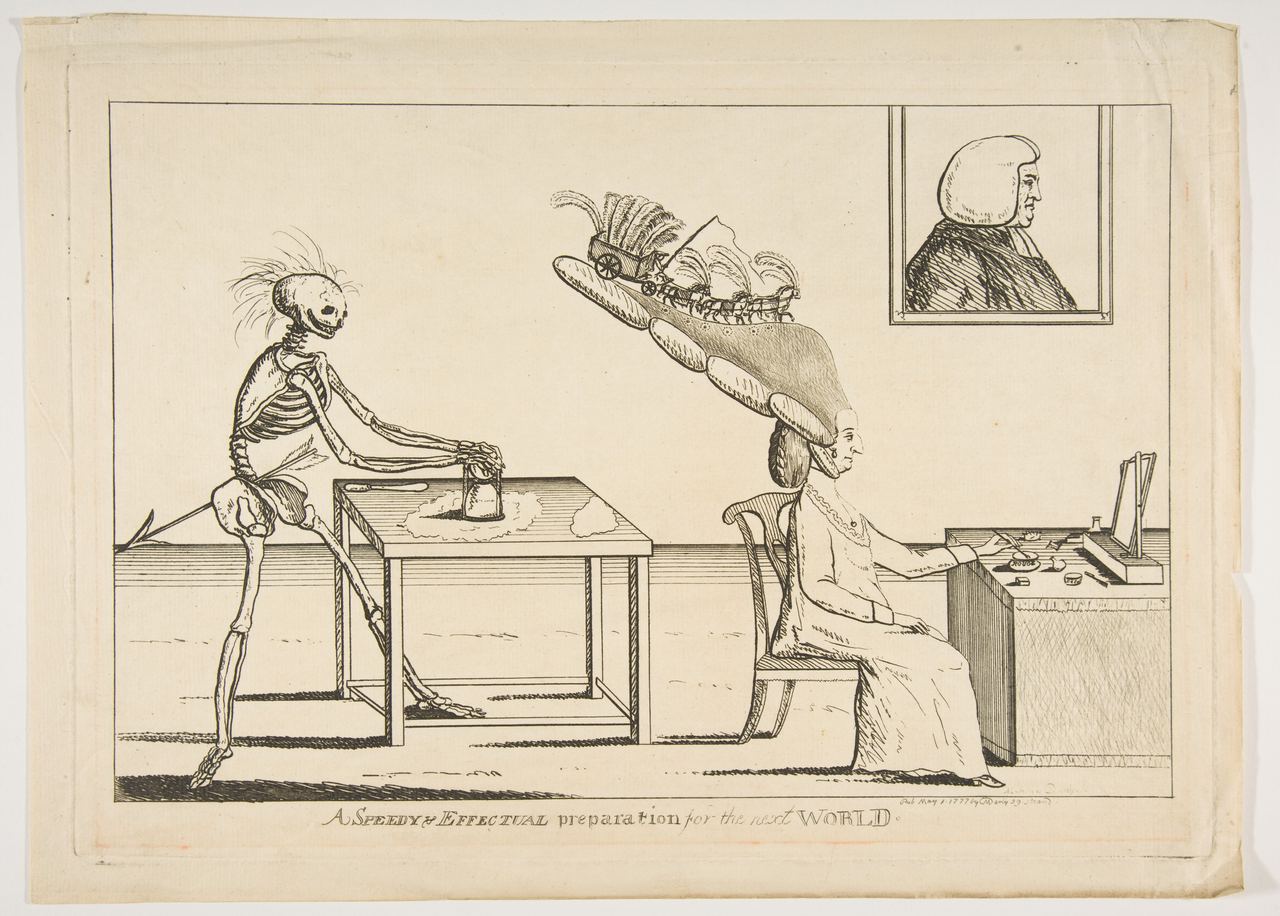
Mercier, a few years later, has fashion merchants in general "combining poufs." Langlade, who quotes the Mémoires secrets entry, writes that everyone was talking of "the poufs created by the firm of Bertin," but in an anecdote he does not source. What the sources do support is narrower. Poufs were a milliner's craft, Bertin was the most famous milliner of her day, and her clients wore them. Kesterton notes that the towering pouf and the very large panniers of the late 1770s made a good setting for artificial flowers. Campan wrote that headdresses grew so tall that women could not find carriages high enough, and were seen stooping or holding their heads out of the windows. The English caricature above, published in 1777, mocks a similar excess.
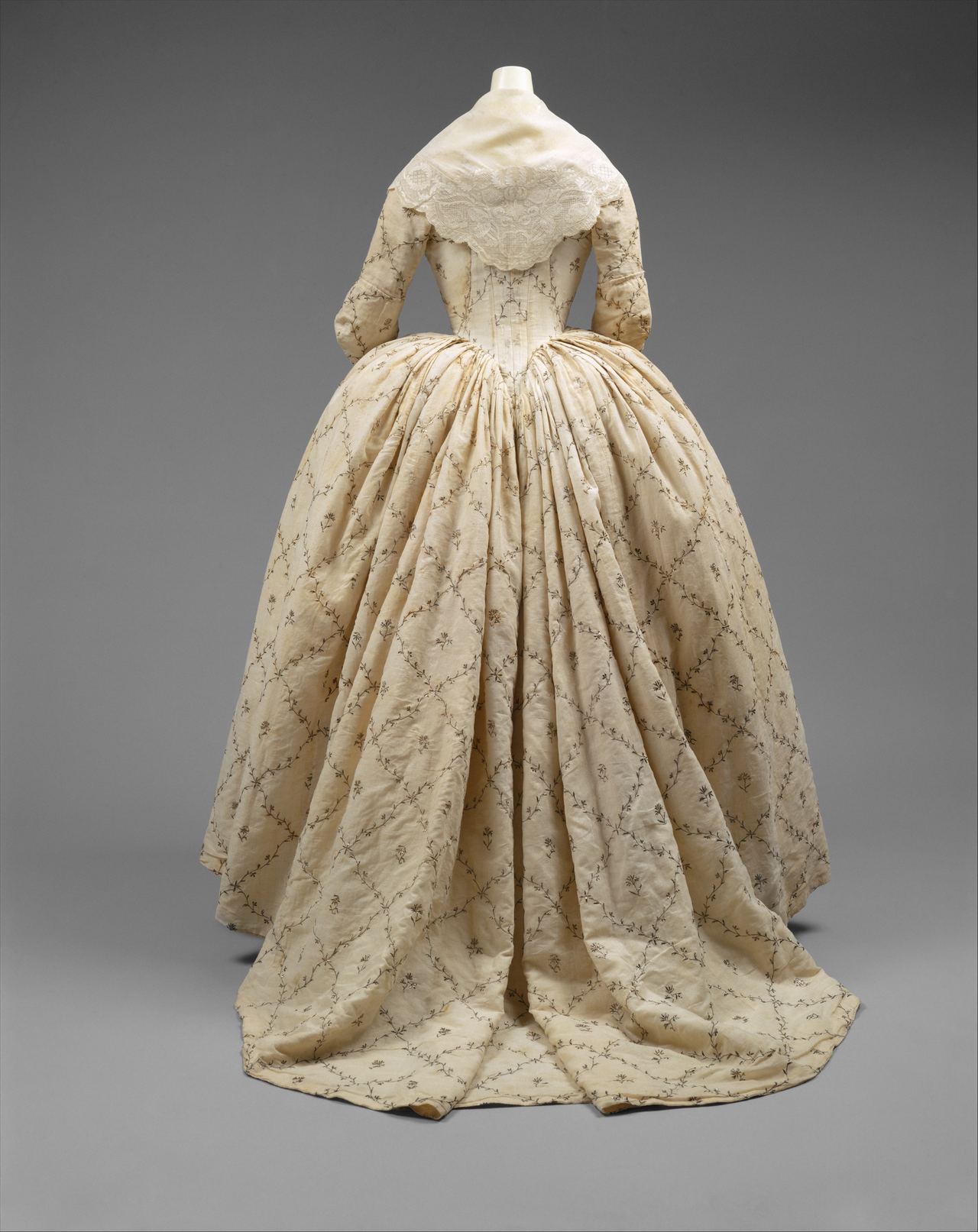
The fashion did not last. Kesterton reports that the queen's hair began to fall out in 1781, during her first pregnancy, making a high pouf harder to carry, and that flower purchases per customer in Bertin's records fell through the 1780s. Universalis adds that from about 1780 the queen and Bertin simplified dress, and the robe à la polonaise gave way to the robe à l'anglaise. The gown below is a museum example of that later type, not a documented Bertin piece.
Where did "Minister of Fashion" come from?
The earliest use of the phrase we could find is a gossip item in the Correspondance secrète dated 11 April 1778. It describes Mademoiselle Bertin, a fashion merchant in vogue and known for her absurd airs, receiving a lady customer lying on a chaise longue. When the customer asked for newer bonnets, Bertin told her that in her "last work with the Queen" they had decided the newest styles would not appear for a week. The writer adds that "since then," she has been called nothing but the "Ministre des Modes." We read the entry in a scan of the 1787 printing and in Nouvion and Liez's quotation; the scan is garbled at the closing phrase, so that wording rests on their transcription.
So the phrase begins as a joke at her expense, about her airs, and it was never an official title. It is sometimes said that the queen coined it. We found no period source for that, only Nouvion and Liez's 1911 preface, which imagines a queen laughing and saying "c'est mon ministre des modes." Chrisman-Campbell, in the Encyclopedia of Clothing and Fashion, says the press had dubbed her "ministre des modes" by 1778, consistent with this entry.
The baronne d'Oberkirch, visiting the shop on 17 May 1782 for a visiting grand duchess, found a workroom full of damasks and brocades and a proprietor swollen with her own importance, treating princesses as equals (our paraphrase of the passage Nouvion and Liez print). A shopkeeper whose standing had outgrown her trade, in other words, not someone who set policy.
What happened to her in the Revolution?
She left France in 1792, stayed away about three years, and survived. The clientele that had made her did not.
According to Nouvion and Liez, on 28 June 1792 she obtained a passport for Frankfurt from the police commissioner of her Paris section, with four "demoiselles en modes," and left on 1 July with fifteen cases of fabrics, lace, feathers and ribbons. Her name was then entered on the list of émigrés and seals were put on her property in Paris and at Épinay. She and her nephews argued that she had left on business. Chrisman-Campbell reports that she spent the next three years in Brussels, Frankfurt and London, dressing foreign and exiled clients, and was twice put on the émigré list and twice cleared. The Convention's legislative committee struck her from all lists on 30 January 1795, according to Nouvion and Liez.
Her papers show how fast the world changed. In 1791 the statements for the queen's account were still drawn up by quarter, listing fabrics, gowns and trimmings. One copy, Nouvion and Liez report, was headed "garde-robe de la femme Capet."
After her return she handed most of the business to her nephew, retired to Épinay, and in 1802 gave him her stock, valued at 10,000 francs. She died there on 22 September 1813, aged 66. The death record, as transcribed by Nouvion and Liez, calls her a landowner (propriétaire), and her nephew a fashion merchant at 26 rue de Richelieu. Her heirs then pursued her debtors. Kesterton counts 1,170 customers with unpaid bills, from 2 livres to nearly 80,000 livres owed by the Vicomtesse de Polastron, and notes that the lawyers never persuaded the families to pay. Those files are why we can study her business at all.
How is she different from Worth, and why does she still matter?
Bertin sold ornament on top of clothing that other trades made. A century later Charles Frederick Worth (1825–1895), English-born, moved to Paris in 1846 and in 1858 opened his own firm; the house at 17 rue de la Paix made garments for clients across Europe. What each sold, more than how famous each was, separates the two.
The Dictionnaire des créatrices calls Bertin the archetype of the tyrannical fashion supplier, announcing the great nineteenth-century creators, Leroy then Worth, ancestors of twentieth-century Paris haute couture. It credits her status to the queen's favor, her exorbitant invoices and the anecdotes about her temper.
For the next stage of the story, see our profile of Jeanne Paquin, who in 1917 became the first woman to preside over the Paris chambre syndicale, the couture trade body.
Where can you see her world, and read her sources?
The Met's open-access collection has the print used above (24.80.141), the Gallerie des Modes et Costumes Français (38.38.8) and the Darly caricature (1970.538.23), plus a robe à l'anglaise of 1784–87 (1991.204a, b). The sitter's identity in the Janinet print rests on the Met's title; Langlade and Nouvion and Liez both describe a Janinet engraving as her portrait, but we found no other confirmation.
Several sources are free to read: Nouvion and Liez's Un ministre des modes sous Louis XVI (1911), Langlade's English-language biography (1913) and the 1909 English edition of Campan's memoirs are on the Internet Archive. Kesterton's article on the credit files, held at the Institut national d'histoire de l'art in Paris, is in The Historical Journal, and Chrisman-Campbell's entry in the Encyclopedia of Clothing and Fashion is the best short English overview.
Sources
- Un ministre des modes sous Louis XVI: Mademoiselle Bertin, marchande de modes de la reine, 1747-1813. Nouvion, Pierre de, and Émile Liez (Henri Leclerc, 1911), via Internet Archive. Scholarly biography, full text read. Transcribes the Saint-Gilles baptism record (2 July 1747), the 1813 death record, the first daybook date (24 Oct 1773), the 1792 passport and émigré papers, the 30 Jan 1795 decision, and quotes the Correspondance secrète of 11 Apr 1778. Used as the transcription of those records; not checked against the originals. Accessed October 28, 2026.
- Memoirs of Madame Campan on Marie Antoinette and her court, vol. 1. Madame Campan, Memoirs, Marie Antoinette Edition (J. B. Millet, Boston, 1909), via Internet Archive. Primary memoir, English edition; read the passages on Mademoiselle Bertin, the first journey to Marly, tall headdresses and the queen's closet. Footnotes in this edition are editorial and were not used. Accessed October 28, 2026.
- Mémoires secrets pour servir à l'histoire de la république des lettres en France, 1777 ed., vol. 7. Mémoires secrets (attrib. Bachaumont), tome 7, via Internet Archive. Primary periodical; read the 26 April 1774 entry on the pouf au sentiment in the scan (OCR with long-s errors, but readable). Searched volume 7 for Bertin: no mention. Accessed October 28, 2026.
- Correspondance secrète, politique & littéraire, vol. 6. Correspondance secrète, politique et littéraire, tome 6 (1787 ed.), via Internet Archive. Primary periodical; read the Paris entry of 11 April 1778 on Mlle Bertin in the scan. The scan is garbled at the closing phrase, so the wording 'Ministre des Modes' rests on Nouvion and Liez's quotation. Accessed October 28, 2026.
- Tableau de Paris, tome II, chapter CLXXIII, Les Marchandes de Modes. Louis-Sébastien Mercier, Tableau de Paris (1783 ed.), via Internet Archive. Primary text; read the full chapter. Describes the fashion merchant combining poufs and the doll of the rue Saint-Honoré; does not name Bertin. Accessed October 28, 2026.
- Rose Bertin: The Creator of Fashion at the Court of Marie-Antoinette. Émile Langlade, trans. Angelo S. Rappoport (1913), via Internet Archive. Older biography, full text read. Flagged as 'entertaining but unreliable' by Chrisman-Campbell. Used for the guild's 1776 reorganization and the quoted Mémoires secrets entry; the 1772 introduction story and anecdotes were not relied on. Accessed October 28, 2026.
- Artificial flowers in the credit records of an eighteenth-century French fashion merchant. Zara Kesterton, The Historical Journal 67(5), 2024. Peer-reviewed article, open full text read. Source for the credit files (INHA), 1,170 debtors, flower counts, Nov 1772 receipts, queen as customer from 1774 per household records, and the 1781 hair loss. Accessed October 28, 2026.
- Bertin, Rose. Kimberly Chrisman-Campbell, Encyclopedia of Clothing and Fashion (Gale), via Encyclopedia.com. Scholarly reference entry, full text read. Used for the 1772 shop date, summer 1774 introduction, guild first mistress, 1778 press nickname, the doll, exile 1792-95 and the bibliography note on Langlade. Accessed October 28, 2026.
- Bertin Rose (1747-1813). Encyclopædia Universalis (Catherine Ormen). Scholarly reference entry; read the free opening (about half the article). Used for birth, apprenticeship, shop dates, trade description, rivals, introduction after 10 May 1774 and the 1780 change of fashion. Accessed October 28, 2026.
- Rose Bertin. Dictionnaire universel des créatrices (Françoise Tétart-Vittu). Scholarly reference entry, full text read. Used for the 1760 apprenticeship, September 1776 guild role, supply records 1776-1792, the 'Rose' name and the Leroy-Worth lineage. Accessed October 28, 2026.
- House of Worth. Textile Research Centre, Leiden. Museum reference page, full text read. Used only for Worth's dates, move to Paris in 1846, firm of 1858 and the rue de la Paix address. Accessed October 28, 2026.
- Mademoiselle Rose Bertin, Dressmaker to Marie-Antoinette, Janinet, 24.80.141. The Metropolitan Museum of Art. Object record via the Met Open Access API (isPublicDomain true, undated, 1765-1814); image inspected. Accessed October 28, 2026.
- Gallerie des Modes et Costumes Français, 38.38.8(1-3). The Metropolitan Museum of Art. Object record via the Met Open Access API (isPublicDomain true); plate inspected, caption transcribed from the plate. Accessed October 28, 2026.
- A Speedy & Effectual Preparation for the Next World, Darly, 1970.538.23. The Metropolitan Museum of Art. Object record via the Met Open Access API (isPublicDomain true); image inspected. Accessed October 28, 2026.
- Robe à l'anglaise, 1784-87, 1991.204a, b. The Metropolitan Museum of Art. Object record via the Met Open Access API (isPublicDomain true); image inspected. Accessed October 28, 2026.
- Rose Bertin; Marchande de modes. Wikipedia. Used to locate references only. Its claims (1770 shop opening, coronation robes carried on a stretcher, pouf invention) were not found in sources we could read and were not used. Accessed October 28, 2026.
Glossary
Last updated · Markdown · Report an error