Design
Ogata Kōrin: The Painter Whose Name Became a Pattern
Who was Ogata Kōrin, and what is a Kōrin pattern on a kimono? The Kyoto painter from a textile family, the few robes he painted himself, and how his name became a design label.
Ogata Kōrin (1658–1716) was a Kyoto painter and designer born into a family of kimono-fabric merchants. A "Kōrin pattern" is a round, simplified plum blossom, wave, plover, pine or chrysanthemum that pattern books began to sell under his name in 1712. No surviving pattern book shows that Kōrin drew them himself; the name worked like a brand.
Who was Ogata Kōrin?
Kōrin was a painter, lacquer designer and pottery decorator in Kyoto, born in 1658 as the second son of a prosperous textile dealer. He turned to painting as a profession only in adulthood, then became one of the defining artists of the Genroku era and a central figure of the Rinpa tradition. His younger brother Kenzan (1663–1743) became a potter.
Kōrin did not grow up planning to paint. According to art historian Frank Feltens, he studied the arts as part of a wealthy man's education, took to the Noh stage as a teenager, and seems to have committed to painting only well into his thirties. He trained with a Kanō-school painter, the usual route for a wealthy commoner, but never belonged to a professional atelier. In 1701 he received the honorary title hokkyō, after which he signed his works "Hokkyō Kōrin." In the winter of 1704 he went to Edo, and in the spring of 1709 he settled again in Kyoto, where he worked until his death in 1716.
What was the Kariganeya?
The Kariganeya was the Ogata family's Kyoto business, which supplied kimono fabric and designs to the aristocracy. Its best-known customer was Tōfukumon'in (1607–78), consort of Emperor Go-Mizunoo. When she died the business began to fail, and it later dissolved under Kōrin's elder brother.
Two independent sources describe the shop's clientele. Feltens calls it the textile supplier to Tōfukumon'in and her court, and the Japanese Architecture and Art Net Users System (JAANUS) notes a surviving Kariganeya order book showing the kosode styles she ordered. The family was also connected to Hon'ami Kōetsu, the calligrapher and designer at the root of Rinpa, whom Feltens calls Kōrin's great-granduncle.
The decline is told with slightly different timing in different sources. Feltens says the business crumbled in Kōrin's twenties. The National Diet Library of Japan says Kōrin's father died when Kōrin was 30, leaving him a large fortune that he spent, and that he once pawned a family folding screen and asked Kenzan for a loan. Both agree on the result: a man with a textile designer's eye and no shop to run turned to painting for a living.
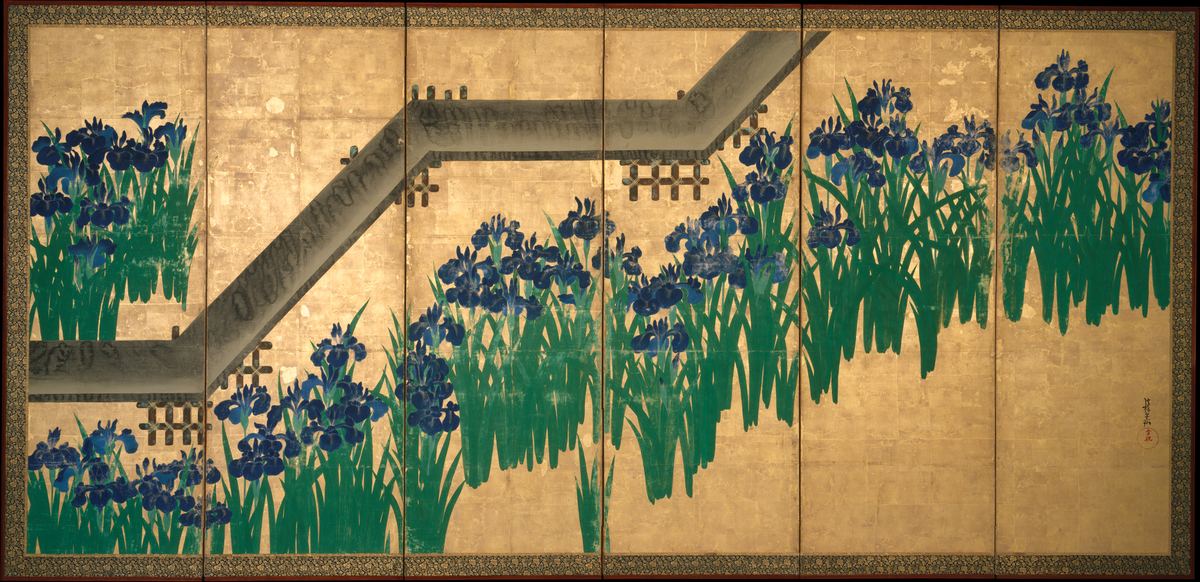
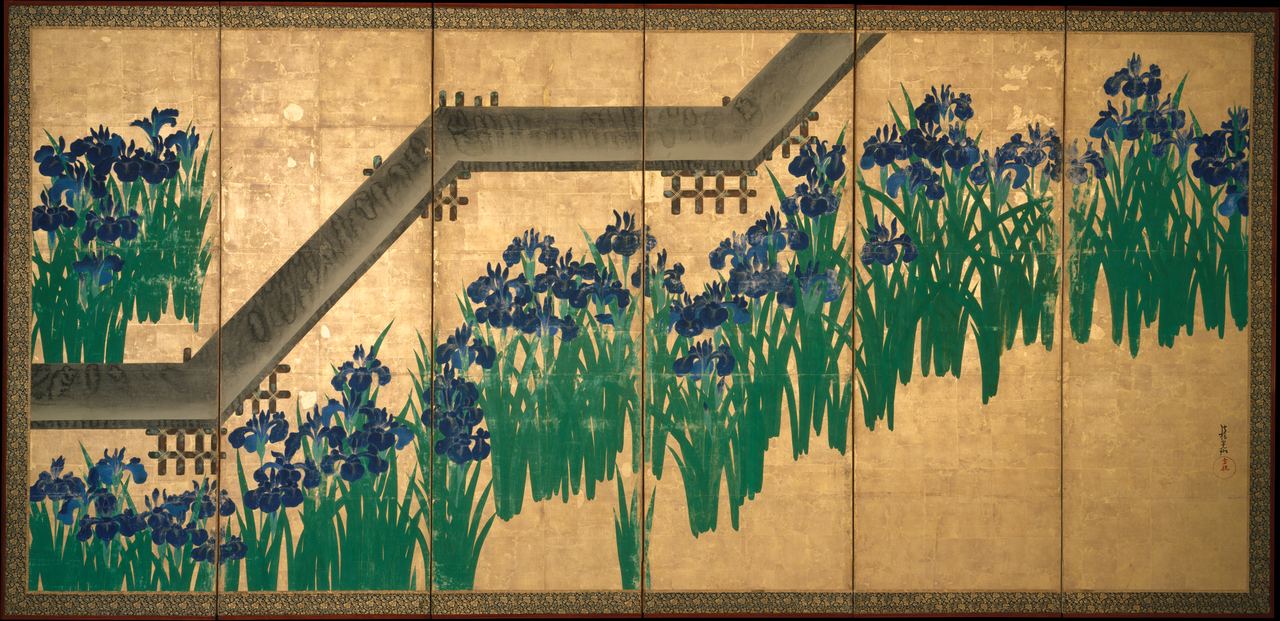
Feltens argues that the family trade shaped his art. In his early Irises screens, one cluster of flowers is repeated on each screen, which Feltens compares to stencil dyeing; the Kariganeya's own design books repeat a flower from several angles. Kōrin also borrowed motifs from those books, including a swirling water pattern called Kanze water.
Did Kōrin design kimono himself?
Yes, but far less than his name suggests. A few kosode painted directly by his brush survive, and the best known is the Fuyuki kosode at the Tokyo National Museum. The "Kōrin pattern" designs that filled pattern books are a separate matter: no surviving pattern book carries any sign of his direct involvement.
The Fuyuki kosode is a robe of white twill silk painted with autumn plants (chrysanthemum, bush clover, bellflower and pampas grass) in shades of indigo. Japan's Agency for Cultural Affairs lists it as an Important Cultural Property, painted by Kōrin, of the 18th century, and notes that painted robes by famous artists were then fashionable among the wives of wealthy merchants. The record says it is traditionally held to have been made for the wife of the Fuyuki family, timber merchants in Fukagawa, Edo, with whom Kōrin first lodged when he traveled east in 1704. "Traditionally" matters: the museum frames the commission as a story handed down, not a documented order. Feltens thinks it was probably made late in Kōrin's life.
Feltens describes a second garment, in the Hatakeyama Memorial Museum of Fine Art. It is a short-sleeved robe of white satin damask with plum branches in ink and white, cut apart and mounted on two folding screens, and signed "Jotting by Seisei Kōrin." He dates it to about 1709. We know this robe only through Feltens's account, so the date is his reading.
A third robe, in the MOA Museum of Art in Shizuoka Prefecture, is catalogued only as "Attributed to Ogata Korin," 18th century, with autumn flowers and grasses painted directly on white silk. The museum itself compares it to the Fuyuki kosode. The caution in that label is worth keeping in mind whenever you see a kimono sold as "by Kōrin."
There is also an early literary hint. A novella of 1699, Kōshoku fumi denju, mentions a patron having Kōrin paint a swift ink picture of pines onto white satin. In Feltens's translation: "Onto the white satin, he had Kōrin paint a swift ink painting of pines." It is the earliest mention of his name in early modern prose, and it ties him to cloth years before the pattern books did.
What are Kōrin patterns?
Kōrin patterns (Kōrin moyō) are textile designs sold in pattern books under his name. Their shapes are simple, rounded and bold, echoing the plants, birds and water of his paintings. Most appeared after his death, probably adapted by professional designers; whether Kōrin took part is unknown.
To understand them you need the hinagata bon, or pattern books. The first surviving one, Shinsen o-hiinagata, was printed in 1666. Feltens counts nearly 180 editions between then and the 1820s. They were printed cheaply in black ink, usually showed only the back of a garment, and served as catalogues from which a customer and a dyer could assemble a robe. The British Library describes them as manuals for designers and merchants and also as fashion magazines for customers.
The first Kōrin-labeled design appeared in 1712 in Shinpan fūryū hinagata taisei: a plum blossom, "Kōrin plum." Feltens notes the book drew the plum differently from Kōrin's brushed version, and that within two years pattern books were copying his plum much more faithfully. Later books added Kōrin paulownia, pines, chrysanthemums, plovers, maple leaves and swirling water. In Tōfū bijo hinakata, the preface promises "rare patterns dyed after Kōrin's brush." According to Kirihata Ken, cited by Feltens, 33 pattern books between 1711 and 1753 carry Kōrin patterns or patterns in his style, and 14 of them are devoted to them entirely.
Even the spelling of the name moved, and the sources disagree on the order. Feltens says early books used the painter's own characters (光琳) or phonetic script, and later ones the variant 光林, which he reads as a sign that "Kōrin" was becoming a trademark detached from the man. The National Diet Library says the 光林 spelling was later replaced by 光琳.
| Date | Event | Source |
|---|---|---|
| 1658 | Kōrin is born in Kyoto, second son of the Kariganeya's owner | National Diet Library; Feltens |
| 1666 | *Shinsen o-hiinagata*, the earliest surviving kosode pattern book, is printed | Feltens; British Library |
| 1678 | Tōfukumon'in dies; the Kariganeya begins to decline | Feltens; JAANUS; nippon.com |
| 1699 | A novella mentions Kōrin painting pines in ink on white satin | Feltens |
| 1701 | Kōrin receives the title hokkyō | nippon.com; Feltens |
| 1704 to 1709 | Kōrin goes to Edo in 1704 and settles again in Kyoto in spring 1709 | nippon.com; Feltens |
| 1712 | First pattern book to use his name, with "Kōrin plums" | Feltens |
| 1716 | Kōrin dies in Kyoto | National Diet Library; Feltens |
| 1717 | A novel describes a woman who "obtained" a Kōrin-pattern garment | Feltens |
| 1727 | *Kōrin hinagata wakamitori* and *Hinagata itosusuki* appear; *Tōfū bijo hinakata* is reprinted | Feltens |
| 1815 | Sakai Hōitsu marks the centenary of Kōrin's death with a memorial exhibition and the book *Kōrin hyakuzu* | National Diet Library |
| 1864 | *Kōrin shinsen hyakuzu* is printed | Met; Smithsonian Libraries |
| 1915 | Mitsukoshi holds a "New Kōrin Patterns" contest and a Kōrin exhibition for the 200th anniversary of his death | National Diet Library |
| 1972 | The Tokyo National Museum's "Rimpa" exhibition popularizes the school's name | National Diet Library |
Which motifs count as Kōrin style?
Plum blossoms, waves and water, plovers, pines, chrysanthemums and autumn grasses are the core of Kōrin style. In the pattern books each is reduced to a few curves with a smooth outline. Iris is his most famous painted motif, but Feltens does not list it among the Kōrin patterns.
| Motif | In his painting | In pattern books and kosode |
|---|---|---|
| Plum | Blossoms brushed in ink with two semicircular strokes | First Kōrin pattern (1712); the most frequent one |
| Waves and water | Waves built from small and large curves; twisting streams | "Kōrin swirling water"; later called Kōrin waves |
| Plover | Effortless forms made of a few brushstrokes, per Feltens | "Kōrin plovers" in *Tōfū bijo hinakata* |
| Autumn grasses | Chrysanthemum, bush clover, bellflower | The Fuyuki kosode; a favorite Rinpa subject per MOA |
| Chrysanthemum | Clearly articulated petals on the Fuyuki kosode | "Kōrin chrysanthemum": a circle with filled-in oval petals |
| Iris | Repeated clusters on gold screens | Not among the Kōrin patterns Feltens lists |
The National Diet Library puts the style in one sentence: plants and birds in round shapes, "just like Korin's works, but Korin himself was not involved in them." Feltens is more careful: it is not known whether he was involved, though the closeness of some designs to his sketches suggests a link, and his late workshop may have acted as a filter. Designers could also have seen his painted robes. Feltens describes the patterns as borrowed shapes that designers "modified at will."
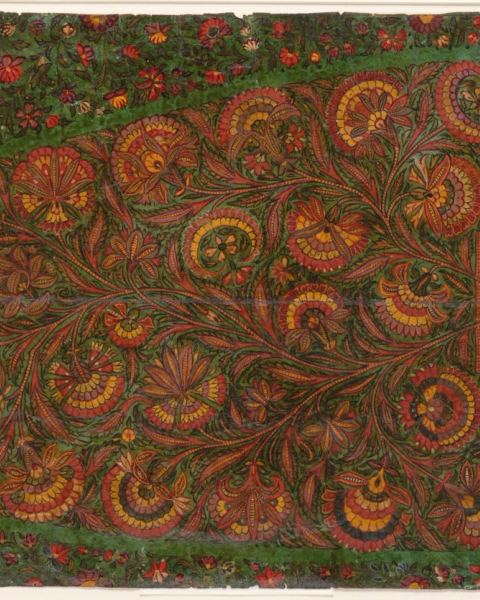
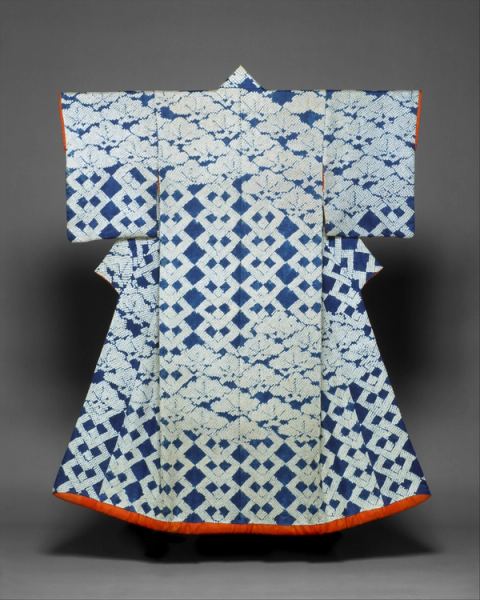
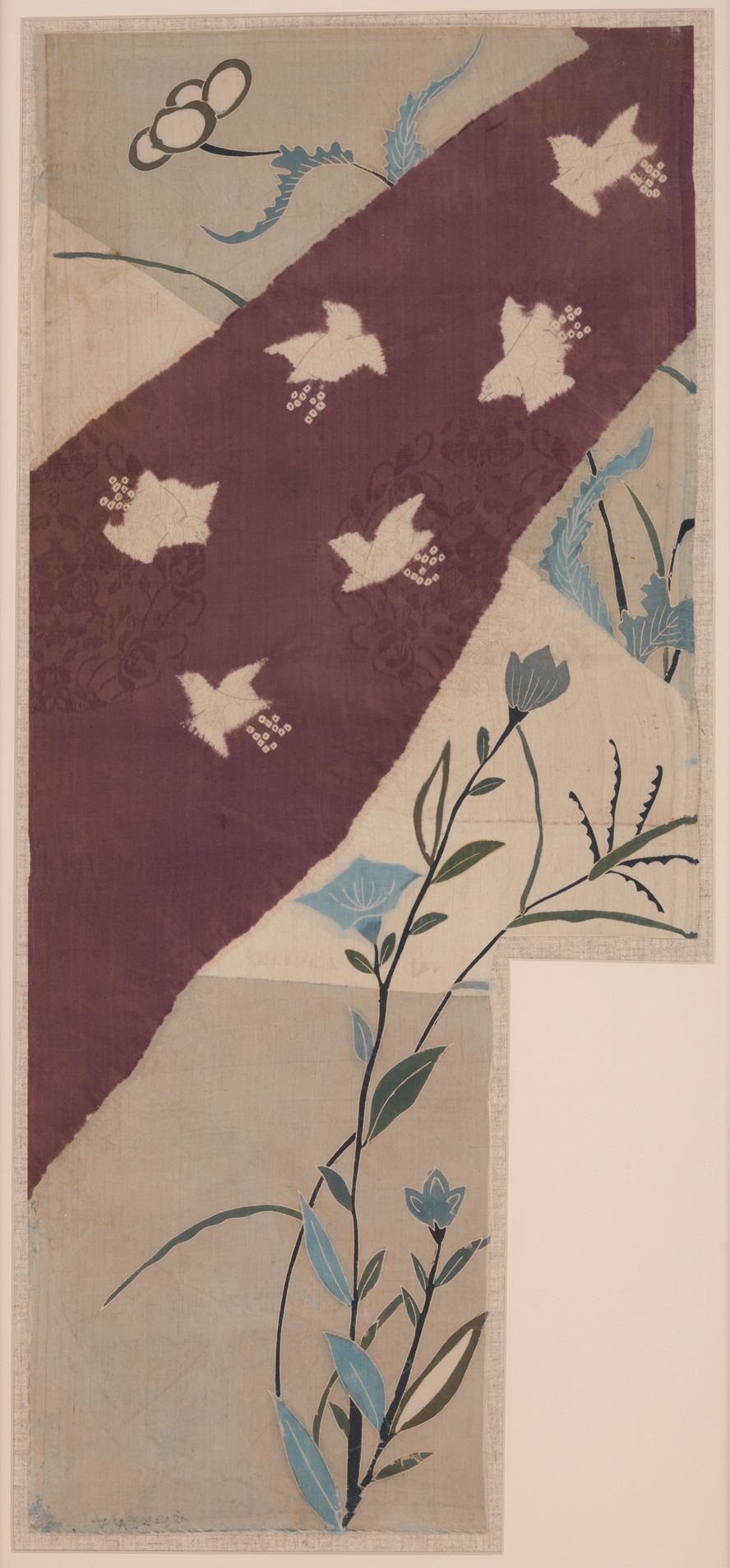
A kosode in the Met's collection shows what a dyed and painted robe of this period looked like, though its designer is not recorded. Its medium is listed as stitch- and paste-resist-dyed and painted silk, a reminder that one robe could combine several techniques; see resist dyeing and shibori.
How did Kōrin's name become "Rinpa"?
Rinpa is a twentieth-century name for a school that stretches from Kōetsu and Sōtatsu in the early 1600s through Kōrin to Sakai Hōitsu in the 1800s. The "rin" is the second half of Kōrin's name. It became standard only after a 1972 exhibition, though the idea of a "Kōrin school" is older.
JAANUS dates the term to the Meiji period and lists earlier names for the group, including Kōetsu school, Kōetsu-Kōrin school and, more recently, Sōtatsu-Kōrin school. The central figure in the revival was Sakai Hōitsu (1761–1828), the younger brother of the lord of Himeji Castle, who studied Kōrin's work in Edo. In 1815, the centenary of Kōrin's death, he held an exhibition and published Kōrin hyakuzu ("One Hundred Designs by Kōrin") together with Ogata-ryū ryakuinpu, a catalog of sixteen artists in the "Ogata school." The National Diet Library calls that catalog the beginning of thinking of them as a school.
In the Meiji period, "Kōrin school" first meant living painters and craftsmen working in his manner, then a historical school, in a government-compiled art history of 1901 and in a 1903 album, Kōrinha gashū. The shorter "Rinpa" appears in print by the Taishō era and became the standard term after the Tokyo National Museum's 1972 show. Chizawa Teiji, head of the museum's arts and culture division, explained the choice: "We took the 'Rin' from Korin."
How did Kōrin style reach the modern kimono?
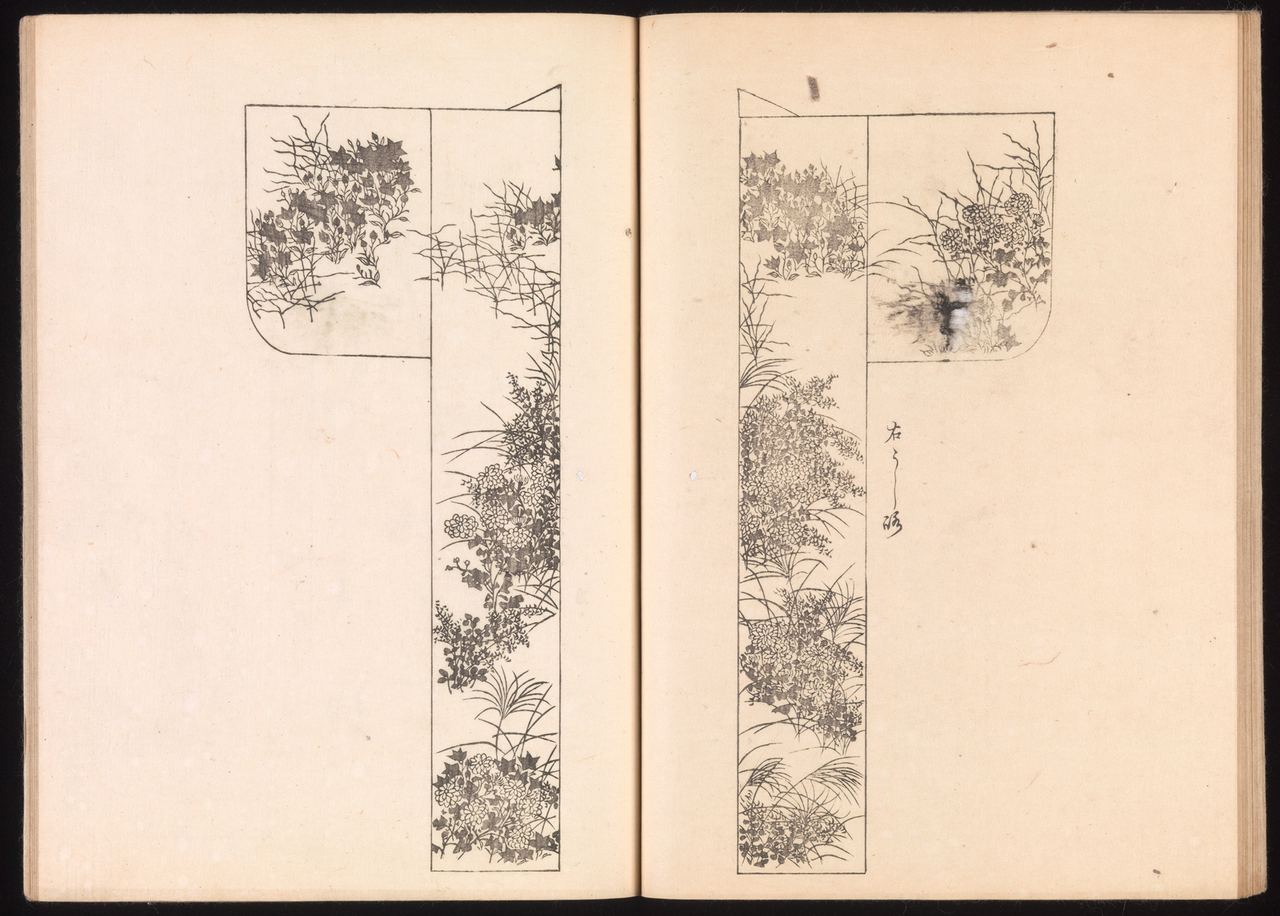
Through books, then shops. Reprints of Hōitsu's Kōrin hyakuzu were issued many times, and the Met owns an 1864 book with a different title, Kōrin shinsen hyakuzu, whose pages lay out plant designs on garment-shaped outlines. In the early twentieth century, department stores made Kōrin a selling point.
The 1864 book, in two woodblock-printed volumes, is catalogued by the Met under Kōrin's name and also appears in the Smithsonian Libraries. Like the pattern books of the 1700s, its pages plan a design for the sleeve and body of a robe. The Met's record does not say who compiled it. The National Diet Library also holds an 1894 Hakubunkan edition of Kōrin hyakuzu, so Kōrin's designs were still being reprinted in the Meiji era.
Then came retail. The National Diet Library traces a long relationship between the Mitsukoshi store (whose predecessor, the Mitsui kimono shop, began operating as Japan's first department store in 1904) and Kōrin. A design department employee praised the Rinpa school in the customer booklet Hanagoromo in 1899. In April 1915 Mitsukoshi invited the public to a "New Kōrin Patterns" design competition, and in June it mounted an exhibition for the 200th anniversary of his death. The winning designs, the Library notes, mixed Japanese and Western flowers and showed Art Nouveau influence. By the late nineteenth century, according to the British Library, Kyoto publishers were also working with designers such as Kamisaka Sekka and Furuya Kōrin on color design albums.
None of this is unusual in the history of named patterns. Paisley is named for a Scottish town rather than for a person, but it too carries a name that drifted away from its source. Feltens calls Kōrin's absorption into popular fashion "a singular case among early modern painters."
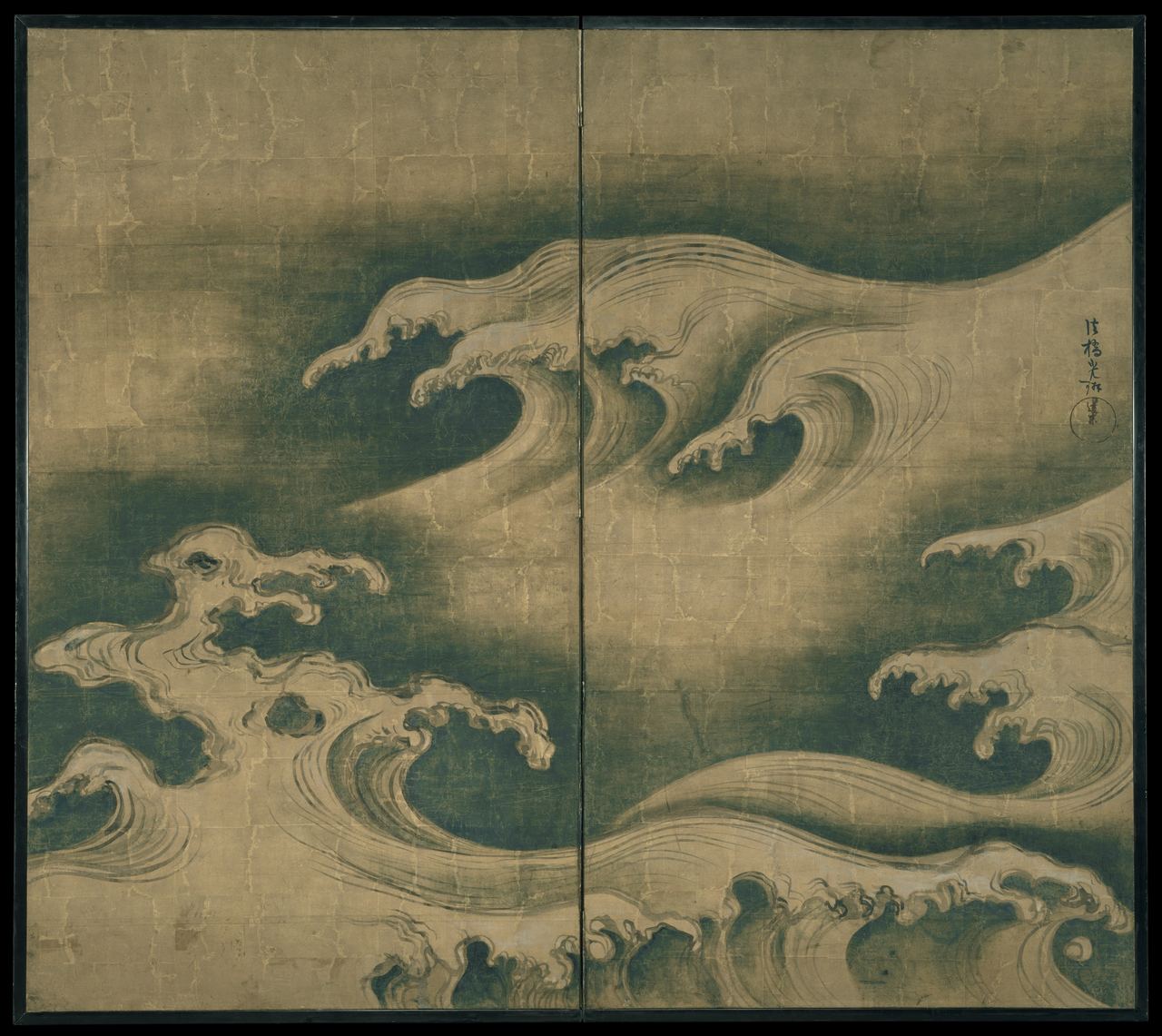
Where can you see his work?
Kōrin's painted robe is in Tokyo; his screens are spread across museums worldwide. The Met holds Irises at Yatsuhashi (53.7.1, .2), Rough Waves (26.117), a pair of screens with cranes, pines and bamboo (1975.268.62, .63) and a fan remounted as a hanging scroll, Chinese Bellflowers (1975.268.64). The Cleveland Museum of Art has works under his name including a Plum Tree of about 1700. For kosode, look to the Tokyo National Museum's Fuyuki kosode and the MOA Museum's attributed robe; check each museum's schedule, because textiles rotate off view for conservation.
If you are shopping for a "Kōrin-style" garment, the history above gives you a short test. The pattern should be a plum, wave, plover, pine, chrysanthemum or grass rendered in a few smooth curves. Calling it Kōrin-style is fair, since that has been a commercial category since 1712. A robe described as painted by Kōrin himself is a different claim, and only a few garments are credited that way.
Sources
- Sartorial Identity: Early Modern Japanese Textile Patterns and the Afterlife of Ogata Kōrin (Ars Orientalis 47, 2017). Frank Feltens, Ars Orientalis / Japan Art Society. Scholarly, primary for the pattern-book chronology. Full text read (PDF, pp. 117-57): Kariganeya, 1699 novella, Fuyuki and Hatakeyama kosode, 1712-1727 pattern books, 33/14 book count. Accessed November 4, 2026.
- The Rimpa School and Its Influence as Seen in Books: Forms that were created by the Rimpa school and passed on through books. National Diet Library, Japan. Full page read: Kariganeya, Kōrin-moyo, 1815 Hōitsu, 1894 reprint, Mitsukoshi 1899 and 1915. Accessed November 4, 2026.
- The Rimpa School and Its Influence as Seen in Books: Until the Rimpa school became known as such. National Diet Library, Japan. Full page read: Ogata school 1815, Kōrin school in Meiji, 1901 and 1903 books, 1972 exhibition, Chizawa quote. Accessed November 4, 2026.
- Rinpa (JAANUS). Japanese Architecture and Art Net Users System, Columbia University. Entry read: term origin, earlier names, lineage Kōetsu to Hōitsu. Accessed November 4, 2026.
- Kosode (JAANUS). Japanese Architecture and Art Net Users System, Columbia University. Entry read: definition, construction, Kanbun style, Kariganeya order book for Tōfukumon'in (1607-78). Accessed November 4, 2026.
- Kosode, white twill ground with autumn-plant design (Fuyuki kosode), Important Cultural Property. Agency for Cultural Affairs, Japan (Cultural Heritage Online). Japanese record read: attributed to Kōrin, Edo period 18th c., silk twill, painted; tradition of commission for the Fuyuki wife; fashion for painted kosode. Accessed November 4, 2026.
- Fuyuki kosode repair project (Bunkaru, Agency for Cultural Affairs magazine). Agency for Cultural Affairs, Japan. Japanese page read: painted for the wife of the Fuyuki timber merchants; chrysanthemum, bush clover, bellflower, pampas grass in shades of indigo. Accessed November 4, 2026.
- Ogata Kōrin: The Artistic Innovator Famed for His Folding Screens. nippon.com. Full text read: biography, 1701 hokkyō, 1704 to Edo, spring 1709 return. Accessed November 4, 2026.
- Kosode Dress with Design of Autumn Grasses (attributed to Ogata Korin). MOA Museum of Art. Museum record read: attribution wording, comparison to Fuyuki kosode, autumn grasses as Rinpa motif. Accessed November 4, 2026.
- Exquisite patterns: Japanese textile design books. British Library. Full post read: first pattern book 1666, how they were used, late 19th-century design albums. Accessed November 4, 2026.
- Kosode (ArtWiki). Ritsumeikan University Art Research Center. Entry read: construction, cloth width, kosode as forerunner of the kimono. Accessed November 4, 2026.
- Irises at Yatsuhashi (Eight Bridges), Ogata Kōrin, 53.7.1, .2. The Metropolitan Museum of Art. Object record via Met Open Access API (web page blocked by bot check): date, medium, CC0. Accessed November 4, 2026.
- One Hundred Newly Selected Designs by Kōrin (Kōrin shinsen hyakuzu), 1864, JIB124a, b. The Metropolitan Museum of Art. Object record via Met Open Access API; pages inspected in the image. Smithsonian Libraries record (library.si.edu/digital-library/book/korin-shinsen-hyakuzu) read for the date [1864]. Accessed November 4, 2026.
- Pieces from a Robe (Kosode) with Autumn Grasses, 2001.428.26a-c. The Metropolitan Museum of Art. Object record via Met Open Access API: date, medium, CC0. No designer recorded. Accessed November 4, 2026.
- Rough Waves, Ogata Kōrin, 26.117. The Metropolitan Museum of Art. Object record via Met Open Access API: date, medium, CC0. Accessed November 4, 2026.
Glossary
Last updated · Markdown · Report an error