Dyeing
Shibori: Resist Dyeing Beyond Tie-Dye
Kanoko, miura, kumo, nui, arashi and itajime: how six families of Japanese shaped-resist dyeing differ, what each leaves on the cloth, and why Arimatsu still matters.
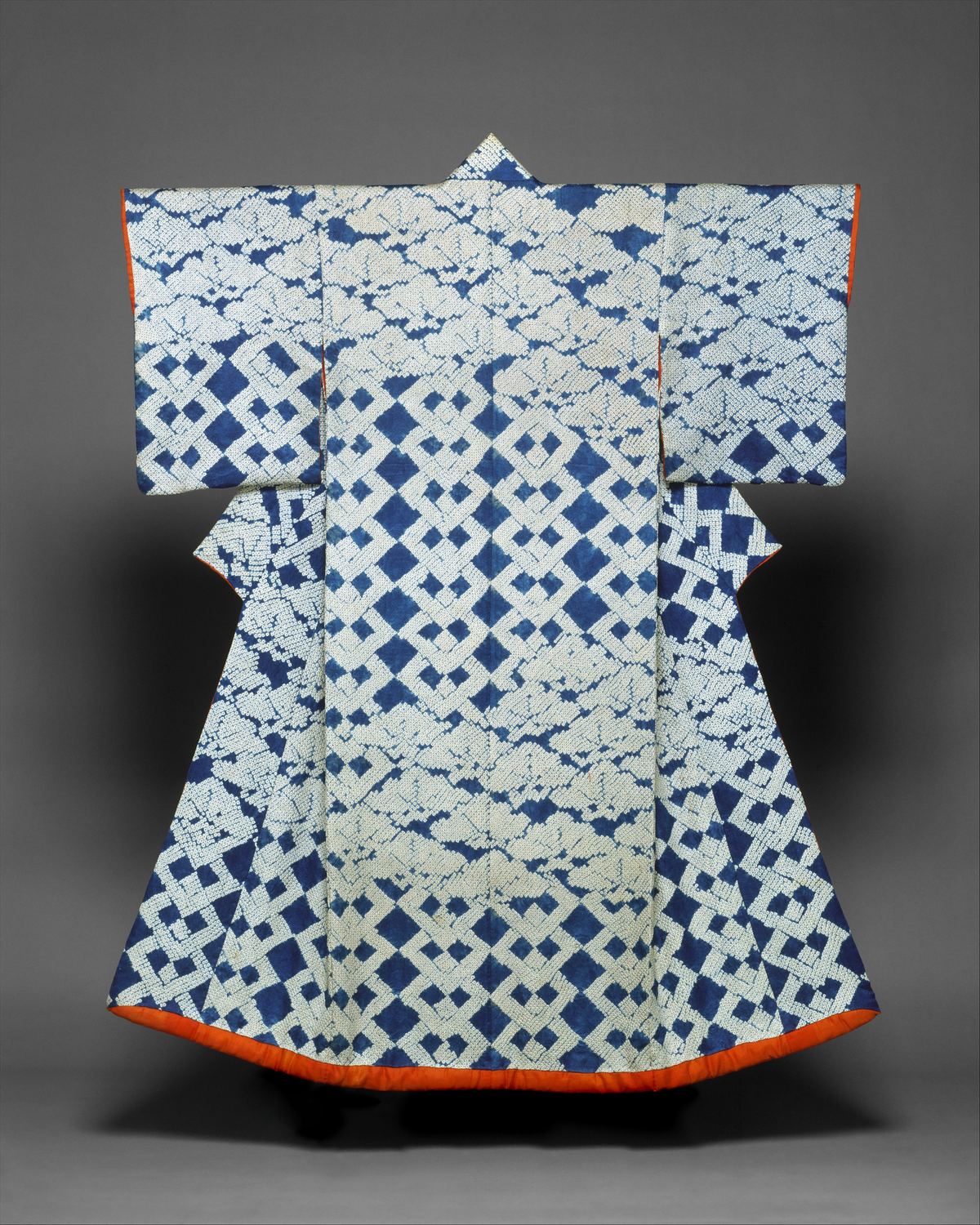
Shibori is the Japanese word for cloth patterned by compression: the fabric is pinched, stitched, pleated, wrapped or clamped so that dye cannot reach some areas, and the design appears when the binding comes off. Teaching lists sort it into six families, kanoko, miura, kumo, nui, arashi and itajime, and each leaves a different mark on the cloth.
What is shibori, and why is it more than tie-dye?
Shibori is a family of resist-dyeing methods in which cloth is shaped and held before it meets the dye. The textile scholar Yoshiko Iwamoto Wada, co-author of the 1983 book Shibori: The Inventive Art of Japanese Shaped Resist Dyeing, summarizes it as patterns made by plucking, stitching or folding cloth and then tightly knotting, binding or clamping it so that dye cannot get in. The word comes from the verb shiboru, to squeeze or wring, and the modern craft writer Jane Callender puts the idea in one word: compression.
English speakers usually say tie-dye, which is only partly right. In a 1994 conference paper Wada noted that textile specialists often avoid the term, partly because of its Grateful Dead associations, and that some scholars use it for both shibori and ikat even though dyeing yarn before weaving and dyeing finished cloth are different processes with different results. She prefers plain English labels such as clamp resist, stitch and bound resist, and pole wrap resist, because many Japanese terms name one specific process.
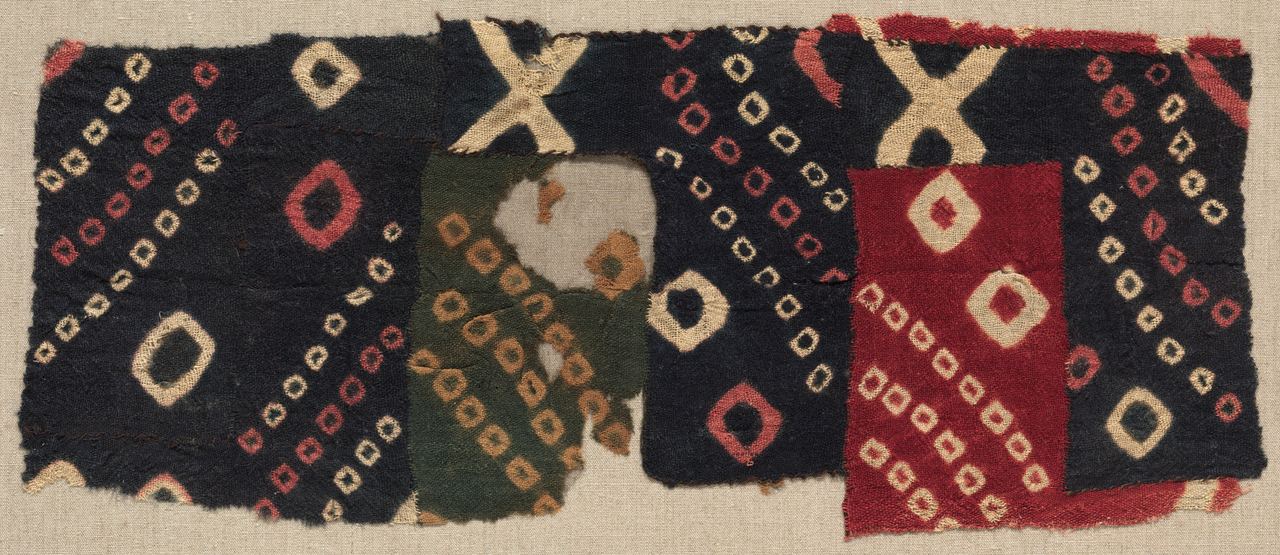
The principle is not Japanese alone. The Cleveland Museum of Art holds a tie-dyed wool fragment from the Wari culture of Peru's south coast, dated about 700 to 1100 CE, patterned in rows of small hollow diamonds. Its collection also includes Indian tie-dyed veils and saris of the 1800s and early 1900s, and Wada's 2016 symposium session on Arimatsu shibori brought in West African indigo and resist-dyed cloth. What marks out Arimatsu is the depth of its vocabulary: Aichi Prefecture counts as many as 100 variations of the tying technique alone.
How old is shibori, and why does everyone say Arimatsu?
Surviving Japanese resist-dyed cloth goes back to the eighth century, when fragments were stored in the Shōsōin repository in Nara. Shibori as a luxury fashion took off in the Edo period. The town most associated with it, Arimatsu on the Tōkaidō road near Nagoya, dates its trade to 1608.
The Japan Architecture and Art Net Users System (JAANUS), a reference hosted by Columbia University, says resist dyeing reached Japan from China and was made there from the Nara period. It lists three early kinds: kōkechi, bound resist; rōkechi, wax resist; and kyōkechi, in which cloth is folded between carved boards. Shōsōin fragments show cloth tied, sewn and pulled taut. JAANUS adds that wax resist and board resist had died out by the early Kamakura period, while bound resist stayed popular and developed into tsujigahana and hittashibori. A Kyoto craft-promotion page gives a different route, saying shibori began in India and arrived with Buddhism, so the path is not settled in these sources.
Bound dyeing was a luxury by the late seventeenth century. The same Kyoto page puts the peak of popularity at the end of the 1600s and says sumptuary regulations briefly set production back because shibori counted as a luxury. The V&A holds a kimono fragment dated 1596 to 1615 that combines kanoko tie-dyeing with embroidery and stenciled gold leaf, and describes it as one of the oldest Japanese textiles in its collection.
Arimatsu's own story starts in 1608. The Arimatsu Narumi Shibori Kaikan, the town's tie-dyeing museum, says the history of the town dates to 1608, when Takeda Shokuro and other pioneers started the business a few years after Tokugawa Ieyasu took power in Edo. The lord of Owari then protected the craft as a regional specialty, and travelers began buying tie-dyed hand towels and bathrobes as souvenirs. Aichi Prefecture says Takeda used a technique handed down from people who worked on Nagoya Castle. A town-history page adds that he moved to Arimatsu from Agui in Chita with seven other households and had seen patterned towels carried by laborers from Bungo, now Ōita Prefecture. Those details come from local heritage and tourism pages, which agree on 1608 and on Takeda but differ on the rest, so treat the Bungo story as local tradition.
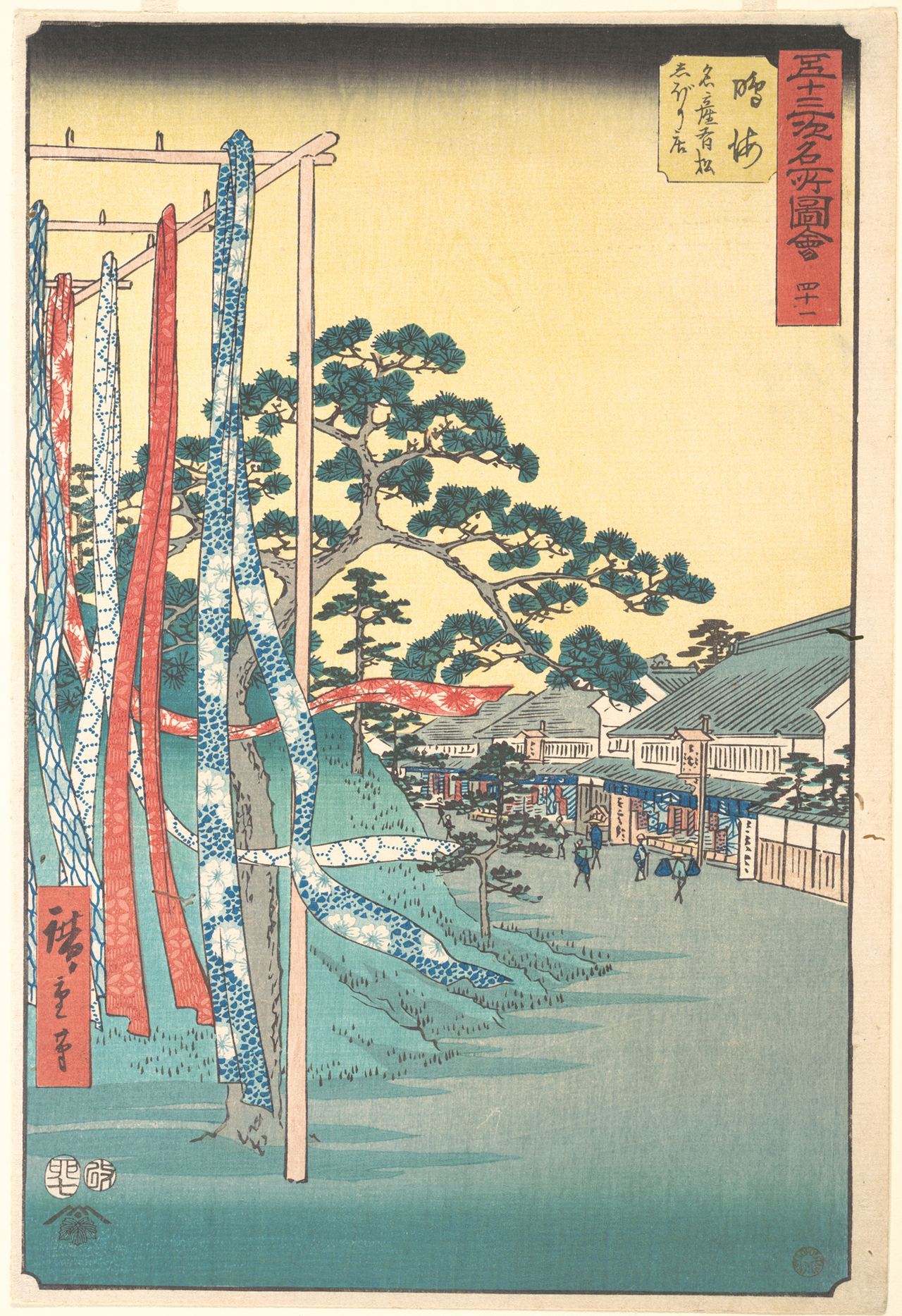
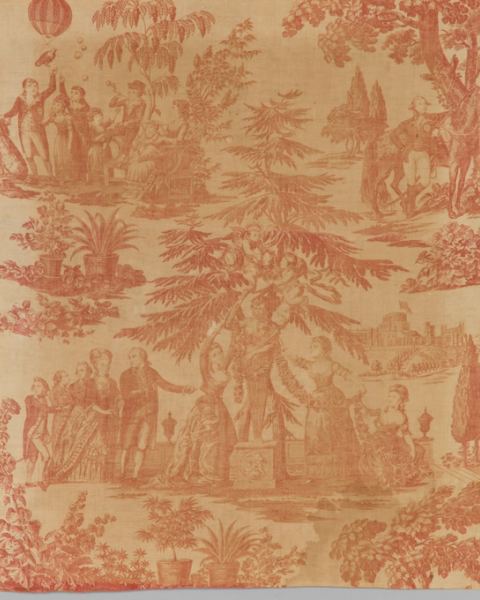
The craft's fame spread through woodblock prints. Utagawa Hiroshige drew the shops and hanging cloth in several Tōkaidō series. The Met's 1855 print above is cataloged by the V&A as no. 41 of the vertical Famous Sights of the Fifty-three Stations. The Kaikan notes that such prints labeled the scene Narumi, the larger town beside Arimatsu, although the cloth sold was Arimatsu's. Aichi Prefecture lists Arimatsu Narumi shibori as a traditional craft from 4 September 1975.
What are the main types of shibori?
The six main families are kanoko (bound spots), miura (looped binding), kumo (pleated and bound webs), nui (stitched), arashi (pole-wrapped) and itajime (board-clamped). There is no single official list, though. Aichi Prefecture says Arimatsu's tying technique has as many as 100 variations. A Japanese kimono retailer's history of the town says more than 100 methods have existed and about 70 are still practiced, in three broad groups: tying, sewing and folding. A Brigham Young University exhibition abstract names six methods, Kanoko, Miura, Kimo, Nui, Arashi and Itajime, and that six-way list is used here as a working map.
| Family | Name and meaning | How the resist is made | Typical pattern |
|---|---|---|---|
| Kanoko | "Fawn spots" | Tiny points of cloth are pinched and bound with thread, one by one | Rings with a dot at the center, in rows, dense fields or outlines |
| Miura | Looped binding | A hook holds the cloth while thread is looped around each gathered unit | Small rings; one retailer's guide likens it to water ripples |
| Kumo | "Spider" | Cloth is caught on a hook or drawn into a narrow cone, then bound from base to tip | Web-like rings that radiate from a center |
| Nui | Stitched | Running stitches follow a line or outline, then are drawn tight | Lines, wood-grain effects, and crisp white shapes |
| Arashi | "Storm" | Cloth is wrapped round a pole, bound with thread and compressed | Diagonal stripes and pleated texture |
| Itajime | Board-clamped | Cloth is folded and clamped between boards or shaped blocks | Mirrored geometric shapes such as squares and triangles |
Treat the table as a map and not a rulebook, because real pieces combine families. A sleeve in the V&A, bought from Liberty in 1891, was tied in kanoko spots and outlined in nui stitches before it went into a red bath, and embroidery was added afterward.
How do kanoko, miura and kumo use binding?
In all three, small units of cloth are gathered and wrapped tightly with thread, and the wrapped part resists the dye. The differences lie in how the unit is formed. Kanoko pinches a tiny point. Miura loops the thread around the gathered cloth. Kumo folds the cloth into a pleated cone first.
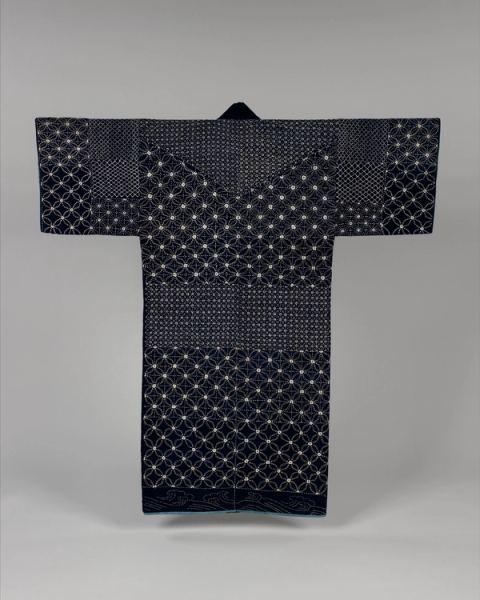
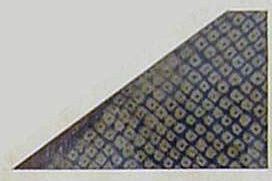
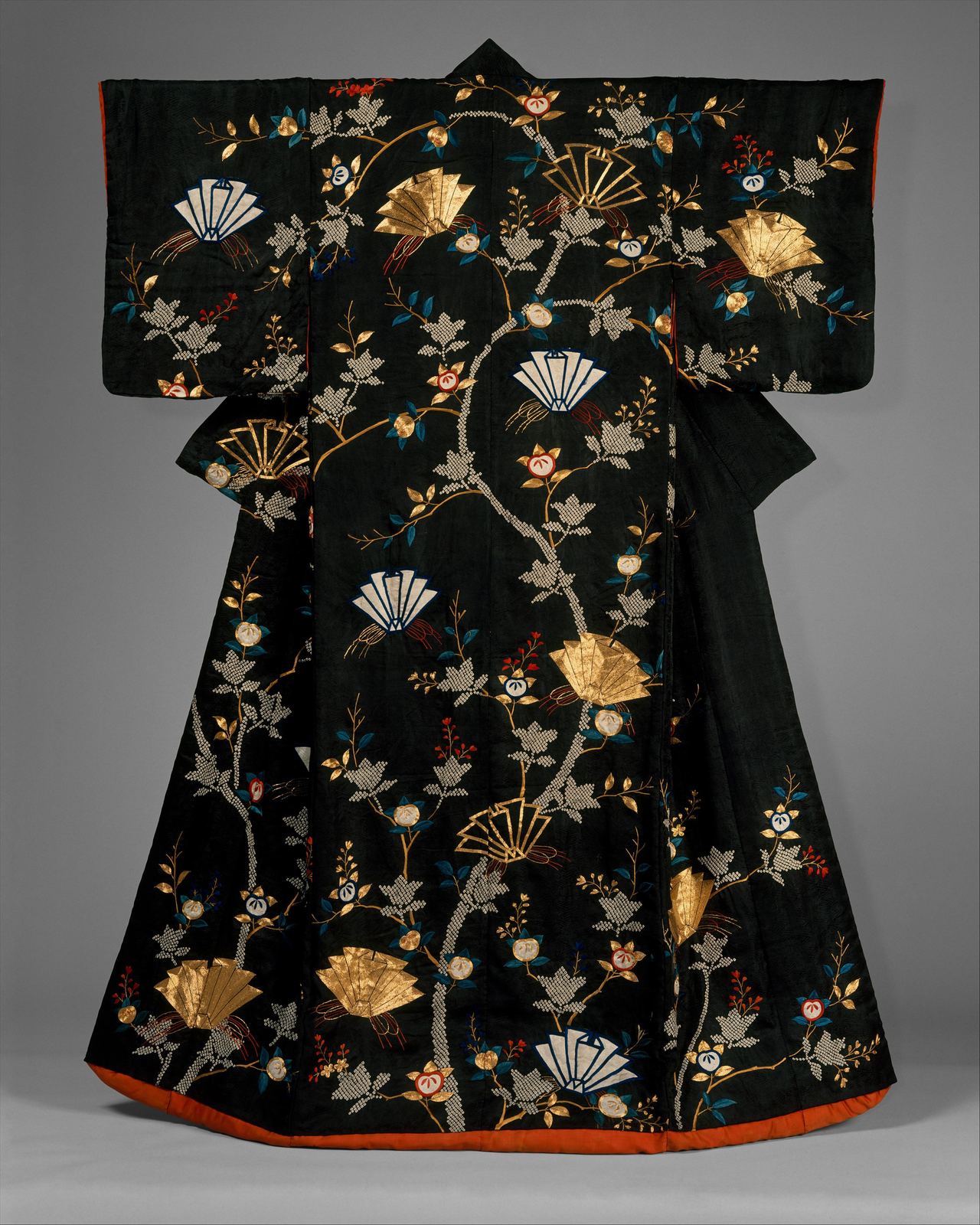
Kanoko is the version most people picture. A Kyoto craft page says the name comes from a pattern resembling fawn spots, and that a skilled worker ties the knots one by one. At the Met, a swatch cataloged as kanoko shibori shows a regular grid of tiny pale rings. The large robe in the lead image has dotted fields that look like the same binding, set beside solid indigo diamonds.
Binding can also draw outlines. A V&A kimono of 1800 to 1850 uses kanoko to make folded-paper butterflies, sometimes as an outline and sometimes as a filled shape. The V&A explains that such paper ornaments were wrapped around the mouths of sake bottles at wedding receptions, a symbol of harmony in marriage, and the museum notes the red dye there comes from safflower. On the Met's black uchikake below, whose title names folded-paper butterflies, branches and leaves are drawn in tiny white dots beside the embroidered paper shapes.
Miura and kumo are best known through Arimatsu's own tools. The Kaikan describes yokomiura as a method in which a metal hook hangs by a cord from the upright of a tying stand, the cloth is pushed up from below, a loop of thread is placed round the part to be bound, and the hook catches the center of the cloth so the loops lie horizontally. For tegumo, the cloth is caught on the hook and drawn into folds, and thread is bound from the base of the unit up toward the hook. ClothRoads, a textile-education site, describes the same spider-web effect as cloth pulled into a narrow cone and wound from base to tip and back. The Kaikan also lists a machine-assisted version, kikaigumo, which it says binds more efficiently and makes finer patterns.
How do stitching, pole-wrapping and clamping work?
Nui, arashi and itajime all keep dye out by compressing cloth, but with a needle, a pole and boards. Nui draws a line in stitches and pulls the thread tight. Arashi wraps cloth around a pole, binds it and compresses it into pleats before dyeing. Itajime presses folded cloth between boards.
Nui and arashi
The Kaikan names several stitched types. In mokumenui, lines printed on the cloth are stitched at regular intervals and gathered tightly, and the irregular folds create a wood-grain effect. In orinui, the cloth is folded on a pattern line, stitched along the fold and pulled tight. The V&A sleeve mentioned above shows a third use: slightly larger areas were outlined in tiny stitches, pulled tight and bound before dyeing, which left white shapes that were then embroidered over, though most of the embroidery is now missing.
Arashi means storm. ClothRoads says the cloth is wrapped around a pole and bound with string or floss in straight or diagonal patterns, then compressed and tied off; Callender describes the fabric being eased up the pole as yarn is wound on. It is usually credited to an Arimatsu artisan, Suzuki Kanezo. Callender and a Surface Design Association article give the date as 1880, while ClothRoads spells the name Susuki and gives no year, so the attribution is better held loosely.
Arashi is a language of stripes, but the textures and pleats are also an intrinsic part of the process.
Arashi traveled well. Wada's 1994 paper is about what happened when Japanese wooden poles were replaced by American PVC pipes, and she calls pole-wrapping one form of tie-dye whose effects can be hard to recognize.
Itajime
Itajime resists dye by pressing folded cloth between boards, so the dye cannot reach where the boards touch. JAANUS describes the early form, kyōkechi, as folding thin silk between a pair of thick boards carved with symmetrical relief, with dye poured through holes in the boards and the cloth between the raised parts staying white. A Shōsōin gauze in the Kyoto National Museum is described the same way, and the museum notes that later examples usually have two colors while the Shōsōin ones are multicolored.
The technique stayed alive in humbler work. A V&A length of Shiga Prefecture cloth, 1850 to 1900, was woven from yarns pre-dyed by tying and board-clamping before an indigo bath, which gives its umbrella and blossom pattern. A V&A kimono set from the Meiji period has an inner garment of bright red silk patterned by block-clamped resist with cherry blossoms. The museum says that fabric was not meant to be seen and was mass-produced, so cheaper than the outer layer, but was still considered modern and stylish. The Museum of Fine Arts, Boston describes itajime today as accordion folds and wooden blocks held with bands, giving square or triangular patterns.
How long does shibori take, and what is it dyed with?
Making shibori takes weeks to years, depending on the technique and the piece. Aichi Prefecture says the tie-dyeing process takes 50 to 60 days on average and involves different craftsmen at each stage. The Kaikan says the tying alone usually takes four to ten months and is handed out to several households. A Kyoto source says a bolt of overall kanoko can take a year and a half, and more than two years for a furisode length, and adds that each color is dyed separately.
Dyes vary with fiber. The V&A names safflower red, beni, for several silk kimono, and says beni was very expensive. The Museum of Fine Arts, Boston names indigo on cotton or silk as typical for shibori. The design drawing can itself be dyed: Aichi Prefecture says the pattern is stenciled with dayflower extract, and the Kaikan says the blue ink, made from tsuyukusa, washes out in water. A 1992 V&A kimono by Furusawa Machiko was dyed yellow with kariyasu grass, then indigo over it for green, with parts wrapped in plastic film before binding.
How does shibori relate to other indigo cloth?
Shibori sits beside several other ways of keeping dye out of cloth: batik with wax, ikat with yarn, and hand-drawn paste resist. Teazle's piece on printed cloth covers the opposite approaches, adding dye with blocks and rollers or, in the indigo-discharge process, dyeing the cloth blue first and bleaching the pattern out. The V&A's firefighter's jacket pairs a paste-resist dragon with quilted sashiko stitching on indigo cotton.
The nearest cousin in everyday cloth is Teazle's piece on sashiko and boro, which explains how Edo-period sumptuary rules shaped indigo clothing in northern Japan. Shibori could be luxury silk for a kimono, while boro is patched farm cloth, and the two meet in indigo.
Where can you see shibori, and what should you read?
The Met's open-access search for shibori returned 37 public-domain records on 1 November 2026, including the robe, swatch, uchikake and print used here. The V&A and the Cleveland Museum of Art have searchable records, and the Kyoto National Museum's database includes Shōsōin fragments. In Nagoya, the Arimatsu Narumi Shibori Kaikan, which runs the tie-dyeing museum, explains the process step by step on its website.
For books, start with Wada, Rice and Barton, Shibori: The Inventive Art of Japanese Shaped Resist Dyeing (Kodansha International, 1983), and Wada's Memory on Cloth: Shibori Now (Kodansha International), whose contents run from the meaning and history of shibori to contemporary work. The Textile Society of America proceedings, hosted by the University of Nebraska-Lincoln, carry Wada's papers on arashi and on Arimatsu's trade with Africa in 1948 and 1949.
Sources
- Tie-Dyeing (Arimatsu Narumi Shibori Kaikan). Arimatsu Narumi Shibori Kaikan. Primary. Full page read: 1608 founding by Takeda Shokuro, Owari protection, souvenirs, prints labeled Narumi, tying times, tegumo, yokomiura, mokumenui, orinui, kikaigumo. Accessed November 1, 2026.
- Arimatsu Narumi Shibori. Aichi Prefecture. Full page read: Takeda and Nagoya Castle technique, about 100 variations, dayflower stencil, 50-60 days average, designation 4 Sept 1975. Accessed November 1, 2026.
- Arimatsu (town history). Kimono Yamato. Full page read: Takeda and seven others from Agui, Bungo laborers and tenugui, Owari exclusive rights, over 100 methods and about 70 still practiced, three groups. Retailer site; local tradition, not independent history. Accessed November 1, 2026.
- Kōkechi (bound resist), JAANUS. Japanese Architecture and Art Net Users System (Columbia University). Entry read, plus its related kyōkechi and rōkechi entries: three early resist types, Shōsōin fragments, died out by early Kamakura, tsujigahana and hittashibori. Accessed November 1, 2026.
- Shōsō-in fragment, yellow ground, kyōkechi silk gauze (IK1-37). Kyoto National Museum. Record read: 8th century, clamp resist between carved boards, later examples usually two colors while Shōsōin ones are multicolored. Accessed November 1, 2026.
- Kyo Kanoko Shibori. KOGEI JAPAN. Page read: fawn-spot name, hand-tied one by one, 50+ techniques, peak end of 17th century, sumptuary setback, durations, dayflower ink. Promotional page; its India-via-Buddhism origin claim is reported as one view only. Accessed November 1, 2026.
- Fragment of kimono fabric with kanoko shibori, gold leaf and embroidery, 1596-1615 (1588-1899). Victoria and Albert Museum. Record read via the V&A API and page: kanoko, surihaku, one of the oldest Japanese textiles in the V&A. Accessed November 1, 2026.
- Length of kimono fabric, phoenix and paulownia, kanoko and nuishime shibori (873B-1891). Victoria and Albert Museum. Record read: kanoko and nuishime in a red bath, embroidery added, bought from Liberty & Co. 1891. Accessed November 1, 2026.
- Kimono with butterflies and orange blossoms (FE.101-1982). Victoria and Albert Museum. Record read: kanoko butterflies, nui oranges, paper ornaments on sake bottles at weddings, safflower red. Accessed November 1, 2026.
- Kimono, women picking tea (FE.18:1-2014). Victoria and Albert Museum. Record read: Meiji-period inner kimono in block-clamped (itajime) bright red, mass-produced and cheaper. Accessed November 1, 2026.
- Length of bast fibre with itajime-clamped wefts (T.106-1957). Victoria and Albert Museum. Record read: Shiga Prefecture, 1850-1900, warps hand-tied and wefts board-clamped before indigo. Accessed November 1, 2026.
- Kimono for a young woman (FE.32-1982). Victoria and Albert Museum. Record read: kanoko furisode, beni safflower red very expensive, possible link to sumptuary laws on red. Accessed November 1, 2026.
- Myriad Green Leaves kimono by Furusawa Machiko (FE.422:1-1992). Victoria and Albert Museum. Record read: aobana tracing liquid from Commelina communis, kariyasu yellow then indigo, plastic wrapping. Accessed November 1, 2026.
- Firefighter's jacket (FE.107-1982). Victoria and Albert Museum. Record read: indigo quilted cotton, sashiko stitching, tsutsugaki paste-resist dragon. Accessed November 1, 2026.
- No. 41, Narumi: Shop with Famous Arimatsu Tie-dyed Cloth (E.4026-1886). Victoria and Albert Museum. Record read: Hiroshige, vertical Tokaido series, 1855; confirms the identity and date of the Met print JP637. Accessed November 1, 2026.
- Open Access records: 45399, 74585, 65607, 37088 (checked via the Met collection API). The Metropolitan Museum of Art. Object records read via the Met API (isPublicDomain true, images viewed and enlarged). Web pages returned HTTP 429 to bots, so the API records are the source. Related objects: 74585, 65607, 37088. Accessed November 1, 2026.
- Tie-Dyed Fragment, 1933.393. The Cleveland Museum of Art. Record read via the Cleveland Open Access API: Wari culture, Peru, c. 700-1100, tie-dyed wool, CC0. Accessed November 1, 2026.
- New Twist on Shibori (abstract). Textile Society of America, Yoshiko Iwamoto Wada, 1994. Abstract read (full PDF blocked by a bot challenge): terminology of tie-dye, ikat, plangi, tritik; pole wrap, clamp and stitch resist. Accessed November 1, 2026.
- Arimatsu to Africa: Shibori Textiles Developed for African Trade in 1948-49 (abstract). Textile Society of America, Yoshiko Iwamoto Wada, 2016. Abstract read (full PDF not reachable): Wada's definition of shibori; session on West African indigo and resist cloth. Accessed November 1, 2026.
- About Shibori. Jane Callender. Page read: shiboru as squeeze or wring, compression, Arimatsu 1608, arashi invented by Kanezo Suzuki in 1880. Craft author's page. Accessed November 1, 2026.
- Shibori: A Shaped Resist Cloth. ClothRoads (Marilyn Murphy). Page read: arashi and kumo descriptions, Kanezo Susuki of Arimatsu, no year given. Cites Wada's books. Accessed November 1, 2026.
- Ana Lisa Hedstrom and Yoshiko Wada Traverse History and the World, talking about Shibori. Surface Design Association (Eva-Maria Spampinato). Article read: Hedstrom quote on arashi; 1880 and Suzuki Kanezo stated by the article's author, not by a speaker. Accessed November 1, 2026.
- Shibori (art-making at home). Museum of Fine Arts, Boston. Page read: definition, itajime, kumo and kanoko summaries, indigo on cotton or silk, vat safety notes. Accessed November 1, 2026.
- The Art of Shibori: The History and Revival of a Dying Art (abstract). Brigham Young University, Journal of Undergraduate Research. Abstract read only: names six methods, Kanoko, Miura, Kimo, Nui, Arashi, Itajime, without defining them. Accessed November 1, 2026.
- Arimatsu Shibori (film description). Slow Fiber Studios. Page read: film on Arimatsu Narumi shibori narrated by Wada; techniques grouped as hand-knotting, stitching, pleating, fold-and-clamp. Accessed November 1, 2026.
- Shibori Dyeing Techniques. The Japanese Shop. Retailer blog read; used only for the water-ripples description of miura, attributed in the text. Accessed November 1, 2026.
- Shibori: the inventive art of Japanese shaped resist dyeing (catalog record). Internet Archive. Catalog record read (Wada, Rice, Barton; Kodansha International, 1983). The book itself is borrow-only and was not read. Accessed November 1, 2026.
- Memory on cloth: shibori now (catalog record). Internet Archive. Catalog record and contents note read (Wada; Kodansha International). The book itself was not read. Accessed November 1, 2026.
Glossary
Last updated · Markdown · Report an error