Craft
Shen Shou, Who Embroidered Light and Shadow
Who was Shen Shou, and what is Suzhou embroidery? The Qing court embroiderer who learned to stitch light and shade into silk, and dictated China's most detailed embroidery manual.
Shen Shou (1874–1921) was an embroiderer from Wu county, today part of Suzhou, who became the best-known needlewoman of late Qing and early Republican China. Renamed by the Empress Dowager Cixi, she developed "simulation embroidery," a branch of Su embroidery that uses silk to render light and shade, and dictated its stitches to the reformer Zhang Jian for a manual published in 1919.
Who was Shen Shou?
Shen Shou was born Shen Yunzhi in Wu county, Suzhou, a center of silk and embroidery. Most records, including the Shanghai Museum's, give her birth year as 1874; the historian Grace Fong gives 1872. She was selling her embroidery by her early teens, served the Qing court as an embroidery instructor, and ran schools until her death in 1921.
What we know of her girlhood comes mainly from Zhang Jian, the Nantong industrialist and educational reformer (1853–1926) who became her patron in her last decade. In the tomb inscription he wrote for her, as translated by Fong, she was threading needles for her elder sister at six and embroidering at seven. By her early teens her work was known locally, and the two sisters sat up past midnight stitching pieces that they sold to help support the family.
At about twenty she married Yu Jue (Yu Zhaoxiong), a scholar from Shaoxing who later passed the provincial examinations. Yu painted and wrote calligraphy, and he drew designs that she embroidered; the couple sold the results. Fong reads this as the moment Shen Shou's needlework left the women's quarters, where embroidery had been a shared domestic accomplishment, and became a commercial art.
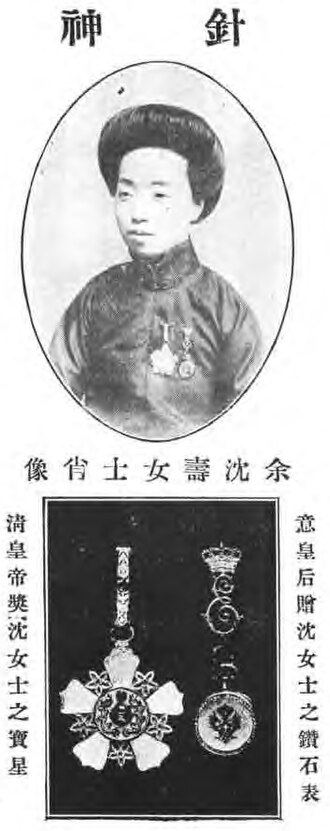
Period sources often add her husband's surname to her own: a household-management compendium published in Shanghai in June 1919 captions her portrait "Needle Goddess, Madame Yu Shen Shou."
How did the Empress Dowager give her a name?
Shen Yunzhi became Shen Shou through a gift from the throne. Yu Jue presented her embroideries to the Empress Dowager Cixi, who was so pleased that she wrote out the characters shou (longevity) and fu (good fortune) for the couple. Shen took shou as her name. The sources disagree on the details.
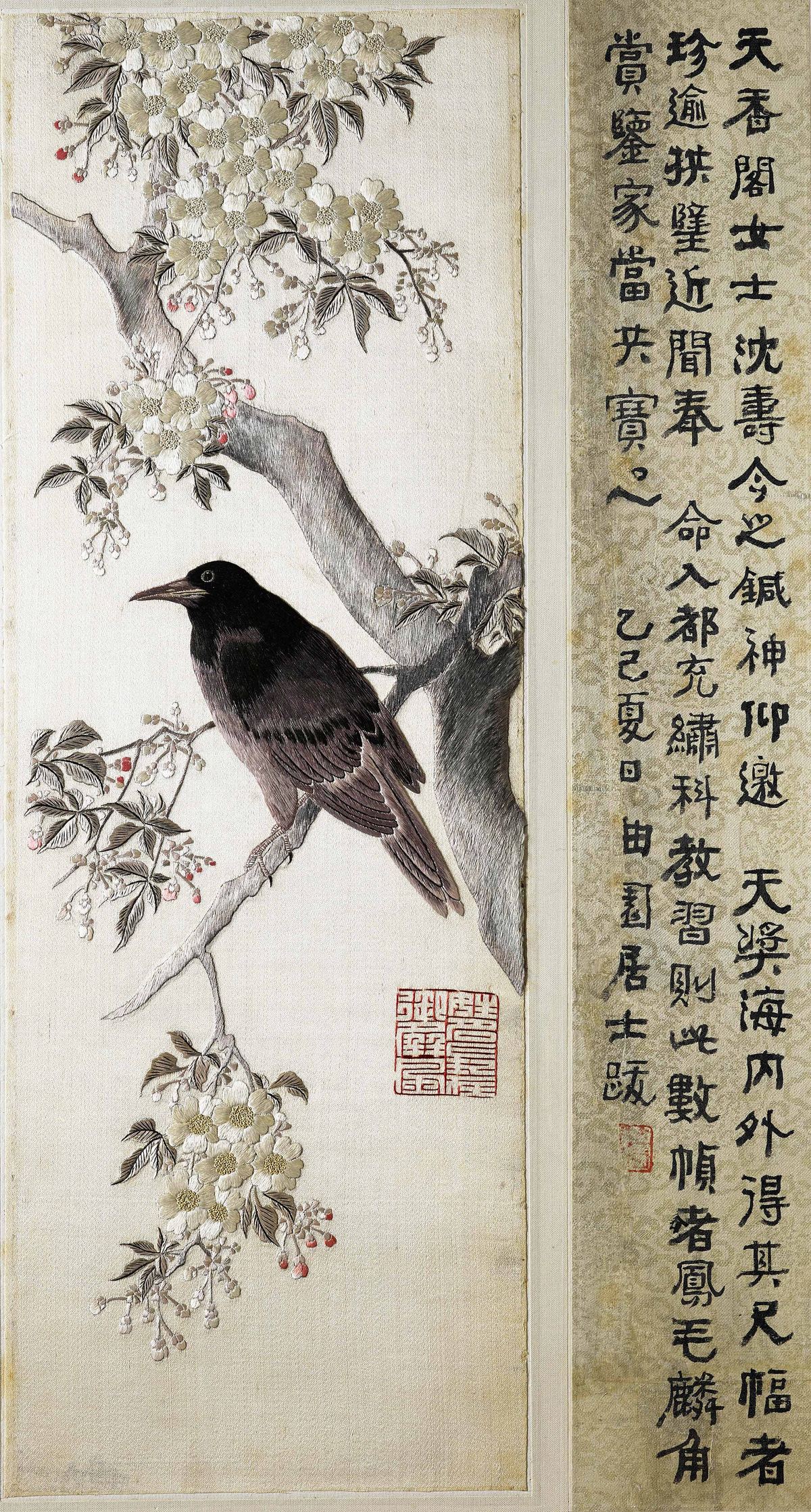
The Shanghai Museum dates the gift to 1904, when Shen embroidered the Eight Immortals for Cixi's seventieth birthday. Fong, following Zhang Jian's tomb inscription, gives 1901, and notes that accounts vary between 1901, 1903 and 1904, and between two and eight embroideries. The new name was certainly in use by 1905. A scroll in the Shanghai Museum carries an inscription by the scholar Yu Yue, dated summer 1905, calling "Shen Shou of the Tianxiang Pavilion" the "needle goddess of today" and noting that she had recently gone to the capital as an embroidery instructor.
She was made chief instructor of the embroidery section in the Qing government's Ministry of Agriculture, Industry and Commerce, a title recorded both by Fong and by China's national intangible heritage register. In 1905 she and her husband traveled to Japan, where she looked closely at Japanese "art embroidery" and at Western painting.
What is Su embroidery?
Su embroidery (Su xiu) is the silk hand embroidery of Suzhou, with related branches elsewhere in Jiangsu, long tied to painting: from the Ming period its makers often worked from scholars' paintings. China listed it as national intangible heritage in 2006, and added Shen Shou's "simulation" style, as practiced in Nantong, in 2008.
The heritage register traces surviving pieces to the Song dynasty and says that by the Qing, Suzhou was known as an "embroidery market." It credits a Suzhou woman, Ding Pei, with the first Chinese book on the craft, the Xiupu (Treatise on Embroidery), whose preface Fong dates to 1821. Today the register divides living Su embroidery into three lineages: traditional fine embroidery, Shen Shou's simulation embroidery, and the "random-stitch" embroidery that Yang Shouyu developed in the 1930s.
For a maker, three things set the work apart.
- The thread is divided. Su-family workshops split silk thread into finer strands (pi si). The heritage listing for Wuxi's micro-embroidery, a branch of Su embroidery, describes splitting a single thread to one-eightieth of its thickness to stitch a face no bigger than a mung bean; the Yangzhou branch counts fine splitting among the marks of good work.
- Stitches have jobs. Each stitch has a name and a set of subjects it suits. Qi zhen, which Fong translates as "even stitching," is the first stitch the manual teaches; tao zhen and san tao zhen build up petals and plumage in graded color; gun zhen draws fine lines for stone bridges, hills and running water, in the examples a 2023 Suzhou Museum exhibition put on show.
- Sheen is a color. The direction of each stitch changes how light bounces off the silk. The Shanghai Museum describes a pair of Shen Shou's calligraphy panels in which the thread's angle follows each brushstroke, so that the black silk shows varied ink tones and the heaviest strokes look still wet.
What was "simulation embroidery"?
Simulation embroidery (fangzhen xiu), also called Shen embroidery, is the style Shen Shou developed after about 1905 to make silk look like a photograph or an oil painting. Instead of flat, outlined areas of color, it models form with light and shadow, using spiral stitches and "void-and-solid" stitches to render texture.
Shen Shou explained the idea herself. Asked by Zhang about her method, she said that she had learned in "the old way" as a child, then noticed that European lithographs and oil paintings depend on reflected light. In Fong's translation: "Reflection arises from light, and light has yin and yang." She thought hard about how to separate the two, "infused my old methods with new ideas," and learned more from the art embroidery she saw in Japan.
In practice, the national heritage register names two signature stitches: xuan zhen, a spiral stitch, and xu shi zhen, a "void-and-solid" stitch, both used to give texture to surfaces. Subjects were often taken from Western portraits and landscapes, and portraits were the specialty. The Shanghai Museum's catalogue of Shen's bird-and-flower panels lists nine stitches, from gun zhen (rolling stitch) to dazi zhen (seed-knot stitch), and singles out three, xuan zhen, chan zhen and san tao zhen, laid in successive layers so that the shading of feathers and tree trunks turns naturally.
The unstitched areas mattered as much as the stitched ones. In Clams, a piece now in the Nantong Museum, she stitched six shells and left the highlights as bare satin ground, shading the undersides in pale brown, according to a 2023 exhibition report in People's Daily. The glint is the cloth itself.
Did her portraits really win prizes in Turin and San Francisco?
Her two most famous portraits went abroad, but their prizes are harder to pin down. Chinese accounts say her portrait of the queen of Italy won a top award in Turin in 1911, and that her Portrait of Jesus won first prize in San Francisco in 1915. The official 1915 catalogue lists the Jesus portrait without any award beside it.
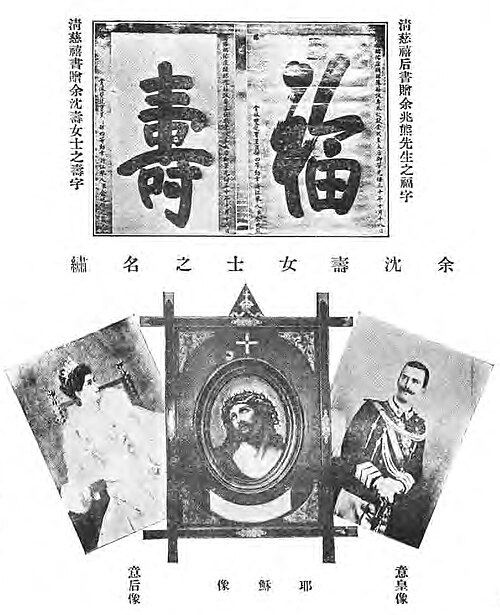
The Italian portrait came first. Zhang Jian first saw it at the Nanyang Industrial Exposition in Nanjing, China's first world's fair, where he led the judging. His preface to her treatise dates the fair to the first year of the Xuantong reign, 1909; it opened to visitors in June 1910. Shen Shou had come from Beijing to assess the embroidery, and her portrait of the Italian queen, he wrote, was finer than anything the world had seen. When he showed her a large screen said to be Lu Xiang Yuan work, the embroidery of the Gu family of late-Ming Shanghai, she unrolled the first panel and confirmed it. Asked how she knew, she answered: from the stitches.
The queen of Italy at the time was Elena, consort of Victor Emmanuel III. Fong, drawing on Zhang Kaiyuan's biography of Zhang Jian, says the portrait won the top award at the 1911 international exhibition in Turin and was then presented by the Qing government to the king of Italy. Nantong's municipal website also reports the Turin honor. We could not find an Italian record of the award. A Shanghai compendium of 1919 does reproduce, among her "famous embroideries," portraits of both the queen and the king of Italy, and pictures with her portrait a diamond watch captioned as the Italian queen's gift to her.
The Portrait of Jesus was worked, by Shen's own account in her treatise, from a photograph of a European oil painting, and she described experimenting with combinations of colored threads to reproduce its lighting. The piece went to the Panama-Pacific International Exposition in San Francisco in 1915. Chinese sources describe its award as a first prize or a grand prize; English Wikipedia says gold medal.
The Fine Arts department's official catalogue "with awards" is more cautious. It lists, under embroidery and silk painting in the Chinese section, "Yu Shen-sheo. 317. Embroidered Portrait of Jesus Christ," almost certainly Yu Shen Shou in the spelling of the day. Other Chinese exhibitors on the same pages have their medals printed under their names; this entry has none. The prize may have come from another jury, or the Chinese reports may have grown in the telling; the American record does not confirm it.
What is in the Xuehuan xiupu?
The Xuehuan xiupu (雪宧繡譜, "Xuehuan's Embroidery Manual," also romanized Xueyi xiupu) is the treatise Shen Shou dictated to Zhang Jian in Nantong. It was published in 1919, two years before her death. Organized in eight sections, it runs from frames and needles through stitches, color and shading to posture and working hours.
Zhang wrote the book down because he feared her knowledge would die with her. She was nearly forty and often ill when she moved to Nantong, and he asked her to go through every stitch and method from start to finish. His preface describes the process: sometimes they finished one or two entries a day, sometimes one entry took two or three days. In Fong's translation he wrote: "There is not one written word that did not come from me, but in truth there is not one spoken word that did not come from Shou."
The eight sections, as Fong summarizes them, cover tools (stands, frames, scissors, needles); preparing thread (cutting, joining, smoothing, moistening); stitches, with thirteen ordinary and eighteen special stitches and the subjects each suits; the fundamentals, the longest section, on design, color subdivision, light and shade and realism; the embroiderer's bearing; economy with materials; working hours; and what embroidery shares with painting and calligraphy.
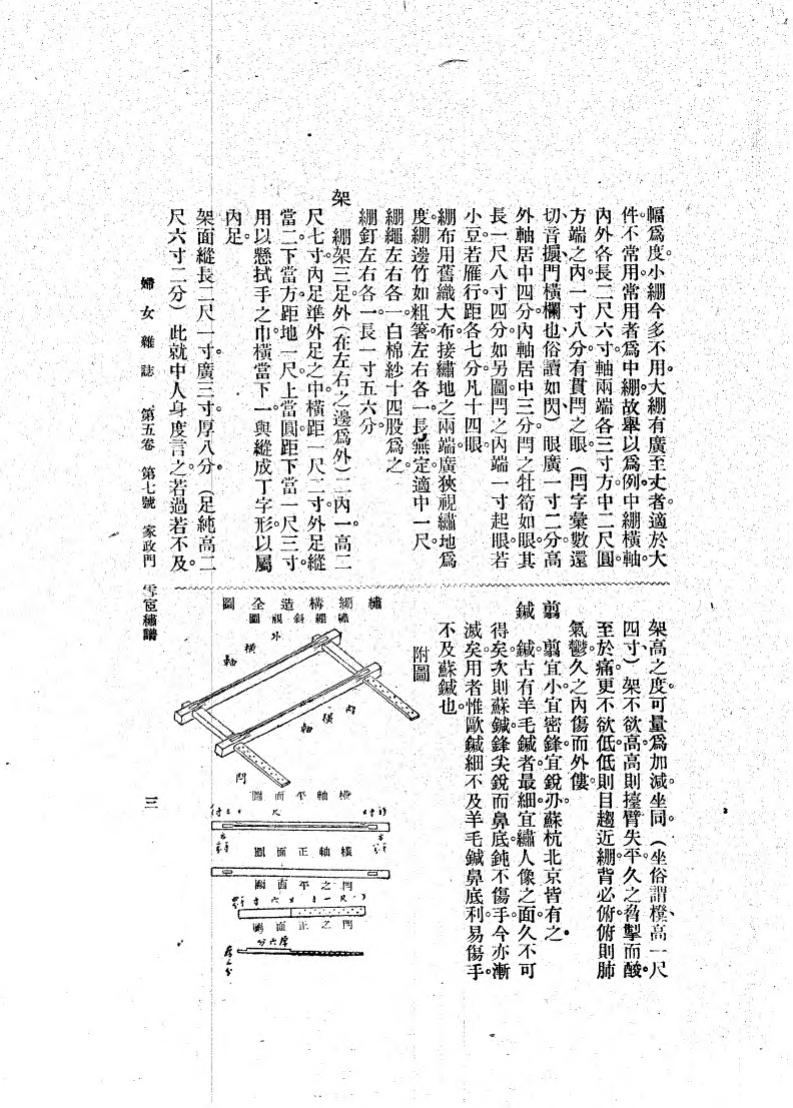
The advice is concrete. The 1919 magazine printing of the first section, with its diagram of the frame, recommends small, sharp, close-bladed scissors. On needles, it says the finest of all, a "goat-hair needle" once used for the faces in portraits, could no longer be had; the Suzhou needle, sharp at the point and blunt at the eye so it does not hurt the hand, was disappearing; and the European needles now in use were not as fine as the goat-hair kind, and their sharp-edged eyes hurt the hand. (Today's needle families are sorted out in which needle for which thread.) The stand should be neither too high, which strains the shoulders, nor too low, which bends the back and cramps the chest.
Beginners start with flowers and plants, using even stitches. When a length of thread runs out, lay the needle on the forefinger to cut the remaining thread, so the eye is not damaged and the needle lasts. On working hours, Shen spoke from experience: she had stitched day and night since her teens and made herself ill, so she recommended sitting for two hours at a time and then getting up to move.
The Shanghai magazine Funü zazhi (The Ladies' Journal) serialized the manual from July 1919, crediting it as "written by Zhang Jian of Nantong, narrated by Shen Shou of Wu county."
How did she turn embroidery into a profession?
From her court appointment on, Shen Shou taught, running schools in Beijing, Suzhou, Tianjin and Nantong. After the 1911 revolution ended the Qing court she and her husband opened a school for women's crafts in Tianjin, and from 1914 she directed the women's needlework institute that Zhang Jian founded for her in Nantong.
Zhang's aim was practical: needlework as a living for women and, by extension, self-sufficiency for China. By Shen's death, Fong writes, the institute had graduated more than 150 students, and the Shen style of embroidery no longer depended on one family. The same idea drove Candace Wheeler in New York and, in a different key, May Morris in London.
The institute's pupils carried the method on. According to the national heritage register, they went on to develop double-sided embroidery, double-sided embroidery with different colors on each face, and other new types. Nantong simulation embroidery was listed as national intangible heritage in 2008.
| Year | Event |
|---|---|
| 1874 | Born Shen Yunzhi in Wu county, Suzhou (Fong gives 1872) |
| At about 20 | Marries Yu Jue (Yu Zhaoxiong), who draws designs for her work |
| 1901–1904 | Embroideries presented to the Empress Dowager Cixi; renamed Shou (sources differ on the year) |
| 1905 | Called "needle goddess" by Yu Yue; instructor at the Qing court; visits Japan |
| 1909–1910 | Portrait of the queen of Italy shown at the Nanyang Industrial Exposition, Nanjing (opened June 1910) |
| 1911 | Portrait reported to win a top award at Turin; presented to the king of Italy |
| After 1911 | Runs a women's crafts school in Tianjin with her husband |
| 1914 | Directs the Nantong women's needlework institute founded by Zhang Jian |
| 1915 | Embroidered Portrait of Jesus Christ shown at the Panama-Pacific International Exposition |
| 1919 | Xuehuan xiupu published; serialized in Funü zazhi from July |
| 1921 | Dies |
Where can you see Shen Shou's embroidery today?
The Shanghai Museum holds and publishes her work, including a set of small bird-and-flower hanging scrolls with Yu Yue's 1905 inscription and a pair of embroidered calligraphy panels. The Nantong Museum holds Clams and in 2023 mounted an exhibition on her simulation embroidery. In Nantong the former institute building is now a museum of Shen embroidery, according to the city's website.
Online, the Shanghai Museum's pages for the bird-and-flower panels and the calligraphy pair give stitch lists and inscriptions in Chinese. The 1915 Fine Arts catalogue with awards and the July 1919 issue of Funü zazhi are on the Internet Archive.
The fullest English account we found is Grace S. Fong's "Female Hands," Late Imperial China 25, no. 1 (2004), which translates long passages of Zhang Jian's preface and the treatise.
Sources
- Grace S. Fong, "Female Hands: Embroidery as a Knowledge Field in Women's Everyday Life in Late Imperial and Early Republican China," Late Imperial China 25, no. 1 (2004): 1–58. Columbia University (author's manuscript PDF); published by Johns Hopkins University Press. Scholarly. Full text of the manuscript version read (pp. 49–65 on Shen Shou): birth as Shen Yunzhi in Wuxian (dates given as 1872–1921), childhood per Zhang Jian's tomb inscription, marriage to Yu Jue at about 20, tribute to Cixi and shou/fu calligraphy with the 1901/1903/1904 discrepancy (n. 93), chief instructor post, Japan 1905, Nanyang exhibition and Turin 1911 award citing Zhang Kaiyuan (n. 94), Jesus portrait "first prize" citing Yu Jianhua and Zhu Qiqian (n. 95), Zhang Jian's preface (Gu family screen; method quote; dictation process), Tianjin school, Nantong institute and 150+ graduates, eight sections of the Xuehuan xiupu, even stitch, thread-cutting advice, two-hour sitting rule. Quotations are Fong's translations. Publication details checked on Project MUSE (muse.jhu.edu/article/172202). Accessed November 12, 2026.
- Shen Shou, Embroidered bird-and-flower pictures (沈寿 刺绣花鸟图), object record. Shanghai Museum. Museum record read in full (Chinese): Shen Shou 1874–1921, Wu county, original name Yunzhi, name Shou granted after 1904 Eight Immortals embroidery for Cixi's 70th birthday, simulation embroidery, Xuehuan xiupu 1919; each scroll 42.2 × 15 cm, silk; nine stitches listed, layered spiral/mixed/scattered interlocking stitches; seals; Yu Yue colophon dated summer 1905 (yisi). Accessed November 12, 2026.
- Shen Shou, Pair of embroidered panels with seven-character lines in regular script (沈寿 刺绣楷书七言诗纹(一对)), object record. Shanghai Museum. Museum record read in full (Chinese): each panel 96.5 × 17.6 cm, silk; text from a poem by Cao Xun; stitch mainly scattered interlocking; thread direction follows the brush so the sheen reads as ink tones; seals including "Yu ci shou" (Shou, imperially bestowed). Accessed November 12, 2026.
- Su embroidery (苏绣), national intangible cultural heritage item VII-18. China Intangible Cultural Heritage Network (Chinese National Academy of Arts). Official register entry read in full: listed 2006 (first batch); Song survivals, Yuan fragment with 9 stitches, Ming painting-based designs, Qing "embroidery market"; Ding Pei's Xiupu (Daoguang era) as first specialist book; Shen Shou's simulation embroidery and dictated Xuehuan xiupu; three lineages incl. Yang Shouyu's random-stitch embroidery (1930s); related branches Changzhou, Yangzhou, Nantong, Wuxi. Accessed November 12, 2026.
- Su embroidery (Nantong simulation embroidery) (苏绣(南通仿真绣)), item VII-18, 2008. China Intangible Cultural Heritage Network. Official register entry read in full: listed 2008; also called Shen embroidery; Shen Shou chief instructor of the embroidery section of the Ministry of Agriculture, Industry and Commerce's crafts bureau, then head of the Nantong women's needlework institute; spiral and void-and-solid stitches; subjects from Western oil portraits and landscapes, faces a specialty; Xuehuan xiupu; pupils developed double-sided and double-sided two-color embroidery. Accessed November 12, 2026.
- Su embroidery (Wuxi micro-embroidery) (苏绣(无锡精微绣)), item VII-18, 2008. China Intangible Cultural Heritage Network. Read in full: splitting a silk thread to one-eightieth for faces the size of a mung bean. Accessed November 12, 2026.
- Su embroidery (Yangzhou embroidery) (苏绣(扬州刺绣)), item VII-18, 2014. China Intangible Cultural Heritage Network. Read in full: fine thread splitting (劈丝精细) named among the qualities of good work; stitch names (qi zhen, san tao zhen, xuan zhen, gun zhen). Accessed November 12, 2026.
- "百件刺绣精品亮相苏博 呈现江南画绣史" (A hundred embroideries at the Suzhou Museum), People's Daily Overseas Edition, 29 December 2023. People's Daily. Read in full (Chinese): Shen Shou's names (Yunzhi, Xuejun, Xuehuan/Xueyi, Tianxiang Pavilion), Yu Yue's "needle goddess"; 1905 Japan visit with husband, Western painting and Japanese art embroidery; Clams (Nantong Museum): six shells, highlights left as satin ground, pale-brown shading below; schools in Beijing, Suzhou, Tianjin, Nantong; 1914 Nantong institute; stitch examples (gun zhen for bridges, hills, water; qi zhen, tao zhen). Accessed November 12, 2026.
- "Nantong's embroidery legacy: A pioneer's vision that endures," 26 August 2026. Nantong Municipal People's Government (presented by China Daily). Read in full: Shen Shou 1874–1921; Japan 1905; light and shadow; spiral and other stitches; Queen of Italy portrait first prize at Nanyang and top honor at Turin 1911; 1915 Jesus Christ "grand prize" in San Francisco; Zhang Jian 1853–1926; 1914 Nantong institute; former institute now a Shen embroidery museum. Accessed November 12, 2026.
- "Jiangsu exhibit revisits female embroidery master's achievements," 28 January 2023. China Daily / chinaservicesinfo.com. Read in full: Nantong Museum exhibition on Shen Shou's simulation embroidery (Jan 12–Mar 12, 2023); Shen Shou 1874–1921; 1919 treatise held by the Nantong Museum. Accessed November 12, 2026.
- Official Catalogue (Illustrated) of the Department of Fine Arts, Panama-Pacific International Exposition (with Awards), San Francisco, 1915. Internet Archive (scan). Primary. OCR read and checked in two editions (also archive.org/details/officialcatalog00pana and officialcatalogu1915pana): Chinese Section, "Embroidery and Silk Painting": "Yu Shen-sheo. 317. Embroidered Portrait of Jesus Christ." No award line, while other Chinese exhibitors on the same pages carry "Awarded Gold/Silver/Bronze Medal: P.P.I.E., 1915" or "Honorable Mention". Accessed November 12, 2026.
- Funü zazhi (The Ladies' Journal) 5, no. 7 (July 1919), table of contents. Internet Archive (scan of the National Library of China copy). Primary. Table of contents and page images read (leaves n86–n88): title 雪宧繡譜 with byline 吳縣沈壽述 南通張謇著; p. 1, Zhang Jian's preface on the Nanyang exposition (dated by him to Xuantong 1, i.e. 1909), Shen Shou as assessor, her portrait of the Italian queen, and the Lu Xiang Yuan screen identified "by the stitches"; p. 3, frame diagram and the passages on stands, scissors and needles (goat-hair, Suzhou and European needles), translated by us. Continuations listed in nos. 8–11 (Aug–Nov 1919). Accessed November 12, 2026.
- Portrait of Shen Shou, from Gao Jianhua (ed.), Zhijia quanshu (Shanghai: Jiaotong tushuguan, June 1919), Wikimedia Commons file page. Wikimedia Commons. File page read: caption "針神余沈壽女士肖像", source the 1919 household-management compendium, licence PD-China. Used for the period form "Yu Shen Shou". Accessed November 12, 2026.
- Cixi's shou and fu calligraphy and "Madame Yu Shen Shou's famous embroideries," from Gao Jianhua (ed.), Zhijia quanshu (Shanghai, June 1919), Wikimedia Commons file page. Wikimedia Commons. File page and image read: captions for Cixi's shou (to Yu Shen Shou) and fu (to Yu Zhaoxiong); embroidered portraits of the Italian queen, Jesus and the Italian king; licence PD-China-1996. The companion portrait page (s13) captions a diamond watch as the Italian queen's gift and a Qing decoration. Accessed November 12, 2026.
- Paul French, "Images of the Nanyang Industrial Exposition, 1910," China Rhyming, 14 February 2026. China Rhyming. Read: opened 5 June 1910 in Nanjing, ran 177 days. Second date source with Godley's article title, "China's World's Fair of 1910" (Modern Asian Studies 12.3, 1978), cited by Fong. Accessed November 12, 2026.
- Shen Shou. Wikipedia. Used to locate references (Fong; Ko 2009) and as the source of the English "gold medal" wording quoted as such in the text; no fact rests on it alone. Accessed November 12, 2026.
Glossary
Last updated · Markdown · Report an error