Design
Candace Wheeler, Who Made Needlework a Profession
Who was Candace Wheeler, and what did Associated Artists make? The New York designer who turned art needlework into paid work for women, from Tiffany's partner to her own women-run studio.
Candace Wheeler (1827–1923) was a New York textile designer who turned needlework into paid, professional work for women. She co-founded the Society of Decorative Art in 1877, ran the textile side of Louis C. Tiffany's decorating firm, and from 1883 led her own Associated Artists, a women-run studio that made embroidered hangings, "needle-woven" tapestries and silks woven and printed by Cheney Brothers.
Who was Candace Wheeler?
Candace Thurber was born on March 24, 1827, in Delhi, a young settlement in Delaware County, New York, the third of eight children of Abner and Lucy Dunham Thurber. Her own memoir gives only "one wild March morning"; the day comes from the Metropolitan Museum's 2001 catalogue and from Women in World History. The 200th anniversary falls on March 24, 2027.
At seventeen, on June 28, 1844, she married Thomas Mason Wheeler and moved to New York City. The couple later built a house they called Nestledown at Jamaica, Long Island, and filled it with painter friends. She studied flower painting, spent the winter of 1866–67 painting in Dresden, and first exhibited at the National Academy of Design in 1871. Nothing in those years looked like the start of a business. The turn came in 1876: her eldest daughter, Candace, died on June 7, and that summer Wheeler went to the Centennial Exhibition in Philadelphia.
What did she see at the 1876 Centennial?
At Philadelphia she found the stand of the Royal School of Art Needlework from South Kensington, London, a school founded to give genteel women without money a skilled trade. In her memoir, Yesterdays in a Busy Life (1918), she disliked its phrase "decayed gentlewomen" but took the idea whole.
She was not dazzled by the needlework itself. The pieces were mostly towels made into chair-back "tidies" with a small flower in what was being called "the Kensington stitch," plus gray linen table covers, one or two designed by Walter Crane. "It was not a new stitch," she wrote. What struck her was that the work was "easily within the compass of almost every woman," and that good designs, from artists such as Crane and Morris, gave it value. Between visits to the exhibits she drafted a circular for an American version. The same English revival of art embroidery would, less than a decade later, have May Morris running the embroidery department of Morris & Co.
What were the Society of Decorative Art and the Woman's Exchange?
The Society of Decorative Art was a New York shop, school and jury for women's handwork, founded in 1877 at Wheeler's instigation. The New York Exchange for Woman's Work, founded the next year, took anything a woman could make well, including food. Wheeler helped start both.
The first planning meeting was held on February 24, 1877, and the society was formally established on March 28, according to the chronology in the Met catalogue. Wheeler asked Mrs. David Lane, who had run the great Sanitary Fair of the Civil War years, to be president and kept the post of corresponding secretary for herself, so she could build branch societies in other cities. The widowed Elizabeth Bacon Custer was hired as paid secretary. A committee of painters judged what could be sold, and classes in Kensington embroidery were taught by a graduate of the London school. By the end of the first year there were related societies in Chicago, Saint Louis, Hartford, Detroit, Troy and Charleston.
The society sold only "art." Wheeler later wrote that she favored a broader plan, and she joined Mrs. William Choate in a second venture, the Woman's Exchange, where, as Choate put it in Wheeler's telling, a woman could send "a pie, if she can make a good one." It opened its salesrooms on May 10, 1878. Wheeler's dislike of copied, commercial patterns ran deep: in The Development of Embroidery in America (1921) she judged that Berlin wool work "failed to achieve dignity" in America, and argued that a design loses interest once it becomes "an article of commercial supply."
What did she make with Louis Comfort Tiffany?
From 1879 Wheeler was the textile partner of Louis Comfort Tiffany. Their firm, Tiffany & Wheeler, merged in 1881 into Louis C. Tiffany & Company, Associated Artists, with Samuel Colman and Lockwood de Forest. Wheeler ran the embroidery rooms; she says she proposed the name "Associated Artists."
The first big job, in her memory, was an embroidered drop curtain for the new Madison Square Theatre. Tiffany designed it; Wheeler directed the work. It was a woodland view made almost entirely in appliqué, with velvets and plushes for foreground plants and thin silks and crepes for distance. The theater opened on February 4, 1880; on February 26 a fire destroyed the curtain, and a replacement was hung on May 1.
Other commissions followed: the Veterans' Room of the Seventh Regiment Armory on Park Avenue (commissioned in 1880 by the Met chronology, 1879 in other accounts, and finished in 1881; Architectural Record's report on the 2016 restoration credits Wheeler with the textiles), the yacht Namouna of the publisher James Gordon Bennett Jr., the Union League Club and Mark Twain's house in Hartford. The damask with a thistle pattern, woven for the yacht, survives at the Met, though the catalogue notes that its stiff, regular design is more like Tiffany's taste than Wheeler's.
One popular claim needs correcting. Tiffany's firm did redecorate rooms at the White House for President Chester A. Arthur, a job contracted in 1882. The Met catalogue notes that the surviving documents name only Louis C. Tiffany & Company and concludes that Wheeler apparently was not involved.
In October 1881 the embroidery department swept a wallpaper design competition sponsored by Warren, Fuller & Company: Wheeler took the $1,000 first prize with a bees-and-honeycomb design, and the other three prizes went to Dora Wheeler, her daughter, and two of her employees, Ida F. Clark and Caroline Townsend. Sources disagree on the order: the Met chronology places Clark second, while Wheeler's memoir gives second prize to Dora.
What was needle-woven tapestry, and what did she patent?
Needle-woven tapestry was Wheeler's method of making tapestry-like pictures with a needle instead of a loom. Colored silk was stitched in and out of a special silk canvas so that the picture looked woven into the cloth. She patented both the stitch and the ground fabric in 1882–83.
She traced the idea to a piece of needlework tapestry sent in to the Society of Decorative Art. Late in 1880, with Cheney Brothers, the silk mill in South Manchester, Connecticut, she developed a loosely woven silk canvas to work on; the first samples arrived in December, and her first piece, a portiere called Mephistopheles, was finished by January 2, 1881.
The patents can be read today. US patent 268,332 (November 28, 1882) covers the stitch. US patent 271,174 (January 23, 1883), "Fabric for Needle-Woven Tapestries," describes a cloth with a closely woven back of thick weft threads and a looser face of soft weft, bound by fine warp threads that pass from face to back. The gaps on the face receive threads "introduced with a needle by hand" so they lie flush, "as apparently woven with the fabric in the loom." The same patent records an English patent of March 14, 1882. There was a dispute, too: a former employee, Mary E. Tillinghast, filed for a similar patent in July 1881, Wheeler sued, and the case was dissolved in May 1882 when both sides agreed the stitches differed. Tillinghast received her own patent, 268,149, on the same day as Wheeler's.
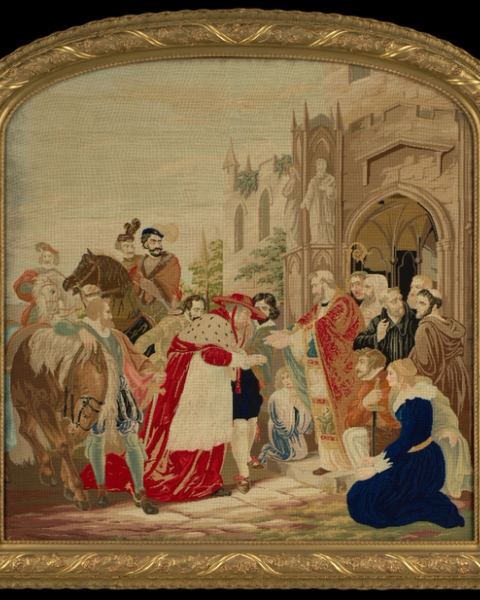
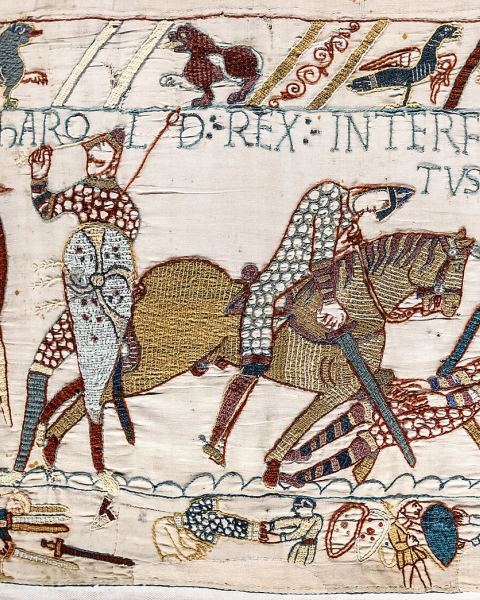
The big pictures were designed by others in the studio. Dora Wheeler drew figure subjects such as Penelope Unraveling Her Work at Night (1886, now at the Met). The firm's most ambitious piece, a copy of Raphael's cartoon The Miraculous Draught of Fishes, was worked by Anna G. Lyman and shown at Chicago in 1893. Wheeler later described transferring its outlines by pricking and pouncing, while an 1893 account says the design was photographed onto the ground, and the Met catalogue doubts her later dating. Like the Bayeux Tapestry, these "tapestries" are needlework, not true tapestry.
What did her own Associated Artists make after 1883?
In 1883 Wheeler left Tiffany and kept the name. Her Associated Artists was a textile firm run and staffed largely by women. It designed and sold embroidered hangings, needle-woven tapestries, and furnishing silks and cottons made by Cheney Brothers, and it trained its own designers.
The split came, probably, in March or early April 1883; Wheeler wrote simply that the members "agreed to resume their own responsibility." Her new firm first appears in a credit ledger on April 28. It worked from a house Wheeler had bought at 115 East Twenty-third Street, with a design room where, she recalled, "every girl in it was there because she knew how to draw."
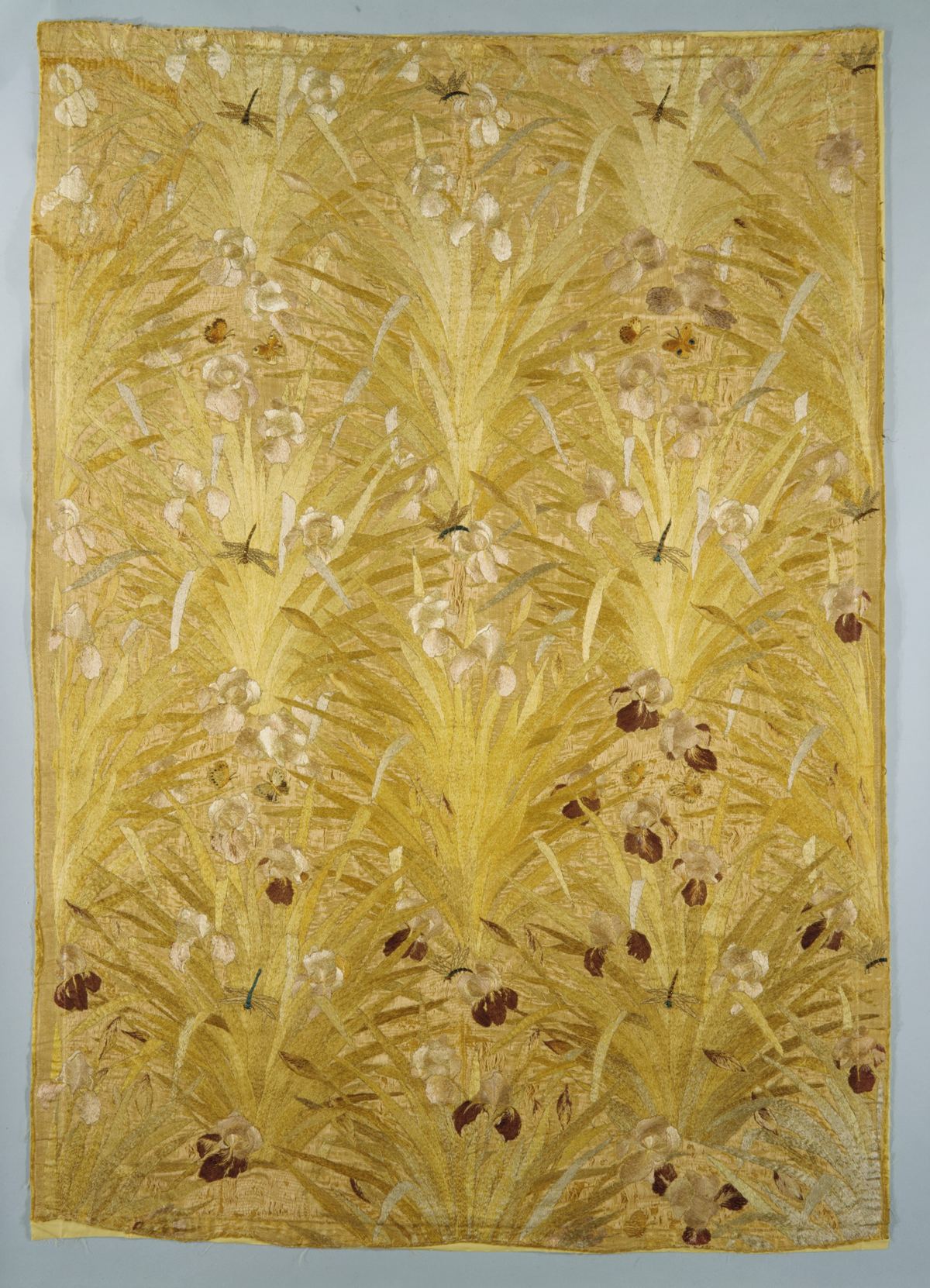
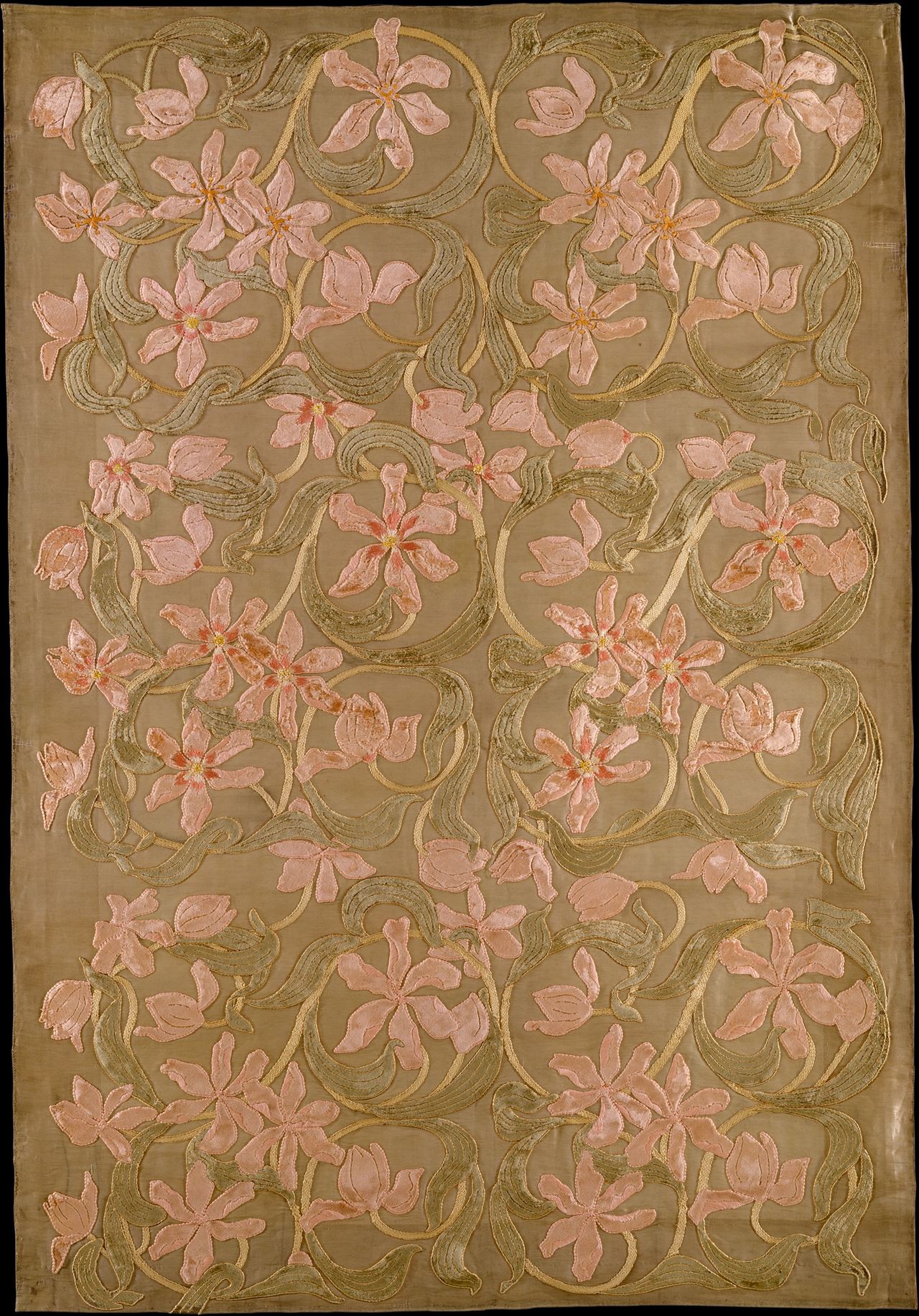
The irises panel at the top of this page was among the first big pieces she designed for the new firm. It was originally the center of a portiere with a border, and was shown at the Pedestal Fund Art Loan Exhibition in December 1883, when the Art Interchange described its dragonflies, beetles and butterflies with jeweled eyes and spots. The shading is worked in close stitches of the kind then called "Kensington" or feather stitch. The tulips panel goes further. The flowers are cut from silk velvet, applied and outlined in couching, and Wheeler drew them past their prime, petals spread and about to drop.
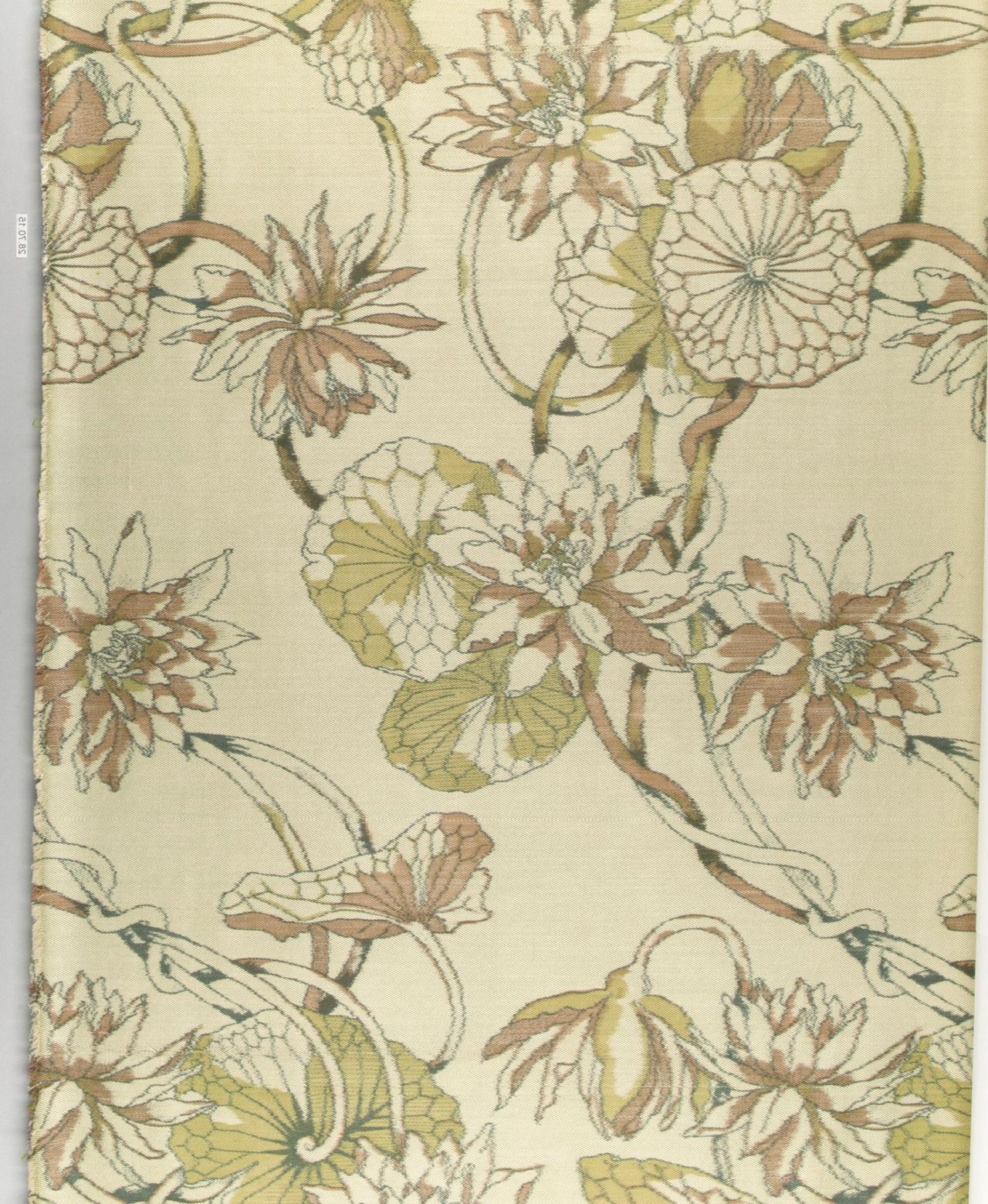
The mass-produced side mattered as much to her. Wheeler wanted American design on American looms, and Cheney Brothers wove and printed the firm's patterns. The best-known were "shadow silks," in which the warp was printed before weaving so that the pattern blurred slightly on the loom; a twill weave and contrasting warp and weft colors added a shifting sheen. A nineteenth-century source quoted by the Met says the firm produced more than 500 designs in silks and cottons between 1884 and 1894; textiles survive for perhaps forty of them.
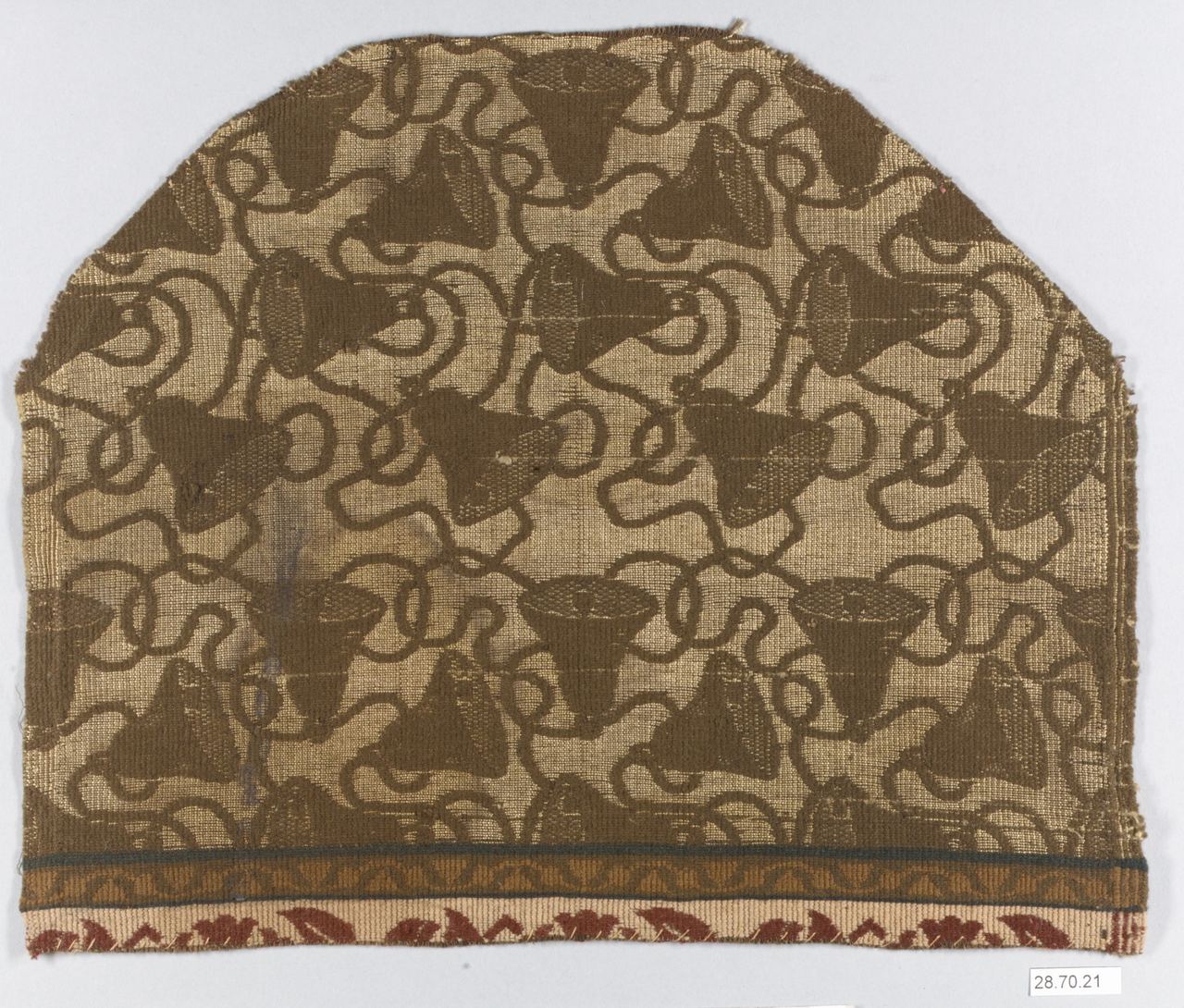
Who designed what is not always Wheeler. Ida F. Clark began as an embroiderer and became one of her head designers, doing "the more conventional designing" and patterns with bells, wheels and smoke for Pullman railroad cars. Dora Wheeler, Rosina Emmet and others drew figure cartoons. The firm's trademark, two linked A's, dates from 1883. Wheeler retired from the firm in 1900, and her son Dunham closed it in 1907.
What did she do at the 1893 World's Columbian Exposition?
At the Chicago fair of 1893 Wheeler was in charge of the color and decoration of the Woman's Building. She also directed New York State's applied-arts exhibit and designed the New York library inside the building, with a painted ceiling by her daughter.
In June 1892 New York's Board of Woman Managers named her director of its Bureau of Applied Arts, and in July the national Board of Lady Managers made her color director of the whole building. In her memoir she calls herself "Director of the Woman's Building" and admits the job was hard: regular pay for her workers was difficult to secure, and she leaned on Bertha Palmer and the painter Frank Millet to get things done. For the library she chose blues and greens to answer the lake outside the window. Dora Wheeler Keith painted the ceiling, with Science, Literature and Imagination at its center; Maud Howe Elliott's 1893 book on the building judged the library, "from a purely artistic standpoint," its most important room after the Hall of Honor, and noted that its decoration had been "intrusted to Mrs. Wheeler."
What came later, and where can you see her work?
After 1893 Wheeler wrote. She edited Household Art (1893) and published Content in a Garden (1901), How to Make Rugs (1902), Principles of Home Decoration (1903), her memoir (1918) and The Development of Embroidery in America (1921), which the Met catalogue calls the first book on the history of American embroidery of all types.
In May 1883 her brother Francis Thurber bought a farm near Tannersville in the Catskills, where they built the first two cottages of what became the Onteora colony, opened on July 4, 1888. In 1907 she built a winter house, Wintergreen, in Thomasville, Georgia. She died in New York on August 5, 1923, aged 96. A Washington paper's notice the next day called her an "author of fairy tales," and said nothing of her design work.
| Date | Event |
|---|---|
| March 24, 1827 | Born Candace Thurber in Delhi, New York |
| June 28, 1844 | Marries Thomas Mason Wheeler; moves to New York City |
| Summer 1876 | Sees the Royal School of Art Needlework exhibit at the Philadelphia Centennial |
| March 28, 1877 | Society of Decorative Art formally established |
| May 10, 1878 | New York Exchange for Woman's Work opens |
| 1879 | Tiffany & Wheeler founded; Wheeler is the textile partner |
| February 1880 | Madison Square Theatre opens with the firm's curtain; fire destroys it on February 26 |
| 1881 | Firm becomes Louis C. Tiffany & Company, Associated Artists |
| Nov. 28, 1882 | US patent 268,332 for the needle-woven tapestry stitch |
| Jan. 23, 1883 | US patent 271,174 for the ground fabric |
| Spring 1883 | Leaves Tiffany; her own Associated Artists begins |
| 1892–93 | Color director of the Woman's Building, World's Columbian Exposition |
| 1900 | Retires from Associated Artists (closed by her son Dunham in 1907) |
| 1921 | Publishes *The Development of Embroidery in America* |
| August 5, 1923 | Dies in New York, aged 96 |
The Metropolitan Museum of Art holds the largest public group, much of it given by her family in 1928, and its 2001 catalogue by Amelia Peck and Carol Irish, Candace Wheeler: The Art and Enterprise of American Design, 1875–1900, is the standard study; a scan is on the Internet Archive. The Mark Twain House in Hartford and the Veterans Room at the Park Avenue Armory keep interiors from the Tiffany years.
- Irises panel, 1883 (Met 28.34.1)
- Tulips panel, 1883–87 (Met 28.34.2)
- Thistle textile, Tiffany & Wheeler, ca. 1881 (Met 28.70.3)
- Penelope Unraveling Her Work at Night, Dora Wheeler, 1886 (Met 2002.230)
- Peck and Irish, the Met catalogue (Internet Archive)
- Wheeler, Yesterdays in a Busy Life, 1918 (Internet Archive)
- Wheeler, The Development of Embroidery in America, 1921 (Project Gutenberg)
Sources
- Amelia Peck and Carol Irish, with Elena Phipps, Candace Wheeler: The Art and Enterprise of American Design, 1875–1900 (Metropolitan Museum of Art / Yale, 2001). The Metropolitan Museum of Art (scan on Internet Archive). Scholarly, primary reference. Full OCR text read: chronology pp. 255–58 (birth 24 March 1827, marriage, SDA 1877 dates, Exchange 1878, Tiffany & Wheeler 1879, Madison Square Theatre curtain dates, Armory 1880, 1881 merger, patents and Tillinghast case, 1883 split, Onteora, 1892–93 Chicago appointments, 1900 retirement, 1907 closure); p. 80 (death 5 Aug 1923); White House passage (Wheeler apparently not involved); cat. entries for Thistle, Irises, Tulips, Ida F. Clark, water-lily shadow silks, Miraculous Draught (Anna G. Lyman); note 196 on patents. Accessed November 11, 2026.
- Candace Wheeler, Yesterdays in a Busy Life (New York: Harper & Brothers, 1918). Internet Archive. Primary memoir. OCR read: ch. II (birth, March 1827, Delhi); ch. VIII Society of Decorative Art and Woman's Exchange (Centennial, Kensington stitch, Mrs Lane, Mrs Custer, Mrs Pode, Mrs Choate); ch. IX Associated Artists (name, Madison Square curtain, design room, Warren-Fuller prizes, split, needle-woven tapestries); ch. X Onteora (1883); ch. XII Columbian Exposition. Quotes checked word for word. Accessed November 11, 2026.
- Candace Wheeler, The Development of Embroidery in America (New York: Harper & Brothers, 1921). Project Gutenberg. Primary. Full text read: ch. V Berlin woolwork, ch. VI Centennial and Society of Decorative Art, ch. VII American tapestry (theater curtain in appliqué, needle weaving, Miraculous Draught transfer, Langtry hangings). Accessed November 11, 2026.
- US Patent 271,174, C. T. Wheeler, Fabric for Needle-Woven Tapestries (23 January 1883). Google Patents. Primary. Specification read in full OCR: application filed 27 March 1882, English patent 14 March 1882 no. 1,233, reference to her patent 268,332 of 28 November 1882, structure of face and back weft and binding warp, two-shuttle loom. Accessed November 11, 2026.
- US Patent 268,149, M. E. Tillinghast, Needle-Woven Tapestry (28 November 1882). Google Patents. Primary. Specification read: Mary E. Tillinghast of West Orange, NJ; granted 28 November 1882 (same day as Wheeler's 268,332). Accessed November 11, 2026.
- Wheeler, Candace (1827–1923), Women in World History: A Biographical Encyclopedia (Gale). Encyclopedia.com. Secondary. Read in full: born Delhi 24 March 1827, died New York City 5 August 1923, married 28 June 1844, SDA 1877, Exchange 1878, own Associated Artists 1883, color director of the Women's Building 1893, retired 1900. Accessed November 11, 2026.
- Maud Howe Elliott, ed., Art and Handicraft in the Woman's Building of the World's Columbian Exposition, Chicago, 1893. Internet Archive. Primary (1893). OCR read pp. 39–41: library decoration entrusted to Mrs Wheeler, ceiling by Dora Wheeler Keith (Science, Literature, Imagination); Associated Artists section on the Miraculous Draught tapestry. Accessed November 11, 2026.
- Washington Daily News, 6 August 1923, p. 9 ('Woman's World'). Library of Congress, Chronicling America. Primary. OCR read: 'Mrs. Candace Thurber Wheeler, 96, author of fairy tales, died yesterday in New York.' Accessed November 11, 2026.
- Candace Wheeler: Pioneer American Designer (24 October 2001). UPI. Secondary, read via WebFetch: SDA 1877, Exchange 1878, Tiffany 1879, own Associated Artists 1883, Cheney Brothers, over 500 designs 1884–94, interior decorator of the Women's Building. Accessed November 11, 2026.
- Tiffany's Shift to Artistic Decorating. Lyndhurst (National Trust for Historic Preservation). Secondary, read via WebFetch: Louis C. Tiffany & Company, Associated Artists dissolved in 1883; hired for the White House by 1882; Wheeler then started her own Associated Artists. Accessed November 11, 2026.
- Veterans Room at the Park Avenue Armory (2016). Architectural Record. Secondary, read via WebFetch: project begun 1879 with Associated Artists; original team credits 'Candace Wheeler, Textiles'. Accessed November 11, 2026.
- The White House: art in the President's House (Arthur and Tiffany). The White House (archived Clinton-era site). Secondary, read via WebFetch: redecoration commissioned in 1882 by President Arthur from Tiffany and Associated Artists; glass screen designed by Tiffany. Accessed November 11, 2026.
- Candace Wheeler, Principles of Home Decoration (1903). Project Gutenberg. Primary. Read the chapter on draperies (portières 'in the nature of pictures'). Accessed November 11, 2026.
- Met object records 28.34.1, 28.34.2, 28.70.3, 28.70.15, 28.70.21, 2002.230. The Metropolitan Museum of Art Collection API. Primary records read via API: titles, makers, dates, media, dimensions, credit lines, isPublicDomain true for the four images used (2002.230 is not open access and is only linked). Accessed November 11, 2026.
Glossary
Last updated · Markdown · Report an error