Technique
Which Needle for Which Thread? Embroidery Needles Explained
What is the difference between a tapestry needle and an embroidery needle, and which should you use for embroidery floss? Needle parts, the main families, how sizes work, and a chooser table.
For stranded cotton stitched freely on ordinary woven cloth, reach for an embroidery needle, also called a crewel needle: sharp, with an eye long enough for several strands. A tapestry needle differs in the way that matters. Its tip is blunt and its eye is large, so it slips between the threads of canvas or open-weave cloth instead of piercing them. In most families a higher number means a finer needle, but every maker numbers its own range.
Beginners are who this guide is for. Etsy's preview of its Spring/Summer 2026 Seller Trend Report lists beginner needlepoint kits at +175% under a "World of Whimsy" trend, and its "Soft Stitch Era" trend gathers crochet, embroidery and stitched textures (Etsy Community; Stylist). The question is old: which needle goes with which thread?
What are the parts of a needle, and why does the point matter?
A hand needle has three features that decide what it is for: the eye that carries the thread, the shaft that makes the hole, and the point that enters the cloth. Makers vary the length and shape of the eye, the thickness and length of the shaft, and whether the point is sharp or blunt.
The eye comes in two broad shapes. Sharps, the general-purpose sewing needle, have a small round eye. Embroidery needles have a longer eye, according to the maker John James, which makes stranded cotton easier to thread; apart from that, their length, diameter and point profile are akin to a sharp's. Tapestry needles are, in Bohin's description, shorter and stockier than other sewing and embroidery needles, with a longer eye. Milliners' needles go the other way: their small eye is the same thickness as the shaft, the Embroiderers' Guild of America (EGA) notes, so the needle keeps one width from eye to tip.
The point is the bigger decision. A sharp point pierces the cloth, which is what you want on tightly woven cotton, linen or silk. A blunt point is for cloth that already has openings. DMC explains that on Aida or canvas, where the holes decide where each stitch goes, you want a needle that passes smoothly through the holes rather than piercing the fabric. John James says the blunt tapestry point lets the needle pass through canvas without tearing or splitting its fibers. Bohin adds that tapestry needles are made both with a point and without one, so read the pack.
Which needles are used for embroidery, and what is each for?
Seven families cover almost every job. Embroidery (crewel) needles and sharps pierce ordinary cloth. Tapestry and cross-stitch needles work in counted cloth and canvas. Chenille needles take thick threads and ribbon, milliners' needles make knots, darners mend, and beading needles carry beads and sequins.
Embroidery (crewel). A sharp point and a medium-to-long eye. DMC sells sizes 1 to 10, Bohin sells 1 to 10, and John James lists 1 to 12. The EGA says the sharp tip pierces tightly woven cotton, linen and even silk, and calls the crewel needle the safest bet if you are unsure what to buy. DMC notes that its sizes 3, 5 and 7 are known as crewel needles, after the style of embroidery worked in fine two-ply wool (crewelwork, built on a two-ply yarn), while John James and the EGA treat "embroidery" and "crewel" as one family. Sharps, by contrast, have a small round eye and suit general sewing and small, precise work such as appliqué (EGA).
Tapestry and cross-stitch. A blunt point and a large eye, in sizes 13 to 28 (DMC, John James, EGA). DMC points them at counted cross-stitch, needlepoint and tapestry; the EGA adds Hardanger and pulled and drawn thread work, and notes that the blunt tip slides under existing stitches without snagging them, which is why it is used for whipping stitches. DMC also sells a cross-stitch needle, blunt with an elongated eye, in sizes 22 to 26. The name "tapestry" is a habit of the trade: the work these needles do on canvas is stitched, whereas a true tapestry is woven on a loom. Teazle's guide to needlepoint, tapestry and cross-stitch untangles the words.
Chenille. John James describes chenille needles as identical to tapestry needles in length and diameter, but with a sharp point that lets the needle pass through the coarsest fabrics. DMC calls them a cross between tapestry and embroidery needles: a sharp point, a large eye and a thicker shaft than a standard embroidery needle. They suit thick threads, fine yarns and ribbons, and the EGA lists wool, felt and denim among the cloths they pierce. DMC sells sizes 18 to 24; John James lists 13 to 26.
Milliners' (straw). Traditionally used in the millinery trade, these needles are now used for pleating, decorative stitching and some beadwork, John James says; they resemble a sharp but are longer. The EGA recommends them for wrapped stitches such as bullion knots and French knots, because the length makes it easier to wrap the thread several times. Sizes run 1 to 10, with 15 and 18 also made. Sue Spargo's needle guide warns that the milliners' 15 is the largest in her range, an exception to the rule that a bigger number is a finer needle; John James's table agrees (see below). The milliner trade gave the needle its name.
Darners. DMC describes darning needles as long, with a sharp point and an elongated eye, and advises matching the size to the thread you are mending with. John James lists them as long and sharp with elongated eyes, and the EGA adds that their length suits basting, smocking and long running stitches.
Beading. John James makes beading needles from the finest steel wire, using a different wire diameter for each size, so that they pass through beads, sequins and pearls. The EGA lists sizes 10 to 15: long, thin, flexible, with a tiny eye. They serve beadwork and the attaching of sequins.
How do needle numbers work?
Within a family, most makers number needles so that a larger number means a thinner, shorter needle. Beyond that, the number is a label rather than a measurement, and it does not carry across families or makers. John James's published table shows sharps, embroidery, milliners' and cotton darning needles that are all 0.69 mm thick at size 7, while a tapestry size 24 is 0.76 mm, as thick as an embroidery size 5.
| Family | Sizes listed | Thickest listed | Finest listed |
|---|---|---|---|
| Embroidery / crewel | 1 to 12 | 1: 1.02 / 48.5 | 12: 0.41 / 29.5 |
| Tapestry | 13 to 28 | 13: 2.34 / 69 | 28: 0.53 / 32.5 |
| Chenille | 13 to 26 | 13: 2.34 / 69 | 26: 0.61 / 34 |
| Milliners' / straws | 1 to 10, plus 15 and 18 | 15: 1.83 / 69 | 10: 0.53 / 40.5 |
| Cotton (short) darners | 1 to 11 | 1: 1.02 / 57.5 | 11: 0.46 / 36 |
| Yarn darners | 14 to 18 | 14: 2.03 / 75 | 18: 1.27 / 60 |
| Beading | 10 to 15 | 10: 0.46 / 55 | 15: 0.25 / 45 |
Three cautions follow from the tables. First, ranges differ: DMC's and Bohin's embroidery needles stop at 10, John James's go to 12, and Bohin says its 1 is the longest and thickest. Second, the milliners' row above runs the wrong way, as Sue Spargo warned: the 15 is thicker than the 1. Third, makers disagree about darners. DMC says darning sizes run opposite to other hand needles, so that its size 18 is the thickest it sells. John James's yarn darners go the other way, with the 18 (1/0) at 1.27 mm thinner than the 14 (5/0) at 2.03 mm. A number is only a reliable guide inside one maker's chart, so compare diameters when you can, and do not convert between brands by number.
How do I match the eye to the thread?
The eye has to let the thread through without stripping it, while the shaft should leave no more hole than the thread can fill. DMC pairs its sizes with strand counts of its own six-strand floss, so treat those pairings as a starting point and then test them in the cloth.
Two thread types set most of the questions. Stranded cotton, called embroidery floss in the United States, is a six-strand thread that can be divided, so you choose thickness by the number of strands in the needle. Coton perlé, or pearl cotton, is a twisted thread that cannot be divided; DMC sells it in sizes 3, 5, 8 and 12, with 3 the thickest and 12 the finest (DMC; Needle 'n Thread).
| DMC needle | Size | DMC suggests it for |
|---|---|---|
| Embroidery, mixed pack | 1 to 5 | 2 to 6 strands of Mouliné Spécial, or Coton Perlé 5 to 8 |
| Embroidery, mixed pack | 3 to 9 | 1 to 4 strands of Mouliné Spécial, or Coton Perlé 5 to 8 |
| Embroidery, mixed pack | 5 to 10 | 1 to 2 strands of Mouliné Spécial, or Coton Perlé 5 to 8 |
| Tapestry | 13 and 16 | 6 strands, Coton Perlé 3, tapestry wool or soft cotton |
| Tapestry | 18 | 4 to 6 strands, Coton Perlé 5, tapestry wool or soft cotton |
| Tapestry | 20 | 6 strands, Coton Perlé 5, tapestry wool or soft cotton |
| Tapestry | 22 | 4 strands, Coton Perlé 5, tapestry wool or soft cotton |
| Tapestry | 24 | 3 to 4 strands, Coton Perlé 5 to 8, or soft cotton |
| Tapestry | 26 | 2 to 3 strands, or Coton Perlé 8 |
| Tapestry | 28 | 2 strands, or Coton Perlé 12 |
| Chenille | 18 to 22 | Soft cotton and Coton Perlé 3 and 5 |
| Chenille | 24 | Coton Perlé 5 and 8 |
DMC's own pages overlap: its size 18 tapestry needle is listed for four to six strands, its size 20 for six. Treat them as ranges, not laws. Needle 'n Thread, an embroidery site, suggests judging by feel. The thread should follow the eye through the cloth with a little resistance but no wrestling. If the thread turns fuzzy or frays at the eye, go up one size, for example from a 9 to an 8 or a 7. If the needle only goes through dense stitching or taut fabric with effort, and it is still large enough for the thread, a finer needle may slip through more easily. That site's author uses a size 7 or 8 even for one strand, reasoning that it opens the cloth enough for the thread to pass with less abrasion without leaving noticeable holes. The author also cautions against matching needle width to thread width exactly: a thread looks thinner once pulled, and it is doubled at the eye.
What goes wrong with the wrong needle?
The EGA puts it bluntly: choosing the wrong needle for the project and fabric "can lead to snagged thread and ruined fabrics." The failures are specific.
- Too fine for the thread. The needle takes real effort to pull through, the fabric distorts, and the thread frays at the eye or goes fuzzy quickly (Needle 'n Thread).
- Too coarse for the thread. The opening is larger than the thread can fill and leaves a noticeable hole (Needle 'n Thread).
- Sharp point on counted cloth. A tapestry needle is designed to pass through the open holes of Aida or canvas rather than pierce the fabric (DMC), without splitting its fibers (John James). A sharp needle is not built for that.
- Blunt point on a tight weave. The EGA assigns the piercing job on tightly woven cloth to the sharp crewel needle, and DMC describes the tapestry needle as one for fabrics with open holes. A blunt needle on a closely woven cloth has no opening to slide into.
- Ribbon through a small hole. DMC recommends chenille needles for ribbon embroidery because the sharp point makes a hole large enough that the ribbon is not damaged or worn as it passes through.
Which needle should I pick? A quick chooser
| Task | Needle | Sizes to look at | Basis |
|---|---|---|---|
| Floss, 1 to 2 strands, tightly woven cotton or linen | Embroidery (crewel) | 5 to 10 | DMC mixed pack for 1 to 2 strands |
| Floss, 2 to 6 strands, tightly woven cloth | Embroidery (crewel) | 1 to 5 | DMC mixed pack for 2 to 6 strands |
| Cross-stitch on Aida or evenweave, 2 strands | Tapestry or cross-stitch | 26 to 28 | DMC tapestry sizes 26 and 28; its cross-stitch needle runs 22 to 26 |
| Needlepoint on canvas, tapestry wool or Perlé 3 to 5 | Tapestry | 13 to 18 | DMC tapestry pack notes |
| Perlé 5, soft cotton or ribbon on closely woven cloth | Chenille | 18 to 22 | DMC chenille pages; Bohin ribbon assortment 18 to 22 |
| French knots and bullion knots | Milliners' | 1 to 10 | EGA, John James |
| Mending with wool or cotton | Darner | Match the size to the thread | DMC; yarn darners 14 to 18 (John James) |
| Beads and sequins | Beading | 10 to 15 | EGA, John James |
If you are planning a cross-stitch, Teazle's Embroidery Floss Estimator works out how many skeins a chart needs from the strands you put in the needle. For the wider choice of which stitch family to start with, see Which Embroidery Should You Learn First?, and for how canvas-work kits and charts began, Berlin wool work.
Where can you see needles and their cases?
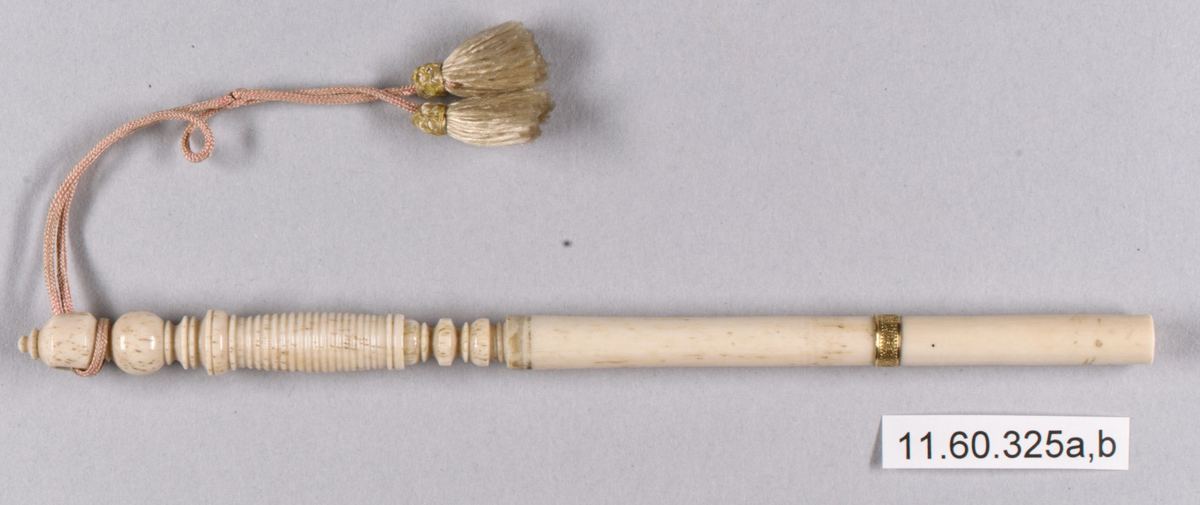
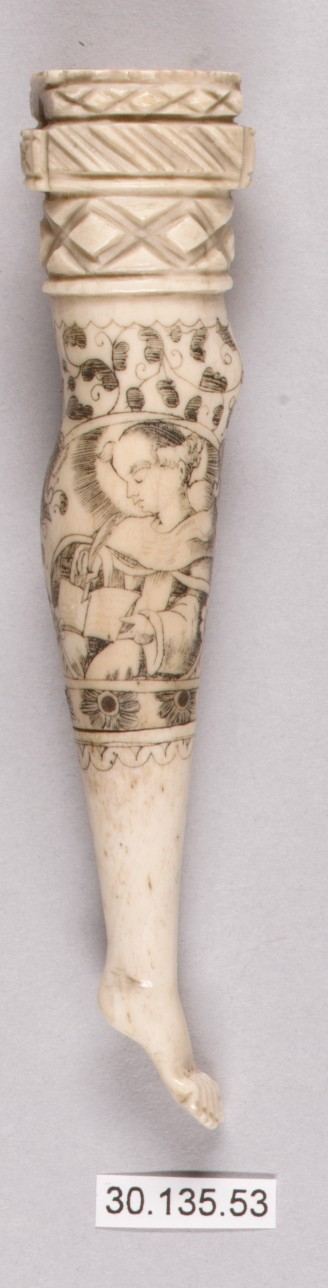
Museums hold the cases that were made to keep needles in. The Metropolitan Museum of Art's open-access collection includes an American case of ivory and gold dated 1800 to 1830 (the image at the top of this page), a 17th-century ivory case carved as a lower leg and foot, a 17th-century bronze case 23.5 cm long, an étui of soft-paste porcelain from the Vincennes Manufactory of about 1752, and a porcelain case from the Meissen Manufactory, listed as 18th century.

For actual-size drawings of every needle named here, see the John James Needle Guide, a PDF that holds the length and diameter tables behind the figures above. DMC's embroidery, chenille and darning needle pages list its own strand pairings.
Sources
- Tapestry needles. DMC. Full page read via curl: blunt point, large eye, sizes 13-28, finer with higher number, why blunt for Aida/canvas, per-size strand and Coton Perle pairings (sizes 13 to 28). Accessed October 27, 2026.
- Embroidery needles. DMC. Full page read via curl: sizes 1-10, sharp point, medium/long eye, crewel naming for sizes 3, 5, 7, mixed-pack strand pairings. Accessed October 27, 2026.
- Chenille needles. DMC. Full page read via curl: sharp point, large eye, thicker shaft, sizes 18-24, ribbon rationale, pairings with Soft Cotton and Coton Perle. Accessed October 27, 2026.
- Darning needles. DMC. Full page read via curl: long, sharp, elongated eye; sizes 1-18 with 18 the thickest (reversed numbering); match size to mending thread. Accessed October 27, 2026.
- Cross stitch needles. DMC. Full page read via curl: elongated eyes, blunt point, sizes 22-26. Accessed October 27, 2026.
- Coton Perle. DMC. Full page read via curl: non-divisible, sizes 3, 5, 8, 12, 3 thickest. Accessed October 27, 2026.
- Needles Guide (PDF). John James Needles. Full PDF downloaded and read as text: family descriptions and the length/diameter tables for sharps, embroidery, tapestry, chenille, milliners, darners and beading. All size/diameter figures in the article are from these tables. Accessed October 27, 2026.
- EGA's Guide to Embroidery Needles. Embroiderers' Guild of America. Full page read via curl (posted 21 April 2025): crewel, tapestry, chenille, milliner, beading, sharps, darner families, sizes and uses. Accessed October 27, 2026.
- Embroidery needles. Bohin. Product page read: sizes No. 1-10, No. 1 longest and thickest, No. 10 shortest and thinnest. Accessed October 27, 2026.
- Astro Couture Tapestry Needles without Point. Bohin. Product page read: sizes 18-26, shorter, stockier, longer eye, available with and without a point. Accessed October 27, 2026.
- Ribbon embroidery needles No. 18/22. Bohin. Product page read: ribbon embroidery assortment 18/22. Accessed October 27, 2026.
- Embroidery Stitch Tip: Changing Needle Sizes. Needle 'n Thread. Full article read via curl: signs a needle is too small (effort, fabric distortion, fraying at the eye), when to go finer, why exact thread-width matching is unreliable. Accessed October 27, 2026.
- A Brief Guide to Cotton Hand Embroidery Threads. Needle 'n Thread. Full article read via curl: stranded cotton is divisible into six strands; perle cotton non-divisible, sizes 3/5/8/12. Accessed October 27, 2026.
- Ultimate Needle Guide. Sue Spargo. Full page read via curl: higher number is smaller needle; milliners 15 is the largest in her range. Accessed October 27, 2026.
- Etsy Insights: Explore the Trends Shaping Spring and Summer 2026. Etsy Community. Full post read via curl: Etsy's trend expert preview of the Seller Trend Report; beginner needlepoint kits +175% listed under World of Whimsy; Soft Stitch Era lists embroidered straw bags and crochet clothing. The +175% figure is for needlepoint kits, not embroidery kits. Accessed October 27, 2026.
- These are 6 of the biggest spring/summer trends, according to Etsy. Stylist. Full article read via curl (17 March): 'According to Etsy, crochet, embroidery and stitched textures are stepping into the spotlight.' Accessed October 27, 2026.
- Needle Case, 1800-1830. The Metropolitan Museum of Art. Object record read via the Met Open Access API (isPublicDomain true): ivory, gold, American, 11.60.325a. Accessed October 27, 2026.
- Needle case, 17th century. The Metropolitan Museum of Art. Object record read via API (public domain): ivory, L. 13 cm, 30.135.53. Accessed October 27, 2026.
- Needle case, 17th century. The Metropolitan Museum of Art. Object record read via API (public domain): bronze, L. 23.5 cm, 30.135.54. Accessed October 27, 2026.
- Needle case (Etui), ca. 1752. The Metropolitan Museum of Art. Object record read via API (public domain): Vincennes Manufactory, soft-paste porcelain, gold. Accessed October 27, 2026.
- Needle case, 18th century. The Metropolitan Museum of Art. Object record read via API (public domain): Meissen Manufactory, porcelain, gold. Accessed October 27, 2026.
- Sewing needle. Wikipedia. Used to locate references only; no claim rests on it. Accessed October 27, 2026.
Glossary
Last updated · Markdown · Report an error