Mending
Sashiko vs. Boro: One Is a Stitch, One Is a Cloth
Sashiko is a way of stitching; boro is what a lifetime of patching leaves behind. How the two Japanese mending traditions differ, where they overlap, and how to try the stitch yourself.
Sashiko and boro are not two names for the same thing. Sashiko is a way of stitching: small, even running stitches that reinforce, quilt or decorate cloth. Boro is the result of mending: textiles patched and re-patched over years, usually in indigo-blue cotton and hemp. The two overlap because boro is so often held together with running stitches.
What is the difference between sashiko and boro?
Sashiko names a technique, and boro names a kind of object. You can learn sashiko in an afternoon and use it on brand-new cloth. You cannot "do" boro in the same way, because boro is what repeated repair leaves behind, layer on layer, over a lifetime of use.
| Sashiko | Boro | |
|---|---|---|
| What is it? | A stitching technique | A kind of mended, patched textile |
| Meaning of the word | "Little stabs," from the motion of the needle | Rags or scraps |
| Typical look | Regular geometric patterns in white thread on indigo | Uneven patchwork in layered indigo shades, with visible stitching |
| Planned or accumulated? | Often planned, drawn on the cloth in advance | Accumulated, patch by patch, as the cloth wore out |
| Where you meet it | Museum costume and textile collections, craft books | Folk-textile collections and recent exhibitions |
The overlap is real, and the sources below treat it differently. Hayes and Seaton, writing about sashiko, note that the method of darning and quilting with running stitches "is also referred to as boro." Japan Objects draws the line more cleanly: sashiko is the stitch style, boro is a mending approach built on layering and patching.
What is sashiko?
Sashiko means "little stabs," a name for the push of the needle through cloth. The stitch itself is the plain running stitch, worked in rows to hold layers together or to draw patterns, and it is traditionally done in white cotton thread on indigo-dyed cloth.
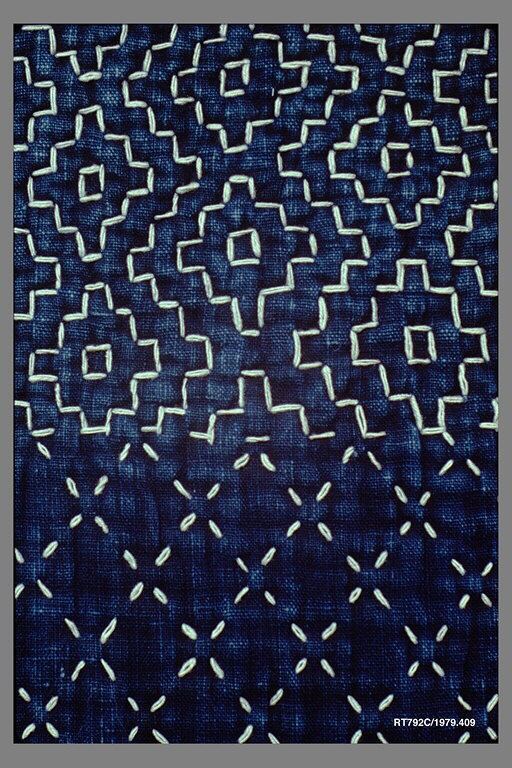
Running stitch is old and universal, so claims about the first sashiko vary. Cynthia Shaver, in a paper for the Textile Society of America, points to an eighth-century monk's robe in the Shoso-in repository whose purple silk running stitches no longer do any structural work, and calls it the oldest surviving example in Japan. Japan Objects also cites the robe but treats it as a hint of deeper roots rather than a birthplace. The sashiko most people recognize, with its named geometric patterns, belongs to the Edo period (1603–1868), according to Carol Hayes and Katherine Seaton.
They also offer a social explanation. During the Edo period, they write, sumptuary regulations forbade commoners to wear silk and cotton, and in the northern Tohoku region people wove their own rough, open hemp cloth, usually dyed with indigo. "It can be argued," they add, that surface stitching developed to soften that poor cloth, and that quilting let wadding of plant matter or old rags be added between layers for warmth. Hayes's 2019 paper in Japanese Studies traces the practice from the Edo period through its decline in the late Meiji period to its present revival as decorative embroidery.
White cotton thread changed the look. Barbara Setsu Pickett writes that early repairs were made in the same fiber, dyed the same color, to blend in; once white cotton thread became common in the countryside in the 1800s, stitchers began to show the stitches instead. At the Textile Research Centre in Leiden, the entry on Tsugaru kogin places the arrival of white cotton thread there in the late eighteenth century.
Not all sashiko is rural. The Art Institute of Chicago holds a firefighter's coat (hikeshi sashiko banten) of quilted, painted cotton dated about 1875–1900. Hayes and Seaton note that firefighters needed thick coats to protect them from flames.
Where do the regional styles come from?
Hayes and Seaton name three main traditional types: Tsugaru kogin-zashi and Nambu hishi-zashi, both from Aomori Prefecture in northern Tohoku, and Shonai sashiko. All three count the threads of the cloth to build the design, they say, much as cross-stitch or blackwork does.
| Style | Region | What defines it |
|---|---|---|
| Tsugaru kogin-zashi | Tsugaru district, Aomori | Pattern darning in horizontal stitches over an odd number of threads; originally on coarse hemp, later ramie |
| Nambu hishi-zashi | Nambu district, eastern Aomori | Lozenge patterns over an even number of threads; paler blue ramie ground, because dyeing was costly |
| Shonai sashiko | Shonai, Yamagata | Running stitch in straight lines that cross and recross; originally to join layers, now often a single layer |
The Leiden Textile Research Centre records that kogin declined after 1894, when a railway reached Hirosaki and soft, strong cotton cloth became widely available, and was nearly extinct by the early twentieth century. In 1932, it says, the folk-craft theorist Soetsu Yanagi drew attention to it and local people began a revival, which later included a dedicated institute founded in 1962.
Shonai sashiko is also where a very practical garment turns up. The Victoria and Albert Museum holds a sleeveless jacket for hauling sledges, dated 1850–1900 and said by the dealer who sold it to come from Shonai. Its record explains that the diagonal band of white quilting reinforces the spot where the hauling rope is slung.
What is boro?
Boro is the Japanese term for rags or scraps, and it names textiles patched, pieced and mended until little of the original cloth may remain. The International Quilt Museum describes it as the cycle of wearing cloth out and mending it again, mostly before the Second World War.
Most of what survives comes from the colder north. The Paper Sky article on boro locates its development in Aomori, where winters are harsh and cotton remained a luxury until well into the Meiji period (1868–1912), so people relied on hemp and prized every scrap of cloth. Quilts, overcoats and work clothes in the Amuse Museum collection, Artscape reports, were made from scraps and are mostly hemp; some of the heavy coats are said to have weighed up to 14 kilograms and to have been slept under by whole families.
The scraps themselves traveled. Hayes and Seaton, citing the scholar Yoshiko Iwamoto Wada, say rags were saved from older items and that scraps were bought from merchants selling used garments from Edo, Osaka and Kyoto. Wada's own 2004 paper examines boro, many of them futon made from recycled blue cotton, that came north along the Kitamaesen shipping route from the port of Sakai.
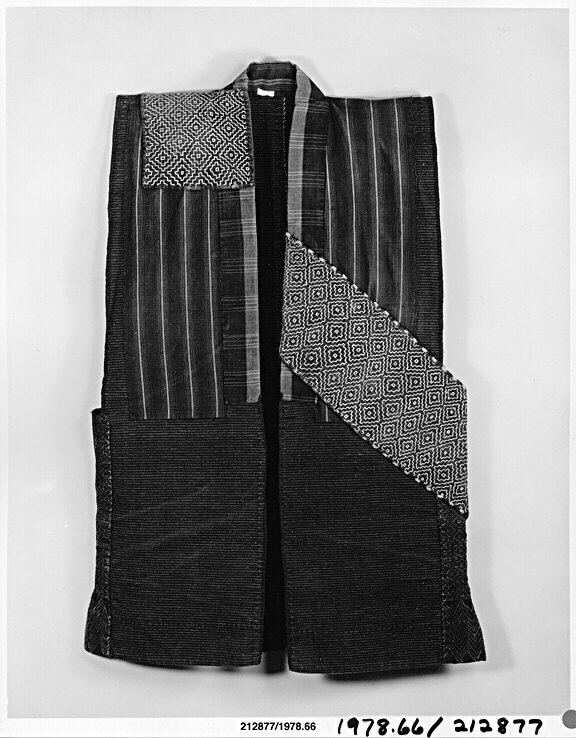
A boro piece is therefore an accumulation. Worn areas of bed covers and clothing were covered with scraps and held with simple running stitches, and the patches, mostly in shades of indigo, built up into a mottled, uneven surface. A hand-pieced and appliquéd futon cover in the International Quilt Museum's collection, dated 1880–1900, carries the native name boro on its record. The Met's sledge-hauling vest, above, does not use the word boro in its title, but it shows the same habit: its record lists plain-weave fabrics of cotton and of cotton and silk, some reinforced with embroidery.
How did boro become art?
Boro was collected as folk culture before it was shown as art. Chuzaburo Tanaka, an Aomori ethnologist and archaeologist according to Paper Sky, began collecting boro after recognizing it as a distinctive textile art, worried that its stories would be lost. His collection grew to nearly 30,000 folk artifacts, many of them boro; Artscape adds that he gathered things that would otherwise have been thrown away. Part of the collection went to the Amuse Museum in Tokyo's Asakusa district, founded by the Aomori native Yokichi Osato. The museum has since closed and now operates as a traveling exhibition, according to Paper Sky.
The recognition outside Japan is recent. The Japan Society in New York introduced a talk by the editor and photographer Kyoichi Tsuzuki by saying boro has only recently been categorized as an art form. The society's own exhibition, Boro Textiles: Sustainable Aesthetics, opened in March 2020 with about fifty historic pieces from Tanaka's collection, according to Apollo, and the International Quilt Museum showed a boro exhibition curated by Yoshiko Wada from February to June 2026. Designers including Issey Miyake and Yohji Yamamoto have drawn on boro's look, Paper Sky reports.
English-language sources do not agree on a precise date when attitudes turned, so this article does not give one. What the sources do support is the framing itself: a repair record, valued for the history of use it carries.
How do the two relate?
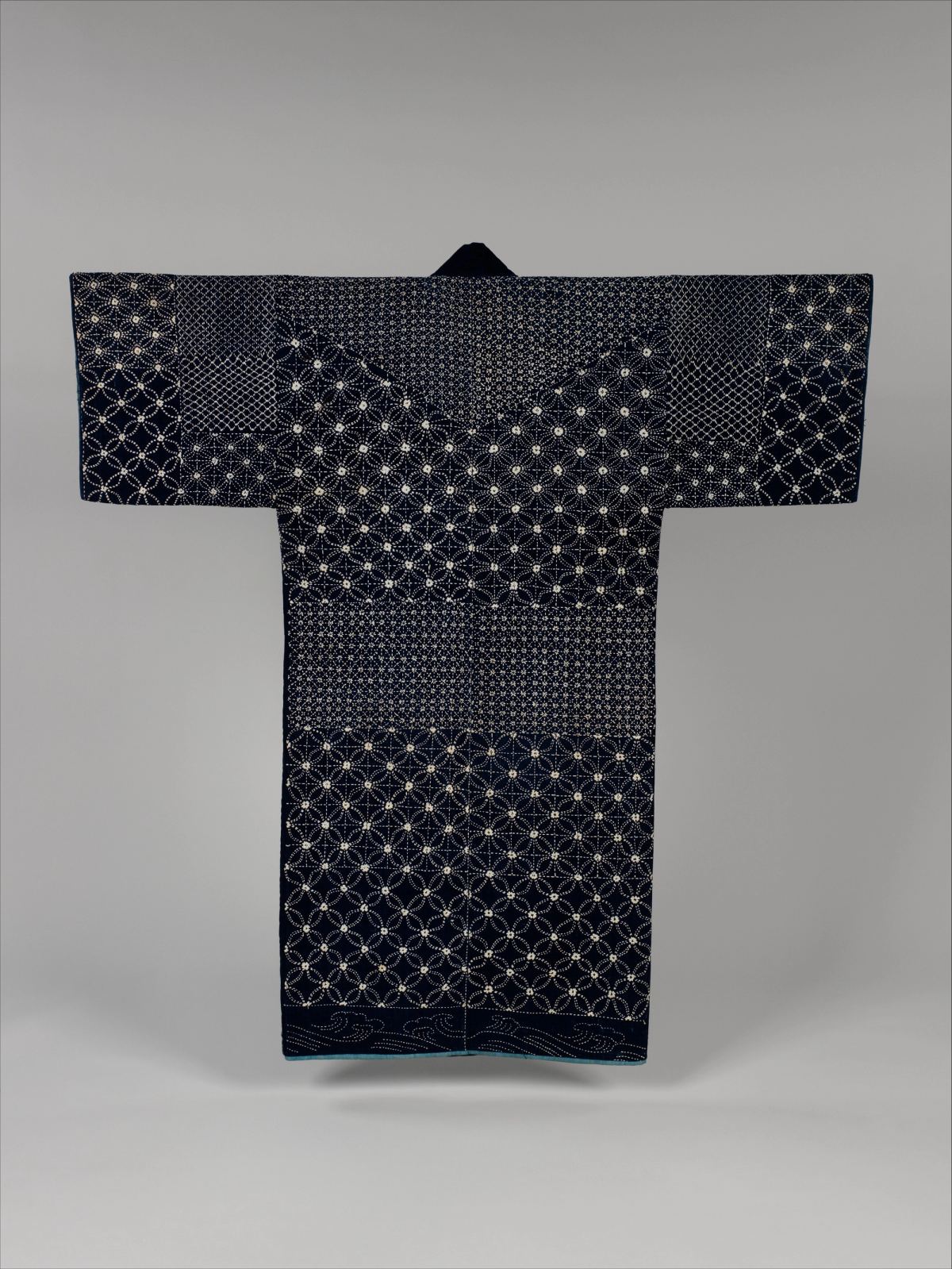
Sashiko is a how, and boro is a what. In the simplest case, a boro textile is a stack of patches fixed down with running stitches of the sashiko kind. In the opposite case, sashiko is pristine: the Met's kimono and jacket are stitched all over in deliberate patterns, with no sign that the stitching began as a repair.
The shared history explains the confusion. Both belong to the same northern, cloth-poor world; both use running stitch; both favor indigo. But the intention differs. Sashiko pattern can be drawn before a single stitch, then counted and repeated. Boro cannot be drawn in advance, because it depends on what wore out and what scrap was at hand.
How do you start sashiko?
Start with plain tools. Sarah's Hand Embroidery recommends tightly woven, even-weave fabric, a long needle of about two inches, and sashiko thread: pure cotton without sheen, heavier and more tightly twisted than perle cotton. Japan Objects adds that sashiko thread is twisted into a single strand rather than split from multi-strand floss. Colonial Needle suggests a shorter needle for corners and small motifs.
Stitch length. Shaver gives a range of about five to ten stitches per inch, which is roughly 2.5 to 5 millimeters from the start of one stitch to the start of the next. Sarah's Hand Embroidery recommends keeping the front stitch longer than the gap, at about 3:2, and suggests around half a centimeter per stitch on larger work, with smaller stitches for small projects. Even stitches matter more than any single number, because unevenness shows in the pattern.
Layout. Pickett shows that most traditional patterns come from marked grids. Mist and mountain patterns use parallel lines on a square or triangular grid. The hemp-leaf pattern (asa-no-ha) comes from a triangular grid, with connecting lines running from the tips of triangles to their centers. Seven treasures (shippo) is built from overlapping sets of circles on a square grid. Seigaiha, the wave pattern Japan Objects lists among sashiko designs, is a set of overlapping concentric circles of which only the upper arcs show, according to the Japan Architecture and Art Net Users System (JAANUS) dictionary; in the architectural version, each alternate row straddles the joints of the row below.
Order. Sarah's Hand Embroidery works horizontal and vertical lines first, then diagonals, then curves. Hayes and Seaton's kit instructions say to finish all the stitches in one direction before moving to the next. Clover, the sewing-tool maker, offsets each row so its stitches fall where the previous row had gaps.
Corners. Sarah's Hand Embroidery puts the rule plainly: place one stitch exactly at a corner point, and leave the centers of intersections open. It follows that the number of stitches between two corners is something to settle before you start, not discover when you reach the corner. Shaver makes the same point in general terms: sashiko patterns depend on consistent, counted stitch lines.
Ends. Traditionally you do not knot the start and end. Overlap a few stitches to secure the thread and bury the tails on the back, as Sarah's Hand Embroidery describes. Where the back will never show, a knot is fine.
How do you mend with it today?
For a visible patch, both the Clover and Oliver Bonas guides follow the same sequence. Trim loose threads. Cut a patch larger than the hole. Pin it behind the damage on the wrong side. Tack the border, then turn the garment right side out and stitch rows across the patch and into the sound cloth around it, first in one direction and then the other. Remove the tacking. Clover recommends a patch at least two to three inches larger than the hole on every side, and a grid with lines at least a quarter inch apart.
Fabric matters. Japan Objects notes that denim copes well with thick thread, while delicate vintage cloth may tear under it. Choose a patch that matches the weight of the garment, the Oliver Bonas guide advises.
Mending is also having a retail moment. Etsy's spring/summer 2026 trend report, as summarized by Stylist, names visible mending among the details its sellers are offering, and Luxus+ reports the same Etsy data showing beginner embroidery kits up 175%. These are signals about shopping, not a measure of how many people mend, but they fit the longer story: a craft that began as thrift is now sold as choice.
Where can you see sashiko and boro?
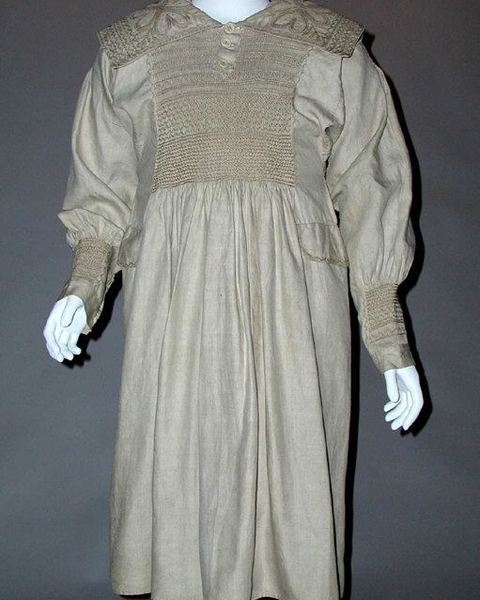
The Metropolitan Museum of Art has a quilted Sashiko Jacket (67.172.1) and a Sashiko Kimono (1979.409) in open access, along with the sledge-hauling vest (1978.66). The Art Institute of Chicago holds the firefighter's coat (2006.159), and the V&A holds the sledge-hauling jacket (FE.108-1982). The International Quilt Museum has a boro futon cover (2024.018.0001c). Two related pieces on Teazle approach stitching from other angles: smocking, where embroidery fixes the gathers of the English farm worker's smock-frock, and printed cloth, which shows how patterned fabric is made rather than stitched.
Sources
- A two-dimensional introduction to sashiko (Bridges workshop paper). Carol Hayes and Katherine A. Seaton, via arXiv. Full text read. Three traditional types, counted-thread method, Edo sumptuary context, boro/visible-mending note, kit instructions; cites Wada 2004. Accessed October 17, 2026.
- Sashiko: the Stitched Geometry of Rural Japan. Barbara Setsu Pickett, Bridges Conference Proceedings 2006. Full text read. Origins, white cotton thread, grid construction of asa-no-ha, shippo and other patterns. Accessed October 17, 2026.
- Sashiko: A Stitchery of Japan. Cynthia Shaver, Textile Society of America Symposium Proceedings, 1992. Abstract page read (the PDF is behind a bot check): Shoso-in robe, women stitchers, white cotton on indigo, about five to ten stitches per inch, counted lines. Accessed October 17, 2026.
- Sashiko needlework reborn: from functional technology to decorative art. Carol Hayes, Japanese Studies 39(2), 2019. Abstract read via the ANU research portal: Edo origins, decline in late Meiji, revival as decorative art. Accessed October 17, 2026.
- 'Boro no Bi': Beauty in Humility, Repaired Cotton Rags of Old Japan. Yoshiko Iwamoto Wada, Textile Society of America Symposium Proceedings, 2004. Abstract page read (the PDF is behind a bot check): Nukata Collection, futon from recycled blue cotton on the Kitamaesen route from Sakai. Accessed October 17, 2026.
- Kogin Zashi; Nambu Hishi Zashi; Shonai Sashiko; Sashiko. Textile Research Centre, Leiden (TRC Needles). Four entries read in full: regions, counting, ground cloth, thread, kogin decline after 1894, Yanagi 1932, 1962 institute. Accessed October 17, 2026.
- Boro. Paper Sky. Read in full: Aomori origins, cotton scarcity until Meiji, Tanaka and his collection, Amuse Museum (founder, closure), designers. Accessed October 17, 2026.
- More Amazing than Amusing: Asakusa’s Amuse Museum. Artscape Japan. Read in full: boro means rags or scraps, hemp, 14 kg coats, Tanaka collected discards. Accessed October 17, 2026.
- BORO: The Hidden and the Visible in Japanese Mended Textiles; Boro Futon Cover 2024.018.0001c. International Quilt Museum. Exhibition page and object record 2024.018.0001c (node/24444) read: definition, running-stitch patching, 2026 exhibition dates, 1880-1900 futon cover. Accessed October 17, 2026.
- Boro Textiles: Sustainable Aesthetics; Kyoichi Tsuzuki: The Beauty of Survival. Apollo Magazine; Japan Society. Apollo article and Japan Society event page (japansociety.org/events/kyoichi-tsuzuki-the-beauty-of-survival/) read: 2020 exhibition, 50 pieces from the Tanaka collection, boro only recently categorized as art. Accessed October 17, 2026.
- What is Sashiko? 8 Things to Know About Japanese Embroidery. Japan Objects. Read in full: sashiko as stitch and boro as mending approach, pattern names including seigaiha, thread, denim versus delicate cloth. Accessed October 17, 2026.
- Sashiko Lesson 1. Sarah's Hand Embroidery. First 100,000 characters read: fabric, needle, thread, 3:2 ratio, half a centimeter per stitch, corners, order of work, ends. Hobbyist tutorial, used for practical guidance only. Accessed October 17, 2026.
- Sashiko / Japanese Running Stitch (blog post, July 2026). Colonial Needle. Read: long needle loads several stitches, shorter needle for corners, thread weight. Retailer blog, practical guidance only. Accessed October 17, 2026.
- Visible Mending: Sashiko Jeans Patch; How to fix your clothes with sashiko mending. Clover USA; Oliver Bonas. Both read: patch size, tacking, grid stitching, finishing. Oliver Bonas: https://www.oliverbonas.com/care-guides/fashion/sashiko. Commercial how-to pages, practical guidance only. Accessed October 17, 2026.
- seigaiha. Japanese Architecture and Art Net Users System (JAANUS). Read: overlapping concentric circles, only upper arcs show; tile layout. Accessed October 17, 2026.
- Metropolitan Museum of Art Open Access records: 67.172.1, 1979.409, 1978.66. The Metropolitan Museum of Art. Titles, dates, media, credit lines and CC0 status read from the Collection API (object pages return 429 to bots): objects 50805, 50806, 59664. Accessed October 17, 2026.
- Sleeveless sledge-hauling jacket, FE.108-1982. Victoria and Albert Museum. Record read via api.vam.ac.uk: indigo cotton, sashiko, 1850-1900, reinforcing band, Shonai attribution by the dealer. Accessed October 17, 2026.
- Fireman's Coat (Hikeshi Sashiko Banten), 2006.159. Art Institute of Chicago. Record read via api.artic.edu: c. 1875-1900, quilted and painted cotton, public domain. Accessed October 17, 2026.
- Etsy Spring/Summer 2026 trends coverage. Stylist; Luxus+. Stylist (visible mending named in the Etsy "soft stitch" trend) and Luxus+ (embroidery kits +175%, 7 April 2026; https://luxus-plus.com/en/luxus-magazine-spring-summer-2026-the-7-trends-redefining-our-desires-according-to-etsy/) both read in full. Retail signals only. Accessed October 17, 2026.
Glossary
Last updated · Markdown · Report an error