Technique
Reading a Yarn Label: Weight, Ply, Fiber, Twist
A ball band gives a weight number, a gauge, a length and a fiber, and each says something different. How to read them, why ply is not thickness, and how to swap a yarn without ruining the pattern.
Yarn weight is the thickness of the strand, not how heavy the ball is. The Craft Yarn Council numbers it from 0 (lace) to 7 (jumbo), and the label's gauge, length and fiber fill in the rest. To substitute a yarn, match the gauge first, then recompute the number of skeins from yards per skein, then check fiber and swatch.
Crochet and knitting patterns are a busy corner of online shopping. In June 2026, eRank's Etsy keyword data listed "socks knitting pattern," "blanket crochet pattern" and "amigurumi crochet pattern" among the fastest-growing searches of the season. Every one of those patterns ends at the paper band on a ball of yarn.
What does yarn weight mean?
Yarn weight means the thickness of the strand, not the mass of the skein. SweetGeorgia's Katrina Stewart makes the same distinction: weight describes how thick or thin the yarn is, not how heavy the skein is. In North America the usual scale is the Craft Yarn Council's Standard Yarn Weight System, which has eight categories numbered 0 to 7.
On a label the category appears as a small skein symbol with the number inside, 0 being the finest and 7 the thickest. Each category comes with a typical gauge and a range of needle and hook sizes. The council's own Standard Yarn Weight System page lists them as follows.
| No. and name | Yarns in the category | Knit gauge and needle | Crochet gauge and hook |
|---|---|---|---|
| 0 Lace | Fingering, 10-count crochet thread | 33–40 sts; 1.5–2.25 mm (US 000–1) | 32–42 double crochets; steel hooks 1.4–1.6 mm, or regular 2.25 mm |
| 1 Super Fine | Sock, fingering, baby | 27–32 sts; 2.25–3.25 mm (US 1–3) | 21–32 sts; 2.25–3.5 mm |
| 2 Fine | Sport, baby | 23–26 sts; 3.25–3.75 mm (US 3–5) | 16–20 sts; 3.5–4.5 mm |
| 3 Light | DK, light worsted | 21–24 sts; 3.75–4.5 mm (US 5–7) | 12–17 sts; 4.5–5.5 mm |
| 4 Medium | Worsted, afghan, aran | 16–20 sts; 4.5–5.5 mm (US 7–9) | 11–14 sts; 5.5–6.5 mm |
| 5 Bulky | Chunky, craft, rug | 12–15 sts; 5.5–8 mm (US 9–11) | 8–11 sts; 6.5–9 mm |
| 6 Super Bulky | Super bulky, roving | 7–11 sts; 8–12.75 mm (US 11–17) | 7–9 sts; 9–15 mm |
| 7 Jumbo | Jumbo, roving | 6 sts or fewer; 12.75 mm and larger (US 17 and larger) | 6 sts or fewer; 15 mm and larger |
The council marks these figures "guidelines only." It adds that lace-weight yarns are usually worked on larger needles and hooks, so a gauge range for that category is hard to give. Tabetha Hedrick, also of SweetGeorgia, puts the label's needle and gauge as a recommendation, not a requirement: designers pick the yarn, needle and stitch for the drape they want.
How do you read a ball band?
A ball band carries six kinds of information: a weight symbol, a gauge with a recommended needle or hook, the length and weight of the skein, the fiber content, care symbols, and a color name with a dye lot number. For substitution, the first three matter most.
- Weight symbol. The 0 to 7 number described above. It narrows the field but does not settle it.
- Gauge and tool size. Stitches and rows over a measured square, usually 10 cm or 4 inches, with the needle or hook that produced them. The council advises relying on the millimeter size, because number and letter sizes vary between companies.
- Length and weight. Labels normally give the skein's weight in grams and its length in meters and yards, and patterns state quantities in grams, meters or yards. One yard is 0.9144 meter, so a 100 g skein of 170 yards is also 155 meters.
- Fiber content. What the yarn is made of: wool, cotton, acrylic or a blend. It predicts stretch, drape and care better than weight does.
- Care symbols. The council describes five symbol families: a tub for washing, a triangle for bleaching, a square for drying, an iron for ironing and a circle for professional care, with a cross through any of them meaning "do not." International labels give water temperature in Celsius; North American yarn lists both scales.
- Dye lot. The batch in which the yarn was dyed. Lion Brand explains that yarn from a different batch may vary in color, and two lots can look alike under one light and very different in daylight.
A label is not a fixed specification. Designer June Gilbank, testing worsted-weight acrylics for amigurumi in 2012, found that Bernat Satin kept its 100 g skein weight but went from 149 to 152 meters per skein on older labels to 182 meters on newer ones, with the printed gauge unchanged. Her wraps-per-inch count rose from 11 to 12, so the yarn had become thinner.
What does ply mean, and what is twist?
A ply is one strand in a plied yarn. A "single" is one strand of spun fiber; plying means twisting two or more singles together, traditionally in the opposite direction to the one they were spun in. The ply count describes how the yarn is built. It does not tell you how thick the yarn is.
A maker picks the weight wanted, decides how many plies to use, then spins each to the thickness that gets there, as Stewart describes. Names such as "2-ply" or "10-ply" for weights, still heard in the UK, date from a time when ply count and weight tracked each other, because mills spun every single to one standard thickness and added more for a heavier yarn. Some mills still do.
Construction changes how a yarn behaves. Stewart's notes run like this:
- A single is flatter in stitch definition, more prone to pilling, and hard to pull apart if you need to rip back.
- A 2-ply has an oblong profile and suits lace, because the plies pull against each other and hold the holes open.
- A 3-ply is rounder and gives crisper stitches, good for cables and socks.
- Each added ply adds strength and density. At the same skein weight, a 5-ply DK gives fewer yards than a 4-ply DK. To count plies, untwist one end.
Twist is the direction of the spin. A yarn slanting from top left to bottom right is S twist; one slanting from top right to bottom left is Z twist. Most manufactured singles are spun Z and plied S, which gives a balanced yarn, and almost all yarn sold to knitters and crocheters is made that way. Twist direction can also change how easily a yarn splits as you work.
Twist can also be a design choice in its own right. Crepe cloths are woven from yarns with far more twist than usual, a story told in our piece on moss crepe.
How can you check a yarn's weight without a label?
Wrap the yarn snugly around a ruler or pencil, strands side by side with no gaps, and count the wraps in one inch. More wraps means thinner yarn. This is wraps per inch, or WPI, and Hedrick calls it quick but not exact. Sheep and Stitch advises averaging several points, and wrapping thick yarns over several inches before dividing.
WPI charts disagree with one another. Hedrick gives 9 to 12 wraps for worsted and 12 to 15 for DK, while the UK shop A Yarn Story's chart gives about 9 for aran and 11 for DK. Treat WPI as a rough check, then swatch.
Same-weight yarns also differ more than the label suggests. In the 2012 test above, eight worsted acrylics worked with the same 3.5 mm hook gave single crochet stitches between 5.3 and 6.3 mm wide, with WPI counts of 11 to 13.
Are UK and US yarn names the same?
Not quite. The council's 0 to 7 numbers are the most portable part of a label, though not every maker prints them, and the words around them change by country. A UK "DK" is a US "light worsted," and UK "aran" corresponds to US "worsted." The UK also still uses ply names that mean something different from US numerals.
| CYC number | US name | UK or ply name |
|---|---|---|
| 1 | Fingering, sock (super fine) | 4 ply |
| 2 | Sport (fine) | 5 ply |
| 3 | Light, light worsted | DK; 8 ply |
| 4 | Worsted, medium | Aran; 10 ply |
| 5 | Bulky | Chunky; 12 ply |
| 6 | Super bulky | Super chunky |
The biggest trap, as A Yarn Story puts it: in the UK, 4 ply is among the finest yarns on the shelf, while a "4" on a US label means worsted. Aran is the British name for the same council category as worsted, though it tends to sit at the heavier end. "Worsted" is also a spinning method, so a worsted-spun 4 ply is a fine yarn. When name and number disagree, the shop says, read the gauge. The same US and UK split shows up in crochet stitch names, covered in US or UK? How to Read a Crochet Pattern Without Ruining It.
How does fiber change what a yarn does?
Fiber decides stretch, drape and care more than weight does. Utah State University Extension offers a first rule: cotton and flax, being plant fibers, are very absorbent and breathable but wrinkle easily, while wool and silk are protein-based and a little stronger. The rest comes from yarn makers and designers, not laboratory tests.
| Fiber | What to expect | Source |
|---|---|---|
| Wool | A lot of elasticity: garments tend to spring back and hold their shape. Elasticity and fuzziness also help hide uneven tension. | Elizabeth Smith Knits |
| Cotton | Very little elasticity, so it relaxes and grows with wear. Can feel stiff after soaking and soften with wear. Shows uneven stitches. Heavy in textured or cabled garments. | Elizabeth Smith Knits; Knit Picks |
| Linen | Strong and resists stretch. Adds drape, and is described as getting softer with every wash. | Knit Picks |
| Acrylic | A synthetic made to imitate wool's fuzziness and warmth. Thickness, loft, stretch, softness and sheen vary widely between brands, even within one weight. | Utah State Extension; June Gilbank |
| Blends | Acrylic added to cotton to give some elasticity; linen or modal added to cotton for drape. | Knit Picks |
Two further points apply to every fiber. Utah State's guide says synthetics are very likely to pill, and Stewart finds singles pill more than plied yarns, so structure counts as well as fiber. And a 1975 University of Idaho extension sheet on fabrics states that care for a blend follows its most delicate fiber, and a 50/50 cotton-wool blend should be treated as wool.
How do you substitute one yarn for another?
Match the gauge first, then the yardage, then the fiber, and swatch before you commit. The further a swap moves from any of these, the more the fabric changes.
- Read the pattern's yarn. Note its weight category, gauge, yards or meters per skein, fiber, and the number of skeins.
- Shortlist yarns in the same category or one step either side, and read each label's gauge.
- Swatch in the pattern's stitch with the candidate and treat it as you will treat the garment. Hedrick says patterns are written for the finished gauge, after wetting or steaming and drying, so wash and dry the swatch the way you plan to care for the piece. For cotton, designer Elizabeth Smith suggests shaking the swatch out and, if possible, hanging it overnight before measuring.
- Adjust the tool, not the stitch count. The Craft Yarn Council's rule: if the swatch comes out larger than the pattern gauge, redo it with a smaller needle or hook; if smaller, with a larger one.
- Recompute the yardage. Multiply the skeins in the pattern by yards per skein, then divide by the candidate's yards per skein and round up.
- Compare fiber and structure. A cotton for a wool changes how the fabric stretches and hangs.
- Buy it all at once, from one dye lot, and consider a spare skein: the blog Crochet 365 Knit Too says that dye lot matters and an extra skein is wise.
The size effect of ignoring step 3 is easy to calculate. A pattern gauge of 22 stitches over 4 inches is 5.5 stitches per inch, so a 40-inch chest needs 220 stitches. If your swatch gives 20 stitches over 4 inches, or 5 per inch, those same 220 stitches measure 44 inches.
Here is the yardage step as a worked example for a hypothetical pattern that calls for six skeins.
| Step | Pattern yarn | Substitute |
|---|---|---|
| Yards per 50 g skein | 137 | 110 |
| Total yards needed | 6 × 137 = 822 | 822 |
| Skeins needed | 6 | 822 ÷ 110 = 7.47, round up to 8 |
| Yards bought | 822 | 8 × 110 = 880 (58 yards spare, about 7%) |
| Grams bought | 6 × 50 = 300 g | 8 × 50 = 400 g |
The grams row is the trap. The substitute has fewer yards per gram, so the same pattern needs a third more skeins and a third more grams.
What mistakes should you avoid?
- Matching by ply, name or grams. Ply describes construction, "worsted" is also a spinning method, and grams say nothing about length. Match gauge, then yards.
- Skipping the swatch, or measuring it before it has been washed and dried the way the project will be.
- Treating the label's needle size as mandatory. It is a starting point; the swatch decides.
- Mixing dye lots within one piece, or leaving the last skein to a later trip.
- Swapping fibers without thinking about stretch, such as cotton in a pattern drawn for wool.
Where can you see skeins and twisted yarn?
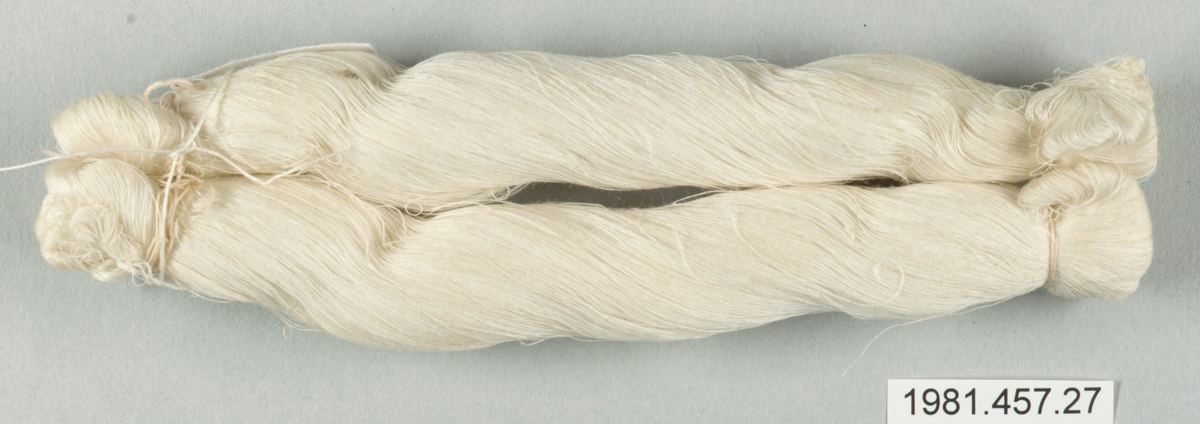
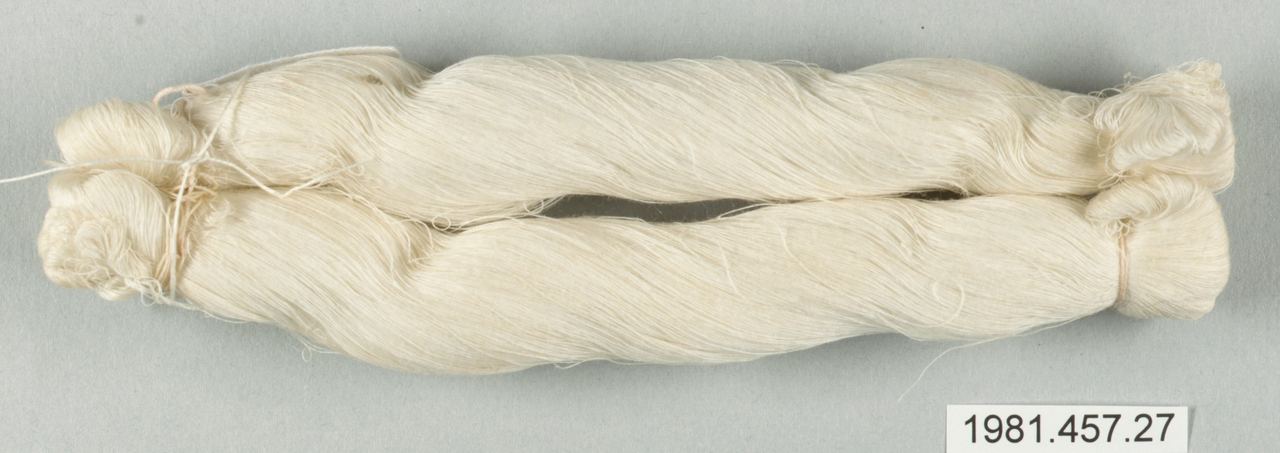
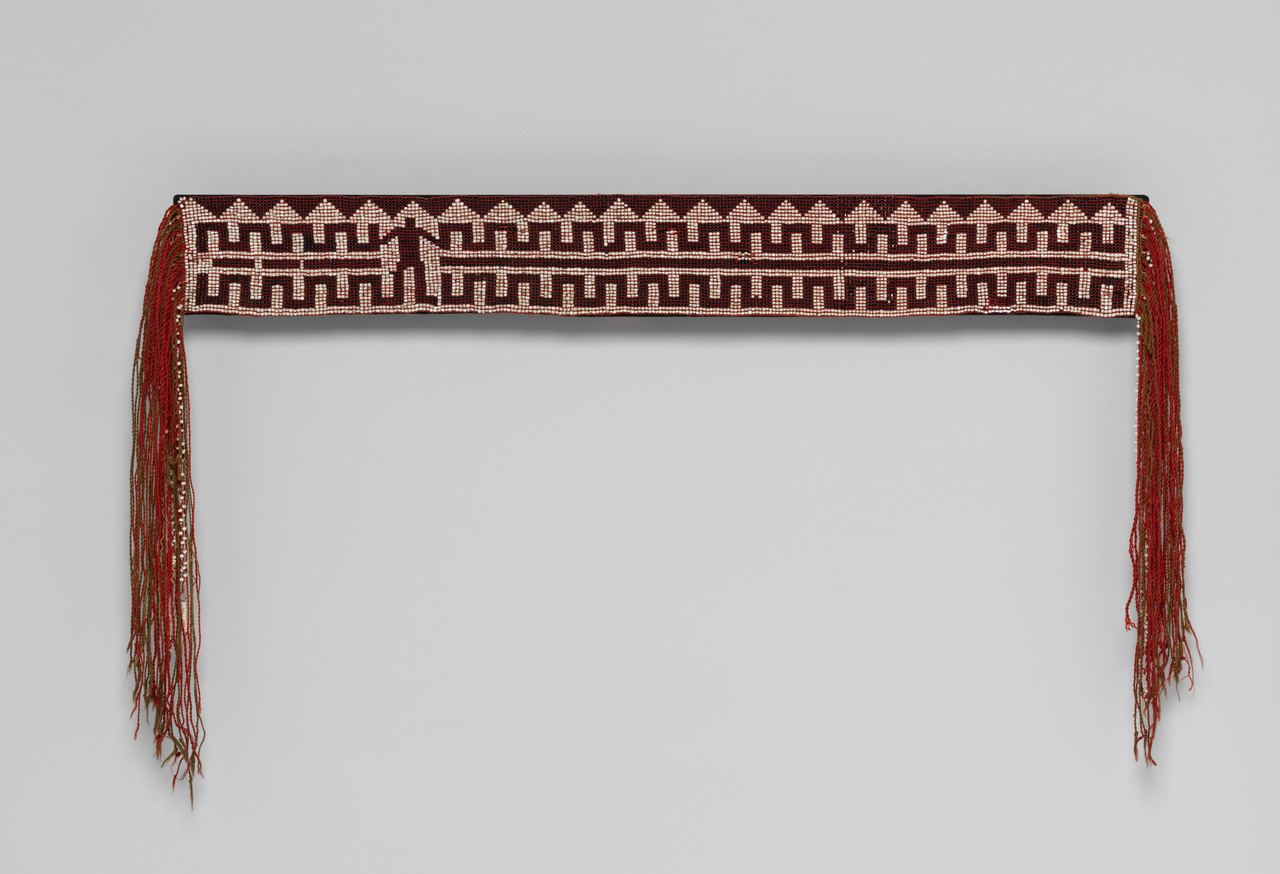
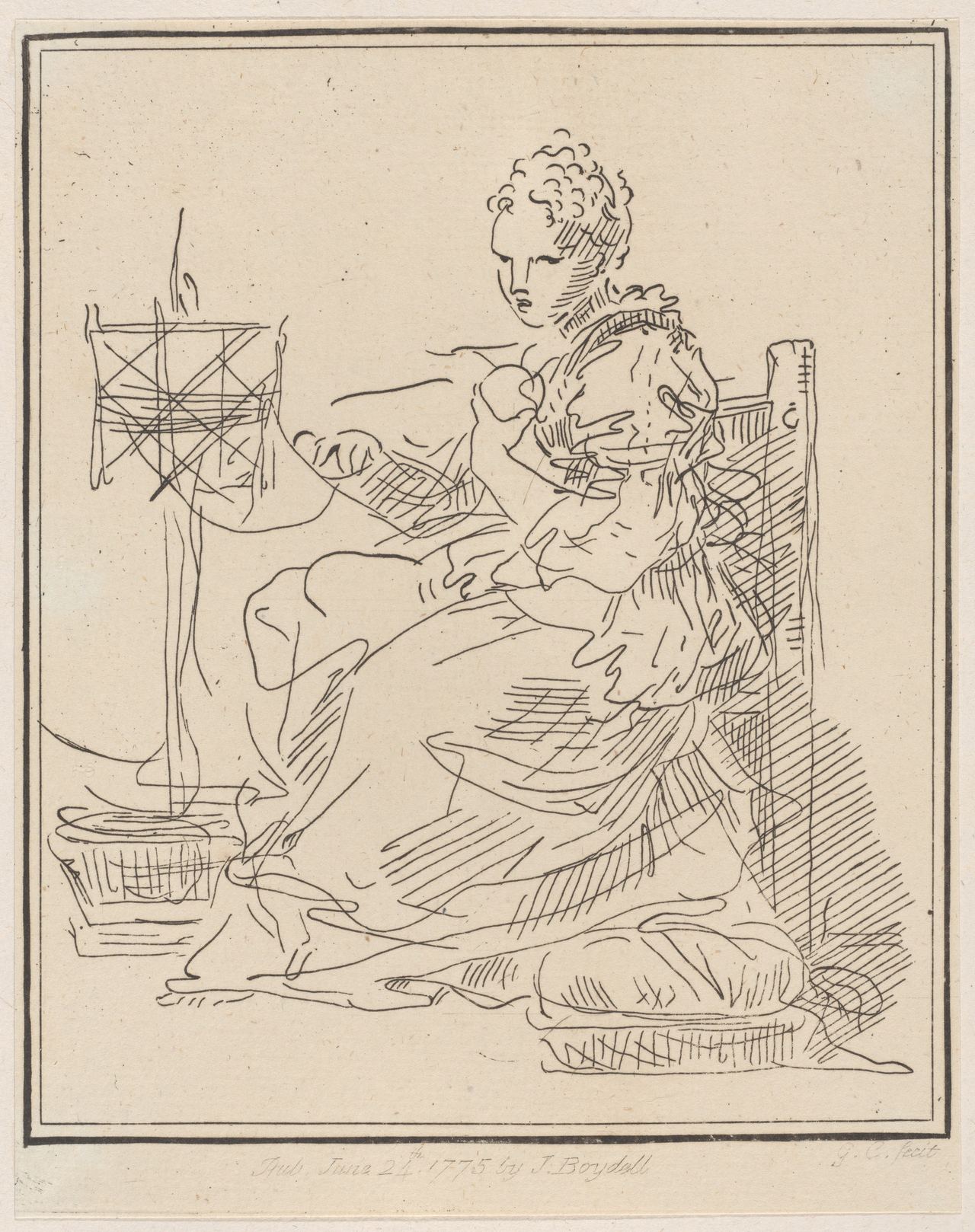
The Metropolitan Museum of Art's open-access records show the objects pictured here: a cotton skein of about 1840, Giuseppe Canale's 1775 etching *Seated woman winding yarn*, and a sash of about 1800, made of wool yarn and glass beads, with long twisted fringes. Terms used here: knitting, crochet, gauge, ply, yarn weight and dye lot.
Sources
- Standard Yarn Weight System. Craft Yarn Council. Read in full: the eight-category table (names, knit and crochet gauge, needle and hook sizes) and the "guidelines only" footnotes. Accessed October 20, 2026.
- Yarn Label Information. Craft Yarn Council. Read in full: weight symbol is a skein with a number from 0 (finest) to 7 (thickest). Accessed October 20, 2026.
- Care Symbols. Craft Yarn Council. Read in full: five symbol families, cross means do not, Celsius vs both scales. Accessed October 20, 2026.
- Hooks & Needles. Craft Yarn Council. Read in full: rely on mm sizes; swatch rule (larger swatch, smaller tool). Accessed October 20, 2026.
- Understanding Yarn Plies For Knitters & Crocheters (Katrina Stewart, 22 Dec 2024). SweetGeorgia Yarns. Read in full: singles, plies, S/Z twist, UK ply names and weight history, behavior of 1-, 2-, 3- and 4+-ply, yardage vs density, WPI. Accessed October 20, 2026.
- Demystifying Yarn Weight (Tabetha Hedrick, 2023). SweetGeorgia Yarns. Read in full: weight as thickness and density, WPI method and ranges, label gauge is a recommendation. Accessed October 20, 2026.
- Working Gauge vs Finished Gauge (Tabetha Hedrick). SweetGeorgia Yarns. Read in full: her rule that patterns are based on finished (washed, dried) gauge. One author's statement, attributed in the text. Accessed October 20, 2026.
- How-To: Plying Yarn. Make:. Read in full: definition of plying, S and Z twist, balanced yarn. Accessed October 20, 2026.
- Yarn twist. Yarnsub. Read in full: S and Z twist; most manufactured singles Z, plied S; twist direction and splitting. Accessed October 20, 2026.
- Yarn Weight Chart: 4 Ply, DK, Aran & Worsted Compared. A Yarn Story. Read in full: UK shop's chart mapping CYC numbers to US, UK and ply names; the "4" trap; aran vs worsted; WPI figures (about 14, 12, 11, 9, 7). Accessed October 20, 2026.
- Worsted weight yarn comparison (June Gilbank, 16 Apr 2012). PlanetJune. Read in full: eight worsted acrylics tested (WPI, single crochet stitch size on a 3.5 mm hook), Bernat Satin label change (149-152 m to 182 m per 100 g). Accessed October 20, 2026.
- Wraps Per Inch Chart (Davina Choy, 28 May 2025). Sheep and Stitch. Read the method and tips text (wrap snugly, average several points, wrap thick yarn over several inches). The chart itself is an image and was not used. Accessed October 20, 2026.
- 5 tips for working with cotton yarn (June 2026). Elizabeth Smith Knits. Read in full: wool vs cotton elasticity, cotton stiff after blocking, hang swatch overnight, rowing out with cotton and linen. Accessed October 20, 2026.
- Working With Cotton Yarns. Knit Picks Staff Blog. Read in full: cellulose vs protein fibers, cotton elasticity, blends with acrylic, linen and modal for drape. Retailer blog; claims attributed in the text. Accessed October 20, 2026.
- Fibers and Fabrics. Utah State University Extension (Juab County). Read in full (PDF): plant vs protein fibers; synthetics likely to pill; acrylic meant to mimic wool. Accessed October 20, 2026.
- Fiber facts, Current Information Series No. 256 (May 1975). University of Idaho Cooperative Extension. Read the OCR text of the PDF: blends take the care of the most delicate fiber (a 50/50 cotton-wool blend is treated as wool). A 1975 fabric sheet, not yarn-specific. Accessed October 20, 2026.
- What are dye lots? Can I order more of the same lot?. Lion Brand Yarn Support. Read in full: dye lot definition, color can differ in different light, cannot match lots, alternate rows. Accessed October 20, 2026.
- Does Dye Lot Matter. Crochet 365 Knit Too. Read the opening section: same-dye-lot rule, buy an extra skein, "no dye lot" labels that still show a lot number. Accessed October 20, 2026.
- How To Read A Yarn Label. Handy Little Me. Read the relevant paragraphs: length given in grams, meters and yards; patterns give quantities in g, m or yd; color and dye lot. Its sample numbers (100 g / 80 m / 121 yd) do not agree with each other and were not used. Accessed October 20, 2026.
- The Fastest Growing Etsy Keywords for Summer 2026 (13 July 2026). eRank. Read the keyword list: "socks knitting pattern", "blanket crochet pattern", "amigurumi crochet pattern" listed among the fastest-growing searches in June 2026. Secondary signal only. Accessed October 20, 2026.
- Skein, ca. 1840 (1981.457.27). The Metropolitan Museum of Art. Open Access record via the Met API: isPublicDomain true; title, date, cotton, credit line. Also read the records for 814444 (Canale etching) and 751503 (sash). Accessed October 20, 2026.
Glossary
Last updated · Markdown · Report an error