Fabric
Moss Crepe: The Grain Is in the Yarn
Moss crepe is more than a crinkly fabric: its grain comes from a two-ply yarn of mixed twists woven in a special crepe weave. How it differs from crêpe de chine and georgette, where it came from, and how to sew and care for it.
Moss crepe is a woven dress fabric with a grainy, mossy surface and a spongy feel. The grain comes from the yarn as much as the weave: a two-ply yarn made by doubling an ordinary-twist yarn with a hard-twisted one, woven in a crepe weave with a large repeat. A U.S. trade magazine was already writing about the vogue for it in 1934, and by the late 1960s Ossie Clark was cutting it in viscose.
What is moss crepe?
Moss crepe is a crepe fabric with a spongy handle and a fine, mossy grain, made by weaving a special two-ply yarn in a crepe weave. The Textile Institute's dictionary defines it by those two ingredients, and notes that cloth made with only one of them has "some but not all of the characteristics of true moss crêpes."
The name describes a surface, not a fiber. A January 1934 article in the American trade journal Textile World says moss crepe was derived from sand crepe, a sheer cloth, and that the first moss crepes were so heavy they were "more of a suiting than a dress weight." Mills then made it from silk, acetate, rayon and spun rayon, and even tried cotton. In the Victoria and Albert Museum's records for Ossie Clark's dresses, the fiber is viscose.
How does crepe get its crimp?
Crepe gets its crimp from twist. Yarns spun with far more twist than usual are woven into cloth, and when the cloth is washed or dyed they contract and kink, pulling the surface into a pebbly grain. Alternating yarns twisted in opposite directions, called S and Z after the slant of the letters, lets the pull go both ways so the surface comes out even.
Elizabeth Dyer's American textbook Textile Fabrics puts it simply: a yarn for crepe has much more twist than a yarn for an ordinary fabric, and when the cloth is washed or dyed the yarns "take up in different directions and produce an even crepe surface." A 1923 fabric glossary says such yarns "kink up when released from the loom."
Mill figures show how much twist that means. In a 1924 handbook for silk mills, Horace Neild describes a crêpe de chine with an unthrown raw-silk warp and a weft of three-thread silk twisted 60 to 65 turns per inch, half right-hand and half left-hand, laid in as two picks of one twist followed by two of the other. His georgette is twisted 75 turns per inch, in both warp and weft. A single hard-twisted yarn curls and snarls in skeins, he notes, so such goods were woven "in the raw" and dyed afterward in the piece. His crêpe de chine came off the loom 44 inches wide and finished 39 to 40, a shrinkage he attributes to the twist.
Crimp can also come from finishing rather than twist. The 1911 Encyclopaedia Britannica describes soft crape, whose twisted weft relaxed when the silk gum was boiled out, and hard crape, whose crisp texture came from finishing processes after weaving, details that the makers guarded closely. That second route belongs to mourning cloth, taken up below.
How is moss crepe different from crêpe de chine and georgette?
Georgette and crêpe de chine are plain weaves whose crimp comes from high-twist single yarns. Moss crepe changes both ingredients: the yarn is a two-ply made of two different twists, and the weave is a crepe weave rather than a plain one. The result is heavier, bumpier and spongier, with the body of a light suiting rather than the transparency of georgette.
| Fabric | Yarns | Weave | Surface |
|---|---|---|---|
| Crêpe de chine | Ordinary-twist warp, crepe-twist weft alternating S and Z (60 to 65 turns per inch in Neild's 1924 example) | Plain | Fine crinkle, soft, lightly lustrous |
| Georgette | Crepe-twist yarns in both warp and weft, alternating in pairs (75 turns per inch in Neild's example) | Plain | Sheer, dull, "crepy" |
| Moss crepe | Two-ply yarns, normal twist doubled with high twist, S and Z, in warp and weft | Crepe weave with a large repeat | Spongy, mossy grain, more body |
The Textile Institute defines a moss-crepe yarn as a two-ply yarn made by doubling a normal-twist yarn with a high-twist one. Its typical example is a 100-denier dull viscose, S or Z, doubled with a 75-denier yarn; denier is a measure of fineness. Robinson and Marks, in Woven Cloth Construction (1967), say that, as a rule, a 75-denier viscose crepe yarn was used in these combination yarns. Textile World described the same construction in 1934 as a soft-twist yarn wrapped around a crepe core, and said the same yarn usually went in both warp and filling.
The weave is the second half. The Textile Institute calls it a crepe weave whose repeat, in warp and weft, is large compared with many others. Textile World described it as sand-crepe weave, "an extended mummy weave," combined with the new yarn.
Why does moss crepe drape the way it does?
Writers in the 1930s credited the yarn. Textile World said the wrapped, twisted yarn "produces a well-bodied fabric but with a soft, mossy surface and good draping qualities." The Textile Institute calls the handle spongy. Taken together, that describes a cloth with weight and spring that still falls in folds, which fits the V&A's description of one Clark design as having a "flowing silhouette."
None of the sources I read measures drape, so treat this as what mills and curators reported rather than a laboratory result. Two practical details do come from the trade article. Moss crepe was best woven square or balanced, for example 48 threads by 48, because then a garment could be cut either lengthwise or crosswise. And its rough surface made printing technically difficult, which limited the designs that could be put on it. A textile reference site adds that the pebbled surface hides wrinkles, though it gives no test. How printing machines work is covered in Printed Cloth, Block to Screen.
When did moss crepe become fashionable?
By the account of Textile World, the first moss crepe reached the United States from Europe the previous February (1933, going by the issue date), made of spun silk wrapped around a silk crepe. By October and November it had reached "high-pressure popularity," and the magazine said its success was paralleled only by the velvet boom. Silk-and-acetate versions were copied at lower prices until they were all-rayon, and the average mill price of $1.35 had slipped to mostly $1.00 to $1.15.
| Date | What the source says | Source |
|---|---|---|
| 1933 | First moss crepe arrives in the U.S. from Europe; a boom by October and November | Textile World, Jan. 1934 |
| 1934 | Printed moss crepes expected for spring; printing called technically difficult | Textile World, Jan. 1934 |
| c. 1941 | A collectors' guide labels dresses of about 1941 and of the 1940s as moss crepe | Albrechtsen, Vintage Fashion Complete (2014) |
| 1967 | Textile engineers say moss-crepe fabrics "were popular over a period of years" but shrank violently | Robinson and Marks, Woven Cloth Construction |
| 1969 | "Poppy" shirt dress, Ossie Clark with a Celia Birtwell print, printed viscose moss crepe | V&A T.282-1985 |
| Spring/summer 1971 | Moss crepe tiered dress by Ossie Clark, £20 at the boutique Quorum | Lester, Boutique London (2010), caption |
| 1973 to 1976 | Clark designs for the Radley label in moss crepe, plain and printed | V&A T.430-1988, T.138-1995, T.348-2000 |
Did Ossie Clark really use moss crepe?
Yes, and the evidence is in the V&A's catalog, which records at least four Clark dresses in the cloth. The 1969 "Poppy" shirt dress is cream viscose moss crepe printed in emerald green and black from a design by Celia Birtwell, with a black moss crepe collar and cuffs. A 1973 evening dress in dusty purplish-pink moss crepe is described as "a classic Ossie Clark crêpe design" with a loose silhouette, long sleeves and a waist-tie; its label reads "Dry clean only." A black dress of 1974 to 1976 and an orange, green and black maternity-worn evening dress of 1973, both made for Radley, are also listed as moss crepe. The V&A adds that Radley made this style in printed fabrics and in a range of coloured crêpes.
The Fashion and Textile Museum in London opened an exhibition on Clark and Birtwell on 2 October 2026; Art Fund lists it to 11 April 2027, though one trade report gives 27 April, so check the museum before you go. The listing I read does not mention moss crepe. The cloth's role comes from the V&A records and the other sources above.
How is crepe related to crape and mourning?
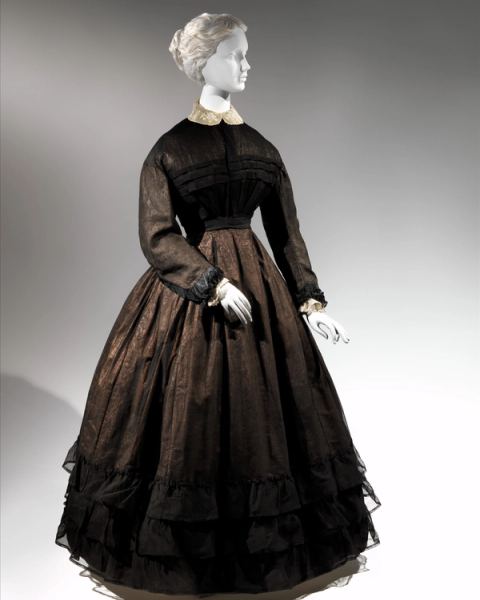
Crape and crepe are two spellings of one word and two neighboring fabrics. Hard black crape, a silk gauze crisped by finishing, was the cloth of Victorian mourning; modern crepes mostly get their crimp from twist. The V&A holds a rare machine-woven black mourning shawl and notes that three firms, Hinde; Hardy, Grout and Bayliss; and Samuel Courtauld, dominated British mourning crêpe in the nineteenth century.
Nothing I read says moss crepe descends from mourning crape. What they share is the word and the idea of a crisped surface, and the sources keep the processes apart. For the mourning system itself, see Black, and Not Just Black: Victorian Mourning Dress and the glossary entries for crape and crepe.
How do you cut, sew and care for moss crepe?
Treat moss crepe as a springy, slippery, fraying cloth. Cut a single layer with weights or a rotary cutter, use a fine new needle, enclose or finish every seam, and check the label before you wash anything. Most moss crepe on sale today is viscose, which sewing sources warn shrinks, and one of the V&A's Clark dresses carries a dry-clean-only label.
The sewing advice below comes from three sewing sites (By Hand London, WeAllSew, and Pound Fabrics) written for slippery drapey fabrics and viscose in general, not moss crepe in particular. Test everything on a scrap of your own cloth.
| Step | What to do | Why |
|---|---|---|
| Read the label | If the cloth can be washed, pre-wash and dry it before cutting. If it is dry-clean-only, do not pre-wash; use a pressing cloth instead | Viscose is described as prone to shrinking; Robinson and Marks say moss crepes once shrank violently |
| Stabilize | Spray starch on washable cloth before cutting | It temporarily adds stability and takes away a little drape |
| Cut | Single layer, with pattern weights and a sharp rotary cutter or table-top shears; re-lay the pattern piece after cutting and trim any shift | Slippery fabric moves as it is cut |
| Needle | A new fine needle, metric size 60 to 70 sharps (or a fresh universal if you have nothing finer); test on a scrap | Fine cloth fights a dull or thick needle |
| Seams | French seams, or an overlocked or zigzagged edge; a walking foot keeps the layers together | Raw edges fray quickly |
| Hem | A narrow single-fold or blind hem | It is the least bulky and keeps the flow |
| Press | Use a pressing cloth and an iron setting matched to the fiber; test first | Water marks can show |
Where can you see moss crepe, and what should you read?
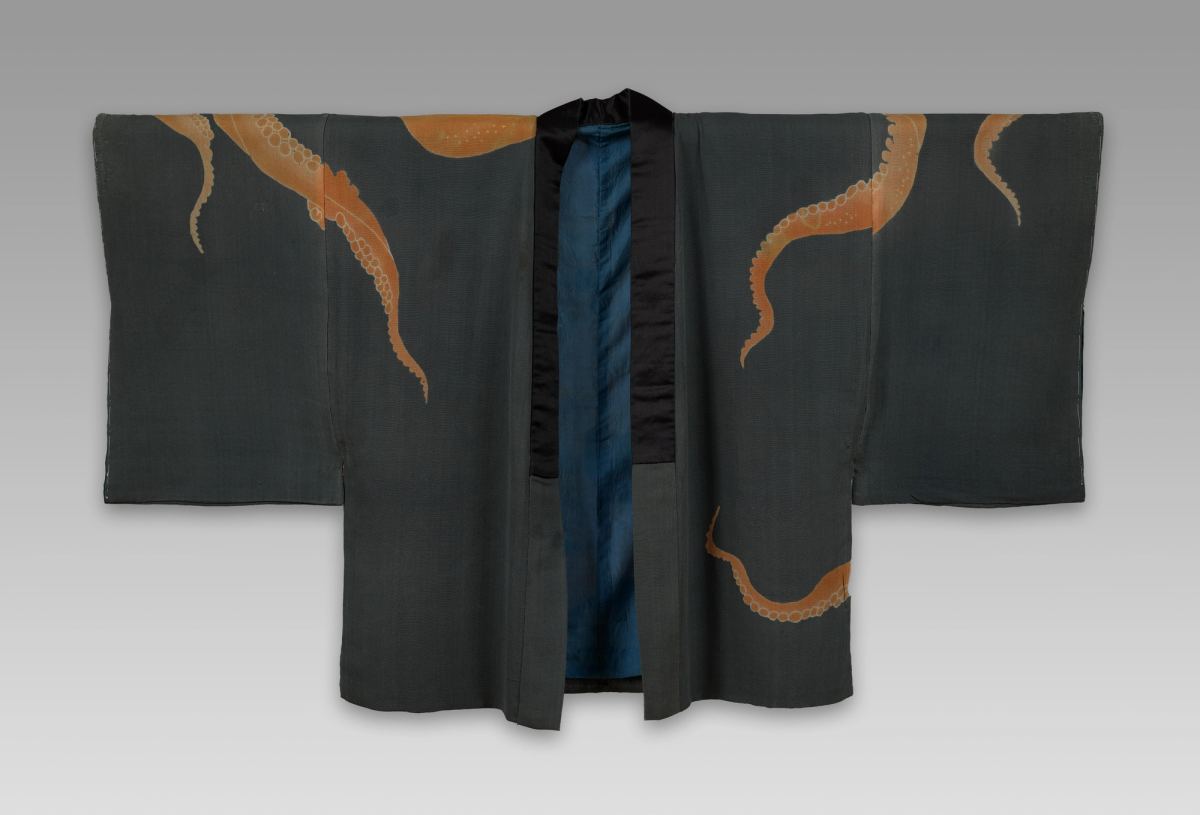
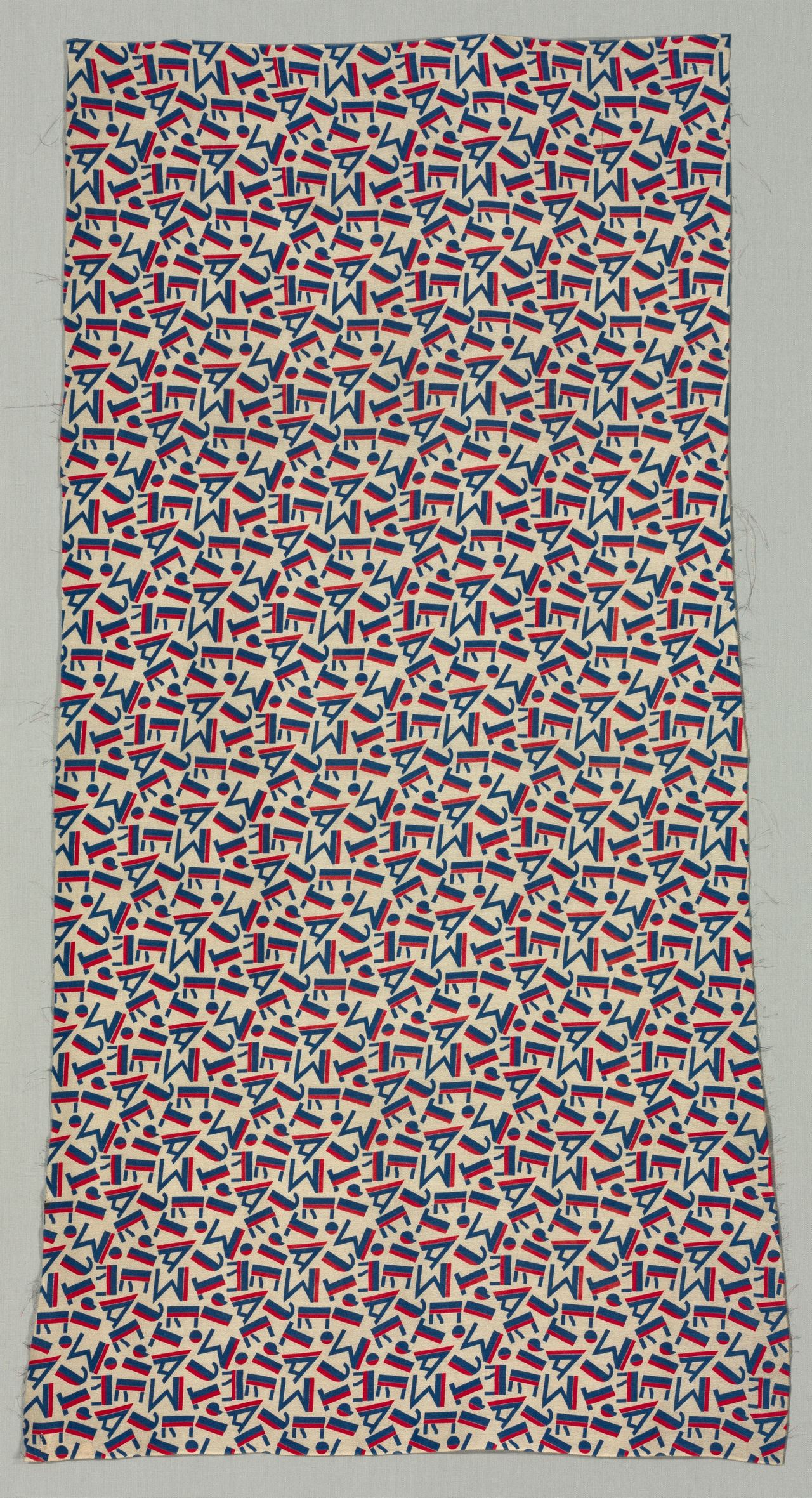
The V&A's Ossie Clark dresses are searchable by accession number: T.282-1985, T.430-1988, T.138-1995 and T.348-2000. The Cleveland Museum of Art's open-access records for the 1927 printed silk crepe and the Japanese chirimen jacket shown here are 1928.269 and 2020.66. Neither is moss crepe; they show what the crepe family looks like before the second yarn is added.
For the technical definitions, read the Textile Institute's Textile Terms and Definitions and Robinson and Marks's Woven Cloth Construction. For the 1930s craze, the January 1934 Textile World is on the Internet Archive. For the Clark and Birtwell years, Richard Lester's Boutique London (2010) is the place to start.
Sources
- Textile World, January 1934, vol. 84, no. 1, pp. 74-75 (moss crepe construction; mossy crepe trade report). Textile World (via Internet Archive). Full OCR text read (archive.org djvu text): ondé yarn, sand-crepe weave, balanced construction, shrinkage allowance, printing difficulty, 1933 arrival and vogue, prices. Accessed October 18, 2026.
- Horace Neild, Dissecting and Calculating Silk Fabrics (1924). The American Silk Journal, New York. Full OCR text read: cost calculations for georgette crepe (3x3, 75 turns per inch) and crepe de chine (60 to 65 turns, two picks right, two picks left; 44 in. to 39-40 in.); hard-twist section; piece-dye chapter. Accessed October 18, 2026.
- Elizabeth Dyer, Textile Fabrics (scan dated 1927; another scan 1923). Houghton Mifflin, Boston. Full OCR text read: crepe surfaces from alternating right- and left-twist yarns; yarns take up in different directions when washed or dyed. Accessed October 18, 2026.
- Grace G. Denny, Fabrics and How to Know Them (1923). J. B. Lippincott, Philadelphia. Full OCR text read: entries Creped, Crepe de Chine, Georgette; she attributes crepe de chine's crinkle to twist of warp yarns, where Neild and Robinson and Marks place the crepe twist in the filling. Accessed October 18, 2026.
- Textile Terms and Definitions (1960 ed.; later eds. 1975, 1995). Textile Institute, Manchester. Entries moss-crepe fabric, weave and yarn read as full-text search excerpts from the borrowable scan (search-inside), 1960, 1975 and 1995 editions agree. Accessed October 18, 2026.
- A. T. C. Robinson and R. Marks, Woven Cloth Construction (1967). Butterworth / Textile Institute. Passages on moss-crepe (combination-crepe) yarns, the moss-crepe weave, and violent shrinkage read as full-text search excerpts from the borrowable scan. Accessed October 18, 2026.
- Crape, Encyclopaedia Britannica (1911). Encyclopaedia Britannica, 11th ed. (Wikisource). Entry read via WebFetch summary (Wikisource raw page blocked by rate limit): soft crape (twisted weft, gum boiled out) and hard crape (finishing). Accessed October 18, 2026.
- Dress 'Poppy', Ossie Clark and Celia Birtwell, 1969, T.282-1985. Victoria and Albert Museum. Record read (website and V&A API): printed moss crepe (viscose), London 1969. Accessed October 18, 2026.
- Evening dress, Ossie Clark, 1973, T.430-1988. Victoria and Albert Museum. Record read via V&A API: moss crepe (viscose); label 'Dry clean only'. Accessed October 18, 2026.
- Evening dress, Ossie Clark for Radley, 1974-1976, T.138-1995. Victoria and Albert Museum. Record read via V&A API: black moss crepe (viscose); Radley printed and coloured crepes; 'flowing silhouette'. Accessed October 18, 2026.
- Evening dress, Ossie Clark for Radley, 1973, T.348-2000. Victoria and Albert Museum. Record read via V&A API: moss crepe, worn as a maternity dress. Accessed October 18, 2026.
- Black crepe mourning shawl, 19th century, T.1-2019. Victoria and Albert Museum. Record read via V&A API: machine-woven mourning crepe; Hinde; Hardy, Grout and Bayliss; Courtauld; 'Norwich crepe'. Accessed October 18, 2026.
- Boutique London: A History (2010). Richard Lester. Caption 'Moss crepe tiered dress by Ossie Clark, £20 from Quorum, Spring/Summer 1971' read as a full-text search excerpt; borrowable scan, not opened page by page. Accessed October 18, 2026.
- Vintage Fashion Complete (2014). Nicky Albrechtsen. Captions labeling dresses of c. 1941 and c. 1940s as moss crepe, and Radley moss crepe, read as full-text search excerpts only. Accessed October 18, 2026.
- Ossie Clark / Celia Birtwell, Fashion and Textile Museum, 2 October 2026 - 11 April 2027. Art Fund. Listing opened in full (supplied by the museum); no mention of moss crepe. Accessed October 18, 2026.
- Ossie Clark and Celia Birtwell to be celebrated in new exhibition. FashionUnited. Opened: gives 2 October 2026 to 27 April 2027, differing from Art Fund's 11 April 2027. Accessed October 18, 2026.
- Nerdy Sewing Tips: working with drapey silks and other slippery fabrics (2016). By Hand London. Full page read: spray starch, rotary cutter, sharps 60-70, French seams, pressing cloth, do not pre-wash if dry-clean-only. General slippery fabrics, not moss crepe. Accessed October 18, 2026.
- Tips for Sewing Rayon and Crepe Fabric. WeAllSew (BERNINA). Page opened: table-top shears, re-lay pattern after cutting, starch on washable cloth, walking foot, French or finished seams, iron setting by fiber. Accessed October 18, 2026.
- How to sew viscose fabric. Pound Fabrics. Page read in full: pre-wash because viscose shrinks, sharps 70/10, walking foot, finish edges, narrow single-fold blind hem. The page's history of viscose was not used (it contains errors). Accessed October 18, 2026.
- Moss Crepe / Pebble Crepe. TextileGlossary.com (Textile Glossary). Page opened: pebbled surface hides wrinkles, drapes well; a modern trade-glossary description, no tests. Accessed October 18, 2026.
- Je T'aime (No. 632), 1927, 1928.269. Cleveland Museum of Art. Object record via Cleveland Open Access API: CC0, silk crepe, plain weave, roller printed. Accessed October 18, 2026.
- Jacket with Octopus, c. 1800-1868, 2020.66. Cleveland Museum of Art. Object record via Cleveland Open Access API: CC0, silk crepe (chirimen). Accessed October 18, 2026.
Glossary
Last updated · Markdown · Report an error