Technique
US or UK? How to Read a Crochet Pattern Without Ruining It
US single crochet is UK double crochet, and every name above it shifts one step. A mapping table verified against the Craft Yarn Council, clues to tell which system a pattern uses, and how a gauge swatch catches the mistake.
The same crochet stitch has two names. What US patterns call single crochet, UK patterns call double crochet, and every name above it shifts by one step: US double is UK treble, US treble is UK double treble. Only chain and slip stitch match. To tell which system your pattern uses, look for US-only "sc" and "hdc" or UK-only "htr", test the first row, and swatch before you commit.
What is the difference between US and UK crochet terms?
Only the names differ, not the stitches. The Craft Yarn Council, a US industry body that publishes standards for patterns and labels, tabulates the differences: five stitch names move up one step in UK patterns, while chain and slip stitch stay put. The stitch your hook makes is the same. What it is called, and so what the pattern asks for, is not.
| What the hook does | US name (abbreviation) | UK name (abbreviation) |
|---|---|---|
| Pull a loop through a loop | chain (ch) | chain (ch) |
| Pull through the work and the loop on the hook in one move | slip stitch (sl st) | slip stitch (ss) |
| Insert, pull up a loop, pull through both loops | single crochet (sc) | double crochet (dc) |
| Yarn over, insert, pull up a loop, pull through all three loops | half double crochet (hdc) | half treble (htr) |
| Yarn over, insert, pull up a loop, pull through two loops, then two again | double crochet (dc) | treble (tr) |
| Two yarn overs, insert, pull up a loop, then pull through two loops three times | treble (tr) | double treble (dtr) |
| Three yarn overs, insert, pull up a loop, then pull through two loops four times | double treble (dtr) | triple treble (trtr) |
That table hides two traps. The abbreviations "dc", "tr" and "dtr" appear in both systems and mean a different stitch in each, so they cannot tell you which system you are reading. Only "sc" and "hdc" (US) and "htr" (UK) are exclusive.
The UK names have a logic. According to Wikipedia, they count the loops on the hook after you pull up a loop: two for a double, three for a treble. Period diagrams agree: Eléonore Riego de la Branchardière's 1847 The Crochet Book shows two loops on the needle for her "plain stitch, called French or double crochet" and three for her treble. No source I opened states a rule for the US names.
Some other words travel with the stitch names.
| US patterns | UK patterns | Source |
|---|---|---|
| gauge | tension | Craft Yarn Council |
| yarn over (yo) | yarn over hook (yoh) | Craft Yarn Council |
| skip | miss | LoveCrafts; Stitches n Scraps |
"UK terms" is shorthand. The Council groups Canada with the US for stitch names but with the UK for "tension" and "yoh", and Wikipedia says the UK-style notation is used across Europe, Australia and India.
Why does this matter now? Two secondary signals point to more people reading patterns. The analytics site eRank reports "crochet pattern" at 7th among Etsy's top searches in June 2026, up from 30th. Stylist, summarizing Etsy's spring and summer 2026 trend report, describes a "soft stitch era" with crochet "stepping into the spotlight". Neither measures misreading, but more patterns bought means more chances to buy one written in the other system.
How did printed crochet patterns begin?
Printed crochet instructions became common in Britain in the 1840s. A bibliography of pre-1925 crochet publications at Threadwinder lists, among the earliest dated entries, Mrs. Gaugain's The Lady's Assistant (dated there 1840 to 1863), Mrs. Mee's manual of knitting, netting and crochet (1842) and The Ladies' Hand-Book of Knitting, Netting, & Crochet (1842). Wikipedia likewise dates the arrival of numerous crochet books to that decade.
The books of Riego de la Branchardière are the best documented for our question. The first series of The Crochet Book is dated 1847 on its title page (London, Simpkin, Marshall). A researcher writing at the Loopholes blog calls it the first series of instructions for crochet lace in a planned multipart production, and notes that the preface to the second series is dated 1 January 1848. Her directions are written out in words: "1 treble, 1 chain", "3 treble, 3 chain, miss 1", and a stitch she calls "plain". The verb for skipping a stitch is "miss", as in UK patterns today.
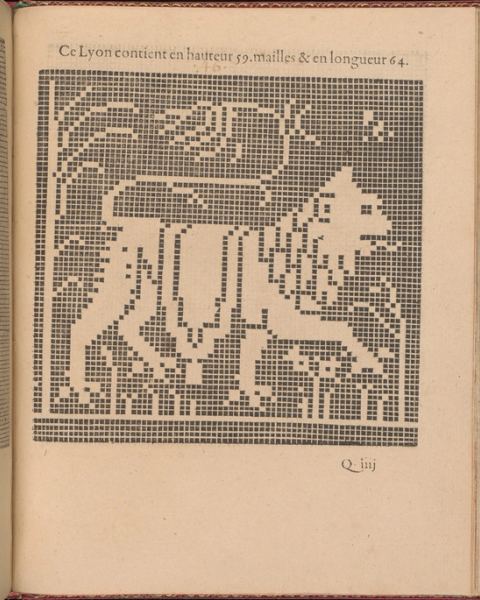
A pattern that counts instead of naming is older still. A pattern book printed in Paris in 1587 and 1588 editions prints a lion as a grid and tells the reader it is 59 meshes high, as we describe in This Lion Is 59 Meshes Tall. A filet crochet chart works on the same principle, one square of the chart for one square of the work, and the Filet Crochet Chart Generator on our Workbench makes one from text or an image.
Modern charts use symbols instead. A symbol needs no translating, but the Council's standard set comes with the advice: "Always refer to the pattern key for additional symbol definitions." The key still names the stitches, so that is where the US or UK question comes back.
Why do the US and UK terms differ?
I found no source that documents a decision, a date or a person. What survives is printed evidence that, in the United States, both systems were in use around 1900, sometimes from the same publisher.
| Year and place | Book | What it says |
|---|---|---|
| 1847, London | Riego de la Branchardière, *The Crochet Book* | "Plain stitch, called French or double crochet": two loops on the needle, thread drawn through both. Next comes the "treble stitch", with three loops. |
| 1899, New York | Perkins and Ford, *A Treatise on Embroidery, Crochet and Knitting* (M. Heminway & Sons) | Double crochet: two stitches on the needle, drawn through together. Single crochet: drawn through the work and the stitch on the needle in a single draw. Treble crochet: three stitches on the needle. |
| 1908, Boston | *The Priscilla Crochet Book* (wool and silk articles) | Single crochet: draw the wool through, wool over, draw through both loops. Double crochet starts with wool around the hook. Uses "skip" more often than "miss". |
| 1916, Boston | *The Priscilla Crochet Book: Edgings and Insertions, No. 2* (thread) | The two-loop stitch is "double". "Miss" throughout, never "skip". |
Read against the table in the first section, the 1847 and 1899 books use UK-style names, and the 1908 wool book uses the modern US ones. The 1916 book, from the same Boston publisher, goes back. Its stitch explanations carry a parenthetical note that the two-loop stitch "has been, especially in wool crochet, called 'single crochet.' But it simplifies crocheting to call it 'double crochet,' after the custom of workers in Irish crochet."
That note is the most useful clue I found, and it needs care. It does not say who invented either system. It shows that an American publisher in 1916 knew two names for one stitch, associated one with wool work and the other with Irish crochet, and picked the latter for a book of edgings. Four books are not a survey, so they cannot say when the US convention became standard or why. LoveCrafts guesses at emigration and word-of-mouth teaching in the 1800s, but says the reasons "are lost in the mists of time", and I found nothing to confirm it.
How can you tell which system a pattern uses?
Read the pattern's own notes first. The Craft Yarn Council says a pattern's own special abbreviations are generally defined at its start, and LoveCrafts says a pattern will usually state whether it uses US or UK terms. When it does not, use several weak clues together.
| Clue | Suggests US | Suggests UK | How far to trust it |
|---|---|---|---|
| Stitch list | sc, hdc | htr, or a list with no sc | Strong, because sc and hdc exist only in US terms and htr only in UK terms. "dc" alone proves nothing. |
| First row | "sc in 2nd ch from hook"; "dc in 4th ch from hook" | "dc in 2nd ch from hook"; "tr in 4th ch from hook" | Strong. See below. |
| Turning chains | ch 1 for a row of sc; ch 3 for a row of dc | ch 1 for a row of dc; ch 3 for a row of tr | Strong, same logic. |
| Wording | skip, yo, gauge | miss, yoh, tension | Weak. Both sets are widely understood now, and the Council groups Canada with the UK for two of them. |
| Yarn amounts | yards, ounces | meters, grams | Moderate. Many labels print both. |
| Hook size | letters and numbers such as G-6, H-8 | millimeters only | Weak. Use the millimeters. |
| Where the designer works | US-based | UK, Europe or Australia-based | Weak, a hint only. Wikipedia says the UK-style notation is used across Europe, Australia and India. |
The first-row clue comes straight from the Council's own examples of US usage. Its guide gives "Ch 15; sc in 2nd ch from hook" for a first row of single crochet, and "Ch 17. Row 1: Dc in 4th ch from hook" for a first row of double crochet. Run those through the table and the UK versions are "Ch 15; dc in 2nd ch from hook" and "Ch 17. Row 1: Tr in 4th ch from hook". That translation is mine, not the Council's, but it follows from the mapping. A "dc in 2nd ch from hook" row is almost certainly UK, because a US double crochet needs three chains of height.
The Council's guide also explains why: the turning chain of a single crochet row does not count as a stitch, while on double crochet and taller stitches it counts as the first stitch. Many patterns end a row with a stitch count such as "(14 sc)", and the Council advises counting at the end of every row.
Hook sizes are the other place the systems meet. US hooks carry letter and number sizes that vary from company to company, so the Council tells makers to rely on the millimeters printed on the package.
| Millimeters | US size |
|---|---|
| 3.5 mm | E-4 |
| 4 mm | G-6 |
| 5 mm | H-8 |
| 6 mm | J-10 |
| 6.5 mm | K-10½ |
LoveCrafts adds that UK crocheters used imperial hook sizes until the move to metric in the 1970s, which matters if you are working from a vintage British pattern. Steel hooks for thread and lace-weight yarn run the other way: the Council says that for these, the higher the number, the smaller the hook.
What is gauge, and how do you swatch?
Gauge, called tension in UK usage, is the number of stitches and rows that fit in a measured square of fabric, usually 4 inches or 10 centimeters according to LoveCrafts. It is how a pattern tells you the size of its stitches, and it is the best test of whether you have read the pattern in the right system.
The method, following the Craft Yarn Council:
- Work a square in the pattern's yarn and stitch, not in whatever stitch is easiest.
- Measure how many stitches and rows fall in 4 inches or 10 centimeters, and compare them with the pattern.
- If your swatch is larger than the pattern's gauge, make another with a smaller hook. If it is smaller, use a larger hook.
- Choose hooks by millimeter size, because letter and number sizes vary between makers.
- Count your stitches at the end of every row once you start the real piece.
A swatch also catches the terminology error: the Stitches n Scraps blog says a swatch far from the stated gauge, or unlike the pattern's stitch, may mean you are working the wrong stitches. Fix that before changing hooks.
Yarn amounts need care too. US patterns usually give yards and UK patterns meters, and a meter is about 8.6 centimeters (3.4 inches) longer than a yard. If you substitute a yarn, the Yarn Converter and Skein Planner on our Workbench works from meters per 100 grams on the label to the number of balls you need. The same swatching habit applies to knitting, which depends on gauge too.
What happens if you misread a pattern?
You make the right number of the wrong stitches. Because the two systems share the abbreviations "dc" and "tr", reading a UK pattern as US, or the reverse, swaps each stitch for one a step taller or shorter, and the fabric changes size and texture with it.
The effect follows from the turning chains, by my reading of the Council's figures: a row of single crochet needs one chain to reach the height of the next row, while a row of double crochet needs three. A UK pattern's "dc" is the shorter stitch, so reading it as US "dc" builds each row on a taller stitch and gives a bigger, looser fabric. LoveCrafts says the item "will turn out twice the size". Berroco says only that projects come out "much larger", or much smaller if you are used to British terms. I could not find a measured comparison, so treat "twice" as the retailer's estimate. Read the other way, a US pattern worked in UK terms comes out smaller.
The mistake is cheap early and expensive late: a swatch or the first rows will show it, a finished sleeve will not forgive it. Three habits protect against it: settle the system before the first chain, swatch in the pattern's stitch, and measure against the stated size after the first few rows. If the pattern is written in the other system, rename each stitch with the table above before you begin rather than translating as you go.
Where can you see crochet lace?
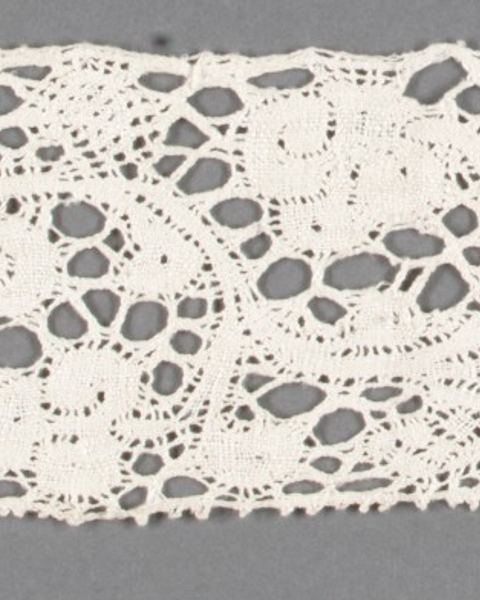
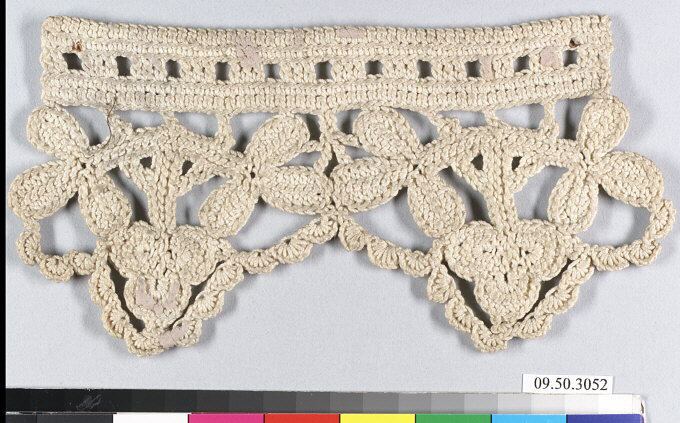
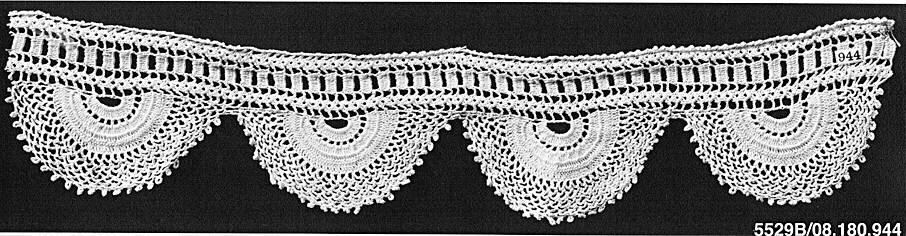
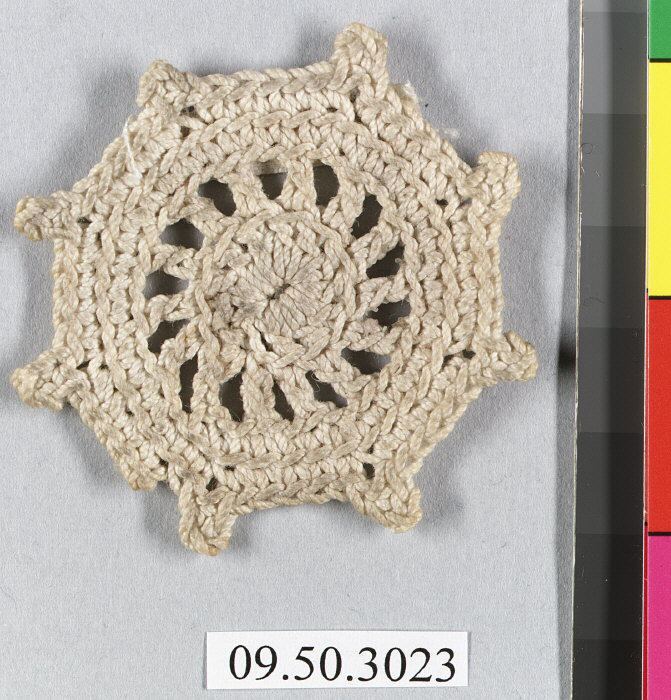
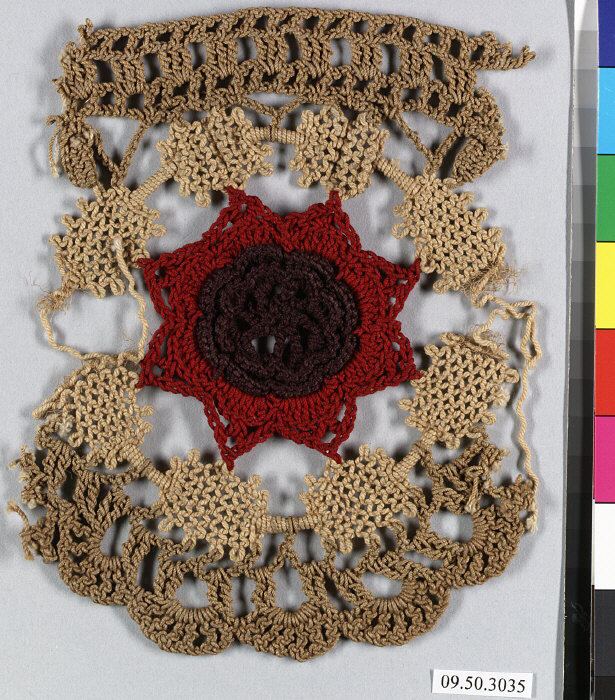
The four pieces shown here are in The Metropolitan Museum of Art, which releases images of public-domain objects under CC0. They are an edging with scalloped fans (08.180.944), a border of leaf-like motifs (09.50.3052), a small round motif (09.50.3023) and a sample with a red star (09.50.3035). In the records I read, the Met gives dates, sizes and (for three of the four) the medium, "Crochet", but no stitch names, so working out their stitches means reading structure, as with a pattern. Our guide to telling handmade lace from machine lace shows the habit for other lace types.
The Craft Yarn Council's crochet abbreviations, guide to reading a crochet pattern and hooks and needles pages are free to read, and the period books are scanned on archive.org: Riego's *The Crochet Book*, the 1908 Priscilla book and the 1916 edgings book.
Sources
- Crochet Abbreviations Master List. Craft Yarn Council. Primary (industry standard). Read in full, including the table of differences between U.S., U.K. and Canadian terms. Accessed October 18, 2026.
- How to Read a Crochet Pattern (Jean Leinhauser). Craft Yarn Council. Read in full: first-row and turning-chain examples, stitch-count hints. Accessed October 18, 2026.
- Hooks & Needles. Craft Yarn Council. Read in full: millimeter advice, hook size rows, swatch rule. Accessed October 18, 2026.
- Steel Crochet Hook & Crochet Thread Sizes. Craft Yarn Council. Read the opening text: steel hook numbers run in reverse. Accessed October 18, 2026.
- Crochet Chart Symbols. Craft Yarn Council. Read in full: symbols and the advice to refer to the pattern key. Accessed October 18, 2026.
- Crochet terms: UK vs US. LoveCrafts. Read in full (HTML): UK/US/AU table, gauge and tension, skip and miss, hook sizes and the metric change, yards and meters. Second authority for the table. Accessed October 18, 2026.
- US and UK Crochet Terms. Stitches n Scraps. Read in full: conversion chart, how to tell the system, swatch advice. Third check of the table. Accessed October 18, 2026.
- UK Crochet Terms versus US Crochet Terms. Berroco. Read in full: the table is an image; used only for the "much larger / much smaller" statement. Accessed October 18, 2026.
- The Crochet Book (Mlle. Riego de la Branchardiere), 1847. Internet Archive (Google Books scan). Primary. Full text read: stitch explanations (plain stitch called French or double crochet; treble) and pattern wording ("miss"). Accessed October 18, 2026.
- A Treatise on Embroidery, Crochet and Knitting (Perkins and Ford), 1899. Internet Archive. Primary. Full text read: single, double and treble crochet definitions. Accessed October 18, 2026.
- The Priscilla Crochet Book (Hettich, ed.), 1908. Internet Archive. Primary. Page 3 viewed as an image and read: explanation of stitches in wool crochet. Accessed October 18, 2026.
- The Priscilla Crochet Book: Edgings and Insertions, No. 2 (Robinson), 1916. Internet Archive. Primary. Page 3 viewed as an image and read: explanation of stitches and the note on "double crochet". Accessed October 18, 2026.
- Mlle. Riego's crochet stitch atlas. Loopholes (blog). Read in full. Secondary, a researcher's analysis of The Crochet Book; checked against the book itself. Accessed October 18, 2026.
- Pre-1925 Crochet Publications. Threadwinder.info. Read via WebFetch: bibliography; earliest dated entries and the Riego series. Accessed October 18, 2026.
- Crochet. Wikipedia. Used to locate references; also read for the international vs US terminology section (attributed in text). Accessed October 18, 2026.
- Top Keywords on Etsy: June 2026. eRank. Secondary, a marketplace analytics blog: "crochet pattern" ranked 7th, up from #30. Treated as a signal only. Accessed October 18, 2026.
- Etsy spring/summer 2026 trends. Stylist. Read in full: the "Soft stitch era" section. Secondary signal only. Accessed October 18, 2026.
- Crochet work, 09.50.3052. The Metropolitan Museum of Art. Primary. Object record via the Met API: CC0, Rogers Fund, 1909. Accessed October 18, 2026.
- Crochet, 08.180.944. The Metropolitan Museum of Art. Primary. Object record via the Met API: CC0, Nuttall Collection, 1908. Accessed October 18, 2026.
- Crochet work, 09.50.3023. The Metropolitan Museum of Art. Primary. Object record via the Met API: CC0, Rogers Fund, 1909. Accessed October 18, 2026.
- Crochet work, 09.50.3035. The Metropolitan Museum of Art. Primary. Object record via the Met API: CC0, Rogers Fund, 1909. Accessed October 18, 2026.
Glossary
Last updated · Markdown · Report an error