Weaving
The Warp-Weighted Loom: Weaving Standing Up
What is a warp-weighted loom and how does it work? The warp hangs from a top beam, weights pull it straight, and the weaver stands, beating the weft upward. Parts, steps and evidence, before Stockholm's Threads opens.
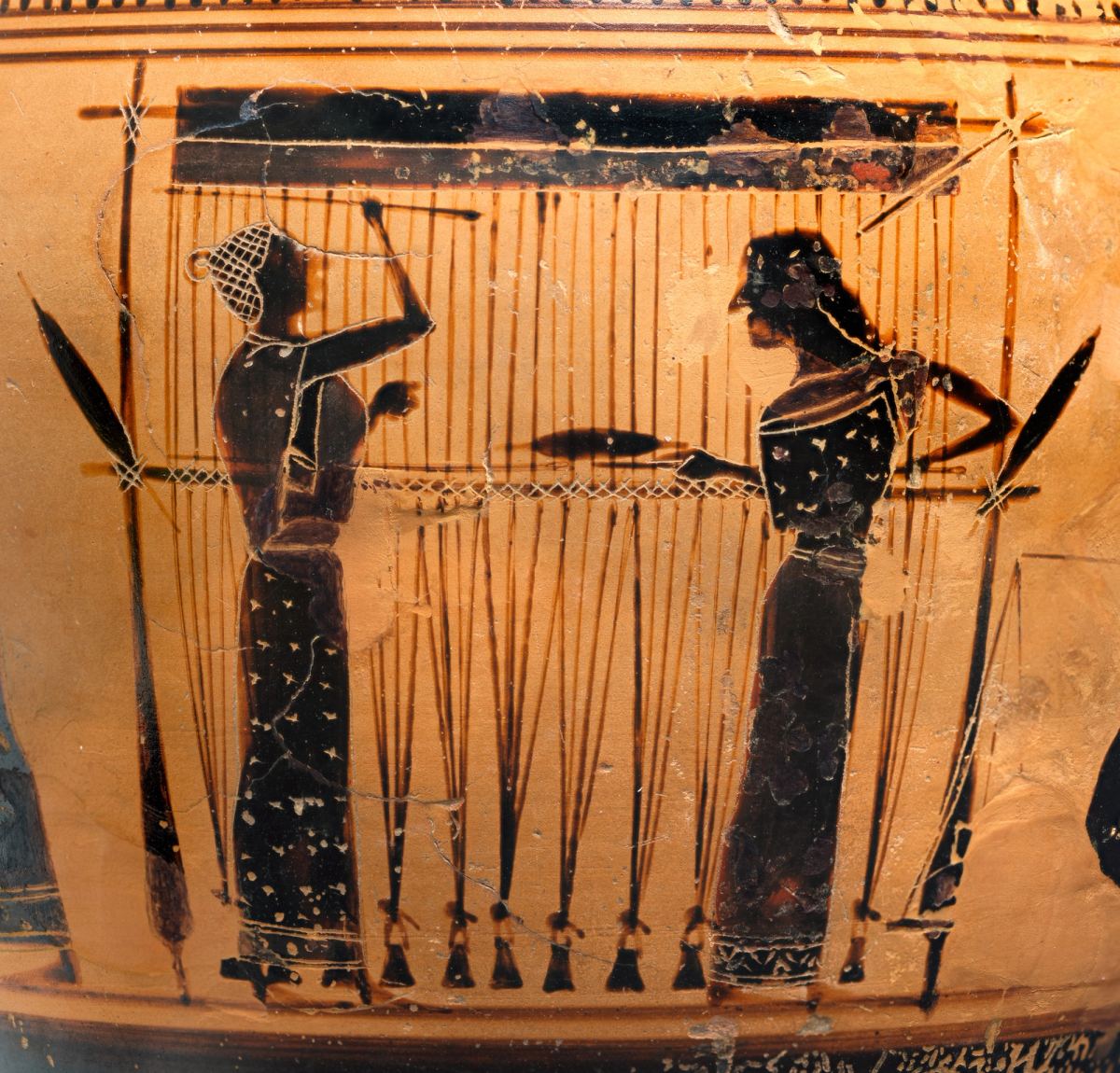
A warp-weighted loom is an upright frame. The warp hangs from a beam at the top, and its threads are pulled straight by clay or stone weights tied on in bundles. The weaver stands and works from the top down. She passes the weft through the hanging threads and beats it upward, against gravity, and the finished cloth is rolled up onto the top beam.
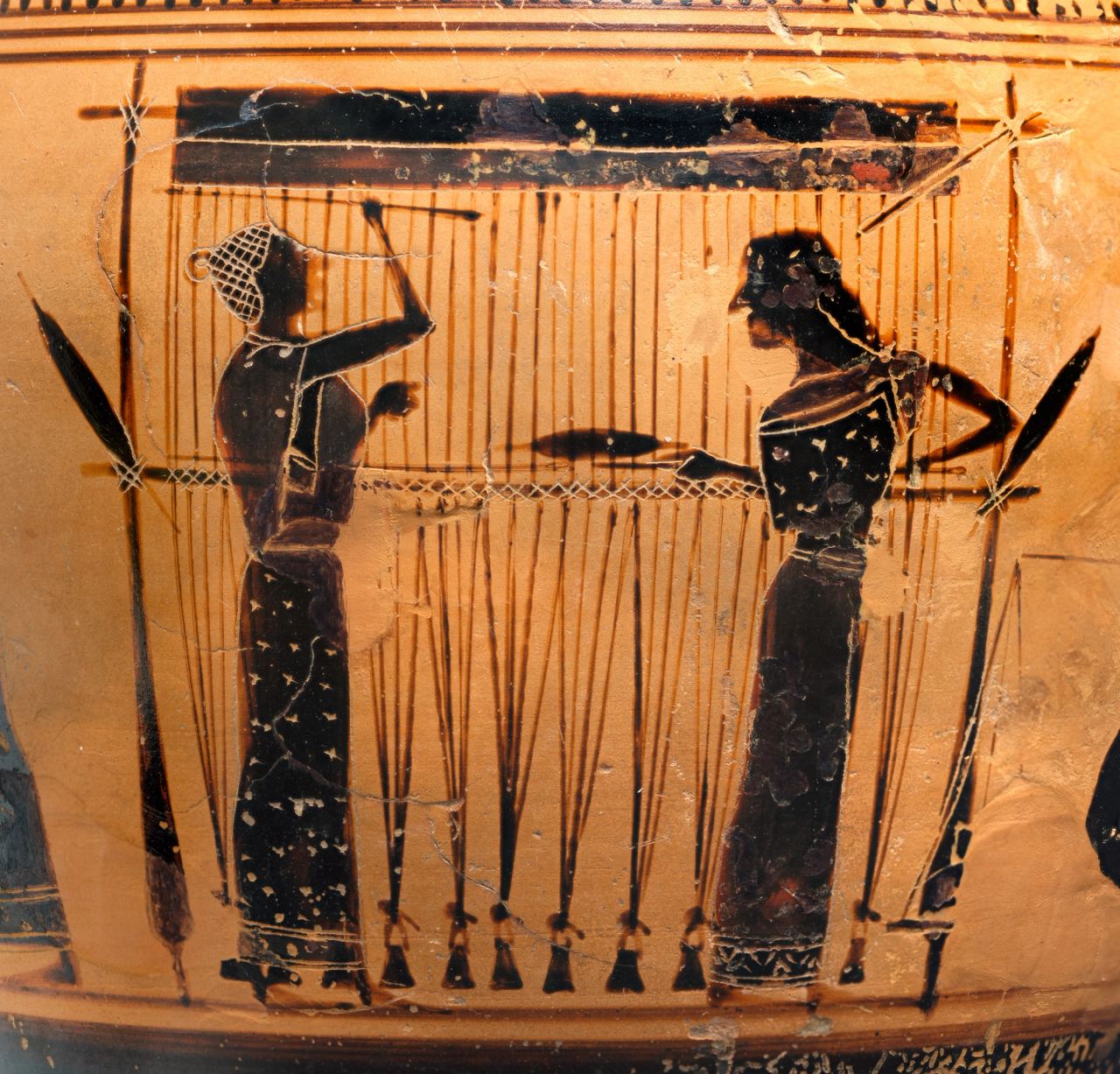
This was the main loom of the ancient Greek world. In parts of Norway it was still in use within living memory. On 22 January 2027 Nordiska museet in Stockholm opens Threads, which puts Faroese and Norwegian warp-weighted looms next to Greek vases that show the same machine. One of those vases is a small oil flask lent by The Metropolitan Museum of Art.
What is a warp-weighted loom?
A warp-weighted loom is a vertical loom with only one beam that holds the warp. The threads hang from that top beam, and weights at their lower ends keep them taut. There is no lower beam. The frame leans against a wall, and the cloth grows downward from the top beam as the weaver works.
The clearest free account is Picturing Homeric Weaving by Susan T. Edmunds, who built a warp-weighted loom and wove on it. The table follows her description, top to bottom.
| Part | What it does |
|---|---|
| Uprights | Two posts that lean against a wall and carry everything else |
| Top beam (cloth beam) | Holds the heading band and the warp; the woven cloth is rolled onto it as work goes on |
| Heading band (starting border) | A narrow band woven first. Its weft loops become the warp of the main cloth |
| Heddle bar | A movable rod tied by loops of thread (heddles) to every second warp thread. Pulling it forward opens the counter-shed |
| Shed rod (shed bar) | A fixed crossbar. Alternate warp threads hang in front of it and behind it, which opens the natural shed |
| Loom weights | Stone, clay or metal weights, each tied to a bundle of warp threads to keep them taut |
| Weaving sword and pin beater | Tools for beating the weft up into place and evening out the threads |
How do you weave on it, step by step?
To weave, the weaver opens a gap between the warp threads, called a shed. She passes the weft through it, changes the shed, and beats the weft upward against the cloth above. The shed rod gives one shed without any effort; the heddle bar gives the other.
Weaving starts with the band. Edmunds describes making the heading band on a small band loom, drawing long loops of the future warp through its sheds. Researchers at the Centre for Textile Research (CTR) in Copenhagen describe the same principle in a 2007 experiment: the starting border's weft threads become the warp of the cloth. In early Iron Age Denmark, tablet weaving served this loom as a helper technique: a large cloak from Skærsø, studied by Lise Ræder Knudsen, has a tablet-woven starting border that held its whole warp.
| Step | What happens |
|---|---|
| 1. Weave the heading band | On a small band loom; its long weft loops will become the warp |
| 2. Hang the warp | Tie the band to the top beam and lean the frame against a wall |
| 3. Divide the warp | Lay alternate threads in front of and behind the shed rod |
| 4. Attach the heddles | Loop every thread from the back layer to the heddle bar |
| 5. Weight the warp | Tie the threads in bundles to loom weights hung side by side |
| 6. Weave | Pass the weft through the natural shed, pull the heddle bar forward for the counter-shed, pass it back |
| 7. Beat up | Push each weft upward with a sword or pin beater |
| 8. Roll on | Wind the finished cloth onto the top beam, lower the warp and reset the weights |
In the Copenhagen experiment the weft was laid in as a loose bow with a bone pin beater, the shed was changed, and the weft was beaten up with a wooden sword. Rolling on (step 8) is how a cloth longer than the loom gets woven: Edmunds notes that most Greek loom paintings show cloth already wound on the top beam, and Alfred Barlow's 1878 history of weaving says the Icelandic weights were drawn up and tied on again as the cloth grew.
Why does it use weights?
Weights keep every bundle of warp at its own steady tension, whatever the weaver does to the threads. Gravity does the tensioning. The cost is that the weaver has to beat the weft upward, against the weights.
The Greeks treated that as the normal way to weave. Herodotus thought it worth noting that Egyptian weavers pushed the weft down, while everyone else pushed it up (Histories 2.35). Edmunds points out that the weft is beaten upward only on a warp-weighted loom, so this was the loom Herodotus knew. She also argues that weighting gives very even tension, which helps in pattern weaving when wefts of different thicknesses go in.
How heavy should a weight be? It depends on the yarn. In the CTR tests, a thin wool yarn needed about 20 grams of pull per thread, so 14 threads were tied to each weight of about 275 grams. The thickness of the weights mattered as well. The weights hang side by side in a row, and the researchers found that the row should be as wide as the cloth or slightly wider. They concluded that weights with flat sides work best. In a later experiment with Norwegian double-cloth, Katherine Larson and Marta Kløve Juuhl used one-kilogram weights with 15 threads each, about 66 grams per thread.
How do archaeologists find a loom that has rotted away?
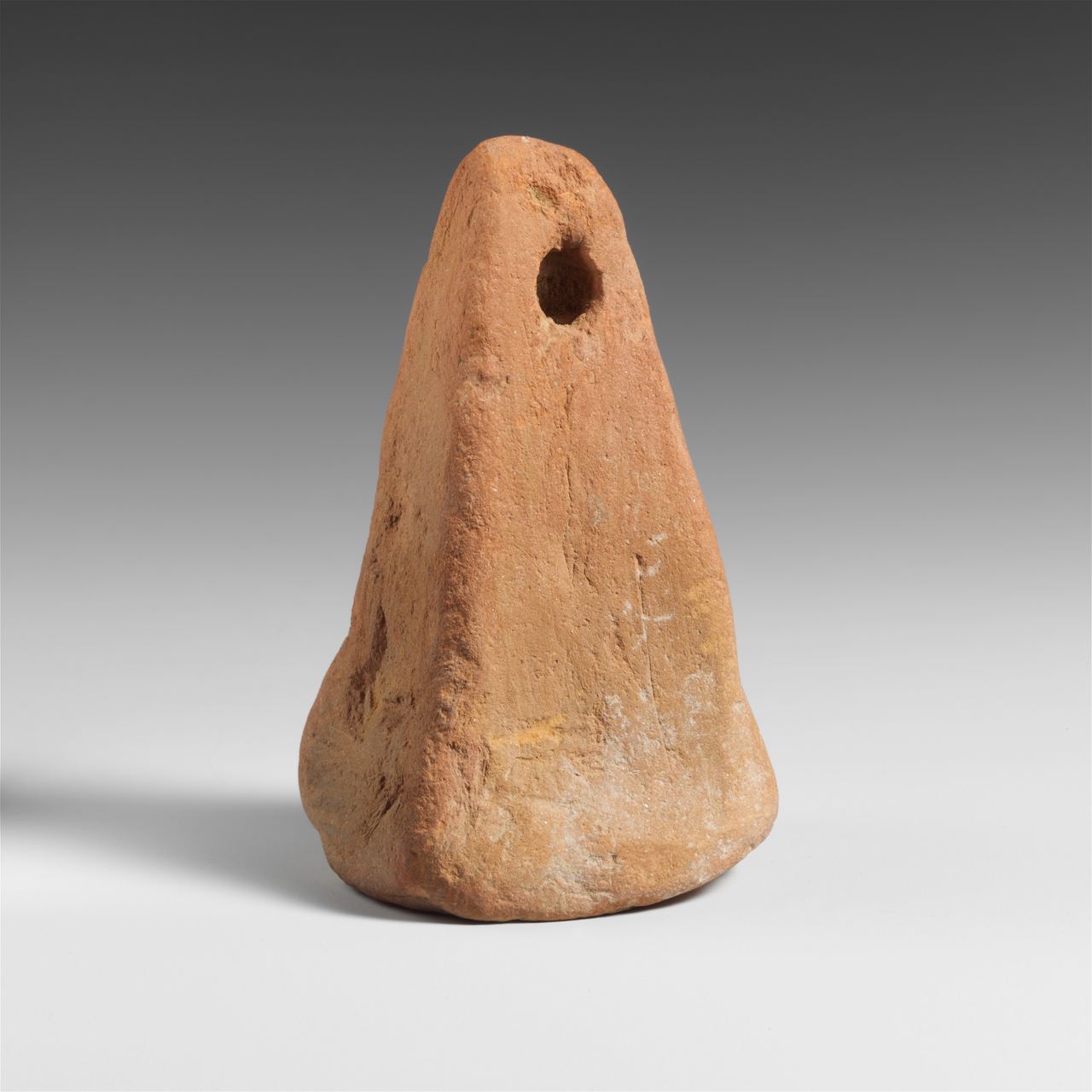
The wooden frame of a loom rarely survives, but the weights do. A row of fired-clay or stone weights on a floor shows where a loom stood. The length of the row suggests how wide the cloth was. Such weights are frequent finds from late prehistory and antiquity.
The authors of a 2026 paper in Antiquity trace the warp-weighted loom back to the Early Neolithic, in the seventh to sixth millennia BCE, in regions from Anatolia to central Europe. They follow Elizabeth Barber's survey of the evidence. Larson and Juuhl, citing Barber too, place it in Europe from the sixth to seventh millennia BCE. Edmunds also uses Marta Hoffmann's report of possible loom weights at Jericho dating from the seventh millennium. That is a range, not a date of invention.
At Virje–Sušine in northern Croatia, excavators in 2014 found 36 clay weights still in place in a sunken building of the third to second century BCE. Twenty-eight of them lay in a line, which the researchers estimate could have woven cloth 140 to 150 cm wide. At Cabezo Redondo in south-east Spain, a fire around 1500 BCE (radiocarbon dated to 1507–1428 cal BCE) sealed a loom under a collapsed roof. The team found 44 small cylindrical weights, most of about 200 grams, together with charred pine timbers and esparto cords. Some cords were still in the holes of the weights.
Cloth can be evidence too, but it needs care. A tablet-woven upper border has long been read as a sign of the warp-weighted loom. Ræder Knudsen has also shown, though, that some Iron Age cloaks had their upper borders woven on after the main cloth was finished. Those cloaks may have come from the two-beam loom instead. For why so little ancient cloth survives at all, see why so few old clothes survive.
What do Greek vases show, and what about Penelope?
The Met's lekythos by the Amasis Painter, about 550–530 BCE, shows the whole loom: two women weaving, a dark band of finished cloth, a crossbar, and warp bundles ending in weights. Homer's Penelope weaves on the same kind of loom.

Edmunds discusses eleven surviving Greek images of the loom and reads this one closely. It has one crossbar and one row of weights. One weaver holds a light rod just above the bar. The other holds a stick and appears to be beating in the weft. Spare bobbins of weft rest in the cross-lashing where the crossbar meets the uprights. She also cites a doubt from Marta Hoffmann, who thought the beams looked too slender and the crossed lashings unable to stop the beam from turning. Edmunds answers that one Sámi loom in Hoffmann's own book has even more slender beams. Around the rest of the flask, women weigh wool, spin it and fold a finished cloth.
Penelope is literary evidence, not a technical drawing. In Odyssey 2, she sets up a great loom (the Greek histos) in her halls and weaves a shroud for Laertes. For three years she weaves by day and unravels by night. Homer does not describe the loom. Edmunds argues that the trick is far more plausible on a warp-weighted loom, because the cloth was rolled onto the top beam as it grew and was never visible all at once. Translations can blur the picture: Samuel Butler's 1900 English version turns the loom into a "tambour frame" and the weaving into needlework.
How did it survive into modern Norway and Iceland?
The warp-weighted loom lasted longest on the northern edge of Europe. In the 1950s Marta Hoffmann found women in western Norway and in Finland who could still set one up and weave on it. In Iceland it wove vaðmál, the twill cloth that served as legal currency. There it remained in use into the eighteenth century.
Hoffmann's book The Warp-Weighted Loom, published in Oslo in 1964 as Studia Norvegica 14, is still the standard study. It is not freely available online, so we have used it through the scholars who cite it. According to Edmunds, Hoffmann's Norwegian weavers used the loom for woolen coverlets in traditional patterns. Larson and her coauthors write that, thanks to her fieldwork, the way plain weave was woven on this loom is "well understood". It also showed that practice varied: the Sámi in northern Norway used a woven starting border, while weavers in south-west Norway beat the weft in with a sword.
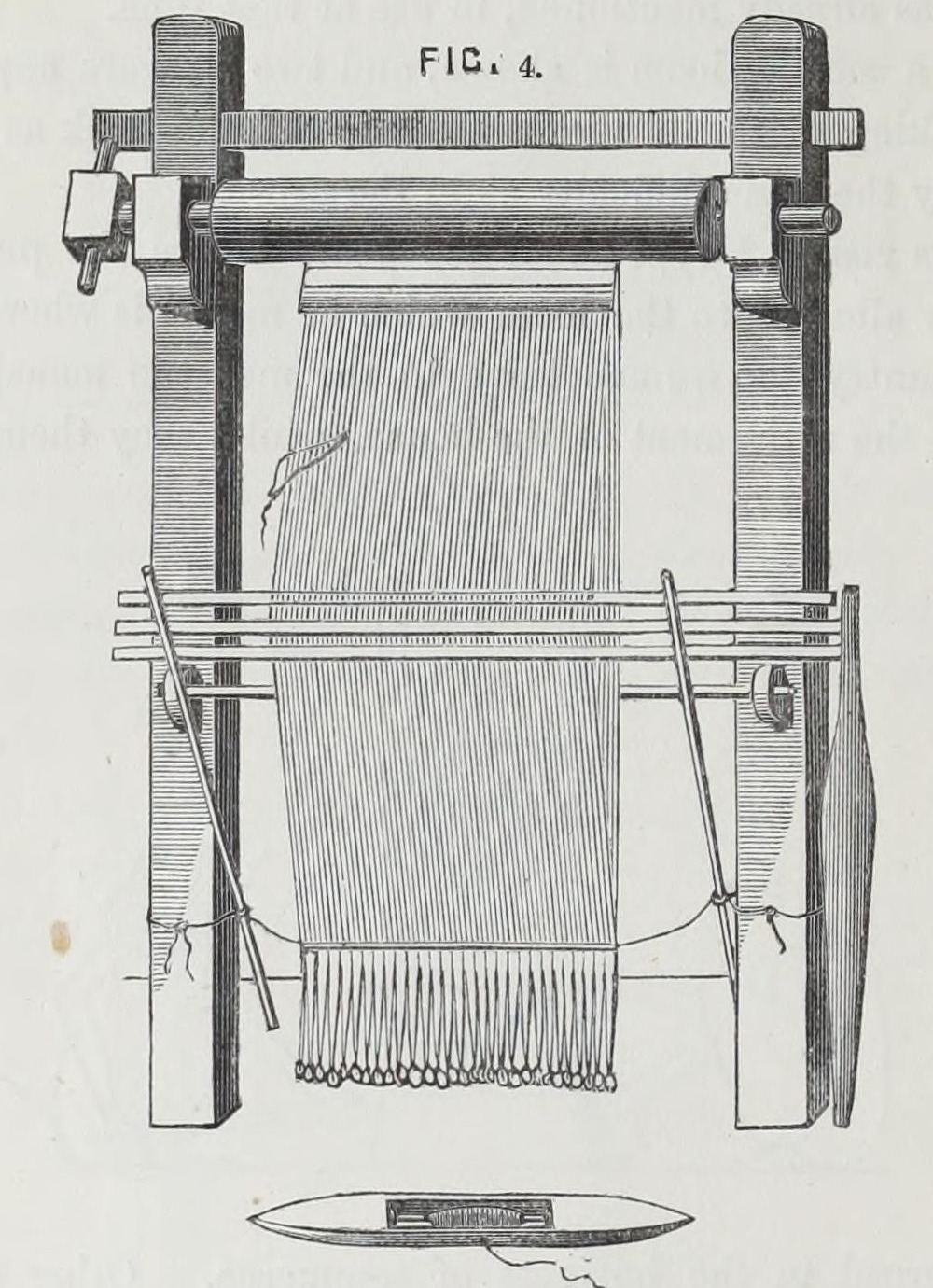
Iceland kept the loom through the Middle Ages. The Grágás law code defined a unit of legal tender as vaðmál six ells long and two ells wide, new and unused. Michèle Hayeur Smith describes this cloth as a regulated wool twill woven by women on warp-weighted looms. Meghan Korten's 2026 doctoral study from the University of Iceland finds that the loom, called vefstaður, stayed in use there into the eighteenth century. Larson's team adds Icelandic drawings of twill weaving from the late eighteenth century, and late nineteenth-century letters from two elderly women who remembered weaving twill on it when they were young. Writing in 1878, Barlow said the Icelandic loom was in use "if not at the present, at all events in very recent times".
Osterøy Museum, part of the Museum Centre in Hordaland, says that people in Nordhordland and on Osterøy still weave on it. In Norway more generally, the flat loom arrived in the seventeenth century and gradually replaced it.
How does it compare with other looms?
The warp-weighted loom stands upright and is tensioned by weights. The two-beam upright loom, the ground loom and the treadle loom hold the warp taut between fixed beams or in a frame instead. Most of the differences follow from that one choice: which way the weft is beaten, how the shed opens, and what the loom leaves behind for archaeologists.
| Warp-weighted | Two-beam upright | Ground loom | Treadle (floor) loom | |
|---|---|---|---|---|
| How the warp is held | Hangs from a top beam, weighted in bundles | Stretched between two horizontal beams | Stretched between beams pegged out on the ground | Stretched in a horizontal frame |
| Direction of beating | Upward | Downward (Herodotus on Egypt) | — | Toward the weaver, with a reed in a swinging batten |
| How the shed opens | Shed rod and heddle bar, by hand | — | — | Foot treadles |
| Who wove, in the sources | Women, in Greek texts and in Hoffmann's fieldwork | Men, in Egyptian images | Women, in early Egyptian images | Male professionals in guilds, in medieval Europe |
| Where and when | Europe and the Near East from the Neolithic; Norway and Iceland into modern times | Egypt; replaced the weighted loom around the Mediterranean by Roman times | Early Egypt; suited to desert and nomadic life | Commercial weaving in Europe from the early Middle Ages; Norway from the 17th century |
A dash means our sources do not say.
The Egyptian and medieval columns follow Edmunds, who draws on Barber and Hoffmann; the treadle-loom details follow Barlow's 1878 description of the hand loom. Edmunds notes, via Hoffmann, that the shift to the treadle loom moved commercial weaving from women in manor workshops to male weavers in guilds. Every one of these looms uses heddles in some form. Our guide to dobby, Jacquard and plain weave follows that part into the age of punched cards. On the weighted loom, the turning weft also forms a selvage down each side of the cloth.
What should you look for at Threads in Stockholm?
Look at the Greek vase and the Nordic loom side by side. Find the top beam with its rolled cloth, the bar halfway down, and the row of weights. Nordiska museet says its researchers began comparing Greek weaving scenes with Nordic looms almost a hundred years ago.
According to the museum, Threads opens on 22 January 2027 and brings together more than 400 objects. These include textiles and tools from Nordic and Arctic collections and Greek antiquities from museums in the United States, Italy and Greece. The museum describes a six-month loan from the Met, and its page shows the Amasis Painter lekythos as the loaned "oil flask". It also lists a skyphos by the Penelope Painter, about 440 BCE, from the National Etruscan Museum in Chiusi, on which Penelope sits before her loom talking with Telemachus. Edmunds counts that vase among the loom images with two crossbars and two rows of weights. Compare it with the single row on the Met flask.
Further reading
- Susan T. Edmunds, *Picturing Homeric Weaving*, Center for Hellenic Studies.
- Centre for Textile Research, Technical Report, Experimental Archaeology Part 3: Loom weights (2007).
- The Met's lekythos by the Amasis Painter, 31.11.10, and Nordiska museet: *Threads*.
Sources
- Terracotta lekythos (oil flask), 31.11.10, collection API record. The Metropolitan Museum of Art. API record read: Amasis Painter, Attic, ca. 550–530 BCE, 17.1 × 9.9 cm, Fletcher Fund 1931, isPublicDomain true, all image views. Web page returned 429; object page linked for readers. Accessed November 11, 2026.
- Picturing Homeric Weaving. Susan T. Edmunds, Center for Hellenic Studies. Full text read: loom parts and setup, heading band, natural shed and counter-shed, upward beating and Herodotus, cloth wound on the top beam and Penelope, eleven Greek loom images, reading of the Met loom (§77–79) incl. Hoffmann's objection, Chiusi loom with two crossbars, ground and two-beam looms, shift to treadle looms, Hoffmann's 1950s informants, Jericho weights. Accessed November 11, 2026.
- Threads (exhibition page). Nordiska museet. Page read 2026-11-11: opens 22 January 2027; 400+ objects; Faroese and Norwegian warp-weighted looms with Greek vases; six-month Met loan; Amasis Painter lekythos 'On loan from The Metropolitan Museum of Art'; Penelope Painter skyphos from Chiusi; Nordic research nearly 100 years ago. Accessed November 11, 2026.
- Nordic Museum to display rare ancient Greek art treasures in Threads exhibition. Sweden Herald, 8 September 2026. Read via WebFetch (site blocks curl): confirms opening date, Met loan of an oil bottle and Chiusi drinking vessel with Penelope. Second confirmation of the hook. Accessed November 11, 2026.
- Technical Report, Experimental Archaeology Part 3: Loom weights (2007). Linda Mårtensson, Eva Andersson, Marie-Louise Nosch, Anne Batzer; Centre for Textile Research, University of Copenhagen. Full PDF read: ~20 g per thread, 14 threads per 275 g weight, pin beater and wooden sword, row of weights as wide as or slightly wider than the cloth, flat-sided weights best. Accessed November 11, 2026.
- Technical Report, Experimental Archaeology Part 4 (spools). Centre for Textile Research, University of Copenhagen. PDF read: warp-faced starting border whose weft threads become the warp of the weave. Accessed November 11, 2026.
- Norwegian double-cloth: warp-weighted loom experiments in a complicated technique, Archaeological Textiles Review 64. Katherine L. Larson and Marta Kløve Juuhl. PDF read: loom known in Europe from the 6th–7th millennia BCE (citing Barber 1991); survival into the 20th century in Norway (Hoffmann 1964); 1 kg weights, 15 warps per bundle, 66 g per thread. Accessed November 11, 2026.
- Twill on the warp-weighted loom: reconsidering double-notched supports, Archaeological Textiles Review 67. Katherine Larson, Marta Kløve Juuhl and Monika Ravnanger. PDF read: Hoffmann documented practitioners in Norway and Finland; plain weave 'well understood'; Icelandic late-18th-century drawings and late-19th-century letters; Sámi starting border, sword in south-west Norway. Accessed November 11, 2026.
- Evidence of a warp-weighted loom in the Bronze Age settlement of Cabezo Redondo (south-east Spain), Antiquity 100 (2026), open access CC BY. Ricardo E. Basso Rial, Gabriel García Atiénzar et al.. Article read in Cambridge Core reader: Early Neolithic origin (7th–6th millennia cal BC, Anatolia to Central Europe, after Barber 1991); 44 weights; destruction dated 1507–1428 cal BC. Accessed November 11, 2026.
- UA researchers find 3,500-year-old loom that reveals key aspects of textile revolution in the Bronze Age. University of Alicante, 23 March 2026. Press release read: 44 cylindrical weights mostly ~200 g, Aleppo pine timbers, esparto cords, cord remains in weight perforations, collapsed roof. Accessed November 11, 2026.
- Understanding the Archaeological Record: Reconstructing a Warp-Weighted Loom, EXARC Journal 2018/2 (CC BY 4.0). Tena Karavidović and Tajana Sekelj Ivančan. PDF read: Virje–Sušine, 2014, 36 in-situ weights, La Tène C, 28 in a line, cloth 140–150 cm. Accessed November 11, 2026.
- Early Iron Age Tablet Weaving in Denmark, Archaeological Textiles Review 57. Lise Ræder Knudsen. PDF read: tablet weaving as auxiliary technique for the warp-weighted loom; Skærsø cloak starting border; upper borders woven after the ground fabric, so some textiles may come from two-beam looms. Accessed November 11, 2026.
- Odyssey 2.84–110, Greek text and A. T. Murray translation. Homer, via Perseus Digital Library. Read in English and Greek (στησαμένη μέγαν ἱστόν): great web set up in her halls, shroud for Laertes, three years, unravelled by night. Accessed November 11, 2026.
- The Odyssey, translated by Samuel Butler (1900), Book II and Book XIX. Project Gutenberg. Full text checked: 'tambour frame' and 'needlework' for Penelope's web; translation dated 1900 in the front matter. Accessed November 11, 2026.
- Histories 2.35, A. D. Godley translation. Herodotus, via Perseus Digital Library. Read: 'in weaving all others push the woof upwards, the Egyptians push it downwards'. Accessed November 11, 2026.
- The History and Principles of Weaving by Hand and by Power (London, 1878), pp. 57–60 and the hand-loom chapter. Alfred Barlow, via Internet Archive (Getty Research Institute scan). Full text and page scans read: Icelandic loom 'if not at the present, at all events in very recent times'; fig. 4; warning that the drawing is not faithfully copied from Olavius (1780); weights drawn up as cloth grows; treadle, shuttle and batten. Accessed November 11, 2026.
- Thorir's bargain: gender, vaðmál and the law, World Archaeology (2014), author's copy. Michèle Hayeur Smith, via NSF Public Access Repository. PDF read: vaðmál a woollen 2/2 twill of regulated length, width and fineness; woven by women on warp-weighted looms; Grágás two ells wide, six ells long. Accessed November 11, 2026.
- Intertwined Threads: The Value and Function of Vaðmál as Cloth and Money, and Beyond (PhD dissertation, University of Iceland, 2026). Meghan Anne Korten. PDF read (pp. 27–28 and legal section): Grágás unit six ells long, two ells broad, new and unused; loom (vefstaður) in use into the eighteenth century. Accessed November 11, 2026.
- Weaving is one of our most important inventions. Osterøy museum (MUHO). Page read: people in Nordhordland and Osterøy still weave on the warp-weighted loom; flat loom came in the 17th century. Its 'known from around 500 BC' is not used (contradicted by Antiquity and Larson/Barber). Accessed November 11, 2026.
- Terracotta loom weight, 26.199.89, collection API record. The Metropolitan Museum of Art. API record read: Lydian, Sardis, 6th century or later, L. 7.6 cm, public domain. Accessed November 11, 2026.
- Oppstadvev 2 (Nomina rerum mediaevalium term sheet). Museum of Cultural History, University of Oslo. PDF read: Nordic part names; bibliography gives Hoffmann, The Warp-Weighted Loom (Studia Norvegica No. 14), Oslo 1964. Hoffmann's book itself not accessible online; used via citing scholars. Accessed November 11, 2026.
Glossary
Last updated · Markdown · Report an error