Technique
Blackwork: How Tudor Embroiderers Drew in Black Silk
What is blackwork embroidery, and how do you do it? Tudor smocks and cuffs, the Catherine of Aragon story tested, why Holbein stitch has no wrong side, and how to start.
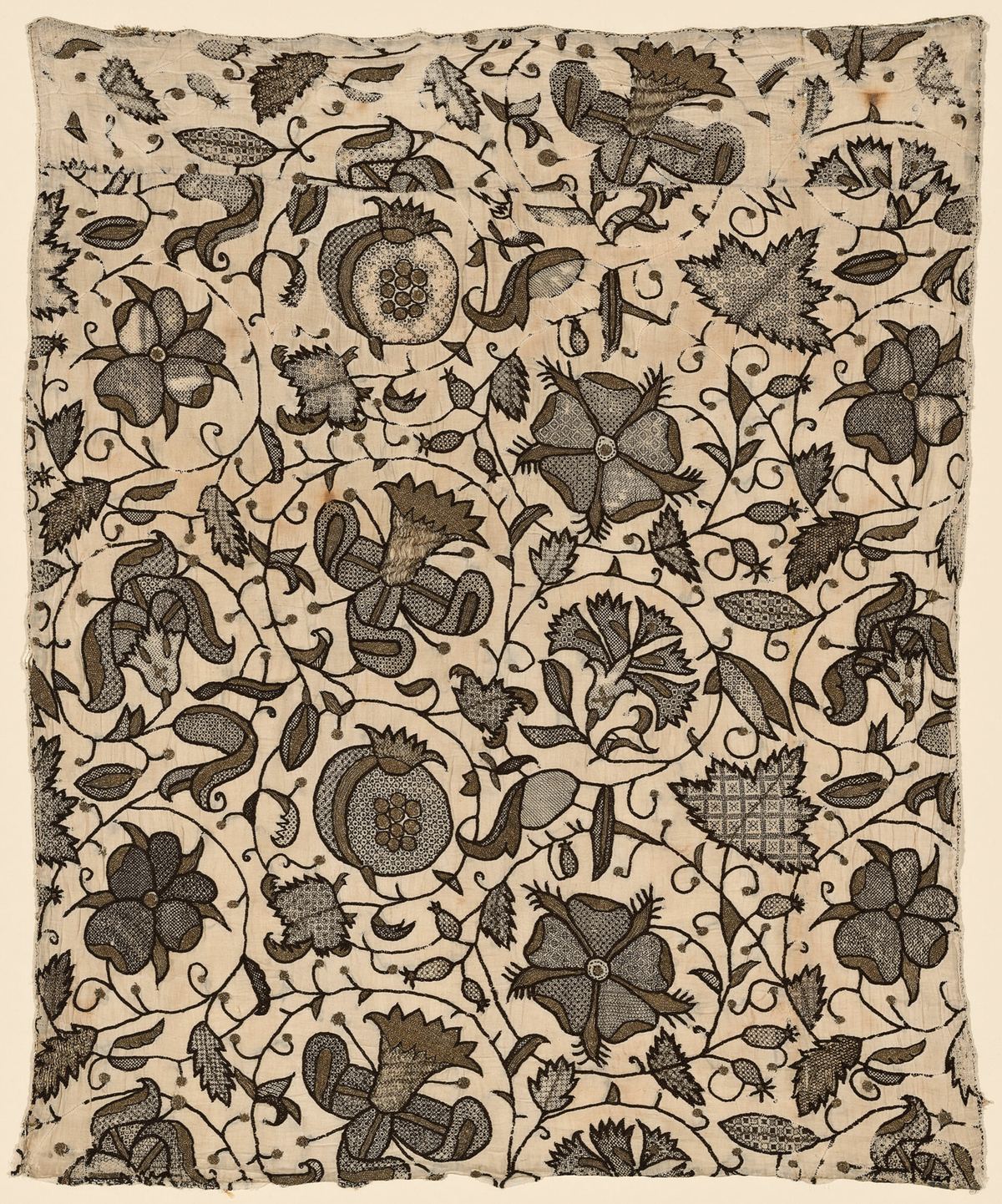
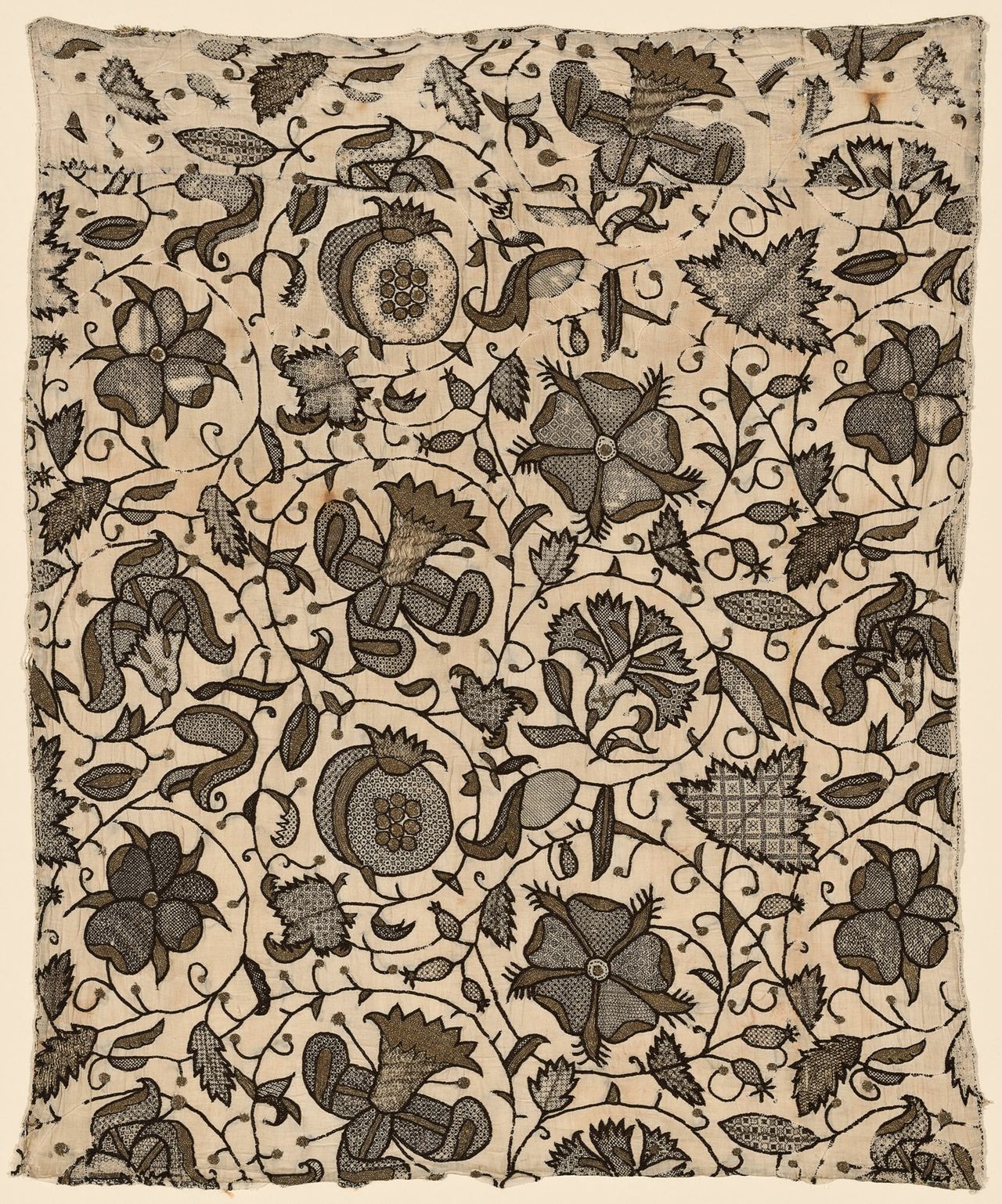
Blackwork is embroidery in a single dark thread, traditionally black silk on white linen, built from lines rather than filled areas. You can work it by counting the threads of the cloth, as with double running stitch, or freely over a drawn design, as Elizabethan embroiderers did on smocks, coifs and waistcoats.
What is blackwork embroidery?
Blackwork is monochrome embroidery, generally in black thread, worked either as counted-thread patterns on evenweave cloth or as freeform embroidery. That is the Royal School of Needlework's definition. The word covers two different ways of working that share one look: dark lines on pale linen.
The Royal School of Needlework (RSN) says the thread is traditionally silk on white or off-white linen or cotton, sometimes with metallic accents, and that some pieces use one other color, most often red. The Victoria and Albert Museum (V&A) describes its Elizabethan and Jacobean examples the same way: one color of silk, usually black, but also blue, red or green.
Nor is it a single stitch: the Metropolitan Museum's "Panel of blackwork," 1580–1620 (35.21.3), is recorded in buttonhole, cross, outline and herringbone stitches. What unites such pieces is the drawing: line, outline and small repeating fillings.
In museum databases, "blackwork" also names a goldsmiths' ornament style: the V&A lists dozens of "blackwork engravings" from 1550 to 1619.
The interest is current. Pinterest's 2026 Hobbies Trend Report, published August 25, 2026, lists searches for "hand embroidery art" up 1,351% and "medieval knitting" up 275%, comparing global text searches in May 2026 with May 2025.
Where did Tudor and Elizabethan dress use it?
Blackwork lived on linen worn close to the body: shirts and smocks, collars and cuffs, coifs, hoods, handkerchiefs and, by the early seventeenth century, whole women's waistcoats. These layers showed at the neck, wrists and face.
The RSN places sixteenth-century blackwork on linen collars and cuffs "as seen in many Tudor portraits," and on coifs by the end of that century. A V&A sleeve panel of 1610–1620 (T.11-1950) notes that it was particularly popular for handkerchiefs, coifs, caps, shirts and smocks.
The V&A holds the embroidered top of a woman's smock of 1575–1585 (T.113 to 118-1997), black silk on bleached linen, with pomegranates, roses and leaves outlined in stem stitch and filled with counted geometric patterns. Its record explains that a smock was worn under the outer layers but was never meant to be wholly hidden. A coif of 1600–1625 (252-1899) mixes black silk with silver-gilt thread and spangles; a woman's waistcoat of 1620–25 (T.4-1935) is covered in scrolling stems, roses, pea pods, birds and wasps.
Such linen also changed hands as gifts. Bury Palliser's History of Lace, citing Elizabeth I's New Year's gift rolls, records "a smock of cameryke wrought with black work and edged with bone lace of gold" from Sir Gawine Carew. A smock, like the chemise it resembles, was underwear in name and display in practice. And it could outlive its first use: the Art Institute of Chicago titles the piece above "Cushion Cover (Made from a Woman's Dress)."
Did Catherine of Aragon bring blackwork from Spain?
No one has shown that she did. The evidence supports a smaller claim: the English called this kind of work "Spanish work" in the sixteenth century, and black silk embroidery on linen was already known in England a century before Catherine arrived.
Catherine came to England in 1501 to marry Prince Arthur; Barbara Clay Finch's Lives of the Princesses of Wales (1883) dates the wedding at St Paul's to Sunday, November 14, and Palliser gives the same year. Lady Marian Alford's Needlework as Art (1886) states that Catherine "introduced the Spanish taste in embroidery," and Palliser's History of Lace (1902 revised edition) says the "Spanish stitch" was brought in on her marriage.
Their evidence proves less. Palliser cites a 1523 inventory of Lord Monteagle listing "eight partlets, three garnished with gold, the rest with Spanish work," and New Year's gifts to Mary I in 1556, most of the smocks "wrought with black silk, Spanish fashion." Alford quotes the Monteagle entry differently, as "eight partletts garnished with gold and black silk work." Neither prints the original document, so its wording cannot be settled from their books. What the entries do show is that "Spanish work" was a name in use, linked with black silk.
The earliest English evidence points the other way. In Chaucer's Miller's Tale, from the late fourteenth century, Alisoun's white smock is embroidered front and back, on her collar, "Of col-blak silk, with-inne and eek with-oute," in Walter Skeat's edition: coal-black silk, inside and outside. The RSN reads this as a collar embroidered on both sides, with a caution: it is impossible to know whether that embroidery was the sixteenth-century kind.
Even Grace Christie's Samplers and Stitches (1921) hedged, saying black work "was said to have been brought by Catherine of Aragon from Spain." The RSN's verdict is the fair one: some authors credit Catherine, the work was certainly called "Spanish work," but there is no conclusive evidence that she introduced it.
Why is Holbein stitch reversible, and why did it matter?
Double running stitch looks the same on both sides because each side receives the same stitches. You make a line of evenly spaced running stitches, then travel back along the same line and fill the gaps, sharing the same holes. On a cuff that folds back or a collar that shows its reverse, there is no wrong side.
Christie describes running the thread "all round the pattern," which "works just half the necessary stitching," then going round again in the contrary direction. A stitch branching off the main line is best completed with one satin stitch that covers both sides at once. Thérèse de Dillmont's Encyclopedia of Needlework names the real difficulty: placing the first row to ensure "an unbroken course back."
The RSN says "Spanish stitch" dates from at least the sixteenth century, and that "Holbein stitch" is credited to Hans Holbein the Younger (1497–1543), the portrait painter who showed blackwork cuffs on his sitters. Christie agrees: patterns in the stitch "occur several times in Holbein's pictures, hence its name."
Reversibility was a working need. The V&A smock of 1575–1585 has a border at each sleeve edge "worked in reversible embroidery, to turn back at the wrists." A turned-back cuff shows its inside, so a one-sided stitch would display the tangle of the reverse.
The stitch is far older than Tudor England. The RSN notes double running on a medieval fragment excavated in Egypt, and the Art Institute of Chicago holds a comparable one.
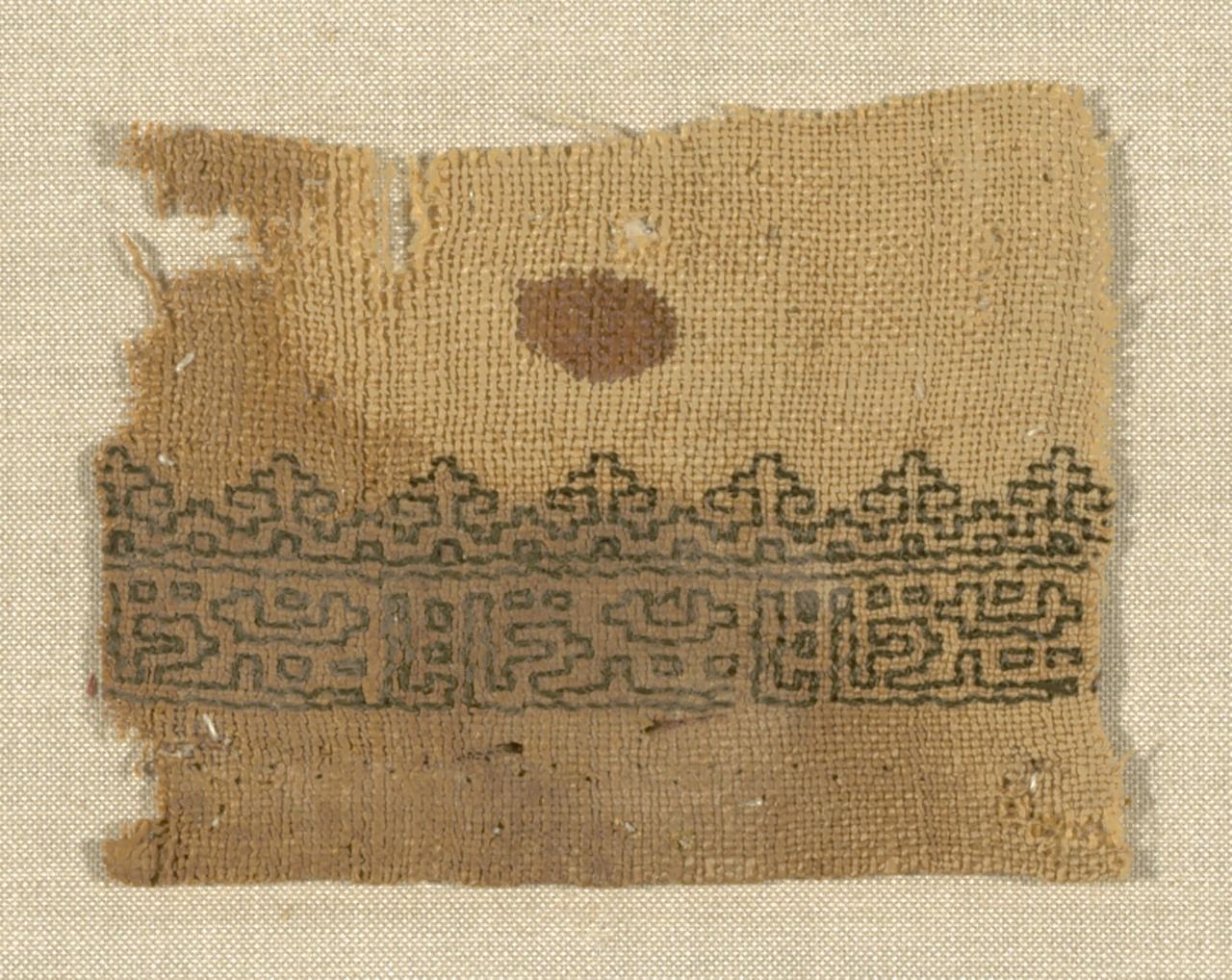
Recorded as silk floss in double running on linen, this thirteenth- or fourteenth-century border climbs the weave thread by thread, centuries before the stitch was named after a painter.
Which stitches and patterns make blackwork?
Four kinds of stitch do most of the work: double running and back stitch for counted lines, stem or outline stitch for free curves, and speckling, also called seeding, for shading. Geometric fillings laid inside outlines are the signature.
| Stitch | How it is worked | Counted or free | Same on both sides? | Where it was used |
|---|---|---|---|---|
| Double running (Holbein, Spanish stitch) | Running stitches, then a second pass filling the gaps in the same holes (RSN) | Counted, usually on evenweave | Yes, if the route is planned (Christie, RSN) | Collars and cuffs (RSN); samplers, such as the Met's 1648 band sampler (13.109) |
| Back stitch | Each visible stitch is worked backward to make a solid line (RSN) | Counted or free | No; the RSN contrasts it with double running | V&A panels of about 1600, in stem and back stitch (T.20 to M-1972) |
| Stem or outline stitch | Straight stitches, each brought up beside the last, form a rope-like line; outline holds the loop to the other side (RSN) | Free | No | Outlines on the V&A smock (T.113-1997) and hood (T.75-1911); the Met panel (35.21.3) |
| Speckling or seeding | Tiny straight stitches; the closer they lie, the darker the area (RSN) | Free | No | Shading on V&A waistcoats and sleeves, 1610s–1620s (T.4-1935, T.11-1950) |
| Geometric fillings | Small counted repeats inside an outlined shape | Counted | Depends on the stitch | Inside the smock's pomegranates and roses (V&A); the Chicago cushion cover |
The last column comes from museum records; the others from the RSN's StitchBank and Christie.
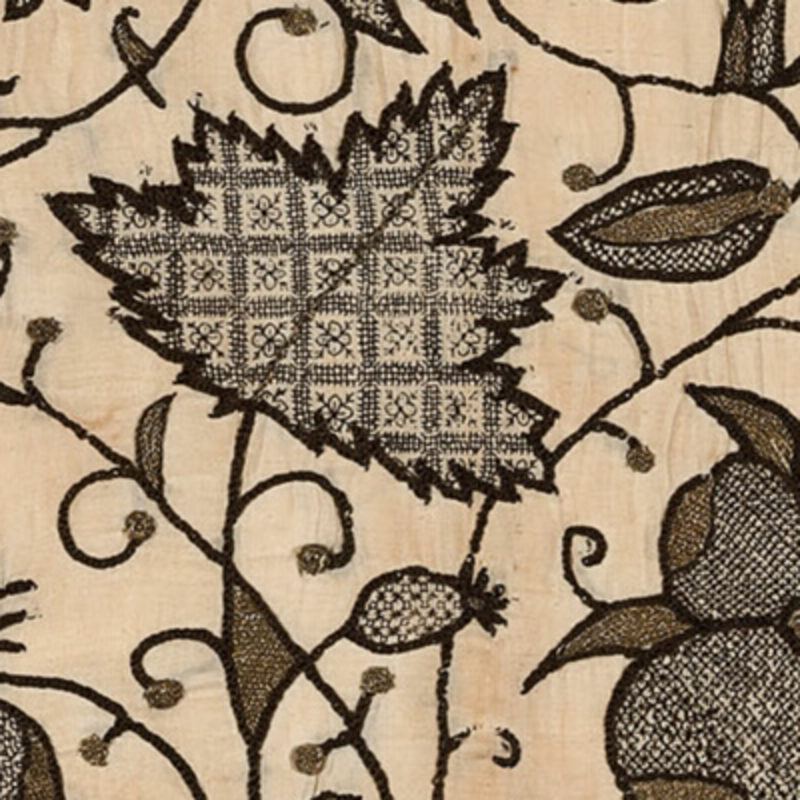
Late Elizabethan pieces often combine the two systems. The RSN says surviving garments with flowers, fauna and curving stems are often freeform rather than counted: motifs are outlined in black, then filled with blackwork patterns or embellished with stitches, especially seeding. The V&A smock and the Chicago cushion cover both show free outlines with lattices inside.
In the early seventeenth century a shaded style appears. The V&A says the "extremely fine speckling stitches" on its 1620–25 waistcoat create the effect of a woodblock print, a style thought to be inspired by the woodblock designs embroiderers used. Counted blackwork then moved to samplers in the second half of the century, the RSN says, waned in the eighteenth, and was revived in the twentieth.
Blackwork, redwork, Assisi or cross-stitch?
Blackwork draws: lines, outlines and open fillings, with plenty of bare linen. Cross-stitch builds the picture from X-shaped stitches, each filling a square of the grid. Assisi work reverses blackwork's logic: the Embroiderers' Guild of America (EGA) describes motifs left as unstitched voids, often outlined in Holbein, stem or back stitch, against a background filled with embroidery or cross stitches.
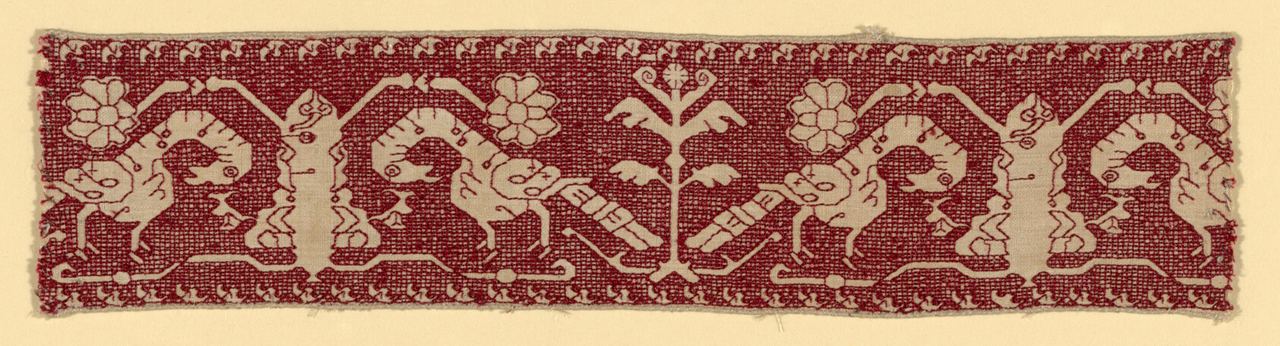
This seventeenth-century Italian border uses that voiding principle: its creatures and rosettes are bare linen outlined in thin red lines, and the Art Institute records double running and back stitches.
Redwork is the hardest to separate, because the difference can be only the thread. The RSN notes that double running was popular in redwork across north-western Europe, and the V&A notes that English blackwork was sometimes worked in red. A red line design can be redwork by name and blackwork by method.
Why does old black silk crumble?
Because of the iron in the dye. Iron was used to fix the black, and, in the V&A's words, it "eventually oxidises, causing the silk thread to crumble." That is why many surviving pieces show bare linen where outlines and fillings used to be.
The V&A's linen hood of 1600–1625 (T.75-1911) is an example: its record says the threads are disintegrating because iron was used as a mordant, or fixative, for the black dye. The museum's 1575–1585 smock is the exception. Its record suggests the silk was probably Spanish because it has lasted very well, while English black silk of the period contained more iron. That comparison is the V&A's inference, not a laboratory result.
The chemistry has been tested. Helen Wilson, Chris Carr and Marei Hacke, in Chemistry Central Journal (2012), describe iron-tannate dyes as accelerating oxidation and acid hydrolysis of the material they color. In their trials, dyed silk lost tensile strength faster than undyed silk under accelerated aging, and they note that many historic iron-tannate dyed objects are brown, fragile or crumbled to dust. Teazle's piece on why so few old clothes survive covers what else decides which textiles last.
How do you start blackwork today?
Start counted, small and in one color: an evenweave linen of 28 or 32 count, a blunt tapestry needle and black stranded cotton or fine silk. Work the outlines first, then the fillings, and for double running plan each route so the return pass closes every gap.
Cloth. Evenweave has the same thread count vertically and horizontally, forming an even grid with clear holes (EGA), which names 28- and 32-count linen as popular for blackwork. The RSN adds that Aida, woven for counted work, is easier to count than most evenweaves, a reasonable practice ground.
Thread. Black silk is traditional; the EGA notes many stitchers now use cotton. Christie advised fine thread for fillings.
Needle. A blunt tapestry needle passes through the holes of counted cloth instead of splitting its threads (DMC). DMC pairs its size 26 with two or three strands of its stranded cotton and size 28 with two; Teazle's guide to needles and threads explains the sizes. Our suggestion: test one strand and two on a spare corner and keep the cleaner line.
Order of work.
- Draw or chart the design. The V&A's fourteen linen panels of about 1600 (T.20 to M-1972) are all inked for blackwork and only some stitched, so the drawing stage survives. Teazle's guide to prick and pounce shows how designs reached linen.
- Work the outlines first; in Elizabethan work, motifs were outlined in black, then filled (RSN).
- For double running, make the outward pass along the whole route, then the return pass into the gaps (RSN). Plan the way back before you start (Dillmont) and close short branches with one stitch that serves both sides (Christie).
- Lay the geometric fillings inside the outlines, aligned to the grid.
- Add any speckling last, packing stitches closer where you want shade.
Size and thread. Before cutting cloth, run your chart through Teazle's Embroidery and Cross-Stitch Size Calculator. It treats evenweave 28 worked over two threads as 14 stitches per inch, so a 140-stitch design finishes at 10 inches before margins.
The floss estimator counts line work in chart squares, with back stitch costing one square of thread on the front and two on the back. Double running, by our arithmetic on the same assumptions, puts one square on each side, so it uses roughly a third less thread. New to embroidery? Teazle's beginner's guide compares the main styles.
Where can you see blackwork?
The V&A's online records cover the smock top (T.113 to 118-1997), the waistcoat (T.4-1935), the hood (T.75-1911), the coif (252-1899), the sleeve panel (T.11-1950) and the inked panels (T.20 to M-1972). The Metropolitan Museum has the "Panel of blackwork" (35.21.3) and a "Blackwork Embroidery" of about 1590 in silk and gilded-silver thread (2013.598). The Art Institute of Chicago's records for the cushion cover (1955.1221), the Egyptian border (1923.367a) and the Italian border (1907.741b) have free downloads.
The RSN's StitchBank illustrates each stitch above, and Christie's and Dillmont's handbooks are free on the Internet Archive. Read Alford and Palliser with care: they are the source of the Catherine of Aragon story, not proof of it.
Sources
- Blackwork (StitchBank). Royal School of Needlework. Full page read via curl: definition (counted or freeform), silk on linen, other single colors, Chaucer both-sided collar with caution, Catherine 'no conclusive evidence', coifs, freeform rinceaux, seeding, samplers in later 17th c., 18th-c. decline, 20th-c. revival. Accessed November 24, 2026.
- Double running stitch (StitchBank). Royal School of Needlework. Full page read via curl: method, evenweave, Egyptian medieval fragment, Spanish stitch from 16th c., Holbein name, redwork in NW Europe, same both sides compared with back stitch. Accessed November 24, 2026.
- Holbein stitch (StitchBank). Royal School of Needlework. Full page read via curl: same on both sides, collars and cuffs, name credited to Holbein the Younger. Accessed November 24, 2026.
- Counted thread; back, stem, outline and seeding stitch (StitchBank). Royal School of Needlework. Pages read via curl: counted-thread (evenweave tpi, Aida easier to count) and the stitch pages rsnstitchbank.org/stitch/back-stitch, /stem-stitch, /outline-stitch, /seeding-stitch for the table. Accessed November 24, 2026.
- Smock part, 1575-1585, T.113 to 118-1997. Victoria and Albert Museum. Record read via V&A API: stem outlines, counted geometric fillings, reversible border to turn back at wrists, smock not meant to be hidden, silk probably Spanish because it lasted, English black silk contained more iron. Accessed November 24, 2026.
- Hood, 1600-1625, T.75-1911. Victoria and Albert Museum. Record read via V&A API: outline and running stitches; single color usually black but also blue, red, green; iron mordant oxidises and silk crumbles. Accessed November 24, 2026.
- Waistcoat, 1620-1625, T.4-1935. Victoria and Albert Museum. Record read via V&A API: speckling, stem and double-plait stitches; motifs; 'extremely fine speckling stitches', woodblock-print effect and inspiration. Accessed November 24, 2026.
- Sleeve panel, 1610-1620, T.11-1950. Victoria and Albert Museum. Record read via V&A API: stem and speckling; popular for handkerchiefs, coifs, caps, shirts and smocks. Accessed November 24, 2026.
- Coif, 1600-1625, 252-1899. Victoria and Albert Museum. Record read via V&A API: black silk speckling and outline stitch with silver-gilt thread and spangles. Accessed November 24, 2026.
- Blackwork panels, ca. 1600, T.20 to M-1972. Victoria and Albert Museum. Record read via V&A API: fourteen linen panels all inked for blackwork, some worked in stem and back stitch with speckling. V&A API search also confirmed 'Blackwork engraving' records dated 1550-1619. Accessed November 24, 2026.
- Panel of blackwork, 1580-1620, 35.21.3. The Metropolitan Museum of Art. Record read via Met Collection API (objects/223032): linen with silk; buttonhole, cross, outline, herringbone. Also read objects 239343 (2013.598, ca. 1590) and 219509 (13.109, 1648 band sampler with double running). Met web pages return 429 here. Accessed November 24, 2026.
- Cushion Cover (Made from a Woman's Dress), late 16th century, 1955.1221. Art Institute of Chicago. API record and object page read: medium and stitches incl. double running and back; CC0 Public Domain Designation on the page. Also 1923.367a (artworks/8489) and 1907.741b (artworks/62631), both CC0. Accessed November 24, 2026.
- Bury Palliser, A History of Lace (1902 revised edition). Project Gutenberg (Internet Archive). Full text read: note 32 (Spanish stitch brought by Katharine, 1501; Monteagle 1523 'the rest with Spanish work'; Mary Tudor 1556 'Spanish fashion'); Elizabeth's smocks with black work; note 870 (Sir Gawine Carew). Accessed November 24, 2026.
- Lady Marian Alford, Needlework as Art (1886). Project Gutenberg (Internet Archive). Full text read: Catherine 'introduced the Spanish taste in embroidery'; note 602 quotes Monteagle 1523 as 'garnished with gold and black silk work', citing Palliser. Accessed November 24, 2026.
- Chaucer's Works, vol. 4, ed. Walter W. Skeat: The Miller's Tale, ll. 3238-3240. Project Gutenberg (Internet Archive). Full text read: Alisoun's smock 'brouded al bifore / And eek bihinde, on hir coler aboute, / Of col-blak silk, with-inne and eek with-oute'; Skeat's notes (vol. 5): brouded = embroidered. Accessed November 24, 2026.
- Grace Christie, Samplers and Stitches (1921). B. T. Batsford (Internet Archive). Full text read: Holbein stitch method (fig. 133), name from Holbein's pictures; black work fillings and fine thread; 'was said to have been brought by Catherine of Aragon'. Accessed November 24, 2026.
- Thérèse de Dillmont, Encyclopedia of Needlework. Project Gutenberg (Internet Archive). Full text read: two-sided line stitch (Holbein), 'an unbroken course back'. Accessed November 24, 2026.
- Barbara Clay Finch, Lives of the Princesses of Wales (1883). Cornell University Library (Internet Archive). Full text read: Katharine left Spain 21 May 1501; wedding Sunday 14 November at St Paul's. Accessed November 24, 2026.
- Wilson, Carr and Hacke, Production and validation of model iron-tannate dyed textiles (2012), 6:44. Chemistry Central Journal. Full text read (PMC): iron-tannate dyes accelerate oxidation and acid hydrolysis; dyed silk lost strength faster in accelerated ageing; historic objects brown, fragile or crumbled to dust. Accessed November 24, 2026.
- Embroidery Techniques from Around the World: Blackwork. Embroiderers' Guild of America. Read via WebFetch (posted 29 May 2025): 28- or 32-count linen; black silk traditional, cotton now common; reversible on collars and cuffs; calls the Catherine story apocryphal. Accessed November 24, 2026.
- Embroidery Techniques from Around the World: Assisi. Embroiderers' Guild of America. Read via WebFetch (posted 13 May 2026): voided motifs, background filled with embroidery or cross stitches, outlines in stem, back or Holbein stitch. Accessed November 24, 2026.
- The Beginner's Guide to Embroidery Fabrics. Embroiderers' Guild of America. Read via WebFetch (posted 22 Nov 2022): evenweave has the same count both ways, even grid with clear holes. Accessed November 24, 2026.
- Tapestry needles. DMC. Full page read via curl: blunt point for fabrics with open holes; size 26 for 2-3 strands and size 28 for 2 strands of Mouliné Spécial. Accessed November 24, 2026.
- Pinterest Hobbies Trend Report 2026. Pinterest Newsroom. Full page read via curl (dated August 25, 2026): 'hand embroidery art' +1,351%, 'medieval knitting' +275%; footnote: Pinterest internal data, global, text-based searches, May 2025 vs May 2026. Accessed November 24, 2026.
Glossary
On the Workbench
Last updated · Markdown · Report an error